




You've probably seen the phrase skin resurfacing attached to everything from a carbon facial to an aggressive laser procedure. Then you arrive at a consultation, point to sun damage, uneven colour, acne scars, or fine lines, and ask the practical question: what is skin resurfacing doing to my skin, and how much recovery will I need?
In South Africa, that answer must account for more than the device name. Skin tone, pigment history, ultraviolet exposure, clinic safety systems, SAHPRA compliance, local pricing, and the difference between a single intensive treatment and a planned course all influence whether resurfacing is appropriate.
Table of Contents
- Understanding What Skin Resurfacing Actually Does
- Comparing the Main Resurfacing Methods
- Real Results and What to Expect from Treatment Courses
- Choosing the Right Candidates for Resurfacing
- Safety Protocols and Regulatory Compliance in the Clinic
- Aftercare and Managing Recovery Risks
- How Advanced Platforms Deliver Resurfacing Outcomes
Understanding What Skin Resurfacing Actually Does
A patient sits in the consultation chair and points to fine lines around the mouth and patches of sun damage across the cheeks. She's had facials, uses a good moisturiser, and wants to know why a laser would be different.
The short answer is that skin resurfacing creates a controlled injury. Depending on the modality and settings, it removes or remodels part of the epidermis and dermis. The healing response then encourages cellular turnover and new collagen formation. It's a medical-aesthetic procedure, not a stronger facial.
The biology behind the visible change
A superficial peel or microdermabrasion mainly works at the outermost layer, the stratum corneum. Those treatments can improve surface dullness and smoothness, but they don't create the same degree of controlled dermal remodelling as an ablative or fractional laser.
Resurfacing energy may be delivered through heat, light, or another controlled form of tissue injury. The treatment creates microscopic treatment zones, or removes a selected amount of surface tissue, and the body responds through its normal repair process. Fibroblasts contribute to the production of new collagen and elastin, while the epidermis renews itself as the treated area heals.
The result develops gradually. Some texture changes become visible as the surface recovers, while collagen-related improvement continues over weeks to months. That's why a patient who expects an instant result often misjudges the treatment. The procedure happens in the clinic, but much of the improvement happens during healing.

Depth determines both benefit and risk
Light resurfacing may focus on epidermal renewal, mild uneven tone, and surface texture. Deeper treatment reaches further into the dermis and can produce more substantial remodelling, but it also creates more inflammation, downtime, and risk.
Practitioners often use the Fitzpatrick skin classification as one part of candidate assessment. It helps describe how skin responds to ultraviolet exposure, but it isn't a substitute for examining pigment behaviour, previous reactions, scarring tendency, current medication, and the specific indication.
A fractional treatment leaves untreated skin between microscopic treatment columns. Those intact areas support faster healing than a fully ablative pass across the entire surface. The right choice depends on whether the patient needs improvement in fine texture, acne scarring, etched lines, or another concern, and how much recovery the patient can manage.
For a patient-friendly explanation of laser mechanisms and recovery, the Chernoff guide to laser resurfacing provides useful background. A clinic's own skin rejuvenation treatment information should then translate that general explanation into an assessment-led plan.
Comparing the Main Resurfacing Methods
There isn't one universal resurfacing treatment. Ablative lasers, non-ablative lasers, chemical peels, and microneedling all alter skin in different ways. The practical decision is a balance between depth, expected improvement, pigment risk, downtime, and the number of sessions a patient is prepared to complete.
How the categories differ
Ablative lasers, including CO2 and Er:YAG, vaporise selected tissue and expose the skin to a more significant healing response. They can produce a stronger single-session change for deeper wrinkles, sun damage, and certain scars, but the trade-off is more visible recovery and a greater need for conservative selection in pigment-prone skin.
Non-ablative lasers, including Nd:YAG and diode categories, heat dermal targets while preserving more of the epidermis. Patients usually experience less disruption to the surface, but improvement is built through repeated treatments rather than one aggressive intervention.
Fractional delivery can be ablative or non-ablative. Instead of treating every part of the surface uniformly, the device creates microscopic columns with untreated tissue between them. That design supports healing, while allowing the practitioner to adjust depth and density for the indication.
Chemical peels vary widely. Glycolic treatments may be relatively superficial, while TCA and phenol-based treatments can be selected for deeper resurfacing. Their safety depends on formulation, concentration, application technique, patient preparation, and aftercare. Microneedling creates mechanical micro-injuries, and radiofrequency microneedling adds heat below the surface. These options may be useful for patients with darker skin tones, although they still require careful technique and pigment monitoring.
| Method | Mechanism | Downtime | Sessions Needed | Fitzpatrick IV–VI Suitability |
|---|---|---|---|---|
| Ablative CO2 or Er:YAG | Vaporises or removes selected tissue and stimulates deeper healing | More substantial recovery, often around 7–14 days for aggressive treatment | May deliver a strong result in one session, but the plan is individual | Requires conservative assessment because thermal injury can increase pigment complications |
| Non-ablative laser | Heats dermal targets while preserving much of the epidermis | Minimal to limited visible recovery | Usually requires a course | Often more controllable for darker skin, though risk isn't absent |
| Fractional ablative laser | Creates microscopic ablative columns with untreated skin between them | Faster than fully ablative treatment, but still procedure-dependent | Commonly delivered as a course | Can be appropriate with careful settings, patch testing, and pigment planning |
| Fractional non-ablative laser | Creates controlled dermal heating zones without broad surface removal | Limited downtime | Usually requires repeated sessions | Often considered when reducing epidermal disruption is a priority |
| Chemical peel | Uses a chemical agent to remove or injure selected skin layers | Varies from mild peeling to substantial recovery | Depends on peel depth and indication | Darker skin needs careful formulation, preparation, and monitoring |
| Microneedling with or without RF | Uses mechanical needles, with optional controlled radiofrequency heating | Usually limited, but depends on intensity | Commonly needs a series | Can be considered for IV–VI skin, with appropriate energy control and aftercare |
The more aggressive the treatment, the greater the potential single-session effect, but also the greater the chance of prolonged inflammation and post-inflammatory hyperpigmentation, particularly in melanin-rich skin. A fractional approach may be slower, yet it often offers a more workable balance for South African patients who can't accept extensive recovery.
Clinics considering a CO2 treatment should understand both the device settings and the treatment environment before discussing it with patients. The CO2 laser treatment information should support that conversation, not replace a skin assessment.
Real Results and What to Expect from Treatment Courses
A patient may book resurfacing expecting one appointment to settle the concern. In practice, results often come through a staged course, with sessions separated by healing intervals and followed by maintenance when appropriate. The plan must also account for time away from work, social activities, and the patient's ability to follow aftercare.
Published South African pricing lists fractional CO2 treatment at about R2,850 for the face, R3,450 for the face and neck, and R4,600 per session for the face, neck, and décolleté. The same pricing guide lists hands at R2,000, scars at R800 per area, and stretch marks at R950 per area. The treated area and indication therefore need to be confirmed before quoting.
Course length depends on the modality, treatment intensity, indication, and skin response. One South African provider describes laser and light treatment plans that typically require 6–8 treatments, with results lasting 6–12 months after the course. A separate Erbium course may involve 5 treatments spaced every 4–6 weeks, with quoted pricing from R5,750–R10,150, depending on intensity. These examples show why a single-session price can give patients the wrong expectation.
The recovery sequence
The early phase may include inflammation, redness, sensitivity, crusting, or peeling. Treatment time and visible recovery vary with the area and settings. Patients should receive a written explanation of recovery after laser resurfacing before booking, including what normal healing looks like and when to contact the clinic.
Surface improvement is only part of the result. Collagen remodelling continues after the skin appears calmer, so review appointments should assess progress over time rather than promise a final outcome immediately after peeling.
The image above summarises a course, but local prices vary by area, intensity, provider, and protocol. A full-face quote should not be applied to a scar, hand, neck, or décolleté treatment without checking the planned treatment area.
Patients also need clear instructions on cleansing, moisturising, sun avoidance, and when makeup or active skincare may resume. In darker South African skin tones, consistent aftercare and pigment monitoring help reduce avoidable recovery problems.
Choosing the Right Candidates for Resurfacing
South Africa's patient population includes a wide range of skin tones, and the same settings won't suit every face. A consultation should assess Fitzpatrick type, pigment history, current skin condition, scarring behaviour, medication, sun exposure, and the patient's ability to follow aftercare.
Darker skin, especially Fitzpatrick IV–VI, contains more active melanin and may respond to thermal or inflammatory injury with post-inflammatory hyperpigmentation. That doesn't automatically rule out resurfacing. It does mean the practitioner may choose lower density, a different modality, a test area, a longer preparation period, or a staged course rather than an aggressive first treatment.
Screening before the treatment plan
The following issues should be discussed openly:
- Active inflammation: Active acne, rosacea, infection, or a disrupted barrier may need management before resurfacing.
- Medication history: Recent isotretinoin use requires careful medical review before treatment.
- Pregnancy or breastfeeding: Elective resurfacing should be deferred and assessed within appropriate medical guidance.
- Healing and scarring history: A history of keloid or hypertrophic scarring changes the risk conversation.
- General health: Uncontrolled diabetes and significant immune compromise can affect healing and infection risk.
- Lifestyle factors: Smoking can impair recovery, while heavy sun exposure makes pigment complications more likely.
- Expectations: A patient seeking a lift, restored volume, or instant correction may be asking resurfacing to solve the wrong problem.
Some practices use a priming programme with prescription retinoids or hydroquinone for selected pigment-prone patients. That decision belongs within a clinically appropriate plan, because these products can irritate the skin and aren't suitable for everyone. The priority is to stabilise active pigment and inflammation rather than start a procedure on unsettled skin.
A South African laser safety resource recommends patch testing, particularly for sensitive or dark skin, together with a medical history review that includes scarring and herpes history (South African laser safety guidance). That screening is not a paperwork exercise. It helps determine whether the patient should proceed, start with a test area, choose a gentler method, or be referred to a dermatologist.
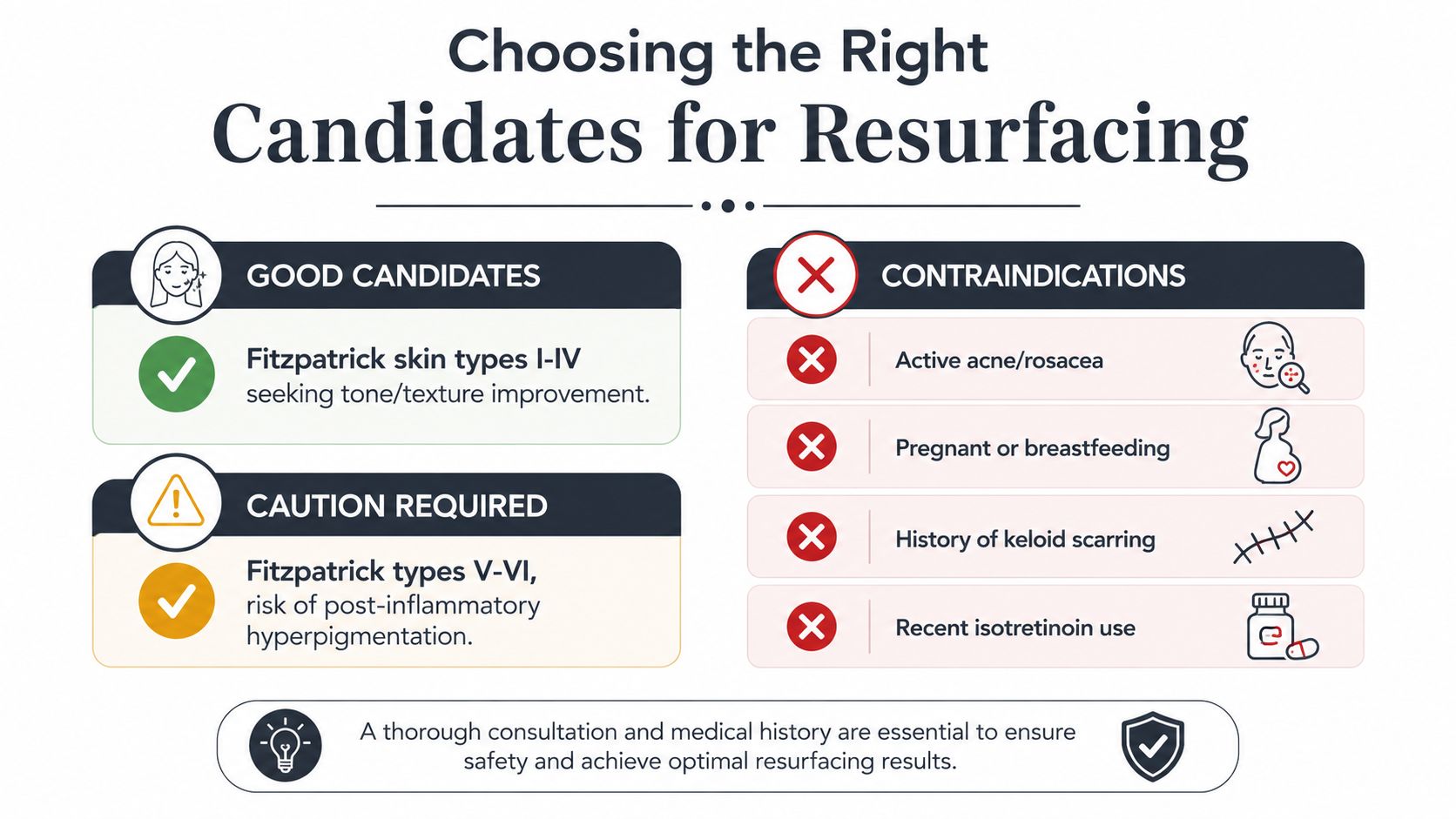
A practitioner should decline or defer treatment when the indication is unclear, the skin is actively inflamed, the patient won't follow aftercare, or the risk cannot be managed within the clinic's competence. Referral isn't a failure. It's the correct decision when the patient needs medical diagnosis, medication management, or a more specialised approach.
Safety Protocols and Regulatory Compliance in the Clinic
Resurfacing is controlled tissue injury, so a safe clinic treats the device, room, operator, patient, and aftercare plan as one system. A polished consultation can't compensate for an unlicensed device or poor environmental controls.
In South Africa, class 3 and class 4 lasers require SAHPRA registration, and each device model needs its own licence (South African laser regulation guidance). Clinic owners should verify registration, keep device documentation organised, and ensure the platform is deployed according to its technical specifications.
What responsible rooms have in place
Before treatment, the practitioner should complete a medical history, examine the skin, document the indication, explain alternatives, and obtain informed consent. Photographs and treatment parameters create a record that supports continuity, review, and investigation if a complication occurs.
During treatment, the patient and operator need wavelength-appropriate protective eyewear. The South African safety guidance also recommends covering windows, preventing reflective surfaces such as mirrors in the treatment cubicle, and controlling access to the room. Ablative procedures require plume management, and the clinic should have appropriate fire precautions when flammable preparation products are used.
Infection control must be practical, not decorative. Handpieces should be cleaned and sterilised according to the manufacturer's instructions, single-use components should not be reused, and the room should be decontaminated between patients. Staff should know how to respond to burns, unexpected pain, allergic responses, vasovagal symptoms, and suspected infection.
Practical rule: If a clinic can't show how it verifies its device registration, records its settings, protects eyes, manages plume, and handles an adverse event, it isn't ready to offer resurfacing responsibly.
Competence also requires more than attending a product demonstration. Operators need training in skin assessment, energy delivery, contraindications, emergency procedures, and the differences between skin types. Ongoing education helps teams recognise when a treatment is outside their scope and when a patient needs medical referral.
Aftercare and Managing Recovery Risks
Aftercare begins before the patient leaves the room. The practitioner should provide written instructions for cleansing, cooling, barrier support, sun protection, activity, makeup, and warning signs. The exact plan depends on whether the treatment was ablative, fractional, non-ablative, or a peel.
Immediately after treatment, the skin may need cooling and a gentle, non-irritating routine. More intensive ablative procedures may require an occlusive dressing or a prescribed wound-care approach. Patients shouldn't scrub, pick crusts, introduce unapproved actives, or restart retinoids and acids until the practitioner confirms that the barrier has recovered.
Photoprotection is part of the procedure
South African national dermatology guidance advises avoiding peak sun exposure between 10:00 and 15:00 and using a broad-spectrum sunscreen with SPF 20–30 for protection against UVA and UVB (South African dermatology guidance). After resurfacing, the clinic may prescribe a more protective routine based on the procedure and the patient's pigment risk.
Patients should expect redness, dryness, sensitivity, and temporary bronzing or peeling. They should contact the clinic promptly if swelling becomes excessive, pain is unusual, pus appears, fever develops, or the treated skin worsens instead of settling.
A history of cold sores matters. South African medical-aesthetic commentary notes that non-ablative laser resurfacing can trigger a herpes-virus flare-up (laser rejuvenation safety commentary). Patients with a relevant history may need medical assessment and antiviral prophylaxis before treatment.
For a practical visual recovery schedule, day-by-day laser recovery advice can help patients understand the stages without treating a general timeline as a substitute for clinic instructions. Barrier support should also be selected carefully, using products and routines appropriate for recently treated skin, such as those discussed in skin barrier repair products.
How Advanced Platforms Deliver Resurfacing Outcomes
A modern resurfacing platform should give the practitioner control over depth, density, pulse behaviour, spot size, cooling, and treatment coverage. Those controls matter because a patient with pigment-prone Fitzpatrick IV skin may need a different risk-benefit balance from a patient with fair, sun-damaged skin and deep etched lines.
Platforms that combine fractional delivery with more than one treatment mode can help clinics tailor the plan without changing the entire treatment workflow. A clinician may choose a lighter pass for texture, a denser treatment for selected scars, or a combination approach when the patient's indication supports it. The point isn't to use every feature in one visit. The point is to make the treatment adjustable.
Procurement questions for clinic owners
Before purchasing, ask:
- Is the exact device model properly registered? SAHPRA verification is a procurement requirement, not an optional administrative detail.
- Can the operator adjust fluence and density precisely? Fixed, limited settings may not suit a diverse patient base.
- What spot sizes and handpieces are available? The answer affects efficiency, treatment zones, and protocol flexibility.
- How does cooling work? Epidermal protection becomes increasingly important as treatment intensity rises.
- What training and technical support are included? A device is only as consistent as the team operating and maintaining it.
- What does the service agreement cover? Downtime, maintenance response, consumables, and calibration all affect clinic operations.
Omega Lasers supplies fractional and multi-technology systems for aesthetic practices, with training, technical support, marketing support, and business development guidance included in its broader clinic enablement model. Its portfolio is positioned around treatments such as resurfacing, skin rejuvenation, and anti-ageing, while device selection still needs to match the clinic's patient demographics, operator competence, and registered specifications.
The financial case should be assessed alongside clinical safety. A broader treatment menu may support workflow efficiency and patient retention, but only if the clinic can deliver consistent consultations, settings, documentation, aftercare, and follow-up. The machine is part of the outcome. The protocol is what makes the machine useful.
If you're evaluating resurfacing for your clinic, start with your patient profile, the skin tones you treat, the indications you want to address, and the recovery patients can realistically accept. Explore the fractional and multi-technology options available from Omega Lasers, then speak with the team about SAHPRA-compliant equipment, training, technical support, and a protocol that fits your practice.