



You’re probably at the point where basic facials, peels, and entry-level devices no longer feel like enough. Patients want visible texture change, scar revision, wrinkle softening, and lesion work that sits closer to medical aesthetics than beauty maintenance. At the same time, you can’t afford a device that looks impressive in a demo but creates inconsistent outcomes, difficult recoveries, or endless operator anxiety.
That’s where co2 laser treatment earns its place. In the right hands, it’s one of the most useful resurfacing tools a South African clinic can add. It can treat surface damage and deeper textural problems, it can be adapted for different indications, and it gives you a treatment category that patients recognise as serious, results-driven care.
In South Africa, that promise comes with responsibility. You’re working across a broad range of skin phototypes, with a high need for careful pigment management, stricter consultation standards, and protocols that respect downtime, healing, and compliance. A clinic that understands those realities can do very well with CO2. A clinic that treats it like a generic “skin rejuvenation laser” usually struggles.
Table of Contents
- Why CO2 Laser Treatment Belongs in Your Clinic
- The Core Science of CO2 Laser Resurfacing
- Clinical Indications and Ideal Patient Candidacy
- The Complete CO2 Laser Treatment Journey Step by Step
- Managing Expectations Results Risks and Complications
- Strategic Comparison CO2 Laser vs Other Resurfacing Modalities
- Integrating CO2 Lasers into Your Clinic A Business Guide
Why CO2 Laser Treatment Belongs in Your Clinic
A clinic usually starts looking at CO2 when patients begin asking for more than maintenance. They want acne scars softened, peri-oral lines improved, uneven texture refined, or stubborn lesions removed with more precision than topical care can offer. If you can’t meet that demand, those patients leave for a practice that can.
CO2 laser treatment belongs in a clinic because it fills a gap few other modalities cover well. It reaches the category of concerns that are visible, emotionally important to patients, and often resistant to superficial treatments. That makes it clinically relevant and commercially useful.
Three things make it stand out:
- It treats high-value concerns: Deep textural issues, advanced photoageing, selected scars, and certain lesions aren’t entry-level complaints. Patients seeking help for them usually understand that proper treatment requires expertise.
- It supports a premium positioning: Clinics offering advanced resurfacing tend to move beyond basic facial menus and into more medical, consult-led care.
- It creates treatment planning depth: CO2 rarely sits alone. It often leads to skincare programmes, scar follow-up, pigment management, maintenance resurfacing, and review appointments.
Practical rule: Don’t buy a CO2 platform because it’s fashionable. Buy it because you already see the patient demand for texture correction, scar work, and higher-level rejuvenation.
There’s also a business reality here. A strong CO2 service can help a clinic build authority. Patients talk about visible resurfacing results differently from how they talk about a pleasant facial. They remember the improvement, the healing journey, and the standard of care around it.
That said, this isn’t a “plug it in and print money” device. It rewards clinics that have proper consultation systems, informed consent, disciplined protocols, and staff who understand both treatment endpoints and recovery management. If your team can deliver that level of care, CO2 can become a cornerstone service rather than a machine that gathers dust.
The Core Science of CO2 Laser Resurfacing
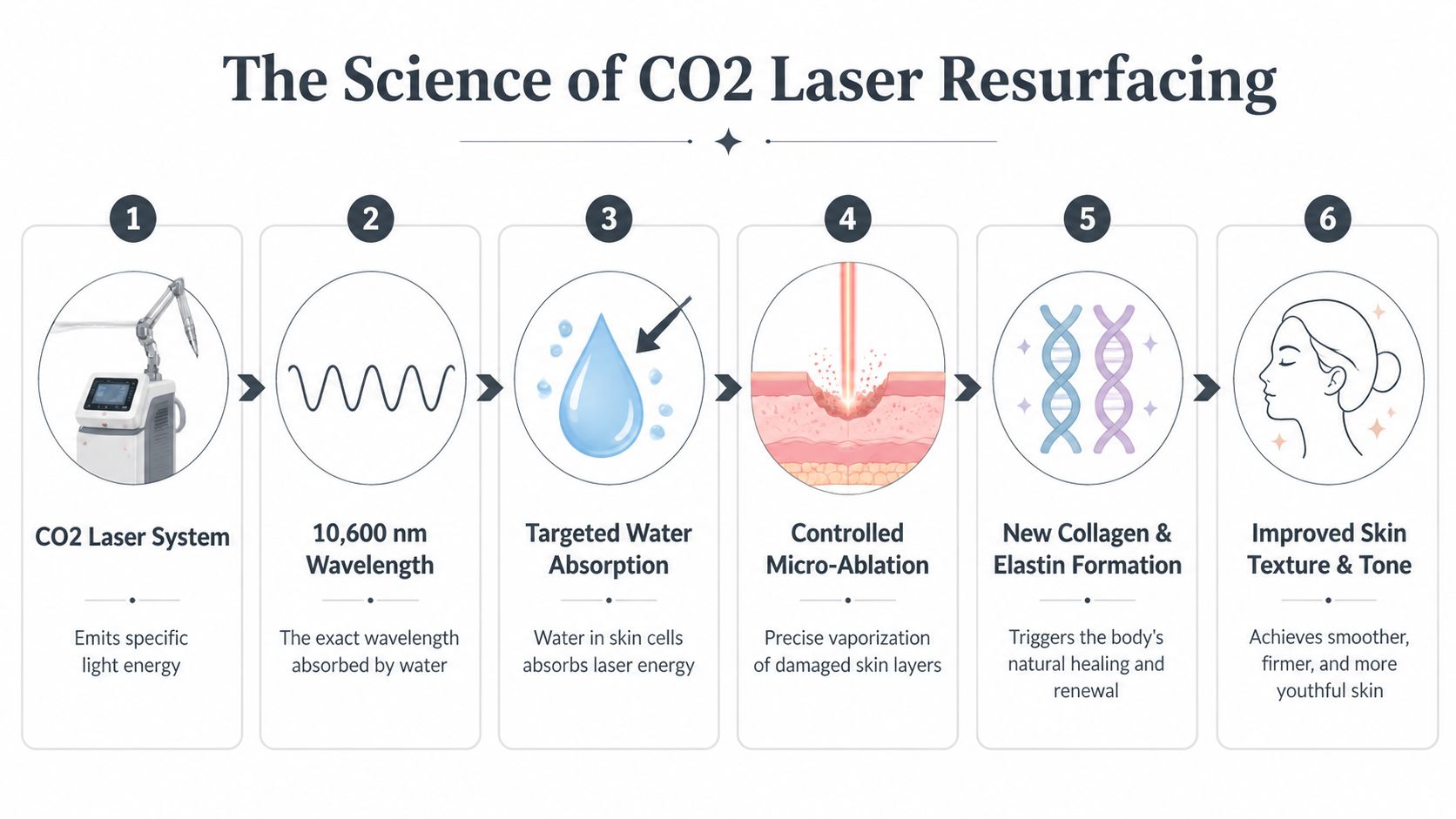
CO2 works because it targets water in tissue. That’s the central principle. Skin contains water, and when the laser energy is absorbed, it creates controlled ablation. In practical terms, that means the device removes or vaporises targeted tissue with a level of precision that makes resurfacing, lesion treatment, and scar work possible.
Why the wavelength matters
SAHPRA-licensed CO2 systems operate at 10,600nm, with a power range of 1-30W, and commonly offer continuous wave, pulsed wave, and ultra-pulse delivery, plus adjustable spot sizes from 0.1-0.5mm and controlled ablation depths of 20-100μM per pulse. Short pulse durations of less than 1ms help minimise thermal damage, as outlined in the CO2 system technical specifications.
That matters because results don’t come from “heat” in a vague sense. They come from where the energy goes, how long it stays there, and how much surrounding tissue you spare. A better operator understands this immediately. You’re not just choosing power. You’re choosing tissue effect.
Here’s the practical translation:
- Higher control over depth: Useful when you need to work on texture, scar edges, or lesion removal with precision.
- Pulse structure changes recovery: Shorter, more controlled pulse delivery reduces unnecessary thermal spread.
- Spot size affects accuracy: Smaller spots allow finer work. Broader patterns can improve efficiency on selected resurfacing treatments.
Fully ablative versus fractional
The easiest way to explain this to new staff is with a lawn analogy.
Fully ablative CO2 is like removing the entire top layer of a lawn and starting again. You get a more dramatic reset, but recovery is heavier because all of the treated surface has to heal.
Fractional CO2 is like aerating the lawn in a grid. You create controlled micro-injuries while leaving surrounding tissue intact. That untouched tissue helps drive faster repair and a more manageable healing process.
Fractional treatment usually gives clinics a better balance between meaningful results and a recovery period patients can realistically tolerate.
That’s why fractional systems are so widely used in modern practice. They still trigger collagen remodelling and visible texture change, but they generally allow for a safer and more adaptable protocol, especially when treating patients who need a more conservative approach.
What settings actually change in practice
New clinic owners often focus too much on headline wattage and not enough on treatment logic. The operator should think in layers:
Indication first
Acne scars, wrinkles, hypertrophic scar tissue, and lesion work don’t all need the same strategy.Skin behaviour second
Skin thickness, oiliness, phototype, healing history, and pigment risk change your approach.Density and depth third
The more aggressive the pass, the more recovery you create. That’s not automatically better.Endpoint always
You need to know what you’re trying to see in the skin before you fire the first pulse.
A CO2 platform is powerful because it combines ablation with a wound-healing response. That response drives collagen and texture improvement. But the machine never “creates results” by itself. The result comes from matching the right tissue effect to the right patient, then managing healing properly.
Clinical Indications and Ideal Patient Candidacy
A CO2 laser can do a lot, but candidacy determines whether the treatment becomes a success or a complication. That’s especially true in South Africa, where patient populations include many darker phototypes and where pigment risk must be built into the consultation from the start.
Where co2 laser treatment works best
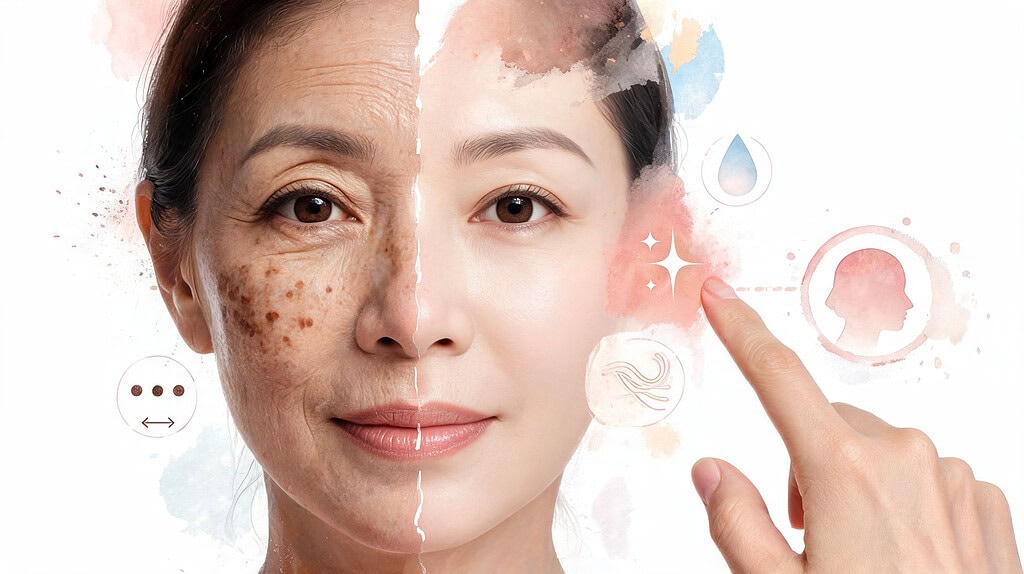
The strongest candidates are usually patients with concerns that involve texture, surface irregularity, or tissue overgrowth rather than simple redness or mild dullness. In practice, clinics commonly use CO2 for:
- Acne scar remodelling: Particularly atrophic scars where resurfacing and collagen stimulation can improve contour and texture.
- Photoageing and wrinkles: Especially etched lines and roughened, sun-damaged skin.
- Selected benign and premalignant lesions: Where the treatment plan sits within proper clinical scope and diagnosis.
- Scar revision and wart removal: According to the Aetna clinical policy summary, CO2 resurfacing achieved 74% excellent or good results in adults for scar revision and wart removal, and showed an 81.4% complete remission rate after one session for certain premalignant lesions, with significant wrinkle reduction that rivals peels while adding collagen remodelling benefits.
Some indications stand out because CO2 can solve a problem that other modalities only partly improve. Hidradenitis suppurativa is a good example in the medical setting, but even in aesthetic practice the lesson is the same: this is not just a “glow” treatment. It’s a tissue management tool.
Who needs extra caution
South African clinics have to treat phototype assessment as a core safety step, not a formality. In this market, darker skin isn’t a niche. It’s the main reality.
Local guidance notes that 70-80% of the population has darker skin types, roughly Fitzpatrick IV-VI, and that post-inflammatory hyperpigmentation can reach 45% after CO2 resurfacing if protocols aren’t adapted, which is why approaches such as hydroquinone priming and lower fluence settings are critical, according to this South African-focused guide on fractional CO2 in darker skin.
That single fact should shape your whole candidacy process.
Patients who need extra caution include:
- Darker phototypes with a history of PIH: They may still be treatable, but not casually.
- Anyone with a history of keloids or abnormal scarring: Particularly relevant in populations where scar over-response is more common.
- Patients with inconsistent sun protection habits: Poor compliance before or after treatment raises risk quickly.
- Patients seeking aggressive treatment after hearing social media hype: They often need education before they need a booking.
If a patient says, “I want the strongest setting you can do,” that’s usually a sign to slow the consultation down, not speed the treatment up.
Who should wait or avoid treatment
Good clinics get respect by declining the wrong case.
A patient should usually wait, or be redirected, when there is active infection, uncontrolled inflammation, recent tanning, poor wound healing history, unrealistic expectations, or limited commitment to aftercare. The same applies when the indication would respond better to another modality.
A few practical screening questions reveal a lot:
| Screening area | What you’re checking |
|---|---|
| Skin response history | PIH, prolonged redness, difficult healing, previous laser outcomes |
| Lifestyle reliability | Sun exposure, product compliance, ability to attend reviews |
| Scar biology | Keloid tendency, hypertrophic response, trauma history |
| Motivation | Real concern versus trend-driven treatment request |
Candidacy is where experienced clinics protect both outcomes and reputation. The best CO2 practitioners aren’t the ones who treat everyone. They’re the ones who know when not to.
The Complete CO2 Laser Treatment Journey Step by Step
Patients usually judge a co2 laser treatment long before the first pass and long after the final crusting resolves. The treatment itself matters, but the full journey determines whether the case feels safe, professional, and worth the investment.

Consultation and preparation
A proper consult is not a quick skin scan followed by a quote. You need indication clarity, phototype assessment, medical history, healing history, scar risk review, and a frank discussion about downtime and aftercare.
For higher-risk patients, especially darker skin types, preparation often matters as much as the laser settings. Skin priming, pigment-control planning, and strict instruction around sun avoidance should be handled before treatment day. If the patient seems unlikely to comply, it’s better to postpone.
Comfort planning also starts here. If you use topical anaesthesia, explain exactly how long it needs to sit and what the patient should expect from the sensation of treatment. Clinics that use medical-grade topical options should make that part of a controlled protocol, not an improvised add-on. Where appropriate, many practices use a dedicated topical product such as Super Numb numbing cream as part of their pre-procedure workflow.
Treatment day workflow
On treatment day, the room setup should be calm, organised, and standardised. The patient should already know what the noise, smell, heat, and immediate skin reaction may be like.
For hypertrophic scars, published guidelines describe a common protocol of 30-45 minutes of topical anaesthesia under occlusion, then one or two passes with a fractional CO2 laser at around 21W, performed monthly for four sessions, with a yellow wound bed and pinpoint bleeding as the clinical endpoint indicating ablation to the papillary dermis, as detailed in the carbon dioxide laser guidelines.
Even if you’re not treating hypertrophic scars specifically, that guideline shows how operators should think. The endpoint matters. You treat to a visible, planned tissue response, not to a random sense of “enough.”
A disciplined sequence helps:
Confirm consent and photography
Never skip baseline documentation.Cleanse and degrease thoroughly
Residue, makeup, and oils interfere with consistency.Apply or remove anaesthetic according to protocol
Comfort is part of treatment quality.Test and proceed methodically
Handpiece movement, overlap, and pass control matter more than speed.Observe the endpoint continuously
Skin tells you whether to continue, reduce, or stop.
A rushed operator usually leaves one of two signatures. Under-treatment that disappoints, or over-treatment that complicates recovery.
Aftercare and follow-up
Many clinics perform the treatment well, then hand the patient vague instructions and hope for the best, often leading to a loss of good results.
Post-care should cover cleansing, barrier support, avoidance of irritants, sun protection, what’s normal, what isn’t, and when to contact the clinic. Patients need to know how redness, heat, swelling, oozing, crusting, and peeling may evolve. They also need a review structure so they don’t self-manage a complication too late.
A reliable aftercare pathway usually includes:
- Immediate skin protection: Use the clinic’s chosen healing support protocol and explain reapplication clearly.
- Written home instructions: Don’t rely on memory after a stimulating procedure.
- Early review contact: A message or call can catch concerns before they become bigger problems.
- Scheduled progress photography: This helps both the patient and the clinic see the actual trajectory of healing and improvement.
Clinics that get CO2 right don’t treat aftercare as admin. They treat it as part of the procedure.
Managing Expectations Results Risks and Complications
The fastest way to create unhappy CO2 patients is to promise “amazing results” and discuss risks like an afterthought. Patients tolerate downtime surprisingly well when the clinic explains the trade-offs clearly. They lose confidence when their normal recovery isn’t framed in advance.
What good outcomes look like
Results vary by indication, treatment density, skin behaviour, and how well the patient follows aftercare. In resurfacing work, improvement often appears in stages. First the surface heals. Then texture starts to look cleaner. Then collagen remodelling continues to refine the result.
For a condition-specific example, CO2 treatment for hidradenitis suppurativa in South African patients showed a 95% improvement rate, a 91% patient recommendation rate, an average healing time of one month, and a 29% recurrence rate linked mainly to higher BMI, according to this hidradenitis suppurativa CO2 treatment summary.
That doesn’t mean every aesthetic indication will mirror those numbers. It does show what matters when discussing outcomes: symptom change, healing time, recurrence, and patient-perceived value.
Expected reactions versus actual complications
Many reactions after CO2 are expected. They’re part of the tissue response, not evidence that something has gone wrong.
Typical expected reactions include:
- Redness and heat: Common in the early recovery phase.
- Swelling: Often more noticeable in thinner or more mobile facial zones.
- Dryness, crusting, or peeling: Expected as treated tissue sheds and repairs.
- Temporary sensitivity: Particularly during cleansing and barrier repair.
Complications are different. They include infection, prolonged inflammation, delayed healing, scarring, and pigment disturbance. The clinic’s job is to identify which category a patient is in and respond early.
A safety culture matters before you even touch the patient. Proper room standards, plume management, eye protection, and device handling protect both staff and clients. Every operator and assistant should work with appropriate laser safety glasses as part of routine protocol, not only during high-energy sessions.
Good complication management starts before treatment. Most serious problems come from poor selection, poor settings, poor aftercare, or poor escalation.
How to reduce problems before they start
Complications are easier to prevent than to fix. The strongest clinics build prevention into the entire workflow.
A practical risk-reduction approach looks like this:
| Risk area | What reduces it |
|---|---|
| PIH | Conservative settings, patient priming, strict sun avoidance, careful case selection |
| Infection | Clean technique, clear aftercare, early review if healing deviates |
| Scarring | Correct indication, endpoint discipline, avoiding over-treatment |
| Dissatisfaction | Realistic consent, good photography, staged treatment planning |
Expectation management should also include what CO2 won’t do well. It won’t replace a lift in a patient with structural laxity. It won’t solve every pigment disorder. It won’t behave the same on every skin type. If you say that plainly, patients trust you more.
Strategic Comparison CO2 Laser vs Other Resurfacing Modalities
A clinic owner shouldn’t ask whether CO2 is “better” than every other resurfacing tool. The better question is where it fits, where it wins, and where another modality is the smarter choice.
Where CO2 sits in your device mix
CO2 is strongest when you need meaningful tissue change. That includes deeper texture correction, more assertive wrinkle work, selected lesion removal, and scar revision that needs more than stimulation alone.
That’s where it differs from RF microneedling, non-ablative fractional systems, and peels. Those treatments all have value, but they solve different clinical problems and carry different downtime profiles.
If your clinic already offers lighter resurfacing options, CO2 becomes the step up for patients who say:
- “I’ve done milder treatments and the scars are still there.”
- “My skin is smoother after peels, but the lines come back.”
- “I want a treatment with a stronger reset, even if recovery is tougher.”
For clinics comparing platforms across categories, it also helps to understand how adjacent technologies sit in the portfolio. A system like an Nd YAG laser platform serves very different indications and tissue targets, so it shouldn’t be evaluated as a direct substitute for CO2 resurfacing.
Resurfacing modality comparison
The simplest way to compare is by mechanism, best-fit indication, downtime pattern, and general skin type flexibility.
Resurfacing modality comparison
| Modality | Primary Mechanism | Best For | Typical Downtime | Skin Type Suitability (General) |
|---|---|---|---|---|
| CO2 laser | Ablation with thermal coagulation and collagen remodelling | Deeper wrinkles, acne scars, texture, selected lesions | Moderate to significant, depending on intensity | Strong caution needed in darker phototypes |
| RF microneedling | Mechanical needling with radiofrequency heat delivery | Texture, mild to moderate scars, tightening support | Usually shorter than CO2 | Often more flexible across skin types |
| Non-ablative fractional laser | Fractional thermal stimulation without full ablation | Mild texture change, tone, lower-downtime rejuvenation | Usually lighter than CO2 | Often preferred when recovery tolerance is low |
| Medium to deep chemical peels | Controlled chemical exfoliation and injury | Pigment, surface texture, some photoageing | Variable | Depends heavily on peel choice and patient selection |
CO2 keeps its place because it delivers a level of resurfacing intensity that milder modalities often can’t match. The trade-off is obvious. More impact usually means more recovery and more need for operator judgment.
That trade-off is often worth it when the indication is right. For adult scar revision and wart removal, CO2 produced 74% excellent or good results, and for certain premalignant lesions it reached 81.4% complete remission after one session, while also delivering wrinkle reduction that rivals peels with added collagen remodelling, as reported in the earlier linked clinical policy summary.
Integrating CO2 Lasers into Your Clinic A Business Guide
Buying a CO2 platform is not the business decision. Building a service line around it is. Clinics that succeed with CO2 usually do three things well: they choose the right device category, they train properly, and they build a workflow that makes the treatment sustainable.

Buy for workflow not just specifications
A spec sheet matters, but it doesn’t tell you how the machine fits your practice. Key questions are operational:
- Will your team use it confidently?
- Does the handpiece logic support the treatments you plan to sell?
- Can your patient base tolerate the downtime profile?
- Do you have enough consultation skill to select the right cases?
The strongest device purchase is one that matches your clinic’s current and near-future model. A dermatologist’s practice, a medical spa, and a mobile aesthetic business won’t deploy CO2 in the same way.
Cooling and recovery support also affect commercial viability. Emerging systems that integrate cryotherapy for faster cooling, such as Tetra Cool, can reduce healing time by 30% and may improve clinic throughput enough to support 2.5x ROI, according to this guide on fractional CO2 systems with cooling support.
Training is the real profit driver
Many owners make a mistake. They budget for the device, then under-budget for competency.
With CO2, training has to cover more than button-pressing. Your team needs to understand tissue response, endpoint recognition, contraindications, darker skin precautions, consent, photography, emergency response, and aftercare coaching. If only one person in the clinic knows how to manage a difficult healing question, the business is fragile.
A training-first clinic usually performs better because it:
- Screens more intelligently: Fewer inappropriate bookings.
- Treats more consistently: Less variation between operators.
- Handles recovery better: Higher patient trust and fewer panicked callbacks.
- Protects its reputation: Better reviews come from better expectations, not only better outcomes.
The machine creates opportunity. Training decides whether that opportunity turns into repeat business or reputational risk.
How clinics make the treatment commercially viable
CO2 becomes profitable when it’s packaged as a service pathway, not a one-off impulse purchase. That means consult fees, skin prep, treatment plans, review visits, homecare, and realistic scheduling.
A useful business checklist looks like this:
Define your core indications
Don’t market everything at once. Start with the cases your team can treat best.Build consent and photography systems
Advanced treatments need advanced documentation.Protect appointment flow
Allow enough time for prep, treatment, and post-care discussion.Train front desk staff properly
A poor explanation at booking stage creates poor-fit patients.Market outcomes responsibly
Lead with suitability and safety, not hype.
For South African clinics, there’s an extra commercial advantage in being known for careful treatment of diverse skin tones. Patients actively look for providers who understand pigmentation risk, downtime realities, and practical healing guidance. If your clinic can speak confidently to those concerns, CO2 doesn’t just add revenue. It strengthens trust.
If you’re planning to add co2 laser treatment to your clinic, Omega Lasers can help you evaluate the right platform, training pathway, and support structure for your market. Their portfolio is built for South African aesthetic professionals who need compliant technology, practical education, and business support that continues after installation.