



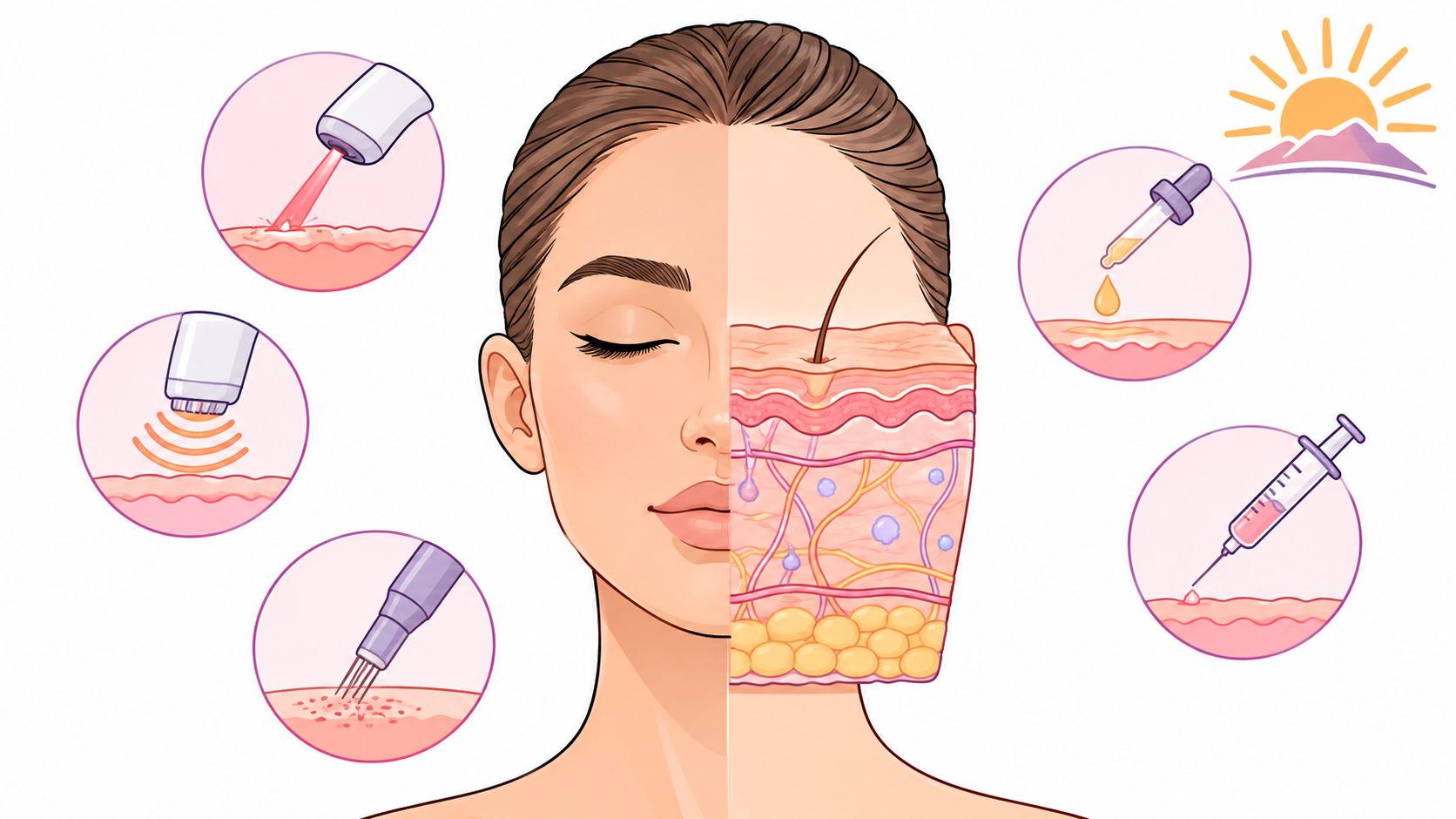
A client arrives asking for “skin rejuvenation treatment” and expects one clear answer. In a South African clinic, that answer rarely comes from one device. High ultraviolet exposure, mixed Fitzpatrick phototypes, melasma, acne scarring, laxity, cost pressure and previous pharmacy-grade skincare all change the decision.
A well-designed menu matches the dominant concern to the right biological target, recovery window, regulatory requirement and maintenance plan. The aim isn't to sell the most advanced treatment in the room. It's to build a protocol that a patient can tolerate, afford and maintain, while the clinic can deliver safely and profitably.
Table of Contents
- A Real Morning in a Skin Rejuvenation Clinic
- How Skin Rejuvenation Works Beneath the Surface
- The Main Modalities and What Each One Really Fixes
- Sessions, Downtime and How Long Results Last
- Patient Selection, Contraindications and Skin of Colour
- Devices, Multi-Modality Platforms and the Regulatory Checklist
- Marketing, ROI and Building a Rejuvenation Revenue Stream
- Putting It All Together in Clinical Practice
A Real Morning in a Skin Rejuvenation Clinic
Tuesday morning in a Sandton practice starts with three very different consultations.
The first patient is a 42-year-old teacher with mixed acne scarring and melasma. She's already used pharmacy-grade skincare and asks, “Can you smooth the scars without making the dark patches worse?” The clinical answer requires restraint. Scar texture may respond to controlled dermal remodelling, but melasma and darker phototypes increase the need for careful energy selection, conservative settings and strict photoprotection.
The second patient is a 38-year-old runner with sun damage and mid-face laxity. Her question is more practical: “What can I do if I can't take a week off work?” A resurfacing laser might offer stronger textural correction, but it carries more recovery. Radiofrequency microneedling or a lighter non-ablative approach may fit her schedule better, even if the result requires a course rather than one intensive appointment.
The third is a 55-year-old returning for maintenance. She doesn't need a new diagnosis or a dramatic promise. She needs a review of what has held, what has recurred and whether her current sunscreen and home-care routine support another session.
Clinical rule: The treatment menu should follow the patient's concern, skin behaviour and downtime tolerance, not the device the clinic most recently purchased.
South African clinics also work within real cost constraints. A patient may want visible improvement but need staged appointments. The clinician must balance results against pigment risk, consumables, staff time and the likelihood that the patient will return for maintenance. Clear client expectation management is therefore part of treatment planning, not an administrative extra.
The framework is straightforward. Assess whether the main problem is texture, pigment, laxity or scarring. Then select from laser, radiofrequency, microneedling, peels and injectable options, often in a sequence rather than as isolated services. The rest of the decision rests on mechanism, safety, sessions, downtime, pricing and long-term follow-through.
How Skin Rejuvenation Works Beneath the Surface
A patient may present with fine lines, uneven colour and mild laxity, but those concerns do not arise from one skin layer or respond to one mechanism. Skin rejuvenation treatment works through three main biological targets, and menu design starts by identifying which target is dominant.
The first is collagen and elastin remodelling in the dermis. Collagen provides structural support, while elastin contributes to recoil. Heat or controlled mechanical injury signals the skin to repair and reorganise that structure. This mechanism supports many tightening, scar and fine-line protocols, although the treatment must match the patient's laxity and tolerance for recovery.
The second target is controlled epidermal injury. Resurfacing removes or disrupts portions of damaged surface skin, encouraging turnover and producing a more even surface. Ablative wavelengths vaporise or remove tissue more aggressively. Non-ablative wavelengths heat deeper tissue while preserving more of the epidermis. Greater surface disruption can produce stronger resurfacing, but it also brings more recovery and greater risk when selection or settings are poor.
The third target is pigment and vascular chromophores. Selective photothermolysis delivers energy that a chosen target, such as melanin or blood vessels, absorbs preferentially, while limiting heating in surrounding tissue. This can improve sun-related colour irregularity or visible redness. In melanin-rich skin, however, the epidermis is also a strong competing chromophore, so pigment correction requires conservative planning and careful follow-up.

The renovation analogy
Resurfacing works like stripping old paint from a damaged wall. Neocollagenesis, the formation of new collagen, repairs the underlying structure. Pigment treatment is closer to repainting the finished surface, with the aim of creating an even result rather than removing more material.
Inflammation supplies part of the repair signal and is not automatically a complication. A controlled response can initiate healing. Excessive or prolonged inflammation can worsen post-inflammatory hyperpigmentation, particularly in darker skin or in patients with active inflammatory conditions.
The presenting concern sets the priority. Texture and shallow scars may favour resurfacing or dermal remodelling. Laxity may respond to heat-based contraction and collagen stimulation, but energy treatment cannot replace significant surgical correction. Pigmentation requires diagnosis first, because melasma, post-inflammatory marks and sun-related spots do not behave identically.
Barrier support also affects treatment planning. Clinics should discuss skin barrier repair products before and after energy treatments, rather than treating post-treatment skincare as an afterthought. One device rarely addresses every layer or concern. A workable South African menu pairs each modality with the patient's biology, pigment risk, downtime tolerance and budget.
The Main Modalities and What Each One Really Fixes
The right comparison isn't “Which technology is best?” It's “Which technology matches the dominant problem with an acceptable risk and recovery profile?”
| Modality | Best For | Downtime | Skin Type Fit | Role in Plan |
|---|---|---|---|---|
| Fractional non-ablative laser | Texture, fine lines, early scarring | Low to moderate | Requires cautious settings in darker phototypes | Course-based remodelling |
| Fractional ablative laser | More pronounced texture, scars and resurfacing needs | Moderate to high | Select carefully in Fitzpatrick III to VI | Intensive corrective treatment |
| IPL or BBL | Selected pigment, redness and photodamage | Low | Greater caution with darker or recently tanned skin | Targeted colour correction |
| RF microneedling | Texture, mild laxity and selected scars | Low to moderate | Often adaptable across skin types with conservative protocols | Course-based remodelling |
| Chemical peels | Surface dullness, selected pigment and texture | Minimal to moderate | Depends on acid, depth and skin response | Staged surface treatment |
| Skin boosters | Hydration and skin quality | Low | Individual assessment remains essential | Adjunctive refinement |
| Biostimulators | Gradual support for selected laxity and skin quality concerns | Low to moderate | Requires qualified injectable assessment | Longer-term adjunct |
Fractional lasers earn their place when texture is the priority. Ablative treatment can create a stronger resurfacing effect, but it demands careful pre-treatment preparation, aftercare and downtime planning. Non-ablative treatment suits patients who prefer a gentler course, although the clinic must explain that “less downtime” doesn't mean “no biological recovery”.
IPL and broadband light are useful when colour is the main issue, particularly selected sun-related pigment and redness. They're often overused when a patient has melasma or a poorly defined mixed pigmentation pattern. In darker phototypes, the margin for error narrows because epidermal melanin can absorb energy alongside the intended target.
RF microneedling sits between mechanical injury and thermal remodelling. It can be useful for textural irregularity, mild laxity and some acne scars, but needle depth, energy delivery and operator technique determine the protocol. Clinics considering RF microneedling treatment should assess the indication before presenting it as a universal tightening service.
Peels can be commercially accessible and clinically useful, particularly when a patient needs gradual change or can't accept device downtime. Injectables such as skin boosters and biostimulators address skin quality or structural support rather than replacing resurfacing. Combination protocols often outperform a single-modality plan because texture, pigment and laxity frequently coexist. The combination still needs sequencing. More treatment isn't automatically better treatment.
Sessions, Downtime and How Long Results Last
A patient booking a rejuvenation course needs more than a per-session figure. A credible quotation separates the per-session price from the total course cost, then explains the likely number of visits, recovery period and review point. Local clinic guidance presents microneedling as 3 to 6 treatments spaced 4 to 6 weeks apart, with one South African example quoting about R2,650 per session. Other services are marketed as 6 to 8 treatments, with results described as lasting 6 to 12 months after the course. Ultrasound-based tightening services may describe results lasting up to 2 years, with touch-ups as ageing continues.
Those figures vary by modality, indication, provider and patient response. Quote a range, not a falsely precise promise. The table below provides planning bands for South African clinic modelling, not a guarantee for an individual patient.
| Modality | Sessions Needed | Per-Session Downtime | Result Duration | ZA Price Band |
|---|---|---|---|---|
| Fractional non-ablative laser | 3 to 5 sessions, 4 weeks apart | Low to moderate | Often assessed after collagen remodelling | R1,800 to R3,500 per session |
| Ablative resurfacing | Usually one intensive treatment | 7 to 10 days | Longer-lasting structural improvement with maintenance | Quote after clinical assessment |
| RF microneedling | 3 to 4 sessions, 4 to 6 weeks apart | Low to moderate | Maintenance varies with ageing and exposure | R2,500 to R5,000 per session |
| Chemical peels | A staged ladder, from repeated light peels to one medium-depth peel | None to moderate | Variable, depending on concern and home care | R1,200 to R2,800 per session |
| Biostimulator injectables | 2 to 3 sessions, about a month apart | Low to moderate | Gradual and maintenance-dependent | Quote by product, area and clinician plan |
Downtime must be discussed in practical terms. A low-to-moderate recovery period can still affect work, exercise, social plans and sun exposure. Ablative resurfacing requires a more intensive schedule, while a peel may offer a staged option for patients who cannot accept device-related recovery.
Collagen remodelling develops gradually. Set a review around 90 days for meaningful assessment rather than judging the final outcome immediately after treatment. Results can hold for 12 to 24 months with SPF and suitable skin maintenance, although ageing, sun exposure and pigment recurrence continue.
Package pricing should include consumables, clinician time, follow-up and maintenance, rather than just discounting three appointments. Sell the course with a defined review, then make maintenance a separate clinical decision. This approach gives the clinic room to adjust treatment while avoiding a promise of permanent correction from one session.
Patient Selection, Contraindications and Skin of Colour
Patient selection starts before the booking is confirmed. The first triage question is whether the request reflects a clinical need that the chosen modality can address. A patient with active inflammation, unstable pigment or an unrealistic demand for complete correction needs assessment before a treatment slot.
Fitzpatrick III to VI patients require particular care. South African laser guidance emphasises strict pre- and post-treatment photoprotection for darker phototypes because high ambient ultraviolet exposure increases the risk of post-inflammatory hyperpigmentation after fractional laser procedures. One cited protocol recommends a depigmenting cream and high-quality broad-spectrum sunscreen for six weeks before treatment and 12 weeks after treatment. The clinical guidance on darker skin phototypes should be read alongside the practitioner's own protocol and scope of practice.
A longer wavelength, such as 1064 nm Nd:YAG rather than 755 nm alexandrite, may be considered for selected indications in melanin-rich skin because wavelength choice affects epidermal melanin absorption. That doesn't make one wavelength universally safe. Fluence, pulse duration, cooling, overlap, treatment interval and the diagnosis still matter.
Contraindication triage
The following issues should trigger postponement, referral or a documented medical decision:
- Active acne or infection: Treat the active condition before introducing additional injury.
- Recent isotretinoin: A history within six months requires careful medical review before resurfacing.
- Pregnancy: Defer elective energy and injectable procedures unless the treating medical professional determines otherwise.
- Recent tanning: Tanned skin changes the risk profile for light and laser treatment.
- Keloid history: Discuss abnormal scarring risk before creating controlled injury.
- Uncontrolled diabetes or immunosuppression: Healing and infection risk require medical assessment.

A consultation should document medical history, medication use, sunscreen habits, previous procedures, prior adverse reactions and the patient's actual goal. Take consistent baseline photographs. Assess phototype and pigment stability. Explain what one course can and can't change, then record consent in writing, including downtime, aftercare, likely maintenance and material risks.
Red flags include “fix-it-in-one” demands, escalating requests for procedures and distress that doesn't match the visible concern. A treatment plan can't resolve body dysmorphia or unrealistic expectations. The correct response is a pause and appropriate referral, not a more aggressive setting.
Devices, Multi-Modality Platforms and the Regulatory Checklist
A multi-modality platform is a clinic strategy, not merely a larger equipment purchase. Combining laser, radiofrequency and microneedling capability can help a practice match more indications, improve chair utilisation and create a coherent training pathway. It also creates more governance responsibility because every handpiece, consumable and protocol must be controlled.
The supplier conversation should begin with paperwork. South African guidance states that Class 3 and Class 4 laser devices must be registered with SAHPRA, a Laser Safety Officer must be appointed, and treatments must take place in a clinical setting. A separate regulatory summary also states that equipment needs a valid SAHPRA import licence before registration for use. South African laser safety guidance should be checked against current regulatory requirements before procurement.
Clinics should also recognise that regulatory history hasn't always been straightforward. A University of Johannesburg study on IPL protocol adherence noted that IPL and laser devices were not governed by legislation or licensing in South Africa at the time of that study, which made them available in non-medical fields such as beauty and somatology. That background makes current documentation, staff competence and clear scope of practice even more important.
Procurement questions that expose weak deals
- Approval evidence: Request the FDA clearance or CE Mark documentation for each relevant handpiece, then verify SAHPRA registration status locally.
- Service capacity: Confirm warranty terms, spare-part availability and service-level response within South Africa.
- Consumables: Price every consumable per treatment and confirm supply continuity before signing.
- Training: Establish whether the manufacturer provides on-site clinical training, protocol documentation and competency assessment.
- Clinical proof: Run a supervised trial session and visit a reference site before committing.
- Review clause: Build a 90-day performance review into the purchase, including utilisation, treatment quality and staff confidence.
Omega Lasers can be considered as one supplier option for clinics assessing multi-technology equipment. Its portfolio includes systems for rejuvenation, resurfacing and RF microneedling, so the clinic should still verify the approvals, training, service terms and treatment economics for the exact configuration being considered.
Marketing, ROI and Building a Rejuvenation Revenue Stream
A rejuvenation menu earns its place when it produces repeatable clinical work, not when the brochure lists many technologies. A single operator may target approximately 60% to 70% utilisation by month three, but that figure is a planning assumption rather than a guaranteed outcome. It depends on consultation conversion, staff confidence, local demand, treatment time and how consistently the clinic rebooks patients.
Indicative ticket ranges can help a practice model the menu:
| Modality | Avg. Ticket (ZAR) | Sessions per Course | Consumable Margin | Repeat Cadence |
|---|---|---|---|---|
| Light chemical peels | R1,200 to R2,000 | Course-based | Depends on product and preparation | Every 4 to 8 weeks during a course |
| RF microneedling | R3,500 to R6,500 | Course-based | Needle cartridges and consumables must be costed | Every 4 to 8 weeks during a course |
| Fractional laser | R4,500 to R8,500 | Course-based or intensive plan | Device time and aftercare affect margin | Course follow-up, then maintenance |
| Injectables per area | R2,800 to R4,500 | Based on clinical plan | Product cost is a major variable | Review and maintenance-led |
These bands belong in a financial model with room rental, clinician time, consumables, finance costs, cancellations and aftercare included. A package can improve cash flow, but it shouldn't obscure the patient's total commitment. A three-modality bundle may look attractive commercially, yet it must have a clinical rationale for sequencing and recovery.
Repeat visits usually follow a course cadence of every 4 to 8 weeks, followed by quarterly maintenance when appropriate. The value comes from consistent rebooking, not from pressuring patients into unnecessary treatment. Track the operational points that reveal whether the menu works:
- Show rate: Are booked consultations and treatment appointments attended?
- Course conversion: Do suitable patients commit to a complete plan?
- Photograph retention: Are baseline and follow-up images consistent enough to assess outcomes?
- Eight-week rebooking: Does the patient return for the next clinically appropriate step?
- Consumable margin: Does each treatment remain commercially viable after direct costs?
Training depth, consumable reorder margins and manufacturer marketing support can influence return on investment more than the headline device price. A cheaper machine that produces inconsistent outcomes or leaves staff unable to manage darker phototypes can become an expensive purchase. A clinic should sell a protocol, document outcomes and improve the menu from real utilisation data.
Putting It All Together in Clinical Practice
The consultation can be reduced to three questions:
- What does the patient see in the mirror? Clarify whether the dominant complaint is texture, pigment, laxity, scarring or a combination.
- What is the dominant histology? Distinguish photoageing, melasma, post-inflammatory pigmentation, vascular change, active acne and true laxity.
- What is the patient's downtime tolerance? A patient who can't accept recovery needs a staged plan, not an aggressive treatment sold as convenient.
Communication should follow a fixed order. Take the photo baseline, assess Fitzpatrick phototype, map expectations, complete informed consent and provide a written post-care plan. Record sunscreen habits, medication, previous treatments and the maintenance cost of the result.
For a clinic deciding what to add, audit current utilisation first. Identify the largest gap in your local demographic, then trial one multi-modality platform against that gap before expanding the menu. Measure patient selection, treatment completion and outcomes at 12 weeks, and review whether the service is safe, repeatable and financially sound.
Operational protection belongs in the same planning conversation. Clinics adding energy-based services can review insurance for skin care clinics as part of their broader risk management, alongside device governance, staff training, consent and incident documentation.

A skin rejuvenation treatment menu is a clinical protocol set first and a marketing asset second. Build it around diagnosis, skin type, downtime, maintenance and measurable follow-up, then choose equipment that supports that model.
Omega Lasers supplies laser and multi-technology platforms for clinics, salons and aesthetic professionals, with equipment options covering rejuvenation, resurfacing and RF microneedling alongside training, technical support and marketing enablement. Visit Omega Lasers to assess platform options and plan a skin rejuvenation treatment menu around your clinic's indications, compliance needs and commercial goals.