



Customer retention rate is the percentage of existing clients who remain customers over a set period, calculated as [(E − N) ÷ S] × 100. South African benchmarks vary sharply, from 38% in e-commerce to 75% in banking and 77% in IT and software, which is why aesthetic clinics need their own cohort-based view rather than one universal target (South African retention benchmark).
A clinic can look busy and still be losing its most valuable clients. The reception area fills with first-time consultations, social media enquiries arrive throughout the day, and the monthly revenue report appears healthy. Then the team checks the diary and finds that many clients never returned for their next laser session, skin review, or maintenance treatment.
That gap matters because aesthetic services rarely depend on a single appointment. Laser hair removal, skin rejuvenation and body contouring usually require a planned course, consistent treatment delivery and enough trust for the client to continue. New leads create activity, but returning clients create continuity.
Table of Contents
- Understanding Customer Retention Rate in Aesthetic Clinics
- How to Calculate Your Clinic Retention Rate
- Industry Benchmarks for South African Aesthetic Practices
- Why Retention Drives Clinic Profitability
- The Reliability Gap That Costs Clinics Repeat Bookings
- Practical Strategies to Improve Client Retention
- Building a Retention-First Clinic Culture
Understanding Customer Retention Rate in Aesthetic Clinics
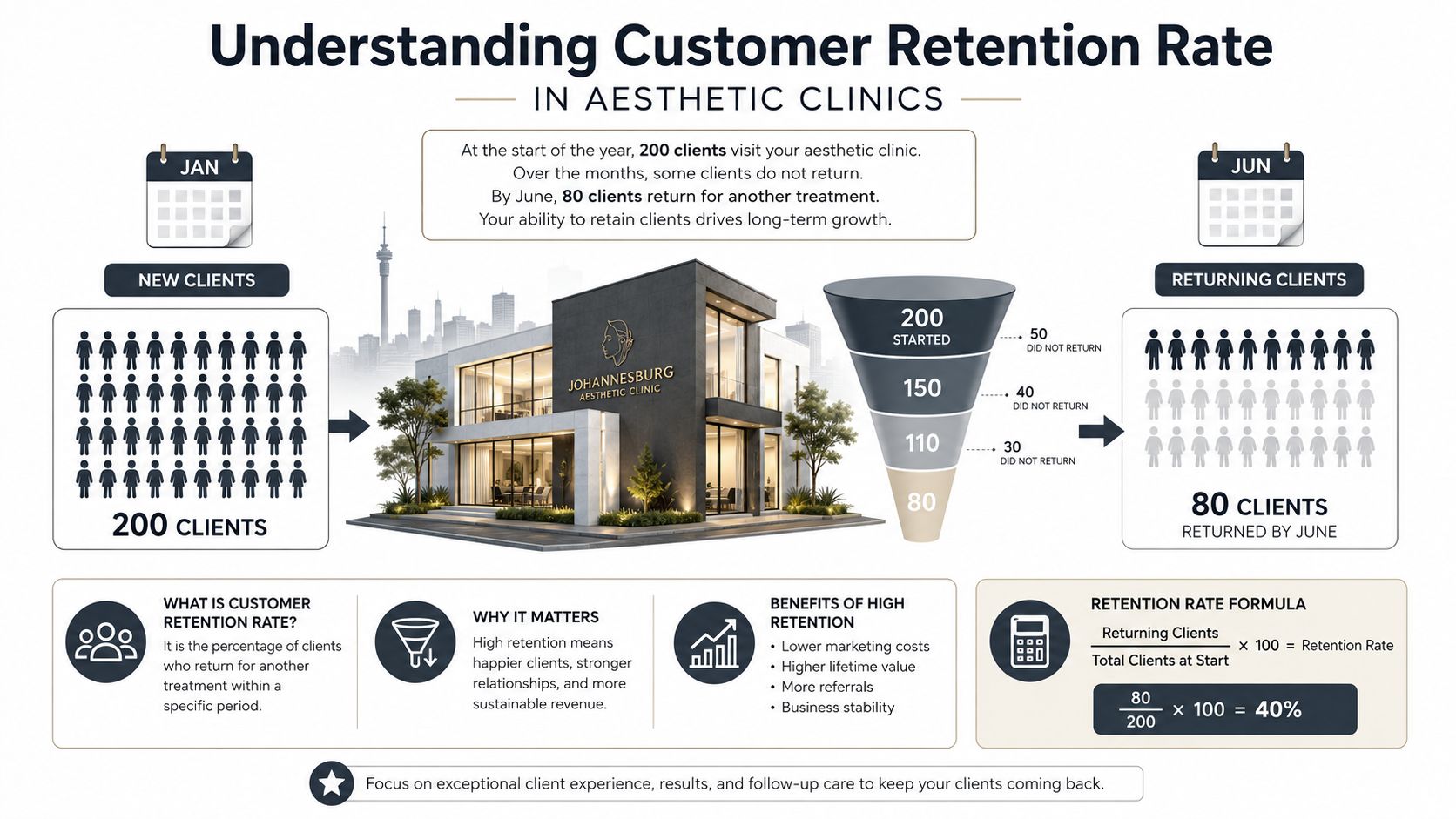
A Johannesburg clinic may welcome 200 clients in January and still have a quiet follow-up diary by June. The cause may not be weak marketing. Unreliable devices can force cancellations, inconsistent treatment outcomes can reduce trust, and poor recall or follow-up can leave clients without a clear next step.
Customer retention rate measures the percentage of existing clients who remain customers during a defined period. The standard formula is:
[(E − N) ÷ S] × 100
- E is the number of clients at the end of the period.
- N is the number of new clients gained during that period.
- S is the number of clients at the start of the period.
If a clinic starts with 100 active clients, ends with 90, and adds 20 new clients, the calculation is [(90 − 20) ÷ 100] × 100 = 70%. The result indicates that 70 of the original clients remained. Removing new clients from the end figure prevents fresh acquisition from disguising losses in the existing client base.
Retention is not the same as loyalty
Retention is behavioural. The client returned, booked another session, or continued a treatment plan. Loyalty is attitudinal. The client trusts the clinic, prefers its practitioners, and may recommend it even before making another booking.
A prepaid course can bring someone back without creating strong loyalty. A satisfied client may recommend the clinic yet delay treatment because of personal circumstances. Track both measures, but keep repeat bookings separate from positive feedback, referrals, and loyalty-programme participation.
Practical rule: A client who says they love your clinic but does not return belongs in your feedback data, not automatically in your retention data.
Broad sector benchmarks are useful for context, not as clinic targets. South African retention data reports 77% for IT and software, 75% for banking, 63% for retail and 38% for e-commerce (South African benchmark data). An aesthetic practice should set expectations around protocol length, treatment frequency, device uptime, practitioner training, and the quality of post-treatment follow-up. A multi-session laser plan requires a different retention view from a once-off procedure, so one target can misrepresent operational performance.
Measure retention by treatment type and client cohort. A clinic-wide result may conceal reliable returns among laser clients while showing that procedure clients leave after their first appointment. That split points owners toward the operational fix, whether it is equipment availability, protocol consistency, or a follow-up process that gives each client a clear reason to book again.
How to Calculate Your Clinic Retention Rate
Start with a fixed period and a clear client definition. Consider Skin & Laser Co. in Cape Town. At the beginning of Q1, the clinic has 180 active clients, so S = 180. During the quarter, marketing campaigns and referrals add 60 new clients, giving N = 60. By the end of Q1, the clinic has 210 active clients, so E = 210.
The formula removes new clients from the ending total:
[(210 − 60) ÷ 180] × 100 = 83.3%
Skin & Laser Co. retained approximately 83.3% of its starting client base during the quarter. In practical terms, about 83 of every 100 clients who were active at the start were still active at the end, excluding clients acquired during the period.
A second clinic shows why acquisition figures need context. It starts with 150 clients, gains 90 new clients, and ends with 195 clients:
[(195 − 90) ÷ 150] × 100 = 70%
This clinic brought in more new business, yet retained fewer existing clients. Lead volume can therefore make a clinic appear healthy while repeat bookings are weakening. Owners should review both figures before deciding whether marketing or service delivery needs attention.
| Metric | Clinic A, High Retention | Clinic B, Low Retention |
|---|---|---|
| Starting clients, S | 180 | 150 |
| New clients, N | 60 | 90 |
| Ending clients, E | 210 | 195 |
| Retained existing clients, E − N | 150 | 105 |
| Customer retention rate | 83.3% | 70% |
Keep the inputs consistent
The calculation is only useful when “active client” means the same thing in every period. Count unique clients with a genuine treatment relationship, not everyone who entered the clinic.
Avoid these errors:
- Counting one-time walk-ins as active clients: A free enquiry or casual retail purchase may not indicate an established treatment relationship.
- Using revenue instead of client counts: Revenue retention measures spending continuity, not whether clients returned.
- Mixing treatment cycles: A short window can classify a client as lost before their protocol is due for review.
- Changing definitions between periods: Comparing consultations in one quarter with paid treatments in another produces a misleading result.
Aesthetic protocols can span 6–12 weeks, so quarterly or bi-annual measurement may show operational performance more accurately than a very short window. Record each client's start date, treatment category, recommended next visit, and actual return date. These fields help identify whether missed bookings relate to protocol timing, unreliable device availability, inconsistent treatment delivery, or weak follow-up. Use this aesthetic clinic data collection guide to organise the records consistently.
Industry Benchmarks for South African Aesthetic Practices
A clinic can report a healthy retention rate while losing laser clients between sessions, injectables clients after an uneven result, or once-off procedure clients after a poor follow-up experience. South African aesthetic practices need a local reference point, then a baseline built around treatment category, protocol timing, practitioner and client cohort.
There is no verified national retention figure that applies to every aesthetic clinic. Broader South African comparisons show 38% retention in e-commerce, 63% in retail, 75% in banking and 77% in IT and software (local retention benchmark). Banking and other recurring-service models may offer more useful context than e-commerce, but neither provides a target for a clinic with scheduled treatment courses.

Use benchmarks as a diagnostic, not a promise
South African hotel research reported nearly 66% overall average retention, with 66% of business guests retained compared with 38% of leisure guests (South African retention statistics). The gap illustrates why client intent and visit pattern matter when interpreting a clinic result.
Treatment type changes the expected return pattern:
- Laser hair removal: A planned course creates a natural recall cycle. Device downtime, inconsistent treatment intervals, or weak rescheduling can break continuity even when clients remain satisfied.
- Injectables: Return behaviour depends on the client's preferred maintenance rhythm, visible outcome, practitioner confidence, and the quality of the review process.
- Once-off procedures: A lower return rate may reflect normal treatment completion. Separate that outcome from clients who intended further care but stopped booking after poor communication or an unresolved concern.
A 65% rate can look acceptable beside broad service benchmarks, yet conceal weak retention in a treatment category that should produce repeat visits. Set separate baselines for each category and cohort. Then check where clients stop booking: consultation, treatment delivery, device availability, practitioner training, result review, or post-treatment follow-up.
The operational cause matters more than a loyalty offer. A points scheme cannot compensate for cancelled appointments caused by unavailable equipment, uneven technique, or a team that fails to contact clients after treatment.
South African consumers also place strong emphasis on dependable service. The 2024 South African Customer Experience Report found that 71% of consumers want a reliable service or product they can depend on and buy from again, while 85% of economically active South Africans participate in loyalty programmes (South African customer experience report). Loyalty mechanics may support a reliable experience, but they cannot repair repeated cancellations, inconsistent results, or missing follow-up.
Why Retention Drives Clinic Profitability
A full diary can hide an unprofitable clinic. Owners may spend heavily on advertising, consultations and introductory offers, then lose clients before they complete a treatment course. Retention protects the acquisition work already paid for and turns more of each booking into repeat revenue.
Returning clients already know the clinic's location, booking process and treatment environment. The team can review earlier consultation notes instead of rebuilding the relationship from the beginning. That usually creates a more efficient route to repeat revenue, although it does not make every returning client profitable.
The operational question is simple: does the clinic deliver the next appointment reliably enough for the client to continue?
Measure client lifetime value
Client lifetime value estimates what a client contributes across the relationship. A practical starting calculation is:
Average treatment value × expected visits during the relationship
For a useful management view, segment the result by treatment category and subtract direct delivery costs, practitioner time, consumables and follow-up workload. A laser hair removal client who completes a planned course and later returns for maintenance has a different value profile from someone who books one discounted consultation and never returns.
The customer lifetime value guide can help structure this analysis around retention and related client behaviour.
| Metric | New Client Acquisition | Existing Client Retention |
|---|---|---|
| Primary objective | Convert an unfamiliar prospect | Continue an established relationship |
| Main operational requirement | Lead response, consultation and trust-building | Reliable delivery, recall and follow-up |
| Common cost drivers | Advertising, sales time and introductory offers | Communication, maintenance and service recovery |
| Revenue pattern | Uncertain first booking | More predictable when treatment plans are completed |
| Growth contribution | Adds new relationships | Compounds value through repeat visits and referrals |
Use discounts carefully
Discounts can fill unused capacity, but repeated promotions may teach clients to wait for lower prices and weaken confidence in the standard fee. Treatment completion incentives, priority booking and useful aftercare support can reinforce continuity without making price the only reason to return.
A retention programme should therefore support reliable operations rather than disguise gaps in them. If equipment availability disrupts a course, practitioner capability varies, or the team does not follow up after treatment, the financial value of the client relationship falls regardless of the offer attached to the next booking.
Satisfied clients may leave reviews, refer friends and consider related services such as skin tightening or body contouring. Those outcomes matter, but they follow dependable delivery and clear communication. A referral request cannot recover revenue from a cancelled treatment course or an outcome the practitioner failed to explain properly.
The Reliability Gap That Costs Clinics Repeat Bookings
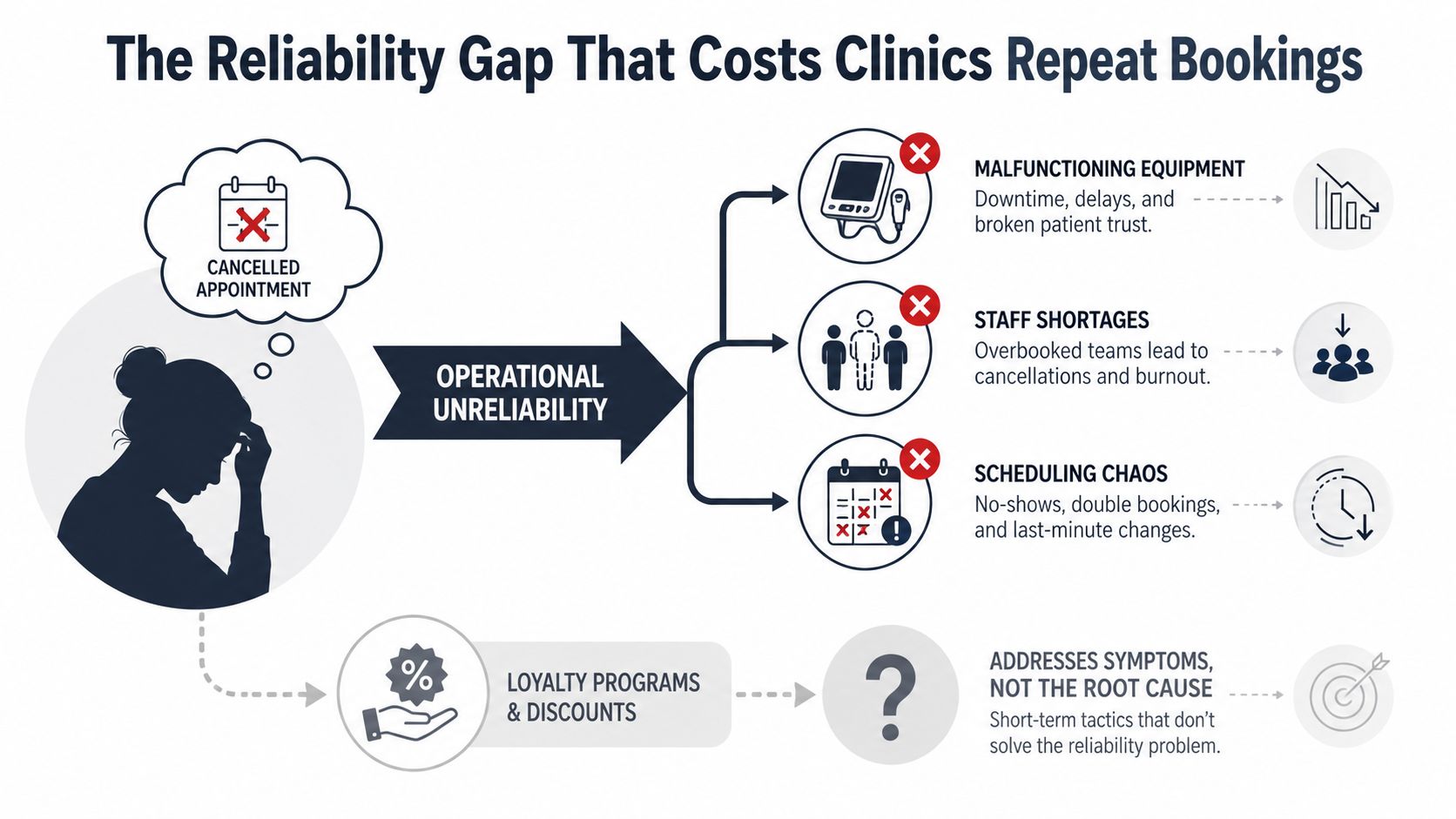
A client arrives for the second session of a planned treatment course, only to learn that the device has been unavailable since the previous afternoon. The clinic offers a new appointment two weeks later. By then, the client may have rearranged work and travel plans, lost confidence in the expected result, or booked elsewhere.
Birthday discounts, points and promotional messages can keep a clinic visible. They do not repair the operational failures that cause clients to stop returning. A retention plan works only when the clinic can deliver the promised treatment with consistent standards and recover quickly when something goes wrong.
Three operational levers shape trust
Device uptime affects availability and treatment continuity. For example, if a laser fails before a fully booked treatment day, four clients might need rescheduling, while a course client may miss the timing recommended for the next session. Preventive maintenance, an escalation route and access to technical support help the team address faults before they become client-facing cancellations.
Training quality affects consistency. Practitioners who understand treatment parameters, contraindications, skin considerations and aftercare can deliver a more controlled experience. Inconsistent technique may produce uneven results, unclear expectations or avoidable discomfort, which can reduce the likelihood of rebooking even when the device performs correctly.
Post-treatment follow-up closes the care loop. The team should confirm aftercare instructions, record concerns and make the next appointment easy to arrange. Earlier South African customer experience findings also point to a reliability gap between what clients value and what businesses assume drives repeat behaviour (2024 South African CX findings). Owners should use that gap to examine delivery, not just add more loyalty messaging.
Omega Lasers supplies medical-aesthetic devices and supports clinics with equipment maintenance, practitioner training, technical assistance and marketing materials. The clinic still owns daily scheduling, documentation, client communication and follow-up.
A loyalty offer can encourage a return. Reliable treatment delivery gives the client a reason to return.
Build a simple incident log. Record the device issue, affected appointments, client communication, rescheduling time and whether each client completed the next visit. Over time, the log can show whether retention losses arise mainly from equipment, people, capacity or communication.
Practical Strategies to Improve Client Retention
Start with the failures clients have already identified. A clinic doesn't need a complicated transformation programme to find useful evidence. It needs a consistent review process and named owners for each corrective action.
Audit the service before buying more leads
Review the last 20 client complaints and classify each one under device performance, operator skill, scheduling or communication. The practice manager can complete the first pass, then discuss recurring patterns with practitioners and the technical contact.
- Device issues: Check maintenance records, recurring faults and missed appointments.
- Operator issues: Review treatment notes, training needs and outcome conversations.
- Scheduling issues: Look for long waits, double bookings and insufficient recovery time.
- Communication issues: Examine reminders, aftercare messages and unanswered questions.
This exercise should produce an action list, not a blame list. Assign one person to each item and review progress at the next team meeting.
Install a follow-up rhythm
A structured sequence is easier to execute than relying on individual memory:
- After treatment: Confirm aftercare instructions and invite the client to report concerns.
- During the course: Contact the client for a progress check and update the treatment record.
- Before the next session: Send a rebooking prompt based on the practitioner's recommended timing.
- After a missed booking: Call promptly, understand the barrier and offer suitable alternatives.
The exact channel can vary, but every contact should be documented. A short feedback question after the visit can reveal service friction before the client becomes a lapsed client.
Treat training as retention infrastructure
Training isn't only a compliance exercise. It supports consistent consultation, safer device operation, realistic expectation-setting and better aftercare conversations. The clinic owner should review competency when a new device arrives, when a practitioner begins a new treatment and when client feedback points to inconsistent outcomes.
Your equipment supplier may also have treatment protocol guides, before-and-after imagery and co-branded social media assets. Use those resources to explain treatment value accurately instead of creating claims that overpromise results. Clinics reviewing broader ways to reduce wasteful acquisition spend can also consult this guide to lowering acquisition costs.
Reward completion, not random transactions
A treatment completion incentive can encourage clients to finish an agreed course without discounting every appointment. Keep the terms clear, avoid pressuring clients to continue unsuitable treatment and make clinical review the priority.
Track the results in a simple retention dashboard. The client retention strategies resource provides a useful framework for monitoring repeat booking frequency, churn and average client value alongside retention rate.
Building a Retention-First Clinic Culture
A client completes a treatment course, then cannot find a suitable follow-up slot. Another waits weeks for a device repair while the clinic offers no clear update. Both situations can erase the goodwill created during treatment.
Retention becomes durable when the team treats it as part of clinical service. Reception protects the booking journey, practitioners protect treatment quality, managers protect capacity, and owners review the numbers together.
Use [(E − N) ÷ S] × 100 as a regular health check, then segment the result by treatment, practitioner and client cohort. A falling rate should prompt an operational review before the clinic increases advertising. Check equipment uptime, practitioner training, recall completion and unresolved concerns. The number is useful only when it leads to a specific fix.
South African customer experience research links repeat purchasing with reliable service, while retention can vary by relationship type. Audit the point where clients first disappear. Then ask whether the equipment partner provides dependable maintenance, practical education and technical assistance. Omega Lasers supports aesthetic practices with devices, training, technical support and marketing resources for clinics building longer client relationships.
Start with the client journey. Then prioritise the operational change that removes the clearest reason for non-return.