


At its core, laser hair removal is beautifully simple. It sends a highly concentrated beam of light into the skin, where the dark pigment in the hair follicle absorbs it. This light energy instantly converts to heat, which then damages the follicle and stops it from growing new hair.
But the real magic is in the precision. It’s a targeted process that leaves the surrounding skin completely untouched.
How It Really Works: The Science of Laser Hair Removal
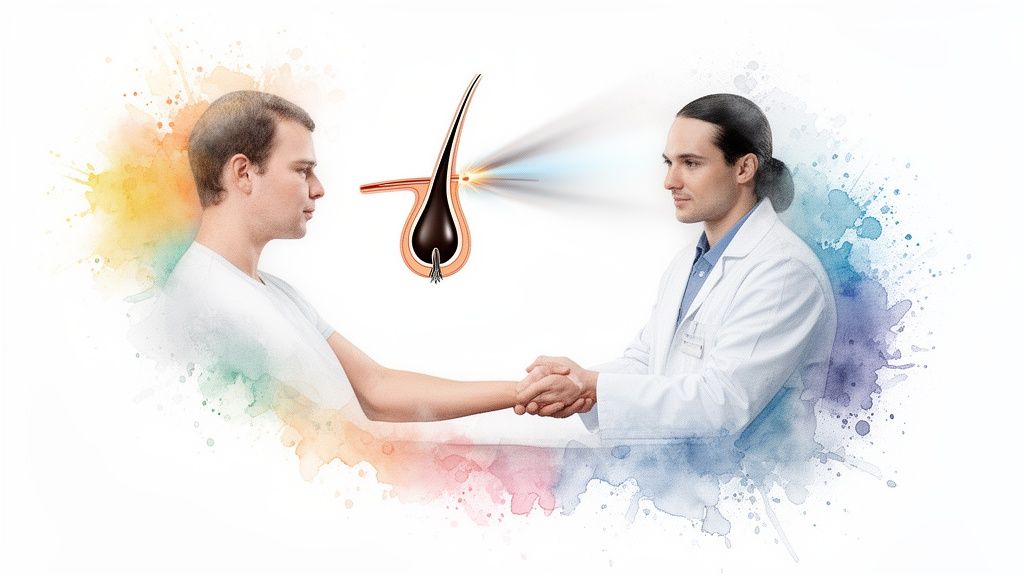
Think of the laser as a heat-seeking missile on a very specific mission. Its one and only target is the dark pigment, or melanin, found deep inside the hair follicle.
When the laser fires a pulse of light, that light passes right through the skin without causing any harm. But the melanin in the hair shaft and follicle greedily soaks it up. In that split second, the light energy becomes intense heat, and it's this thermal damage that knocks out the key structures responsible for hair growth.
To give you a clearer picture, here’s a quick comparison of the fundamental concepts.
A Quick Look at How Laser Hair Removal Works
This table breaks down the core differences between a modern laser approach and the temporary solutions your clients are trying to escape.
| Concept | Laser Hair Removal | Traditional Methods (Waxing/Shaving) |
|---|---|---|
| Target | Melanin within the hair follicle (the root). | Hair visible above or just below the skin's surface. |
| Mechanism | Selective Photothermolysis (light into heat) to disable the follicle. | Mechanical removal (cutting or pulling). |
| Result | Long-term reduction in hair growth. | Temporary removal; hair grows back quickly. |
| Process | Targets hair in the active growth phase only. | Removes all visible hair regardless of growth phase. |
As you can see, the laser is playing a long game, aiming for a permanent solution by targeting the source, not just the symptom.
Targeting the Active Growth Phase
One of the first questions clients ask is, "Why do I need so many sessions?" Explaining the hair growth cycle is your key to managing expectations and building trust.
Hair doesn't grow all at once. It cycles through three distinct phases:
- Anagen (The Growth Phase): This is the sweet spot. The hair is actively growing and physically connected to its root (the papilla). Laser hair removal is only effective during this phase, as the connection provides a direct pathway for heat to travel down and destroy the follicle's growth centre.
- Catagen (The Transitional Phase): Here, the hair detaches from the papilla and the follicle starts to shrink. The laser can't effectively reach its target.
- Telogen (The Resting Phase): The old hair is either resting or shedding while the follicle lies dormant. The laser has nothing to target until a new Anagen hair begins to form.
At any given moment, only about 10-20% of a person's hair is in that perfect Anagen phase. This is precisely why multiple sessions are non-negotiable. By scheduling treatments 4-8 weeks apart, you systematically catch the next wave of follicles as they enter their active growth stage.
This isn't a one-and-done fix; it's a process of attrition. Each session builds on the last, methodically wearing down the number of active follicles until you achieve that smooth, hair-free result your client is looking for. Consistency is everything.
Understanding this science—the interplay between light physics and hair biology—is what separates a good technician from a great one. For clinics serious about delivering world-class results, using a device with precise energy control is non-negotiable. To see how modern, multi-wavelength technology makes this process even more effective across various skin types, take a look at the advanced Tetra Cool system.
Understanding Selective Photothermolysis
Ever wondered how a laser zaps a hair follicle without touching the skin around it? The science behind it is a principle called selective photothermolysis. It might sound complicated, but the concept is actually quite straightforward—and it’s the key to getting safe, incredible results for your clients.
Let's break down what that term actually means in practice.
- Selective: The laser is precise, targeting only one thing.
- Photo: It uses energy from light.
- Thermo: That light energy turns into heat.
- Lysis: The heat destroys the target.
Simply put, the laser uses a focused beam of light to generate heat and destroy a specific target—the hair follicle—while leaving the surrounding skin completely unharmed.
The Power of Precision Targeting
So how does the laser know what to target and what to ignore? It all comes down to colour. The laser is calibrated to a specific wavelength of light that is strongly absorbed by melanin, the dark pigment found in hair.
Think about a black car parked in the sun next to a white one. The black car gets much hotter because its dark surface absorbs more light and converts it into heat. The laser works in exactly the same way.
The beam of light passes straight through the lighter skin tissue without being absorbed. But when it hits the dark, melanin-rich hair follicle, the energy is absorbed instantly. This creates a rapid, intense spike in heat that’s just enough to disable the parts of the follicle responsible for growing new hair.
This incredibly precise targeting is the foundation of modern laser hair removal. It’s what allows a trained professional to deliver heat exactly where it’s needed—and nowhere else—for safe and effective treatments.
The Role of Chromophores
In laser science, the molecule that absorbs the light is called a chromophore. For laser hair removal, our main chromophore is melanin. The more melanin a hair contains (meaning the darker and coarser it is), the better it absorbs the laser’s energy, making it an ideal target.
This is why, traditionally, the perfect candidate was someone with fair skin and dark hair. The high contrast between the dark hair (full of melanin) and the light skin (low in melanin) gave the laser a clear and easy target.
- High Melanin in Hair: Acts like a magnet, drawing the laser's energy in.
- Low Melanin in Skin: Allows the laser's energy to pass through safely, preventing burns or damage to the surrounding tissue.
Of course, technology has moved on. Advanced systems, like those from Omega Lasers, now use multiple wavelengths. This allows us to safely treat a much wider range of skin tones by fine-tuning which chromophores are targeted and how deeply the energy penetrates, ensuring great results without compromising on safety for clients with darker skin.
The gap between professional technology and cheaper alternatives is huge. Professional laser hair removal is a medically precise procedure. A study comparing professional-grade lasers to home-use devices found a massive difference in results: professional lasers achieved hair reduction of 85-88%, while home-use gadgets only managed 46-52%. You can find more details on these market findings in this report on laser hair removal effectiveness.
This is why professional treatments are so reliable. It’s not just about shining a light on the skin; it’s about using a medically certified device that gives the operator full control over the energy, pulse duration, and wavelength. This ability to customise the treatment to each client’s specific hair and skin profile is what guarantees safe, repeatable, and impressive results.
Choosing the Right Wavelength for Every Client
Trying to treat every client with the same laser setting is like a locksmith using a single key for every door—it just doesn't work. In laser hair removal, getting fantastic, safe results comes down to one thing: matching the right technology to a client's specific skin and hair. This isn't just a best practice; it's the core of a professional, results-driven clinic.
The science of laser hair removal is all about targeting melanin. But here's the catch: different laser wavelengths "see" melanin differently. Each wavelength is like a specialised tool, designed for a very specific job.
That job is defined by your client's Fitzpatrick skin type and hair colour. Using the wrong tool isn't just ineffective; it's dangerous. You could risk burning a client with a darker skin tone or get zero results on someone with lighter hair.
The Three Main Wavelengths
In any professional clinic, you’ll find that three primary wavelengths are the workhorses of laser hair removal. Knowing what each one does—and when to use it—is what separates the amateurs from the experts.
-
Alexandrite (755nm): This is your go-to for clients with fair to light skin (Fitzpatrick I-III). Its shorter wavelength is a powerhouse at targeting melanin in the hair, making it incredibly effective for dark hair on light skin. The downside? That high melanin absorption means it can't tell the difference between melanin in the hair and melanin in the skin, making it unsafe for darker skin types.
-
Diode (808nm): The versatile all-rounder. The Diode wavelength penetrates a bit deeper than the Alexandrite, offering a great balance between power and safety. This makes it a solid choice for a wider range of skin tones, from fair to olive skin (Fitzpatrick I-IV).
-
Nd:YAG (1064nm): This is the undisputed gold standard for safely treating darker skin (Fitzpatrick IV-VI). Its long wavelength goes deep, bypassing most of the melanin in the upper layers of the skin (the epidermis) to heat the follicle directly. This dramatically lowers the risk of burns or pigmentation issues, making it the safest and most effective choice for pigmented skin.
The decision tree below gives you a clear visual guide for how this selection process works in practice.
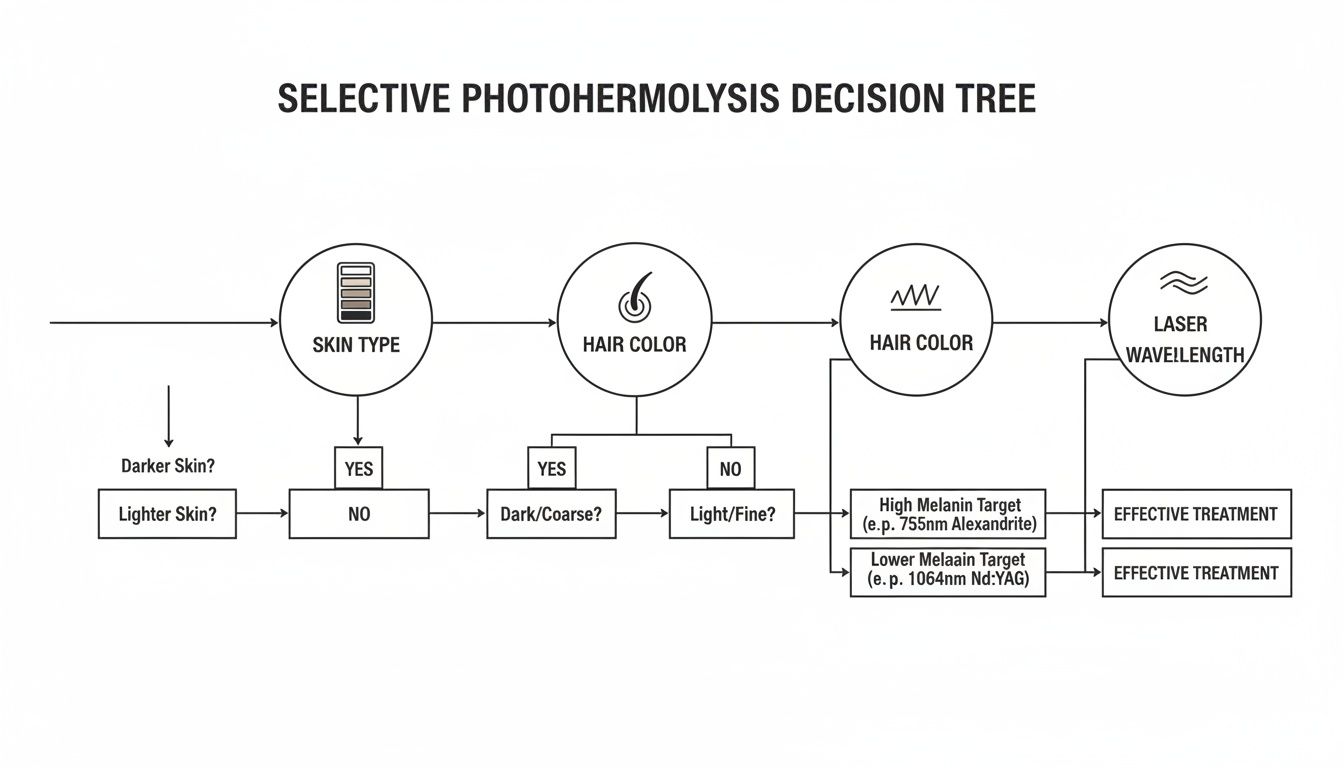
As you can see, a proper consultation that accurately identifies the client's skin type is the non-negotiable first step. From there, you can confidently choose the wavelength that will deliver the best results without compromising safety.
To make it even clearer, here’s a quick-reference table matching wavelengths to skin types.
Matching Laser Wavelengths to Fitzpatrick Skin Types
| Wavelength | Ideal Fitzpatrick Skin Types | Key Characteristics |
|---|---|---|
| Alexandrite (755nm) | I, II, III | Highest melanin absorption. Ideal for light skin with dark hair. Not safe for darker skin. |
| Diode (808nm) | I, II, III, IV | Versatile & balanced. Good for a broad range of skin tones, including olive and lightly tanned skin. |
| Nd:YAG (1064nm) | IV, V, VI | Lowest melanin absorption. The safest choice for dark and deeply pigmented skin, as it bypasses epidermal melanin. |
This table shows why having access to multiple wavelengths is a clinical necessity, not a luxury.
The Multi-Wavelength Advantage
Why would you invest in a single-wavelength machine that forces you to turn away a huge portion of the market? In a country as diverse as South Africa, sticking to one laser type is a huge commercial disadvantage. This is exactly why multi-wavelength platforms are no longer just a trend—they’re a business essential.
A device that combines multiple wavelengths in one platform gives you true treatment freedom. It means you can confidently and safely build a customised plan for almost anyone who walks through your door.
Take a system like Omega Lasers’ Tetra Cool, for example. It integrates Alexandrite, Diode, and Nd:YAG wavelengths into a single handpiece. This lets you switch between them instantly, not just for different clients, but even for different areas on the same client.
Being able to treat a broader demographic doesn’t just increase your potential revenue; it builds your clinic’s reputation as a safe, inclusive, and expert-led practice. Staying on top of these advancements is critical, as you can see from the top aesthetic device trends in South Africa.
Ultimately, mastering different wavelengths is fundamental to understanding how laser hair removal truly works. It elevates the service from a generic procedure to a precise, personalised solution that clients trust—and that’s how you get the best outcomes and a thriving business.
Mastering the Client Journey from Start to Finish

Great tech is only half the battle. The other half is delivering a professional client experience that builds trust and keeps people coming back. A smooth, standardised journey isn’t just about safety—it’s how you turn a first-time client into a walking, talking advertisement for your clinic.
This process takes the science we’ve discussed and makes it a real, reassuring service for your client. It all starts with a rock-solid consultation.
The Foundational Consultation
The initial consultation is your most important tool for managing expectations and ensuring safety. This isn’t just a friendly chat; it’s a critical diagnostic step where you establish your expertise and build a relationship based on trust.
A thorough consultation must cover these key areas:
- Fitzpatrick Skin Typing: You need to accurately assess the client’s skin type. This is non-negotiable for choosing the safest and most effective laser wavelength.
- Medical History Review: This step helps you spot any contraindications, like specific medications or skin conditions, that could make the treatment unsafe.
- Setting Realistic Expectations: Clearly explain the process, how many sessions are typically needed, and what “permanent hair reduction” actually means in practice.
- The Patch Test: This is your essential safety check.
The patch test is where you treat a small, hidden patch of skin with your proposed settings. It confirms the client’s skin reacts well and that your parameters are on point, removing guesswork and minimising risk.
The Treatment Session Step-by-Step
Once the consultation and patch test are done, the client is ready for their first full session. Having a consistent workflow for every appointment shows your clinic is committed to quality and care. A typical session should be predictable and professional.
- Client Preparation: The client should arrive with the area cleanly shaven. This ensures the laser’s energy goes straight to the follicle instead of being wasted on surface hair.
- Skin Cleansing and Marking: The technician cleans the skin to get rid of any lotions or oils. For large areas like the back or legs, a white grid might be drawn on the skin to guarantee full, even coverage with no missed spots or overlap.
- Applying Cooling Gel (If Applicable): A clear, conductive gel is often spread over the skin. It helps the handpiece glide smoothly and adds an extra layer of cooling to protect the epidermis.
- Performing the Treatment: The technician works methodically across the area, delivering precise pulses of light. Good communication is key here—constantly checking in with the client to make sure they’re comfortable.
- Post-Treatment Care: Once the laser work is done, a soothing lotion is applied to calm the skin. The technician must provide clear aftercare instructions, like avoiding sun exposure and hot showers for the first 24-48 hours.
Client comfort is not a luxury; it’s a core component of a premium service. Systems with advanced cooling, like the Tetra Cool technology, actively chill the skin’s surface just before each laser pulse. This simple feature transforms the experience from a series of sharp “rubber-band snaps” into a far more comfortable and tolerable sensation.
By mastering and standardising this client journey, you’re doing more than just performing a procedure. You are delivering a complete, professional, and reassuring experience that leads to happy clients, repeat business, and the kind of positive word-of-mouth that grows a clinic.
Navigating Safety and Regulations in South Africa
In the aesthetics game, offering safe and effective treatments isn’t just a nice-to-have; it’s your entire reputation. In South Africa, understanding the local safety and regulatory landscape is what separates the trusted professionals from the rest.
The truth is, the South African market has some serious regulatory gaps when it comes to laser hair removal. This puts clients at risk and can land unprepared clinics in hot water. Leading with professionalism and investing in certified tech isn’t just about compliance—it’s how you build a brand that people trust.
The Importance of Certified Medical Devices
Not all laser devices are built the same, and that difference can have huge consequences for your clients and your business. Using uncertified equipment doesn’t just risk bad results; it opens the door to serious safety issues. This is why investing in medically certified systems is a non-negotiable for any serious clinic.
When you’re choosing a laser, look for these key certifications:
- SAHPRA Licensed: The South African Health Products Regulatory Authority is our local watchdog, ensuring devices meet national standards for safety and quality.
- CE Certified: This mark means the device meets the health and safety standards for products sold in the European Economic Area—a solid benchmark for quality.
- FDA Approved: Approval from the U.S. Food and Drug Administration is a globally respected sign of a device’s safety and effectiveness.
Committing to certified equipment, like the medically graded platforms from partners such as Omega Lasers, sends a powerful message. It tells clients you’ve invested in technology that is proven to be both safe and effective.
Choosing a certified device is the first and most critical step in managing risk. It guarantees the machine itself has been rigorously tested, giving both you and your clients peace of mind.
But the best hardware in the world is useless without a skilled operator.
Staff Training and Certification as a Pillar of Safety
Even the world’s best laser is only as good as the person using it. A major concern in South Africa’s current climate is the lack of mandatory qualifications for laser operators. This gap is a recipe for preventable complications.
Because there’s no strict government oversight, anyone can theoretically buy a machine and start offering treatments. The research is alarming: one study found that 51.2% of laypersons performing laser treatments held no formal qualifications at all. That same research directly linked this lack of training to bad outcomes, attributing roughly 30% of all laser therapy complications to treatments done by non-medical personnel. You can dig into the full study to understand more about laser therapy safety standards.
For any clinic that wants to be both ethical and successful, proper staff training is an absolute must. It ensures your team understands the science—not just how to push a button, but everything from skin typing to managing treatment parameters safely.
A truly professional clinic makes these points non-negotiable:
- Comprehensive Device Training: Every technician must be thoroughly trained by the manufacturer or a certified educator on the exact device they use daily.
- Ongoing Education: The aesthetics field moves fast. Regular refresher courses keep your team sharp and up-to-date on the latest techniques and safety protocols.
- Certification: Formal certifications are documented proof of your team’s expertise and their commitment to professional standards.
When you invest in certified technology and demand rigorous training for your staff, you’re doing more than just ticking boxes. You’re building a clinic culture around excellence and safety—and that’s the surest way to long-term success and client loyalty.
Boosting Your Clinic’s ROI with Advanced Laser Systems
The science is fascinating, but let’s get down to business. As a clinic owner, the real question is: what will an advanced laser system actually do for my bottom line? Investing in a superior device isn’t just about spending money—it’s a strategic move that directly fuels growth and profitability.
Getting this right is what separates a struggling practice from a thriving one. The right technology translates into more clients, higher daily revenue, and a stronger reputation in the market.
Expand Your Client Base with Multi-Wavelength Technology
A multi-wavelength platform is your ticket to serving a much larger market. If your current system limits you to only certain skin types, you’re turning away paying clients every single day. In a diverse country like South Africa, that’s a huge disadvantage.
By offering safe treatments for all Fitzpatrick skin types, you instantly become the go-to clinic for a wider community.
- Treat More People: A machine that combines Alexandrite, Diode, and Nd:YAG wavelengths means you can effectively treat everyone from the fairest to the darkest skin tones.
- Build a Reputation for Inclusivity: Your clinic becomes known as the trusted expert for all communities, which is powerful for brand building and word-of-mouth referrals.
This isn’t just a nice-to-have feature; it’s a direct path to a bigger client roster and healthier revenue.
This market expansion is crucial, especially now. The Middle East and Africa laser hair removal market, valued at USD 36.62 million in 2024, is set to explode to USD 164.63 million by 2032. Here in South Africa, we’re seeing huge demand in hubs like Johannesburg, Cape Town, and Durban. Durban’s multicultural demographic, in particular, is fuelling the need for lasers designed specifically for Fitzpatrick IV-VI skin. You can learn more about these key market trends in the MEA region.
Increase Daily Revenue with Speed and Efficiency
How many clients can you realistically see in a day? The answer comes down to your laser’s speed. Modern systems are built to cut down treatment times and maximise your appointment book.
Think about it. Faster treatment speeds, thanks to high repetition rates and larger spot sizes, let you do a full back or full legs in a fraction of the time it used to take. That means you can slot more appointments into your day, directly boosting your daily earnings.
A premium client experience is a powerful driver of retention. Features like advanced contact cooling not only make treatments more comfortable but also transform a potentially unpleasant service into a luxury experience. Happy clients are loyal clients.
This focus on comfort and speed leads to better reviews, higher satisfaction, and more word-of-mouth referrals—the best marketing you can get. Ultimately, investing in top-tier technology pays for itself through increased capacity and client loyalty. For a detailed financial breakdown, you might be interested in our guide on calculating the ROI for a professional diode laser.
Plan Your Laser Hair Removal Service: Related Guides
This guide explains the science. When you are ready to choose equipment, set prices and run the service, these guides go deeper:
- Choosing a laser hair removal machine for your clinic
- Diode vs IPL: which technology suits your clinic
- Laser hair removal machine cost and investment
- What clients pay for laser hair removal in South Africa
- Treating darker skin types safely
- How many sessions clients really need
- Aftercare protocols for your clients
- Laser safety protocols every clinic needs
- Laser hair removal training in South Africa
Common Questions About Laser Hair Removal
Whether you’re consulting with a new client or training a junior therapist, the same questions about laser hair removal pop up again and again. Getting the answers right is crucial for managing expectations and building trust from the very first appointment.
Here’s a quick guide to the most common queries we hear from practitioners and their clients.
Is Laser Hair Removal Really Permanent?
The most honest and accurate term is permanent hair reduction, and it’s important to explain why. The treatment is incredibly effective at destroying the follicles it targets, meaning those specific hairs will never grow back.
But life happens. Hormonal shifts from things like pregnancy, PCOS, or menopause can sometimes trigger new, previously dormant follicles to start producing hair. For most clients, this isn’t a major issue. They typically achieve an 85-90% permanent reduction and find that a single top-up session once a year is all they need to stay perfectly smooth.
How Painful Is The Treatment?
This is probably the number one concern for new clients. The sensation is usually described as a quick, hot snap, like a rubber band on the skin. While pain tolerance varies, modern laser technology has made comfort a top priority.
Today’s best-in-class systems, like the Tetra Cool from Omega Lasers, feature integrated contact cooling. The handpiece instantly pre-chills the skin just milliseconds before each laser pulse. This simple but powerful feature numbs the treatment area, making the entire procedure feel comfortable and easily manageable.
How Many Sessions Will I Need?
You can’t get the desired results in a single session—it’s just not how hair growth works. A series of treatments is non-negotiable, and here’s why: the laser is only effective when the hair follicle is in its active growth (Anagen) phase.
At any given time, only a fraction of the body’s hair is in this stage. That’s why clients generally need 6 to 8 sessions, spaced 4-8 weeks apart, to successfully catch and treat every follicle as it cycles through. The good news is that clients will see a noticeable, progressive drop in hair density after every single visit.
Partner with Omega Lasers to equip your clinic with medically certified, multi-wavelength technology that delivers superior results and a strong return on investment. Explore the Tetra Cool multi-wavelength diode laser or request a demo and quote.