




You’re probably sitting with three quotes open, a sales rep following up, and a spreadsheet that still doesn’t answer the main question. Which machine will work in your clinic, on your client base, under South African operating conditions, without turning into a compliance or maintenance headache?
That’s the key purchase decision. Not which brochure looks polished, and not which global brand appears most often in overseas reviews.
For a South African clinic, the best laser hair removal machines have to clear three tests at the same time. They need to produce reliable hair reduction across varied skin types. They need to be legally and safely operable under local regulation. They need to generate revenue consistently enough to justify the capital outlay, training time, and service dependence that come with any energy-based device.
Choosing Your Clinic’s Next Revenue Engine
A clinic owner usually starts this process by comparing handpieces, cooling claims, pulse speeds, and package pricing. Then practical questions arise. Can the device treat darker skin safely? Will therapists use all the settings correctly? If the system fails during a busy week, who fixes it? And if the importer hasn’t handled local registration properly, who carries that risk?
That’s why laser hair removal equipment shouldn’t be treated like a one-off hardware purchase. It’s closer to buying a treatment category, an operational workflow, and a business model in one decision.
This market is worth taking seriously. In South Africa, laser hair removal procedures in clinics rose by 67% from 2019 to 2022, and SAHPRA-licensed multi-wavelength systems are achieving up to 90% hair reduction according to the referenced market overview on South African growth in clinic laser hair removal demand. That matters because demand is no longer confined to a narrow client profile. Clinics need systems that can serve a broader range of skin tones and treatment areas without constant compromise.

What a strong buying decision looks like
The clinics that choose well usually assess machines through three lenses:
- Clinical fit: Does the technology match your actual client mix, including darker skin types and hormonally driven regrowth cases?
- Operational fit: Can your team run it confidently, comfortably, and fast enough to keep appointment flow efficient?
- Commercial fit: Will the machine still make sense after training, service, downtime risk, and load-shedding are factored in?
A glossy demo can hide weak points. A machine can feel impressive in a showroom and still underperform once it’s handling full-leg sessions back-to-back, moving between different skin types, and relying on therapists with varying experience levels.
Practical rule: The right machine is the one your team can use safely, repeatedly, and profitably. Not the one with the loudest spec sheet.
Comparison table for clinic buyers
| Machine category | Best suited to | Main advantage | Main limitation | Good fit for |
|---|---|---|---|---|
| Single-wavelength diode | Clinics treating a narrower range of cases | Simple workflow and solid speed | Less flexible across all skin and hair combinations | Focused service menus |
| Alexandrite or Nd:YAG platform | Practices with a clear preferred skin-type profile | Strong performance when wavelength selection is appropriate | More dependence on correct case selection | Clinics with experienced laser staff |
| Multi-wavelength platform | Diverse client bases across multiple Fitzpatrick types | Greater versatility and fewer exclusions | Higher complexity and purchase scrutiny | Urban clinics and mixed demographic practices |
| Multi-technology platform | Clinics combining hair removal with adjacent treatments | Broader revenue potential from one capital purchase | Requires stronger training and support | Growth-focused clinics |
Understanding Core Laser Technologies and Wavelengths
The best laser hair removal machines aren’t “best” because of branding. They’re better when the wavelength, pulse delivery, and cooling system suit the skin, hair, and treatment area in front of you.
Hair removal works by directing light energy into melanin in the hair shaft and follicle. That energy converts to heat. If the follicle absorbs enough heat, future growth reduces. The practical challenge is obvious. You need enough energy to affect the follicle, but not so much epidermal heating that you create avoidable risk.
That’s where wavelength choice matters.
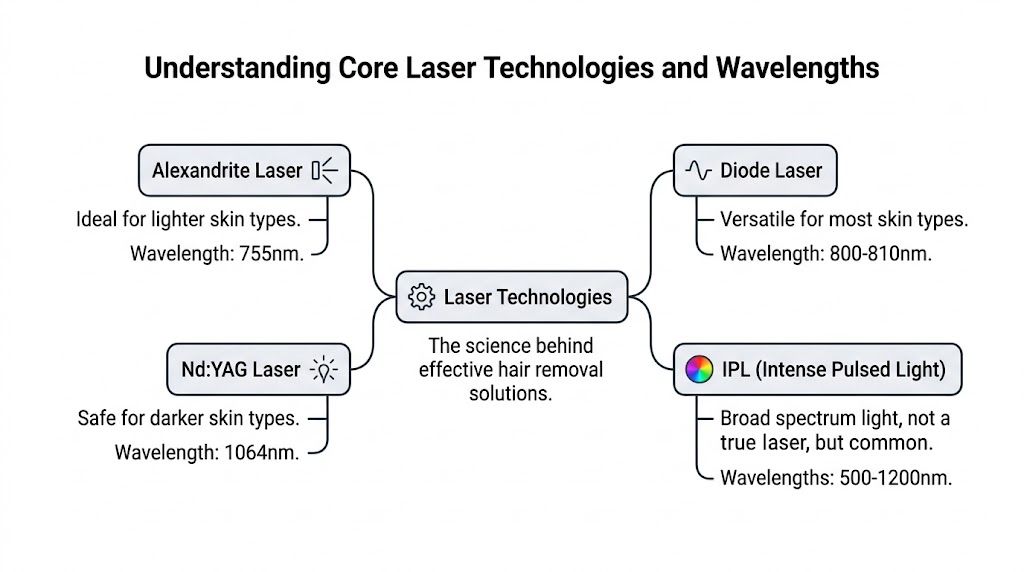
How the core wavelengths differ
Alexandrite at 755nm
Alexandrite is typically chosen for lighter skin types because melanin absorption is strong. In practice, that can mean efficient follicle targeting, especially on dark hair against lighter skin.
The trade-off is that stronger melanin absorption can narrow your safety margin on darker skin. That doesn’t make Alexandrite a poor technology. It means case selection and parameter choice matter more.
Diode at 808nm
Diode systems sit in the practical middle ground for many clinics. They’re versatile, widely used, and often easier to integrate into high-volume hair removal workflows. If you’re comparing categories and want a technical baseline, this overview of professional diode laser hair removal systems is useful for understanding how diode platforms are positioned in clinic settings.
For many practitioners, diode is attractive because it balances penetration depth, treatment efficiency, and usability. It also tends to be available in systems designed around rapid repetition and larger-area work.
Nd:YAG at 1064nm
Nd:YAG penetrates deeper and is generally selected when treating darker skin tones because epidermal melanin competes less aggressively for the energy. In a South African context, that matters a lot. You can’t build a serious hair removal service around a machine that effectively excludes a meaningful share of your market.
The trade-off is that some operators find Nd:YAG less forgiving from a comfort perspective if cooling and parameter selection aren’t strong.
Why single-wavelength systems can limit a South African clinic
A single-wavelength machine can still perform well. Plenty of clinics run profitable hair removal services on one core modality. The limitation appears when your consultation room doesn’t reflect the assumptions built into the machine.
If your clinic sees clients across a broad range of Fitzpatrick types, hair densities, and treatment goals, then one wavelength often means one of two things:
- you exclude clients you could otherwise treat
- you accept a narrower comfort or safety margin on more challenging cases
That’s why multi-wavelength systems have become more attractive locally. They give therapists more room to tailor treatment selection instead of forcing every client into the same protocol.
If your market is diverse, your wavelength options should be diverse too.
Pulse modes and cooling matter more than brochures suggest
Many buyers focus heavily on wavelength and barely ask about pulse delivery. That’s a mistake. The same wavelength can feel very different in practice depending on how energy is delivered and how skin is cooled before, during, or after the pulse.
A few practical points matter:
- SHR-style delivery: Often chosen where comfort and motion-based treatment flow are priorities.
- Cooling design: Good cooling improves comfort, but it also supports safer epidermal management.
- Operator control: A machine that allows sensible adjustment is more useful than one with complicated menus no one uses confidently.
Cooling is often the hidden separator between a device that sells consultations and one that generates referrals. Clients remember comfort. Therapists remember whether they had to fight the machine all day.
What to look for in a demo
When evaluating technology, don’t ask only what wavelengths are included. Ask how those wavelengths translate into day-to-day use.
Use the demo to test:
- Treatment logic: Can the trainer explain why they’d choose one setting over another for different skin types?
- Comfort management: Does the cooling system make the session tolerable on sensitive areas?
- Workflow speed: Can the handpiece and software support real clinic pacing, not just staged demonstrations?
- Learning curve: Will your team apply the protocol consistently after training?
The best laser hair removal machines make clinical sense on paper and operational sense on a Monday morning.
Navigating FDA, CE, and SAHPRA Approvals
A clinic buys a laser that looks strong on paper, the team starts marketing aggressively, and six months later a problem surfaces. Service parts are delayed, the importer cannot produce clear local documentation, and the owner is left explaining to patients, staff, and insurers why a high-value device is now a liability. That is why compliance must be checked before you discuss payment terms.
In South Africa, FDA clearance and CE marking can support a device’s credibility, but they do not settle whether you should buy it for local clinical use. SAHPRA status is the first local compliance question to answer. If that part is unclear, the deal is not ready.

What each approval actually tells you
These terms are often used loosely in sales conversations, but they refer to different regulatory systems.
- FDA: Shows the device has met the applicable United States route to market for its classification.
- CE marking: Shows conformity with relevant European requirements.
- SAHPRA licensing or registration status: Shows whether the device, importer, and local route to market have been handled correctly for South African use.
Those approvals are not interchangeable. A machine can be legally marketed in another country and still be a poor or risky purchase for a South African clinic.
Why SAHPRA comes first in South Africa
Your legal exposure, patient protection duties, and business continuity sit here. Not in the US. Not in Europe.
That matters in practical terms. If there is an adverse event, a complaint, an insurance query, or an inspection, the clinic needs a clear paper trail for the exact device in the treatment room. It also matters when parts, handpieces, or software support are needed. Clinics in South Africa already work around load-shedding, power quality issues, and long service lead times. Adding a compliance gap on top of that is poor risk management.
A supplier who relies on foreign approvals alone is giving you only part of the picture. For a useful explanation of how overseas approvals should be read, see these FDA-approved laser hair removal considerations. Then bring the discussion back to SAHPRA, because that is the decision point that affects your clinic.
A profitable laser is one you can market, operate, service, and defend with confidence in South Africa.
How to verify instead of assuming
Ask for documents, not reassurance. Then check whether the paperwork matches the exact system being quoted.
Review these points before signing:
- Exact device identity: Confirm the model, handpiece configuration, wavelength setup, and intended use.
- Local responsible party: Confirm who the authorised importer or licence holder is in South Africa.
- Training record: Confirm what operator training is provided and how it is documented.
- Service support: Confirm who handles maintenance, downtime calls, calibration, and parts replacement locally.
- Power protection: Ask how the system should be protected against outages and voltage instability common in South African clinics.
One detail is often missed. A document for one platform variant does not automatically cover every version sold under a similar product name. I have seen clinics assume they were buying the same system demonstrated at a congress, only to receive a different configuration with weaker support behind it.
Compliance affects revenue, not just paperwork
Patients rarely ask to see regulatory documents. They assume your clinic has already checked them. That assumption becomes expensive when something goes wrong.
A machine with clear local compliance is easier to insure, easier to support, and easier to keep in treatment rotation. That reduces avoidable downtime and protects your booking calendar. For South African clinic owners, that is the fundamental value of getting this step right. The best laser hair removal machines are not only effective in a demo. They are lawful, traceable, serviceable, and commercially sensible in the market where you earn your revenue.
A Criteria-Based Comparison of Leading Systems
A clinic owner in Johannesburg or Durban often faces the same decision. Buy the platform that looks impressive in a demo, or buy the one that will still be earning through mixed skin types, staff turnover, service calls, and load-shedding disruptions six months later.
That second question matters more.
For South African clinics, the strongest system is rarely the one with the loudest international marketing. It is the platform that treats your actual consultation mix safely, has traceable local compliance, and stays productive in a real operating environment.
Single-wavelength diode lasers
Single-wavelength diode systems are often the entry point for clinics that want a focused hair removal service with disciplined protocols and predictable booking flow. They suit practices that want speed, simpler therapist training, and a treatment room model built around repeatable sessions rather than complex case selection.
Their commercial strength is straightforward. They can move a high number of standard hair removal appointments through the diary if the client profile matches the device well.
What they usually do well:
- High-throughput bookings: Good fit for clinics treating common areas all day with minimal protocol variation.
- Faster staff adoption: Easier for new operators to learn when settings, endpoints, and treatment logic are clear.
- Efficient large-area work: Useful where handpiece design and repetition rates support leg, back, and chest treatments without slowing the room down.
The limitation is case range. In South Africa, a clinic may see a wider spread of Fitzpatrick types and hair characteristics than generic overseas buyer guides assume. A single-wavelength diode can perform well in a narrower service model, but it can leave money on the table when consultations fall outside that sweet spot.
Alexandrite and Nd:YAG platforms
This category remains clinically relevant because wavelength choice still matters. Alexandrite is often preferred for lighter skin types with dark terminal hair. Nd:YAG is commonly selected where deeper penetration and a safer profile for darker skin types are needed.
That creates useful clinical precision, but it also raises the skill threshold.
Where this category earns its place
- More deliberate case matching: Better suited to clinics that assess skin type, tanning status, hair calibre, and treatment history carefully.
- Established treatment logic: Many medically led practices prefer this approach because it reflects classical laser selection rather than one-protocol-fits-all treatment.
- Stronger positioning for complex consults: Clinics with experienced practitioners can handle a broader range of cases with more confidence.
Where margins can tighten
- More operator judgement required: Poor training or overreliance on presets increases inconsistency.
- Comfort can vary: Cooling quality, pulse structure, and fluence selection affect tolerability more noticeably.
- Utilisation must justify the spend: If the team is not using both wavelength options properly, part of the capital cost sits idle.
A skilled laser clinic can do very well with this model. A busy aesthetic practice with rotating therapists may find it harder to maintain consistent outcomes.
Modern multi-wavelength systems
This category deserves close attention from South African buyers because it addresses a common local reality. Many clinics need one platform that can treat a broad demographic, support efficient workflow, and reduce the number of consults referred out or declined.
That has direct revenue value.
A capable multi-wavelength platform gives the practitioner more flexibility without forcing the clinic into a fully fragmented technology stack. It can also simplify capital planning if one machine covers more of the bookings already coming through reception.
A factual local example is the SAHPRA-licensed Omega Lasers Tetra Cool, which combines 755nm Alexandrite, 808nm Diode, 1064nm Nd:YAG, and IPL, with SHR mode and four-wavelength coverage across different treatment contexts, as noted earlier in the article. Clinics assessing this category should compare not only the wavelength list, but also cooling performance, pulse delivery, handpiece ergonomics, treatment speed under real settings, and whether local support can keep the unit productive. For buyers running the numbers, this diode laser ROI breakdown for South African professionals is a useful reference point for how utilisation and downtime affect returns.
Multi-technology platforms
Some clinic owners are not buying a hair removal device alone. They are buying a platform intended to support several treatment categories from one capital purchase.
That can work. It can also become expensive clutter.
The commercial case is strongest when the clinic already has demand for adjacent treatments, staff who can sell them confidently, and enough room utilisation to justify a more complex system. The weak version of this purchase happens when buyers pay for extra functions that remain unused after the launch period.
Ask the harder question early. Will the clinic actively book and deliver those other treatments every month, or is the appeal mainly theoretical?
Side-by-side comparison
| Criteria | Single-wavelength diode | Alexandrite or Nd:YAG platform | Multi-wavelength system | Multi-technology platform |
|---|---|---|---|---|
| Skin-type versatility | Moderate | Good with correct case selection | Strong | Strong if protocols are well managed |
| Treatment speed | Often efficient | Varies by platform and operator | Usually strong in busy clinics | Depends on interface and handpiece design |
| Ease of training | Generally easier | More dependent on clinical judgement | Moderate | More demanding |
| Comfort potential | Good with strong cooling | Variable | Often strong when cooling and pulse control are well designed | Variable |
| Business flexibility | Narrower | Moderate | Broad | Broadest, but easy to underuse |
| Best clinic fit | Focused hair removal service | Experienced laser practice | Clinics serving mixed demographics | Clinics with multiple active treatment lines |
What separates a good purchase from an expensive mistake
The right category depends on bookings, operator skill, room turnover, and the range of skin types your clinic treats every week. It also depends on whether the supplier can keep the machine running in South Africa, not just sell it well on day one.
Buying on a headline feature creates avoidable problems.
- Speed alone is not enough: A fast platform still underperforms if it cannot treat enough of your consultation base confidently.
- More wavelengths do not guarantee better outcomes: The interface, presets, cooling, and operator training still determine whether those options are used correctly.
- Lower capital cost can reduce profit: Delays in parts, weak after-sales support, or poor tolerance under unstable power conditions quickly erase the upfront saving.
The strongest buying decision is usually the least emotional one. Choose the system category that fits your clinic’s case mix, staffing reality, compliance requirements, and revenue model in South Africa.
Modelling Profitability and Total Cost of Ownership
A clinic owner signs off on a machine at R500,000 to R1.2 million, expects it to pay for itself through package sales, then discovers six months later that the problem was not the purchase price. It was underbooked room time, slow staff ramp-up, power interruptions, and service delays. That is how a good device becomes a weak investment.
Total cost of ownership is a clinical and operational calculation. In South Africa, it also has to account for SAHPRA compliance risk, unstable power supply, and the practical question of whether the supplier can keep the platform running without long interruptions.
Start with collected revenue, not brochure revenue
The cleanest model starts with money collected per month, then works backward. Use your average treatment fee, realistic package uptake, expected completion rates, and the number of bookable slots one therapist can deliver without rushing consults or compromising safety.
Then subtract the costs and disruptions that clinics often underestimate:
- Downtime: Breakdowns, delayed parts, software faults, and power-related interruptions
- Service spend: Maintenance, out-of-warranty repairs, replacement handpieces, and callouts
- Consumables: Relevant on some platforms and often ignored in early ROI models
- Staff inefficiency: Longer treatment times, low confidence on difficult cases, and poor protocol consistency
- Drop-off between sessions: Incomplete treatment plans reduce lifetime value sharply
- Compliance exposure: A device with an unclear SAHPRA position can create financial and legal risk that no spreadsheet should ignore
Load-shedding and voltage instability matter here. I would not attach a hard rand-loss figure without a verifiable South African source, but the commercial effect is easy to see in practice. A room that cannot treat during scheduled outages loses capacity. A machine that is sensitive to unstable power can lose more than treatment time. It can also create service events, rescheduling pressure, and refund risk. Clinics comparing systems should ask whether the platform is commonly paired with backup power, what its electrical requirements are, and whether the warranty position changes if the unit operates in a load-shedding environment.
A practical monthly ROI framework
The figures below are illustrative. They are a decision tool, not a market benchmark.
| Metric | Low-Volume Scenario | High-Volume Scenario |
|---|---|---|
| Consultations booked | Modest, steady demand | Stronger inflow from referrals and repeat bookings |
| Treatments completed | Limited by therapist availability and room utilisation | Higher throughput with fuller diaries and tighter scheduling |
| Average fee per session | Based on local pricing and treatment area mix | Based on local pricing and treatment area mix |
| Package conversion | Moderate | Higher if consults are well handled and outcomes are predictable |
| Rebook rate | Sensitive to comfort, results, and admin follow-up | Stronger when protocols are consistent and treatment plans are sold clearly |
| Downtime impact | Severe, because each lost day removes a large share of monthly revenue | Still material, but easier to absorb if utilisation is high |
| Consumable pressure | Easier to monitor, but can erode margin quickly | Higher total spend, often offset by stronger volume |
| Net monthly contribution | Highly dependent on utilisation discipline | Strong if uptime and case flow are stable |
For a more detailed financial worksheet, including repayment assumptions and margin sensitivity, see this diode laser ROI breakdown for South African professionals.
The costs that usually sit outside the quote
Cheap machines are not always poor buys. Some are suitable for a narrow service model. The problem is that many low-price offers shift cost into other parts of the business.
Common pressure points include:
- Longer treatment times: Lower daily capacity reduces revenue per room
- Inconsistent cooling or energy delivery: More discomfort and weaker adherence to treatment plans
- Limited local parts stock: A small fault can stop trading for days or weeks
- Minimal applications support: Therapists stay conservative, which hurts outcomes and conversion
- Weak documentation on compliance: This is a serious procurement concern in South Africa
Those trade-offs affect profit more than the headline discount.
Break-even needs four hard answers
How many sessions can the clinic deliver every month under normal conditions?
Use average conditions, not your busiest month. Include cancellations, public holidays, therapist leave, and slower winter periods if your area sees them.
What percentage of that capacity is likely to be sold?
An expensive platform in an under-marketed room does not become profitable because it has better specifications. Utilisation is the first driver.
How often will treatment be disrupted?
Include power interruptions, maintenance windows, and likely service delays. A machine with excellent clinical performance but poor uptime can still produce weaker returns than a slightly less flexible system with dependable local support.
How many clients will complete a full course?
Hair removal profit comes from completed treatment sequences, top-up sessions, and referrals. Systems that are comfortable, predictable, and well supported usually protect this better.
A profitable purchase is the one that converts treatment capacity into paid, repeatable clinical work with limited interruption. In South Africa, that means the numbers on the proposal must be tested against operating reality, not global marketing claims.
Evaluating Training, Support, and Business Partnership
A clinic in Johannesburg buys a hair removal platform, installs it on Friday, and starts bookings on Monday. By week three, one therapist is hesitant on higher Fitzpatrick types, the front desk cannot answer common questions about treatment intervals, and a software fault stalls a full afternoon list. The machine may be sound. The investment is still underperforming.
That is why I treat supplier capability as part of the device purchase, not an optional extra.
In South Africa, this matters even more. SAHPRA paperwork must be clear. Training records should stand up to scrutiny. Service support has to be local enough to handle faults without long delays, and the supplier should be realistic about conditions such as load-shedding, power protection, and replacement timelines.
What good support changes at clinic level
Training shapes far more than operator safety. It affects consultation quality, parameter selection, treatment speed, comfort management, and whether therapists can treat a broader range of suitable patients with confidence.
Poor training creates a predictable pattern. Staff stay cautious. Fluence stays too low. Intervals drift. Results become inconsistent, and the sales team struggles to convert package enquiries into full treatment plans.
Good support also protects continuity. If a handpiece fails, if software needs reconfiguration, or if a new therapist joins three months after installation, the clinic needs a supplier with a clear response path. A laser that sits idle during a busy booking cycle costs money fast.
Support is part of clinical performance, and clinical performance drives revenue.
I would also be careful with any supplier who makes inflated claims about satisfaction or revenue gains without credible evidence. The safer test is practical: ask how they train, how they document competency, who services the unit locally, what turnaround times they commit to, and how many South African clinics are currently using that exact model.
Questions that separate a seller from a real operating partner
Use the meeting to test how the supplier works after the deposit clears.
- Initial training: Is it hands-on, treatment-based, and specific to the indications your clinic will offer?
- Competency sign-off: Do therapists receive documented training records and protocol guidance suitable for South African practice?
- Onboarding for new staff: What happens when you hire another operator six months later?
- Clinical escalation: Can your team reach a qualified person for difficult cases, adverse-event questions, or parameter review?
- Technical support: Is there a local engineer or authorised service pathway in South Africa?
- Power protection guidance: What do they recommend for surge protection, UPS support, and restart procedures after power interruptions?
- Warranty terms: Which parts are covered, what voids cover, and who pays shipping, labour, or replacement costs?
- Downtime process: If the unit fails, what is the service sequence from first report to resolution?
- Regulatory documentation: Can they show the exact SAHPRA status and model paperwork for the machine being sold?
- Commercial support: Do they provide usable consultation tools, consent templates, launch materials, or package-pricing guidance?
A capable supplier answers those questions directly. A weak one defaults to broad promises.
Partnership quality shows up after installation
The best supplier relationships are operational, not promotional. They review early cases, help correct poor treatment habits, keep documentation in order, and stay reachable when the machine is under pressure in a full clinic week.
That matters because your dependence on the supplier is real. Software updates, replacement parts, handpiece wear, calibration checks, and refresher training all sit downstream of the original purchase decision.
For a South African clinic owner, the final test is straightforward. If this platform becomes a major share of monthly revenue, will this supplier still be useful when a therapist resigns, the power trips midweek, or the unit needs service during a fully booked month? If the answer is unclear, keep looking.
A Final Checklist for Choosing Your Laser System
Use this list before paying a deposit or signing a finance agreement. If a supplier can’t answer these clearly, pause the deal.
Technology checks
- Wavelength fit: Does the machine suit the skin types and hair characteristics your clinic sees?
- Cooling performance: Is comfort handled well enough for sensitive areas and repeat bookings?
- Usability: Can your team operate the interface confidently after training?
- Speed in context: Does treatment flow look efficient in real use, not only in a demo?
Compliance checks
- SAHPRA proof: Has the supplier shown the exact local registration or licensing position for the offered device?
- Documentation match: Do the model and configuration on paper match the machine being sold?
- Operator requirements: Is training documented and aligned with safe clinical use?
Financial checks
- Total ownership cost: Have you accounted for service, consumables, maintenance, and downtime risk?
- Warranty terms: Are exclusions, response processes, and coverage periods clearly written?
- Utilisation plan: Do you have a credible plan to keep the machine busy enough to justify ownership?
Partnership checks
- Technical support path: Do you know who to contact and what happens if the unit fails?
- Training support: Will new staff be able to learn properly after the initial installation period?
- Marketing enablement: Will the supplier help you convert the machine into bookings?
A disciplined checklist protects you from expensive enthusiasm.
Frequently Asked Questions
What is the real difference between professional lasers and at-home IPL devices?
Professional lasers use focused, higher-energy light to target follicles more precisely for long-term hair reduction. At-home IPL devices use broader-spectrum light at lower energy, so they tend to require ongoing use and won’t replace clinic-grade treatment outcomes.
How important is the spot size of a laser machine?
Very important. A larger spot size usually helps therapists cover bigger areas more efficiently, which shortens treatment time and improves daily appointment capacity.
Can one machine truly treat all skin and hair types effectively?
No single wavelength is ideal for every case. That’s why multi-wavelength platforms are often preferred in clinics with a diverse client base. They give the practitioner better options for matching treatment to the individual rather than forcing every client into one protocol.
If you’re comparing the best laser hair removal machines for a South African clinic, start with compliance, then test clinical fit, then model profit under real operating conditions. Omega Lasers supplies SAHPRA-licensed aesthetic platforms and provides training, technical support, and business support for clinics that want a structured path from installation to revenue.