




It’s a common mistake to lump IPL and diode laser hair removal into the same “laser” category. But for a professional clinic, knowing the difference isn’t just technical—it's the foundation of a smart, profitable business. This is exactly why, time and again, diode laser proves to be the superior choice for serious practitioners.
How Light Actually Removes Hair
Before we can compare different machines, you need to understand the one scientific principle they all share: selective photothermolysis. It’s a fancy term, but it’s simply how we turn light into heat to stop hair from growing back.
Think about a black car parked next to a white one on a sunny day. The black car gets much, much hotter because dark colours absorb more light. The exact same thing happens with skin and hair. The "selective" part just means the light is designed to be absorbed by a specific dark pigment—in this case, the melanin inside the hair follicle.
The Critical Role of Melanin
When we fire a pulse of light at the skin, it travels right through the surface and gets soaked up by the melanin packed into the hair shaft and its root. In that split second, light energy becomes intense heat.
The goal is to generate just enough heat to permanently damage the parts of the follicle that grow hair—like the bulb and the bulge—without burning the surrounding skin. When you get it right, the follicle can no longer produce new hair. This is also why clients need multiple sessions; you have to catch each hair in its active growth phase (anagen), when it’s loaded with melanin and firmly connected to its root.
Here’s the key takeaway: The success of any light-based hair removal comes down to how well it sends energy straight to the melanin in the hair root. The type of light you use is what separates an okay treatment from an outstanding one.
The demand for these treatments has exploded, with the global laser hair removal market expected to hit USD 4.60 billion by 2032. A lot of that growth is from cheap at-home IPL gadgets, which only highlights why professional-grade technology is so crucial for getting real, lasting results.
At the end of the day, both IPL and true lasers use this core principle. But how they create and deliver that light couldn’t be more different. That difference has a direct impact on your clinic's ability to get consistent, safe results for every skin type, which we'll get into next. If you want to dive deeper into the science, check out our guide on how laser hair removal works.
The Critical Difference Between IPL and Diode Lasers
While both IPL and diode lasers use light to remove hair, thinking they're the same is like comparing a floodlight to a spotlight. One is scattered and wide, the other is focused and precise. For any professional clinic, understanding this difference is the key to delivering superior, safe, and profitable treatments.
Think of it this way: trying to water one specific plant in a large garden. An IPL (Intense Pulsed Light) device is like a garden sprinkler—it sprays a broad burst of light across a large area, using many different wavelengths. A lot of that energy gets absorbed by the surrounding skin or just misses the mark, which means less power actually reaches the hair follicle where it’s needed.
A diode laser, in contrast, is like a targeted watering can aimed right at the plant's roots. It uses a single, highly concentrated wavelength of light—usually 808 nm—that has been scientifically optimised for maximum absorption by the melanin inside the hair follicle. This precision means nearly all the energy goes deep into the follicle to disable it, with minimal damage to the surrounding tissue.
Light Spectrum and Focus: The Flaw of IPL
The real difference comes down to the light itself. It's a common misconception, but IPL isn't a laser at all. It's a high-intensity lamp that shoots out multiple wavelengths in a scattered, uncontrolled beam.
- IPL (Broad Spectrum): Uses a wide range of wavelengths (e.g., 500 nm to 1200 nm). This unfocused light scatters as it enters the skin, losing energy and the ability to penetrate deeply. It's an inefficient and outdated approach for professional hair removal.
- Diode Laser (Monochromatic): Emits a single, coherent wavelength. This focused column of light travels directly to its target with very little scatter, keeping its power for deeper and more effective treatment.
This technical detail has huge real-world consequences. Because the diode laser's energy is so focused on the melanin in the hair, it can destroy the follicle more efficiently with less total energy. This targeted approach is what makes it a safer and far more effective technology for a professional practice.
Safety and Skin Type Suitability: Why IPL Is Risky
The scattered, unfocused nature of IPL creates a significant risk, especially for clients with darker skin tones. Because IPL’s broad spectrum of light is also absorbed by melanin in the skin's surface (the epidermis), it can easily cause burns, blistering, or hyperpigmentation on melanin-rich skin.
For a clinic, this is a major business limitation. Most IPL systems are only considered safe for a narrow range of fair skin tones (Fitzpatrick types I-III), forcing you to turn away a large and growing segment of the South African market.
Diode lasers are a massive leap forward in both safety and inclusivity. The specific wavelength is chosen because it's strongly attracted to the melanin in the hair but much less so to the melanin in the skin. When you pair that with advanced contact cooling systems that protect the epidermis, you can safely and effectively treat a much wider range of skin tones, including Fitzpatrick types IV, V, and even VI.
This simple diagram shows how controlled light turns into heat to disable the hair follicle.
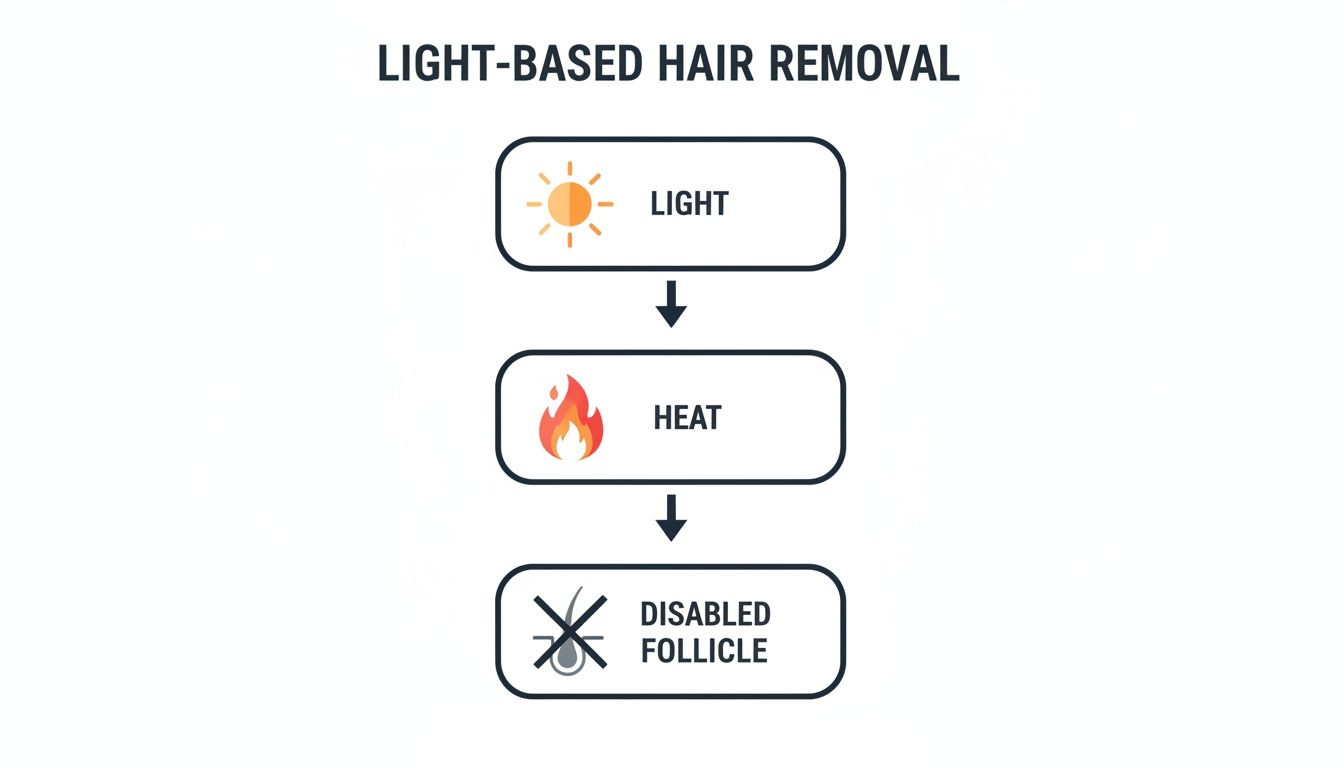
The principle of converting light to heat (photothermolysis) is the same, but the crucial point for a professional is that the quality and focus of that light determine how safely and effectively the heat gets delivered. Diode lasers are simply engineered to do this better.
To make the choice clearer, here’s a direct comparison of the two technologies from a practitioner's point of view.
IPL vs Diode Laser: The Professional Verdict
| Feature | IPL (Intense Pulsed Light) – The Compromise | Diode Laser – The Professional Standard |
|---|---|---|
| Light Source | Broad spectrum (many wavelengths), like a lamp | Monochromatic (single wavelength), true laser light |
| Focus | Scattered and unfocused, loses energy in the skin | Highly focused and concentrated beam |
| Efficacy | Inferior; often only damages hair, leading to regrowth | Highly effective; destroys the follicle for permanent reduction |
| Sessions Needed | More sessions required (e.g., 8-12+) | Fewer sessions required (e.g., 6-8) |
| Skin Type Safety | Limited, high risk on Fitzpatrick IV-VI (darker skin) | Safe for all skin types (I-VI) with proper cooling |
| Pain Level | More painful due to skin heating ("rubber band snap") | More comfortable, especially with advanced cooling systems |
| Business Impact | Limits client base, lower client satisfaction, higher risk | Expands client base, better results, higher ROI |
Ultimately, this table shows why serious aesthetic clinics are moving away from IPL for hair removal and standardising on diode laser technology.
Efficacy and Treatment Efficiency: The Diode Advantage
The difference in focus translates directly to your clinical results and your bottom line. With IPL, a big chunk of the energy is wasted, which makes each treatment less powerful. This almost always means clients need more sessions to see results, and even then, the hair reduction is often less permanent. Many clients find their hair is just weakened or thinned out, not gone for good.
Diode lasers, on the other hand, deliver a potent, concentrated dose of energy right where it counts: the follicle’s growth structures. This leads to:
- Higher Efficacy: Clinical studies consistently show that diode lasers achieve a greater percentage of permanent hair reduction.
- Fewer Sessions: Because each treatment is more powerful, clients reach their goals faster. This boosts client satisfaction and increases your clinic’s daily capacity.
- Lasting Results: The focused heat is far better at destroying the germinative cells that create new hair, leading to truly permanent outcomes.
For a professional clinic that’s built on delivering exceptional, reliable results, the choice becomes very clear. While IPL devices—especially the cheap ones marketed for at-home use—might seem tempting, they just don’t have the power, precision, or safety profile needed for a top-tier aesthetic practice. Diode laser technology isn’t just an alternative to IPL laser hair removal; it’s the definitive professional standard in 2026.
Why Diode Lasers Deliver Superior Clinical Results
The technical debate between a scattered IPL beam and a focused diode laser isn’t just for textbooks—it has a direct impact on your clinic’s results, reputation, and bottom line. While IPL is used for hair removal, only diode lasers truly deliver the precision and power that a professional practice is built on. Time and again, diode lasers outperform IPL, giving clients the kind of results that turn them into loyal advocates for your business.
The key difference is simple: energy efficiency. Think of IPL as a floodlight, scattering light over a wide area. A diode laser, on the other hand, is like a spotlight. It uses a single, optimised wavelength to send a concentrated column of light straight to the melanin in the hair follicle. This targeted approach means less energy is wasted on the surrounding skin, allowing for a much more potent and effective treatment.
Achieving True Permanent Hair Reduction
This efficiency isn’t just a minor technicality; it completely changes the outcome. IPL’s scattered light often just weakens or damages the hair follicle, which almost always leads to regrowth down the line. A diode laser’s focused energy is powerful enough to destroy it completely.
This is how you achieve a high percentage of permanent hair reduction. You’re not just thinning the hair; you’re offering a lasting solution. For your clients, this means getting the smooth skin they want in fewer sessions—a huge factor in client satisfaction and the kind of word-of-mouth referrals that grow a business.
By delivering enough thermal energy to destroy the follicle’s germinative cells, diode lasers move beyond temporary hair management and into the realm of permanent results. This is the standard clients expect from a professional clinic, and it’s something IPL struggles to consistently provide.
Delivering better results, faster, is a powerful driver for your clinic. Happy clients who see real, lasting hair reduction are far more likely to come back for other treatments and recommend you to their friends.
Expanding Your Business with Enhanced Safety
Beyond just being more effective, one of the most compelling reasons to choose diode laser technology is its superior safety profile, especially for a diverse clientele. The unfocused nature of IPL laser hair removal makes it a gamble on darker skin tones. Its broad-spectrum light gets absorbed by melanin in both the hair and the skin, creating a serious risk of burns, blisters, or pigmentation issues on Fitzpatrick skin types IV-VI.
Modern diode laser systems solve this problem with two key features working in tandem:
- Optimal Wavelength: The 808nm wavelength is specifically chosen because it’s strongly attracted to melanin in the hair but poorly absorbed by melanin in the epidermis.
- Integrated Cooling: Advanced contact cooling, like a sapphire crystal tip, actively chills the skin’s surface before, during, and after each pulse. This protects the top layer of skin, allowing the laser energy to safely penetrate to the follicle where it’s needed.
This combination makes diode lasers safe and effective for all skin types, from I to VI. For any clinic in South Africa, this isn’t just a clinical benefit—it’s a critical business decision that allows you to treat your entire community safely and confidently.

Capitalising on a Growing Professional Market
Investing in the right technology positions your clinic to win in a thriving industry. The global market for laser hair removal was valued at USD 1.22 billion in 2026 and is projected to explode to USD 4.60 billion by 2032. This reflects a massive and growing consumer demand for professional, effective treatments. This growth is outpacing the IPL market, clearly showing where discerning clients are choosing to spend their money.
The clinics driving this expansion—and reaping the rewards—are the ones delivering definitive results, like 90% hair growth reduction. Discover more insights about the laser hair removal market from Fortune Business Insights.
In a competitive market, what truly sets a clinic apart is the ability to deliver on its promises. The technical and safety advantages of diode lasers are the foundation for building a premium, trusted, and highly profitable aesthetic business. For any clinic serious about providing best-in-class hair removal, a diode laser isn’t just a better option—it’s the only professional choice.
Why Diode Laser is the Smarter Financial Investment
Great clinical results are one thing, but running a profitable business is what keeps the doors open. Beyond the technical specs, a professional diode laser is a powerful financial engine for your clinic.
While the lower upfront cost of an IPL machine might seem tempting, a closer look at the return on investment (ROI) tells a different story. For a smart, sustainable business, diode laser technology is almost always the more profitable long-term decision.
Let’s move past the science and talk numbers. Investing in a quality diode laser system directly fuels your bottom line through four key drivers. This isn’t just about offering a better service; it’s about building a more resilient and profitable practice.

Justify Premium Pricing with Superior Results
The most direct path to higher revenue is through your pricing. Clients will happily pay more for results they can see and trust. The proven efficacy and safety profile of diode lasers allows you to confidently position your hair removal services as a premium offering.
Because a diode laser achieves a greater percentage of permanent hair reduction in fewer sessions, you’re delivering far more value than a clinic using a less effective IPL system. This justifies a higher price point per session and on packages, giving your revenue an immediate boost.
Increase Client Throughput with Faster Treatments
In a busy clinic, time is your most valuable asset. The faster you can complete a treatment without compromising on quality, the more clients you can book in a day. This is where modern diode lasers create a massive financial advantage over outdated IPL systems.
Think about treating a large area like a full back. With older, less powerful IPL systems, this could easily take up to an hour. A professional diode laser with a large spot size and high repetition rate can knock out the same treatment in as little as 10-15 minutes.
This drastic reduction in treatment time means you can:
- Double or even triple your daily client capacity for hair removal.
- Slot more high-value appointments into your schedule.
- Reduce client waiting times and improve your clinic’s overall flow.
This efficiency isn’t just a nice-to-have; it’s a direct multiplier for your daily revenue. By dramatically increasing client throughput, your diode laser starts paying for itself from day one.
Attract a Broader, More Diverse Client Base
A major limitation of most IPL systems is their inability to safely treat darker skin tones. In a diverse country like South Africa, this means turning away a huge portion of your potential market—a clinical failure and a major business bottleneck.
Diode lasers, particularly those with advanced contact cooling, are safe and effective for all Fitzpatrick skin types (I-VI). By adopting this technology, you break down that barrier and open your doors to a much wider, often untapped, client base. This inclusivity isn’t just ethical; it’s a powerful strategy for market expansion.
For a more detailed look at the numbers, check out our ROI breakdown for South African aesthetic professionals.
Boost Margins with Lower Consumable Costs
Finally, let’s talk about the ongoing costs that eat into your profit margins. Many IPL systems rely on disposable flash lamps or handpiece tips that need replacing after a set number of pulses. These consumable costs add up with every single treatment, slowly chipping away at your bottom line.
Professional diode laser systems, on the other hand, are built for the long haul. Their handpieces are rated for millions of pulses—typically 20 million or more—before needing any service. This means your cost-per-treatment is practically zero, allowing you to keep more of the revenue you generate. Every session becomes more profitable, accelerating your return on investment.
Choosing a Diode Laser Partner Over an IPL Supplier
So, you’re ready to invest in a professional diode laser. Great move. But buying the machine is just the start—in fact, it’s only half the battle. The real secret to long-term success isn’t just the technology you choose, but the company you partner with.
Anyone can sell you a box. A real partner, on the other hand, gives you the framework to operate safely, efficiently, and profitably from day one. This is a totally different ball game compared to buying a basic IPL laser hair removal device online; this is a serious business relationship.
A proper partnership protects your investment and empowers your team long after the initial sale. It’s what separates a thriving aesthetic practice from one that’s constantly dealing with machine downtime, unhappy clients, and avoidable legal risks.
The Pillars of a Strong Supplier Partnership
When you’re looking at suppliers, you have to look beyond the specs on a brochure. What you’re really buying is a support system. Without it, even the most advanced laser can quickly become a very expensive paperweight.
Here’s what you should demand from any technology partner you’re considering:
- Verified Regulatory Compliance: Your supplier must have devices that are fully compliant with local authorities (like SAHPRA in South Africa, CE in Europe, or the FDA in the US). This isn’t just a nice-to-have; it’s your first line of defence against lawsuits and a non-negotiable for client safety.
- In-Depth Professional Training: A user manual isn’t training. A true partner provides hands-on, comprehensive education covering everything from clinical protocols and safety to advanced techniques that get results.
- Responsive Technical Support: When your machine is down, your income stops. A solid manufacturer warranty backed by a local, responsive technical team is critical for minimising downtime and keeping your appointment book full.
- Actionable Marketing and Business Support: The best laser in the world is useless if nobody knows you have it. A good partner gives you marketing materials and business advice to help you attract clients and actually see a return on your investment.
Differentiating Professional Grade from Consumer Trends
The aesthetics market is moving fast. While professional diode lasers are setting the gold standard in clinics, the at-home IPL hair removal market has exploded. This boom in at-home devices is actually good news for you—if you play it smart. It creates more awareness but also highlights the need for professional, reliable services that deliver superior results that a DIY gadget simply can’t promise.
A partnership built on solid support ensures your clinic stands out as the professional authority. It positions your services as a premium, reliable alternative to the inconsistent results of consumer-grade technology, justifying your pricing and building client trust.
Your choice of supplier is just as critical as your choice of technology. It’s a decision that will shape your clinic’s reputation, safety record, and bottom line for years. By choosing a partner who provides end-to-end support, you aren’t just buying a machine—you’re investing in a proven blueprint for success.
To see what proper education looks like, check out our guide on professional laser machine training. This is the kind of in-depth training that gives your staff the confidence to deliver exceptional, safe results—the true cornerstone of any top-tier clinic.
Common Questions About IPL and Diode Lasers
Investing in new technology is a big step, and you need to ask the right questions. We hear the same concerns from clinic owners every day when they’re weighing up IPL versus diode laser systems. This FAQ breaks down the key differences and shows why a professional diode laser is the smarter choice for any modern aesthetic clinic.
Is IPL a Good Starting Point for a New Clinic?
The low initial cost of an IPL machine can look tempting when you’re just starting out, but it’s often a false economy. The truth is, IPL’s limitations can quickly become a bottleneck for your business.
You’ll find yourself turning away clients with darker skin tones—a huge part of the South African market. What’s more, the less predictable results can lead to lower client satisfaction. This means you’re constantly spending money on marketing to find new customers instead of building a loyal client base that grows through word-of-mouth referrals.
Investing in a professional diode laser right from the start positions your clinic as a serious, results-focused practice. It lets you treat a wider range of clients, justify higher prices, and build a reputation for quality that will pay for itself for years to come.
Starting with a diode laser isn’t just about buying a machine; it’s a strategic move that sets you up for long-term growth and avoids a costly upgrade down the line.
Which Technology Is More Painful for the Client?
Client comfort is non-negotiable. It’s what keeps them coming back and telling their friends. While everyone’s pain threshold is different, diode laser treatments are widely considered more comfortable than IPL.
Here’s why: IPL’s broad-spectrum light blasts the surface of the skin as well as the hair follicle. This causes that sharp, “rubber band snap” feeling that many clients really dislike.
Professional diode lasers, on the other hand, are built with advanced contact cooling. Most feature a chilled sapphire tip that pre-cools the skin before, during, and after each pulse. This smart cooling protects the epidermis and minimises discomfort, all while allowing the laser energy to get deep into the follicle where it’s needed. The result is a much more tolerable experience.
Can I Treat All Skin Tones with Both Systems?
This is one of the most critical differences for any clinic in South Africa. Most IPL systems are only safe and effective on lighter skin tones (Fitzpatrick types I-III). Using IPL on darker skin comes with a serious risk of side effects, including:
- Burns
- Blisters
- Post-inflammatory hyperpigmentation (PIH), or dark spots
- Hypopigmentation, or light spots
This dramatically shrinks your potential client pool. In contrast, medical-grade diode lasers are specifically designed to be safe for all Fitzpatrick skin types (I-VI). The combination of a precise wavelength (like 808nm) and built-in skin cooling means the energy targets the hair follicle, not the surrounding melanin. This makes it the clear winner for safely treating our diverse population.
How Many Sessions Do Clients Really Need?
Your goal should always be to deliver the best results in the fewest sessions. Because its energy is so focused and penetrates deeper, a diode laser is far more efficient at permanently disabling the hair follicle.
- Diode Laser: Most clients see significant, permanent hair reduction in just 6-8 sessions.
- IPL: Clients often need 10-12 sessions or more to get close to the same result, which is often less permanent.
Fewer sessions mean happier clients who see results faster. It also frees up your treatment room, allowing you to see more clients and boost your clinic’s revenue. Offering a quicker path to smooth skin is a massive competitive advantage.
Do I Need to Shave Before Every Treatment?
Yes, absolutely. Shaving is a non-negotiable step before any hair removal session, whether it’s with a diode laser or an IPL. The light needs a clear path to the hair root under the skin. If there’s hair on the surface, the energy will just singe it, which wastes the pulse and can burn the skin.
It’s vital to tell your clients to shave 24 to 48 hours before their appointment. Shaving right before treatment can create tiny micro-abrasions, making the skin more sensitive and increasing the risk of irritation.
Crucial Pre-Treatment Instruction: Clients must stop all hair removal methods that pull the hair out from the root—like waxing, sugaring, epilating, or tweezing—for at least four weeks before their first session. The laser needs the hair shaft inside the follicle to act as a guide for the energy.
Clear pre-care instructions ensure every treatment is safe and effective, protecting both your client and your reputation.
Ready to elevate your clinic with technology that delivers superior results, enhanced safety, and a stronger return on investment? Omega Lasers provides medical-grade diode laser systems engineered for professional success. Discover our advanced platforms and comprehensive business support by visiting https://omegalasers.co.