



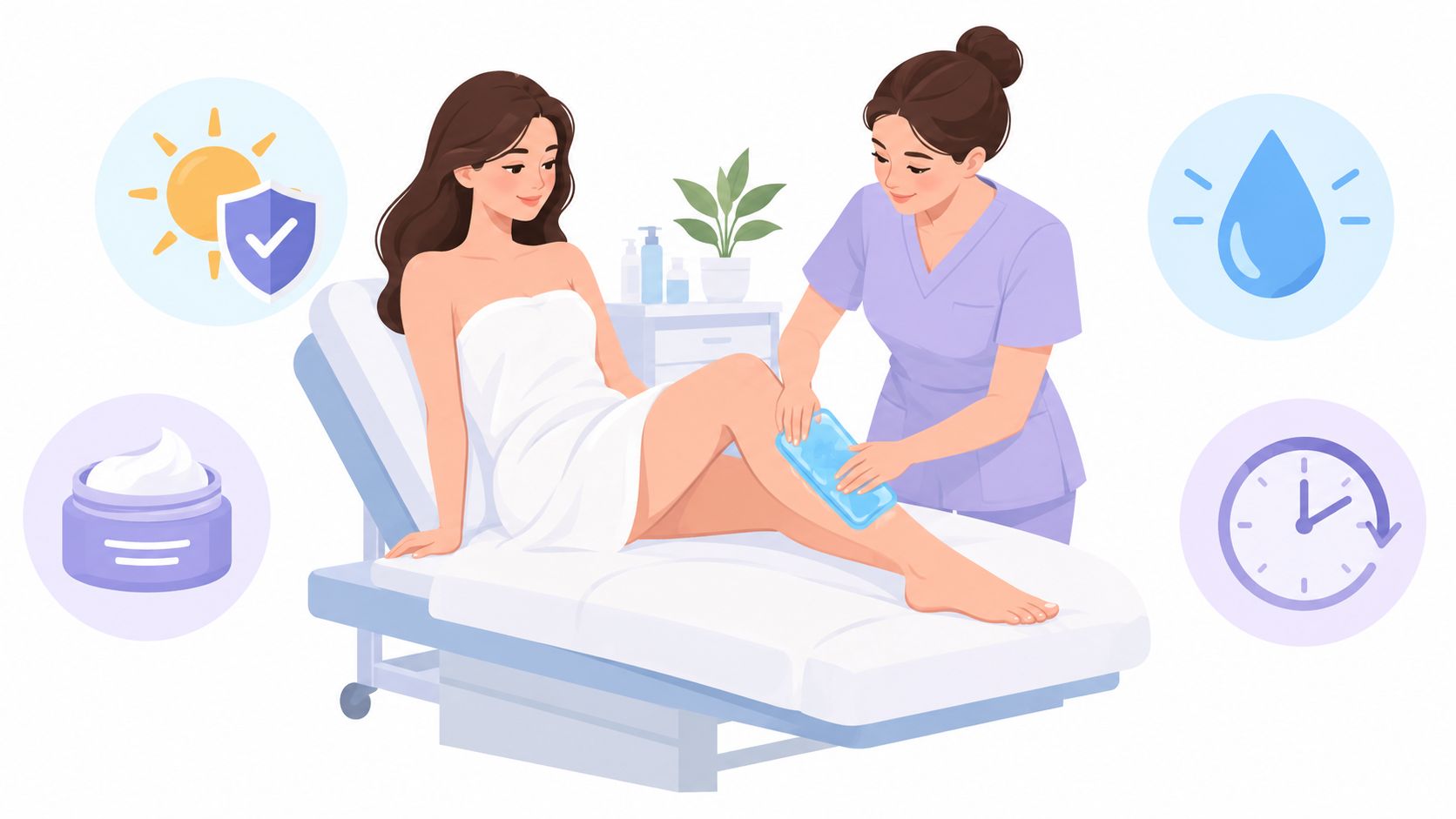
You've just left the treatment room. The area feels warm, looks pink around the follicles, and you're wondering whether to cool it, moisturise it, cover it, or leave it completely alone. In South Africa's strong sun and heat, the next few hours matter. Good laser hair removal aftercare protects comfort, supports the skin barrier, and reduces avoidable pigment problems.
The protocol below follows four practical time windows: the first 24 hours, days 1 to 3, weeks 1 to 2, and the longer-term maintenance cycle between sessions. Your therapist should still adapt it to the treated area, device wavelength, fluence, cooling method, and Fitzpatrick skin type.
Table of Contents
- What Good Aftercare Actually Does
- The First 24 Hours After Treatment
- Days 1 to 3 The Inflammation Window
- Weeks 1 to 2 Protecting Pigment and Repairing the Barrier
- Aftercare for Darker Skin Tones and Pigmentation-Prone Clients
- Warning Signs and When to Escalate
- Patient Handout and Frequently Asked Questions
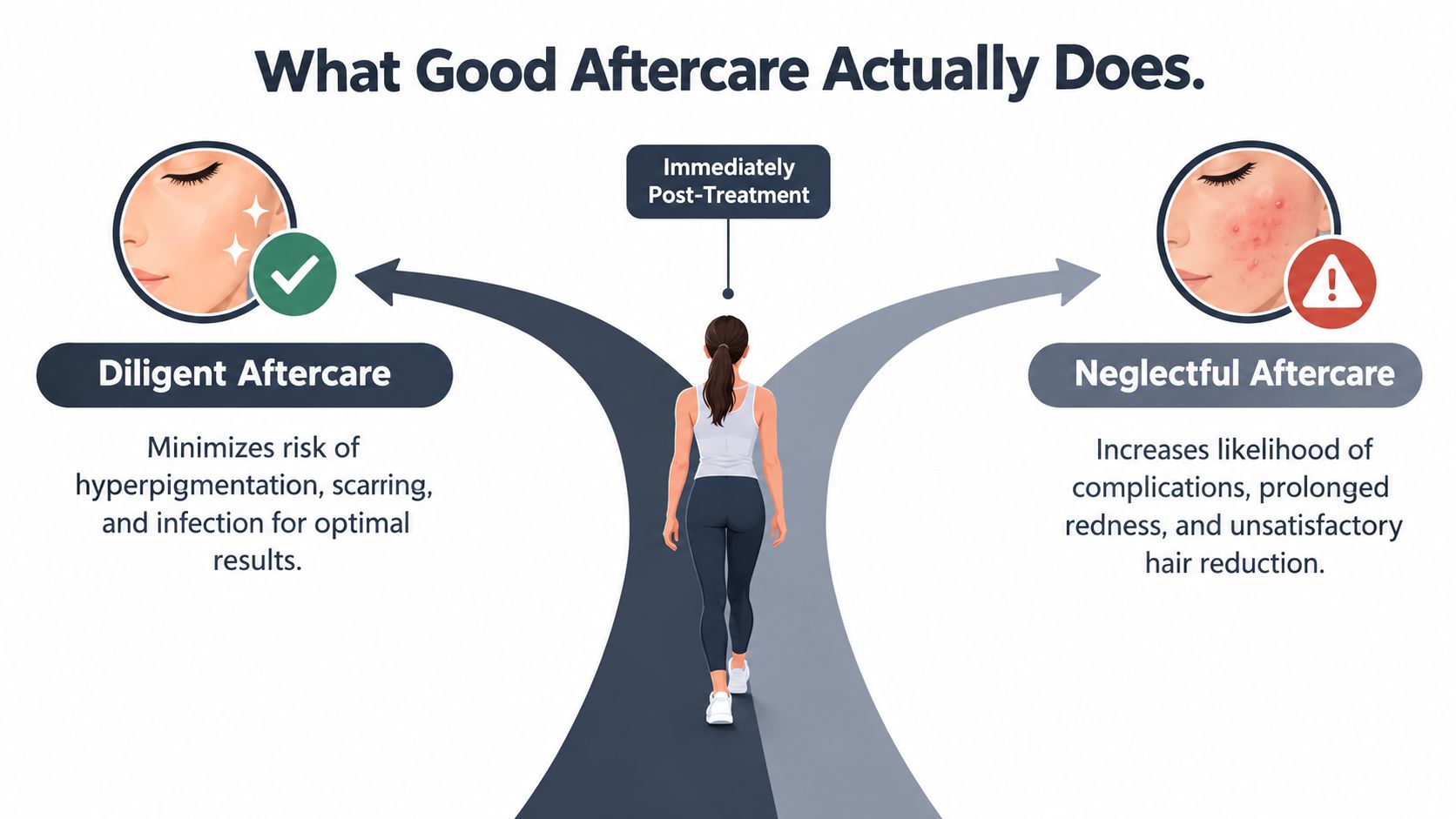
What Good Aftercare Actually Does
The best aftercare starts before you reach reception. A therapist should check the treated skin, apply a suitable soothing product, explain what normal redness looks like, and provide written instructions that match the device and settings used. Cooling the area with a sterile cold pack wrapped in a soft cloth can make the immediate period more comfortable, but cooling isn't a substitute for avoiding heat, friction, and ultraviolet exposure afterwards.
Aftercare is the bridge between a technically sound session and a predictable recovery. It helps preserve three things:
- Barrier function: Gentle cleansing and appropriate moisturising help limit water loss through recently treated skin and reduce the tight, dry feeling that can make patients rub or scratch.
- Controlled inflammation: Heat, sweat, and friction can amplify the inflammatory response around treated follicles. Keeping the area calm reduces unnecessary irritation to surrounding tissue.
- Pigment stability: Ultraviolet exposure can reactivate melanin production in recently inflamed skin. This matters particularly for Fitzpatrick IV to VI clients, who may be more prone to post-inflammatory hyperpigmentation.
Clinical rule: Aftercare shouldn't be copied mechanically from a generic manufacturer leaflet. It should reflect the device wavelength, delivered fluence, treatment area, cooling response, recent sun exposure, and individual Fitzpatrick typing.
South African clinical guidance commonly stresses strict sun protection after laser procedures, including SPF 30+ for three months, applied before outdoor exposure and reapplied during time outside. The same South African clinical aftercare guidance advises pausing irritating products such as toners, alpha hydroxy acids, beta hydroxy acids, and Retin-A during the early recovery period.
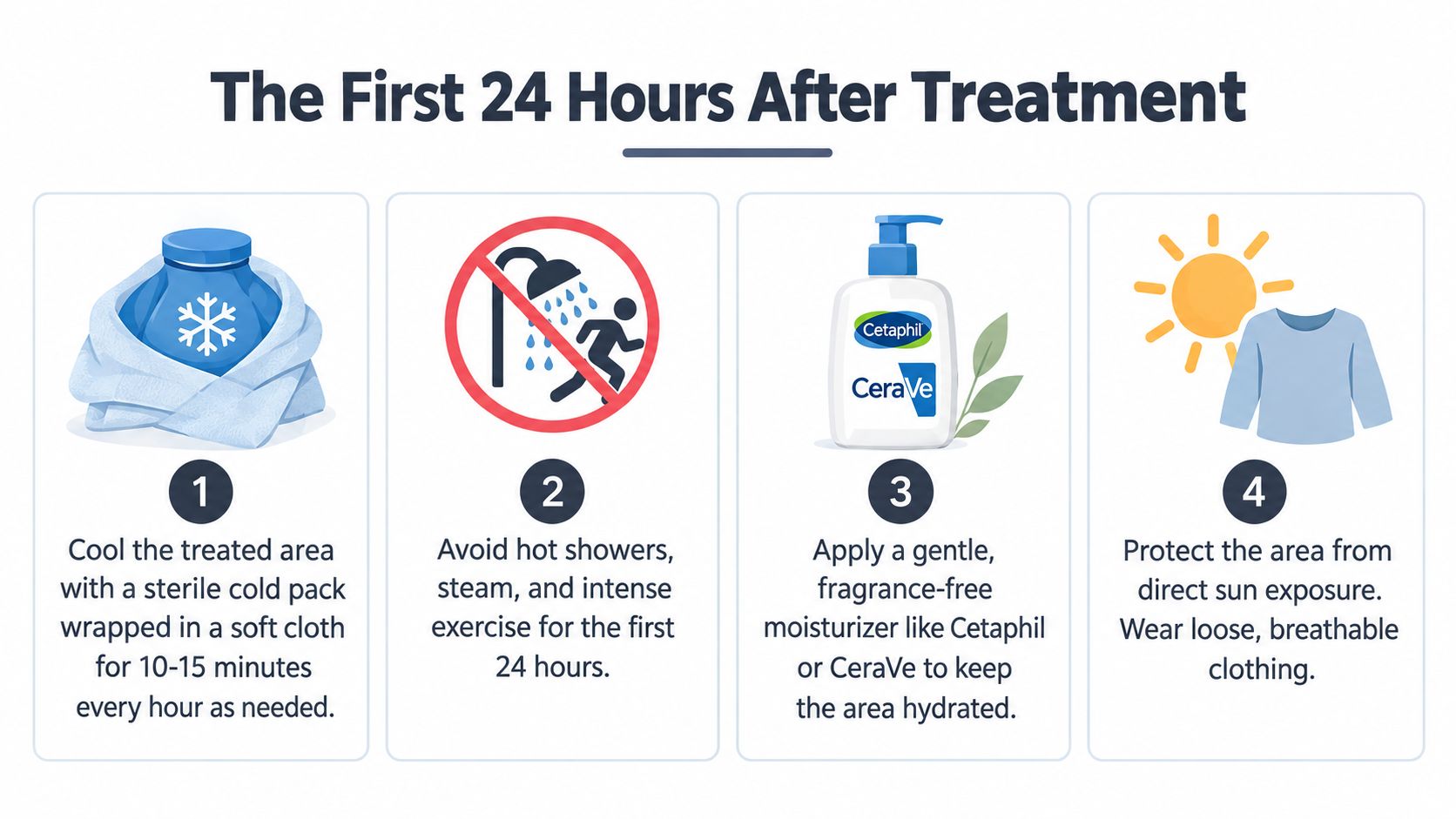
The First 24 Hours After Treatment
The first day is about reducing heat and preventing mechanical irritation. Mild pinkness, a warm sensation, and perifollicular oedema, small raised areas around treated follicles, are common immediate responses. A South African clinic source reports that redness and mild swelling usually settle within hours, while the NHS notes that pinkness and swelling can last for a few hours and that patchy pinkness may occasionally persist for 7 to 10 days or longer. See the NHS laser hair reduction patient guide if your clinic has advised a different recovery window for your treatment.
Cool first, cleanse gently
Use a sterile cold pack wrapped in a soft cloth for 10-minute intervals, allowing the skin to warm naturally between applications. Never place ice directly on the treated area. Excessive cold can injure already reactive skin, so the aim is comfortable cooling, not numbing the tissue.
When you wash, use lukewarm or tepid water and a gentle, fragrance-free, low-pH syndet cleanser. Rinse without scrubbing, then pat dry with a clean, soft towel. A thin layer of a simple soothing gel or fragrance-free moisturiser can support comfort. South African aftercare guidance recommends keeping treated skin cool, applying a soothing cream or gel, and avoiding perfumed or chemical products while irritation is present. Practical clinic guidance for laser hair removal also advises avoiding makeup, fragrance, and deodorant until the following day.
Remove the common heat and friction triggers
For the first 24 hours, avoid:
- Hot water: No hot showers or baths over the treated area.
- Steam and saunas: These can increase warmth and redness.
- Sweat-heavy activity: Skip the gym and strenuous exercise.
- Swimming: Avoid chlorinated pools while the skin is reactive.
- Friction: Choose loose, breathable clothing instead of tight garments.
- Occlusion: Don't apply thick petrolatum-based products that can trap heat unless your clinician specifically recommends one.
Nothing active should touch the area yet. Pause retinoids, Retin-A, alpha hydroxy acids, beta hydroxy acids, benzoyl peroxide, physical scrubs, and vitamin C serums until the skin has entered the next recovery phase. A simple barrier moisturiser is more useful than a crowded routine.
Days 1 to 3 The Inflammation Window
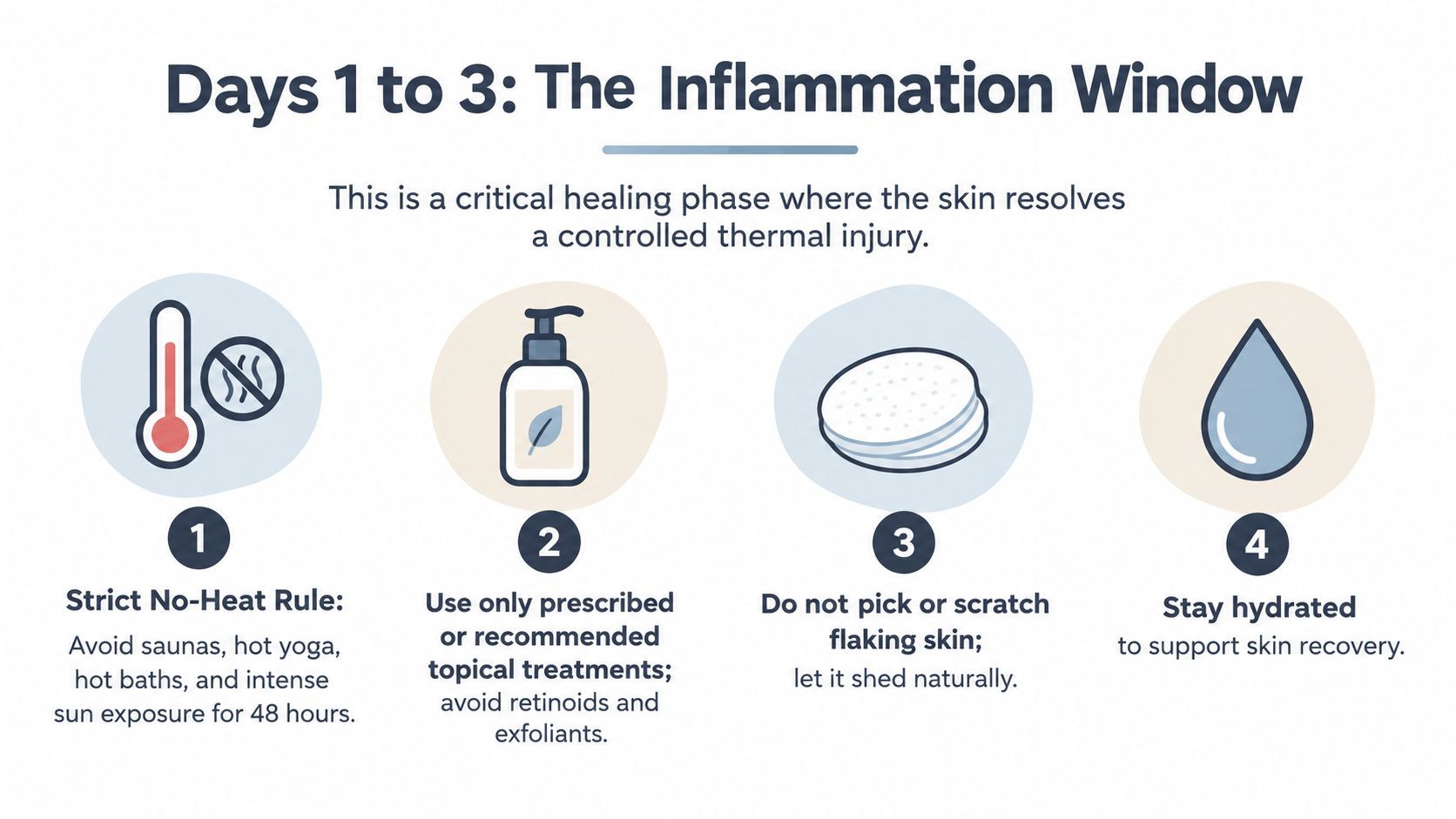
Days one to three are when the skin is resolving the controlled thermal effect of the laser pulse. The surface may look calmer while the follicles remain reactive underneath, so patients often make the mistake of returning to heat, exercise, or strong skincare too quickly.
Keep the 48-hour no-heat rule
For 48 hours, avoid strenuous exercise, hot yoga, jacuzzis, heated pools, saunas, hot baths, and prolonged direct heat. That includes standing over a hot stove for an extended period and using a hairdryer on a high setting over a treated facial area. A South African expert workflow recommends avoiding heat, sweat, and friction during this early period, with strict daytime photoprotection for pigment-prone clients. The clinical YAG aftercare workflow also emphasises documenting expected redness and swelling, prevention advice, and red-flag escalation.
Continue with lukewarm cleansing, loose clothing, and a fragrance-free moisturiser. If erythema remains uncomfortable into day three, cool compresses can still help. A clinician may suggest an antihistamine for a patient with a known reactive tendency, but patients shouldn't self-prescribe medication to mask a reaction that needs review.
Choose barrier support over correction
Pause retinoids, vitamin A derivatives, benzoyl peroxide, salicylic acid, glycolic acid, and physical exfoliants. These products may be useful in an established routine, but they don't repair newly treated skin and can intensify stinging, dryness, or inflammation.
A ceramide-rich barrier cream, panthenol-based balm, or pure hyaluronic acid serum without fragrance or alcohol is generally more appropriate when the skin is intact and dry or tight. Apply a modest amount. More product isn't necessarily better, especially if the area is warm or prone to folliculitis.
Facial treatments may produce overnight swelling. Sleeping with an extra pillow can reduce dependent swelling, while a clean pillowcase helps limit contact with irritants. Fine pinpoint scabbing and continued perifollicular bumps can occur during this window. Don't pick, squeeze, scratch, or manually remove them.
Weeks 1 to 2 Protecting Pigment and Repairing the Barrier
Once the immediate warmth has settled, the priority changes from cooling to protection. Treated skin can remain sun-sensitive for weeks, so daily sunscreen isn't only a beach-day measure. Independent medical guidance recommends daily broad-spectrum SPF 30+, and South African guidance stresses avoiding sun, heat, and friction because inflammation can increase pigmentation risk. The South African aftercare overview is particularly relevant for clients with darker skin tones.
Build the morning routine
Apply broad-spectrum SPF 50+ every morning to exposed treated areas. Reapply every two hours during outdoor exposure, and use a hat, shade, or sun-protective clothing where practical. Mineral filters may be more comfortable on sensitive post-laser skin, but tolerability matters more than choosing a fashionable formulation.
South African UV exposure can occur during ordinary commuting, walking between appointments, or sitting near a bright window. Covering the area or keeping it shaded is often more reliable than trying to compensate after exposure. Avoid tanning and heated activities such as hot yoga or heated pools while the skin still feels reactive.
Repair without overworking the skin
Use a ceramide-rich moisturiser or fragrance-free emollient after cleansing, especially after showering. Twice-daily application can be reasonable while the barrier feels dry, tight, or sensitive. Avoid rubbing the product in aggressively.
Treated hairs may shed gradually rather than disappearing immediately. Guidance from professional clinics describes shedding over the following weeks, and a practical South African protocol places missed hair shedding around days 10 to 21. Don't pluck, wax, thread, or use depilatory creams during this phase. Those methods remove the follicle material needed for future laser targeting. Gentle shaving is acceptable once irritation has resolved.
Reintroduce exfoliation cautiously
From day 10 onward, introduce only gentle exfoliation if the area is fully calm. A soft washcloth is a conservative starting point. A mild AHA may be suitable for some patients, but stop immediately if there is stinging, renewed redness, or itching. Avoid physical scrubs, retinoids, and vitamin A derivatives until at least a week after treatment, and follow the longer pause advised for pigmentation-prone skin.
For a structured approach to restoring comfort after treatment, review skin barrier repair products with the prescribing or treating clinician rather than adding several new products at once.
Aftercare for Darker Skin Tones and Pigmentation-Prone Clients
Fitzpatrick IV to VI aftercare deserves its own clinical pathway, not a footnote at the bottom of a generic handout. Melanin-rich skin can develop post-inflammatory hyperpigmentation after relatively brief irritation or unprotected sun exposure, particularly when heat, friction, and ultraviolet radiation overlap.
Device selection and treatment parameters are part of prevention. For many darker skin types, clinicians may favour a longer-wavelength Nd:YAG 1064 nm platform with conservative fluence, because the wavelength and settings can reduce unwanted melanin absorption compared with shorter-wavelength approaches. That decision belongs to a trained practitioner who has assessed skin type, tanning, hair characteristics, contraindications, and the treatment area.
Keep the routine deliberately boring
During recovery, don't chase a dark mark with multiple brightening products. The first response is cooling, barrier support, shade, and photoprotection. Once the skin is intact and settled, a clinician may approve ingredients such as niacinamide 5%, azelaic acid 10 to 15%, alpha arbutin, or licorice root extract alongside a ceramide moisturiser.
| Ingredient / Product | Status for Fitzpatrick IV–VI | Clinical rationale |
|---|---|---|
| Ceramide moisturiser | Suitable when tolerated | Supports barrier comfort without deliberately stimulating exfoliation |
| Niacinamide 5% | Consider after the skin is calm | May support a more even-looking tone and barrier function |
| Azelaic acid 10 to 15% | Clinician-approved introduction | Can be useful for pigment-prone or blemish-prone skin, but may sting reactive skin |
| Alpha arbutin | Introduce only after recovery | A targeted tone-support ingredient that should not be applied to inflamed skin |
| Licorice root extract | Consider in a gentle formulation | May support a brighter, more even appearance without physical exfoliation |
| Hydroquinone | Pause unless prescribed | Depigmenting treatment requires clinician supervision, especially after inflammation |
| Retinoids | Pause for 14 to 21 days | Can increase irritation while the barrier is recovering |
| Glycolic acid above 10% | Pause for 14 to 21 days | Strong exfoliation can prolong inflammation and increase PIH risk |
| Essential-oil brightening serums | Pause for 14 to 21 days | Fragrance components may irritate recently treated skin |
Escalate pigment changes early
Persistent erythema beyond 72 hours, new brown-grey macules, or any textural change should trigger a clinic review at day 14. Don't begin a new depigmenting agent on your own. A darker mark may reflect post-inflammatory pigmentation, but a clinician must distinguish that from prolonged inflammation, follicular complications, or a thermal injury.
The dark-skin laser hair removal guidance provides useful context for choosing a cautious treatment pathway. In high-UV South African conditions, clinician-approved products and disciplined shade and sunscreen habits are safer than aggressive self-treatment.
Warning Signs and When to Escalate
Staff need a simple triage system that patients can understand without diagnosing themselves. Use the following categories in consultation notes, follow-up messages, and after-hours call handling.
Green signs mean observe and protect
Expected, self-limiting responses include:
- Mild perifollicular erythema: Small areas of redness around treated follicles.
- Warmth: A mild warm or sunburn-like sensation that is settling.
- Light oedema: Small follicular swelling that is improving within 24 hours.
The patient should continue gentle cleansing, cooling when comfortable, barrier moisturising, loose clothing, and sun avoidance. The therapist should record the treated area, device and parameters, Fitzpatrick type, immediate skin response, and the aftercare issued.
Amber signs need a review
Ask the patient to contact the clinic for review within 24 to 48 hours if there is:
- Persistent erythema or itch: Symptoms continuing beyond 72 hours.
- Folliculitis-like papules: Bumps that are increasing rather than settling.
- Localised blistering: A blister smaller than 5 mm.
- Pigmentary change: New brown, grey, or unusually pale areas.
The patient shouldn't exfoliate, pick, apply strong actives, or attempt to lighten the area. The therapist should document time-to-onset, photographs where consent allows, products used afterwards, sun or heat exposure, and any change since the session. The laser hair removal side-effects guidance can support a consistent clinic escalation process.
Red signs require same-day contact
Same-day clinical contact is appropriate for:
- Spreading erythema with pain
- Vesicles larger than 5 mm
- Purulent discharge
- Fever, malaise, or other systemic symptoms
- Suspected burns or significant tissue injury
Don't offer a diagnosis over the phone. Use a calm script:
“I'm sorry you're experiencing this. I'll record when it started, where it is, how it's changing, and the products or activities involved. Please don't apply new products or disturb the area. I'm escalating this to the clinician for same-day advice.”
Record the device, wavelength, fluence, pulse duration if available, cooling used, Fitzpatrick type, treatment area, time-to-onset, photographs, and every instruction given.
Patient Handout and Frequently Asked Questions
Printable aftercare checklist
Keep this section with your treatment record. Follow your clinic's personalised instructions if they differ.
First 24 hours
- Cool gently: Use a sterile cold pack wrapped in a soft cloth for 10-minute intervals. Never place ice directly on the skin.
- Clean lightly: Wash with lukewarm water and a gentle fragrance-free cleanser. Pat dry.
- Moisturise: Use a soothing gel or fragrance-free barrier moisturiser if recommended.
- Avoid heat: Skip hot showers, steam rooms, saunas, gyms, swimming pools, and prolonged sweating.
- Reduce friction: Wear loose, breathable clothing and don't rub or scratch.
- Pause actives: Avoid retinoids, AHAs, BHAs, benzoyl peroxide, physical scrubs, and vitamin C serums.
- Protect from sun: Keep the area covered or shaded and follow the sunscreen instructions supplied by your clinic.
Days 1 to 3
- Continue cooling: Use cool compresses if warmth or redness persists.
- Respect 48 hours: Avoid intense exercise, hot yoga, jacuzzis, heated pools, and other direct heat.
- Let skin shed: Don't pick pinpoint scabs or follicular bumps.
- Support the barrier: Use a fragrance-free moisturiser, ceramide cream, panthenol balm, or suitable hyaluronic acid product.
- Contact the clinic: Seek advice for persistent itch or redness beyond 72 hours, pigment change, or worsening bumps.
Weeks 1 to 2
- Apply SPF 50+: Use it every morning and reapply every two hours during outdoor exposure.
- Cover treated areas: Choose shade, hats, and protective clothing in strong sun.
- Allow shedding: Don't wax, pluck, thread, or use depilatory creams. Shave only once irritation has settled.
- Exfoliate carefully: Consider a soft washcloth or mild AHA from day 10 only if the skin is fully calm.
- Escalate changes: Arrange review for new brown-grey macules or texture changes.
Frequently asked questions
When should I schedule my next session?
Your clinician should schedule it according to the treatment area, hair-growth response, skin recovery, and device protocol. Don't book solely because you see surface regrowth, as some hairs are still shedding.
Will regrowth look different?
It may appear patchy or uneven as treated hairs shed and untreated growth cycles continue. Photographing the same area under similar lighting gives a more useful comparison than checking daily.
Is laser hair removal safe during pregnancy?
Tell the clinic if you're pregnant or trying to conceive. Elective laser hair removal is commonly deferred during pregnancy because safety evidence for cosmetic treatment is limited and hormonal changes can alter skin reactivity and hair growth.
What if I use retinoids or exfoliants?
Tell your therapist exactly what you use. Retinoids, glycolic acid, salicylic acid, benzoyl peroxide, and physical exfoliants may need to be paused, with timing based on the product, area, skin condition, and clinician's assessment.
How should I manage ingrown hairs between sessions?
Don't dig, squeeze, wax, or tweeze treated follicles. Once irritation has settled, your clinician may approve gentle cleansing and carefully timed exfoliation. Persistent or infected-looking bumps need review.
Can I have Botox or filler near my laser appointment?
Tell both practitioners about recent or planned procedures. They can separate appointments when necessary, particularly if the areas overlap or the skin is still inflamed.
What if I acquired a tan before treatment?
Contact the clinic before attending. A fresh tan or sunburn changes the skin's response and may mean the therapist needs to reassess settings or postpone treatment.
How should I document progress?
Take consistent photographs of the same area, using similar lighting, distance, and posture. Record treatment dates, settings supplied by the clinic, shedding, irritation, sun exposure, and any product reaction.
When should I call urgently?
Contact the clinic the same day for spreading painful redness, larger vesicles, pus, fever, malaise, or suspected burns. Don't wait for the next appointment.
Omega Lasers supports clinics with advanced laser platforms, device training, aftercare education, technical support, and follow-up protocols that help therapists deliver consistent patient guidance. Visit Omega Lasers to explore laser systems and clinical enablement for safer, more organised hair-removal services.