



You’re weighing up a machine purchase right now. You’ve looked at wavelengths, handpieces, cooling systems, finance options, and supplier promises. On paper, the device feels like the big decision.
It isn’t.
In South Africa, the core decision is whether your clinic will treat laser hair removal as a regulated clinical service or as a beauty add-on. That choice affects your legal exposure, your treatment outcomes, your client retention, and whether the machine becomes a revenue asset or an expensive problem.
Beyond the Device The True Investment in Laser Hair Removal
A clinic owner starts with the same question. Which machine should I buy?
That’s understandable. Hardware is visible. Training isn’t. A four-wavelength platform looks impressive in a showroom. A certificate file on your practice manager’s desk doesn’t. Yet the certificate, the clinical judgement behind it, and the protocols your team follows will decide whether clients rebook or complain.

Demand is growing, but so is responsibility
South Africa gives clinics a clear commercial reason to offer laser hair removal. The non-invasive aesthetic procedures sector was valued at over R2.5 billion in 2023, with a 25% year-on-year increase in demand for permanent hair reduction according to the South African market data cited here.
That growth attracts new entrants. It also exposes weak operators.
A modern laser machine can deliver excellent results, but if the practitioner can read skin correctly, choose the right settings, recognise contraindications, and manage the full treatment journey from consultation to aftercare. A clinic that skips that groundwork runs into the same issues:
- Poor consultations: Clients are booked without a proper suitability check.
- Wrong settings: Fluence, pulse duration, or wavelength choices don’t match the client’s skin and hair profile.
- Unrealistic promises: Staff sell “permanent removal” as if every body area and every hair type responds the same way.
- Weak aftercare: Clients leave without clear guidance, then return with avoidable irritation or disappointment.
The machine doesn’t protect your reputation
One experienced pattern shows up in aesthetics. Clinics over-invest in equipment and under-invest in operator competence.
Practical rule: A good device in untrained hands is a liability. A trained operator can extract value from the device, protect the client, and protect the clinic.
Laser hair removal training is where a business becomes clinically organised. It standardises consultation forms, patch testing, treatment intervals, documentation, consent, parameter selection, and incident response. Those systems aren’t glamorous, but they’re what make a laser service sustainable.
What thriving clinics understand early
The strongest operators don’t ask only, “What can this device do?” They ask:
- Can my team use it legally?
- Can they use it safely on South African skin types?
- Can they explain expected outcomes without overpromising?
- Can they repeat those outcomes consistently enough to build retention?
That is the primary investment. The device opens the door. Training determines what happens next.
Why Professional Training Is Non-Negotiable in South Africa
Some clinic owners treat certification like paperwork. That view doesn’t survive contact with practice.
Laser hair removal in South Africa sits inside a regulated environment. If your team operates without proper training, you’re not just risking a weak result. You’re exposing the clinic to compliance problems, preventable injuries, and reputational damage that’s hard to reverse.

Training changed the safety record
The clearest argument for proper certification is what happened after regulation tightened. Before 2018, 22% of complaints to the Medical Control Council involved burns or scarring from lasers. After mandatory certification was enforced by SAHPRA and HPCSA, that figure dropped to 2%, as reported in this South Africa laser training overview.
That’s not an abstract policy win. It tells you exactly what training does in practice. It reduces operator error.
When practitioners understand tissue response, endpoint recognition, eye protection, cooling, contraindications, and post-treatment care, fewer clients get harmed. The link between skill and safety is direct.
Legal compliance is not optional
A clinic can recover from a poor month of sales. Recovering from a compliance issue is much harder.
Professional training matters because it creates proof. Proof that your staff were trained on safety standards. Proof that they understand scope. Proof that your clinic took reasonable steps to provide a regulated treatment responsibly.
If your service is challenged, your team’s training records, protocols, consultation standards, and documented competence become part of your defence. Without them, you’re left with verbal assurances and hope.
South African skin diversity makes generic training risky
South Africa is not a market where a generic overseas course is enough. The day-to-day reality here includes a wide range of melanin levels, client histories, cultural expectations, and treatment risks. Darker skin types require more than textbook familiarity. They require disciplined parameter selection and caution around heat injury and pigment response.
That’s why training must go beyond “how to fire the laser.” It must teach judgement.
What untrained teams get wrong
A clinic without strong laser hair removal training stumbles in predictable places:
- Consultation shortcuts
Staff focus on selling a package instead of screening the client properly. - Device confusion
They know the machine has multiple settings, but they don’t know why to choose one combination over another. - Patch test inconsistency
Patch tests are done, or not documented clearly enough to guide treatment. - Poor incident handling
When a client reacts badly, the operator panics because they were never trained on escalation and follow-up.
The legal risk starts before the handpiece touches the skin. It starts with poor assessment, poor records, and poor judgement.
Safety is also a brand issue
Clients may not know your exact wavelength selection. They do know whether they feel safe, informed, and cared for.
A certified team explains risks, sets realistic expectations, and behaves like professionals rather than machine owners. That changes how a clinic is perceived. It also changes referral quality. The market responds to trust.
Professional training isn’t a box to tick. It’s the operating system behind every credible laser service in South Africa.
Navigating Laser Training Courses and Accreditation
The training market is crowded. Some courses are rigorous. Some are little more than a PDF, a quick demo, and a printed certificate. If you’re comparing options, the first job is to separate professional education from shortcuts dressed up as certification.
A useful way to assess laser hair removal training is to group it into tiers. That keeps you from comparing unlike options.
Comparison of Laser Hair Removal Training Tiers
| Training Tier | Core Focus | Typical Duration | Ideal For |
|---|---|---|---|
| Foundation training | Basic laser science, safety, consultation principles, skin and hair assessment, introductory practical exposure | Structured entry-level programme with theory and supervised practical work | New entrants, beauty therapists expanding scope, clinic teams launching laser services |
| Advanced clinical training | Parameter selection, complex skin types, treatment planning, adverse event prevention, clinical decision-making | Extended programme with deeper practical assessment | Experienced practitioners who want stronger treatment judgement |
| Device-specific training | Platform controls, handpiece use, maintenance routines, workflow integration, brand-specific protocols | Shorter add-on module after core training | Clinics purchasing a specific laser system |
| Compliance-focused local training | South African scope, documentation, consent, audit readiness, licensing alignment | Often embedded into accredited local programmes | Owners, managers, and practitioners who need local legal clarity |
Why local accreditation matters
One of the biggest mistakes clinics make is assuming any certificate equals compliance. It doesn’t.
A generic international course may teach the basics of wavelength, pulse duration, and hair growth cycles. It may be well produced. But if it doesn’t address South African regulatory expectations, practitioner scope, and the specifics of local skin diversity, it leaves dangerous gaps.
That matters because 48% of practitioners said they were confused about their legal scope of practice in a 2025 Aesthetic Association SA survey, a gap highlighted in this discussion of SAHPRA-specific training. If nearly half the field is unsure about scope, a vague certificate won’t protect your clinic.
Quick certificates fail in the same places
Short, low-rigour programmes sound attractive because they reduce time off the floor. In practice, they leave out the parts that matter.
Watch for these warning signs:
- Minimal hands-on supervision: Watching a trainer perform treatment isn’t the same as being assessed while you perform it.
- No South African compliance content: If the provider can’t explain local requirements clearly, move on.
- No assessment standard: A course that never tests consultation ability, documentation, or parameter reasoning is weak.
- One-size-fits-all teaching: Programmes that treat all skin types and body areas as broadly similar aren’t preparing people for clinics.
A certificate has value only when it reflects competence that can be demonstrated, documented, and repeated in practice.
Different practitioners need different pathways
A new beauty therapist entering laser work doesn’t need the same training emphasis as a dermatologist adding a new platform to an existing clinic. The first may need a stronger grounding in fundamentals. The second may need focused device-specific calibration and workflow integration.
The important thing is sequence.
Start with proper foundations if you’re new. Add advanced technique work once you’ve built judgement. Add device training when you know the platform you’ll use. That order makes sense clinically and operationally.
Accreditation questions worth asking
Before enrolling staff, ask the provider:
- Who recognises this programme locally?
- How much of the course is supervised practical work?
- How are learners assessed?
- Does the course address South African scope and documentation?
- Will this training still be relevant once we start treating Fitzpatrick IV to VI clients in clinic?
Those questions cut through marketing quickly. Good providers answer them directly. Weak providers pivot back to convenience.
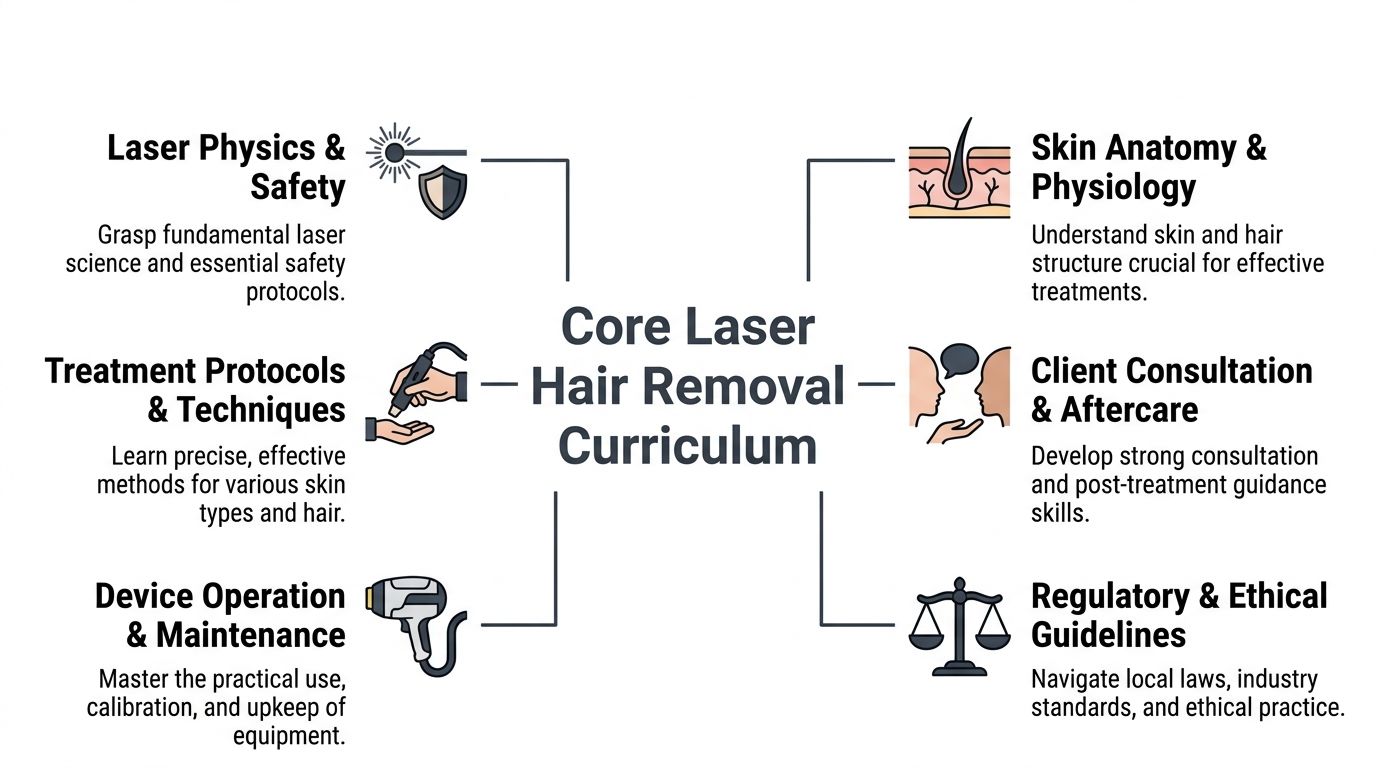
The Core Curriculum What You Will Learn
A serious course does more than teach you where the start button is. It trains your eye, your judgement, and your discipline.
The curriculum should build from science into application. If it doesn’t, practitioners end up memorising settings without understanding why those settings change from one client to the next.
Laser physics and safety
This is the part many newcomers fear, but it isn’t as abstract as it sounds.
Selective photothermolysis is targeted heat. The laser is trying to send energy into the pigment in the hair follicle while sparing the surrounding skin as much as possible. Good training makes that idea practical. You learn what wavelength does, why pulse duration matters, how fluence changes tissue response, and what cooling is there to protect.
You also learn that safety isn’t a side topic. It covers eye protection, room setup, warning procedures, handpiece handling, and recognising when the skin is telling you to stop.
Skin typing in a South African clinic
Training becomes local and clinically relevant here.
For South Africa’s predominantly Fitzpatrick IV to VI skin types, proper training teaches practitioners to move away from riskier 755 nm choices and towards 1064 nm Nd-YAG protocols where appropriate. That protocol shift has been shown to reduce post-inflammatory hyperpigmentation from as high as 25% to under 5%, according to this guide to certification standards and darker skin treatment.
That single concept changes treatment quality dramatically. Operators who don’t understand melanin competition overtreat, chase aggressive endpoints, and create pigment problems that were avoidable from the start.
Treatment planning and consultation
A proper consultation is a clinical filter. It’s where you decide whether to treat, delay, modify, or decline.
A strong course teaches practitioners to assess:
- Hair characteristics: Coarse, fine, dense, sparse, hormonally influenced.
- Skin response history: Pigment tendency, sensitivity, previous laser reactions.
- Medical context: Contraindications, recent procedures, topical use, healing risk.
- Client expectations: Whether the client understands reduction, maintenance, and treatment spacing.
The practitioner should leave the consultation with a treatment plan that makes sense, not a guessed setting.
If you need a patient-friendly explanation of treatment principles, this overview of how laser hair removal works is useful for translating the science into plain language.
Clinical insight: The consultation isn’t admin. It’s where good outcomes begin and complaints are prevented.
Practical technique and hands-on work
Hands-on training should be structured, not improvised.
A good programme includes supervised practice on model clients or in-clinic settings where the learner must perform the full sequence correctly. That means preparing the area, positioning the handpiece, choosing an overlap strategy, watching tissue response, and adjusting when the endpoint isn’t right.
This is also where people learn a hard truth. Speed is not the same as efficiency.
Fast operators who rush miss patch test logic, skip reassessment, or stack too much heat in one area. Efficient operators move well because they understand the treatment map and the machine.
Device operation and maintenance
Every platform has its own logic. Menus differ. Cooling systems differ. Handpieces differ. Shutdown and care routines differ.
That’s why a worthwhile course includes equipment-specific instruction on:
- Start-up checks so the device is safe before the client enters.
- Parameter input so settings are chosen deliberately, not copied blindly.
- Cooling verification so epidermal protection is working as intended.
- Consumable and maintenance routines so performance remains stable.
- Basic troubleshooting so minor issues don’t turn into cancelled days.
Aftercare and complication prevention
Many clinics under-emphasize this area in training. That’s a mistake.
Clients judge treatment quality partly by what happens after they leave. Training should cover immediate aftercare, home instructions, red flags, and follow-up protocols. Practitioners need to know the difference between a normal transient response and a developing complication.
Good aftercare advice sounds calm and specific. Poor aftercare sounds vague, rushed, or copied from a generic template.
Ethics, records, and treatment discipline
A mature laser service is built on consistency. That requires strong documentation.
Every quality course should train practitioners to record what they saw, what they used, why they chose it, how the skin responded, and what they advised afterwards. That record protects the clinic and makes the next session better.
Without that discipline, practitioners rely on memory. Memory is not a protocol.
How to Choose the Right Training Provider in South Africa
By the time you’ve reviewed a few providers, the brochures start to sound the same. Everyone mentions safety. Everyone says their programme is practical. Everyone promises confidence.
The useful question isn’t what they claim. It’s what they can prove.
Start with the trainer, not the slide deck
A polished presentation doesn’t tell you much. The instructor does.
Ask who teaches the course and what kind of clinical experience they bring. You want someone who has worked with treatment variables, not someone who only knows the brand script. A trainer should be able to explain why a setting changes for the same body area when the skin type changes, and why two clients with similar unwanted hair may still need different planning.
Look for assessed hands-on practice
Hands-on exposure matters only when the learner is corrected and evaluated.
A provider should be able to explain how practical training works. Is the learner observed during consultation, patch testing, treatment delivery, and aftercare instruction? Are mistakes corrected in real time? Is there any threshold for competence before a certificate is issued?
If the answer is vague, the training probably is too.
Judge the provider on post-course support
Laser work rarely becomes easy on day one after certification. Questions come up once the team starts treating paying clients. That’s why post-training support matters so much.
Strong providers offer some mix of clinical follow-up, technical guidance, protocol refreshers, or business implementation help. That support becomes important when a clinic is integrating a new platform into an existing service menu.
For teams comparing treatment technologies before training, this overview of IPL and laser hair removal differences can help frame the discussion around what your staff will need to master in practice.
A practical checklist for vetting providers
Use this short filter before you sign anything:
- Local relevance: Does the course deal with South African compliance and local treatment scenarios?
- Clinical depth: Does it go beyond physics into consultation, records, and complication management?
- Practical assessment: Will your team be watched, corrected, and signed off properly?
- Equipment realism: Are learners training on professional-grade systems similar to what they’ll use in clinic?
- Support after certification: Can you still reach someone when a treatment question arises later?
The right provider doesn’t just help you pass a course. They help your clinic operate more predictably once the course is over.
One sign the provider understands business reality
Good training providers recognise that clinics don’t make money from certificates on the wall. They make money from competent treatment delivery, repeat bookings, safe outcomes, and stable team performance.
That’s why the best choice is not the shortest course or the cheapest course. It’s the one that reduces uncertainty once your team starts working.
A provider such as Omega Lasers may fit that model for some clinics because it combines device education with technical and business support around SAHPRA-licensed platforms. The important point isn’t the brand name. It’s the structure. Training works better when the provider can support implementation, not only instruction.
Integrating Training into Your Clinic for Maximum ROI
Certification becomes commercially valuable when the clinic builds it into operations. Many teams finish laser hair removal training, frame the certificate, and then carry on with weak consultations, generic pricing, and inconsistent follow-up. That leaves money on the table.
The clinics that see a return do three things well. They package treatment properly, communicate expertise clearly, and standardise the client journey so every practitioner works from the same playbook.

Retention is where training pays off
The commercial effect of training shows up in repeat business, not just first bookings. A 2026 SA Aesthetic Business Report found that clinics with certified operators see 85% client retention compared with 60% for those with untrained staff, and some clinics reported a R150,000 annual uplift after implementing compliant, effective protocols, as outlined in this laser course and business ROI discussion.
That makes sense in clinic terms. Clients stay when they feel informed, see progress, and trust the practitioner’s judgement. They drift when consultations feel rushed, reactions aren’t managed well, or outcomes seem erratic.
Build the service around the full treatment journey
The money isn’t in a single appointment. It’s in a managed course of treatment delivered consistently.
A clinic should define:
- How consultations are structured
- How suitability is documented
- How packages are explained
- How interval bookings are scheduled
- How aftercare follow-up is handled
- How the next session’s parameters are reviewed
Those systems reduce drop-off. They also make the service less dependent on one “star operator”.
Price for expertise, not just machine time
One common mistake is pricing laser hair removal as if the machine is doing all the work. Clients aren’t paying only for pulses delivered. They’re paying for risk management, clinical judgement, appropriate settings, and a safer route to visible reduction.
That doesn’t mean overpricing. It means presenting the service as a professional treatment, not a bargain commodity.
A strong pricing conversation includes three elements:
- Why a course of treatment is needed
This frames the service realistically from the start. - Why assessment and settings matter
This helps clients understand the value behind trained operation. - Why consistency improves results
This supports package uptake and better attendance.
A certified clinic should sell certainty, not just sessions.
Train the front desk as well
Laser profitability is lost before the practitioner meets the client.
Reception and sales staff need enough training to explain the service without making clinical promises they shouldn’t make. They should know how to describe consultations, package logic, prep requirements, and why some clients need modification or referral before treatment.
That alignment prevents one of the most damaging clinic patterns. The front desk overpromises, then the practitioner has to claw expectations back in the room.
Use certification in your marketing
Your marketing should communicate competence, not hype.
Useful messaging includes:
- Certified practitioners
- SAHPRA-compliant operation
- Suitable treatment planning for diverse skin types
- Consultation-led protocols
- Clear pre-care and aftercare guidance
What doesn’t work is vague “pain-free, permanent, one-size-fits-all” advertising. That attracts the wrong expectations and weakens trust when the practitioner has to explain the full process.
For clinics working on the financial side of implementation, this guide to how much a clinic can earn with a diode laser is a practical starting point for planning revenue around utilisation, packages, and service mix.
Operational habits that improve ROI
A trained team performs better when the clinic also enforces simple operating disciplines:
- Record parameters consistently: This improves continuity and reduces guesswork at follow-up visits.
- Review no-shows and drop-offs: Lost package continuity hurts outcomes and revenue.
- Track consultation conversions: If clients aren’t converting, the issue may be communication, not demand.
- Schedule reassessment points: Visible progress keeps clients committed.
- Standardise aftercare messaging: Inconsistent advice creates avoidable support calls and dissatisfaction.
Training gives the clinic capability. Process turns that capability into revenue.
Your Next Step to Becoming a Laser Expert
If you’re serious about adding or improving laser hair removal in your clinic, start by changing the question. Don’t ask which machine to buy. Ask what level of training your team needs to operate legally, treat safely, and deliver outcomes clients will return for.
That shift matters because this field punishes shortcuts. Generic certificates, weak practical exposure, and poor local compliance knowledge create problems that no marketing campaign can hide for long. Strong training does the opposite. It sharpens consultations, improves treatment planning, protects darker skin types, and gives the clinic a clearer path to retention and repeat revenue.
The clinics that build durable laser services share the same habits. They choose proper accreditation. They insist on supervised practical work. They document carefully. They train the whole team, not only the operator. They treat compliance as part of the business model, not as an obstacle to it.
If you’re comparing providers, audit the course before you pay for it. Ask hard questions. Check local relevance. Check who teaches it. Check what support exists after certification. A course should prepare your team for clients in a South African clinic, not just for a certificate handover.
Professional laser hair removal training isn’t an extra cost around the machine. It’s the part that makes the machine commercially and clinically worthwhile.
If you’re evaluating systems and training together, Omega Lasers offers SAHPRA-licensed aesthetic platforms alongside laser machine training, technical support, and business guidance for South African clinics, salons, and aesthetic professionals.