



If you're pricing laser hair removal right now, you're probably dealing with the same frustration from two different sides. Clients want a simple answer to "what will this cost me?", while clinic owners need a pricing model that covers device costs, staff time, consumables, compliance, rebookings, and profit. Those two conversations often get mixed together, and that's where confusion starts.
A workable hair removal laser cost strategy has to do both jobs. It must give clients a transparent session price they can understand, and it must give the clinic a treatment mix that makes commercial sense over time. In South Africa, that gap matters even more because prices are usually quoted per area and per session, while profitability is driven by package design, treatment speed, and how well your technology fits the clients you treat.
Table of Contents
- Decoding the Price Tag on Laser Hair Removal
- The Client Viewpoint Average Laser Hair Removal Costs in South Africa
- Key Factors That Influence the Final Price
- How Laser Technology Impacts Treatment Cost and Clinic Profit
- A Clinic Owner's Guide to Setting Profitable Prices
- Building a Sample ROI Model with an Omega Laser
- Financing Options Warranties and Choosing a Value-Driven Provider
- Frequently Asked Questions About Laser Hair Removal Costs
- Is laser hair removal permanent, and does that change the price?
- Are there hidden fees clients should ask about?
- Why do two clinics quote very different prices for the same area?
- How should clinics price laser hair removal for men?
- How do clinics justify a premium price without sounding defensive?
- Should clinics discount heavily to win market share?
Decoding the Price Tag on Laser Hair Removal
Hair removal laser cost looks simple on a price list and complicated everywhere else. A client sees "underarms" or "legs" with a single amount beside it. The clinic sees treatment time, operator allocation, device wear, follow-up demand, and the probability that this client buys a package or only books once.
That gap explains why two clinics can both look reasonable on the surface and still be operating on completely different economics. One may be discounting heavily to fill the diary but sacrificing margin on every long-area treatment. Another may charge more because it has built its pricing around better throughput, stronger clinical fit, and fewer operational headaches.
Practical rule: If your pricing page answers only "what does one session cost?", it isn't doing enough work for either the client or the business.
The useful way to think about price is in layers. First, there is the visible client price per area. Then there is the full-course cost across repeat sessions. Under that sits the clinic's internal model, which should account for room time, team skill, device capability, and how often clients complete the series.
For consumers, that means the cheapest line item isn't always the lowest real spend. For clinic owners, it means the highest session fee doesn't automatically create the healthiest margin.
The Client Viewpoint Average Laser Hair Removal Costs in South Africa
South African clients usually encounter laser hair removal as a menu of body areas, not a single market-wide fee. That's the right way to present it, because treatment economics change with the size of the area and the time needed to treat it. Local pricing data shows small areas such as the lip or chin at about ZAR 65 to ZAR 100 per session, medium areas such as bikini or underarms at about ZAR 150 to ZAR 250, and large areas such as legs or back at about ZAR 200 to ZAR 500 per session. The same market reference places the national average at around ZAR 389 per session, and notes that most clients need 6 to 8 sessions, usually spaced 4 to 6 weeks apart according to South African laser hair removal pricing guidance.

What clients usually see first
Clients often compare only the session figure. That's understandable, but it can hide the true budget. A lip treatment and a legs treatment don't just differ in price because one area is larger. They differ because larger zones usually need more treatment time, broader coverage, and stricter scheduling discipline.
A practical consumer reading of the market looks like this:
- Small-area pricing: Usually works for high-convenience treatments like the upper lip or chin, where the upfront entry point feels accessible.
- Medium-area pricing: Sits in the range where many repeat clients start to compare package offers seriously, especially for bikini and underarms.
- Large-area pricing: Feels manageable on paper per session, but the full-series commitment becomes much more meaningful once clients multiply it across the full plan.
For clients researching a specific area, a focused cost breakdown like this underarm laser hair removal pricing guide helps set expectations more realistically than a generic treatment menu.
Why package pricing matters
The biggest budgeting mistake is assuming the first quote represents the whole spend. It rarely does. Because treatment is usually delivered over a series, package design matters as much as the listed single-session price.
Clinics that explain the full course clearly tend to face fewer pricing objections later, because the client understands the commitment before the first session.
From the client's side, the useful questions are simple:
| Question | Why it matters |
|---|---|
| Is this price per session or for a package? | The wording changes the perceived affordability immediately. |
| How many sessions do you usually recommend for this area? | Session count drives total spend more than the first booking does. |
| Are all sessions priced the same? | Some clinics structure pricing differently across packages and add-ons. |
| What happens if I need maintenance later? | Ongoing care may be separate from the initial series. |
Clients don't need a finance lecture. They need clarity. If a clinic can't explain total expected spend by area, expected treatment cadence, and how packages alter value, the quote will feel vague even when the listed number looks attractive.
Key Factors That Influence the Final Price
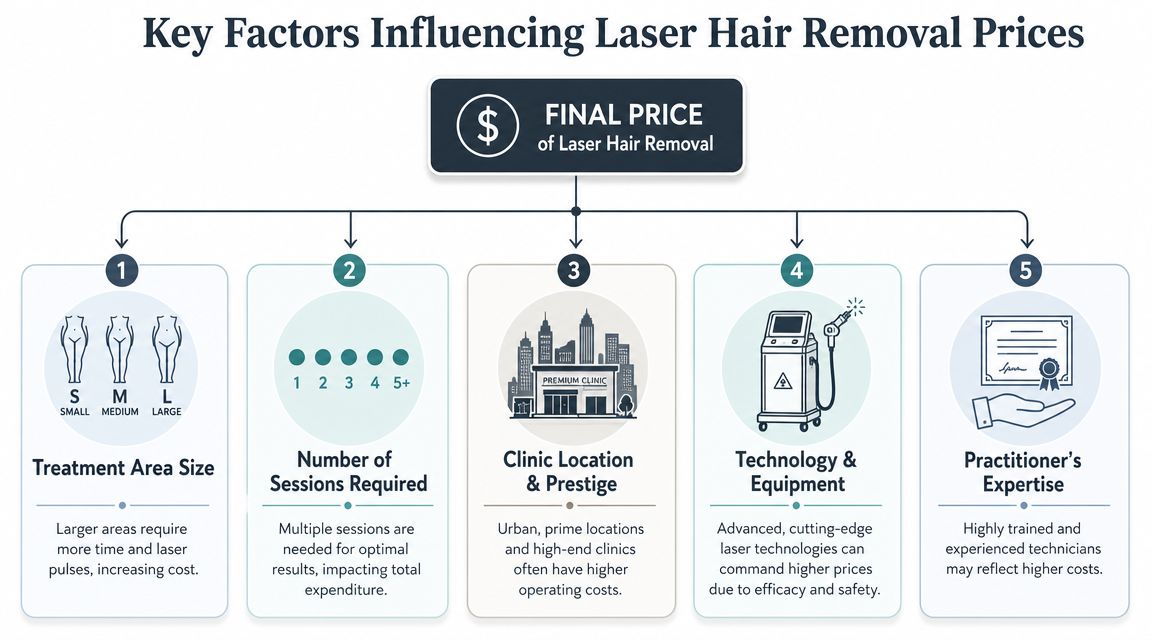
The session fee is only the visible part of the decision. Final cost shifts because laser hair removal isn't a one-visit service. Hair grows in cycles, follicles respond differently, and the commercial model changes with every extra visit the clinic needs to deliver.
WebMD notes that treatment is typically completed over two to six sessions, and broader patient-facing benchmarks show full-body treatment series can reach $5,000 to $20,000 when multiple sessions are required, as outlined in WebMD's overview of laser hair removal.
Session count changes everything
This is the factor most clients underestimate and most clinic owners should model carefully. The total price isn't just "cost per area". It's cost per area multiplied by how many visits are required to reach durable reduction.
That creates several practical consequences:
- Hair-growth timing affects planning. Because follicles respond during particular growth phases, spacing matters. A rushed protocol can disappoint the client and create more chair time later.
- Different clients create different revenue curves. Some complete exactly as planned. Others need a longer series, more review appointments, or a maintenance strategy.
- Packages protect both sides. The client gets budget visibility. The clinic gets clearer forecasting and better utilisation.
The rest of the pricing logic
Once session count is understood, the other price drivers become easier to explain.
- Treatment area size: A small facial zone and a large body zone don't carry the same operational load. Larger areas use more appointment time and place more pressure on scheduling efficiency.
- Hair density and treatment complexity: Two clients booking the same area may not require the same operator effort. Density, regrowth pattern, and response all affect how straightforward the course becomes.
- Clinic positioning: A medically supervised setting, stronger consultation process, and more experienced operators usually sit at a different price point from an entry-level setup.
- Technology choice: The device doesn't just change comfort or versatility. It changes speed, suitability across client profiles, and how confidently the clinic can quote a treatment plan.
Advisory note: If your team can't explain why one client may spend more than another for the same nominal area, your pricing conversation is incomplete.
For a clinic owner, this section is where price stops being a marketing issue and becomes an operations issue. The right question isn't "what are others charging?" It's "what treatment structure can we deliver consistently, safely, and profitably without creating disappointment or rework?"
How Laser Technology Impacts Treatment Cost and Clinic Profit
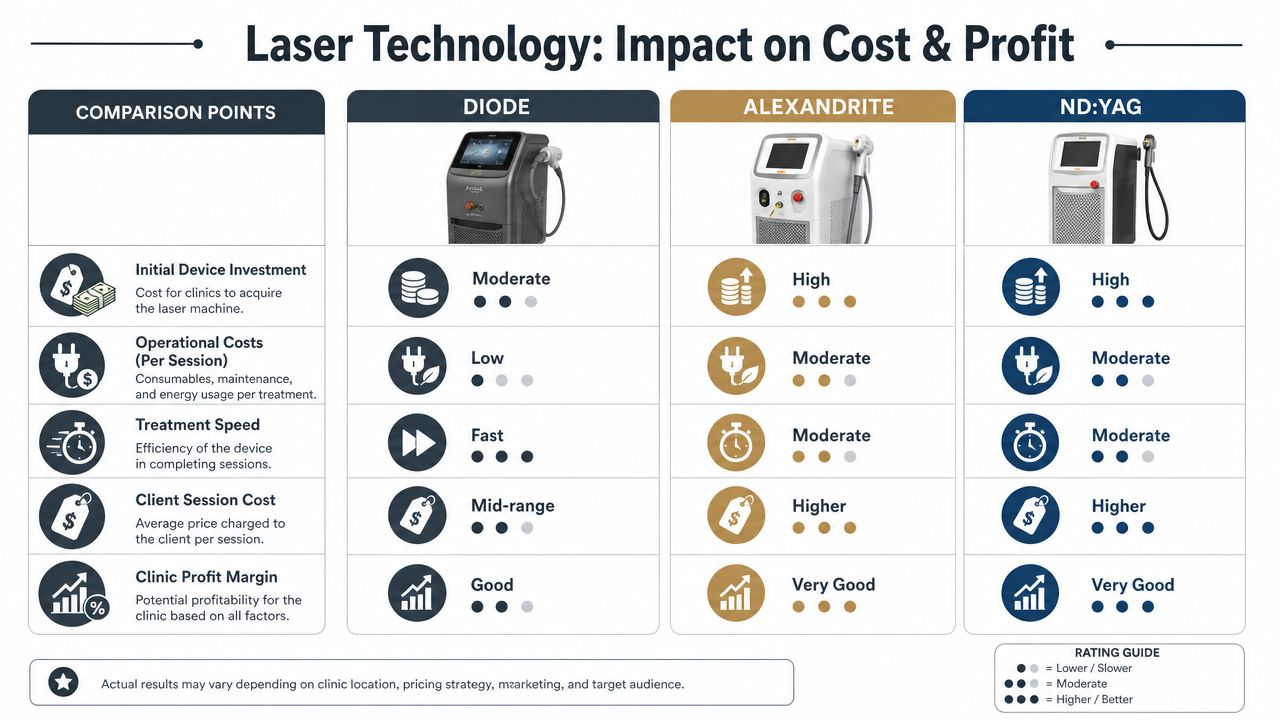
Technology shapes both sides of the ledger. It influences what the client experiences, how many sessions the clinic may need to schedule, and how efficiently the room generates revenue over a week or month. That's why hair removal laser cost should never be separated from device choice.
A broader benchmark often cited in South African market commentary places the average laser hair removal fee at USD 389 per session, while practical U.S. market ranges span roughly USD 50 to USD 600 per session depending on treatment area. The same discussion notes that an older industry statistic cites an average of 4 sessions, while more recent clinic guidance often recommends 6 to 8 sessions for durable reduction, according to this review of laser hair removal pricing statistics.
Not all light-based systems behave the same way
Clinic owners often make one of two mistakes. They either buy on upfront device price alone, or they buy on a headline feature without asking how that feature affects throughput, treatment fit, and repeatability.
The practical distinction is this:
| Technology question | Commercial consequence |
|---|---|
| Can it treat a broad range of skin and hair profiles confidently? | Wider suitability supports stronger utilisation. |
| Can it move quickly across larger areas? | Faster treatment helps diary density. |
| Does it improve comfort enough to support compliance? | More comfortable treatments can reduce drop-off between sessions. |
| Is the protocol straightforward for a trained team to repeat consistently? | Consistency protects reviews, rebookings, and staff confidence. |
A device that appears cheaper can end up more expensive if it limits who you can treat, slows the appointment, or creates mixed outcomes that weaken package conversion.
Technology decisions change commercial outcomes
For clinic owners evaluating systems, the more useful lens is total treatment economics. A modern platform with multi-wavelength capability can matter because it gives the operator more flexibility across different client profiles and treatment conditions. That doesn't guarantee a fixed commercial result, but it can improve how widely the system fits your market and how confidently your team prices packages.
One example in this category is a multi-wavelength platform such as advanced laser hair removal technology, which is designed around broader treatment versatility rather than a narrow single-use setup. In business terms, versatility matters because it can support a more organised treatment menu, reduce the need to refer difficult cases away, and help the clinic build packages around outcomes instead of just discounted visits.
The following usually works better than chasing the lowest capital outlay:
- Choose for utilisation, not only acquisition cost: A device that sits idle because it doesn't fit your client base is never cheap.
- Prioritise repeatable protocols: Strong results come from consistency, not from heroic operator improvisation.
- Look at time per room, not only price per shot: Throughput often decides whether a premium device earns its keep.
- Price around delivered value: If the system improves comfort, efficiency, and treatment suitability, your pricing should reflect that structure.
What doesn't work is copying session prices from another clinic without understanding the machine, protocol, staffing model, or client mix behind those prices. On paper, matching a cheaper rival looks competitive. In practice, it can lock you into low-margin bookings that strain your team and devalue the service.
A Clinic Owner's Guide to Setting Profitable Prices
Most clinics underprice laser hair removal for one of two reasons. They either build prices from fear of local competition, or they start with the machine repayment and add a rough mark-up. Neither method is strong enough on its own.
A durable pricing strategy has to connect four things: treatment time, expected session pathway, operational drag, and perceived value. If any one of those is missing, the clinic either leaves money on the table or creates a price point it can't defend in consultation.

Price the treatment series, not just the visit
A session-only mindset usually leads to messy margins. Instead, structure pricing around the likely series and the type of area being treated.
A sensible clinic framework often includes:
- Single-session pricing: Useful for transparency and first-time bookings, but it shouldn't be the main economic engine.
- Series packages for larger areas: These create better forecasting and give the client a clearer budget path.
- Small-area add-ons: These are often easier to bundle into existing appointments and can improve room yield.
- Maintenance logic: Clients should know whether touch-ups sit inside or outside the initial package design.
If you're working through pricing maths, a practical tool like Zaro's margin calculator can help your team separate mark-up from actual margin before you publish a treatment menu.
Cheap equipment often creates expensive problems
Public pricing discussions often mention provider, location, and technology, but they rarely unpack how training, aftercare, and device quality change the fundamental economics. A recent overview also notes that published U.S. pricing estimates vary widely, including averages from $389 to $913 depending on source and methodology, which shows how unreliable generic benchmarks become when they aren't tied to device, protocol, and skin-type context in this discussion of laser hair removal cost variability.
That matters in South Africa because clinics don't serve a narrow patient profile. A device that struggles with comfort, consistency, or versatility can trigger several downstream costs:
- More consultation friction: Staff spend longer answering objections created by earlier poor outcomes.
- More operational interruption: Maintenance downtime and unreliable performance disrupt booking flow.
- More pressure to discount: If results don't justify confidence, the team falls back on price cutting.
- More reputational risk: Safety concerns and inconsistent experiences damage retention faster than most owners expect.
Buy for the treatment journey you want to deliver, not the cheapest entry point into the category.
Value-based pricing isn't about charging the most. It's about matching price to outcome quality, team confidence, safety standards, and the ease with which clients can complete a full course without confusion.
Building a Sample ROI Model with an Omega Laser
An ROI model for laser hair removal should start with treatment mix, not with a fantasy "full body average". In South Africa, pricing is usually set per session and by treatment area. The American Society of Plastic Surgeons benchmark cited in aesthetic market guidance places the average laser hair removal fee at $697 per session, while stressing that the figure varies by area, provider, and geography, as noted in the ASPS cost overview.
That matters because a clinic doesn't earn revenue from abstract averages. It earns revenue from a weekly mix of small, medium, and large areas, each with different time requirements and package behaviour.
A practical model for monthly planning
Below is a simple planning model. It doesn't invent fixed revenue promises or break-even dates. Instead, it shows how to think about internal ROI using the South African area-based pricing logic already discussed.
| Metric | Calculation | Value (ZAR) |
|---|---|---|
| Small-area revenue block | Number of booked small-area sessions × your posted small-area rate | Depends on clinic pricing |
| Medium-area revenue block | Number of booked medium-area sessions × your posted medium-area rate | Depends on clinic pricing |
| Large-area revenue block | Number of booked large-area sessions × your posted large-area rate | Depends on clinic pricing |
| Package revenue in month | Deposits and package sales recognised under clinic policy | Depends on clinic pricing |
| Operator cost allocation | Staff time assigned to completed sessions | Depends on payroll structure |
| Device cost allocation | Finance or capital recovery spread across operating period | Depends on purchase terms |
| Facility overhead allocation | Room, utilities, admin, booking support | Depends on clinic overhead |
| Monthly gross treatment revenue | Sum of all completed session revenue | Depends on treatment mix |
| Monthly operating surplus before tax | Gross treatment revenue less allocated operating costs | Depends on full model |
Three planning habits improve this model quickly:
- Model by anatomical zone. Small areas can behave like efficient add-ons. Large areas often need package logic and tighter schedule discipline.
- Forecast series completion, not just first bookings. A clinic with strong rebooking discipline usually monetises its laser capacity far better than a clinic chasing constant new leads.
- Track conversion between consultation and package acceptance. Revenue quality depends on completed series, not on enquiry volume alone.
For clinics refining the commercial side of this process, this diode laser ROI breakdown for South African professionals is useful as an internal planning reference. And if your front-end pipeline is the weak point, Roman Sydorenko on funnel optimization offers practical thinking on where enquiries leak before they become paid treatment plans.
What this model tells a clinic owner
The main lesson is simple. ROI improves when the clinic aligns price, protocol, scheduling, and sales process. A faster and more versatile treatment platform can help, but only if the business also controls consultation quality, package design, and follow-up discipline.
What doesn't work is building projections from a single average ticket value. Laser businesses are won or lost in the mix. Small-area add-ons, medium-area repeaters, and large-area packages all contribute differently to profit, so your model should treat them differently too.
Financing Options Warranties and Choosing a Value-Driven Provider
Price matters. Terms matter almost as much. For both consumers and clinic owners, the fundamental decision isn't only "what does it cost today?" It's "what support, reliability, and protection come with that cost?"
That applies on both sides of the market. Clients need to know whether a provider is worth trusting with a treatment series. Clinic owners need to know whether a device purchase will stay commercially stable after installation.
What consumers should ask before booking
The right questions usually reveal more than the treatment menu does.
- Ask about the treatment platform: Clients don't need a physics lesson, but they should know what category of system is being used and whether the clinic can explain its suitability clearly.
- Ask who performs or supervises treatment: Operator training and oversight shape both safety and consistency.
- Ask how the clinic plans the full course: A provider focused only on the first booking often gives weaker guidance than one that explains the pathway properly.
- Ask about aftercare and maintenance expectations: Good clinics don't disappear after the session.
A low advertised price isn't automatically poor value. But if the clinic can't explain protocol, training, safety, and follow-up in a clear way, the cheap quote may become the expensive choice.
What clinic owners should secure before buying
Financing high-ticket equipment can be sensible if the repayment structure matches your expected treatment ramp. The mistake is buying a platform on monthly affordability alone without checking what sits behind the sale.
A value-driven acquisition usually includes:
| Decision area | What to check |
|---|---|
| Warranty cover | Length, exclusions, and what counts as a service event |
| Technical support | Response quality, not just the promise of support |
| Training | Initial onboarding plus refresher pathways for new staff |
| Compliance position | Whether the system is appropriately approved and documented for your market |
| Commercial enablement | Help with pricing, marketing, and treatment rollout |
For clinic owners, warranty is not a small-print issue. It is part of ROI. A stronger warranty reduces uncertainty during the period when you are still building treatment volume. Training matters just as much, because an undertrained team can waste the value of a capable machine.
Omega Lasers states that its systems are FDA approved, CE certified, and SAHPRA licensed, and that buyers receive a 2-year manufacturer warranty together with training, technical support, marketing support, and business development guidance. Those are not minor extras. They directly affect downtime risk, team readiness, and how quickly a clinic can move from installation to repeatable revenue.
Frequently Asked Questions About Laser Hair Removal Costs
Is laser hair removal permanent, and does that change the price?
Clinics should talk about durable hair reduction, not a simplistic promise of permanence. From a pricing perspective, that matters because clients may still need occasional maintenance depending on area, response, and long-term regrowth pattern. The right cost conversation includes the treatment series and the possibility of later touch-ups.
Are there hidden fees clients should ask about?
Yes. Not necessarily in the sense of surprise billing, but in the sense of incomplete quoting. Clients should ask whether the quoted amount is per session or for a package, whether consultation is handled separately, and whether maintenance sessions are part of the plan or additional.
Why do two clinics quote very different prices for the same area?
Because the same area name doesn't guarantee the same business model. Device capability, operator experience, consultation quality, comfort features, supervision, and package structure all influence price. A lower quote may reflect a leaner setup, but it can also reflect a narrower treatment capability or weaker service model.
How should clinics price laser hair removal for men?
Start with area size, treatment time, and likely treatment complexity. Many male treatment areas are operationally larger or denser, so copying a generic menu without adjusting for chair time often compresses margin. The goal is not to charge more automatically. The goal is to price according to the actual delivery load.
How do clinics justify a premium price without sounding defensive?
By explaining the treatment pathway clearly. Clients respond better to a calm explanation of safety, training, treatment suitability, comfort, and expected series design than to abstract claims about quality. Premium pricing becomes easier to defend when the clinic can explain what the client is paying for.
Should clinics discount heavily to win market share?
Usually not. Selective package design works better than broad discounting. Across-the-board price cutting trains clients to shop on price alone and can trap the clinic in low-margin bookings. A smarter approach is to keep menu pricing clear, build structured packages, and improve consultation conversion.
If you're assessing hair removal laser cost from the clinic side, the question isn't only what a machine costs. It's what kind of pricing power, treatment consistency, and operational control it gives your business over time. For clinics that want to evaluate approved aesthetic platforms, training support, and ROI-focused rollout planning, Omega Lasers is a practical place to start.