




You’re probably looking at the nd yag laser from two angles at once.
On one side, it’s a clinical tool. You need to know whether it can treat the patients who already walk into your clinic, especially in South Africa where skin tone diversity isn’t a side issue. It’s daily reality. On the other side, it’s a capital purchase. You need to know whether the machine will stay busy, stay compliant, and pay for itself through treatments your team can deliver safely and consistently.
That’s where many buying decisions go wrong. Owners often separate the science, the treatment menu, and the business case. In practice, they’re the same conversation. The wavelength affects who you can treat. Pulse delivery affects what you can treat. Safety protocols affect your reputation. Regulatory status affects your risk. Together, those determine utilisation and profitability.
The nd yag laser matters because it sits at that intersection. It’s a foundational laser platform with a long clinical history, broad treatment relevance, and strong fit for clinics that need versatility rather than a single narrow use case.
Understanding the Core Physics of the Nd YAG Laser
A patient with darker skin sits in your consult room asking for hair removal, treatment for leg veins, and advice on an old tattoo. Whether one platform can treat all three safely starts with physics, not marketing copy.
An nd yag laser uses a solid crystal as its light source. The crystal is yttrium aluminum garnet doped with neodymium ions, and that doped crystal is what generates the wavelength most aesthetic clinics rely on, 1064 nm. For a clinic owner, the practical point is simple. The material is stable under repeated use, which supports consistent output, predictable servicing intervals, and fewer surprises once the system is in daily rotation.
That 1064 nm wavelength sits in the near-infrared range. In skin, it travels deeper than many shorter wavelengths and is absorbed less strongly by epidermal melanin. The result is not “more power” in a vague sense. It is a different distribution of energy inside tissue.

Why 1064 nm matters in the treatment room
A useful comparison is a longer tool reaching a deeper fitting. Shorter wavelengths tend to deposit more energy closer to the surface. 1064 nm reaches further before enough energy is absorbed to create the treatment effect.
That matters because many profitable aesthetic targets are not superficial. Hair follicles sit below the epidermis. Many vascular structures are not right at the surface. Some pigment work also benefits from deeper delivery, depending on the indication and pulse mode.
For South African clinics, this is directly tied to patient mix and risk control. A wavelength with lower melanin absorption at the epidermal level gives you a wider safety margin in darker skin types when parameters are chosen correctly. Wider safety margins support better consult confidence, fewer complications linked to overtreatment, and stronger word-of-mouth in communities where one poor outcome can damage trust quickly.
Selective photothermolysis, in plain language
The governing principle is selective photothermolysis. The term sounds academic, but the idea is straightforward. You choose a wavelength and pulse pattern that lets the target absorb enough energy to be injured, while surrounding tissue absorbs less.
With Nd:YAG, the main chromophores are usually melanin and haemoglobin, but the interaction is different from shorter-wavelength systems. Because 1064 nm is less readily taken up by superficial melanin, it can deliver useful energy to deeper structures without placing the same burden on the epidermis. That is one reason it has become a standard platform for clinics treating a broad skin-tone range.
Owners should care because this physics affects more than outcomes. It affects cancellation rates after patch testing, complication management time, consumable use, and how many indications one room can support profitably.
The physics behind versatility
Nd:YAG is also a four-level laser system. That matters because four-level systems can achieve efficient laser action without excessive energy being trapped in the lower states of the medium. In everyday clinic terms, this helps manufacturers build platforms that produce reliable energy delivery across different treatment modes.
That is why one Nd:YAG platform can serve several revenue lines if the system is well specified and properly registered. Hair removal, vascular work, skin rejuvenation protocols, and tattoo treatments can all sit on the same business case. If tattoo removal is part of your planned service mix, it also helps to compare Nd:YAG capability with pico laser options for tattoo removal before you decide which platform will produce the strongest return in your local market.
One more business point matters here. Good physics does not automatically produce a good purchase. In South Africa, the platform also needs to fit your compliance process, operator training plan, and documentation standards, including SAHPRA considerations where applicable. The right wavelength is what makes treatment possible. The right regulatory and commercial setup is what turns that capability into a dependable asset on your floor.
Mastering Pulse Delivery Long Pulse vs Q-Switched
A large part of Nd:YAG versatility comes down to how energy is delivered, not only which wavelength is used.
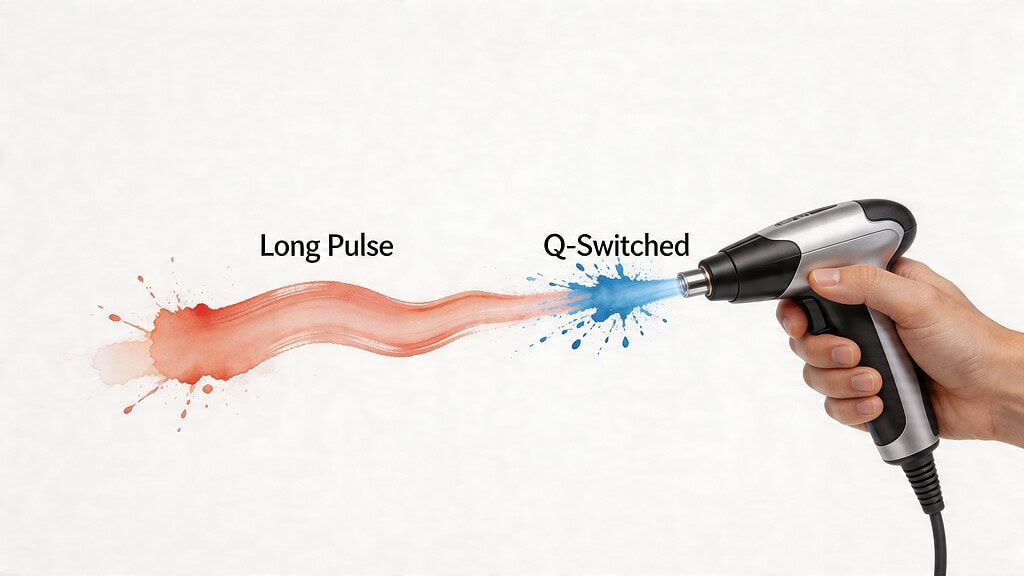
Two modes shape most clinical decision-making. Long-pulse Nd:YAG behaves like a slow, controlled push. Q-switched Nd:YAG behaves like a sharp tap. Same family of laser. Very different tissue effect.
Long pulse as controlled heating
When you use long-pulse delivery, you’re aiming for a thermal effect. Energy is delivered over a longer interval so the target structure heats up in a controlled way.
That makes long pulse useful when the treatment goal is to injure a structure through heat, such as:
- Hair follicles during hair reduction
- Vascular lesions where vessel heating leads to coagulation
- Dermal remodelling in selected rejuvenation protocols
The practical question isn’t “Does the machine fire?” It’s “Can the pulse duration match the target?” Thick, deeper targets usually tolerate and often require a different timing strategy than fine superficial ones.
Q-switched as photoacoustic disruption
Q-switched delivery is different. The pulse is extremely brief, and the effect is more photoacoustic than bulk thermal. Instead of slowly cooking the target, the system creates a rapid energy event that can fragment pigment particles.
That’s why Q-switched Nd:YAG became a mainstay for pigmented targets and tattoo work. If your clinic is evaluating pigment or ink removal options, it also helps to understand how this compares with even shorter pulse technologies such as picosecond tattoo removal systems, which build on related principles of rapid energy delivery.
Use long pulse when you want the target to absorb heat. Use Q-switching when you want the target to fracture under a rapid energy event.
Why the mode flexibility matters commercially
From a business standpoint, pulse flexibility expands your bookable indications without forcing you into multiple single-purpose devices.
According to RP Photonics’ guide to YAG lasers, Nd:YAG lasers operate as a four-level gain medium, which supports high efficiency across both Long-Pulse (thermal) and Q-switched (photoacoustic) applications, with pulse widths ranging from continuous wave to femtoseconds. That broad operating range is the technical reason one platform can support very different protocols while still producing repeatable output.
For a clinic owner, that translates into three practical gains:
- More appointment types from one capital purchase
- Better staff utilisation because one team can be trained on a broader treatment family
- Stronger asset productivity because the laser isn’t tied to a single indication
The confusion usually comes when teams treat pulse duration like a minor setting. It isn’t. Pulse choice determines the mechanism of action. Mechanism determines indication. Indication determines revenue mix.
Unlocking Treatment Versatility with Clinical Applications
A versatile platform only matters if it solves real client problems. The nd yag laser does that best when your team links each indication to the right mode, target, and patient profile.
Hair removal for the patient who has been turned away elsewhere
A common scenario in South African practice is the patient with darker skin or recent sun exposure who has been told to wait, shave differently, or try another technology. That patient isn’t only looking for hair reduction. They’re looking for a clinic that can treat them confidently.
Long-pulse Nd:YAG fits this need well because the wavelength reaches deeper follicular targets while reducing the tendency to overload surface pigment. In practical terms, that gives clinicians a safer route for treating skin types that demand more caution with shorter wavelengths.
The business value is straightforward. If your clinic can safely treat a broader range of skin types, you widen your eligible patient base without changing your location, staffing model, or number of rooms.
Tattoo removal for the client who regrets old ink
The second strong use case is tattoo removal, particularly with darker inks. Here, the treatment logic changes. You’re no longer trying to heat a follicle. You’re trying to disrupt pigment particles so the body can clear them over time.
That’s where Q-switched Nd:YAG has a distinct role. The very short pulse creates the kind of rapid energy delivery that can fragment pigment rather than slowly heating surrounding tissue.
Clients often misunderstand tattoo removal because they assume “stronger” always means “better.” In reality, successful treatment depends on matching pulse behaviour to the target. Good outcomes come from disciplined parameter selection, conservative progress, and expectation management over a treatment course rather than a single dramatic session.
Vascular work for deeper visible vessels
Vascular concerns create another revenue stream because they solve a visible problem patients struggle to conceal. Facial redness, isolated vessels, and leg veins affect confidence, and many clients want an option that doesn’t involve surgery.
The Nd:YAG wavelength is well suited to deeper vascular targets because it reaches further into tissue than more superficial-focused systems. For the clinician, that means a better chance of reaching vessels that sit beyond the comfort zone of shorter wavelengths.
A patient with visible leg vessels, for example, needs more than surface-level energy. They need a beam that can reach the target and generate enough heat in the vessel wall to produce a clinical effect. That’s where long-pulse Nd:YAG earns its place.
Clinics often market “laser vein treatment” as a cosmetic extra. Patients experience it as a confidence treatment. Framing matters.
Non-ablative rejuvenation as a relationship treatment
Not every high-value indication is a dramatic before-and-after category. Some are repeatable maintenance treatments that keep patients engaged with the clinic.
Selected Nd:YAG protocols can support non-ablative rejuvenation by delivering controlled dermal heating without removing the skin surface. Patients usually understand this more easily when you describe it as a deeper stimulation treatment rather than a resurfacing treatment.
That difference matters operationally. A rejuvenation patient may also become a hair removal patient, a pigment patient, or a skincare patient. The treatment itself creates value, but the broader value is retention and cross-referral inside your clinic.
One platform, several revenue conversations
When owners ask whether an Nd:YAG platform is “worth it,” the answer depends less on the machine in isolation and more on how many patient conversations it can convert into treatment plans.
A single system can support a portfolio that includes:
- Hair reduction for a broad range of skin tones
- Tattoo and pigment work when Q-switched capability is present
- Vascular treatments for appropriate deeper targets
- Rejuvenation protocols that support repeat visits
That’s the practical strength of the nd yag laser. It doesn’t force your business into one treatment identity. It lets you build a treatment menu around patient need, then align protocols to the correct pulse mode and target.
The Nd YAG Advantage A Strategic Comparison of Laser Wavelengths
A South African clinic owner usually faces the same real-world question at purchasing stage. Which wavelength will treat the broadest mix of patients safely, keep the diary full, and still make financial sense once training, consumables, maintenance, and compliance are included?
That is why wavelength choice is a business decision as much as a technical one.
Comparing the main options in clinic terms
The practical comparison in aesthetics is usually between 1064 nm Nd:YAG, 755 nm Alexandrite, and 808/810 nm Diode platforms. All three can produce good outcomes in the right setting. The difference lies in how each one interacts with melanin, how far the energy penetrates, and how wide or narrow the clinic’s usable patient pool becomes.
| Wavelength | Primary Chromophore | Relative Tissue Interaction | Typical Skin-Type Use in Practice | Best Fit for a Clinic Model |
|---|---|---|---|---|
| 1064 nm Nd:YAG | Melanin and haemoglobin, with lower epidermal melanin absorption than shorter wavelengths | Deeper penetration with less superficial absorption | Often preferred where darker skin treatment is a priority | Clinics serving a diverse population and offering hair removal, vascular work, and selected pigment or rejuvenation protocols |
| 755 nm Alexandrite | Melanin | Strong melanin absorption with more superficial action | Commonly favoured for lighter skin types | High-throughput hair removal in carefully selected patients |
| 808/810 nm Diode | Melanin | Mid-range penetration and absorption profile | Useful across several skin types, depending on cooling and system design | Clinics focused mainly on dedicated hair reduction services |
A simple way to read this table is to ask one question. Are you buying for the ideal patient, or for the patient population that walks into your clinic every week?
That distinction changes the economics. A system with excellent results in a narrow candidate group can still underperform financially if consultations end with too many exclusions, too much caution around higher phototypes, or frequent referrals out.
Why Nd:YAG often becomes the strategic anchor
Nd:YAG usually earns its place because it gives a clinic more room to operate safely across varied skin presentations. In South Africa, that matters. Your address, referral base, and marketing may bring in a wider range of Fitzpatrick types than a brochure suggests.
Alexandrite can be an excellent performer for suitable lighter-skinned patients. Diode systems can work well in focused hair reduction businesses. But both choices can create a narrower operating lane if your clinic wants to treat mixed heritage patients, darker skin types, or concerns beyond straightforward depilation.
That is where the business case becomes clearer. Broader usability supports higher utilisation. Higher utilisation supports faster payback, provided the team is trained well and protocols are set conservatively.
For owners comparing alternatives, it also helps to see how IPL hair removal systems differ from laser wavelength platforms. IPL can support a wider menu of light-based treatments, but it does not replace the tissue specificity and depth profile of a true Nd:YAG system.
Beam behaviour matters because treatment outcomes matter
The technical advantage of Nd:YAG is not academic. The 1064 nm wavelength penetrates further and interacts less aggressively with epidermal melanin than shorter wavelengths. In practical terms, that often gives the operator a better safety margin in patients where superficial pigment competes strongly for energy.
A useful analogy is this. Shorter wavelengths behave more like a treatment that spends more of its energy budget near the skin surface. Nd:YAG sends more of that budget deeper, where deeper follicles and certain vascular targets sit. That does not make it universally better. It makes it better aligned with specific clinical and commercial goals.
This deeper bias is one reason many multi-service clinics use Nd:YAG as a cornerstone platform rather than a single-purpose tool.
The comparison that matters for profitability
Clinic owners sometimes compare devices by treatment menu alone. A better filter is to compare them by four commercial questions:
- How many of your consultations convert into eligible candidates?
- How much operator caution is required across your actual local demographic?
- How many indications can one platform support without overextending staff competence?
- How easily can the system fit into SAHPRA-conscious procurement, documentation, servicing, and training processes?
That last point is often missed. A profitable laser is not only one that can treat. It is one that can be purchased, documented, maintained, and defended as a sound clinical choice if your protocols, service records, or marketing claims are ever reviewed.
The strongest platform for a South African clinic is usually the one that balances clinical range, skin-type safety, staff trainability, and reliable utilisation.
The strategic takeaway
If a clinic is built around one narrow patient profile, another wavelength may be the sharper choice. If the goal is to build a compliant, resilient practice that can treat a broader South African population and support multiple high-value indications, the nd yag laser often makes more sense as the core system.
Its advantage is not that it wins every technical comparison. Its advantage is that it stays useful across more of the decisions that determine revenue, patient safety, and long-term return on equipment spend.
Ensuring Safe and Effective Treatments for All Skin Types
Safety is where clinic reputation is built or lost.
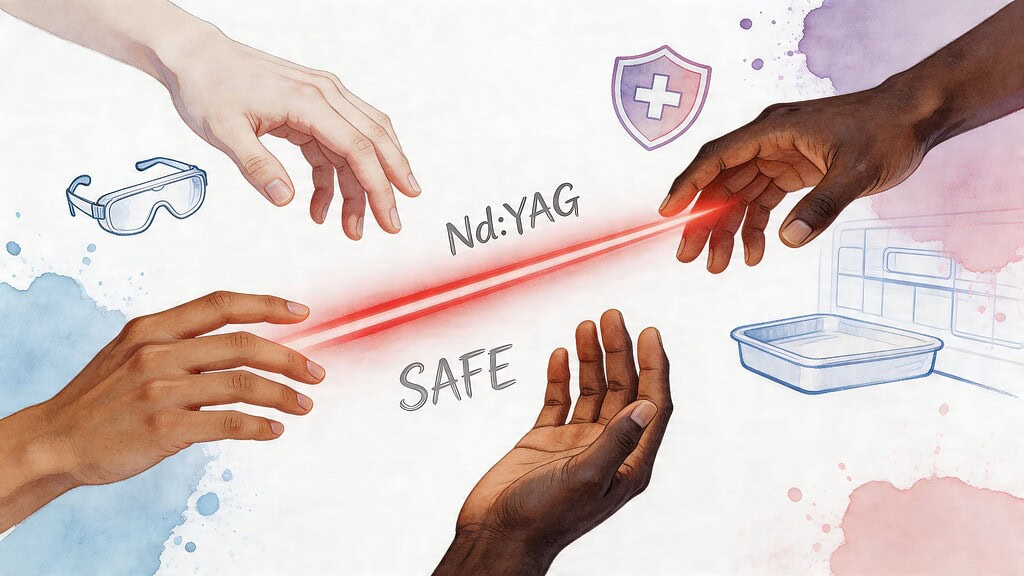
A lot of marketing language says Nd:YAG is suitable for all skin phenotypes. That’s directionally useful, but it’s incomplete. In real practice, safe treatment on darker skin depends on protocol quality, cooling discipline, conservative progression, and knowing when not to treat.
Why safety expertise becomes a market advantage
In Southern Africa, many clinics say they treat all skin types. Fewer clinics develop protocols that reflect the nuances of Fitzpatrick IV to VI presentations, mixed heritage patients, post-inflammatory hyperpigmentation risk, and the realities of sun exposure in this market.
That gap has been noted directly in this discussion of Nd:YAG suitability across phenotypes, which points out the need for localised guidance on complication rates, fluence adjustment, and protocol optimisation for diverse skin tones in Southern Africa.
That means safety expertise isn’t only defensive. It’s commercial. Patients notice when your consultation feels precise rather than generic.
What disciplined practice looks like
Treating darker skin well requires a consistent method. Not guesswork. Not “one setting lower.” A method.
Use this framework in every consultation and treatment course:
- Assess skin thoroughly: Don’t rely on the intake form alone. Look at baseline pigmentation, tanning, inflammation history, and any tendency toward post-inflammatory darkening.
- Patch test properly: Test patches help your team judge endpoint response before committing a full area. They also build patient confidence because the process feels measured.
- Start conservatively: Conservative fluence selection is often the right decision when epidermal risk is a concern. You can escalate carefully. It’s much harder to undo an overly aggressive first treatment.
- Use cooling throughout: Pre-cooling, parallel cooling, and post-treatment cooling all matter. Cooling isn’t a comfort extra. It’s part of epidermal protection.
- Review aftercare in plain language: Patients need clear instructions they will follow. Keep it simple and specific.
If you want a patient-friendly explanation to support consultation conversations, this overview of how laser hair removal works can help frame the treatment process in accessible language.
Common confusion points to address with patients
Patients with darker skin often arrive with two fears. They worry the treatment won’t work, or they worry it will leave marks. Sometimes they’ve experienced both elsewhere.
Address those concerns directly:
Results may be gradual
A safer protocol can still be an effective protocol. Patients need to understand that controlled progress is often the right path.Temporary reactions aren’t always complications
Mild expected responses can occur after treatment. Your team should explain what is normal and what needs review.Sun behaviour affects outcome
If the patient continues behaviours that increase epidermal sensitivity or pigment instability, your risk profile changes.
Patients rarely judge safety by your consent form. They judge it by how clearly your team explains why a cautious plan is the right plan.
Contraindications and treatment discipline
A strong Nd:YAG clinic culture includes saying “not today” when necessary. Active irritation, poorly controlled skin sensitivity, questionable recent sun exposure, or uncertain history around pigment instability should trigger caution.
You also need operational consistency:
| Safety checkpoint | Why it matters |
|---|---|
| Pre-treatment assessment | Identifies avoidable risk before energy is delivered |
| Patch testing | Reduces guesswork and helps refine parameters |
| Cooling method | Protects the epidermis and improves comfort |
| Clear endpoint recognition | Prevents overtreatment |
| Aftercare review | Lowers the chance of preventable post-treatment issues |
Clinics that master these basics often become referral destinations for patients who felt excluded elsewhere. That reputation doesn’t come from broad claims. It comes from repeated, safe outcomes and the confidence that follows.
Integrating an Nd YAG Laser for Maximum Clinic ROI
A laser becomes profitable when three things line up. The platform fits your market. The team can deliver treatments confidently. The business model keeps the device busy.
Too many clinics focus only on the purchase price. That’s understandable, but incomplete. A better question is this: how quickly can the device become a reliable revenue-producing asset without creating compliance headaches or avoidable clinical risk?
Start with the right acquisition criteria
Before comparing brands, define what the clinic needs the system to do.
For some practices, that means a strong hair removal platform with room to add vascular work later. For others, Q-switched capability matters because tattoo and pigment treatments are part of the launch plan. If you don’t define the service mix first, you’ll end up comparing brochures instead of business models.
Your shortlist should include:
- Regulatory status: In South Africa, SAHPRA alignment matters. If a supplier also offers FDA-approved and CE-certified systems, that strengthens confidence in documentation, manufacturing standards, and support culture.
- Pulse capability: Decide whether you need long pulse only, or long pulse plus Q-switched functionality.
- Training depth: Device training must include parameter logic, endpoints, contraindications, maintenance basics, and consultation workflow.
- After-sales support: Downtime damages more than bookings. It damages trust.
- Upgradeable pathway: If your clinic plans to expand into broader energy-based treatments, an upgrade path matters.
Make ROI a utilisation calculation, not a hype exercise
Return on investment is often discussed badly in aesthetics. People jump straight from treatment price to revenue fantasy and ignore booking reality.
A practical ROI framework asks:
- How many treatment indications can this laser support in your clinic?
- How many of those indications already exist in your current patient base?
- How many can your team confidently consult and convert?
- How many treatment hours per week can the device realistically run?
- What support systems will keep utilisation stable?
Nd:YAG often performs well. It can contribute across several categories instead of waiting for one niche use case to carry the entire investment.
Where the revenue usually comes from
A profitable Nd:YAG service line is rarely built on one hero treatment. It’s built on layered demand.
Consider the common commercial structure:
| Revenue driver | Why it matters commercially |
|---|---|
| Hair reduction courses | Supports repeat visits and predictable scheduling |
| Vascular sessions | Solves visible concerns that patients value highly |
| Tattoo or pigment work | Adds a differentiated treatment category where suitable capability exists |
| Rejuvenation treatments | Brings patients back for maintenance and cross-sell opportunities |
The strongest model is usually mixed. Hair removal keeps the diary stable. Higher-value specialist indications create margin and differentiation. Rejuvenation supports continuity.
Consumables, maintenance, and operating reality
Clinic owners often prefer technologies with straightforward operating economics. Nd:YAG systems can fit that preference because they aren’t built around heavy per-treatment consumable dependency in the way some other aesthetic categories are.
That doesn’t mean operating costs disappear. You still need to account for:
- Service and maintenance planning
- Training time for new staff
- Marketing spend
- Room utilisation
- Missed revenue during downtime
The practical takeaway is that a laser doesn’t produce ROI on its own. A system with low operational friction can still underperform if your team hesitates in consultation or lacks confidence with parameters.
The most expensive laser in a clinic is the one staff members don’t feel comfortable using.
Regulatory thinking protects profitability
Compliance is often treated as paperwork. It isn’t. It protects revenue.
A SAHPRA-aligned acquisition process helps reduce the risk of buying a platform that becomes difficult to justify, support, insure, or maintain. FDA approval and CE certification also matter as indicators of product maturity and documentation standards when you assess suppliers.
The point isn’t to collect badges. The point is to lower commercial risk. A system with stronger regulatory footing is easier to build into long-term operations, staff training, and patient trust.
Building utilisation after installation
Once the machine arrives, the core work begins. Busy clinics don’t rely on the device alone to create demand. They build an internal engine around it.
That usually includes:
- Consultation scripts that explain why the Nd:YAG option is appropriate
- Photo documentation protocols for consistency
- Treatment planning templates by indication
- Cross-referral systems between skincare, injectables, and laser consultations
- Rebooking discipline before the patient leaves the room
A common mistake is launching with broad messaging like “advanced laser treatments now available.” Better messaging is problem-led. Unwanted hair on darker skin. Visible vessels. Unwanted tattoo ink. Texture support without ablative downtime. Patients respond to their concern, not your device category.
Staff confidence is an ROI variable
The same machine can produce very different financial outcomes in two clinics. The difference is often operator confidence.
A seasoned operator knows how to read skin, set expectations, recognise endpoints, and modify conservatively. A nervous operator under-treats or avoids the machine. An overconfident operator creates risk. Neither outcome helps profitability.
That’s why training should be treated as part of the asset, not an optional add-on. Good training shortens the path from installation to competent treatment delivery. It also supports standardisation, which matters when multiple practitioners use the same room and device.
The strongest business case
The best business case for an nd yag laser in a South African clinic isn’t “this technology can do everything.” It can’t. No platform can.
Indeed, the case is stronger and more believable. A high-quality Nd:YAG system can become a cornerstone asset because it sits where market demand, skin-type suitability, treatment versatility, and regulatory prudence overlap. That’s exactly what many clinics need from a major purchase.
The Future of Nd YAG and Your Clinic's Growth
The nd yag laser has stayed relevant because its core strengths haven’t gone out of fashion. Deep penetration, flexible pulse delivery, and broad clinical usefulness still solve real problems in modern practice.
What’s changing is how those strengths are packaged.
The platform is evolving, not disappearing
Newer systems continue to build on the Nd:YAG foundation through expanded pulse technologies, improved user control, and integration into multi-technology platforms. Picosecond systems are one example of that evolution, especially for clinics interested in faster pigment and tattoo-focused energy delivery.
The important point for owners is that future technologies don’t erase the value of Nd:YAG. They often refine or extend it.
Why foundational technologies keep winning
Aesthetic markets reward novelty in marketing, but clinics grow on dependable treatment categories. Foundational technologies tend to last because they anchor a service mix that patients continue to request.
Nd:YAG fits that pattern well because it connects to durable demand categories:
- Hair reduction
- Pigment and ink management
- Vascular concerns
- Non-ablative rejuvenation
If your clinic builds around patient need rather than trend-chasing, that matters more than having the newest label in the market.
A smart investment mindset
The smartest owners don’t ask whether a device feels cutting-edge on the day it arrives. They ask whether it will still make sense after years of staff turnover, market shifts, and service expansion.
That’s where Nd:YAG remains compelling. It’s not only a workhorse. It’s a platform logic. It teaches teams how wavelength, pulse duration, target selection, and safety discipline fit together. Those skills transfer directly into more advanced devices and more complex treatment planning later on.
A clinic that understands Nd:YAG well is usually better prepared to grow thoughtfully into the next layer of laser technology.
If you’re evaluating how an nd yag laser fits into your clinic strategy, Omega Lasers offers SAHPRA-licensed, FDA-approved, and CE-certified medical-aesthetic platforms backed by training, technical support, and business guidance. For clinics that want more than a machine, and need a compliant growth partner, they’re worth speaking to.