



You’re standing in the treatment room before the first client arrives. The machine has passed its checks. The handpiece is clean. Consent forms are ready. Then your eyes land on the tray with the laser safety glasses, and that’s usually where confidence either settles or disappears.
Most clinics don’t struggle because they ignore safety. They struggle because laser eyewear looks deceptively simple. If the lenses are dark, the frame feels solid, and the product carries a CE mark, people assume they’re covered. In a South African clinic, that assumption can create a safety problem, a compliance problem, and a downtime problem all at once.
That question comes up often in practices adding new treatments or replacing older stock. Are these glasses matched to the wavelengths we use? Are they documented properly for SAHPRA? Will they still perform after months in a hot treatment room or in a mobile kit bag? Staff need more than a generic answer. They need a system they can apply every day.
Table of Contents
- Your Clinic's First Line of Defence Against Laser Hazards
- The Core Principles of Laser Eye Protection
- Decoding Eyewear Markings and International Standards
- A Step-by-Step Guide to Selecting the Correct Eyewear
- Your Clinic's Safety Protocol Inspection Cleaning and Storage
- The SAHPRA Compliance Gap What Most Clinics Miss
- Conclusion Your Path to a Safer More Reputable Clinic
Your Clinic's First Line of Defence Against Laser Hazards
The moment you power up a Class 3B or Class 4 system, eye protection stops being a stock item and becomes part of your clinical control system. In aesthetic practice, laser safety glasses protect more than eyesight. They protect workflow, staff confidence, patient trust, and your ability to keep operating without interruption.
A treatment room can look organised and still be unsafe. I’ve seen clinics with excellent devices, trained operators, and polished branding, but the eyewear was a mixed collection from old systems, unlabelled replacements, or pairs kept long after the original documentation was lost. That’s where risk hides. Not in the obvious things. In the routine shortcuts.
If your team is adding laser services or refreshing protocols, proper laser hair removal training should sit alongside eyewear checks, because operator skill and protection selection have to work together.
Practical rule: If you can’t immediately prove which laser a pair of glasses is meant for, treat that pair as unverified until you’ve checked it.
Three things decide whether laser safety glasses are doing their job in a South African clinic:
- Correct matching: The eyewear must match the wavelength and operating mode of the laser in use.
- Verified compliance: The paperwork must support the clinical reality, not just the purchase.
- Ongoing condition: Scratched, heat-damaged, or delaminating lenses don’t become safer because they were compliant when new.
Clinics separate checkbox safety from real control based on precise eyewear protocols. The glasses on the tray need to be right for the machine in the room, right for the task being done, and right for the conditions they’re stored in.
The Core Principles of Laser Eye Protection
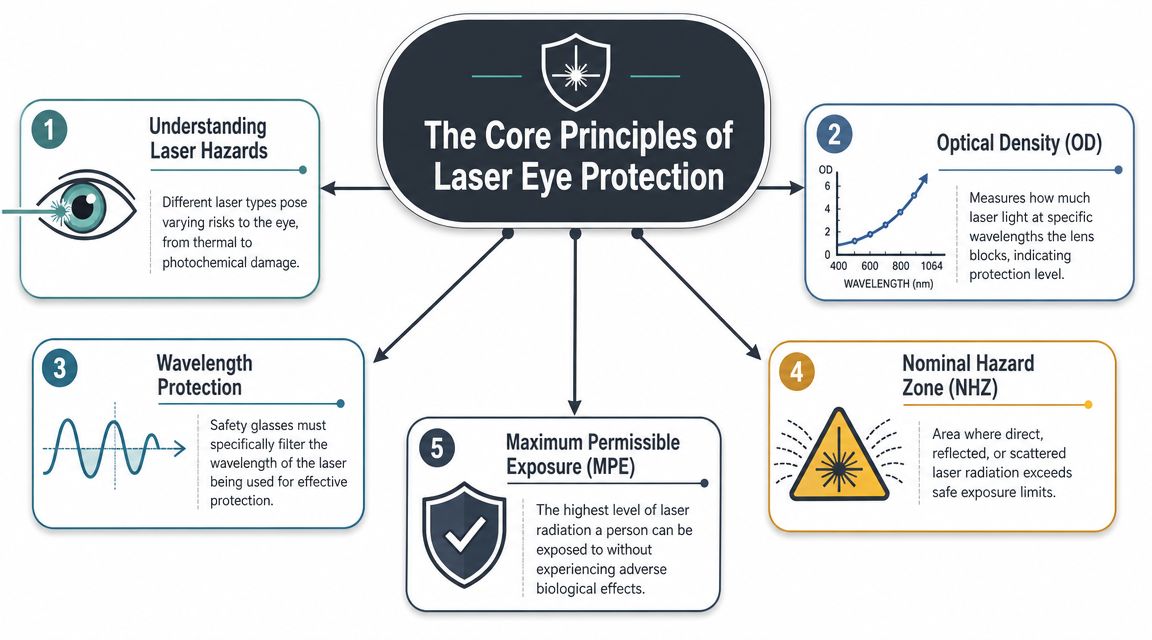
A Class 4 treatment can be running perfectly and still put eyesight at risk within a fraction of a second if the eyewear is wrong. In clinic practice, eye protection fails for predictable reasons. The glasses do not match the wavelength, the optical density is too low for the output, or the pair on hand was bought for a different machine years ago and kept in circulation.
That is why laser eye protection starts with physics, not preference. Laser light is concentrated, directional, and emitted at specific wavelengths. The eye then focuses that energy onto a very small area. In practical terms, even a brief exposure can cause retinal or corneal injury before the operator or patient has time to respond.
Polycarbonate laser eyewear is projected to hold a 42.1% market share in 2025 because it balances impact resistance with lower weight for repeated use, according to laser safety eyewear market data. That matters in a busy South African clinic, where staff may wear protection for long sessions in warm treatment rooms. Comfort affects compliance, but comfort never replaces the correct rating.
Why laser light is different
Ordinary ambient light spreads out. A laser beam stays organised and carries energy in a controlled wavelength band. That is what makes it useful for hair removal, pigment work, vascular treatments, resurfacing, and surgical applications. It is also what makes exposure more dangerous than many teams assume.
The eye is an efficient focusing system. If the beam, or in some cases a reflected beam, reaches tissue that absorbs that wavelength, injury can occur quickly. The clinical question is never whether the glasses look dark enough. The question is whether they are rated for the beam your device produces under the way you use it in the room.
This distinction matters in South Africa because many clinics operate mixed platforms, imported devices, and replacement eyewear sourced separately from the original machine. If the paperwork does not clearly tie the glasses to the laser in service, the clinic is relying on assumption. Assumption is weak protection and poor compliance practice.
What wavelength means in practice
Wavelength is the specific band of light emitted by the laser, whether visible or invisible. Laser eyewear only protects against the wavelengths listed for that product. It does not provide universal cover across every platform in the clinic.
A dark lens can still be the wrong lens.
That catches clinics out when one room runs a diode system and another uses Nd:YAG laser technology, or when a single platform offers multiple treatment modes. The eyewear has to match the wavelength range and the use case. Treatment labels such as "hair removal" or "pigment" are not enough. Two devices used for similar indications may require different protection.
A simple way to explain it to staff is this. Laser safety glasses work like a key cut for one lock. If the wavelength does not match, the lens may reduce visible brightness while still allowing hazardous energy through.
How optical density works
Optical Density, or OD, states how much laser energy a lens attenuates at a specific wavelength. In clinic terms, OD is not a rough guide. It is the minimum barrier needed to reduce exposure below the safe limit for that system.
OD works on a logarithmic scale, so small numerical changes represent large changes in protection. That is where clinics make expensive mistakes. A pair that is close to the required rating is still the wrong pair.
I usually explain OD to operators as a control valve on a high-pressure line. The beam is the pressure. OD reduces what gets through. If the valve is undersized, too much energy reaches the eye. If the lens is dark, without the right certified OD at the right wavelength, visibility drops but verified protection may still be missing.
Three terms should be familiar to any operator, manager, or clinic owner reviewing eyewear:
- OD value: the attenuation provided at a stated wavelength
- MPE: the Maximum Permissible Exposure, meaning the exposure limit the eye should not exceed
- NHZ: the Nominal Hazard Zone, meaning the area where direct, reflected, or scattered radiation can exceed safe limits
These are not academic terms. They affect procurement, room setup, training, and incident prevention. In South African conditions, they also affect business continuity. If an eyewear failure leads to an injury, the problem is not limited to one treatment. It can stop a room, trigger reporting questions, expose gaps in documentation, and put your SAHPRA position under unwanted scrutiny.
Decoding Eyewear Markings and International Standards
Most clinics own at least one pair of laser safety glasses that nobody can confidently interpret. The marking is printed on the lens or frame. People recognise a few numbers. Nobody wants to guess, but nobody wants to admit they’re guessing either. That’s a poor position to be in when a Class 4 treatment list is booked out for the day.
What EN 207 is actually testing
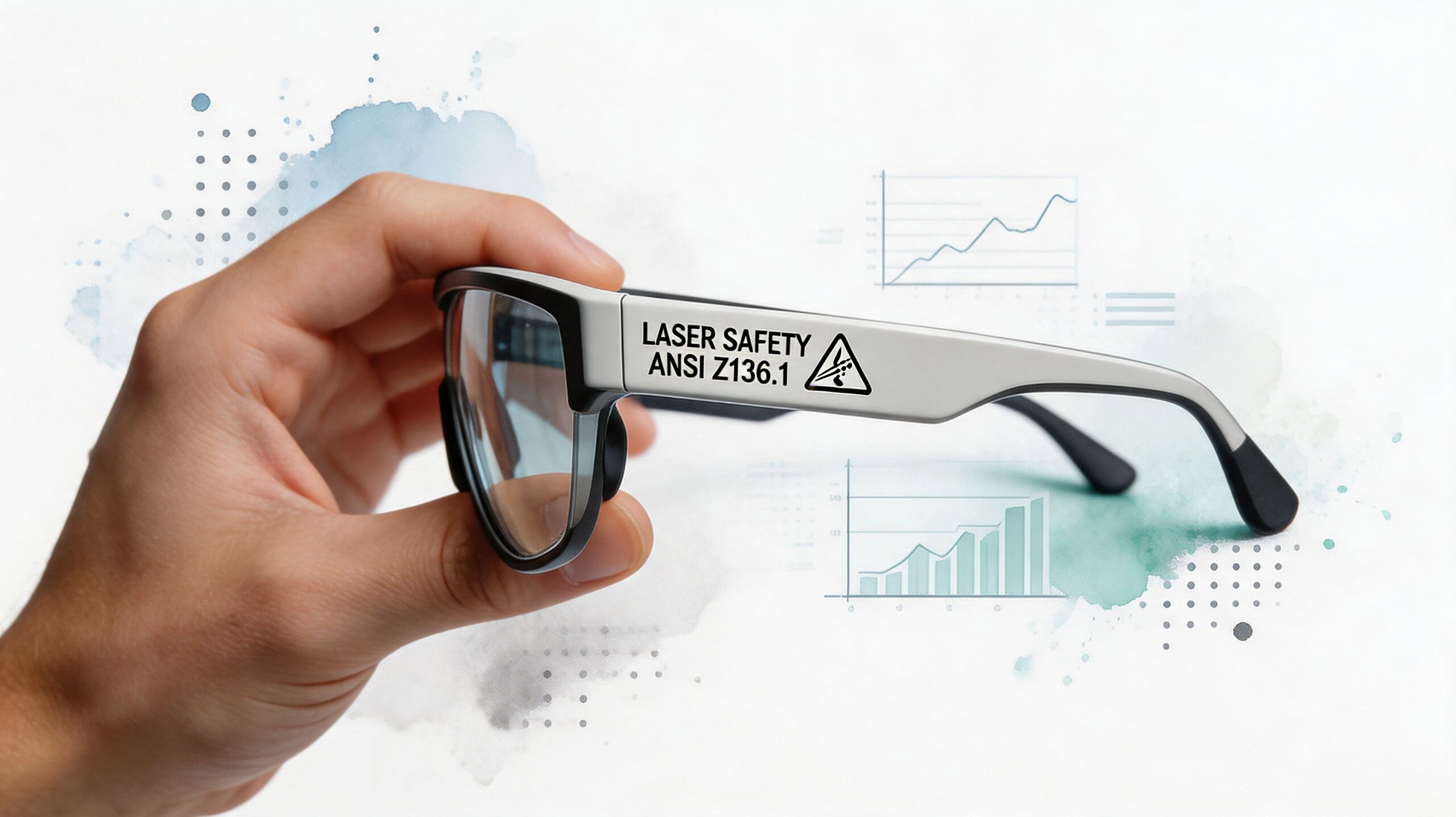
In South Africa, imported eyewear used in this context must meet EN 207 for CE certification. The important point is that EN 207 doesn’t stop at asking whether the lens is dark enough. It asks whether the lens and frame combination can survive a direct hit under test conditions. For continuous wave lasers, that means withstanding a direct hit for at least 5 seconds. For pulsed modes common in aesthetic work, it means surviving 50 pulses without failing, as outlined in the EN 207 laser standards overview.
That distinction matters because a lens can appear to block light well enough in normal use but still fail under a worst-case exposure. In a clinic, worst-case exposure is what standards are for. A handpiece slips. Alignment is off. A reflective instrument catches the beam. Someone turns before the operator expects it.
If the eyewear only performs under perfect conditions, it isn’t clinical protection. It’s wishful thinking.
How to read a marking on the lens or frame
A marking like 1064 D LB5 + IRM 10 looks technical because it is technical. But it can be broken down into useful parts.
Here’s the practical reading:
| Marking element | What it tells you | Why it matters in clinic use |
|---|---|---|
| 1064 | The wavelength in nanometres | It must match the laser you’re using |
| D | The laser mode code | Continuous wave and pulsed systems create different demands |
| LB5 | The EN resistance level | This indicates the tested damage threshold |
| IRM 10 | Additional specification detail | It helps define the protection range and test context |
The exact code matters less than the habit of reading it properly. Staff should be able to answer four simple questions from the marking and the certificate: What wavelength is covered? What operating mode is covered? What protection level is stated? Does the marking match the device in our room?
For clinics using multiple modalities, this check should happen before a pair is assigned to a room. It’s also why marketing terms such as “universal laser goggles” should trigger scrutiny rather than confidence.
Why this matters during an audit
During an audit or internal inspection, you’re not only proving that eyewear exists. You’re proving that it’s appropriate. If your clinic uses imported platforms marketed with claims around performance or approval, such as those discussed in device approval considerations for laser hair removal systems, that still doesn’t remove the need to verify the eyewear separately.
A practical eyewear audit should include:
- Marking check: Confirm the printed wavelength and rating are legible.
- Certificate check: Match the product to its conformity documentation.
- Room check: Verify the glasses stored in that room match the laser assigned there.
- Condition check: Remove pairs with scratches, cracks, or uncertain history from use.
What works is disciplined interpretation. What doesn’t work is relying on colour, staff memory, or the assumption that any dark lens supplied with a machine must still be correct years later.
A Step-by-Step Guide to Selecting the Correct Eyewear
A patient is booked for Nd:YAG hair removal at 09:00. At 08:55, staff discover the goggles in the room are marked for a different wavelength range, and the spare pair has no readable label. Treatment stops. That is how eyewear selection fails in real clinics. Not in theory, but on a busy day when a wrong assumption turns into cancelled appointments, patient frustration, and a preventable compliance problem.
Selection starts with the laser parameters used in that room, on that machine, for that treatment. Frame style, tint, and comfort matter later. First, establish whether the eyewear is correct for the beam you are controlling.
Start with the device not the glasses
Use the device manual, technical sheet, and supplier documentation. Before anyone orders or assigns eyewear, confirm three points:
- The wavelength or wavelengths
Aesthetic platforms often create confusion here. A diode unit may operate at more than one wavelength. An Nd:YAG platform may have additional outputs for different indications. If your clinic uses only one of those outputs, select for the output you use. If the device can be switched between outputs in routine practice, the eyewear must match that reality.
- The operating mode
Continuous wave, pulsed, and Q-switched systems do not present the same exposure profile. The marking must cover the mode in use. This is one of the first places imported eyewear sets fail in South African clinics. The goggles arrive with the machine, but nobody checks whether the stated protection matches the way the platform is operated in practice.
- The task being performed
Treatment, servicing, fault-finding, and beam alignment can require different protection choices. A pair selected for routine treatment may be unsuitable for engineering work or alignment.
Vague requests such as "glasses for hair removal" are not enough. Hair removal in one room may mean diode. In another, it may mean Nd:YAG. The treatment name does not select the eyewear. The beam does.
Match the specification to the real treatment room
Once the device output is confirmed, determine the required optical density and the correct EN marking for that application. OD works like sunscreen for laser energy, but with a far stricter margin for error. If the filter reduces too little energy, hazardous exposure passes through. If it reduces too much for a task such as alignment, staff may lose safe visual control of the beam path.
In practice, the cleanest method is to document eyewear requirements room by room and machine by machine. That matters in South Africa because many clinics run mixed inventories. A room may contain an older imported platform, a newer replacement handpiece, and eyewear sourced from a different supplier after the original pair was damaged or lost. Without a written room-specific record, staff start relying on lens colour and memory. That is where mistakes enter.
Use a selection process like this:
- Confirm the machine outputs: Check the manual and technical data, not the treatment menu or sales brochure.
- Determine the required attenuation: Base this on the device parameters and your safety assessment.
- Match the marking to the hazard: Confirm the wavelength range, operating mode, and protection level on the eyewear.
- Assign eyewear to the room: Label and store it with that machine so it does not migrate between rooms.
- File the documentation: Keep the certificate and selection record where the clinic can produce it during inspection or incident review.
Use alignment glasses only for alignment work
Alignment work needs its own decision. High-OD treatment eyewear can block so much light that the operator loses sight of the beam path. That makes precise alignment harder and can increase risk during servicing.
Alignment eyewear is selected to reduce the beam to a safer visible level while still tolerating exposure under the relevant standard. The point is controlled visibility, not lower standards. If your clinic does not perform alignment in-house, do not buy alignment glasses as a substitute for treatment eyewear. If your technician does perform alignment, document which pair is used, for which device, and by whom.
Eyewear selection for common aesthetic lasers
Use the table below as a starting reference. Final selection still depends on the exact machine specification, the operating mode, and the product certificate.
| Laser Type | Wavelength(s) | Typical Use | Required Eyewear Marking Example |
|---|---|---|---|
| Diode | 755 nm / 808 nm / 940 nm / 1064 nm | Hair removal | Marking must explicitly cover the stated diode wavelengths and operating mode |
| Nd:YAG | 1064 nm | Vascular work, deeper pigment, hair removal | Marking must match 1064 nm and the relevant mode and protection level |
| KTP or visible green output | 532 nm | Pigment or vascular indications, depending on device | Marking must explicitly cover 532 nm and the relevant pulse profile |
| Er:YAG | 2940 nm | Resurfacing | Marking must cover 2940 nm and the device's operating mode |
| CO2 | Above 5,000 nm, commonly 10,600 nm | Ablative resurfacing and surgical-style applications | Marking must explicitly cover the CO2 wavelength and required resistance level |
One supplier note deserves a practical response. Some platforms are sold with eyewear intended for that system. Omega Lasers states that its packages include laser protection goggles manufactured to EN207 standards for the wavelengths used in its equipment. Treat that as a starting point, not the end of the process. The clinic still needs to verify the markings, keep the documentation, and make sure replacement stock matches the original specification.
Good eyewear selection is not complicated. It is disciplined. In South African clinics, that discipline protects patients, staff, and your appointment book at the same time.
Your Clinic's Safety Protocol Inspection Cleaning and Storage
A clinic can buy the correct laser safety glasses, file the paperwork, and still end up with unsafe eyewear on the treatment floor six months later. I see this in aesthetic settings more often than clinics admit. The problem is rarely the original purchase. It is poor inspection, poor cleaning, poor storage, and no clear chain of responsibility.
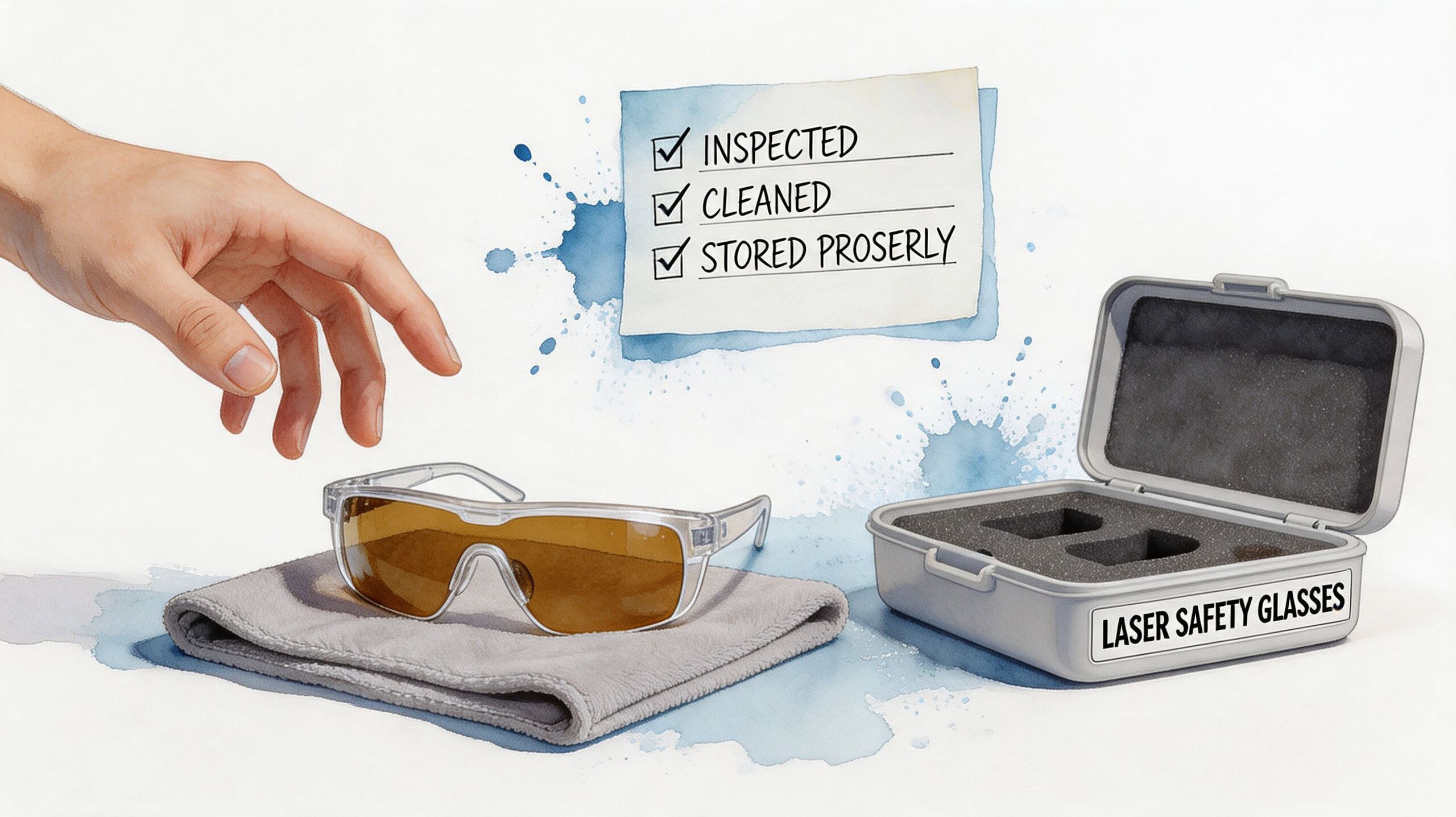
In practice, eyewear fails unnoticed. A scratched filter, unreadable marking, warped frame, or coating damaged by the wrong disinfectant can sit in a drawer until the room is full, the patient is ready, and someone notices too late that the only available pair should have been taken out of service weeks ago. That is a safety problem and a business continuity problem.
Inspection must be a daily control, not an occasional check
The first check of the day should take less than a minute per pair. It still needs to be hands-on. Staff should pick up the glasses, look through both lenses under good light, inspect the edges, and confirm the markings are still legible.
Use a simple inspection routine:
- Lens surface: Check for scratches, pits, haze, cloudiness, or peeling.
- Filter integrity: Look for bubbles, separation between layers, discolouration, or any change in tint.
- Frame condition: Check hinges, side protection, nose bridge, arms, and overall fit.
- Markings: Confirm the wavelength and protection rating can still be read.
- Cleanliness: Make sure residue, makeup, dust, or treatment products are not sitting on the lens.
If a pair fails any of these checks, remove it from use immediately and label it clearly. Do not leave suspect eyewear in the same drawer as serviceable stock. In a busy clinic, mixed storage is how damaged PPE finds its way back into a treatment room.
A damaged pair does not give partial reassurance. It gives uncertainty, and uncertainty is unacceptable around Class 3B and Class 4 systems.
Cleaning methods often cause the damage
Many clinics shorten the life of laser eyewear during cleaning. The pattern is familiar. Someone grabs the nearest surface disinfectant, sprays the lens, wipes it with paper towel, and returns it to the case while still damp. The pair looks clean. The filter or coating pays the price later.
Follow the manufacturer’s cleaning instructions for that specific model. Remove dust first so you do not grind particles into the lens. Use a clean microfibre cloth or other approved material. Let the pair dry before storage. If the lens starts looking milky, patchy, or streaked after repeated cleaning, treat that as a fault signal, not a cosmetic issue.
Write this into your SOPs. Do not leave it to personal preference at room level.
South African storage conditions are harder on eyewear than many imported guides assume
Heat, humidity, dust, and transport stress matter. In Durban and coastal KZN, humidity can sit high for long periods. In inland clinics, treatment rooms and storage cupboards can heat up fast during load-shedding or if air conditioning drops out. Mobile operators add another problem. Eyewear left in a vehicle between calls can be exposed to temperature swings that no clinic manager would accept inside a treatment room.
Manufacturers such as Thorlabs state that laser safety glasses should be stored in a clean, dry environment and protected from conditions that can damage the filters or frames, as set out in their certified laser safety glass maintenance guidance. That aligns with what clinics here already know from hard experience. Heat and moisture shorten the useful life of many materials. Laser eyewear is no exception.
Optical density works like sunscreen with a verified rating. If the protective layer is scratched, chemically damaged, or degraded by heat, the printed number on the frame does not help you. The pair may still look serviceable while its safety margin has been reduced. In a clinic, that matters most on busy days, because pressure makes people trust appearance instead of process.
For South African clinics, the storage rules should be practical and strict:
- Store each pair in a hard case: A soft pouch alone does not protect against crushing, dust, or accidental scratching.
- Keep eyewear out of direct sun and away from heat sources: Do not leave it on windowsills, machine shelves, reception counters, or inside vehicles.
- Use a dry storage location: A closed cupboard in a temperature-controlled area is better than an open trolley in a humid room.
- Separate clean, in-service stock from damaged or doubtful stock: Quarantine failed pairs immediately.
- Assign ownership: The Laser Safety Officer or a named manager should record inspections, withdrawals, and replacements.
Mobile technicians need tighter controls than fixed-site clinics. Travel increases impact risk, contamination risk, and heat exposure. If eyewear moves between branches or rented rooms, log where it is kept and who checked it last.
Good storage protects more than the glasses. It protects your ability to keep treating safely, avoid cancelled sessions, and show an inspector that your controls work in real South African operating conditions, not only on paper.
The SAHPRA Compliance Gap What Most Clinics Miss
A treatment room can look orderly and still fail a compliance check. I see it in South African clinics that have good machines, trained operators, and branded laser safety glasses on the shelf, but no clear evidence that the eyewear matches the exact system in use. That gap matters during an incident, an insurer review, or a SAHPRA-related inspection. In those moments, “we bought CE-marked glasses” is not enough.
CE marking is not the end of the question
CE marking helps show that a product was manufactured to a recognised standard. It does not prove that the pair in your clinic is suitable for your device settings, your wavelength range, your treatment mode, and your documented risk controls.
That is where clinics come unstuck.
Aesthetic practices often buy eyewear the same way they buy consumables. They order a reputable brand, confirm the frame marking, and move on. Laser eye protection does not work like generic stock. It has to be matched and traceable. If a clinic cannot show why one specific pair belongs with one specific laser, the compliance file is weak even if the glasses look legitimate.
In South Africa, that problem is more common than many clinic owners expect because imported advice usually stops at CE or EN compliance and says little about local recordkeeping, mixed-device rooms, branch transfers, or the way heat and storage conditions affect day-to-day control.
What your file should contain
Each treatment room should have a file that another competent person can follow without guessing. If I pick up your records and cannot trace the eyewear back to the laser, the process is incomplete.
That file should include:
- Device identification: Make, model, wavelength, pulse characteristics, and the treatment indications used in that room.
- Eyewear identification: Product name, model code, shade or OD marking, and any frame or lens markings visible on the unit.
- Conformity evidence: CE and EN documents linked to the exact product supplied, not a general catalogue sheet.
- Suitability record: A simple matrix or written sign-off showing that the eyewear was selected for that device and its operating range.
- Inspection history: Dates of issue, condition checks, withdrawals from service, and replacement dates.
- Staff control: Evidence that operators know which eyewear belongs to which machine and who authorised any change.
Insurers and inspectors assess evidence. They do not fill in the gaps for the clinic.
What goes wrong in real clinics
The failure pattern is usually ordinary. A second machine arrives. A therapist borrows a spare pair from another room to avoid delaying a client. The box with the original certificate has been discarded. A supplier sends a similar-looking replacement because the previous model is out of stock. Nobody checks the revised marking against the device before it goes into service.
That is how a compliance problem starts. Subtly, and with good intentions.
I have seen this more often in multi-site practices and mobile setups. Equipment moves between branches. Eyewear sits in a boot during a Highveld summer. One manager assumes another branch verified the paperwork. By the time someone asks for proof, the clinic has glasses in circulation that nobody can confidently assign to a specific system.
Optical density works like a security gate rated for a certain threat. If the gate is rated for the wrong vehicle, it may still look solid, but it is not doing the job you need. In a clinic, the equivalent mistake is using eyewear with markings that look plausible while the wavelength match or protection level is wrong for the machine in the room.
How to close the gap
The fix is administrative, operational, and very practical.
Label eyewear by machine, not by colour or by staff preference. Keep the certificate copy and selection record with the equipment file for that room. Require a formal check when ordering replacements, even if the product name looks familiar. If a supplier changes the variant, treat it as a new verification step. Quarantine any pair with uncertain origin until the match is confirmed.
For South African clinics, add one more control. Review branch transfers and storage exposure as part of compliance, not only as maintenance. Heat, transport, and poor storage create enough uncertainty that undocumented eyewear should not go straight back into use.
Clinics that manage this well make one thing clear. A pair of laser safety glasses is controlled clinical equipment tied to a specific device, a specific file, and a specific duty of care.
Conclusion Your Path to a Safer More Reputable Clinic
Laser safety glasses sit at the intersection of clinical science, regulation, and day-to-day discipline. If any one of those parts is weak, the whole system becomes unreliable.
The clinics that handle this well don’t rely on habit or memory. They understand the basics of wavelength, OD, MPE, and damage thresholds. They select eyewear by matching it to the actual device, mode, and task. Then they maintain that standard with inspections, controlled storage, clear records, and staff accountability.
That approach does more than reduce risk. It improves how the clinic operates. Staff work with more confidence when the room setup is clear. Clients notice when a practice is organised and serious about safety. Managers spend less time dealing with preventable interruptions, missing paperwork, and last-minute substitutions.
In South Africa, that discipline matters even more because local compliance and local climate both create pressures that generic international advice often ignores. A pair of glasses that looks acceptable on paper can still be the wrong fit for a SAHPRA-regulated clinic if the documentation is weak or the storage conditions are poor.
A reputable clinic doesn’t treat laser safety glasses as accessories. It treats them as controlled clinical equipment.
If you’re reviewing your current eyewear, replacing older stock, or setting up a new laser room, Omega Lasers can help you align device selection, training, and practical safety processes with the realities of aesthetic practice in South Africa.