



A clinic owner usually notices tattoo removal demand in the same way. It doesn’t arrive as one dramatic enquiry. It builds gradually through consultations: a client who wants a faded sleeve cleared for a corporate role, another who needs an old name lightened for a cover-up, and a growing number of younger patients with layered, multi-coloured work that older systems struggle to shift cleanly.
The problem isn’t demand. The problem is what happens when your device can’t keep pace with patient expectations. With older nanosecond platforms, sessions stretch out over months, difficult colours remain stubborn, and the gap between what the patient wants and what the clinic can reliably deliver becomes obvious. That gap affects reviews, referrals, and repeat bookings.
Pico laser for tattoo removal has changed that conversation. It gives clinics a tool that’s clinically sharper and commercially easier to justify. Results come faster, treatment plans are easier to explain, and the safety profile is better suited to the diverse skin types commonly seen in South Africa. For a clinic owner, that matters as much as the physics.
Introduction The New Standard in Tattoo Removal
A typical consultation in South Africa now involves more than a small black amateur tattoo. Many clinics are seeing dense professional ink, cover-ups, and mixed colours that have already been treated elsewhere with disappointing results. The patient often arrives frustrated, not merely curious. They’ve paid for sessions before, they’ve tolerated the discomfort, and they still don’t have a result they feel comfortable with.
That’s where the conversation around device choice becomes practical rather than theoretical. A clinic can keep offering tattoo removal with older technology, but the service starts to feel slow and hard to scale. Or it can move toward modern systems designed for shorter treatment pathways, broader colour capability, and a safer experience for higher-melanin skin.
What clinic owners are dealing with now
Three patterns come up repeatedly in the South African market:
- More complex tattoos: Patients aren’t only asking to remove black script. They want blue, green, red, and layered pigment addressed properly.
- Less patience for long plans: Once patients understand that better technology exists, they don’t want to commit to outdated treatment timelines.
- Higher expectations around comfort and downtime: People will tolerate discomfort if the result is worth it, but they won’t stay loyal to a clinic that offers a harder experience than necessary.
A modern pico laser for tattoo removal answers all three. It allows a clinic to position itself as current, capable, and safe. That matters whether you’re a dermatology practice adding a stronger tattoo service or a medical spa looking at tattoo removal machines for clinics and salons.
The clinics that do well in tattoo removal don’t just own a laser. They own a repeatable protocol, realistic consultation process, and technology that patients can trust.
Why pico has become the benchmark
The shift happened because pico platforms solved the main weaknesses of older systems. They improved clearance speed, expanded the ability to treat difficult colours, and reduced the amount of unwanted thermal injury around the target. For the clinic owner, that translates into a service that’s easier to market transparently and easier to run profitably.
Patients don’t buy picoseconds. They buy confidence that the tattoo can fade in a reasonable timeframe without creating a new skin problem. That’s the standard the market now expects.
How Pico Lasers Revolutionise Ink Removal
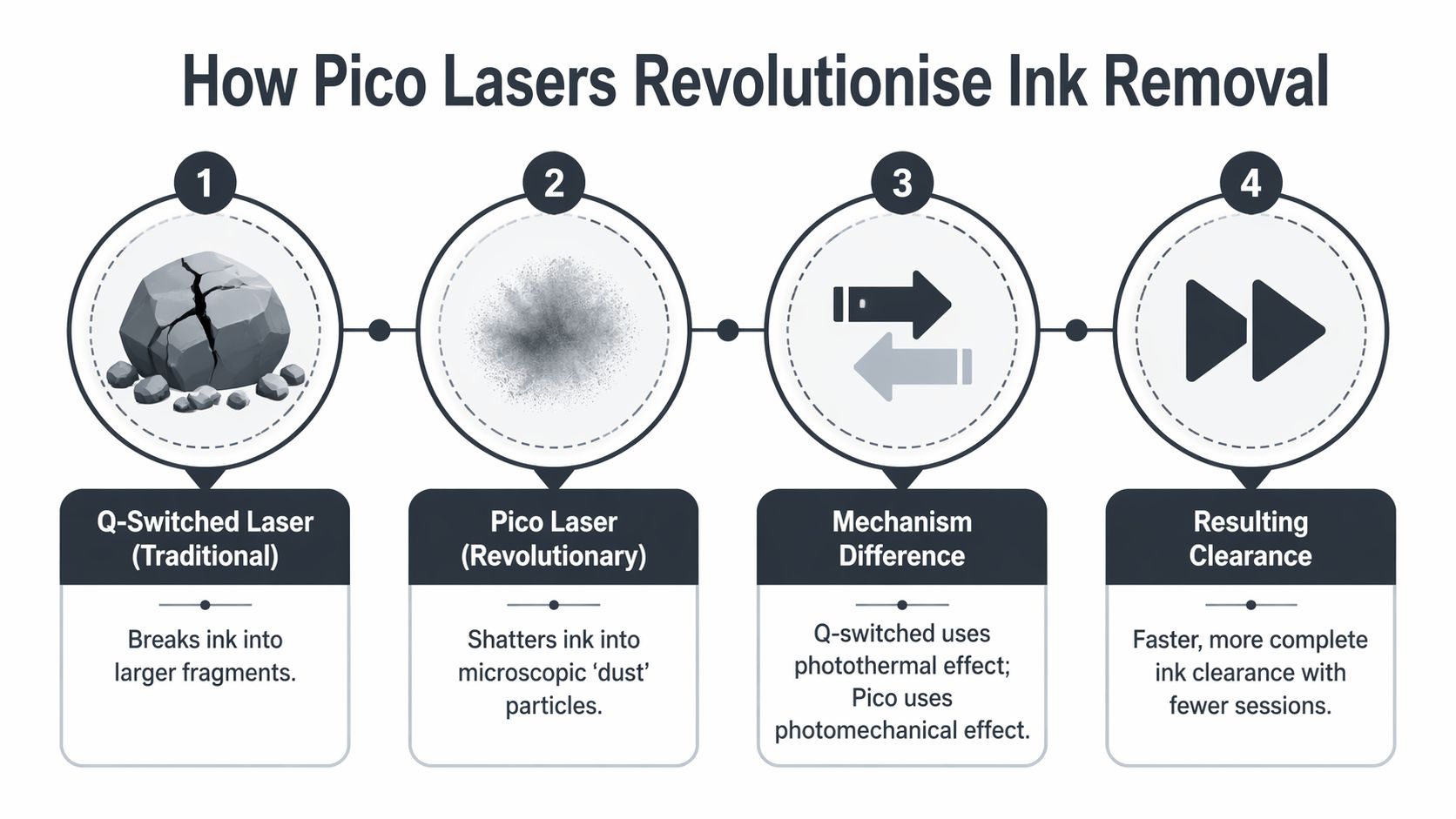
The easiest way to explain pico technology is this. A traditional Q-switched laser breaks tattoo ink like a hammer hitting a rock and turning it into pebbles. A pico laser hits that same rock and turns far more of it into dust. The body can clear dust faster than pebbles.
That difference comes from pulse duration. In SAHPRA-approved 755nm systems, picosecond pulses of 550-750 ps create a photomechanical PressureWave™ effect that shatters ink into sub-micron particles. Because the pulse widths are 100x shorter than nanosecond systems, black ink tattoos often need less than half the treatments, with examples of 4-6 sessions versus 10-15 sessions for Q-switched lasers, according to the PicoSure tattoo physician brochure.
Why shorter pulses matter
A nanosecond device relies more heavily on heat. Heat can break pigment, but it also affects surrounding tissue more aggressively. That’s why older treatments often feel harsher and can become more difficult to manage safely in patients prone to post-inflammatory pigment change.
A pico laser shifts more of the work toward a photomechanical effect. In practical terms, the energy delivery is so brief that it creates a high-intensity stress wave through the ink before heat has as much time to spread through adjacent skin. That is the core reason the treatment feels different in clinic, not just on a spec sheet.
How to explain it to patients
Patients don’t need a lecture in laser physics. They need a clean explanation they can remember. This usually works:
- The laser targets the ink, not the tattoo shape. Different wavelengths are chosen because different colours absorb light differently.
- The pulse breaks pigment into smaller fragments. Smaller fragments are easier for the body to remove naturally.
- Less unnecessary heat reaches surrounding skin. That’s why modern pico systems are often a better fit when comfort and skin safety are priorities.
- The result is usually a shorter journey. Patients understand “fewer sessions” better than they understand “photomechanical fragmentation”.
Practical rule: If your staff can’t explain the difference between pico and nano in under 30 seconds, patients will leave the consultation confused.
What actually improves in the treatment room
The benefit isn’t abstract. The treatment behaves differently in ways your team notices immediately:
- Ink response is faster: Black inks often start showing meaningful fade earlier in the plan.
- Challenging colours become more manageable: Blue and green pigments are no longer the category you apologise for before you begin.
- Skin recovery is easier to monitor: Because there’s less reliance on broad thermal injury, endpoint observation becomes more precise.
- Consultations become simpler: A stronger mechanism is easier to sell ethically because you’re not overpromising around old technology’s weak spots.
For clinic owners, this is why pico laser for tattoo removal isn’t just a technology upgrade. It’s a communication upgrade. Your team can explain it clearly, your patients can see why it matters, and your treatment plans become easier to defend clinically.
Assessing Patient Candidacy and Ink Types
Not every tattoo is equally removable, and not every patient is equally ready for treatment on the day they enquire. Good outcomes start with selection. That means assessing the tattoo, the skin, the patient’s healing behaviour, and the reason they want removal in the first place.
The first question is simple. Is this a candidate for removal, or for fading ahead of a cover-up? That answer changes how aggressively you treat and how you set expectations. A patient asking for complete clearance needs a different conversation from one who only needs enough lightening to give a tattoo artist room to work.
Which tattoos respond best
Some tattoos are straightforward. Others will test your protocol and your patient’s patience.
Strong candidates often include:
- Black and dark brown ink: These remain the easiest categories to target because the pigment absorbs the chosen wavelengths well.
- Previously treated tattoos that stalled: Recalcitrant cases often respond well when the fragmentation method improves.
- Patients seeking faster visible movement: Pico is well suited when the main complaint is that prior treatment was too slow.
- Blue and green-heavy designs: Multi-wavelength pico systems give clinics a better chance of treating colours that older platforms often leave behind.
Wavelength selection matters. In SAHPRA-approved PicoWay and Candela systems, 1064nm and 532nm wavelengths are used across Fitzpatrick skin types I-VI, with 1064nm generally suited to deeper black and brown pigment and 532nm for more superficial red and orange tones, as detailed in the Candela PicoWay technical brochure.
Fitzpatrick skin type changes the plan
South African practice isn’t the same as a market built around lighter skin only. Many clinics routinely treat Fitzpatrick IV-VI, and that changes how cautious and how disciplined you need to be.
In darker skin, the question is never just “can the device remove ink?” It’s also “can the clinic remove ink without creating a pigment complication that the patient dislikes more than the tattoo?” Reduced thermal effect is one reason pico has become a preferred option in this population, but operator judgment still matters.
Use a more conservative starting approach when melanin competition is a concern. Watch endpoints carefully. Don’t chase immediate whitening or dramatic tissue response at the expense of later dyschromia. In darker skin, restraint is often what produces the better final result.
A good tattoo removal consultation in Fitzpatrick IV-VI should spend as much time on pigment risk and aftercare discipline as it does on clearance potential.
Absolute and relative cautions
A safe consultation should screen for factors that can turn an otherwise simple treatment into a poor decision.
Avoid or postpone treatment when you see:
- Active local infection: Never treat through inflamed or infected skin.
- Compromised skin barrier: Recent trauma, open wounds, or unstable dermatitis around the tattoo should be settled first.
- Photosensitising medication use: If a patient is on medication that raises light sensitivity, review timing and appropriateness carefully.
- Poor aftercare reliability: A patient who won’t protect the area from sun or friction is a higher-risk candidate.
- Unrealistic expectations: If they expect a single-session result or guaranteed total removal of every colour, stop and reset the consultation.
Ink type affects the business case too
Dense professional tattoos generally need a longer commitment than simple amateur pigment, but they also tend to justify higher patient motivation and better treatment adherence. Cosmetic tattoos, cover-ups, and layered work need a more nuanced plan because pigment composition can be less predictable.
That’s why assessment isn’t only a clinical step. It’s also where you protect your margins. The right candidate tends to complete the plan. The wrong one consumes chair time, generates complaints, and undermines confidence in a service that can otherwise perform very well.
A Step-by-Step Clinical Treatment Protocol
A strong pico laser for tattoo removal service is built on routine, not improvisation. Clinics that achieve clean outcomes don’t jump straight to firing the handpiece. They control the consultation, document properly, patch test when indicated, and match settings to tissue response rather than ego.
Start with consultation and consent
The consultation has one job. It must turn a tattoo into a treatment plan.
Record the tattoo’s colours, density, age, location, whether it has been previously treated, and whether the patient wants full removal or fading for a cover-up. Photograph the tattoo in consistent lighting. Document skin type, medical history, medication use, healing tendency, and the patient’s actual deadline, if there is one.
Then address what the treatment can and can’t do. Don’t promise perfection. Explain that clearance is progressive, colour-dependent, and influenced by the body’s own removal process. Patients who understand that tend to stay compliant.
Patch testing and planning
Patch testing is useful when skin type is high risk, pigment is unusual, or the tattoo has already behaved unpredictably under previous treatment. It gives you a chance to assess tissue response before committing to a wider pass.
Your plan should specify:
- Treatment goal: Full removal or controlled fade.
- Likely target wavelengths: Based on the dominant visible pigments.
- Session spacing: Long enough for healing and visible immune clearance.
- Trigger points for adjustment: For example, when a colour plateaus or when the skin shows more reactivity than expected.
For pain preparation, some clinics combine cooling with topical anaesthesia. If you use a numbing protocol, make sure patients receive clear timing instructions and use a product intended for professional treatment preparation, such as Super Numb numbing cream.
Delivering the session
Energy selection should always be linked to your endpoint, not to what looks impressive on a settings screen. Start conservatively, especially in higher Fitzpatrick types or in tattoos with uncertain pigment history. Adjust only when the skin response supports it.
Useful operator habits include:
- Choose the wavelength for the visible target. Dark pigment and red pigment don’t belong in the same default setting approach.
- Use spot size deliberately. Smaller spots can help on resistant focal areas, but don’t reduce spot size and raise aggression carelessly.
- Watch the tissue, not the clock. Endpoint observation matters more than finishing a large area in one pass.
- Avoid over-treating overlap zones. Unnecessary thermal load and delayed healing often begin in these areas.
Treat the tattoo in front of you, not the one in the brochure. Colour load, depth, skin tone, and prior treatment history always change the session.
Fresh tattoo removal needs careful judgement
A newer development worth noting is early intervention on fresh black ink. A 2025 pilot study reported that picosecond treatment of freshly inked black tattoos within 8-14 days was safe across 62 subjects, with zero adverse events. It challenged the older wait period of 4-6 weeks and suggested that total session counts may be reduced by up to 50% compared with historical norms, according to the Removery pilot study announcement.
That doesn’t mean every fresh tattoo should be treated immediately. It means experienced clinics now have evidence to support an earlier conversation in selected black-ink cases, with careful documentation and clear patient counselling.
Aftercare is where many clinics lose control
The laser session is only part of the outcome. The patient’s next few days matter just as much.
Give aftercare in writing, not only verbally. Keep it simple:
- Clean the area gently: No scrubbing, no aggressive actives.
- Protect the skin from sun exposure: Pigment risk rises quickly when patients ignore this.
- Don’t pick, peel, or friction-irritate the site: Mechanical trauma can undo a well-run session.
- Report anything outside expected recovery: Prolonged blistering, unusual discharge, or marked worsening needs review.
Clinically, consistency wins. Commercially, consistency also wins. The clinics with the best tattoo removal reputation usually aren’t the ones using the most aggressive settings. They’re the ones running the most disciplined protocol.
Pico Lasers Versus Q-Switched Nanosecond Lasers
If you’re deciding whether to upgrade, the comparison should be based on outcomes patients notice and metrics clinics can monetise. Physics matters, but only because it changes what happens to clearance speed, comfort, downtime, and skin response.
In South African clinical settings, pico lasers achieve 70-90% tattoo clearance in 6-10 sessions, while traditional Q-switched lasers often require 15-20 sessions. Patients also report significantly less pain (P < 0.001), and on Fitzpatrick IV-VI skin the risk of hyperpigmentation is reduced by up to 90% compared with older methods, according to the South African picosecond tattoo removal data summary.
Pico Laser vs. Q-Switched Laser At a Glance
| Feature | Picosecond Laser | Q-Switched Nanosecond Laser |
|---|---|---|
| Average treatment pathway | 6-10 sessions for 70-90% clearance | Often 15-20 sessions for comparable clearance |
| Patient comfort | Significantly less pain reported | More discomfort commonly reported |
| Fitzpatrick IV-VI suitability | Lower hyperpigmentation risk, up to 90% reduction versus older methods | Higher pigment risk in darker skin |
| Performance on difficult colours | Better suited to stubborn colours in modern multi-wavelength systems | More limited on challenging colours |
| Clinical positioning | Premium, faster, lower-friction service | Slower pathway, harder expectation management |
What the table means in practice
The biggest operational difference is treatment burden. When a patient needs fewer sessions, the clinic gains two things at once. The patient sees a more attractive care plan, and the business reduces the drag that long, repetitive treatment cycles create.
The second difference is how comfortable the consultation becomes. It’s easier to secure consent when the expected pathway is shorter and the pain profile is better. Staff spend less time defending the process and more time guiding it.
Why clinics upgrade
Most clinics don’t replace a Q-switched device because it stops firing. They replace it because the market around it changes. Patients compare options. Artists refer clients for fading. Competitors start advertising colour capability and faster timelines. Suddenly the old system still works, but it no longer supports the position the clinic wants in the market.
Patients rarely ask whether a laser is nanosecond or picosecond. They ask how many sessions they’ll need, how sore it will be, and whether their skin will look normal afterward.
That’s why the upgrade decision is usually straightforward when tattoo removal is a meaningful revenue line. Better outcomes aren’t only clinically satisfying. They’re easier to sell, easier to retain, and easier to scale.
Device Selection and Return on Investment
A pico laser is only a strong investment if the device suits the work you plan to do. Too many buyers focus on headline claims and ignore the factors that determine whether the platform will generate revenue reliably in their setting. In South Africa, that means looking at wavelengths, approvals, handpiece flexibility, training quality, and after-sales support with the same seriousness as clinical power.

What to look for before you buy
Not every pico platform is configured equally. The right buying criteria are practical:
- Wavelength coverage: If your patient base includes black, red, and difficult mixed-colour tattoos, you need a platform that gives your team real treatment options.
- Handpiece versatility: Spot size flexibility matters when you’re moving between large fields and resistant focal pigment.
- Regulatory status: SAHPRA licensing isn’t a marketing line. It’s a risk-control issue.
- Training depth: The best device underperforms if your team only knows basic operation and not consultation, endpoints, and problem prevention.
- Support after installation: Downtime, consumables, technical response, and business guidance all affect revenue.
A clinic owner should also ask a blunt question. Will this supplier help fill my diary, or only deliver the box?
The numbers that matter in ZA
Real-world pricing gives the clearest business lens. In South African clinics, average tattoo removal pricing sits at R1,200-R2,500 per session, and clinic audits indicate that a 40% margin is typically achieved only after 150 treatments per year, according to the ZA pico tattoo removal pricing and margin summary.
Those numbers matter because they expose a common mistake. Owners often assume the technology alone creates profit. It doesn’t. Profit appears when the clinic can keep the device busy enough, price correctly, and deliver results that bring referrals and repeat treatment completion.
How to think about ROI properly
Use a simple framework instead of chasing vague promises.
- Estimate realistic treatment volume. Count likely tattoo removal demand from your own patient base first, not from wishful projections.
- Map session value. Use your intended fee structure within the local range and decide how you’ll price by size and complexity.
- Check throughput. Faster treatment pathways help, but only if scheduling, consultation, and photography are organised.
- Stress-test support. Marketing help, training refreshers, and referral visibility often determine whether you reach sustainable treatment volume.
If you want a broader framework for evaluating aesthetic equipment economics, the principles in this ROI breakdown for South African professionals are also useful when assessing tattoo platforms.
Buying the right pico system is a business decision first and a hardware decision second. The clinics that recover investment fastest usually have stronger systems around the laser, not just a stronger laser.
Throughput beats theory
A device that clears tattoos efficiently but sits unused is a poor asset. A device backed by competent training, clear protocols, and commercial support can become one of the most defensible treatment categories in a clinic. Tattoo regret is persistent. Cover-up preparation is ongoing. Patient motivation tends to be high once they start seeing visible fade.
That’s what makes pico laser for tattoo removal attractive from an ownership perspective. It doesn’t rely on trend treatment behaviour. It solves a problem patients are willing to commit to, provided the clinic can demonstrate competence from consultation through aftercare.
Navigating Safety and SAHPRA Compliance in ZA
In South Africa, safety and compliance can’t be treated as paperwork that sits behind the treatment room. They directly affect who you can treat, how you can market the service, and how much regulatory exposure the clinic carries. A strong tattoo removal service starts with the assumption that device legality, training, documentation, and patient communication are all part of the same safety system.
The compliance gap in this category is real. A 2024 SAHPRA update noted only 12 licensed pico systems nationwide, and clinics may face non-compliance fines of R50,000+. The same market discussion also points to a 15% higher incidence of hypopigmentation in type V-VI patients reported in local dermatology forums in 2025, which reinforces the need for nuanced local protocols rather than imported assumptions, as noted in the SAHPRA-focused pico laser overview.
What safety looks like day to day
Safe practice is usually not dramatic. It’s procedural.
A compliant clinic should have:
- A SAHPRA-licensed device: This protects the clinic legally and improves patient trust during consultation.
- Documented operator training: Not informal shadowing, but structured training tied to protocols and indications.
- Clear consent language: Patients should understand expected endpoints, normal recovery, and pigment-change risk.
- Incident review habits: If a skin response falls outside your expected pattern, the team should review, document, and adapt.
Normal response versus adverse event
One operational weakness in many clinics is poor patient education. Patients are sent home without understanding what’s expected, then routine reactions become panic calls.
Typical short-term treatment responses may include erythema, oedema, and local skin sensitivity. Those are not automatically signs of poor treatment. An adverse event is something different. It’s a response that is excessive, prolonged, infected, or inconsistent with the clinical endpoint you intended.
That distinction matters because poor communication harms confidence even when the treatment was technically sound.
Why local protocol matters
A protocol copied from a lighter-skin market won’t automatically fit a South African patient base. Fitzpatrick IV-VI treatment requires more conservative judgement, especially when treating high-density tattoos or patients with a history of post-inflammatory pigment issues.
Supplier quality matters indirectly. A reputable supplier should help clinics build practical protocols for the skin types they see, not just hand over generic settings.
Compliance protects more than your licence. It protects your reputation, your insurance position, and your ability to keep patients confident when treatment takes time.
The safest clinics don’t just own approved devices. They build a culture where every tattoo is assessed properly, every operator knows when to step down rather than escalate, and every patient leaves understanding what normal healing looks like.
Frequently Asked Questions About Pico Laser Removal
Can pico lasers completely remove a tattoo
Sometimes yes, but not every tattoo clears to the same endpoint. Black ink usually responds best. Mixed colours, layered work, cover-ups, and unusual pigments can leave residual traces even after good fading. The right promise is improvement with a structured plan, not guaranteed perfection.
How long should a patient wait between sessions
The spacing should allow the skin to recover and the body time to clear fragmented pigment. In practice, the interval depends on the tattoo, the skin response, and the treatment objective. If you shorten spacing too aggressively, you usually create more irritation without gaining meaningful clearance.
Is pico laser useful for cover-up preparation
Yes. In many clinics, that’s one of the most commercially reliable indications. A patient often doesn’t need complete removal. They need the existing tattoo lightened enough for a tattoo artist to work with better contrast and less show-through. That can make the treatment plan shorter and easier for the patient to commit to.
Does pico work well on blue and green ink
It can work very well when the platform has the right wavelength options and the operator selects them properly. This is one of the areas where pico systems changed expectations most noticeably compared with older devices.
How should practitioners manage expectations
Use photography, plain language, and staged goals. Don’t explain tattoo removal as a single promise. Explain it as a series of responses. First visible fade, then progressive clearing, then reassessment. Patients do better when they know what success looks like at each step.
Is pico safer for darker skin
It is often the better option because it reduces unnecessary thermal injury, but safer doesn’t mean foolproof. Higher Fitzpatrick types still require careful parameter selection, clear aftercare, and a conservative mindset.
What usually causes disappointing outcomes
Several issues come up repeatedly:
- Poor candidate selection: The patient was never a strong match for the promised endpoint.
- Weak consultation: Nobody clarified whether the goal was fading or full removal.
- Aggressive treatment choices: The operator chased speed instead of a controlled endpoint.
- Inconsistent aftercare: Sun exposure, friction, or poor wound care interfered with recovery.
- Inadequate documentation: The team couldn’t compare progress properly from session to session.
A good pico laser for tattoo removal service is built as much on consultation discipline as on device quality. That’s what separates clinics that get strong referrals from clinics that keep having to explain why progress stalled.
If you’re evaluating a pico platform for your clinic, Omega Lasers supplies FDA-approved, CE-certified, SAHPRA-licensed systems backed by training, technical support, marketing support, and business development guidance. For clinics that want safer treatment delivery and a clearer path to revenue, that kind of end-to-end support makes the difference between owning a machine and building a dependable treatment category.