



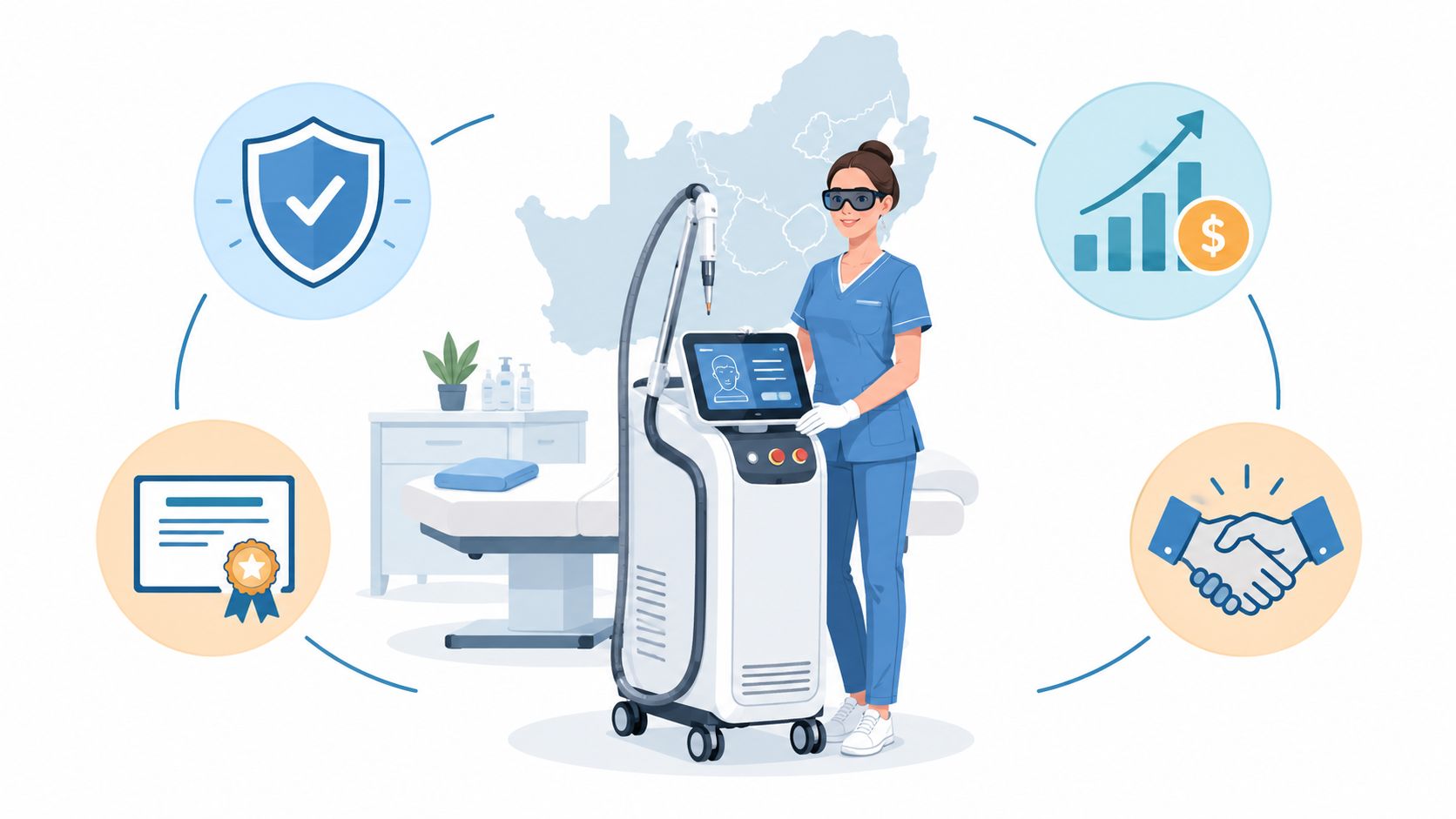
You've watched the demonstration, the treatment looks convincing, and the supplier has sent a quotation that seems to fit your expansion plan. Then a regulator or local inspector asks for the device licence, the site controls, and the name of your Laser Safety Officer. Suddenly, the purchase isn't just about wavelength, fluence, cooling, or treatment speed.
A laser machine in South Africa is a regulatory and commercial decision before it's a device decision. South Africa's laser hair removal market was estimated at USD 9.4 million in 2025 and is projected to reach USD 22.5 million by 2033, with an implied 11.3% CAGR from 2026 to 2033, according to South Africa laser hair removal market data. Demand is expanding, but a growing market doesn't make a poorly documented or badly supported machine a good investment.
Table of Contents
- Why Buying a Laser in South Africa Starts with Compliance
- The Main Aesthetic Laser Types and What They Do
- SAHPRA Licensing, the LSO and Site Readiness
- How to Read Supplier Offers Without Getting Burned
- Training, Marketing Enablement and After-Sales Support
- Pricing, ROI and Clinic Deployment in Practice
- Your Next Step as a Laser Buyer in South Africa
Why Buying a Laser in South Africa Starts with Compliance
A Joburg clinic owner can follow a familiar path. She attends a polished demonstration, tests the handpiece, discusses the price, and calculates how many treatments will cover the instalment. The supplier highlights international certifications and a fast installation date. Then, just before the purchase order is signed, someone asks whether the exact unit is licensed for use in South Africa, whether the importer is authorised, and who will act as the Laser Safety Officer, or LSO, at the premises.
That buying sequence is backwards. Compliance must be the first filter on your shortlist, before wavelength, fluence, cooling, or treatment speed. South African controls apply particularly to Class 3B and Class 4 laser products. They cover the device, safety management, operator training, protective equipment, controlled access, room controls, and records. The LSO also needs a defined responsibility for managing laser safety at the site.
The regulatory history reinforces the point. Earlier literature on laser hair removal described the position in 2019, including the absence at that time of legislation governing who could perform treatments. It also noted that informal training commonly lasted two to four days. Read that historical context in the peer-reviewed South African laser hair removal discussion, then confirm current SAHPRA requirements and local guidance before committing funds.
Procurement rule: An international safety mark may support your technical assessment, but it does not replace South African licensing and site obligations.
A CE mark or FDA clearance alone does not authorise treatment on a South African patient. Confirm the device classification, SAHPRA licensing position, import route, intended use, room controls, operator records, and LSO arrangements. If any part is unclear, pause the purchase. Review the site controls and safety obligations in the safety and compliance overview before you compare handpieces.
Guidance for South African clinics has warned that unregistered lasers can be confiscated and that a separate licence may be required for each device model. Examine the practical regulatory concerns in this South African laser regulation guide for clinics.
Before paying a deposit, demand a written compliance pack. It should identify the manufacturer, model, classification, licence status, importer, intended use, safety documentation, training records, and person responsible for local support. A supplier that cannot provide those details has not earned a place on your shortlist. Room modifications, delayed launch dates, or a replacement purchase can erase the margin you expected from the platform.
The Main Aesthetic Laser Types and What They Do
Choose the hazard category before you choose the treatment menu. Class 3B and Class 4 systems can create serious eye and skin exposure risks, so your purchase decision must account for access controls, warning signs, protective eyewear, operator training, and Laser Safety Officer responsibilities. Output power is only one part of the risk profile. The room layout, procedure, operator, patient flow, and staff access to the controlled area all affect how safely and profitably the device can be used.
The platform also determines which patient groups and revenue streams your clinic can serve. Melanin absorbs light, so wavelength and settings must match skin colour, hair characteristics, treatment area, and the risk of thermal injury. A system that performs well for lighter skin and dark hair may be a poor commercial and clinical choice for a clinic serving a broader South African patient base.
Buy the platform that fits your patient mix, operator capability, room capacity, and planned treatment menu. A broader specification is not automatically a better investment.
Hair reduction platforms
A diode laser is commonly shortlisted for hair reduction because it can support a broad treatment mix, including patients with darker pigmented skin when the protocol, cooling, operator training, and wavelength selection are appropriate. Do not buy on the word “diode” alone. Request the actual wavelengths, pulse controls, spot sizes, cooling method, treatment protocols, maintenance requirements, and safety documentation. These details affect both treatment quality and the number of appointments the clinic can deliver.
An Nd:YAG at 1064 nm is often considered for hair reduction on Fitzpatrick V to VI skin and can also support vascular work. Its longer wavelength penetrates further and is less strongly absorbed by epidermal melanin than shorter wavelengths, but it still requires conservative assessment and experienced operation. Review the Nd:YAG treatment information before treating this platform as a substitute for every other hair-reduction system.
An Alexandrite at 755 nm generally suits lighter skin and dark hair more naturally, and it may be relevant to selected pigmented-lesion treatments. Its shorter wavelength interacts more strongly with melanin, so patient selection, settings, cooling, and operator judgement carry greater weight.
Light and resurfacing systems
Intense pulsed light, or IPL, is not a single-wavelength laser. It emits a broad band of light and may be used for photo-rejuvenation and superficial vascular concerns. Assess filter options, cooling, pulse control, intended indications, treatment protocols, and regulatory documentation. Treating IPL as interchangeable with a diode, Nd:YAG, or Alexandrite platform is a procurement error.
A fractional CO₂ laser is a resurfacing system for skin texture, scarring, and selected rejuvenation procedures. It creates a different clinical and operational burden from hair removal. Your purchase assessment should include plume management, patient preparation, downtime counselling, consumables, room procedures, and the training required for more demanding treatments.
A Q-switched Nd:YAG is associated with tattoo and pigment removal. It serves a different treatment mix from long-pulse Nd:YAG hair reduction, even though both use the Nd:YAG name. Confirm the pulse mode, handpieces, intended applications, and treatment protocols before assuming one platform can replace the other.
| Platform | Best skin types | Common treatments |
|---|---|---|
| Diode | Broad range, subject to protocol and assessment | Hair reduction |
| Nd:YAG 1064 nm | Fitzpatrick V to VI and other appropriately assessed patients | Hair reduction and vascular work |
| Alexandrite 755 nm | Generally lighter skin with suitable hair contrast | Hair reduction and selected pigment work |
| IPL | Selected skin types according to filter and protocol | Photo-rejuvenation and superficial vascular concerns |
| Fractional CO₂ | Carefully selected patients requiring resurfacing | Scarring, texture, and rejuvenation |
| Q-switched Nd:YAG | Indication and skin type dependent | Tattoo and pigment removal |
Industry market data cited earlier in this guide identifies diode as the largest revenue-generating type in South Africa's laser hair removal market in 2025, with Nd:YAG identified as the fastest-growing segment. Use that as market context, not as a purchase instruction. Your existing patient base, treatment area mix, operator capability, room capacity, consumable costs, and expected utilisation should decide the platform.
Before signing a purchase order, match every promised indication to a documented wavelength, handpiece, protocol, training plan, and service arrangement. That comparison will show whether the device supports a real clinic strategy or only an attractive supplier brochure.
SAHPRA Licensing, the LSO and Site Readiness
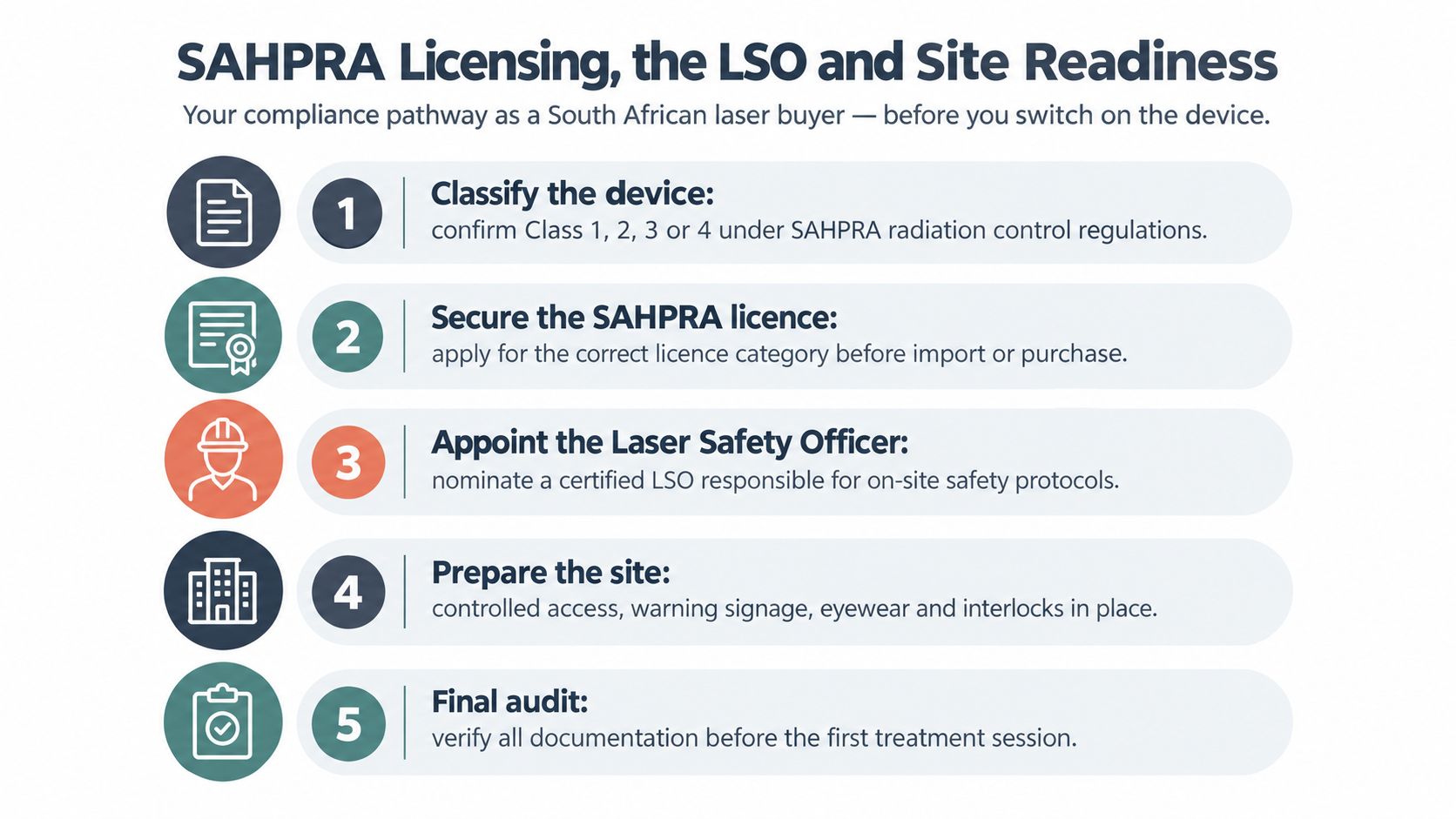
A laser can arrive on schedule and still remain unusable if the licence, responsible officer, or treatment room is not ready. Treat compliance as part of the purchase decision, not as paperwork to complete after delivery. South Africa's regulator for laser-related oversight is SAHPRA's Radiation Control unit, which regulates activities involving electronic generators of ionising radiation and radioactive sources. SAHPRA also oversees medical-device safety, quality, and performance. Add the regulator's Radiation Control information to your procurement file.
Confirm the device and licence pathway
Start with the exact unit you intend to buy. Ask the supplier for the manufacturer, model designation, intended use, classification, licence category, and supporting licence documentation. “Approved” is not enough. You need to establish whether that specific device can be imported and used lawfully at your premises for the treatments you plan to provide.
Cross-check the device you are quoted against SAHPRA-registered products before accepting a supplier's approval claim. The registration or approval route must match the actual model, not a related product in the same range.
For Class 3B and Class 4 lasers, SAHPRA requires use licences. Its current guidance also addresses licences for importing, manufacturing, and using laser systems. The current SAHPRA document library lists a dedicated guideline for the Class 3B and Class 4 laser use-licence application process dated 15/09/2026. Check the current documents yourself before relying on an older supplier pack.
Appoint the Laser Safety Officer
A Laser Safety Officer, or LSO, needs authority to monitor and enforce controls for relevant non-ionising radiation medical devices. The role covers defining the controlled area, checking protective eyewear, restricting access, supporting staff training, keeping records, and confirming that procedures match the device and room.
The SAHPRA guidance for non-ionising radiation medical devices addresses the safe use of Class 3B and Class 4 lasers or laser systems. Name the LSO before installation. Document that person's authority, duties, inspection schedule, and reporting route, then confirm whether the supplier supports the appointment and required records.
South African standards provide the technical requirements behind the room and equipment controls. SANS 60335-2-113:2023 includes lasers and intense light sources used in beauty care. The broader laser safety regime references SANS 60825-1 for workplace risk assessment. Use the South African government publication covering these standards when reviewing device documentation and workplace controls.
Before the first treatment, verify that your internal file contains:
- Licence in hand: Confirm the relevant SAHPRA documentation for the specific unit and intended use.
- LSO appointed: Record the person's authority, duties, and contact details.
- Controlled room prepared: Install warning signage and restrict access to the treatment area.
- Eyewear verified: Match protective eyewear to the device wavelength and hazard.
- Emergency equipment available: Provide an extinguisher appropriate to the electrical and laser environment.
- Procedures filed: Keep safe operating procedures, training records, maintenance records, and incident procedures on site.
Make the supplier help close these actions, but keep the final decision with the clinic. Do not treat a patient until the licence, LSO controls, room, equipment, and written procedures are ready.
How to Read Supplier Offers Without Getting Burned
A quote sheet is evidence, not marketing. If it contains only a device name, a glossy photograph, a price, and a warranty sentence, it's incomplete. You need to understand what arrives, who supports it, what the clinic must provide, and what happens when the first fault occurs.
Test the offer line by line
Request the device's SAHPRA licence information, original country of manufacture, exact model designation, and the identity of the South African distributor or importer. A reseller that can't explain its local service route may be selling a parallel-imported unit without the parts, training, or regulatory support your clinic needs.
Ask direct questions about the warranty:
- Coverage: Which components, handpieces, cooling systems, screens, and consumables are included?
- Duration: When does coverage start, and does installation or delivery alter the start date?
- Service: Who services the handpiece after the warranty period?
- Downtime: What response time applies when the machine stops working?
- Parts: Which replacement parts are held locally, and which require importation?
- Training: How many operators are trained, by whom, and with what certification?
- Commercial support: Does the package include treatment menus, patient education, launch material, or business guidance?
“FDA-cleared” without a South African licence reference is a red flag. So is a remarkably low quotation that excludes training, consumables, local technical support, and LSO assistance. A cheap box can become an expensive interruption if the handpiece fails and the only available parts are overseas.
A supplier's real offer is the machine plus the operating system around it.
Omega Lasers' enablement offering provides a useful example of what to request from any supplier. A complete quote should itemise the device, training, consumables, warranty terms, LSO assistance, technical support, and the expected total cost of ownership across the first three years. Whether you choose that supplier or another, insist on the same level of detail.
| Quote Item | Must-Have (Yes/No) | Notes |
|---|---|---|
| Exact manufacturer and model | Yes | Match the quotation to the licence and demonstration unit |
| SAHPRA documentation | Yes | Request the applicable licence information in writing |
| Importer or distributor identity | Yes | Confirm local accountability and service responsibility |
| Operator training | Yes | Name the trainer, scope, assessment, and certificate terms |
| LSO assistance | Yes | Define appointment support and ongoing responsibilities |
| Warranty terms | Yes | List exclusions, start date, and covered components |
| Consumables and replacement parts | Yes | Request pricing, availability, and lead-time information |
| Technical response process | Yes | Record contact route, escalation, and repair expectations |
| Marketing enablement | No, but commercially valuable | Specify launch assets, treatment menus, and patient education |
| Three-year ownership estimate | Yes | Include service, consumables, training, and downtime assumptions |
Don't sign a quote that forces you to discover these answers after delivery.
Training, Marketing Enablement and After-Sales Support
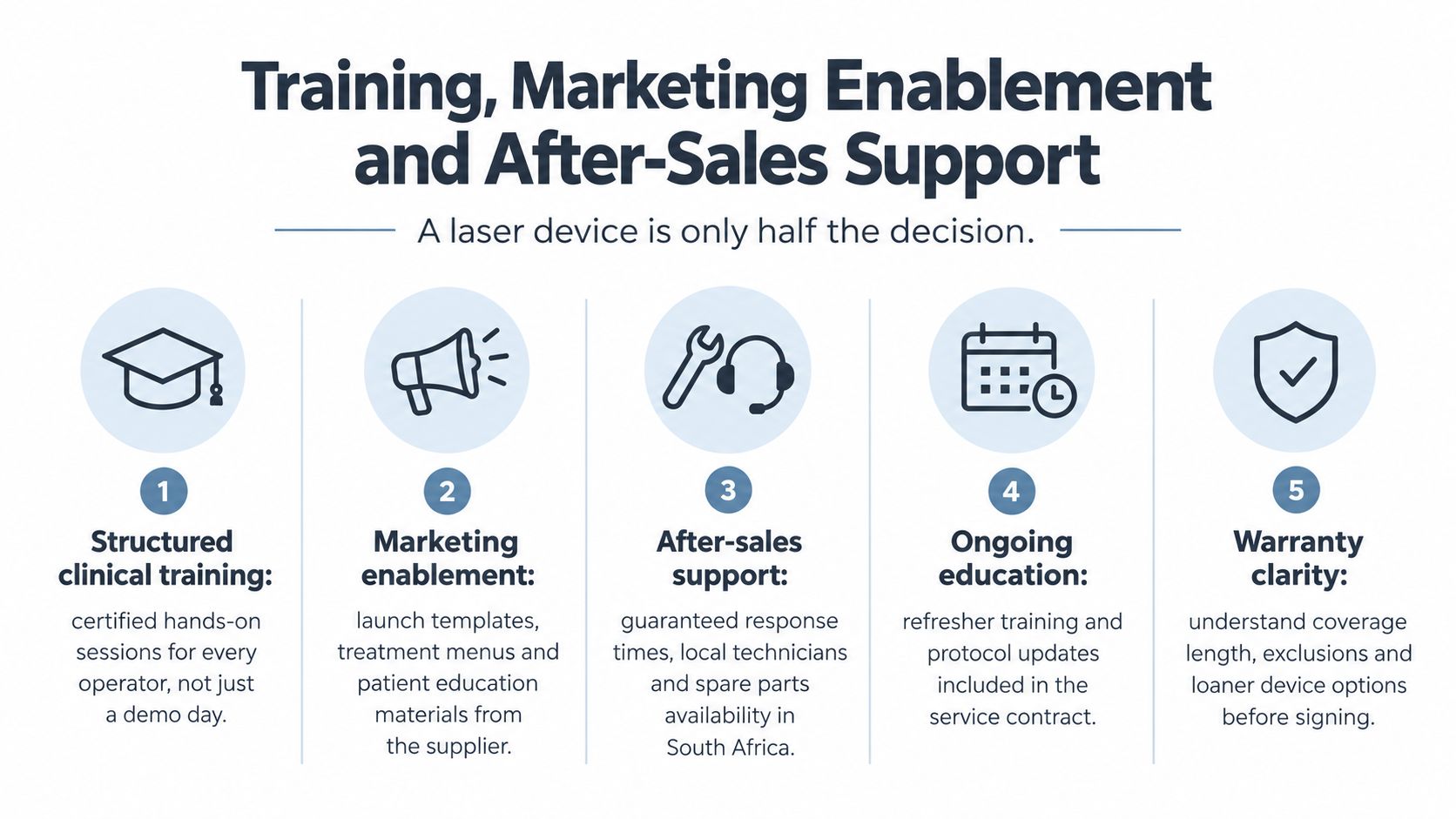
A laser purchase succeeds only when your team can operate the device safely, explain treatment limits clearly, keep bookings active, and restore service quickly after a fault. Treat training, demand generation, and technical support as procurement requirements, not complimentary extras added to a quotation.
Test the training programme before signing
A demonstration proves what the device can do in controlled conditions. It does not prove that an operator can assess a patient, identify contraindications, choose settings, document consent, manage an adverse event, or follow a repeatable protocol.
Ask the supplier for a written training plan. Confirm the number of hands-on hours per operator, the trainer's clinical experience, the procedures covered, and the ratio of trainees to devices. Ask how competency is assessed. Does the operator complete a practical treatment, pass a written test, or only attend a presentation? Confirm who issues the certificate, what it authorises, how long it remains valid, and what refresher training costs.
Require training for every operator who will use the machine. A short handover and an invitation to call later leave your clinic carrying the operational risk.
Require marketing support with practical outputs
Start patient education before installation. Your team needs approved explanations of suitability, expected results, treatment intervals, aftercare, contraindications, and realistic limitations. Ask whether the supplier provides treatment menus, patient education material, launch templates, consent support, and guidance for documenting before-and-after results.
Request examples before you value this part of the offer. A supplier should show what it will provide, when those materials arrive, and whether your clinic may adapt them to its pricing, positioning, and target patient groups. Marketing support has commercial value only when it helps staff explain the treatment and convert suitable enquiries into booked consultations.
Put after-sales promises into the contract
Your service agreement should name the support contact, technician location, escalation route, maintenance schedule, spare-parts process, and repair procedure. Ask whether a loaner device is available during extended repairs, how the supplier handles unavailable consumables, and whether technical assistance is delivered directly or through a subcontractor.
Define response times, exclusions, warranty-preservation duties, software or protocol updates, and the process for reporting faults. Record every promise in the signed agreement. “We respond quickly” is not a service level when a full diary depends on an available handpiece. Insist on written accountability before the purchase order is approved.
Pricing, ROI and Clinic Deployment in Practice
The purchase price is only one line in the ownership model. Your worksheet should show treatment revenue minus consumables, finance costs, maintenance, room costs, clinician time, marketing, training, and downtime. If you leave out any of those items, the payback calculation will flatter the machine.
Use your own patient base rather than the supplier's ideal utilisation scenario. A clinic with recurring hair-removal demand may fill a diode platform consistently, while a practice with occasional resurfacing enquiries may need a different model, a shared room, or a staged purchase. Capacity you can't sell is not an asset. It's an overhead with a handpiece.
Build the worksheet before comparing finance
Calculate the expected monthly contribution from each treatment category. Use realistic bookings, not the number of hours the machine could theoretically operate. Then model what happens if bookings are slower, consumable prices rise, an operator leaves, or a repair removes the machine from service.
| Line Item | Monthly Value | Assumption / Source |
|---|---|---|
| Treatment revenue | R____ | Expected completed treatments multiplied by actual treatment price |
| Consumables | R____ | Supplier quotation and expected use per treatment |
| Finance repayment | R____ | Written finance offer and total repayment |
| Maintenance provision | R____ | Service contract and expected replacement parts |
| Clinician or therapist time | R____ | Internal labour cost per treatment hour |
| Room and utilities | R____ | Allocated clinic overhead |
| Marketing | R____ | Planned launch and ongoing patient-acquisition budget |
| Training provision | R____ | Supplier training and refresher costs |
| Downtime allowance | R____ | Conservative provision for service interruptions |
| Monthly contribution | R____ | Revenue less all operating and ownership costs |
If you need a general explanation of structures such as asset finance, rental-to-own, and supplier-assisted finance, use this medical equipment financing guide as background, then ask your accountant and finance provider to confirm the tax and repayment consequences for your clinic. Don't choose a finance structure on the monthly instalment alone. Compare the total repayment, ownership position, early-settlement terms, tax treatment, and exit options.
Prepare the room as part of the purchase
Site readiness can add cost and delay if you leave it until delivery. Confirm the room layout, controlled access, warning labels, door controls, protective eyewear storage, electrical requirements, ventilation, and fire-safety arrangements. CO₂ resurfacing may require plume evacuation, while higher-powered systems may impose more demanding electrical and room controls. Your LSO and supplier should review the site before installation, not after the machine is on the floor.
Commercial position: Training and after-sales support deserve the same weighting as the device specification. Without them, utilisation and safety both suffer.
Before signature, require four approvals: regulatory documentation, site readiness, supplier support, and a written ROI model. If one remains unresolved, the purchase isn't ready.
Your Next Step as a Laser Buyer in South Africa
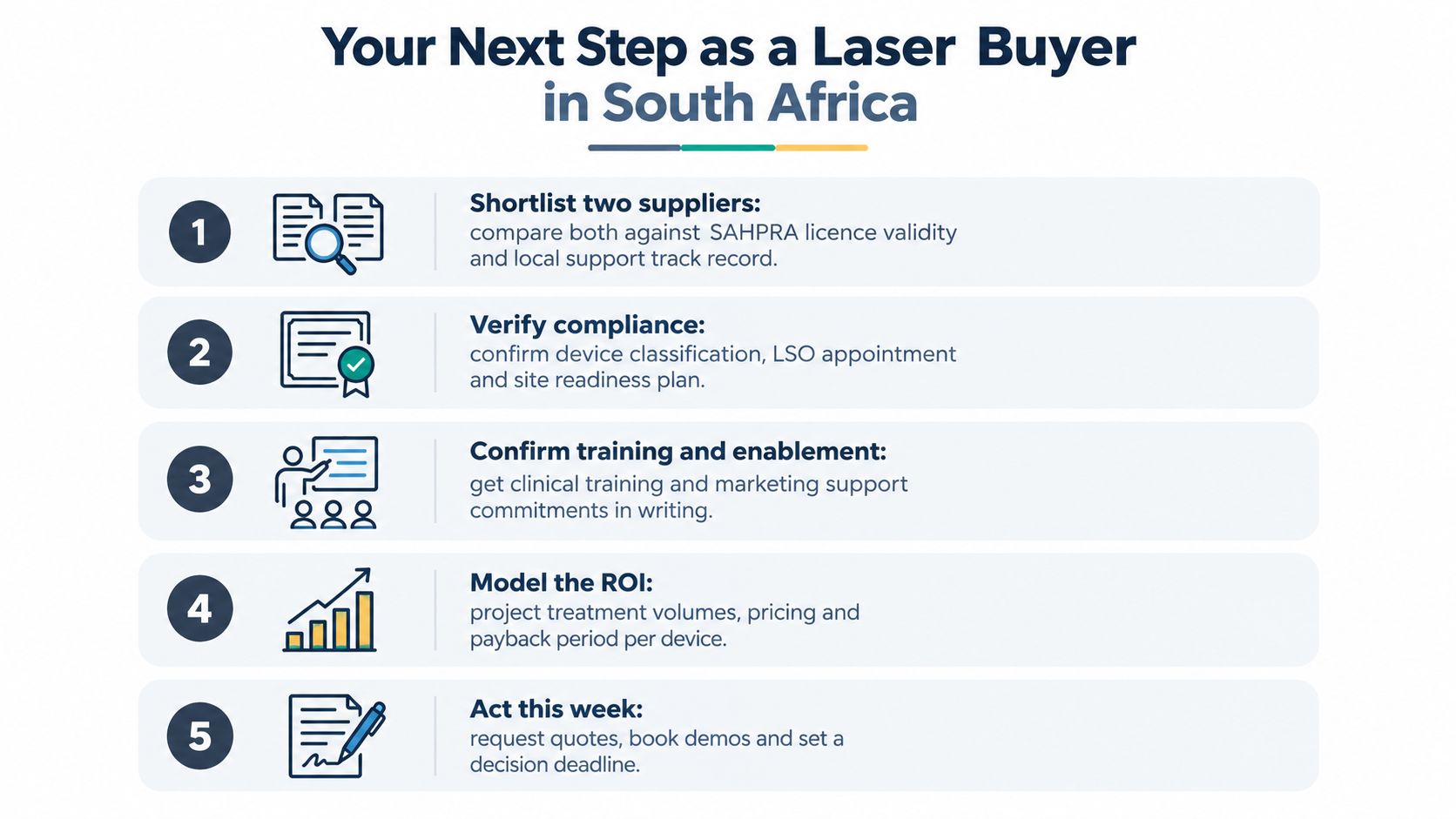
Turn the decision into a short procurement exercise you can complete this week. Shortlist two suppliers, but compare them against the same criteria. The supplier with the lowest price shouldn't win if it can't show local licensing, LSO support, operator training, parts availability, and a credible repair process.
Ask each shortlisted supplier for a paid on-site demonstration with a willing, appropriately assessed patient. A live demonstration lets you evaluate consultation quality, treatment preparation, comfort management, documentation, operator technique, room controls, and post-treatment advice. It also reveals whether the promised protocol works in your actual room with your actual team.
Use a final decision gate
Your written decision should answer these questions:
- Licence verification: Have you confirmed the device classification, applicable SAHPRA documentation, importer, and use requirements?
- LSO appointment: Is the LSO named, appointed, and involved in the room and operating procedures?
- Site readiness: Are access controls, warning signage, protective eyewear, emergency equipment, and written procedures complete?
- Training: Does every intended operator have documented, hands-on training and access to refreshers?
- Service-level agreement: Does the contract define support routes, response expectations, repair handling, parts, and downtime?
- Consumables: Do you know the pricing, availability, storage requirements, and replacement process?
- Commercial model: Does your worksheet use realistic treatment volumes, staff time, finance costs, maintenance, and marketing?
- Exit clause: Can you resell, transfer, or settle the asset if the treatment line underperforms or your clinic changes direction?
Don't force a payback promise onto a part-time room or a new practice with no established patient flow. If demand is uncertain, consider a shared, sub-let, or mobile operating model before committing to unused capacity. The right structure depends on the treatment mix and the documented numbers in your own worksheet, not on a generic industry promise.
South Africa's market offers room for clinics that combine suitable technology with disciplined operations. It doesn't reward buyers who treat compliance as paperwork, training as a once-off demo, or support as a courtesy. Book the compliance walk-through before the device walk-through, and refuse to sign the order until both have been signed off.
Omega Lasers supplies SAHPRA-licensed aesthetic platforms alongside laser machine training, technical support, marketing enablement, and business guidance for clinics and salons. Visit Omega Lasers to arrange a compliance-focused discussion before you commit to a device purchase.