




You're reviewing a new laser platform for your clinic. The supplier says it's “SAHPRA approved”, the brochure promises multiple treatments, and the price appears attractive. Then a practical question interrupts the excitement: what exactly has been registered, who holds the relevant licence, and will the paperwork still protect the clinic after installation?
That uncertainty is common among salon owners, clinic managers, aesthetic doctors, and medical spas. For energy-based devices, registration isn't just a phrase for a website banner. It can affect whether a device enters the South African market, whether a supplier can distribute it through regulated channels, how confidently your team can promote treatments, and how well you can respond to an inspection or patient query.
This guide treats SAHPRA registered products as a purchasing and operating issue, not merely a marketing label. You'll learn how establishment licensing differs from product registration, how to verify a supplier's documents, why registration timelines vary, and what obligations continue after approval. You'll also find practical ways to organise records and make compliance part of your normal clinic routine. For broader operational guidance, review these industry best practices for aesthetic clinics.
Table of Contents
- Introduction to SAHPRA Registered Products for Aesthetic Clinics
- What SAHPRA Registration Means and How It Works
- Why SAHPRA Registration Matters for Clinics and Devices
- How to Check if a Product Is SAHPRA Registered
- Inside the SAHPRA Registration Process and Timelines
- Regulatory Implications for Purchasing and Marketing Devices
- Practical Compliance Tips to Stay SAHPRA Ready
Introduction to SAHPRA Registered Products for Aesthetic Clinics
A clinic manager might begin with a treatment plan rather than a regulatory question. Perhaps clients are asking about hair reduction, skin rejuvenation, resurfacing, or a combined facial platform. The supplier demonstrates the handpiece, explains the settings, and discusses training. When the manager asks for proof of South African compliance, the response may be a product page, an overseas certificate, or a statement that the device is “in the process” of registration.
Those documents aren't interchangeable. An overseas approval may support a regulatory submission, but it doesn't by itself demonstrate that the specific device has been accepted for the South African market. A supplier's establishment licence also doesn't automatically prove that every product in its catalogue is registered. The clinic needs to connect the evidence to the exact device model, manufacturer, local applicant, and intended use.
That matters for more than administrative neatness. A laser or multi-technology platform can influence patient safety, treatment protocols, staff training, maintenance, advertising language, and the clinic's ability to defend its purchasing decision. A device that lacks clear regulatory evidence can create uncertainty at the point of importation, distribution, installation, or inspection.
Practical rule: Treat a registration claim like a clinical claim. Ask what it refers to, request the supporting record, and keep the evidence with the device file.
The reassuring part is that verification can become a repeatable process. You don't need to interpret every technical page in a supplier's dossier, but you should know which documents to request, which details must match, and which answers should trigger further questions. You should also understand that compliance continues after a product reaches your premises. Registration, licensing, renewals, retention requirements, quality documentation, and post-market responsibilities all form part of the device's commercial life.
For a busy aesthetic practice, the best approach is practical rather than alarmist. Buy technology that fits the clinical service, confirm that the regulatory pathway supports its use in South Africa, document the decision, and choose a supplier that can answer questions after delivery. That turns SAHPRA status from a vague badge into a meaningful part of patient protection and business control.
What SAHPRA Registration Means and How It Works
SAHPRA's role is easiest to understand if you separate the organisation selling or supplying the device from the device itself. SAHPRA's Medical Devices Unit regulates the licensing of medical-device establishments and the registration of both IVD and non-IVD medical devices to ensure an acceptable level of safety, quality, and performance, as set out on the authority's medical devices page.
Think of the distinction as similar to a driver and a vehicle. The driver needs a valid licence to operate within the rules. The vehicle needs its own evidence that it is suitable for use. A supplier's establishment licence addresses the business activity, while product registration addresses the device. A clinic should ask about both.
The establishment side
An establishment can include a business involved in manufacturing, importing, distributing, or wholesaling medical devices. Licensing gives SAHPRA visibility into the organisation handling those activities and links the business to defined quality and compliance expectations. It doesn't mean the clinic can assume every item supplied by that business has the same regulatory status.
For an aesthetic practice, this distinction becomes important when a supplier offers a broad catalogue. A distributor might be properly licensed, while a specific laser model is still pending, not registered for the stated use, or documented under a different legal manufacturer. The business licence is relevant evidence, but it's only one part of the purchasing file.
The product side
Product registration relates to the individual medical device and its supporting evidence. The regulatory assessment is concerned with whether the device meets expected standards for safety, quality, and performance. Device risk and the evidence required can influence the pathway, which is why a small accessory and a complex energy-based platform shouldn't be treated as identical regulatory objects.
Laser and multi-technology systems typically sit within the broader medical-device compliance area. That doesn't mean every platform has the same classification or documentation requirements. It does mean the clinic should expect the supplier to explain the relevant device identity, regulatory status, intended use, and supporting records in a clear way.
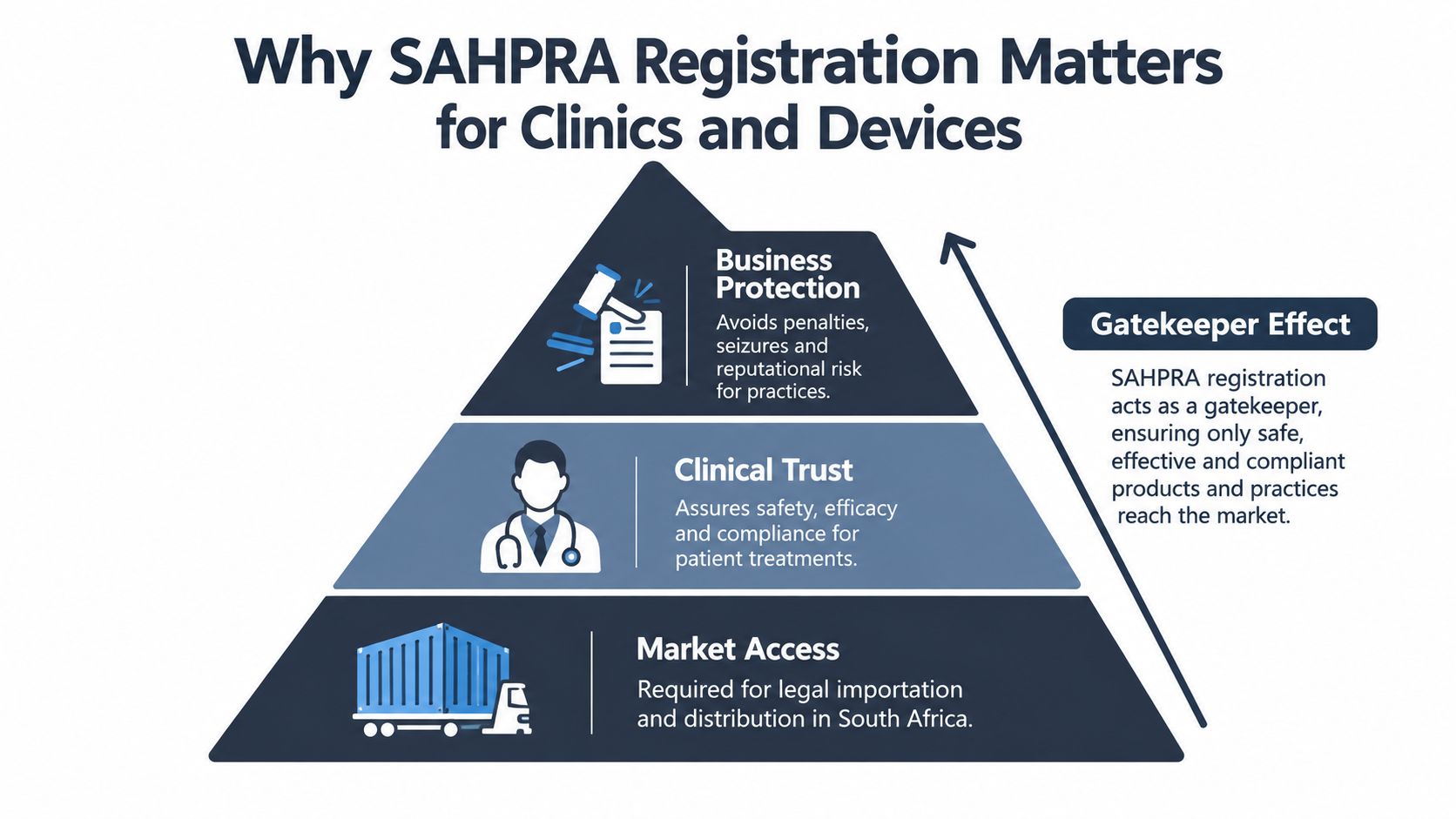
Registration therefore signals more than a promotional benefit. It provides a regulatory basis for market access and helps buyers assess whether the device has been presented through a formal safety and performance framework. It doesn't replace clinical judgement, staff competence, maintenance, or informed patient care. Instead, it gives those activities a more reliable foundation.
The simplest mental model is this: establishment licensing identifies the responsible business, product registration identifies the regulated device, and clinic procedures control how the device is used. A responsible purchase checks all three.
Why SAHPRA Registration Matters for Clinics and Devices
Registration functions as a commercial gatekeeper. It can support importation and distribution, strengthen buyer confidence, and make a supplier's claims easier to scrutinise. Conversely, an unregistered product can face significant barriers in regulated channels, even if the equipment looks technically impressive or has supporting documents from another country.
The shift became especially important in 2018. SAHPRA issued a call-up plan stating that all new medical devices classified as Class B, C, or D had to be registered within six months of the declaration. After that period, they couldn't be sold without an application and confirmation of registration, according to the authority's medical-device registration call-up plan.
Why buyers feel the effect
A clinic purchasing a device is making several decisions at once:
- Market access: Can the product be lawfully introduced and distributed through the intended route?
- Clinical confidence: Does the device have a documented regulatory basis for its safety, quality, and performance?
- Operational resilience: Can the supplier provide records, updates, training, and support if questions arise?
- Reputational protection: Can the clinic explain why it selected the system if a patient, auditor, or regulator asks?
The benefit isn't that registration guarantees a perfect treatment outcome. No registration can replace patient assessment, contraindication screening, correct parameter selection, maintenance, or practitioner training. Its value is that it helps remove a major area of uncertainty before the equipment reaches the treatment room.
Registration as a credibility signal
SAHPRA's approval work extends across many health-product categories. Its 2023/24 annual report recorded 2,315 generic applications received, with 715, or 31%, due for registration by the end of Q4. The figures appear in the authority's 2023/24 annual report.
That activity shows why registration status carries commercial meaning in South Africa. It forms part of a formal regulatory environment rather than an informal supplier promise. For aesthetic clinics, the practical lesson is straightforward: registration evidence should influence the buying decision before price, delivery speed, or a demonstration.
Use the following verification guide as a purchasing prompt, then confirm every item against the supplier's actual documents.
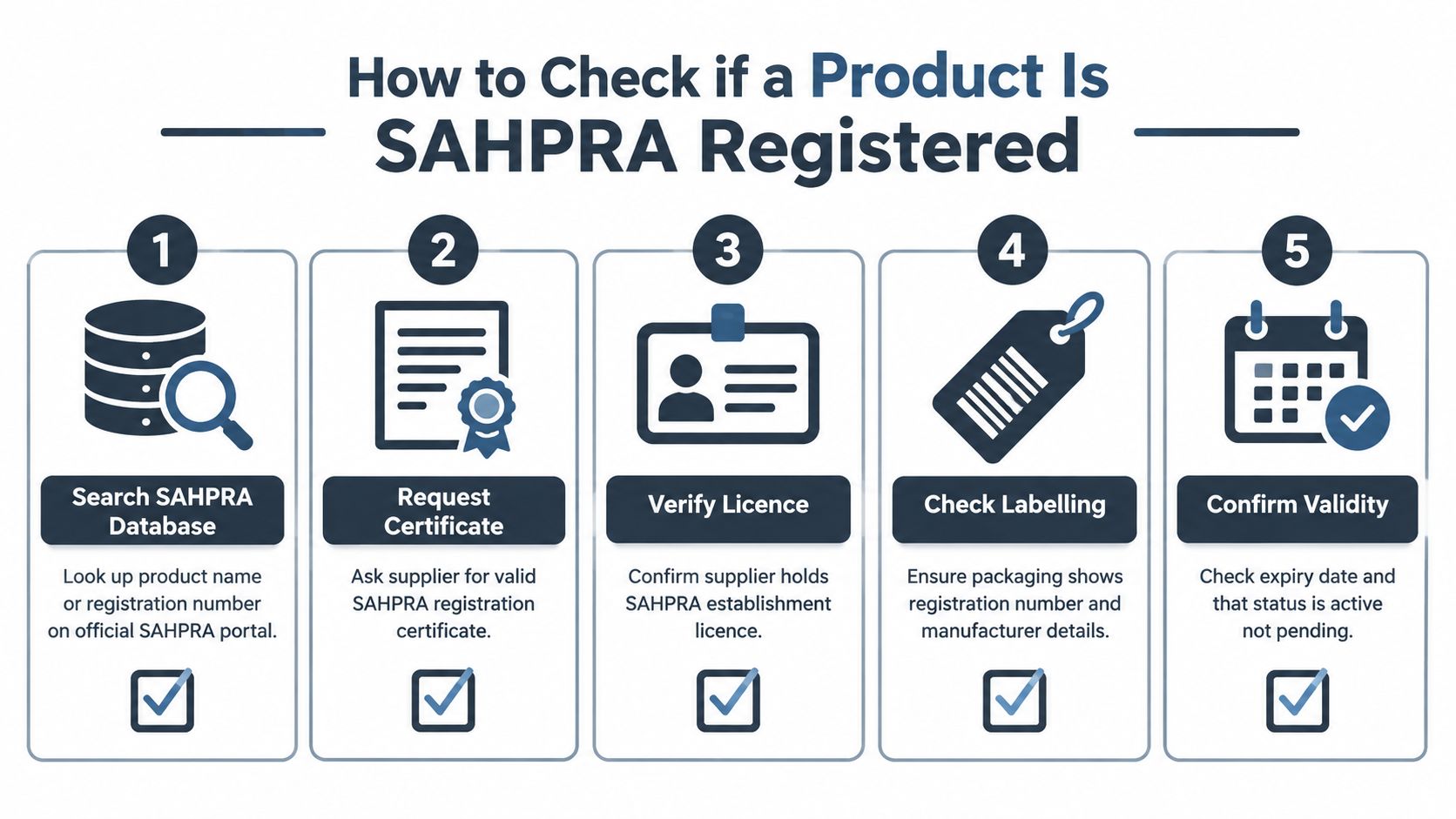
A device that passes this review gives the clinic a stronger basis for importation, procurement, treatment planning, and patient communication. A device that fails should pause the purchase, not pressure the clinic into accepting vague assurances.
How to Check if a Product Is SAHPRA Registered
You are about to pay a deposit for a new device, and the supplier says it is “SAHPRA registered.” Before signing, treat that statement like a treatment parameter. Check the exact product, the responsible local establishment, and the documents supporting the claim. Registration is a commercial gate, not a marketing badge.
Start with the exact product identity
Record the manufacturer, legal product name, model, version, accessories, and intended use. “Diode laser platform” describes a category, not one precisely identifiable device. If the certificate names another model or legal manufacturer, request a written explanation before proceeding.
Ask for the product's SAHPRA registration evidence, such as the registration certificate or official record. Compare it with the device offered in the quotation. The supplier should also identify the South African establishment importing or distributing the product and provide the relevant establishment-licence evidence.
Match the documents
Use a review sheet that follows the product from paperwork to treatment room:
- Product name and model: Do the certificate, quotation, brochure, and equipment label identify the same system?
- Manufacturer identity: Is the legal manufacturer consistent across all documents?
- Local responsibility: Is the importer, distributor, or other responsible establishment clearly named?
- Status: Is the product registered, or is the supplier describing an application, pending review, or another status?
- Intended use: Do the approved details support the treatments and claims the clinic plans to offer?
A certificate for a similar model does not confirm the device in front of you. If the supplier sends only overseas certificates, avoids a direct answer, or relies on verbal reassurance, pause the transaction and request the missing evidence in writing.
Keep an audit-ready record
Create one folder for the registration evidence, establishment licence, quotation, invoice, warranty, training records, installation documents, and correspondence. A structured secure medical document digitisation system can help staff store and retrieve these records, while clinic safety and compliance resources can support the wider operating process.
This file is useful beyond an initial purchase. It helps the clinic answer supplier questions, support internal reviews or inspections, and respond consistently to patient concerns. New managers and practitioners can also trace the device's documentation without depending on one person's memory.
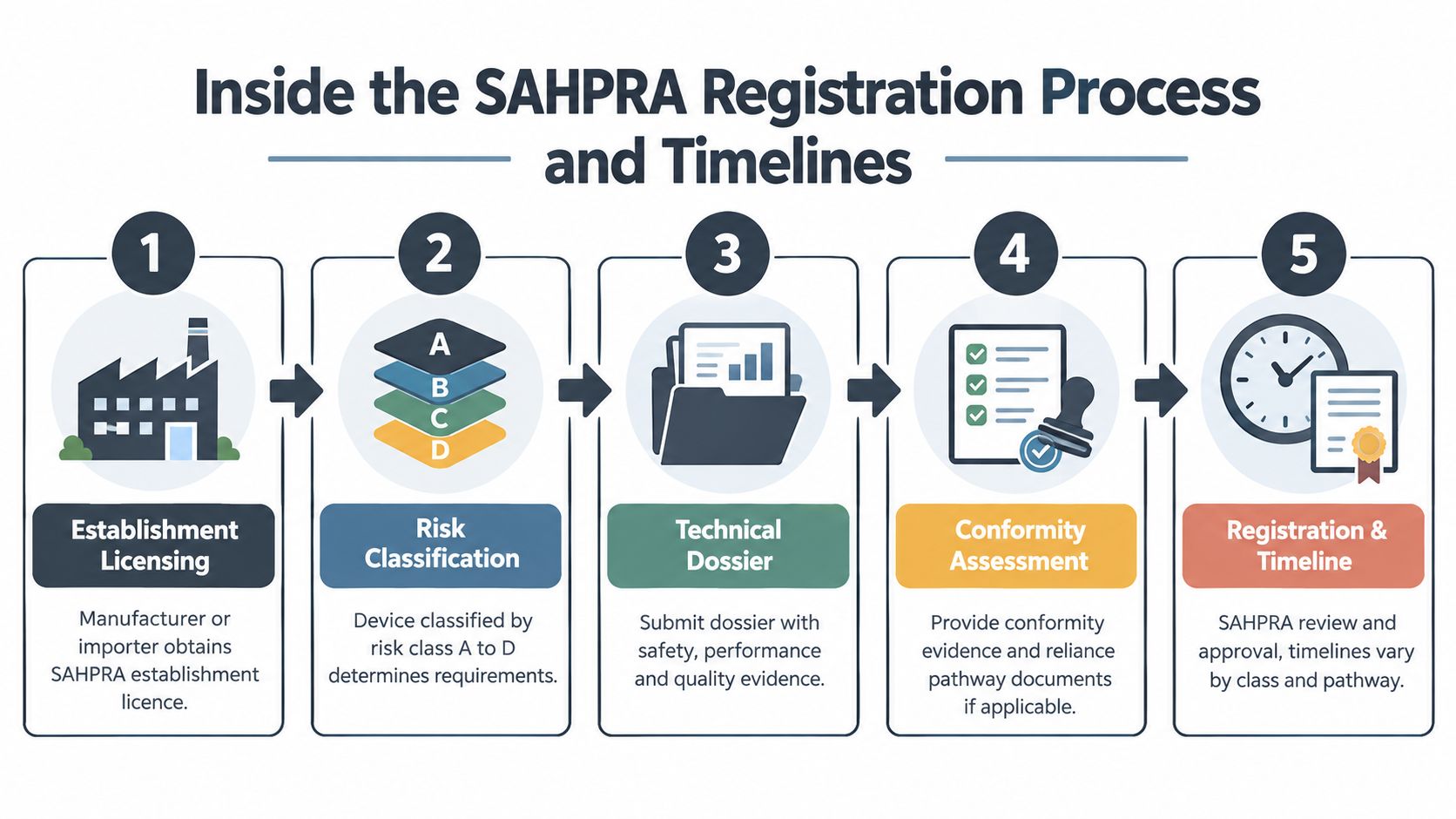
Before advertising or using the device, confirm three points: identity, documentation, and current status. If one remains unclear, hold the purchase or marketing claim until the supplier closes the gap.
Inside the SAHPRA Registration Process and Timelines
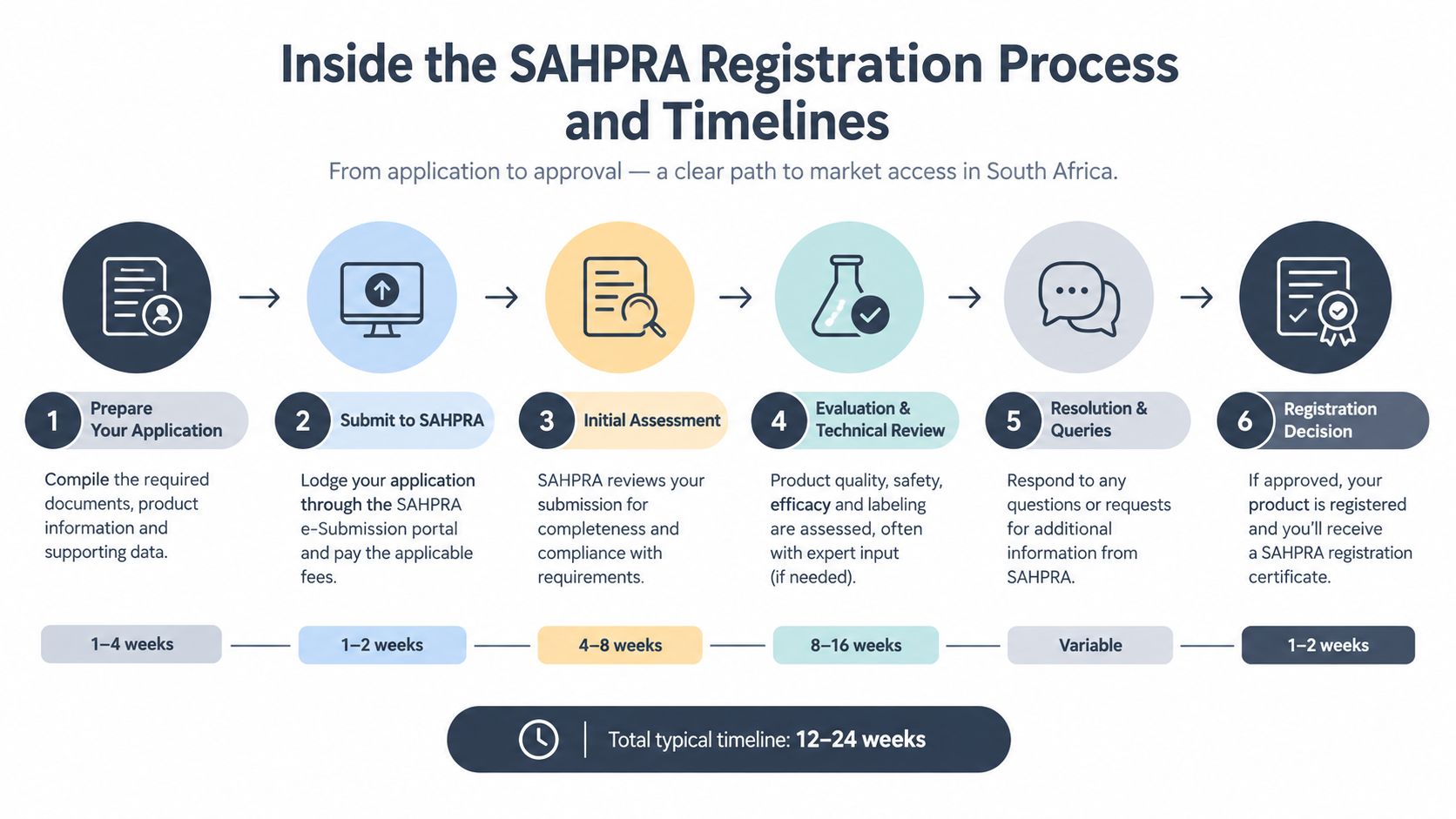
A supplier doesn't obtain product registration through a single upload and instant approval. The pathway normally connects the establishment, the device's risk profile, the technical evidence, conformity information, and SAHPRA's review. The completeness of the submission affects how confidently the regulator can assess the product.
The pathway begins with responsibility
The manufacturer or importing organisation first needs the appropriate establishment position for its activities. That step identifies who is responsible for handling the product in South Africa. A clinic should therefore ask not only, “Is the device registered?” but also, “Which establishment is responsible for this device and supply route?”
The device is then considered according to its risk classification. Higher-risk devices generally require more substantial evidence, although the exact requirements depend on the product and regulatory pathway. A supplier who can't explain the classification or the evidence supporting the submission may not have prepared the product file carefully enough.
Evidence must connect to performance
The technical dossier brings together information about the device's design, safety, quality, performance, labelling, and supporting conformity evidence. For an energy-based platform, the file should connect the physical system and its intended use to the claims made in training, brochures, and advertising.
Registration doesn't make every marketing phrase acceptable. A clinic still needs to ensure that treatment descriptions remain accurate, clinically responsible, and consistent with the device's intended purpose. The registration file should support the way the clinic plans to present and use the system.
Reliance can use trusted evidence
SAHPRA's Medical Devices Reliance Guideline describes reliance pathways for establishment licensing, product registration, clinical trial approvals, ISO 13485 audits, post-marketing and market surveillance, and importation for donations, exhibitions, and appraisals. The Medical Devices Reliance Guideline shows that reliance reaches across the product lifecycle, not only the initial listing.
Reliance doesn't mean automatic acceptance. It means SAHPRA can use relevant decisions, evaluations, or evidence through an applicable pathway while retaining its regulatory role. Suppliers should still be able to explain what evidence supports the submission and what South African requirements remain outstanding.
The timing can vary by device class, pathway, and the quality of the submission. Don't accept an unsupported promise of immediate registration. Ask what stage the product has reached, which documents are complete, who is responsible for follow-up, and how the supplier will communicate changes.
From a buyer's perspective, good regulatory preparation looks like traceable answers. The supplier knows the legal manufacturer, local establishment, device identity, classification, evidence package, conformity records, and post-market arrangements. That clarity is often more useful than a vague delivery promise.
Regulatory Implications for Purchasing and Marketing Devices
A compliant purchasing decision continues into the clinic's advertising, training, treatment records, and supplier management. Registration can support confidence in the device's market status, but the clinic remains responsible for using the system within its intended purpose and representing treatments accurately.
Marketing teams should avoid turning regulatory status into an outcome guarantee. “SAHPRA registered” doesn't mean every patient will achieve the same result, and it doesn't remove the need for appropriate consultation, informed consent, contraindication checks, practitioner training, or maintenance.
If your team is also planning patient acquisition, guidance on how to grow your practice with digital marketing can help align promotional activity with a responsible healthcare communication approach.
| Decision Criteria | Compliant Supplier Signals | Risk Signals to Avoid |
|---|---|---|
| Product identity | Exact model and manufacturer appear consistently on the quotation, certificate, label, and technical records | Supplier relies on a generic device category or says a different model is “equivalent” |
| Establishment status | Supplier identifies the relevant South African establishment and provides licensing evidence | No clear local responsibility for importation or distribution |
| Registration evidence | Supplier provides current documentation and explains the registration status clearly | Only overseas certificates, verbal assurances, or “pending” language |
| Intended use | Training and marketing materials match the documented purpose of the device | Brochures promise uses or outcomes that the supplier can't connect to the device evidence |
| After-sales support | Written warranty, training, servicing, and compliance support are documented | Warranty and technical responsibilities remain unclear |
| Clinic records | Supplier helps the clinic retain installation, training, and regulatory documents | Buyer is expected to organise everything without guidance |
Omega Lasers offers aesthetic laser and multi-technology systems for South African clinic use, with product information describing its systems as SAHPRA licensed. If you're assessing any supplier, apply the same standard: verify the exact model, request the supporting evidence, and retain the documents before launch.
Practical Compliance Tips to Stay SAHPRA Ready
A registered device isn't set-and-forget equipment. The clinic needs a small routine that protects the registration file, establishment relationship, staff competence, and patient records over time.
Start with a compliance calendar. Record registration and licence details, invoice dates, retention obligations, renewal milestones, training updates, servicing, and post-market follow-up. Assign one person to monitor the calendar and a second person to review it, so the task doesn't disappear when a manager is absent.
Keep the device file current
Your file should contain:
- Regulatory evidence: Registration documents, establishment-licence records, supplier correspondence, and any relevant updates.
- Technical history: Installation, servicing, repairs, software or component changes, and maintenance notes.
- People records: Training certificates, competency sign-offs, refresher training, and authorised-user details.
- Clinical controls: Treatment protocols, consent materials, incident records, adverse-event escalation procedures, and patient follow-up notes.
- Commercial documents: Quotations, invoices, warranty terms, and written service commitments.
SAHPRA's 2025 notice states that registration or licensing can be cancelled if retention fees aren't paid by the deadline, with payment due within 30 days of invoice. The same notice says that, from 1 June 2025, manufacturers and distributors submitting renewal or late applications for medical devices and IVDs need a valid ISO 13485:2016 certificate or CAB confirmation. Check the current SAHPRA medical-device application and fee notices before relying on an old supplier checklist.
Post-market surveillance also deserves attention. Ask the supplier how the clinic should report device incidents, safety concerns, faults, or treatment-related issues, and who receives that information. Use a documented escalation route rather than depending on an informal message to a salesperson.
A clear regulatory compliance checklist can help your team review the file at regular intervals. Make digital copies, restrict editing access, and use secure storage for documents that contain patient or business information.
Omega Lasers supplies SAHPRA-licensed aesthetic laser and multi-technology systems, alongside training, technical support, marketing assistance, and business-development guidance. Visit Omega Lasers to discuss a device pathway that fits your treatments, verification needs, and ongoing clinic operations.