



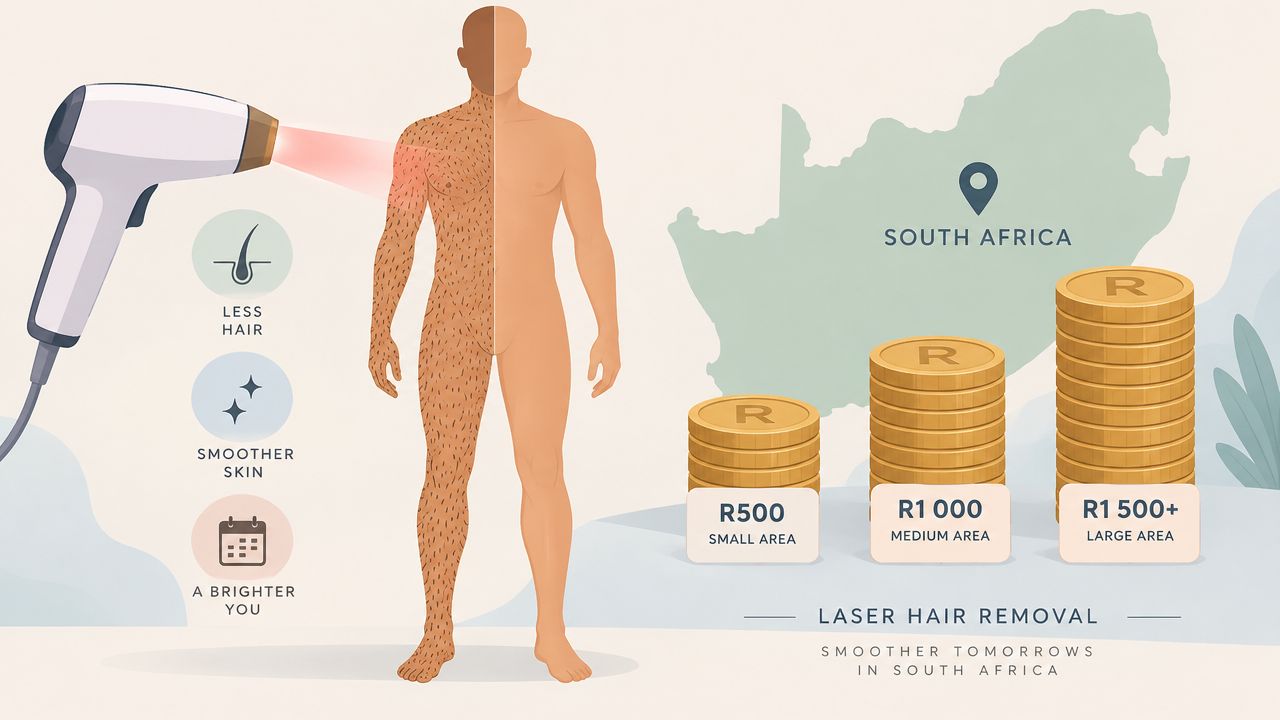
A full-body laser hair removal course in South Africa can realistically cost R18,000 to R45,000, not the attractive single-session figure many adverts put at the top of the page. A quoted R5,500 appointment becomes R33,000 to R44,000 across six to eight sessions, before any maintenance visits. That's the number buyers should budget around, and the number operators should use when building a commercially honest package.
Table of Contents
- What Full-Body Laser Hair Removal Actually Costs in South Africa
- How Clinics Define Full Body and Why It Matters
- The Main Pricing Drivers Behind Every Quote
- Sample Pricing Scenarios From Real ZA Listings
- How Multi-Wavelength Devices Change Per-Treatment Economics
- Buying the Device Versus Paying Per Session
- Buyer and Operator Questions Answered
What Full-Body Laser Hair Removal Actually Costs in South Africa
South African price lists place full-body laser hair removal firmly in the mid-thousands of rand per session. One Cape-based clinic lists full body at R4,900 and full body plus face at R4,950, with both treatments scheduled as two-hour appointments. A Gauteng provider lists full body at R8,500, while a Pretoria marketplace listing shows a ZAR 6,000 full-body offer for two hours. These published figures establish a practical local market band, although the exact zones included still matter. See the South African laser hair removal cost guide for a broader treatment-area view.
The mistake is treating that rate as the complete purchase. A local clinic states that the average course consists of six to eight sessions, while another South African provider describes plans of 6 to 12 sessions, spaced at 2 to 4 week intervals. The correct calculation is therefore:
- R4,900 per session × six sessions = R29,400
- R4,900 per session × eight sessions = R39,200
- R5,500 per session × six sessions = R33,000
- R5,500 per session × eight sessions = R44,000
- R8,500 per session × six sessions = R51,000
The first two calculations use the Cape listing as a local benchmark, and the R5,500 example shows why a seemingly reasonable quote quickly becomes a substantial course investment. Treatment outcomes vary by skin, hair, body area, settings, and treatment consistency. Don't promise a fixed reduction percentage unless a qualified practitioner has assessed the client.
The honest budget range
For a buyer comparing reputable full-body offers, R18,000 to R45,000 for the initial course is a useful planning range, provided the package includes the zones the buyer truly wants. A lower total may reflect a narrower definition of full body, a promotional marketplace rate, or fewer included visits. A higher total may be justified by longer appointments, complex skin and hair requirements, premium positioning, or more extensive zones.
A price under R15,000 for full body deserves scrutiny rather than automatic celebration. It may be a legitimate limited package, but the buyer should ask whether the clinic is using IPL rather than a laser, shortening treatment time, excluding face or intimate areas, or selling too few sessions to complete a meaningful course. South African listings also show extreme variation, including a R590, 60-minute price-list entry, marketplace combinations around ZAR 2,500 to ZAR 3,800, and the higher full-body offers above. Those figures aren't comparable until the zone list, technology, duration, and session count are written down.
Practical rule: Compare the total treatment plan, not the largest discount or the cheapest single visit.
Annual maintenance belongs in the conversation from the beginning. A course reduces hair over time, but clients may still need occasional additional treatment, particularly where hormonal changes or stubborn growth affect results. A clinic that quotes only the first appointment is under-quoting the financial commitment.
How Clinics Define Full Body and Why It Matters
“Full body” isn't a regulated universal package name. One provider may mean legs, arms, underarms, bikini, and selected torso areas. Another may exclude the face, intimate areas, hands, feet, or the back while using the same headline wording. South African marketplace pricing illustrates the problem: one Johannesburg-area package combines Full Face, Underarms, Full Arms, Hollywood, Full Legs, and Buttock for ZAR 2,500, while other providers price full body substantially higher. The definitions aren't interchangeable.
Ask for the zone list first
A buyer should request a written list before paying a deposit. At minimum, confirm whether the package includes:
- Full legs, including knees, feet, and toes if those areas matter
- Full arms, including forearms, upper arms, hands, and fingers
- Underarms
- Bikini or Hollywood, with the exact intimate-area boundary
- Back, chest, stomach, shoulders, and neck, particularly for male clients
- Face, including whether the upper lip, chin, sideburns, and jawline are separate
Some clinics charge face and intimate areas separately because they require different settings, more detailed work, or additional consultation. Add-ons of R800 to R2,500 per zone can materially change the course total, so don't accept a full-body label without an anatomical definition.
What “full body” typically includes at ZA clinics
| Zone | Standard Package | Premium Package | Add-On Cost |
|---|---|---|---|
| Full legs | Legs, usually treated as one large zone | Legs, knees, feet, and toes clearly specified | R800 to R2,500 |
| Full arms | Upper and lower arms | Arms, hands, fingers, and detailed edges | R800 to R2,500 |
| Underarms | Usually included | Included with consultation and preparation guidance | R800 to R2,500 |
| Bikini or Hollywood | Bikini line or selected intimate area | Full intimate treatment with boundaries stated | R800 to R2,500 |
| Back | Often excluded from female packages | Full back, shoulders, and neckline specified | R800 to R2,500 |
| Chest and stomach | More common in male packages | Chest, abdomen, and surrounding edges | R800 to R2,500 |
| Face | Frequently excluded | Full face or named facial zones | R800 to R2,500 |
| Hands and feet | Often excluded | Included with fingers and toes | R800 to R2,500 |
The add-on range above should be treated as a budgeting prompt, not a universal tariff. Clinics price zones differently, and a quoted rate may bundle them rather than itemise them. The important question is simple: what skin will the operator treat for the advertised price?
A R4,500 headline rate can represent eight zones at one clinic and five at another. That difference can exceed R10,000 across a course, even before maintenance. Buyers should compare like for like, and operators should publish a zone map, treatment duration, number of visits, and touch-up policy on the booking page.
The Main Pricing Drivers Behind Every Quote
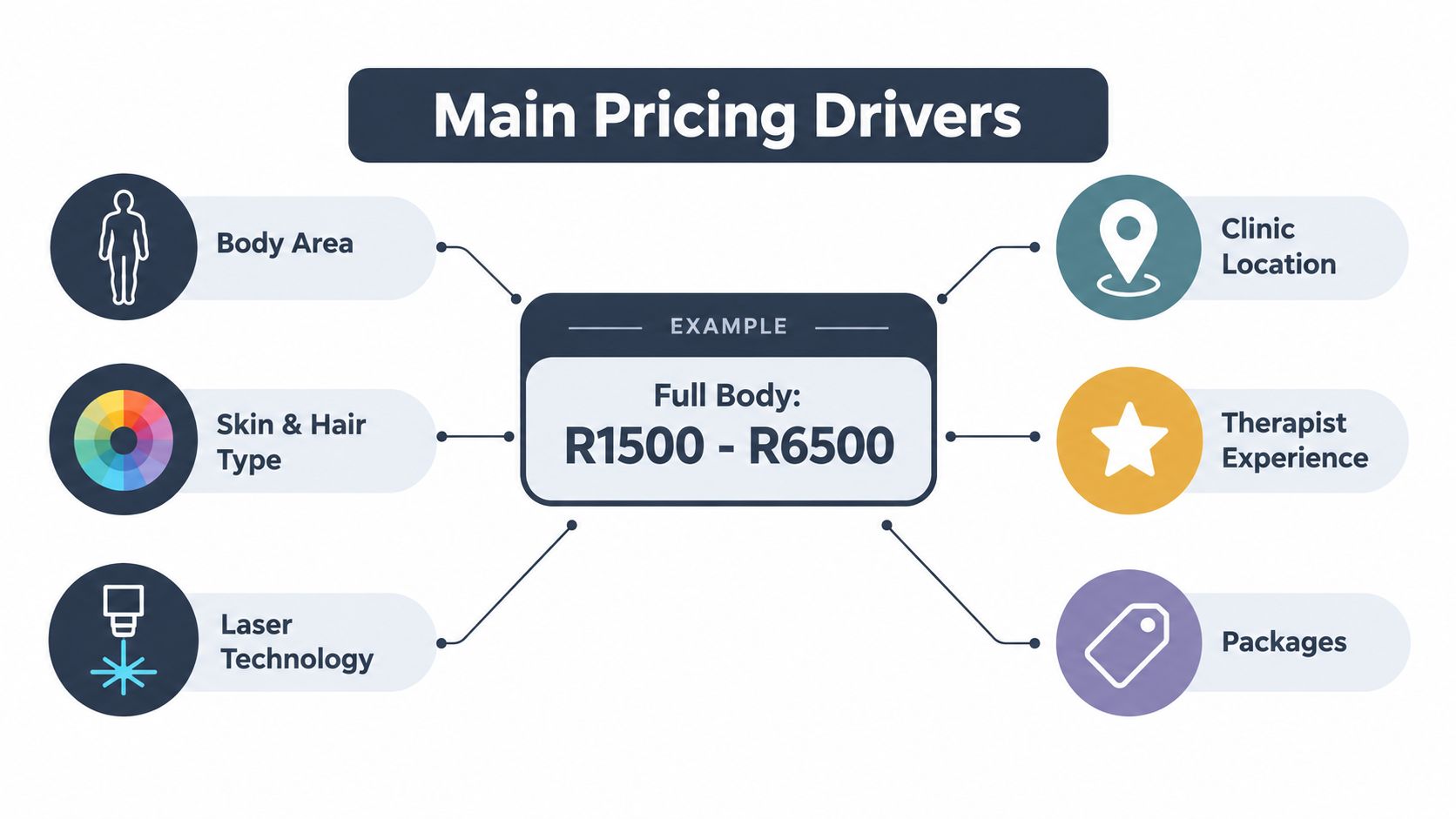
A full-body quote reflects more than the amount of skin treated. Technology, operator skill, client characteristics, appointment length, location, and package design all affect the final price. A provider using a more suitable platform for a wider range of skin types may carry higher equipment and training costs, while a small-area package can look cheaper only because it takes less chair time.
Device and treatment requirements
Clinics may use diode, Alexandrite, Nd:YAG, or IPL technology. These categories aren't equivalent, especially for clients with darker skin tones or dense, coarse hair. Fitzpatrick IV to VI skin requires careful parameter selection and suitable long-wavelength capability, and not every clinic owns or operates a device appropriate for every client.
Device choice can create a meaningful per-session gap. The requested market comparison places that difference at R500 to R1,500 per session, but the final quote must still reflect the actual system, treatment plan, and area definition. A cheaper machine isn't automatically poor, and a more expensive one isn't automatically safer. Ask who will operate it, how settings are selected, and whether the clinic has experience with the client's skin type.
Why the client changes the calculation
Hair density, thickness, colour, body size, and growth pattern alter treatment time and the number of sessions needed. A large area with dense hair takes more passes and more energy than a smaller area with sparse growth. Facial and intimate regions can also behave differently from legs or arms, which is why one fixed promise is commercially careless.
Clinic location matters too. A practice in a high-overhead Johannesburg district may price differently from a secondary-city clinic. That difference can reflect rent, staffing, consultation time, equipment finance, and service standards, rather than markup. Package discounts reduce the rate only when the client completes the package, so the operator must state expiry dates, missed-appointment rules, and what happens when the planned course isn't enough.
A worked ZA example
Take a Fitzpatrick V client with a large treatment area, treated at a Johannesburg clinic using a diode and Nd:YAG-capable device. If the plan requires eight sessions, the requested benchmark places the course at R38,000 to R42,000. That figure makes sense as a complete commercial plan, but it shouldn't be presented as a guaranteed outcome or universal tariff.
For a clinic owner, the quote must cover safe assessment, suitable settings, consumables, staff time, room time, maintenance, client support, and the possibility that the client needs an additional treatment plan. The total cost of ownership framework is useful because a device's purchase price is only one part of the business calculation.
Sample Pricing Scenarios From Real ZA Listings
The most useful comparison is between treatment scope and course cost, not between isolated headline rates. A South African provider lists individual areas such as full leg, full back, chest, abdomen, Hollywood, and full arm separately, which shows how quickly a multi-zone appointment becomes a high-value service. Another local listing places female full back at R1,500, full leg at R2,600, and tummy full at R2,000, while male full back and full leg are each listed at R3,000. Those figures explain why a full-body package can't be judged by a small-area rate.
The scenarios below are planning examples built from the published ZA market band and treatment-course mechanics. They aren't quotes for a named clinic, and the session counts should be confirmed during consultation.
Realistic ZA full-body laser pricing scenarios
| Client Profile | Zones Treated | Per-Session (ZAR) | Sessions for Clearance | Total Course Cost (ZAR) |
|---|---|---|---|---|
| Light-skinned male | Torso, full back, full legs, arms, underarms | R4,900 | 6 | R29,400 |
| Medium-skinned female | Underarms, full legs, full arms, bikini, face | R5,500 | 8 | R44,000 |
| Darker-skinned client | Smaller zones treated with conservative planning and additional visits | R6,000 | 8 | R48,000 |
| Premium express package | Comprehensive full body with a two-hour booking and premium service structure | R8,500 | 6 | R51,000 |
The first scenario sits near the lower end of the course range because it uses six sessions and a published Cape full-body benchmark. The second uses the worked R5,500 rate and shows how eight appointments create a R44,000 commitment. The third exceeds the initial planning band because the rate is based on a published Pretoria offer and the plan assumes eight visits. The fourth is a premium benchmark rather than a value package, based on the listed Gauteng rate.
What gets under-quoted
Packages that advertise six appointments without explaining what happens after the sixth are under-quoted. A client may finish the planned visits with meaningful reduction but still need further treatment, especially when hair density, skin type, or the chosen zones make the course more demanding. The written agreement should state whether additional sessions are discounted, charged at the normal area rate, or excluded.
What gets overpriced
Small add-ons can be overpriced when the clinic charges separately for every minor area without showing the bundled alternative. Feet, hands, fingers, toes, or a narrow facial zone may be inexpensive to treat in isolation, yet become disproportionately costly when appended to every full-body visit. Ask for a complete package price and compare it with the sum of individual zones before signing.
A sensible operator makes the price easy to audit. A sensible buyer asks for the same transparency.
How Multi-Wavelength Devices Change Per-Treatment Economics
A multi-wavelength platform can combine 755nm, 808nm, and 1064nm options in one system. The commercial advantage isn't a marketing label. It's the ability to select a wavelength more appropriately for the client's skin and hair profile, rather than referring every darker-skinned client elsewhere or forcing one setting across every treatment.
High-speed handpieces and larger spot sizes also change the appointment economics. The scenario supplied for this comparison describes full-body treatment moving from roughly three hours to under ninety minutes, depending on the system, operator, zones, and settings. That shorter booking can reduce room occupancy per client and make the service easier for clients to fit into their schedules.
The throughput calculation operators should use
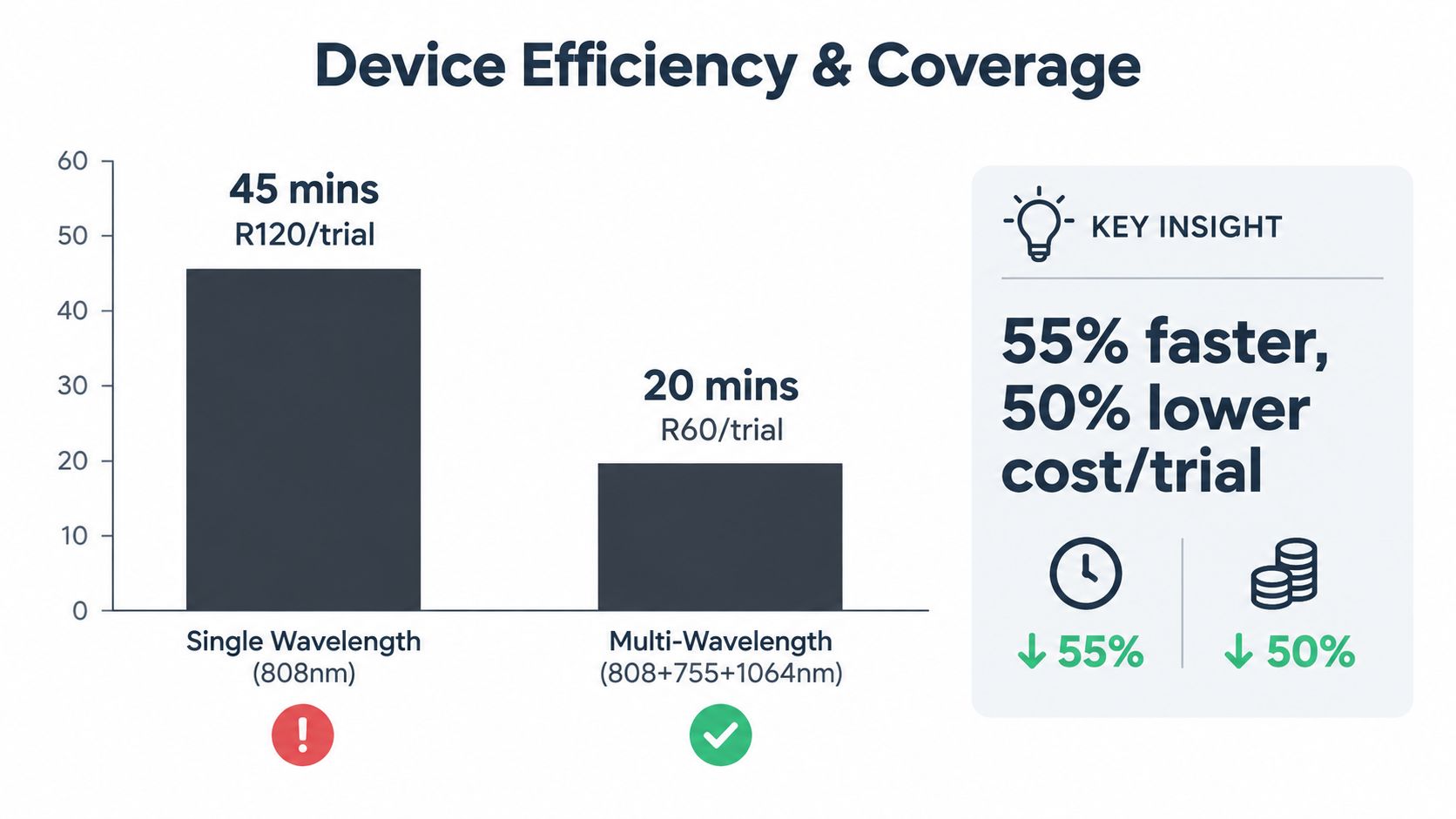
Suppose a clinic compares an 808nm-only system with a multi-wavelength unit. The supplied operating example assigns the single-wavelength treatment 45 minutes and R120 per trial, while the multi-wavelength treatment is shown at 20 minutes and R60 per trial. The graphic presents the difference as 55% faster and 50% lower cost per trial, but those figures are scenario assumptions for device economics, not a universal clinical result.
The commercial logic is still clear:
- Chair capacity: Shorter appointments can create room for more bookings without adding another treatment room.
- Staff fatigue: Fewer minutes of repetitive full-body work can make scheduling less punishing for operators.
- Client attendance: A shorter booking may be easier to keep than a long appointment.
- Skin-type coverage: A clinic with suitable wavelength options can assess more clients instead of referring Fitzpatrick V and VI clients out.
Don't confuse faster movement with rushed care. Skin checks, patch testing where appropriate, protective eyewear, treatment mapping, cooling, and accurate documentation remain essential. The operator should earn more from improved throughput, not by removing safety steps.
A clinic owner should model actual booked hours, not vendor promises. Use your own treatment times, cancellation rate, staffing cost, service price, and maintenance schedule. The cost-benefit analysis for laser equipment provides a useful structure for that exercise.
Buying the Device Versus Paying Per Session
For a clinic owner, buying a device makes sense only when there is enough consistent demand to keep it working. For a solo practitioner still building a client base, leasing, renting treatment time, or partnering with an established clinic can be the more disciplined choice. The wrong purchase creates a fixed financial burden before the operator has a reliable booking pipeline.
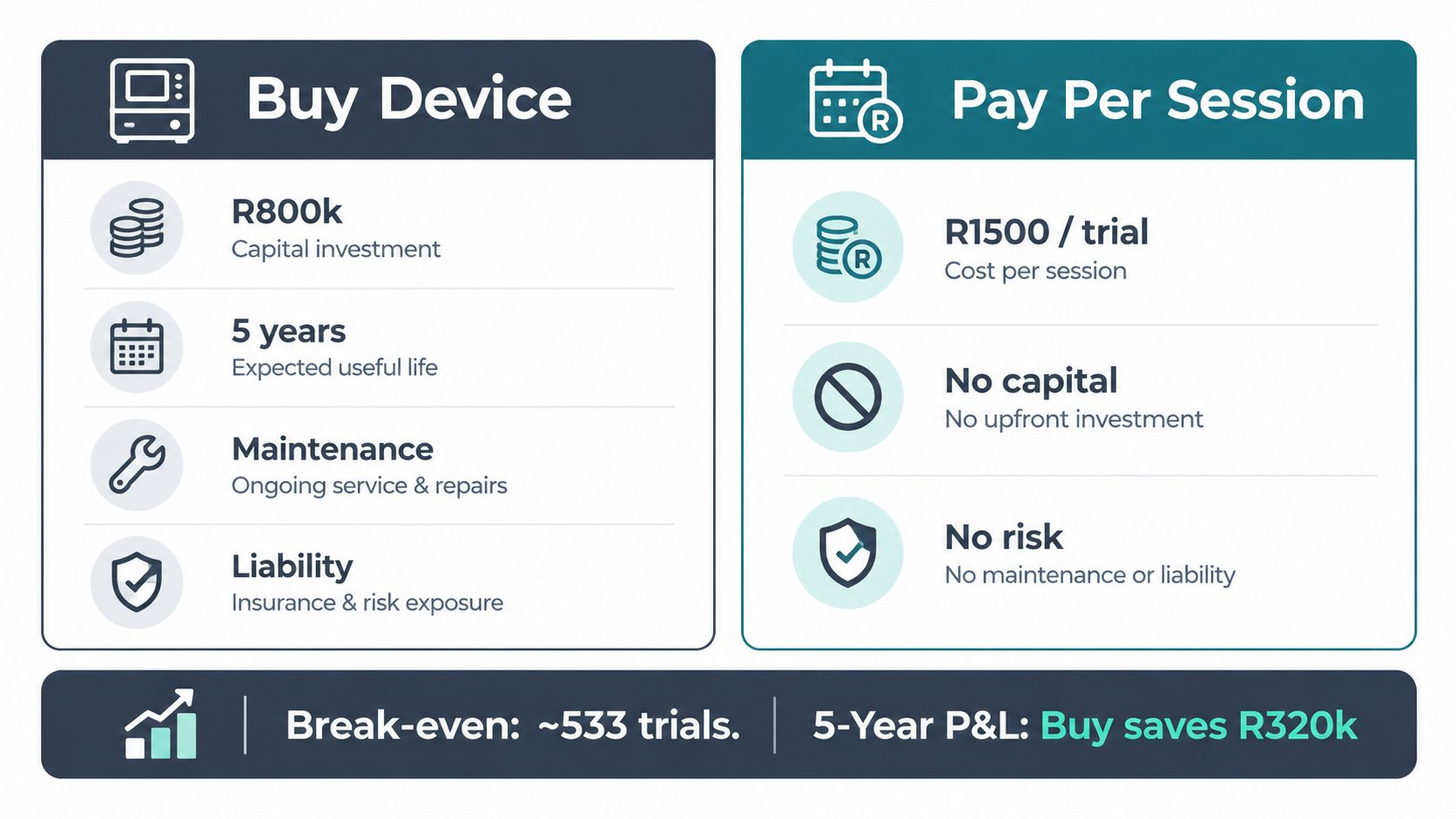
The required business model uses a commercial multi-wavelength diode system, with a working-life assumption of five years, maintenance, liability, and R800,000 capital shown in the financial comparison. Those figures belong to the supplied model, not a universal purchase quote. A buyer must replace them with a written supplier proposal that states VAT, warranty, delivery, training, servicing, handpieces, and consumables.
A simple break-even model
The supplied comparison uses R1,500 per trial, no capital outlay for the pay-per-session model, and a break-even point of approximately 533 trials. It also presents a five-year saving of R320,000 for the buy model. Treat those outputs as modelled assumptions, not guaranteed financial performance. The result changes immediately when the clinic treats a different number of clients, charges a different rate, pays different staffing costs, or carries a different maintenance burden.
The brief also sets a clinic scenario of two full-body clients per day, with a mid-tier device reaching break-even within eight to fourteen months, depending on package pricing. That is an operator's target, not a promise. Before purchasing, calculate:
- Net revenue per completed session, after therapist time and consumables.
- Available treatment days, excluding training, maintenance, leave, and closures.
- Actual utilisation, based on booked appointments rather than optimistic capacity.
- Course completion, because missed visits delay cash flow and weaken forecasts.
- Maintenance and downtime, including the cost of a device that can't treat clients.
When renting wins
Rent or lease time when the practice has uncertain demand, limited working capital, or no trained operator who can use the system safely. It also makes sense when the business wants to validate local demand before committing to equipment, particularly if the owner can negotiate reliable access to a suitable platform.
Buy when the clinic has recurring demand, adequate cash reserves, a trained team, and a plan for multiple treatment categories. A machine that serves only occasional full-body bookings isn't an asset strategy. It's expensive idle capacity. Omega Lasers supplies professional aesthetic systems and supports clinics with training, technical assistance, and business enablement, so prospective buyers can assess equipment alongside implementation requirements rather than treating the machine as a standalone purchase.
Buyer and Operator Questions Answered
Why does a single-session quote look cheap?
Laser hair removal works as a course, not a one-off beauty appointment. South African clinics commonly describe six to eight sessions, and some publish plans extending to 6 to 12 sessions, so the client should multiply the quoted rate before deciding whether it fits the budget. A single-session advert is useful only when the clinic also states the likely course structure.
Do package deals genuinely reduce the cost?
They can reduce the per-session price, but the discount is valuable only if the zones, expiry terms, and number of visits match the client's needs. A package that locks the buyer into too few sessions or excludes face and intimate areas isn't automatically good value.
How are touch-up sessions billed?
The clinic should state this in writing before the first treatment. Touch-ups may be charged as a full-body visit, by individual zone, or at a returning-client rate, but don't assume they're included in the initial package.
What financing options do ZA clinics offer?
Clinics may offer deposits, staged payments, package instalments, or third-party finance, but availability varies by provider. Ask whether the quoted price includes VAT, whether missed appointments affect the payment schedule, and whether financing changes the total amount payable.
What does darker-skin treatment realistically cost?
Darker skin requires careful wavelength selection, conservative settings, and a practitioner who understands the risk profile. A suitable Nd:YAG-capable system may narrow the provider choice, and the client may need a more involved plan, so the lowest headline quote is a poor decision criterion.
Does IPL count as laser for pricing?
No. IPL uses a broad spectrum of light, while laser systems use a more specific wavelength approach. Clinics should name the technology clearly, because an IPL package and a laser package aren't directly comparable on equipment, treatment planning, or price.
What about insurance and VAT?
Aesthetic hair removal is generally a self-funded service, but the clinic must explain its own tax treatment and invoice structure. Ask whether the displayed price includes VAT, and don't treat insurance reimbursement as part of the budget unless the insurer confirms it in writing.
Omega Lasers supplies professional laser and multi-technology platforms for clinics, salons, and aesthetic practitioners, with training, technical support, and business guidance to support services such as full-body hair removal. Review the equipment and implementation options at Omega Lasers, then request a consultation built around your treatment zones, expected bookings, skin-type requirements, and complete course economics.