



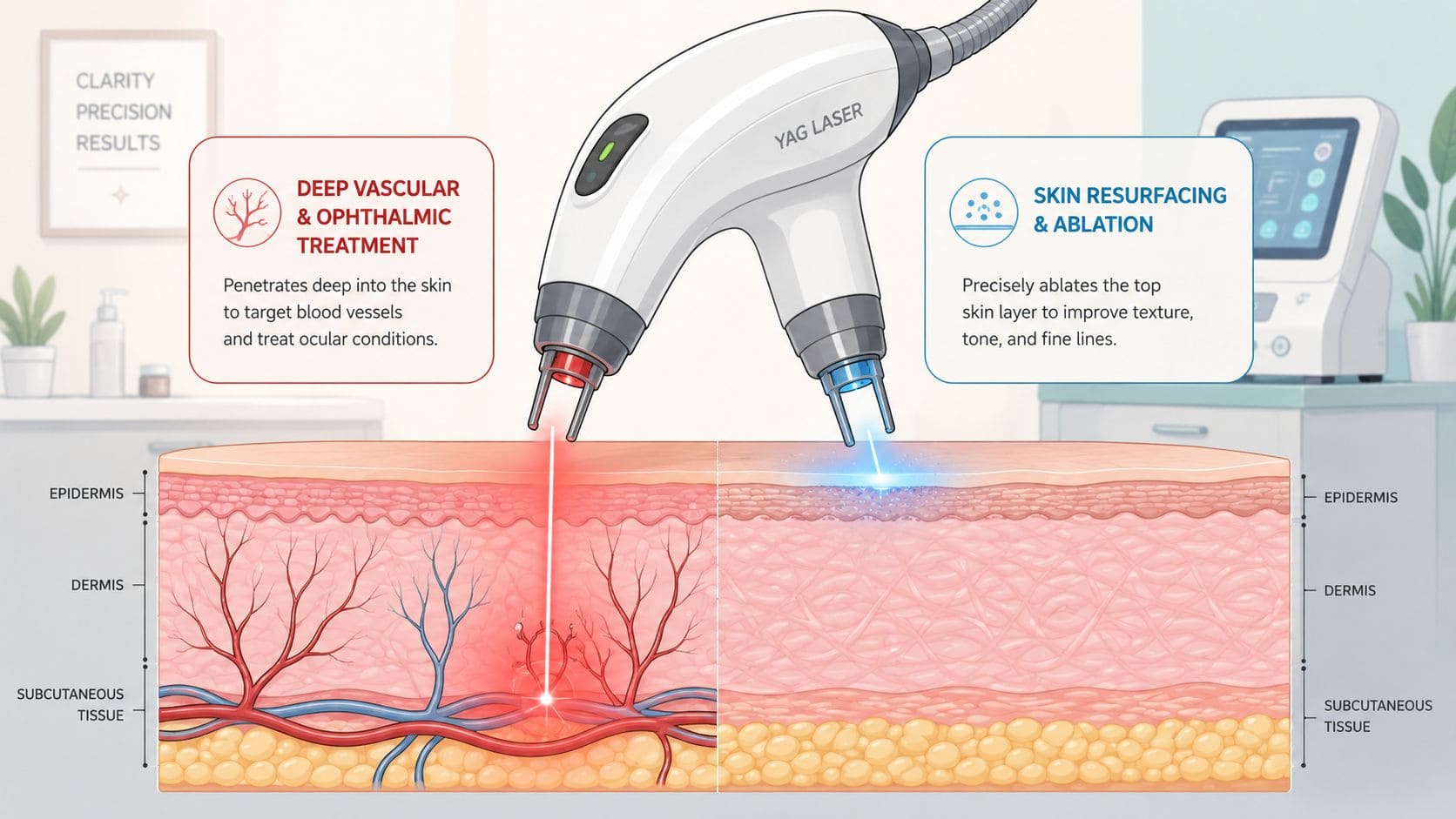
Most advice about YAG laser treatments gets one thing wrong from the start. It speaks as if YAG is a single treatment, when in practice it's a crystal platform that supports very different procedures, with very different risks, downtime, and business cases. If you're choosing equipment for a South African clinic, that distinction matters more than the marketing language around it.
Table of Contents
- Why Not All YAG Lasers Are the Same
- Understanding YAG Wavelengths and Pulse Mechanics
- Clinical Indications and Evidence Base
- What a YAG Treatment Looks Like in Practice
- How YAG Compares to Other Laser Modalities
- Choosing the Right YAG Device for Your Clinic
- Key Takeaways for Aesthetic Professionals
Why Not All YAG Lasers Are the Same
A clinic owner can't buy “a YAG” the way they'd buy one generic device for every indication. Nd:YAG and Er:YAG solve different problems, and they interact with tissue in very different ways. In South African practice, that difference matters even more because patient expectations, Fitzpatrick skin type diversity, and UV-related pigment concerns all affect what's safe and worth offering.
Nd:YAG and Er:YAG serve different clinical jobs
Nd:YAG at 1064 nm is the workhorse for ophthalmic capsulotomy and a range of deeper targets, while Er:YAG at 2940 nm is built for superficial resurfacing and precision ablation. That distinction is not academic. A device that is ideal for a blocked posterior capsule after cataract surgery is not the same thing as a platform for scar revision, and the treatment room should reflect that reality.
In eye care, Nd:YAG is established as the standard laser intervention for posterior capsule opacification, which is why it remains common in cataract follow-up pathways. The clinical burden is real, because posterior capsule opacification is reported in 20.7% of eyes by 2 years and 28.5% by 5 years after cataract surgery, and retinal detachment risk after Nd:YAG capsulotomy is estimated at about 4 times higher than after uneventful cataract surgery without capsulotomy (Nd:YAG posterior capsulotomy review). That is a strong reminder that the device's value sits beside a measurable complication profile.
Why this matters for clinic purchasing
For aesthetics, Er:YAG should be assessed as a resurfacing tool, not as a general-purpose “laser for everything.” Its clinical role is shaped by tissue precision, limited thermal spread, and the need for tight parameter control. In a market where many patients are cautious about downtime and post-inflammatory hyperpigmentation, especially after aggressive sun exposure, selecting the wrong modality can leave a clinic with expensive overlap and weak conversion.
Practical rule: if the sales pitch can't tell you whether the platform is Nd:YAG or Er:YAG, it's too vague to guide a purchase.
If you're evaluating capital expenditure, the device category matters as much as the footprint, and a price conversation without that context usually misses the point. For a starting reference point, a clinic buyer can review laser machine pricing considerations before comparing application fit.
Understanding YAG Wavelengths and Pulse Mechanics
YAG is a laser medium, specifically yttrium aluminium garnet, and the crystal can be engineered into very different clinical outputs. The useful short version is simple, Nd:YAG delivers deep, precise photodisruption, while Er:YAG delivers shallow, highly efficient ablation. Once a team understands that, device brochures become much easier to read critically.
Why wavelength changes what the laser can do
At 1064 nm, Nd:YAG penetrates more and is paired with nanosecond-scale pulses. The South African ophthalmic reference lists 1064 nm ±5 nm, 4.5 ns ±10% pulse width, and a maximum output of 11 mJ for single-pulse delivery, which sits within the sub-10 mJ operating window used to create optical breakdown in a localised plasma bubble rather than broad coagulation (ophthalmic Nd:YAG user documentation). That's why the pulse feels more like a precise hammer tap than a slow burn.
By contrast, Er:YAG at 2940 nm sits near water's absorption peak, so the laser energy is taken up very efficiently at the surface. The result is superficial ablation with less thermal diffusion than deeper-penetrating infrared systems, which is exactly why it's preferred for resurfacing and fine scar work (Er:YAG clinical guidance). In practice, pulse width matters as much as wavelength, because longer exposure leaves more residual heat while shorter pulses prioritise controlled vaporisation.
Energy, pulse mode, and tissue response
Clinical settings are not just numbers on a screen, they change the wound geometry. The same Er:YAG guidance reports superficial ablation settings around 2.5 to 5 J/cm² at 250 microseconds, while deeper scar protocols may use about 3 J/cm² at 1000 microseconds (Er:YAG clinical guidance). A published series also showed treatment passes escalating from 600 mJ micro-short pulses to 1500 mJ extra-long pulses at 5 Hz, which is a useful illustration of how operators adapt energy and pulse mode to lesion depth and scar density (Er:YAG clinical guidance).
Clinical translation: shorter pulses favour precision, longer pulses increase the heat effect, and the wrong choice can change healing just as much as the wrong wavelength.
For teams that also offer hair reduction and want to understand adjacent platforms, the same physics mindset applies when reviewing laser hair removal mechanics.
Clinical Indications and Evidence Base
The commercial mistake is to market every YAG use as equally proven. Some indications are well established, some are useful in narrow settings, and some remain controversial enough that a cautious clinic should treat them as optional rather than core revenue lines. A good acquisition strategy starts with that filter, not with the brochure.
Where the evidence is strongest
Nd:YAG posterior capsulotomy is the clearest ophthalmic use case. In a large FDA-analysed dataset of more than 17,000 cases, the procedure successfully opened the pupillary membrane in 98% of cases and improved vision in 84% of cases (FDA-analysed dataset). A modern clinical series also reported average total energy of 69.6 mJ in one follow-up group and 73.7 mJ in another, with vision improving from about 20/40 to 20/23 and 99% of subjects reporting improved vision (modern Nd:YAG capsulotomy series).
For dermatology, Er:YAG is the more relevant resurfacing tool. It fits scar revision and superficial photoageing treatments because the energy is concentrated where water absorption is highest, which supports precise ablation with tighter thermal control (Er:YAG clinical guidance). That's the use case to take seriously if your clinic sees patients asking for visible surface improvement without the same depth of injury associated with more aggressive ablative systems.
Where evidence is weaker or more conditional
YAG vitreolysis for floaters is the place where many marketing claims overreach. A 2020 systematic review found that after a mean follow-up of 14.7 months, only 35.8% of treated patients reported moderate relief and 2.5% reported significant relief, while 54% reported no relief and 7.7% felt worse (systematic review). Another evidence synthesis noted one randomised study with 54% symptom improvement versus 9% in controls, and another report where 50% of patients said their floaters were significantly or completely better at final follow-up, but the same review also documented 36 eyes treated with a mean of 218 laser shots and 1,316 mJ mean power, which shows how procedure intensity varies (NICE evidence overview).
| Indication | YAG Type | Evidence Strength | Typical Sessions |
|---|---|---|---|
| Posterior capsular opacification | Nd:YAG | Strong | Single treatment in many cases |
| Narrow-angle or angle-closure procedures | Nd:YAG | Strong for the relevant indication | Usually procedure-specific |
| Scar and photoageing resurfacing | Er:YAG | Useful where precision matters | Session count varies by severity |
| Vitreous floaters | Nd:YAG vitreolysis | Controversial | Often multiple, but results are inconsistent |
For vascular work, the treatment burden also varies by lesion depth and vessel size. A practical reference for session planning in related vascular care is dermatologic Nd:YAG treatment guidance, which notes that some vessels respond in a few sessions while others need more.
What a YAG Treatment Looks Like in Practice
A clean consultation is where good YAG outcomes start, because the device doesn't fix poor patient selection. In South African aesthetic practice, that means checking skin type, pigment history, and healing risk before anyone starts talking about fluence or passes. For resurfacing, that assessment is especially important in patients with a strong tendency to post-inflammatory hyperpigmentation.
A typical resurfacing visit
A patient with acne scarring arrives expecting “laser treatment” and needs a plain explanation of what Er:YAG can and can't do. The history should cover recent isotretinoin use and keloid tendency, because both matter when resurfacing is being considered. If the skin is reactive, the plan needs to be conservative, not ambitious.
Once the treatment plan is set, the clinician chooses the pulse mode based on depth. Superficial ablation settings are usually tighter, while deeper scar protocols may move towards the longer exposure range already outlined above (Er:YAG clinical guidance). That escalation is not about chasing stronger energy, it's about matching tissue response to the target.
The room flow and aftercare
Protective eyewear comes first, then cleansing, test pulses, and controlled passes over the target area. A practical workflow can look like this.
- Consultation and cleansing. Confirm the indication, assess the scar or lesion, and prepare the skin.
- Protective eyewear and numbing. Keep the eyes protected and make comfort part of the process.
- Calibration and test pulse. Check how the tissue responds before committing to full coverage.
- Controlled ablation passes. Adjust energy and pulse width according to lesion depth.
- Cooling and aftercare. Calm the skin, then give sun protection and healing guidance.
Do not overcall downtime. The patient needs a realistic recovery plan, not a glossy promise, especially in a sun-heavy environment where pigment control is part of the outcome.
The practical follow-through matters as much as the treatment itself, because a well-educated patient is less likely to panic over expected redness, dryness, or temporary textural change. That's where the consultation earns its place.
How YAG Compares to Other Laser Modalities
A clinic doesn't buy YAG in a vacuum. It buys a workflow, and that workflow has to sit next to IPL, diode, CO2 fractional, and Alexandrite without duplicating everything already in the room. The right question is not “Is YAG powerful enough?” It's “Where does YAG solve a problem another platform handles less well?”
Where Nd:YAG stands out
Nd:YAG is a strong fit when a clinic serves darker skin types or needs deeper targeting. Its value is strongest where pigment competition and depth matter, which is why it often earns its place in vascular work and in hair reduction systems that need broader skin-type flexibility. For clinics that already have faster hair-removal systems, Nd:YAG still matters if the patient mix includes skin types that need more caution.
Where Er:YAG sits beside CO2
Er:YAG and CO2 fractional are not interchangeable. Er:YAG is the precision resurfacing option, while CO2 fractional generally pushes deeper and can be more aggressive. That means CO2 may suit some stronger rejuvenation goals, but Er:YAG is the more restrained choice when a clinic wants visible resurfacing with a tighter thermal footprint and a more measured recovery profile.
Business trade-offs in a mixed-device clinic
IPL is broader but less selective, diode is often the workhorse for volume hair removal, and Alexandrite is favoured in certain lighter-skin hair-removal pathways. Nd:YAG earns its keep where those platforms either become less comfortable to use or less flexible in a diverse population. Er:YAG earns its keep where superficial resurfacing is the actual product, not just an add-on.
The most useful comparison isn't theoretical, it's operational. If a platform duplicates what's already in the clinic without expanding the patient base or improving safety margins, it's probably not the right next purchase.
Choosing the Right YAG Device for Your Clinic
Buying a YAG platform in South Africa should be a compliance decision first and a sales decision second. FDA approval, CE certification, and SAHPRA licensing are not decorative claims, they're the baseline for legal and clinical confidence in a practice that can't afford shortcuts. Once those boxes are ticked, the rest of the decision should focus on patient mix, training, and service support.
The checklist that actually matters
A device with the wrong support structure can become a shelf ornament. The purchase review should cover more than acquisition price, because the true cost includes staff training, maintenance, warranty coverage, and the time it takes to convert a device into booked treatments.
- Regulatory status. Confirm FDA approval, CE certification, and SAHPRA licensing before you talk about ROI.
- Training depth. Make sure training covers patient selection, complication management, and protocol optimisation, not just button operation.
- After-sales support. Ask who handles technical troubleshooting, calibration issues, and service response.
- Workflow fit. Check whether the platform matches the skin types, indications, and session lengths your clinic sees.
- Revenue logic. Decide whether the device adds a new service line or overlaps an existing one.
Why supplier support changes the ROI calculation
A clinic owner often underestimates how much the back-end support matters. If the team gets formal onboarding, marketing support, business development guidance, and a clear service pathway, the device becomes easier to integrate into the schedule and easier to explain to patients. Omega Lasers is one example of a supplier in this space that offers FDA approved, CE certified, and SAHPRA licensed systems alongside training and support, which is the kind of package that makes adoption more predictable.
Vendor question: if the supplier can't explain patient selection and complication pathways as clearly as device settings, keep looking.
The device choice should also reflect the clinic's treatment menu. If you already have strong resurfacing capability, a YAG purchase only makes sense if it closes a gap in depth, safety, or patient type. If you don't, it can still be a strategic buy, but only when the support stack is solid.
Key Takeaways for Aesthetic Professionals
The best way to think about YAG laser treatments is not as one technology, but as a family of very different clinical tools. Nd:YAG is the deeper, photodisruptive platform with strong ophthalmic relevance and useful roles in deeper targets, while Er:YAG is the precise resurfacing platform suited to superficial ablation and scar work. That single distinction should shape how a clinic assesses training, positioning, and return on investment.
The evidence is also not uniform. Nd:YAG posterior capsulotomy has strong support, with a large dataset showing 98% successful opening and 84% vision improvement (FDA-analysed dataset), while floater treatment remains controversial and should be marketed with caution, if at all (systematic review). Er:YAG has a clearer role in precision resurfacing, but it still depends on conservative parameter selection and honest aftercare.
For a South African clinic, the decision framework is straightforward. If your patient base needs ophthalmic follow-up support, deeper precision, or skin-type flexibility, Nd:YAG is the platform to study first. If your real opportunity is resurfacing and scar revision with measured downtime, Er:YAG deserves serious consideration.
If you're evaluating a YAG platform for your clinic, Omega Lasers can help you compare device fit, training needs, and service support against the treatments you plan to offer. Visit Omega Lasers to review the current range and discuss a setup that matches your patient mix and growth plans.