




If you run a clinic in South Africa, you have probably had the same thought recently. Hair removal is steady. Skin treatments are familiar. But clients keep asking for waistline reduction, tummy tightening, bum lifting, muscle tone, and “something that works without surgery”.
That is the point where a body sculpting machine moves from a nice idea to a serious buying decision.
The problem is that most advice online is written for the US market, leans heavily on manufacturer talking points, or skips the two issues that matter most in South Africa. Regulatory compliance and real return on investment. If you get either wrong, a promising treatment category can become an expensive distraction.
The Growing Demand for Body Sculpting in South Africa
Clinics do not add a body sculpting machine because it sounds modern. They add it because clients want visible body-focused treatments that fit into working lives, family schedules, and realistic recovery expectations.
That demand is not a short-lived spike. The global body contouring devices market was valued at approximately USD 1.50 billion in 2023 and is projected to reach around USD 3.86 billion by 2030, representing a CAGR of approximately 14.3% according to this market overview. For clinic owners, that matters because it confirms a broader shift towards non-invasive and minimally invasive aesthetic services.

Why South African clinics are paying attention
South African clients are asking for slimming. They are asking for:
- Low disruption: Treatments that do not force time away from work or home responsibilities.
- Visible improvement: Not vague “wellness” language. They want shape change, firmer tissue, or better definition.
- Alternatives to surgery: Many clients are open to a device-based plan long before they consider an operating theatre.
- Combination outcomes: Fat reduction alone is not enough. Clinics increasingly need options that also address skin quality or muscle tone.
This creates a strong commercial opening for practices that understand consultation, treatment planning, and package sales.
A category that suits modern clinic economics
A body sculpting machine also fits the way many clinics want to grow. It adds a high-interest service line without forcing the practice into theatre-level complexity. That matters if you are expanding and want treatments that your front desk, therapists, and doctors can explain.
A body sculpting service works best when it is positioned as a structured treatment pathway, not a one-off impulse treatment.
If you are tracking where the local device market is moving, Omega Lasers’ overview of top aesthetic device trends in South Africa is useful context. The key point is simple. Body contouring has moved into the mainstream of aesthetic service planning.
For the right clinic, this is not just another machine category. It is a chance to build recurring revenue from consultations, treatment courses, add-on services, and maintenance plans.
Understanding How Body Sculpting Machines Work
A good body sculpting machine does one of two things well, and sometimes both. It either targets fat, or it targets muscle and tissue support, or it combines technologies to address more than one concern in the same treatment plan.
That distinction matters because many buying mistakes happen when a clinic assumes all sculpting devices do the same job.
Fat reduction works by selective targeting
Most fat-focused systems are designed to place stress on fat cells without creating the kind of trauma associated with surgery. The method differs by platform. Some use cold. Some use heat. Some use sound energy.
The principle is similar. The treatment creates a controlled effect in the target tissue, and the body then clears the affected fat cells over time. That is why results are gradual rather than immediate.
A practical way to explain this to clients is to compare it with targeted renovation. You are not knocking down the whole building. You are working on one area, with a tool designed for that tissue.
Muscle-focused systems work differently
Devices that use electromagnetic stimulation are not primarily “fat melters”. They create intense muscle contractions that the client cannot reproduce in a normal workout.
In practice, this changes the consultation. A patient asking for a flatter abdomen may need a fat-reduction treatment, a muscle-toning treatment, or a combination plan. If your team cannot tell the difference, you will overpromise and underdeliver.
Skin tightening is the missing piece
Radiofrequency platforms become commercially useful in this context. A client may lose bulk in one area but still dislike looseness or poor tissue tone. Heat-based technology can support collagen stimulation and improve the look and feel of the treatment area.
That is also why single-technology buying can become limiting. If your market wants “snatched waist plus tighter skin” or “post-weight-loss smoothing”, the device must match the problem.
Why this category has matured
Body contouring is no longer treated as a fringe add-on in aesthetics. The commercial maturity of the space was reinforced when AirSculpt Technologies, Inc. completed its Nasdaq IPO on October 29, 2021, raising approximately USD 160 million, as noted in this company history summary. For clinic owners, the significance is not the stock market story itself. It is that investors backed advanced contouring technology as a serious medical-aesthetic category.
What this means in the treatment room
A body sculpting machine is not a weight-loss device. It is a shape-change tool. It performs best when the patient has a defined concern such as:
- Localised fullness: Abdomen, flanks, thighs, bra line, arms.
- Poor muscle definition: Abdomen, buttocks, arms.
- Mild tissue laxity: Areas where tightening matters as much as reduction.
- Post-lifestyle frustration: Clients who train, eat reasonably well, and still dislike a stubborn zone.
The best consultations focus on the problem in front of you, not on the machine you want to sell.
Once you understand the mechanism, your buying criteria become clearer. You stop asking, “Which body sculpting machine is popular?” and start asking, “Which technology matches my client base, my staff skill level, and my package model?”
Comparing Core Body Sculpting Technologies
If you are choosing a body sculpting machine for a South African clinic, the first practical question is not brand. It is modality.
Each technology solves a different problem. Some reduce fat better than they tone muscle. Some are easier to sell in a salon setting. Some require stronger consultation skills because the results are more gradual or nuanced.
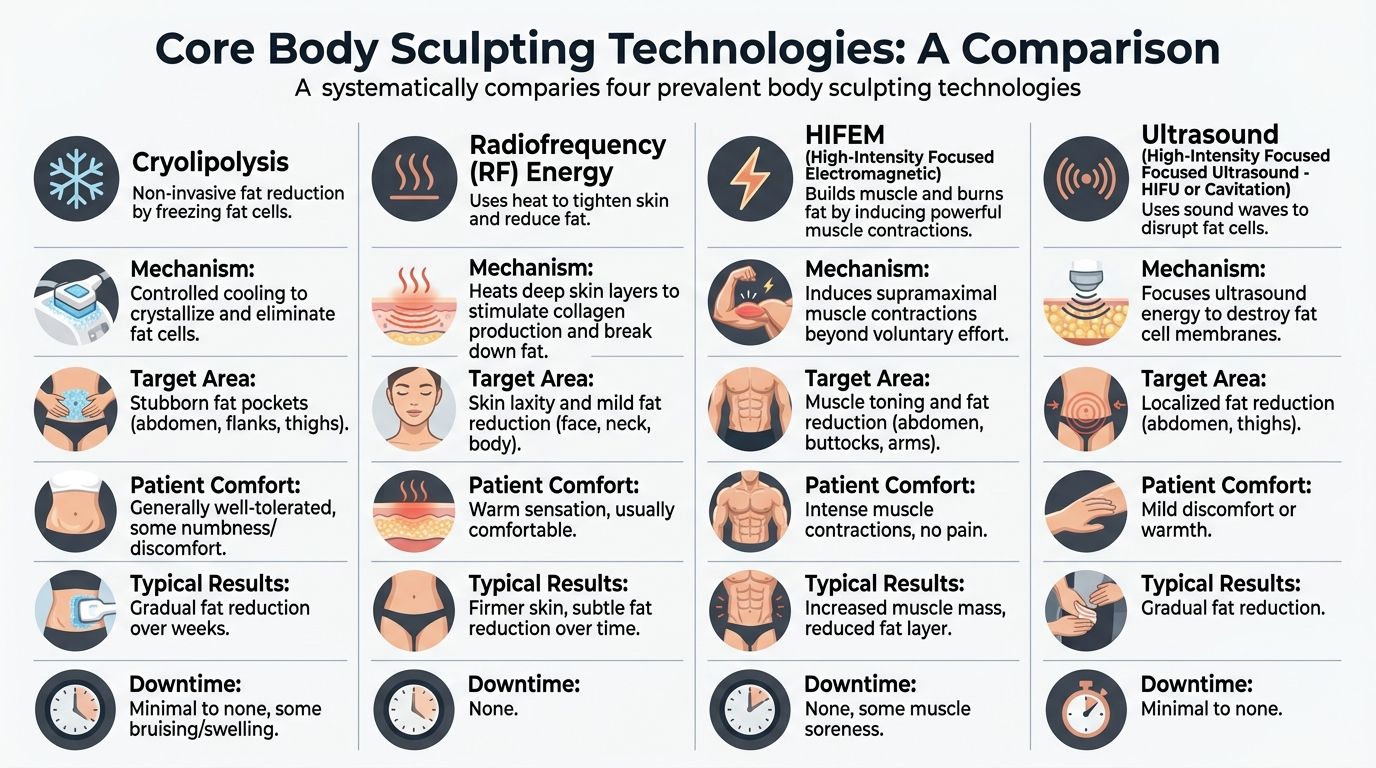
Quick comparison
| Technology | Main job | Best fit | Patient experience | Main limitation |
|---|---|---|---|---|
| Cryolipolysis | Fat reduction | Localised stubborn fat | Pulling, cold, numbness | Does not build muscle |
| Radiofrequency | Skin tightening with some fat support | Mild laxity and contour refinement | Warm and comfortable | Subtler for bulk reduction alone |
| HIFEM or EMS-type systems | Muscle stimulation and body shaping support | Definition-focused clients | Strong contractions, workout-like fatigue | Not ideal when excess fat is the main issue |
| Ultrasound or cavitation | Localised fat disruption | Clients wanting non-surgical inch-loss style services | Mild warmth or sensation | Results depend heavily on patient selection and protocol discipline |
Cryolipolysis
Cryolipolysis remains easy for patients to understand. Fat cells are exposed to controlled cooling, which targets the area without surgery.
For clinics, its strength is clarity. Clients arrive familiar with the idea of “fat freezing”. That lowers the educational burden at consultation.
It suits patients with pinchable, localised fat who are close enough to their desired shape that targeted reduction makes sense.
What works well
- Simple messaging: Easy to explain and market.
- Defined treatment zones: Abdomen, flanks, thighs and similar pockets.
- Minimal interruption: Clients can resume normal activity quickly.
What does not work well
- Poor candidate selection: Generalised obesity is not the right fit.
- Loose skin cases: Volume reduction without tissue support can disappoint.
- One-session expectations: Many clients expect dramatic change too early.
Radiofrequency
Radiofrequency is undervalued because it does not sound as dramatic as freezing or magnetic stimulation. In practice, it can be one of the most commercially sensible options if your clinic sees many clients with mild laxity, early body ageing, or post-partum tissue concerns.
The treatment heats deeper tissue in a controlled way. That can support tightening and improve the appearance of the area over a treatment course.
RF is the technology that saves a result from looking incomplete. A slimmer area with poor skin tone is not always a satisfying outcome.
Strong use cases
- Clients who say their skin feels loose rather than “fat”.
- Patients who need contour refinement rather than aggressive reduction.
- Combination protocols with other body sculpting technologies.
Trade-off
- It can be harder to market if your advertising relies on dramatic before-and-after language. RF tends to reward skilled consultation more than flashy promises.
HIFEM and EMS-based systems
This category appeals to a different buyer and a different patient. It is for muscle engagement, muscle definition, and body shaping support.
The patient experience is distinct. They feel repeated involuntary contractions, described as intense but tolerable. It feels active, not passive.
Clinics do well with these systems when they target clients who care about shape, firmness, posture, and definition. Fitness-oriented patients understand the proposition quickly.
Best for
- Abdominal definition: Clients chasing a firmer midsection.
- Buttock enhancement support: Patients wanting lift and tone without injectables or surgery.
- Maintenance programmes: Clients who respond well to repeat visits.
Watch-outs
- If the area has significant fat volume, muscle stimulation alone will not solve the visual problem.
- Teams oversell “fat loss” when the value is tone and body shape support.
- Contraindication screening and operator training must be tight.
Ultrasound and cavitation
Ultrasound-based contouring sits in an interesting middle ground. It is attractive to clinics because the treatment feels approachable and can be packaged well.
The challenge is consistency. Outcomes depend on the device quality, the treatment protocol, and whether the clinic uses it on the right candidate.
Some clinics make this technology profitable through disciplined package structures and realistic consultation language. Others struggle because they market it too broadly.
Which technology should you prioritise
The best answer depends on your current patient base.
| If your clinic mainly sees… | Prioritise considering… |
|---|---|
| Clients with stubborn fat pockets | Cryolipolysis or ultrasound-based fat systems |
| Clients worried about skin looseness | Radiofrequency |
| Fitness-minded clients seeking tone | HIFEM or EMS-based systems |
| Mixed concerns in one market | Multi-modality platforms |
A clinic with varied demand benefits more from a platform that lets you layer treatment goals than from a single-purpose machine that only solves one problem.
The wrong purchase is not a bad machine. It is a machine bought for the wrong market. Start with your consultation diary, your common treatment requests, and the outcomes your team can explain.
Navigating Regulatory and Safety Requirements in SA
Many clinics make preventable mistakes in this area. They compare a body sculpting machine by price, screenshots, and overseas certifications, then assume local compliance will sort itself out later.
It does not.
In South Africa, a device can look impressive online and still become a problem in your treatment room if its regulatory status is unclear or its claims are not supported.

Why SAHPRA matters more than generic overseas claims
Many distributors market devices with heavy emphasis on FDA or CE references. Those can be relevant, but they do not replace local due diligence.
A 2025 SAHPRA report notes that 40% of imported aesthetic devices fail initial compliance audits due to unverified efficacy claims, and clinics using non-compliant devices risk fines up to R500,000 or device seizures, according to the cited industry reference on SculpSure and compliance context. For a clinic owner, that changes the conversation immediately.
The device is not only a treatment tool. It is a compliance exposure if you buy carelessly.
What to verify before you buy
Ask for documentation before you discuss finance.
- SAHPRA status: Confirm the device’s local regulatory position, not just its overseas approvals.
- Claim support: If a distributor promises inch loss, fat reduction, tightening, or muscle effects, ask what substantiates those claims.
- Supplier accountability: Find out who will support you if there is a technical, safety, or compliance issue.
- Operator training: A compliant machine can still become a clinical risk if the training is weak.
A serious supplier should answer these questions in writing.
Compliance is a business advantage
Clinic owners treat compliance as paperwork. That is the wrong frame.
A compliant body sculpting machine helps you do three valuable things:
Protect the practice
You reduce the risk of enforcement action, reputational damage, and treatment disputes tied to unsupported claims.
Improve consultation quality
Teams speak more carefully and more credibly when they are trained around approved indications rather than exaggerated marketing language.
Market with confidence
Clients are becoming more sceptical. “SAHPRA-licensed” is not a technical footnote. It is a trust signal.
In South Africa, the cheaper machine is the more expensive decision once compliance risk, downtime, and replacement costs enter the picture.
Practical buying discipline
When I advise clinics, I tell them to slow down at the point where excitement is highest. That is after a demo that looks good and before the paperwork has been checked.
Use a short decision filter:
| Question | Why it matters |
|---|---|
| Can the supplier verify local compliance clearly? | Protects the clinic from avoidable risk |
| Are the treatment claims realistic and supportable? | Reduces complaints and refund pressure |
| Is training structured, not improvised? | Helps staff produce consistent results |
| Is technical support local and responsive? | Limits service interruptions |
This is also the point where a supplier such as Omega Lasers, which states that its systems are FDA approved, CE certified, and SAHPRA licensed, becomes relevant as one factual example among the options available to South African practices.
A body sculpting machine should strengthen your reputation, not test it. In this market, compliance is part of clinical quality.
Calculating the ROI of Your New Sculpting Device
A body sculpting machine can earn well. It can also sit in a corner while the clinic pays instalments and wonders why demand did not convert.
The difference comes down to whether the owner built a real utilisation plan before signing the order.
In the South African market, that planning matters even more because electricity costs have risen significantly, and import duties affect equipment pricing. At the same time, with average session prices around R2,500, a clinic can achieve a 6-month payback by conducting 20 sessions per month, according to the cited ROI context in this market reference.
Start with the three numbers that matter
Do not overcomplicate the first model. Start with:
- Your treatment price
- Your realistic monthly treatment volume
- Your operating discipline
Most clinics go wrong on the middle number. They model sales based on hope rather than current consultation flow, database quality, and front-desk selling ability.
Example monthly revenue projection
| Metric | Low Volume Scenario (10 clients/month) | High Volume Scenario (25 clients/month) |
|---|---|---|
| Clients per month | 10 | 25 |
| Average session price | R2,500 | R2,500 |
| Estimated monthly revenue | R25,000 | R62,500 |
That table is deliberately simple. It does not pretend every clinic has the same finance terms, staffing costs, or treatment structure. It does show the core commercial point. Utilisation changes everything.
What clinic owners miss
A sculpting device does not only need bookings. It needs repeatable bookings.
That means you should price and package around a treatment plan, not around a once-off session. A body area consultation should lead to a structured recommendation with review points, photos, and maintenance logic.
The strongest ROI comes from clinics that do the following well:
- Sell courses, not isolated appointments: This improves continuity and helps clients commit.
- Use consultation photography: Better client understanding reduces friction and indecision.
- Train the front desk: Reception makes or breaks machine utilisation.
- Link body services to existing traffic: Hair removal, skin, and wellness clients are the easiest first market.
Your hidden costs are operational, not only financial
Owners tend to worry about purchase price. Fair enough. But underperformance comes from execution failures:
| Common problem | Business effect |
|---|---|
| Weak staff confidence | Poor conversion from consult to booking |
| Vague messaging | Wrong-fit clients and refund pressure |
| Inconsistent protocols | Uneven outcomes and weak word of mouth |
| No maintenance strategy | Strong starts, then declining repeat revenue |
This is why reading a broader service profitability article such as how much a clinic can earn with a diode laser is useful even if the modality differs. The business principle is the same. Device ROI depends on utilisation, retention, and team performance.
The machine does not create ROI. A well-run treatment system does.
A realistic way to judge the investment
Ask yourself four blunt questions before buying:
- Do we have a client base asking for body treatments?
- Can our team explain the difference between fat reduction, skin tightening, and muscle toning?
- Will we launch with packages and a campaign, or just add the service to the menu without much fanfare?
- Do we have supplier support strong enough to keep the device in use, not in repair limbo?
If the answers are solid, a body sculpting machine can become one of the more commercially useful additions to a modern aesthetic practice. If the answers are vague, the machine is not the problem. The rollout plan is.
Integrating and Marketing Your Body Sculpting Service
Buying the machine is the easy part. Building it into the daily rhythm of the clinic is harder.
Most underperforming body services fail for ordinary reasons. Staff are unsure. Consultations are inconsistent. Social media looks generic. The clinic waits for demand instead of shaping it.
Train beyond the operator
Only training the person who presses the buttons is a mistake.
Your receptionist must know how to answer first-contact questions. Your consultation lead must know who qualifies and who does not. Your treating practitioner must know how to explain realistic timelines without sounding hesitant.
A workable structure looks like this:
- Reception training: Cover common questions, pricing language, and how to move interest into consultation.
- Consultation training: Focus on candidacy, contraindications, expectations, and package design.
- Treatment training: Standardise protocols, photography, consent, comfort management, and follow-up.
- Review training: Teach staff how to assess progress and recommend the next step.
Market outcomes, not gadgets
Clients rarely care about the physics first. They care about the problem they want solved.
That means your messaging should be built around concerns such as stubborn tummy fullness, waist definition, post-partum body confidence, or firmer glutes. The technology matters, but only after the client recognises themselves in the message.
Good launch marketing includes a mix of:
- Consultation-led offers: Invite assessment rather than pushing a rushed special.
- Before-and-after education: Use this with realistic framing.
- Short video explanations: Show what the treatment feels like and who it suits.
- Database reactivation: Existing clients are your first body sculpting buyers.
Build packages that make clinical sense
Do not package purely for revenue. Package based on the treatment logic of the modality.
A fat-focused plan differs from a tone-focused plan. A tightening-focused client may need a different spacing and review structure than someone pursuing abdominal definition.
Clinics do better when they create package pathways such as:
| Patient goal | Better package approach |
|---|---|
| Stubborn localised fat | Consultation plus course of area-focused sessions |
| Flatter and firmer abdomen | Combined fat and muscle strategy where appropriate |
| Post-weight-loss refinement | Tightening-led plan with review milestones |
| Ongoing body maintenance | Structured top-up schedule |
Use your current clinic traffic
The fastest wins come from people who trust you.
A client coming for laser hair removal, facials, anti-ageing work, or skin revision may be open to body contouring if you present it correctly. That is where cross-service education matters.
If you are reviewing broader equipment options for expansion, Omega Lasers’ salon equipment range gives a useful sense of how clinics build service lines around complementary devices rather than one isolated purchase.
The strongest body sculpting launch is internal. Existing clients convert faster than cold audiences because trust is already in place.
Protect the patient journey
Every body sculpting consultation should include clear boundaries.
Say what the treatment is for. Say what it is not for. Explain that body contouring is not a substitute for medical weight management. Explain when maintenance may matter. Explain what can limit results.
That honesty does not reduce sales. It improves them. Clients who understand the process are easier to retain, easier to review, and more likely to refer appropriately.
Your Body Sculpting Machine Questions Answered
How do I manage client expectations properly
Be specific early. A body sculpting machine can improve shape, contour, firmness, or muscle tone depending on the technology, but it is not a shortcut for broad weight loss.
Use consultation photos, body-area assessment, and plain language. If the patient expects surgery-level change from a non-surgical device, correct that before they pay.
Who is the right candidate
The best candidates have a defined concern in a defined area. They are looking for contour improvement, not a total body transformation.
Poor candidates include people with unrealistic expectations, unclear medical suitability, or a problem that the chosen technology does not solve. A patient with excess fat and loose skin may need a different plan from someone who desires more abdominal definition.
Should I choose one technology or a multi-function platform
That depends on your market.
If your clinic serves one very specific demand category, a focused device can work. If your consultations reveal mixed concerns, such as fat, laxity, and muscle tone, a broader platform makes more operational sense.
The key is not buying more technology than your team can use well.
How important is after-sales support
It is central.
A body sculpting machine only earns when it is running, understood by staff, and backed by practical support. Delayed service, weak training, or poor consumables planning can turn a promising treatment into an admin problem.
Ask suppliers what happens after installation. Not during the demo, but after.
Can body sculpting be combined with other services
Yes, effectively, provided the treatment logic is sound and the patient is suitable.
Body contouring can sit well alongside broader aesthetic planning when you sequence treatments and avoid crowding the same patient journey with many promises. The best combinations are the ones your team can explain and deliver consistently.
What is the biggest mistake clinics make
They buy for excitement instead of fit.
The right body sculpting machine is the one that matches your local demand, your compliance requirements, your team’s communication skills, and your financial model. Clinics that stay disciplined on those four points make better buying decisions than clinics chasing whatever is trending online.
If you are weighing up a body sculpting machine for your practice, Omega Lasers can help you assess the practical side of the decision, including technology fit, training, compliance expectations, and how the device could sit within your existing service mix.