



You’re probably looking at your treatment menu and asking a practical question. Which service gives consistent demand, visible outcomes, and repeat bookings without turning your clinic into a complication factory.
Permanent hair reduction is usually one of the strongest answers.
For a South African clinic, it’s more than a popular add-on. It can become the treatment that stabilises bookings, introduces new clients to your practice, and creates recurring revenue through consultation, package planning, treatment series, and maintenance. Done properly, it also builds trust fast, because clients can see and feel progress.
Why Permanent Hair Reduction is a Cornerstone Service
A new clinic owner usually sees the same pattern early on. Facials book well, peels bring in regulars, and injectable or body clients can be high value. Yet the diary still needs one treatment category that is easy to sell, simple for clients to understand, and strong enough to support repeat bookings month after month.
Permanent hair reduction often becomes that anchor service.
It solves a problem clients already want fixed. Shaving, waxing, pseudofolliculitis, visible regrowth, and ongoing irritation are not minor frustrations. They affect confidence, grooming time, and comfort. In practice, that means consultations are easier, treatment plans are easier to justify, and package uptake is usually stronger than with many discretionary aesthetic treatments.

Why it works commercially
Demand helps, but demand is not the only factor. A cornerstone service must also work operationally inside a real clinic in South Africa, where staffing, consumables, compliance, patient mix, and cash flow all matter.
Hair reduction performs well because the business model is clear:
- Package-based revenue: Most patients need a treatment course rather than a once-off visit, which improves forward bookings and cash flow visibility.
- High lifetime value: A patient who starts with underarms often adds bikini, legs, face, chest, or back once they trust your assessment and results.
- Low confusion at point of sale: The benefit is easy to explain. Less hair, fewer ingrowns, and less time spent on temporary methods.
- Strong word of mouth: Patients notice reduced density and slower regrowth. Visible change drives referrals better than treatments with subtle results.
From a training perspective, it is also one of the smartest device categories to master early. The consultation structure is repeatable, photography is straightforward, treatment intervals are predictable, and the service creates natural opportunities to improve retail, cross-sell skin treatments, and fill quieter slots with booked series instead of one-off specials.
Practical rule: If you want one device service to support growth, choose a treatment patients already ask for, can afford in packages, and can judge by visible progress. Permanent hair reduction fits that brief.
Why it suits the South African market
South Africa gives clinics a genuine advantage here, but only if the service is set up properly. The patient base is broad. Skin types are diverse. Hair characteristics vary by area, age, hormones, and ethnicity. That creates demand across a wide segment of the market, not only a narrow cosmetic niche.
It also raises the standard required from the clinic owner.
Safe, profitable hair reduction in this market depends on three things. SAHPRA-compliant equipment, careful patient selection, and operators who understand how to treat darker skin types without pushing unsafe settings. A clinic using a modern multi-wavelength platform has far more flexibility than a clinic trying to force every patient into one wavelength and one protocol. That affects safety, outcomes, and marketing. If you can treat a wider range of suitable patients well, your addressable market is larger and your referral base is stronger.
Here, many owners either build momentum or lose it. The clinics that do well do not compete on low pricing alone. They build a reputation for treating mixed skin types responsibly, setting realistic expectations, and getting patients through a full course with good compliance. That combination improves retention and protects margins.
The Science Behind Effective Hair Reduction
Clients often say “hair removal”, but the clinically accurate term is permanent hair reduction. That wording matters. You’re not promising that every follicle will never produce a hair again for the rest of the client’s life. You’re promising a long-term reduction in the number of hairs regrowing after a properly completed treatment course.
How laser energy finds the follicle
A simple analogy helps. Leave a black car and a white car in the sun. The darker surface absorbs more heat. Hair behaves in a similar way because the laser targets melanin in the shaft and follicle.
That process is called selective photothermolysis. The light is selected for a target, melanin. The absorbed light converts to heat. If enough heat reaches the right structures in the follicle for the right amount of time, the follicle is damaged enough to reduce future growth.
Why multiple sessions are not optional
Hair doesn’t grow in one uniform wave. Different follicles are in different stages at different times.
The key stage for treatment is anagen, the active growth phase, because the follicle contains the strongest connection between the visible hair and the deeper target structures. Some follicles are in catagen or telogen, where treatment is less effective. That’s why one excellent session never replaces a full course.
In practice, this is what new operators must understand:
- You’re treating a cycle, not just a hair. Visible hair on the skin doesn’t guarantee that follicle is in the ideal stage.
- Timing matters. Sessions must be spaced correctly to catch new follicles as they enter anagen.
- Consistency matters more than intensity alone. Missing intervals or stopping too early reduces final outcome quality.
Why Nd:YAG matters for darker skin
In South Africa, this is one of the most important technical decisions you’ll make.
The Nd:YAG laser at 1064 nm has deep penetration of 5 to 6 mm and minimal epidermal melanin absorption, which makes it especially suitable for darker skin tones. Its longer wavelength bypasses more melanin in the skin and targets the follicle, producing irreversible damage at 70 to 80°C, with less than 1% burn incidence in Fitzpatrick types V-VI when used correctly, as outlined in the StatPearls review on laser hair removal.
Permanent hair reduction works best when you stop chasing visible hair on the surface and start thinking about follicle biology, wavelength behaviour, and heat placement.
What doesn’t work as well as people think
A few errors show up repeatedly in underperforming clinics:
- Treating tanned or poorly assessed skin: This increases risk and often forces weak settings.
- Overpromising after one or two sessions: Clients then assume the treatment has “stopped working” when dormant follicles emerge later.
- Using one generic protocol on everyone: Hair density, skin tone, body area, and hormonal drivers all change your approach.
- Ignoring consultation language: If your consent and explanation are sloppy, even good results can feel disappointing to the client.
Good science creates good communication. And good communication protects both outcomes and reputation.
Choosing Your Laser Technology Wavelengths Explained
The most expensive mistake in this category isn’t buying a poor machine. It’s buying a machine that doesn’t match your patient mix.
If your clinic serves mainly lighter skin with dark hair, one wavelength may cover much of your demand. If your clinic serves a broad South African demographic, a narrow technology choice can limit both safety and revenue. That’s why wavelength selection is a business decision as much as a clinical one.
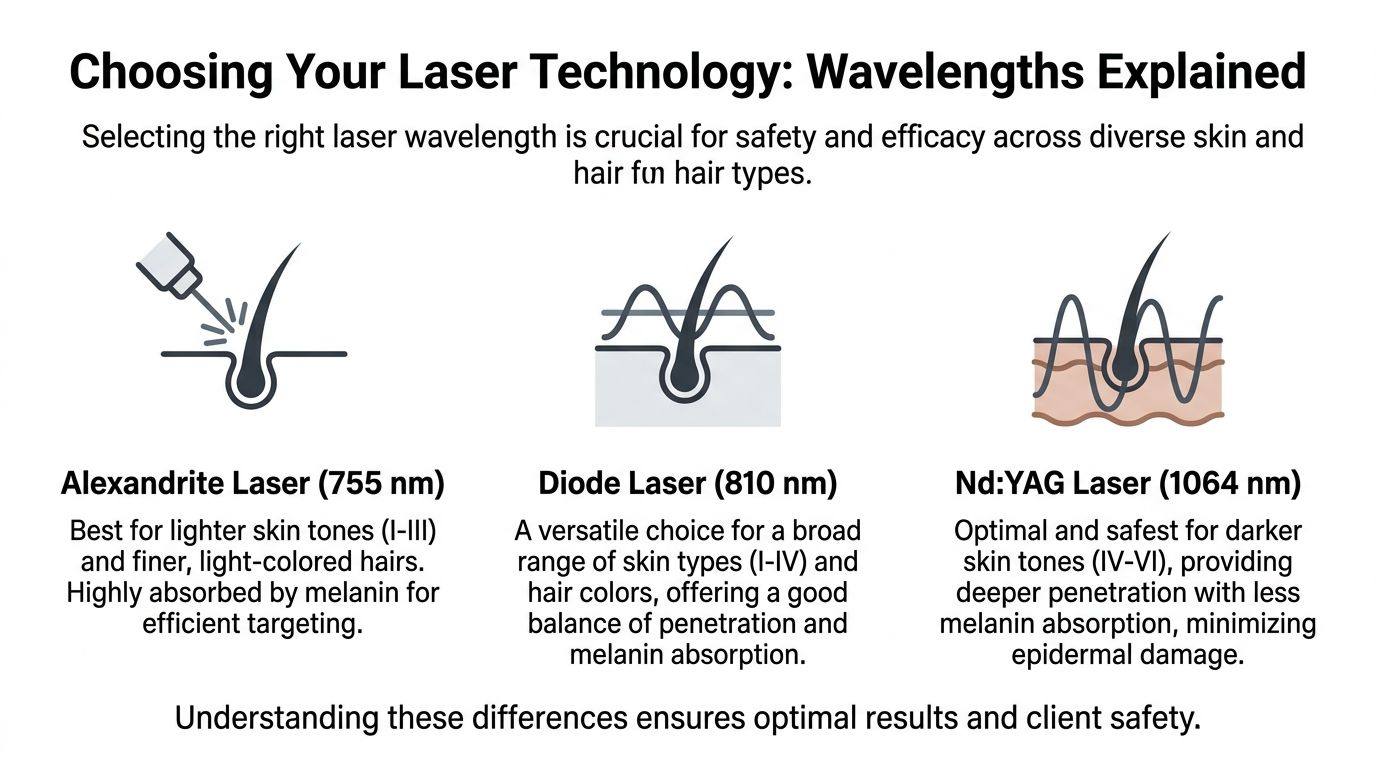
Three wavelengths you need to understand
Alexandrite 755 nm
Alexandrite is strongly absorbed by melanin. That’s why it’s often chosen for lighter skin tones and finer dark hair where efficient pigment targeting is useful.
Its trade-off is also obvious. Strong melanin attraction can become a liability in darker skin if the operator, cooling, or patient selection is poor. In the wrong hands, it narrows your safety margin.
Diode 810 nm
Diode sits in a useful middle ground. It offers a balance between melanin absorption and penetration depth, which is why many clinics use it across a fairly broad range of cases.
It’s a practical wavelength for clinics that want versatility. In real-world use, that often translates into good utility across common body areas and a broad everyday client base.
Nd:YAG 1064 nm
Nd:YAG is the wavelength many clinics rely on for safer treatment of darker skin types. It penetrates deeper and interacts less with epidermal melanin, which helps reduce risk when treating richly pigmented skin.
The trade-off is that treatment can feel less “forgiving” if the operator doesn’t understand endpoint assessment and appropriate settings. Safety improves when technique improves.
Laser Wavelength Comparison for Hair Reduction
| Wavelength | Ideal For | Pros | Cons |
|---|---|---|---|
| Alexandrite 755 nm | Lighter skin tones and finer dark hairs | Strong melanin absorption, efficient targeting | Narrower safety margin in darker skin |
| Diode 810 nm | Broad clinic use across varied hair and skin presentations | Versatile balance of penetration and pigment targeting | May not be the strongest fit for every specific niche on its own |
| Nd:YAG 1064 nm | Darker skin tones and deeper follicle targeting | Lower epidermal melanin absorption, safer option for high-melanin skin | Requires confident technique and good parameter selection |
Single wavelength versus multi-wavelength platforms
A single wavelength platform can still be the right purchase if your market is tightly defined and your protocols are disciplined. But many South African clinics don’t serve a narrow market. Their clientele spans different skin tones, body areas, hair calibres, and comfort thresholds.
That’s where multi-wavelength platforms become commercially useful. They give the operator more clinical range without forcing the business to refer out large parts of the local market.
One example is a platform such as Omega Lasers Tetra Cool, which combines four wavelengths and integrated cooling in a format intended for clinics that want broader treatment flexibility across skin and hair types. If you’re comparing laser against light-based alternatives, this overview of IPL and laser hair removal differences is useful for framing where each modality fits.
The right machine is the one that lets your team treat your market safely, not the one that looks strongest on a brochure.
What to ask before you buy
Don’t reduce the purchase to wavelength alone. Ask harder questions.
- Who are your clients really? Review your skin type distribution, common treatment areas, and whether facial hair or body hair dominates demand.
- How strong is the support model? Training quality, service turnaround, and consumable or maintenance realities affect profitability more than many owners expect.
- Does the cooling system support confident treatment? Good cooling helps comfort, but it also helps your operators work closer to effective settings without unnecessary risk.
- Will it scale with your clinic? A machine that suits one room and one operator may not suit a growing team or mobile expansion model.
What works and what doesn’t
What works is matching your device to your market, then building protocols around skin type, hair type, and area.
What doesn’t work is buying a low-cost platform because the finance figure looks easy, then discovering it can’t safely treat the clients who walk through your door. That usually leads to weak settings, poor outcomes, discounting, and preventable reputational damage.
Setting Realistic Goals for Hair Reduction Results
The consultation is where clinics either build long-term trust or plant the seed of future complaints. Most dissatisfaction in permanent hair reduction doesn’t come from poor technology alone. It comes from poor expectation setting.
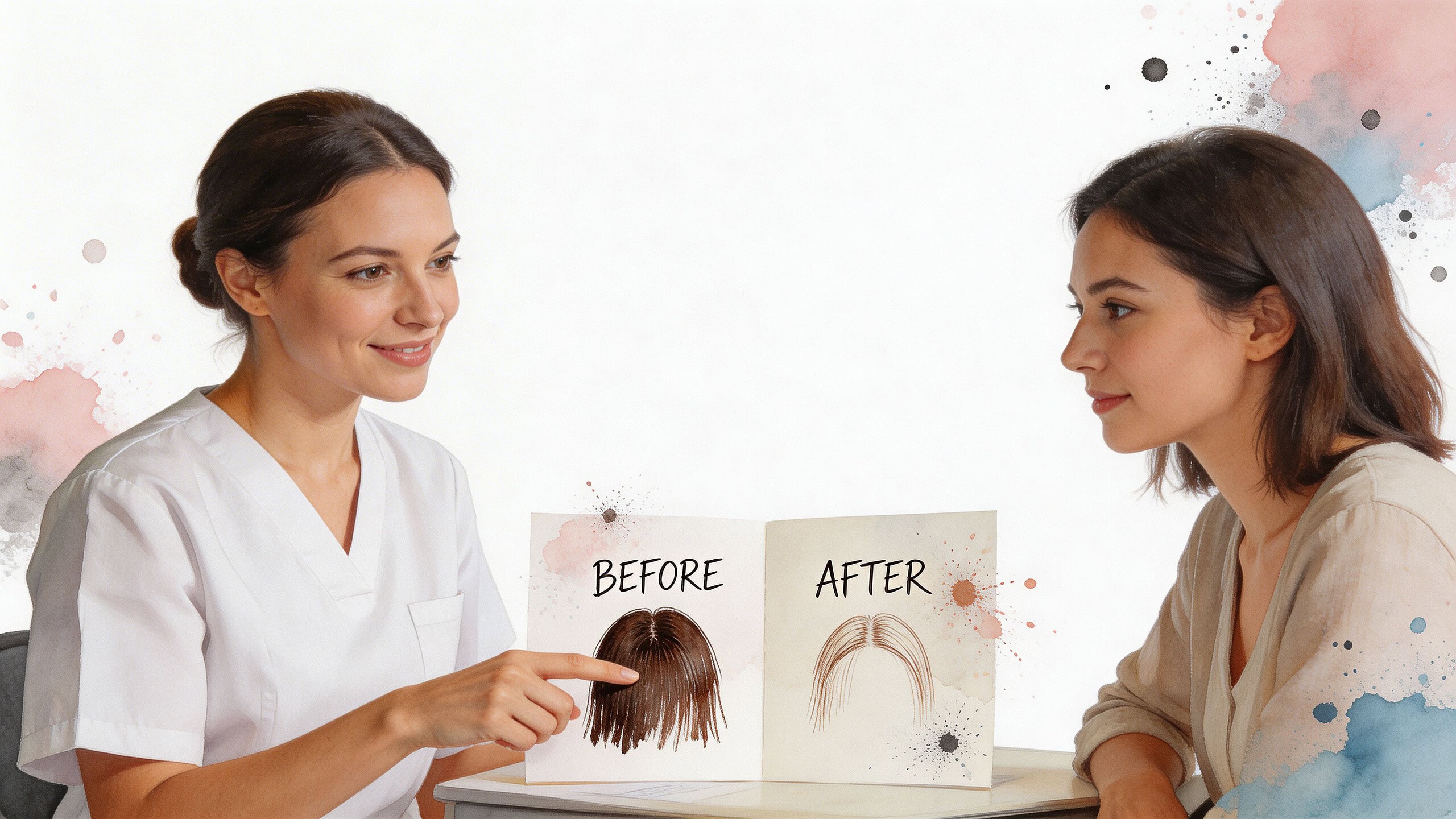
Clinical studies in South Africa show an average 70 to 90% long-term hair reduction after a full course of 6 to 8 treatments, and 87% of patients said they would repeat the procedure when treated with SAHPRA-licensed devices designed for local demographics, according to this evidence-based review of treatment outcomes.
What those results mean in practice
Clients rarely interpret percentages the way clinicians do. If you say “permanent”, many hear “every hair gone forever”. That’s not the right frame.
The better explanation is this:
- Reduction is cumulative: Hair usually becomes sparser, finer, and slower to return over the treatment course.
- A full course matters: Stopping early often leaves clients with partial improvement rather than a stable long-term result.
- Maintenance can still be needed: Hormonal influence, dormant follicles, and individual biology can all affect the long game.
Which areas usually respond well
Not all body areas behave the same way.
Coarser, pigment-rich hair often responds more predictably than fine, hormonally driven facial hair. Dense underarm and bikini hair often gives clients a strong sense of early progress because the hair characteristics are favourable for laser targeting. Facial work can still be highly worthwhile, but it needs a more careful explanation of pace and maintenance.
Clinical advice: Promise the trajectory, not perfection. Clients stay loyal when the treatment course unfolds the way you said it would.
The variables that change outcomes
A strong consultation should include a plain-language discussion of the factors below.
Hair colour and thickness
Laser needs pigment. Very light, grey, white, or red hair is generally harder to treat effectively because the target is weaker. Thicker dark hair usually gives you a better starting point.
Skin type
Skin type changes your wavelength selection, settings, and cooling strategy. It doesn’t decide whether someone can be treated. It decides how you should treat them.
Treatment area
Body areas differ in follicle depth, growth cycling, density, and hormonal sensitivity. That’s why response rates vary from one area to another.
Hormonal drivers
Hormonal conditions can increase the chance of regrowth and can slow the overall journey. That doesn’t mean treatment has failed. It means the plan may need to include maintenance and realistic review points.
Language that keeps clients with you
Try phrasing like this during consultations:
“The goal is a durable reduction in hair growth and density. Most clients see clear change over a treatment course, but the exact pattern depends on the area, the hair, and your biology.”
That kind of wording is accurate, defensible, and reassuring.
Advanced Patient Selection and Contraindications
A skilled operator doesn’t start with settings. A skilled operator starts with selection.
Poor patient selection creates most of the avoidable problems in permanent hair reduction. Burns, pigment changes, disappointment, patchy outcomes, and unnecessary refunds often trace back to one issue. The clinic treated someone they hadn’t assessed properly.
Start with a disciplined consultation
Every consultation should establish four things before a treatment plan is confirmed:
Skin assessment
Determine Fitzpatrick type carefully. Don’t guess from appearance alone. Ask about tanning behaviour, burn history, and recent sun exposure.Hair assessment
Look at colour, calibre, density, and depth. Fine facial vellus hair is a different clinical problem from dense underarm hair.Medical and hormonal context
Ask about medications, endocrine issues, pregnancy status where relevant, and any history that may affect healing or regrowth patterns.Client behaviour
Find out whether the client can follow pre-care, spacing, shaving guidance, and aftercare. A non-compliant client may still be medically suitable, but they aren’t operationally ideal.
Contraindications and caution zones
Some situations mean you should defer, modify, or decline treatment. Your exact protocol must follow training, device guidance, and clinical governance, but common caution categories include:
- Recent tanning or heavy UV exposure: This can reduce your safety margin significantly.
- Photosensitising medication use: Always review carefully.
- Active infection, irritation, or compromised skin in the treatment area: Treat the skin issue first.
- Unrealistic expectations: This is a consultation contraindication many teams ignore.
- Very light or non-pigmented hair: The likely response may be too limited for a worthwhile treatment plan.
Why SAHPRA compliance matters commercially
A clinic owner sometimes treats compliance as paperwork. That’s a mistake.
Using SAHPRA-licensed devices supports safer practice, defensible treatment standards, and more credible marketing. It also helps your team work within a clearer training and operational framework. In permanent hair reduction, compliance isn’t separate from profitability. It protects profitability.
Inclusive practice for transgender clients
Gender-affirming care is an area many clinics still under-serve, even though the need is real and often urgent from the client’s perspective. Hair reduction may be part of facial feminisation preparation, body contouring goals, comfort in social settings, or pre-surgical planning.
For transgender clients in South Africa, diode lasers at 810 nm can achieve 75% facial and body hair reduction in 8 to 12 sessions on Fitzpatrick V-VI skin, with a 90% satisfaction rate when SAHPRA-approved systems are used, according to this report on underserved dermatology populations.
That number matters less than the practice implication. These clients often need:
- Respectful intake processes: Use affirmed name and pronouns consistently.
- Privacy and discretion: Don’t force personal disclosure that isn’t clinically necessary.
- More detailed facial hair planning: Beard-density work can require careful expectation management.
- Sensitivity to dysphoria: Hair removal isn’t cosmetic for every person. For some, it is part of essential identity-affirming care.
Treat the consultation as part of the treatment. Clients remember whether your clinic felt clinically safe and personally respectful.
Who tends to do well
The strongest candidates usually have visible pigment in the hair, a willingness to commit to a treatment series, and realistic expectations about reduction versus total eradication.
The weakest candidates aren’t always the darkest skin type or the most difficult area. More often, they are the poorly assessed client, the under-informed client, or the client promised the wrong outcome.
Integrating Hair Reduction into Your Clinic for High ROI
A new clinic owner often asks the wrong first question. They ask which machine to buy. The better question is how the service will run, from SAHPRA-aligned documentation and consent through to package completion, maintenance bookings, and referral growth.
Permanent hair reduction becomes profitable when it is built as a system. In South Africa, that system has to work for mixed skin-type demographics, variable patient budgets, and a regulatory environment where your documentation, training, and device selection need to stand up to scrutiny. The owners who get strong returns are usually the ones who standardise early.
Build the operating model before you advertise
Launch problems rarely start in the treatment room. They start in the setup.
Before you spend on marketing, decide exactly how a lead moves through the clinic:
- Consult responsibility: Who assesses suitability, explains likely outcomes, discusses contraindications, and presents the package?
- Clinical workflow: What are your patch test criteria, photo protocol, consent forms, cooling method, and review intervals?
- Diary structure: Are courses pre-booked at the right intervals for the area being treated?
- Aftercare process: What written instructions do clients leave with, and how will the team reinforce pigment protection and shaving guidance?
- Escalation pathway: Who reviews unexpected skin responses, missed endpoints, or poor shedding patterns?
If those steps are vague, revenue becomes inconsistent very quickly.
Package design drives completion and cash flow
Single-session pricing matters less than treatment completion. Hair reduction works over a series, so your pricing model should support the biology of the treatment and the economics of the clinic.
Good package structures usually include:
- Clear area-based pricing so front desk staff can quote confidently
- Course packages that match realistic treatment plans rather than optimistic promises
- Maintenance planning introduced at the start, especially for hormonal areas
- Upgrade pathways into additional zones once clinical trust is established
- Expiry and cancellation terms that protect diary efficiency
This is also where profitability is either protected or eroded. Underpricing a full series to win enquiries often leaves the clinic carrying long treatment times, high consumable use, and poor margins. Pricing should reflect operator time, device capability, expected number of sessions, and your local market.
Market for the patient you want to keep
The strongest campaigns bring in suitable candidates, not just volume.
General beauty language pulls in broad interest but weak intent. Better marketing speaks to problems clients already recognise, such as ingrown hairs, shaving rash, beard shadow, repeated waxing costs, or the frustration of maintaining hair on the face, underarms, bikini, chest, or back. For South African clinics, it also helps to state that treatment plans are selected according to skin type and hair characteristics. That reassures darker-skinned patients who may have been told elsewhere that laser is unsafe for them.
Be specific in your messaging. Say who the treatment suits. Say that reduction is progressive. Say that results depend on hair colour, density, hormones, and attendance. Clear messaging improves lead quality and reduces time wasted on unsuitable consults.
Choose suppliers like an owner, not a shopper
A device brochure does not show you what happens after a difficult Fitzpatrick V patient presents with coarse facial hair, post-inflammatory hyperpigmentation history, and unrealistic time expectations.
Owners need supplier support that helps them run the service well:
- Operator training that covers settings, endpoints, and complication prevention
- Technical support when the system is offline
- Structured onboarding for new staff
- Clear warranty terms and service response times
- Practical marketing material that matches clinical reality
If you want a numbers-based view of service economics, this guide on how much a clinic can earn with a diode laser in South Africa is useful for pressure-testing your model.
What ROI Depends On
Return on investment is built in the day-to-day operation. Clinics usually see the strongest results when five parts of the service are controlled well.
Consultation conversion
Your team needs to explain the course clearly, handle cost objections professionally, and recommend the right area plan without overselling. Poor consultation skill wastes qualified leads.
Attendance and interval control
Outcomes drop when patients return too early, too late, or inconsistently. A disciplined booking system protects both results and revenue.
Treatment efficiency
Room turnover, documentation speed, handpiece familiarity, and area mapping all affect how many quality treatments you can deliver in a day. Slow workflow cuts margin.
Expansion into additional areas
Satisfied patients often add new areas once they trust the process. That only happens when the first treatment plan is well selected, well documented, and visibly effective.
Reputation and referrals
Hair reduction generates strong word of mouth when expectations are set correctly and the clinic manages side effects well. It damages trust quickly when staff overpromise, use poor settings, or treat unsuitable candidates.
One practical rule matters here. Do not judge ROI only by how fast the machine can pay itself off. Judge it by whether your clinic can deliver safe, repeatable outcomes across the skin types you treat, while keeping the diary full and the team consistent.
What works in real clinics
The clinics that build this category well usually have trained operators, standard consultation scripts, strong before-and-after photography, pre-booked treatment courses, and monthly review of conversion and completion rates.
The clinics that struggle usually have the opposite. They buy technology before defining protocol, market vague promises, fail to screen properly, and leave too much of the patient journey to individual staff habits.
Your Next Steps Towards Mastering Hair Reduction
Mastering permanent hair reduction doesn’t require gimmicks. It requires competence.
The clinics that build this service successfully usually get three things right. They understand the science well enough to choose appropriate settings and explain outcomes clearly. They use suitable technology for the skin types and hair types they see. They run the service like a business, with disciplined consultation, package strategy, follow-up systems, and staff training.
The three priorities to act on now
Tighten your clinical foundation
Make sure every operator understands follicle targeting, hair cycles, endpoint recognition, skin typing, and contraindications. Weak technical knowledge usually shows up later as inconsistent results.
Audit your market
Look at the clients already coming into your clinic. What skin types do you see most often? Which body areas are people asking about? Are you missing demand because your current platform is too narrow or your team lacks confidence?
Build for repeatability
Permanent hair reduction becomes valuable when it is repeatable. That means consultation scripts, consent, photography, booking intervals, aftercare, review points, and maintenance planning must all be standardised.
Why this service deserves serious focus
It solves an everyday problem for a wide range of clients. It creates visible treatment journeys. It gives clinics a reliable platform for retention and referrals. It also rewards professionalism. Clinics that assess well, communicate, and treat safely tend to stand out quickly.
If your team needs structured education before expanding or launching the category, review the available laser hair removal training options and make sure your protocols are strong before you scale.
The opportunity is real, but so is the responsibility. When your clinic treats permanent hair reduction as both a clinical discipline and a business system, it becomes one of the most dependable services on your menu.
If you’re ready to build or strengthen a permanent hair reduction service, explore Omega Lasers for SAHPRA-licensed platforms, operator training, and practical clinic support that helps turn a device purchase into an organised, profitable treatment offering.