




A clinic owner sits with a quote for a four-wavelength hair-removal platform open on the desk. The marketing promises speed, comfort and a fuller treatment menu, but the harder questions remain: how much will the device cost after delivery, when will it reach consistent utilisation, and what happens if training, servicing or client demand falls short?
That uncertainty is exactly why every serious device purchase deserves a cost benefit analysis. The exercise isn't a hopeful payback guess. It puts the rands leaving your business, the revenue returning, the operational risks and the less visible benefits into one decision framework.
By the end, you'll have a practical method for assessing an aesthetic laser or energy-based device, including South African licensing, imported equipment, training, downtime, retention and sensitivity checks. You can also use a broader Square merchant break even guide when you want to test the point at which treatment income covers fixed and variable costs.
Table of Contents
- Why Every Laser Purchase Deserves a Cost Benefit Analysis
- Understanding Cost Benefit Analysis in Plain Terms
- The Step-by-Step Methodology for Clinic Decisions
- The Three Metrics That Matter
- Sample Calculation for a Laser Hair Removal Platform
- Counting the Costs and Benefits Most Buyers Miss
- Your Template, Sensitivity Checks and Final Decision
Why Every Laser Purchase Deserves a Cost Benefit Analysis
A persuasive demonstration can make an expensive platform feel like an obvious purchase. The room is comfortable, the handpiece looks refined, and the supplier explains how one system could support several treatment lines. None of that answers whether your clinic has enough demand, trained capacity and cash flow to make the investment work.
A cost benefit analysis forces the decision back onto operating reality. You need to ask how many treatments the room can deliver, what clients will pay, what treatment costs recur, and whether the machine will be available when booked clients arrive. A device that looks affordable on a quotation can become difficult to justify once you include compliance, training, finance, consumables, support and the opportunity cost of using the room for something else.
The question behind the quotation
South African health economics provides a useful reminder that value isn't measured by gross spending alone. A major 2020 health-sector analysis estimated the country's cost-effectiveness threshold at about ZAR 38,500 per DALY averted, roughly 53% of 2015 GDP per capita, which was ZAR 72,700. The same analysis associated 1% of national health spending in 2015, about ZAR 1.54 billion out of ZAR 154.07 billion, with approximately 1,050 deaths averted, 34,180 years of life lost avoided, 5,880 years lived with disability avoided and 40,055 DALYs averted. The findings are discussed in this South African cost-benefit analysis project overview.
A private aesthetic clinic is making a different decision, but the principle is similar. The core question isn't, “Can we buy this device?” It is, “Is this the best use of our capital, room capacity and staff time compared with the alternatives?”
What you'll be able to decide
A useful analysis should show:
- The full rand commitment: Purchase, delivery, installation, licensing, room preparation, training, servicing, finance and operating costs.
- The earning mechanism: Treatment volume, average price, repeat visits, practitioner capacity and contribution after direct costs.
- The risk boundary: How far demand, pricing or availability can fall before the investment stops making sense.
- The non-revenue value: Staff competence, safer delivery, consistent outcomes, client retention and reputation.
The result won't remove uncertainty. It will make uncertainty visible, which is far more useful than allowing optimistic assumptions to hide inside a supplier presentation.
Understanding Cost Benefit Analysis in Plain Terms
Think of a device purchase like joining a gym. The membership fee is only one cost. You also spend on transport, clothing, time and perhaps a trainer. The benefit isn't "being a gym member". It comes from the sessions you attend and the results you achieve. If you rarely go, the low membership price doesn't make the decision economical.
A clinic device works in the same way. The purchase price is only the entry cost. The investment creates value through treatments delivered, direct costs controlled, staff time used productively and clients who return because they trust the results.
What belongs on the cost side
Start with every rand that leaves the business because of the device:
- Capital costs: The machine, accessories, delivery, installation and financing charges.
- Compliance costs: SAHPRA registration, the applicable import licence and the cost of meeting laser safety requirements.
- People costs: Initial training, refresher education, paid training time and cover for staff who are away from treatment rooms.
- Room costs: Electrical work, cooling, signage, protective equipment, layout changes and lost availability during setup.
- Operating costs: Consumables, cleaning, maintenance, calibration, repairs, software, service agreements and marketing.
- Opportunity costs: The revenue or service capacity you give up by allocating a room, practitioner or budget to this platform.
South African guidance states that class 3 and class 4 laser devices must be registered with SAHPRA, and clinics must appoint a Laser Safety Officer. The same guidance says IPL and LED devices are currently excluded from those stricter requirements, so the technology category can materially change the compliance workload. Review the South African laser safety guidance for clinics before comparing platforms.
What belongs on the benefit side
Benefits include treatment revenue, but they don't stop there. A platform may free staff capacity, shorten treatment workflows, support a new package, improve repeat bookings or reduce reliance on an external provider. Write each benefit down and decide whether you can value it directly, estimate it with a proxy, or keep it as a qualitative decision factor.
For a broader explanation of the framework, this cost benefit analysis resource from Everglow Prosperity is useful for separating costs, benefits, timing and assumptions. You don't need a consultant's black box. A spreadsheet with clear categories, dated assumptions and conservative scenarios is enough to produce a defensible first analysis.
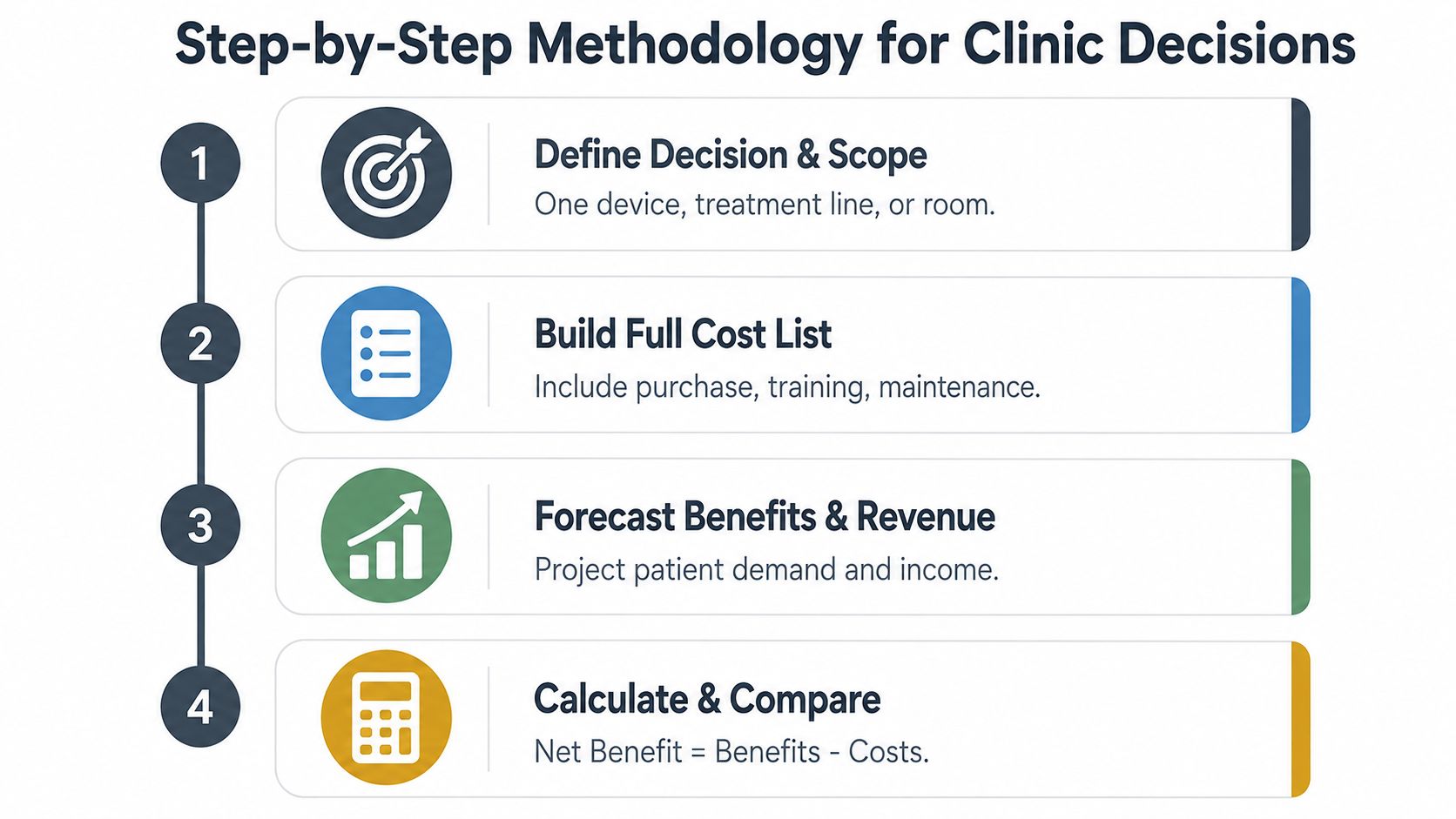
The Step-by-Step Methodology for Clinic Decisions
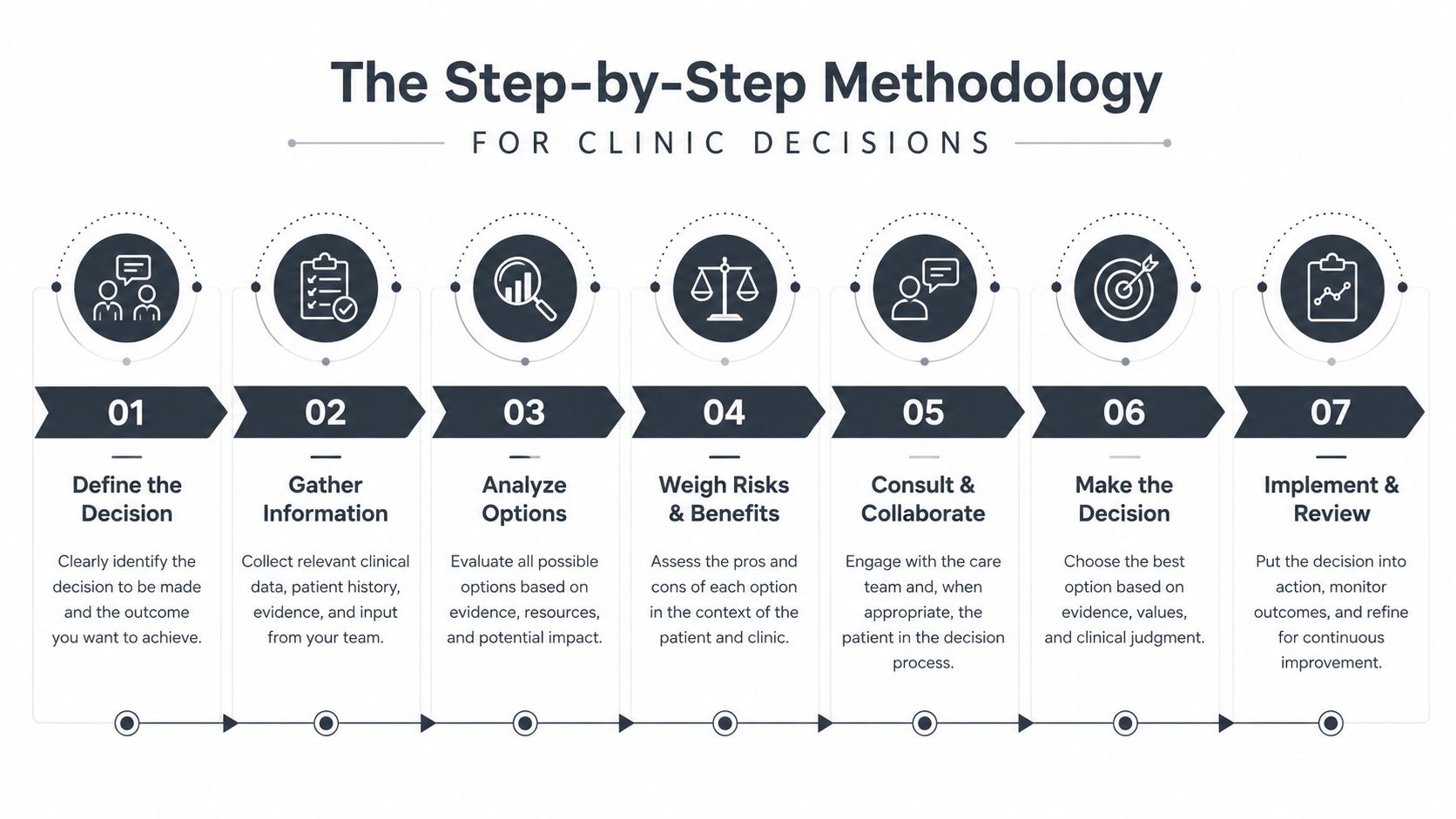
A strong analysis is a chain of decisions. If one stage is vague, the final payback figure will look precise while resting on weak foundations.
Define the decision and scope
Write one sentence that states what you're deciding. For example: “Should the clinic acquire one laser platform for hair removal and related treatments over the next operating period?”
Then define the boundary. Are you assessing one device, one treatment line, one room or a wider expansion? Include the status quo. If the alternative is keeping the current setup, the analysis must compare the new platform with what you already earn and spend, not with an imaginary zero-cost baseline.
Build the complete cost inventory
Separate once-off costs from recurring costs. This isn't just tidy bookkeeping. A South African road-project social cost-benefit analysis recommends separating once-off and recurring costs because timing and classification affect lifecycle feasibility. The recommendation is set out in this South African road-project appraisal study.
For a laser purchase, list the quotation price separately from:
- Delivery, installation and commissioning.
- SAHPRA registration and import-licensing requirements.
- The Laser Safety Officer arrangement where applicable.
- Staff training, practical assessment and paid learning time.
- Room preparation and protective equipment.
- Consumables and treatment-specific supplies.
- Maintenance, support, repairs and downtime.
- Finance costs, insurance and marketing.
- The value of capacity diverted from another service.
South African licensing guidance states that a valid SAHPRA import licence is needed before a machine can be registered for use, and that a separate licence is required for each device model. It also clarifies that the operator doesn't personally register with a controlling body. Those mechanics should appear in your cost inventory rather than being left to assumption. The relevant South African laser licensing guidance explains the model-specific structure.
Forecast benefits conservatively
Use actual clinic evidence wherever possible. Start with booked demand, current enquiries, conversion rates, room availability and practitioner capacity. Avoid assuming that every interested lead becomes a paying client or that every treatment room hour will be filled.
Price each service in rands, then deduct direct treatment costs and the practitioner time required. Separate revenue from contribution. Revenue is what the client pays. Contribution is what remains to help recover the device and overhead after the treatment has been delivered.
Put everything on a common timeline
A rand received later isn't equivalent to a rand paid today. Map the capital outlay, launch costs, monthly operating costs and expected monthly contribution across the analysis period. For a longer horizon, use a justified discount rate to convert future cash flows into present values.
Finally, calculate the result, document every assumption and revisit it after launch. A CBA should remain useful after approval. If actual utilisation, pricing, service costs or training needs differ from the forecast, update the model rather than defending an outdated business case.
The Three Metrics That Matter
No single metric tells the whole story. ROI, payback period and net present value answer different questions, so I use all three when reviewing a device purchase.
ROI shows the size of the return
The basic formula is:
ROI = Net benefit ÷ Total cost × 100
If a device costs R100,000 and produces R130,000 in net benefit over the selected period, the ROI is 30%. That tells you how much value the investment generated relative to its cost. It doesn't tell you whether most of that value arrived quickly or only after several years.
Payback answers the cash-flow question
Payback period asks how long cumulative net contribution takes to recover the initial investment. If a platform requires R180,000 and produces R30,000 in monthly contribution, a simple payback estimate is six months, assuming the contribution is stable and the analysis excludes timing complications.
That assumption is the weakness. Clinics rarely start at full utilisation, and a payback calculation often ignores what happens after recovery, including service costs, declining demand, residual value and future benefits. Use it to understand cash-flow pressure, not as the final verdict. The payback period calculation guide provides a useful reference when building this part of the model.
NPV is the more honest long-term view
Net present value discounts future net cash flows so you can compare them with today's investment. In plain language, it recognises that a benefit expected later carries less certainty and economic value than cash available now.
A positive NPV indicates that discounted benefits exceed discounted costs under your chosen assumptions. The discount rate matters, so document why you selected it and test what happens if the rate changes. A model that produces a positive NPV only under an unusually favourable assumption deserves caution.
| Metric | Question It Answers | Main Strength | Blind Spot |
|---|---|---|---|
| ROI | What return did the investment generate relative to its cost? | Easy to communicate | Ignores timing |
| Payback period | How long until the initial outlay is recovered? | Useful for cash-flow planning | Ignores value after payback |
| NPV | Does the investment create value after discounting future cash flows? | Reflects timing and long-term economics | Depends on the discount rate and forecast quality |
Use ROI for scale, payback for liquidity and NPV for the investment decision. If they point in different directions, investigate the assumptions instead of choosing the most flattering number.
Sample Calculation for a Laser Hair Removal Platform
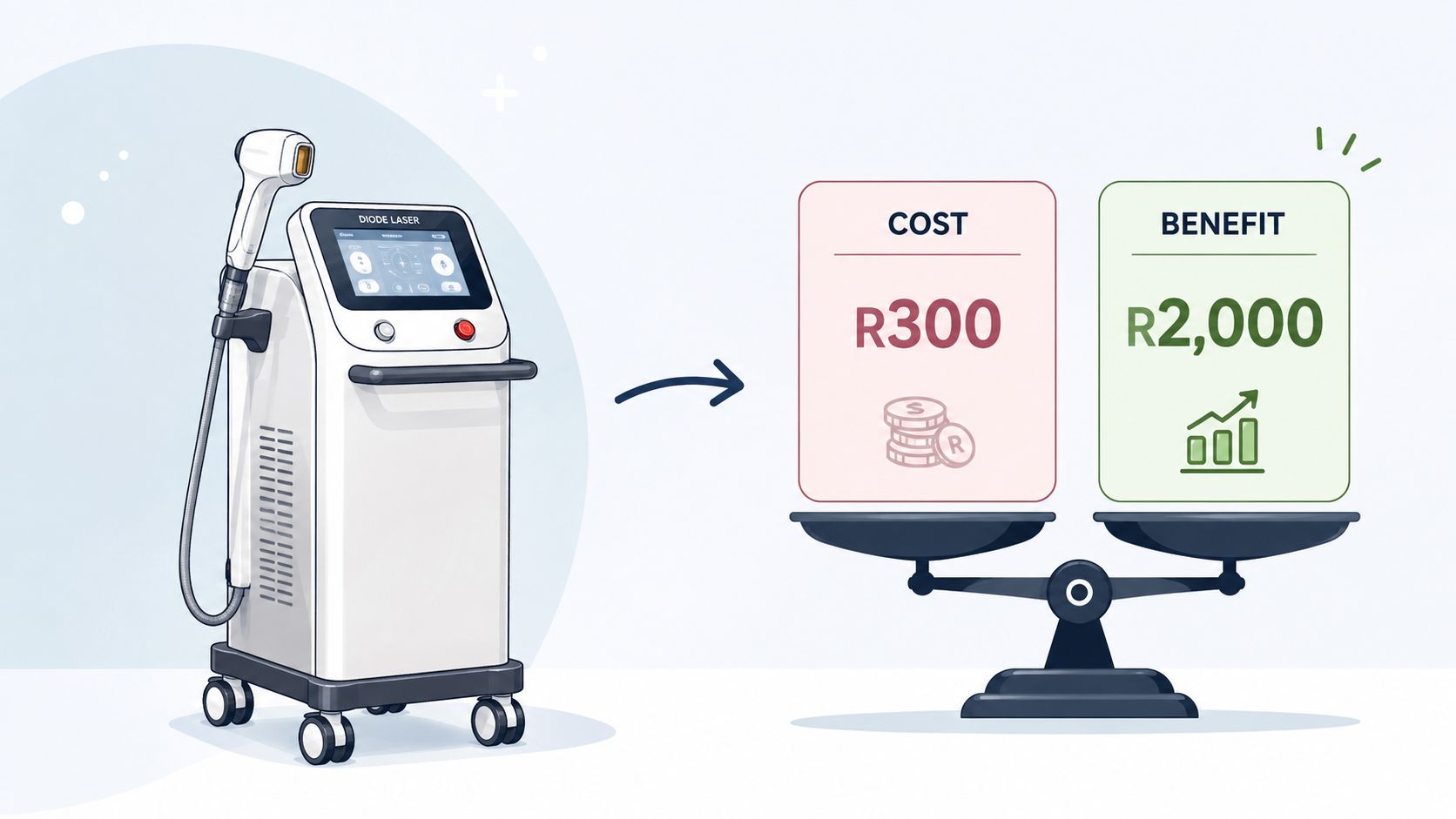
Consider a clinic assessing a diode hair-removal platform. The model below is deliberately simple, so the owner can rebuild it in a spreadsheet using their own quotation, staffing structure and treatment menu. Treatment pricing varies by area, and a working range of R300 to R2,000 per treatment area is used in the supplied earnings model context, but the clinic must replace those figures with its actual price list.
The conservative case
Assume:
- Device and initial setup: R360,000
- Average client visit value: R750
- Monthly treatment visits: 40
- Direct cost per visit: R120
- Monthly fixed device-related operating costs: R12,000
Monthly revenue is:
40 × R750 = R30,000
Monthly direct treatment costs are:
40 × R120 = R4,800
Monthly contribution before fixed device costs is:
R30,000 − R4,800 = R25,200
Monthly net contribution after the device-related fixed costs is:
R25,200 − R12,000 = R13,200
Simple payback is therefore:
R360,000 ÷ R13,200 = about 27.3 months
This is not a promise. It is an illustration of how a reasonable treatment price can still produce a long recovery period when utilisation is modest and fixed costs are included.
The optimistic case
Now test a stronger operating scenario:
- Average client visit value: R1,000
- Monthly treatment visits: 80
- Direct cost per visit: R120
- Monthly fixed device-related operating costs: R12,000
Revenue becomes:
80 × R1,000 = R80,000
Direct treatment costs are:
80 × R120 = R9,600
Contribution before fixed costs is:
R80,000 − R9,600 = R70,400
Net monthly contribution is:
R70,400 − R12,000 = R58,400
Simple payback becomes:
R360,000 ÷ R58,400 = about 6.2 months
The difference between the cases comes from utilisation and average value, not from changing the device. That is why a supplier's earnings illustration should never replace your own booking data.
For a broader explanation of how return assumptions are presented in marketing calculations, compare the real-world ROAS examples, while keeping ROAS separate from device ROI. A campaign can generate attractive advertising returns while the machine still struggles with staffing, service or room capacity.
A simple NPV structure
For NPV, place the initial R360,000 outflow at the start of the model, then enter the monthly net contribution in each future period. Discount those future amounts using a rate your business can justify. The conservative and optimistic cases will produce materially different NPVs because the cash-flow timing and utilisation are different.
The spreadsheet should show every assumption in its own cell. Don't hide client volume, average price or fixed costs inside one headline number.
Counting the Costs and Benefits Most Buyers Miss
A quotation can look affordable until the first replacement part, delayed shipment or service call arrives. South Africa's medical device market remains heavily dependent on imports. A recent projection places the market at USD 1.510 billion in 2026, with imports at USD 1.325 billion, according to this South Africa medical devices market analysis. Treat those figures as market context, not a promise about the device you are considering.
Import dependence changes total cost of ownership. Exchange-rate movement can raise replacement-part costs, while shipping, customs procedures and limited local technical capacity can extend downtime. For a detailed breakdown of these ongoing expenses, use this guide to total cost of ownership. Supplier after-sales support also matters. An idle device can remove treatment revenue, disrupt bookings and weaken client confidence.

Training isn't an optional add-on
Training belongs in the financial model because South African education gaps can become operating costs. A survey of laser and hair-removal education found that only 27.78% of tertiary institutions offered laser hair-removal training. 20% of those institutions offered no practical training, and 50% provided no practical examination. Among surveyed practitioners, 60.87% felt their training was insufficient, according to the published South African training survey.
These figures do not predict your team's results, but they identify training quality as a measurable risk. Underprepared operators may deliver inconsistent outcomes, increase safety exposure and need closer supervision. Include training hours, assessment, refresher education and slower early treatments in the CBA. If staff cannot treat confidently, the device's theoretical capacity has little cash value.
Practical rule: Treat competence as an operating asset. If training changes outcomes, capacity or client retention, it belongs in the business case.
Turning soft benefits into cash flow
Staff confidence and clinic reputation are difficult to price directly. They still affect the decision, so convert them into cautious proxies:
- Retention proxy: Estimate the contribution from clients who return for another booked service. Apply a conservative range rather than attributing every retained client to the device.
- Quality proxy: Track consultation-to-treatment conversion, rebooking and complaint rates before and after training.
- Capacity proxy: Value practitioner minutes released by faster workflows, but count them only when the clinic can fill that recovered capacity.
- Risk proxy: Record delays, corrective work, refunds, supervision and missed bookings as potential costs.
A South Africa-based analysis cited in a 2026 review estimated that supporting training for 254 graduates cost ZAR186 million, with expected lifetime earnings of ZAR15 billion and estimated income tax of ZAR4 billion, as reported in this healthcare training economics review. A clinic will not reproduce that scale, but the principle applies. Training can create economic value beyond its initial invoice through stronger capability and more reliable service.
For a device-level decision, assess whether the system you are evaluating, such as those from Omega Lasers, is FDA approved, CE certified and SAHPRA licensed. Treat those attributes as evidence to examine, not automatic revenue. Their financial value may appear through client trust, consultation confidence and lower compliance uncertainty. Model those effects using your own bookings, rebooking behaviour and documented operating results.
Your Template, Sensitivity Checks and Final Decision
You can build a working cost benefit analysis from the next device quotation you receive. Create a spreadsheet with five tabs or clearly separated blocks.
The practical checklist
- Decision: State the device, treatment line, room and analysis period.
- Capital costs: Record the purchase, delivery, installation, finance and insurance.
- Compliance: Confirm SAHPRA requirements, model-specific licensing and the Laser Safety Officer obligation where applicable.
- People: Include training, practical assessment, paid learning time and supervision.
- Operations: Add consumables, maintenance, service agreements, repairs, utilities and downtime.
- Benefits: Forecast treatment volume, average price, contribution, repeat bookings and capacity released.
- Scenarios: Save conservative, base and optimistic assumptions separately.
- Decision metrics: Calculate net benefit, ROI, payback period and NPV. The ROI calculation guide can help structure the return calculation.
Stress-test the assumptions
Change the two assumptions that usually drive the result most strongly, monthly treatment volume and average price. Reduce each independently, then reduce both together. If the model only works when volume and pricing remain at their most favourable levels, the purchase carries too much operational risk.
Also test a delayed launch, a service interruption and higher recurring costs. A good model doesn't need perfect forecasts. It needs to show which assumptions can break the investment.
Go or no-go rule: Proceed only when the conservative case remains financially survivable, compliance and training are fully funded, and the clinic can explain how it will generate demand.
Review the model after six months by comparing actual treatments, average revenue, direct costs, downtime and repeat bookings with the forecast. Update the assumptions and decide whether to increase utilisation, adjust pricing, improve training or stop further expansion.
The clinics that grow sustainably pair good technology with honest numbers. A disciplined cost benefit analysis turns an exciting laser purchase into a decision you can defend to yourself, your partners and your staff.
Omega Lasers supplies FDA-approved, CE-certified and SAHPRA-licensed aesthetic systems, with training, technical support, marketing guidance, business development support and a two-year manufacturer warranty. Visit Omega Lasers to discuss a device and investment structure that fits your clinic's treatment demand, staffing and cash-flow model.