



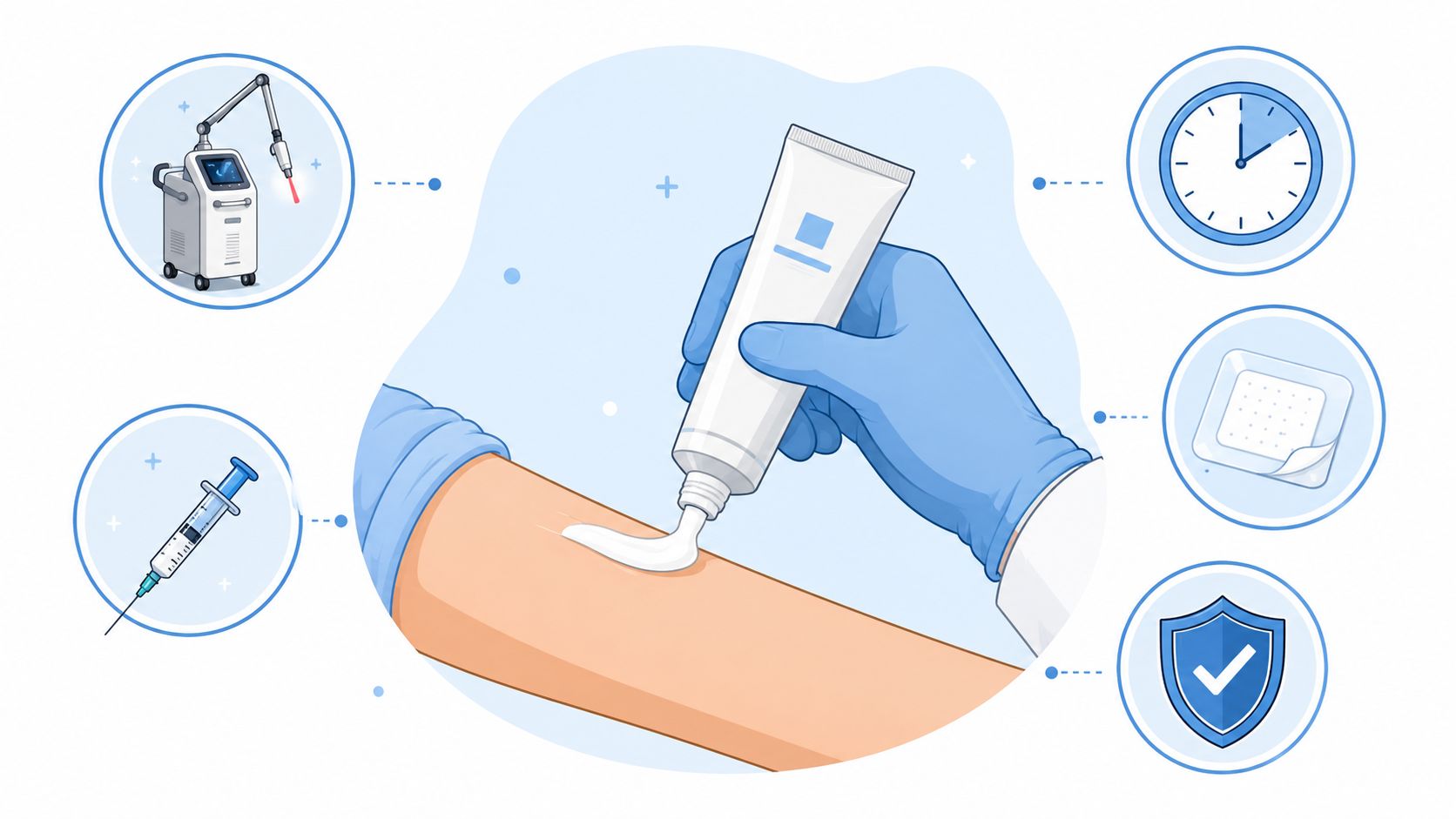
You're often making the same decision under pressure. The patient is anxious. The treatment room is booked. A stronger laser setting, deeper microneedling pass, or filler session will be hard to tolerate without proper numbing. At that moment, topical anesthetic cream isn't a convenience item. It's part of the treatment plan.
Used well, it improves comfort, keeps the patient still, and helps you work with precision. Used poorly, it creates avoidable risk. That risk usually doesn't come from the idea of numbing itself. It comes from bad product selection, vague dosing, poor timing, and overconfidence with creams that were never designed for predictable, clinic-safe use.
In aesthetic practice, comfort and safety have to sit together. Always ensure the information is accurate and true, as this concerns aesthetic lasers, energy-based devices, and health.
Table of Contents
- Why Mastering Topical Anesthetics Is Non-Negotiable
- Understanding Anesthetic Agents and Mechanisms
- Matching Anesthetics to Aesthetic Treatments
- Clinical Protocol for Safe and Effective Application
- Recognising and Managing Risks
- Compounded Creams vs Regulated Products A Critical Choice
- Key Takeaways for Your Aesthetic Practice
Why Mastering Topical Anesthetics Is Non-Negotiable
A common clinic scenario looks simple from the outside. A patient arrives for fractional resurfacing. They've read about downtime, asked whether it hurts, and already look tense before you cleanse the skin. If the numbing step is rushed, badly timed, or chosen without thinking about depth and treatment intensity, the whole session can unravel fast.
When the cream works as intended, the patient settles. You can keep your settings consistent, move methodically, and avoid the stop-start pattern that ruins treatment flow. When it doesn't, patients flinch, treatment speed drops, and the operator starts negotiating between efficacy and tolerance instead of following the intended plan.
That's why numbing shouldn't be treated as a generic prep step.
Practical rule: If the treatment demands precision under discomfort, the anesthetic plan deserves the same attention as the device settings.
In practice, the biggest mistakes aren't dramatic. They're ordinary. Using a fast-onset product for a procedure that lasts too long. Applying cream too thinly. Leaving it on compromised skin. Guessing the amount for a large treatment area. Relying on a compounded formula with no clear surface-area guidance because “it's what everyone uses”.
The clinic cost of those habits is real even when no emergency occurs. Patients lose confidence. Results become inconsistent because the operator shortens passes or lowers energy. Teams also drift into risky workarounds when they don't have a standard protocol.
A skilled practitioner understands that topical anesthesia sits at the intersection of patient experience, treatment accuracy, and legal responsibility. If you perform aesthetic laser, light-based, or minimally invasive skin procedures, this isn't optional knowledge. It's core clinical competence.
Understanding Anesthetic Agents and Mechanisms
Topical anesthetics reduce pain by blocking voltage-gated sodium channels in peripheral nerves. If the nerve cannot depolarize normally, it cannot transmit pain signals effectively. In clinic terms, the patient feels less sting, burning, or sharpness while you work.
Mechanism matters because product labels can sound similar while clinical performance differs. The active drug is only part of the result. Vehicle, concentration, contact time, occlusion, skin integrity, and total dose all change what you get in the treatment room.

How these creams stop pain signals
Three variables shape performance in practice.
- Onset determines how long you need to wait before treatment.
- Duration determines whether comfort lasts through repeated passes or longer sessions.
- Penetration determines whether the product is suitable for superficial discomfort or deeper procedural pain.
The FDA prescribing information for a lidocaine 4% cream notes that the depth and duration of dermal analgesia increase with application time, with analgesia reported after about 30 minutes and more effect after longer contact on intact skin (lidocaine cream prescribing information). That is the practical point many clinics miss. A cream can be pharmacologically active and still be the wrong choice because it does not reach the depth the procedure demands, or it wears off before the final passes.
This is also where regulated products and compounded creams start to separate. With a regulated product, you usually have defined concentration, approved labeling, and clearer instructions on exposure and use conditions. With a compounded preparation, absorption can vary more because the base, concentration, and quality controls may differ between pharmacies. That makes dosing decisions less predictable, especially over large surface areas or inflamed skin.
The main families you work with
In aesthetics, the two groups you will see most often are amides and esters.
| Family | Common examples | Practical use note |
|---|---|---|
| Amides | Lidocaine, prilocaine | Common in clinical protocols. Often chosen for familiar onset and broad use across aesthetic procedures. |
| Esters | Tetracaine, benzocaine | Can provide a stronger or longer topical effect in some formulations, but indication, allergy history, and product standardisation matter. |
For procedural use, I advise teams to think beyond the ingredient name. Two creams that both contain lidocaine may behave differently if one uses a validated vehicle and the other comes from a compounded base with limited consistency data. The risk is not just reduced comfort. The more serious problem is unpredictable absorption, which makes it harder to judge both efficacy and safety.
A practical reference outside aesthetics can help with patient communication. This guide to lidocaine for hemorrhoid pain explains lidocaine in plain language and shows how to describe local numbing without overstating what the drug can do.
The active ingredient matters. The formulation, exposure time, skin condition, and total amount applied matter just as much.
Matching Anesthetics to Aesthetic Treatments
A patient who stays still for the first few passes of laser or the first few needle entries can become difficult to treat ten minutes later if the anesthetic choice was based on habit rather than procedure demands. That is usually a matching problem, not a pain-threshold problem.

Choose for procedure depth, surface area, and treatment time
Match the cream to what the tissue will experience. Short, superficial treatments on intact skin usually need reliable onset and a protocol the team can repeat accurately. More aggressive resurfacing, repeated passes, and procedures where patient movement affects precision need longer useful anesthesia, but they also demand tighter control of dose, coverage area, and skin condition.
Regulated formulations provide a practical advantage. When a product has published use data on intact adult skin for a defined type of procedure, clinicians can make better timing and dosing decisions than they can with a compounded cream that lists the same actives but behaves differently in the skin.
Evidence supports that distinction. A review of self-occluding lidocaine 7% and tetracaine 7% cream reported effective local dermal anesthesia for superficial dermatologic procedures such as laser treatment and filler injection, with prolonged effect after removal and low systemic absorption under studied conditions (review of lidocaine 7% and tetracaine 7% topical anesthetic cream).
Practical matching in clinic
Use the treatment plan as the filter, not the brand name on the tube.
- Laser hair removal on broad areas: Prioritise predictable onset, clear area limits, and a workflow that does not encourage over-application. Large fields increase the consequences of poor dosing decisions.
- Microneedling: Superficial discomfort often responds well to standard amide-based topical anesthesia, but treatment time matters. Full-face needling can outlast a cream that looked adequate during the first treatment zone.
- Dermal fillers and small focal injectables: Choose a product with evidence for intact facial skin and enough persistence to cover repeated entry points without constant reapplication.
- Fractional laser and other higher-discomfort resurfacing: Use products with published procedure-relevant data and avoid casual substitution with compounded formulas just because the ingredient list looks stronger on paper.
A simple treatment table helps standardise decisions:
| Procedure demand | Better fit |
|---|---|
| Fast onset on intact skin | A regulated lidocaine-based topical product with clear timing guidance |
| Longer useful anesthesia | A lidocaine/tetracaine option or another validated longer-acting formulation |
| Large treatment area | Products with defined application limits, clear instructions, and no guesswork on coverage |
| Facial injectables or focal sensitive zones | Formulations studied for superficial facial procedures and controlled use on intact skin |
One caution matters here. Stronger-sounding compounded creams are not automatically better for tougher procedures. In practice, they can create the opposite problem. Variable concentration, uncertain base composition, and inconsistent absorption make both under-treatment and overexposure more likely, especially if staff are working quickly across larger areas.
For clinics reviewing a regulated topical anesthetic cream for aesthetic procedures, the safer question is whether the product fits the procedure, area, and timing requirements your team can reproduce consistently.
If you also advise patients on discomfort control for non-clinical hair removal services, this expert guide to waxing pain relief can support that conversation without confusing it with medical aesthetic protocols.
Clinical Protocol for Safe and Effective Application
A patient is on the bed, the laser room is booked back-to-back, and someone asks, “How much cream do we usually use for this area?” That is the moment poor protocols show up. Safe topical anesthesia depends on decisions made before the lid comes off the tube: exact area, skin condition, product strength, contact time, and who is responsible for checking each step.

Written protocols matter because topical anesthetics fail in predictable ways. Staff estimate the area. Cream is applied to skin that is irritated or recently treated. Occlusion is used without checking whether the product instructions support it. Timing drifts because nobody set a timer. In practice, the biggest safety problems are rarely technical. They come from inconsistent dosing and weak handover between team members.
Pre-application checks
Start with the treatment plan, not the product.
- Define the exact treatment zone. Mark it if needed. Dosing becomes unreliable the moment the area is expanded informally.
- Inspect the skin barrier. Intact skin and compromised skin do not absorb at the same rate. Delay treatment if the skin is broken, inflamed, or recently resurfaced unless the product guidance specifically supports that use.
- Clarify adverse reaction history. Ask what happened, when it happened, and which product was used. “I reacted once” is not enough to guide a safe decision.
- Check body size and total area to be covered. A larger field increases exposure risk even when the application looks routine.
- Document the product, strength, amount used, start time, removal time, and operator. If symptoms appear later, that record is what allows you to assess exposure properly.
Local legal and regulatory rules also need to be built into the protocol. In South Africa, product scheduling affects who can supply certain lidocaine strengths and in what setting they should be used. Teams should know that before stock reaches the treatment room, not during a consult.
If the operator cannot state the product, treatment area, and planned contact time before application, the cream should not be applied.
Application steps that change outcomes
Technique changes both comfort and risk.
Clean and dry the skin first. Remove make-up, sunscreen, oil, and residue from previous topical products. If the surface is not prepared properly, penetration becomes less predictable and reapplication becomes more likely.
Apply a consistent layer across the defined area. Do not rub it in aggressively. The aim is even coverage, not massage. If the manufacturer gives a thickness or amount-per-area instruction, use that instruction rather than informal habits passed between staff.
Use occlusion only when the product guidance allows it. Occlusion can improve contact and reduce drying, but it can also increase absorption. That trade-off matters more on larger areas, thinner skin, and longer contact times.
Set a real timer. Clinics get into trouble when timing is estimated from room flow instead of measured. Many regulated topical anesthetic products used on intact skin work within a practical pre-treatment window, but the useful onset time still depends on the formulation, the area treated, and whether occlusion is part of the instructions. “Leave it on a bit longer” is not a protocol.
Remove all residue before starting the procedure. Residual cream can affect grip, visibility, skin assessment, and some device workflows. Once the cream is removed, reassess sensation and confirm the patient is ready before treatment begins.
A simple clinic protocol should look like this:
| Step | What the team should do |
|---|---|
| Prepare | Clean and dry the skin. Mark treatment borders if needed. |
| Confirm | Recheck product, strength, area, and planned exposure time. |
| Apply | Use an even layer over the defined zone without aggressive rubbing. |
| Occlude | Cover only if the product instructions support it. |
| Time | Start a timer immediately and assign responsibility for removal. |
| Remove | Clear all residue, inspect the skin, and reassess comfort before treatment. |
For clinics that want a fixed product workflow rather than ad hoc staff decisions, a clinic-use topical anesthetic cream protocol is easier to train, audit, and repeat safely than relying on mixed products with different instructions. The wider the gap between what is written on the product and what happens chairside, the harder it is to defend dosing decisions, especially if compounded creams are entering the protocol without consistent application rules.
Recognising and Managing Risks
A patient arrives for a large-area treatment and says, just before you start, that a numbing cream once made them feel “strange.” That is not a throwaway comment. It is a prompt to stop, clarify the product used, the area covered, whether occlusion was involved, and what “strange” meant.
Risk with topical anesthetics usually builds through ordinary decisions made too quickly. The common pattern is not one dramatic mistake. It is excessive area, uncertain dose, compromised skin, repeat application, poor documentation, or a product with unclear concentration and instructions.
Local skin reactions are common. Systemic toxicity is less common, but it is the event that can seriously injure a patient and expose the clinic. Teams need to know the difference without guessing.
What is usually local, and what needs urgent attention
Expected local effects include temporary blanching, erythema, mild swelling, colour change, and short-lived irritation at the application site. Those findings matter, but they do not automatically signal toxicity.
Red-flag symptoms are different. Tinnitus, metallic taste, dizziness, agitation, confusion, palpitations, breathing difficulty, seizure activity, or collapse need immediate assessment. In practice, the earliest problem is often not a dramatic collapse. It is a patient who says they feel odd, lightheaded, or unusually anxious after application. Treat that as a clinical finding, not reassurance material.
The highest-risk situations are predictable:
- Large treatment fields
- Occlusion over broad areas
- Broken, inflamed, or recently treated skin
- Repeat dosing in the same visit
- Unclear strengths or mixed active ingredients
- Compounded creams without clear surface-area guidance
Compounded products deserve extra caution here. If the label does not give clear instructions on amount, area, contact time, and whether occlusion is appropriate, the prescriber and operator are carrying more dosing risk at chairside. That is a practical problem, not just a paperwork problem.
When to stop
Stop if the presentation does not fit a mild local response. Remove all remaining product. Assess airway, breathing, circulation, and mental status. Follow your clinic emergency process early rather than watching symptoms evolve while the patient remains exposed.
I tell teams to document the decision point as carefully as the reaction itself. Write down the exact product used, where it was applied, how long it was left on, whether occlusion was used, the skin condition before application, and when symptoms started. Those details matter later if you need medical review or incident follow-up.
Good anesthetic risk management sits inside the same operational system as infection control standards in aesthetic practice. Product logs, timed application records, staff training, and escalation pathways should already be defined before a reaction happens.
A practical internal checklist is enough if staff know it well:
- Stop treatment
- Remove any remaining cream
- Assess and record symptoms
- Check observations and mental status
- Escalate if symptoms go beyond expected local skin effects
- Document product, strength, area, timing, and occlusion details
Professional handling is simple, but it is not casual. The clinics that manage these events well do not rely on memory or instinct. They use a fixed response every time.
Compounded Creams vs Regulated Products A Critical Choice
Many clinics assume compounded creams are just a stronger, more flexible version of a regulated product. That assumption is where trouble starts. Customisation sounds practical. In reality, it often shifts dosing responsibility onto the practitioner without giving them the tools needed to dose safely.

Why this decision carries more risk than many clinics realise
A key problem with compounded topical anesthetics is the lack of standardised, surface-area-based dosing guidance. An educational review focused on this gap notes that clinicians often don't have a clear formula for deciding how much compounded cream can be applied safely across a given treatment field, especially compared with FDA-approved products that provide defined thickness guidance and dosing tables. The same review highlights the FDA warning against over-the-counter products with more than 4% lidocaine applied heavily over large areas, while providers using higher-concentration compounded creams may still be operating without precise protocols (discussion of compounded topical anesthetic dosing risks).
That creates three practical risks at once:
- Clinical risk: The patient may absorb more anesthetic than intended.
- Operational risk: Staff can't apply a repeatable protocol if every batch or formulation behaves differently.
- Legal risk: “We always use this cream” is not a defensible dosing rationale.
What regulated products do better
Regulated products aren't perfect, but they're easier to govern. They come with defined concentrations, labelled indications, and clearer instructions on thickness, timing, and treatment area. That gives trainers something concrete to teach and auditors something concrete to review.
Compounded creams can seem attractive when clinics want stronger effect or a custom blend. But unless you can answer basic questions about strength, area, exposure time, and safe upper limit, you're not really customising. You're improvising.
A practical comparison looks like this:
| Decision factor | Regulated product | Compounded cream |
|---|---|---|
| Strength clarity | Labelled and standardised | May vary by formulation |
| Application guidance | Usually clearer | Often less defined |
| Staff training | Easier to standardise | More room for inconsistent practice |
| Risk governance | Better documented | Harder to defend if dosing is vague |
Clinics often focus on purchase price. They should focus on protocol reliability. In aesthetics, the cheaper cream can become the expensive decision very quickly.
Key Takeaways for Your Aesthetic Practice
The safest clinics treat topical anesthesia as a clinical system, not a consumable. Product choice, treatment matching, area calculation, timing, monitoring, and documentation all sit inside the same workflow. If one part is weak, the whole step becomes unreliable.
A pre-procedure mental checklist
Before you apply any topical anesthetic cream, run through this:
- Patient fit: Any relevant allergy history, skin barrier issues, or prior reaction that needs clarification?
- Procedure fit: Does the anesthetic's onset, depth, and duration suit the treatment?
- Product fit: Is this a regulated, clearly labelled option with usable instructions?
- Area fit: Have you defined the exact application zone rather than estimating?
- Protocol fit: Does the team know the timing, occlusion plan, removal method, and observation points?
- Record fit: Will another clinician be able to see exactly what was applied and when?
For clinics that serve patients researching topical pain relief more broadly, this lidocaine cream Canada guide is a useful example of how to explain access and use questions in patient-friendly language. Internally, strong clinical record-keeping matters just as much as product choice, because poor documentation turns manageable events into serious governance problems.
The standard isn't whether the patient felt numb. It's whether your clinic can show that numbing was selected, applied, and monitored in a way that was appropriate, lawful, and repeatable. That's what protects outcomes, reputation, and patients at the same time.
If you're building or refining treatment protocols around lasers, resurfacing, hair removal, or skin rejuvenation, Omega Lasers supports clinics with regulated aesthetic technology, training, and practical workflow guidance that helps teams deliver safer, more consistent treatments.