




A lot of clinic managers are trying to solve the same problem from three different angles at once. One day it's a delayed handpiece, the next it's expired consumables sitting in a cupboard, and by Friday it's a cancelled treatment list because one critical item didn't arrive when it should have. That's what supply chain pressure looks like in an aesthetic clinic. It rarely shows up as a dramatic crisis first. It usually starts as small operational friction that insidiously erodes margin, time, and trust.
In aesthetics, supply chain optimization isn't a corporate buzzword. It's the practical work of keeping high-value devices running, making sure consumables are available when booked patients arrive, and maintaining clean documentation for SAHPRA, CE, and FDA-aligned operations. Always ensure the information is accurate and true, as this concerns aesthetic lasers, energy-based devices, and health.
Table of Contents
- From Chaos to Control Your Initial Supply Chain Assessment
- Smart Forecasting and Inventory Strategies
- Building a Resilient Supplier Network
- Optimising Logistics and Ensuring Regulatory Compliance
- Measuring What Matters Clinic Supply Chain KPIs
- Driving Continuous Improvement and Future-Proofing
From Chaos to Control Your Initial Supply Chain Assessment
Monday starts with a full diary, then the first treatment room calls reception. The gel is low, the backup box is the wrong spec, and nobody can confirm whether the last delivery was short or just stored badly. In an aesthetic clinic, supply chain problems show up as cancelled bookings, idle laser time, avoidable waste, and staff scrambling in front of patients.
A first assessment brings that under control. The goal is simple. Find how stock, equipment, paperwork, and decisions move through the clinic, then fix the points where revenue leaks out.
Research on process mapping in healthcare operations has found that visualising the actual workflow can improve service efficiency, as described in evidence on healthcare process mapping and operational improvement. In a clinic, that matters most where high-value devices, regulated consumables, and compliance records meet daily treatment pressure.
Start with the real flow of stock
Walk one product and one piece of equipment through the clinic from start to finish. For consumables, follow the path from low-stock identification to approval, ordering, delivery, checking, storage, issue to the treatment room, and final use. For a laser or other capital device, track the service history, accessories, handpieces, maintenance certificates, warranty records, and downtime escalation process.
Do not map the SOP. Map what staff do on a busy day.
Use a whiteboard or a simple spreadsheet and capture these five control points:
- Need identified. Who spots the issue first, therapist, receptionist, stock controller, or owner?
- Order approved. How long does approval take, and who can release urgent purchases?
- Supplier contacted. Is there one approved method, or are orders scattered across calls, messages, and email threads?
- Goods received. Who checks quantities, batch numbers, expiry dates, packaging condition, and device paperwork?
- Stock stored and issued. Where is it placed, how is it logged, and can anyone trace it back to a treatment or patient file if needed?
One pattern shows up quickly in underperforming clinics. Several people can buy stock, but no single person owns stock accuracy.
That is also where the financial picture gets clearer. Once purchasing and usage flow is visible, managers can connect stock decisions to cash flow, booked revenue, and margin. For clinic owners tightening operational control, financial forecasting for aesthetic clinics becomes far more accurate when the underlying stock process is mapped properly.
Look for control failures, not just mess
A messy storeroom is a symptom. The bigger problem is usually a broken control point.
Expired peel stock beside current stock often means no rotation rule. Missing batch records usually point to weak receiving checks. A laser accessory with no service log creates two risks at once: treatment disruption and a compliance gap if an inspector asks for records.
Focus the assessment on failures that cost money or create exposure:
- Ordering delays that push urgent purchases onto premium shipping or same-day courier fees
- Receiving gaps that let short shipments, damaged consumables, or incorrect device accessories into stock
- Storage errors that affect sterility, shelf life, or traceability
- Treatment-room usage with no reconciliation so shrinkage, overuse, and missed charging go unnoticed
- Incomplete compliance files for SAHPRA, CE, or FDA-linked products and device documentation
In aesthetics, the risk profile is different from general retail. A missing cleanser is inconvenient. A missing certified consumable, expired sterile item, or undocumented laser component can stop treatments, create patient risk, and expose the clinic during an audit.
Run the assessment in one afternoon
This does not need a long project plan. I usually advise clinics to block off half a day and inspect four areas in sequence: stockroom, reception or admin desk, treatment rooms, and equipment records.
Ask staff to show each step live. Where do low-stock requests go? Where are delivery notes filed? How are batch numbers recorded? Who checks whether a replacement handpiece is approved for the machine in use? If each person gives a different answer, the process is not controlled.
Practical rule: If more than one person orders the same stock category without one shared record, the clinic has a purchasing control gap.
Finish with one page. Include the current flow, the top five bottlenecks, the financial or compliance risk attached to each one, and the name of the person responsible for fixing it. That document becomes the baseline for every later improvement.
Smart Forecasting and Inventory Strategies
Aesthetic clinics feel forecasting mistakes fast. One week, cash is tied up in shelves of slow-moving retail stock. The next, a fully booked injectables or laser list is at risk because a certified consumable, cooling tip, or aftercare item is short. Forecasting has to protect revenue, protect compliance, and protect treatment capacity at the same time.

Use booking data to forecast demand
Start with the appointment diary, not instinct. In clinics, demand is visible earlier than in many other businesses because future treatments are already booked, package sessions are scheduled in cycles, and repeat patients often follow predictable intervals. That gives managers a practical base for ordering consumables, planning retail support stock, and scheduling service cover for high-value devices.
For regulated medical device distribution, operators improve inventory decisions by reviewing lead times, reorder settings, and safety stock regularly, then adjusting stock levels to match real usage patterns instead of assumptions, as outlined in medical device distribution best practices for inventory review. The same principle works in clinics. If bookings are visible and usage is stable by treatment type, forecasting should be routine.
Use a weekly review rhythm:
- Check bookings for the next four to six weeks by treatment category.
- Match each treatment to its stock drawdown, including gels, tips, cartridges, disposables, and aftercare.
- Review historical usage by service, not only by SKU.
- Mark demand shifts early for promotions, seasonal peaks, school holidays, package redemptions, and new treatment launches.
- Separate normal demand from short spikes so a one-off campaign does not distort future orders.
Clinics that want tighter control should pair this with an inventory management system for aesthetic operations so usage, reordering, and traceability sit in one workflow.
Sort stock by value, risk, and clinical impact
ABC analysis still works in aesthetics, but clinics should add a risk lens. Invoice value matters. So does the operational effect of a stockout.
| Category | Typical clinic example | How to manage it |
|---|---|---|
| A items | Laser handpieces, branded device consumables, specialised cartridges | Tight approval, frequent review, low tolerance for stockout |
| B items | Treatment serums, aftercare kits, replacement parts used regularly | Moderate review cycle, track trend changes carefully |
| C items | Cotton pads, gloves, cleaning basics | Bulk control, simple min-max levels |
I usually ask managers one question. If this item is unavailable tomorrow, does it stop booked treatments, create a compliance gap, or only create inconvenience? That answer determines control frequency better than unit cost alone.
A low-cost sterile consumable linked to a regulated treatment can matter more than a higher-value retail product. A laser handpiece or approved accessory needs the strictest control because downtime is expensive and replacement lead times can be unpredictable.
Set reorder points that staff can use without guesswork
Reorder rules should be simple enough to survive a busy front desk and a packed treatment schedule.
Reorder point = average usage during lead time + safety stock
That formula is enough for most clinics if the underlying numbers are clean. The mistake is setting one blanket buffer for everything. Safety stock should be higher for treatment-critical items with variable lead times, lower for products with stable supply, and conservative for stock that expires quickly.
A practical starting point is to hold a modest buffer above expected demand for items that directly affect booked procedures, then adjust after two or three review cycles. As noted earlier, buffer stock is meant to absorb supply delays, not to justify over-ordering. For clinics, that usually means protecting approved consumables, replacement parts with longer replenishment times, and items required for high-margin services.
Use these rules on the ground:
- Device-linked consumables need a visible reorder trigger, a named owner, and batch or lot traceability.
- Retail products should be reordered from sell-through trends, not supplier promotions or discount pressure.
- Expiry-sensitive items should be bought in smaller quantities with more frequent review.
- New treatments need cautious opening stock, then a fast reset once real usage is clear.
- Capital equipment spares and service items should be planned with maintenance schedules, not only product usage.
Useful supplier planning habits from TradeAventus India-EU trade insights also support this approach, especially where lead times, documentation, and replenishment reliability can change without much notice.
A full shelf does not prove control. It often proves cash has been parked in the wrong place.
The best inventory process is easy to follow on a Monday morning when the clinic is busy. Staff should know the reorder point, who approves the purchase, what level triggers escalation, and where usage is recorded for each treatment. If those answers change by person or by room, forecasting is still too loose.
Building a Resilient Supplier Network
Supplier choice shapes clinic uptime more than most owners realise. The cheapest quotation can become the most expensive option once delayed deliveries, weak training, poor technical response, and missing compliance documents start disrupting treatments.
In South African municipal research, strategic supplier partnership was a major positive driver of stronger supply chains and better service delivery, improving performance by 30% to 45% compared with organisations that lacked those partnerships, according to research on strategic supplier partnership and supply chain robustness. The setting is different, but the lesson fits clinics perfectly. Transactional buying works poorly when your business depends on service continuity.
Price matters but uptime matters more
Consider two supplier options for a clinic buying a high-value treatment system or essential consumables.
The first looks cheaper on paper. The second costs more upfront but includes dependable lead times, documentation, training, technical support, and clearer escalation when something goes wrong. Many clinic owners still focus on invoice price because it's visible. Downtime costs are less visible, but they hit harder.
Those hidden costs include:
- Cancelled appointments when a consumable or component is unavailable
- Staff underutilisation when treatment rooms are booked but devices can't be used
- Compliance risk when product traceability and certificates are incomplete
- Reputation damage when clients are rescheduled repeatedly
- Higher recovery costs when urgent replacement orders are needed
Useful vendor evaluation frameworks often come from broader trade discussions, and TradeAventus India-EU trade insights offer a practical outside view on vendor management discipline that translates well into structured clinic procurement.
What to check before signing a supplier
A supplier scorecard is more useful than a casual impression. Build one and apply it consistently.
- Regulatory alignment. Confirm the status that matters for your clinic environment, including SAHPRA, CE, and FDA-linked documentation where relevant.
- Service support. Ask who handles faults, turnaround expectations, and whether service logs are provided after intervention.
- Training quality. Check whether your team receives practical device and protocol training, not just handover.
- Documentation readiness. Batch records, certificates, manuals, audit documents, and warranty terms should be easy to retrieve.
- Supply continuity. Ask what happens if the primary stock line is disrupted.
A supplier isn't just selling stock. They're either protecting your treatment revenue or putting it at risk.
After-sales support deserves special weight in aesthetics because device downtime affects booked procedures immediately. Clinics that want to understand what strong support should include can benchmark against after-sales service standards for aesthetic equipment.
Treat key suppliers as operating partners. Review performance, resolve recurring issues quickly, and document everything. Clinics that buy only on price usually end up paying for the same item twice. Once in cash, then again in disruption.
Optimising Logistics and Ensuring Regulatory Compliance
A delivery signed without proper checks can create problems that surface weeks later. A missing batch number, unverified expiry date, undocumented service visit, or incomplete supplier file won't always hurt you on the day. It becomes serious when there's a complaint, recall, inspection, or quality issue.
By May 2026, the FDA's Quality Management System Regulation will require digital records for all quality modules, and logistics documentation and supplier audit reports must be ready for immediate review to show vendor adherence to quality standards, according to advanced technology guidance on medical device supply chains and QMSR readiness. Even clinics outside direct FDA scope should pay attention because this reflects the broader direction of medical device oversight and documentation expectations.
Receiving stock properly
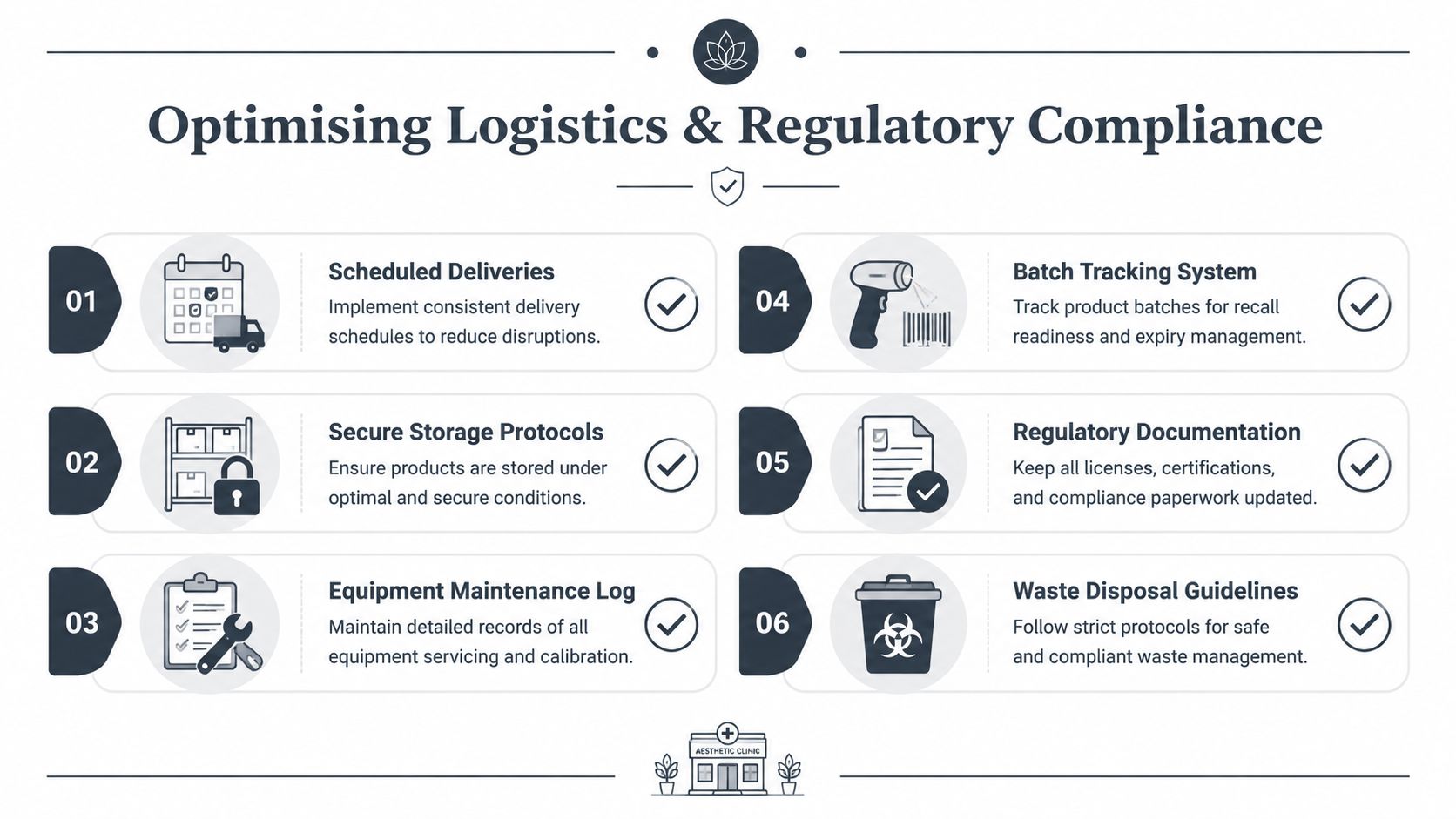
Receiving should never be reduced to signing a box and moving on. A disciplined intake routine protects both patient safety and financial control.
Use a receiving checklist:
- Match the delivery to the order. Item, quantity, and pack size must match what was approved.
- Inspect condition immediately. Check seals, packaging damage, and temperature-sensitive handling where relevant.
- Capture traceability details. Record batch numbers, expiry dates, and serial numbers where applicable.
- File the documents at intake. Invoice, delivery note, compliance paperwork, and any certificates should be stored together.
If your clinic imports products or equipment, customs errors can delay stock unexpectedly. A clear primer such as Dutiful on customs classification is useful for understanding the role of product classification in cross-border movement.
Storage and maintenance discipline
Once stock is accepted, storage conditions matter. Sensitive topicals, sterile items, and device-specific consumables shouldn't be left wherever space happens to exist. Assign shelves by category, label clearly, and separate retail stock from clinical stock.
For capital equipment, maintenance needs its own control system. Keep one file, digital or physical, for each device with:
- Installation records
- Service dates
- Calibration or maintenance reports
- Fault history
- Parts replaced
- Operator training records
If a clinic can't produce the maintenance history for a treatment device quickly, it doesn't have operational control of that device.
Preventative maintenance is often treated as optional because it doesn't generate revenue on the day. In practice, it protects revenue by reducing unplanned downtime and supporting safe, consistent treatment delivery.
What inspectors want to see
Inspectors and auditors generally look for proof, not explanations. They want to see that the clinic can show what was bought, where it came from, how it was stored, how it was maintained, and who used it.
Your documentation set should include:
- Supplier approval records
- Product certificates and licences where applicable
- Batch and serial traceability
- Maintenance and service logs
- Complaint and corrective action records
- Waste disposal records for regulated items
Don't wait for an inspection to discover gaps. Run an internal document drill every quarter. Pick one device and one consumable at random and verify that every supporting record can be retrieved quickly and completely.
Measuring What Matters Clinic Supply Chain KPIs
Without KPIs, most clinics judge supply performance by stress level. If everyone feels busy and treatments are still happening, the assumption is that the system is working. That's not enough. A clinic needs a few hard measures that connect supply chain optimization to margin, utilisation, and service consistency.
According to medical device supply chain strategy guidance on quantifying value, the value of supply chain strategy should be quantified through projections on cost reductions, customer on-time order fulfilment rates, and lead time reductions, then linked to revenue growth and margin improvement so leadership can make decisions with confidence.
The KPI table that matters in a clinic
Essential Supply Chain KPIs for Aesthetic Clinics
| KPI | What It Measures | Why It Matters | Simple Calculation |
|---|---|---|---|
| Inventory Turnover Rate | How quickly stock is used and replenished | Shows whether cash is stuck in slow-moving stock | Cost of stock used in a period ÷ average stock held |
| Stockout Rate | How often a needed item is unavailable | Directly affects cancelled or delayed treatments | Number of stockout incidents ÷ total items requested |
| On-Time Delivery Rate | Supplier reliability against promised dates | Helps identify which suppliers are dependable | On-time deliveries ÷ total deliveries |
| Lead Time | Time from order placement to goods received | Supports better reorder timing and safety stock decisions | Delivery date minus order date |
| Expiry Waste Rate | Value or quantity lost to expiry | Exposes poor forecasting, overbuying, or weak rotation | Expired stock ÷ total stock purchased |
| Cost Per Treatment | Supply cost attached to each procedure | Protects margin and improves treatment pricing decisions | Total consumable cost for treatment ÷ number of treatments performed |
| Supplier Error Rate | Frequency of wrong, damaged, or incomplete deliveries | Shows which relationships create hidden admin and service costs | Problem deliveries ÷ total deliveries |
Track these monthly. Weekly tracking works for high-volume consumables, but monthly review is enough for most clinics if the data is clean.
How to use KPI data in management decisions
One metric alone can mislead you. A clinic with very high inventory turnover might look efficient, but if stockout rate is also high, the clinic is cutting too fine. A clinic with low stockout rate may look safe, but if expiry waste keeps climbing, too much cash is sitting on shelves.
Use KPI combinations to spot the problem:
- High stockout rate plus long supplier lead time usually means reorder points are too low.
- Low turnover plus high expiry waste usually points to overbuying or weak demand planning.
- Poor on-time delivery plus high supplier error rate means the issue is external and needs supplier action.
- Rising cost per treatment with stable bookings suggests pricing, usage discipline, or procurement terms need review.
Good KPI reporting doesn't create more admin. It removes arguments based on opinion.
Keep the scorecard short enough that it gets reviewed every month. If no one acts on a metric, remove it or assign ownership. Metrics should support decisions, not decorate meetings.
Driving Continuous Improvement and Future-Proofing
The clinics that manage supply well don't rely on one big overhaul. They build a repeatable cycle and stick to it. That cycle is simple. Measure, review, adapt. Then repeat before small inefficiencies become expensive habits.
This matters even more in aesthetics because your supply chain isn't only about buying products. It includes maintenance readiness, replacement parts, packaging for resale items, documentation discipline, and what happens when products or components need to move back out of the clinic. If your team hasn't thought through returns, repairs, or end-of-life product flow, a practical reference such as this B2B reverse logistics guide can help frame that often-missed part of operational planning.
Measure review adapt
The rhythm should be brief and consistent.
Measure first. Pull the KPI set, note the biggest exceptions, and compare them to the previous period. Review next. Ask why the metric moved, who owns the cause, and whether it's internal or supplier-driven. Adapt last. Change one process, one reorder level, one supplier term, or one documentation rule at a time.
A useful monthly review agenda looks like this:
- One operational issue that disrupted bookings or treatment delivery
- One inventory issue involving stockout, expiry, or overstock
- One supplier issue involving lead time, errors, or support quality
- One compliance check on records, maintenance, or traceability
- One action item with an owner and deadline
Start small and protect cash flow
Most clinics don't need a dramatic reinvention. They need disciplined fixes in the places where money leaks first.
Good starting points include:
- Tighten one category such as device consumables before trying to reorganise all stock at once.
- Standardise one ordering method so staff stop using mixed channels.
- Review one top supplier using a proper scorecard.
- Clean one compliance file set for your most important device.
- Adjust one reorder point based on actual usage instead of habit.
Continuous improvement works because small operational gains compound. Fewer emergency purchases improve cash control. Better receiving checks reduce disputes. Cleaner maintenance records reduce downtime risk. More accurate forecasting supports steadier bookings and better margin.
The clinics that future-proof best are not the ones with the most complex systems. They're the ones that run simple controls consistently, respond early to warning signs, and treat supply chain optimization as part of clinical quality, financial management, and brand protection.
If your clinic is planning to expand treatment capacity, tighten compliance, or improve ROI from high-value aesthetic equipment, Omega Lasers offers FDA approved, CE certified, and SAHPRA licensed platforms backed by training, technical support, and business guidance built for real clinic operations.