



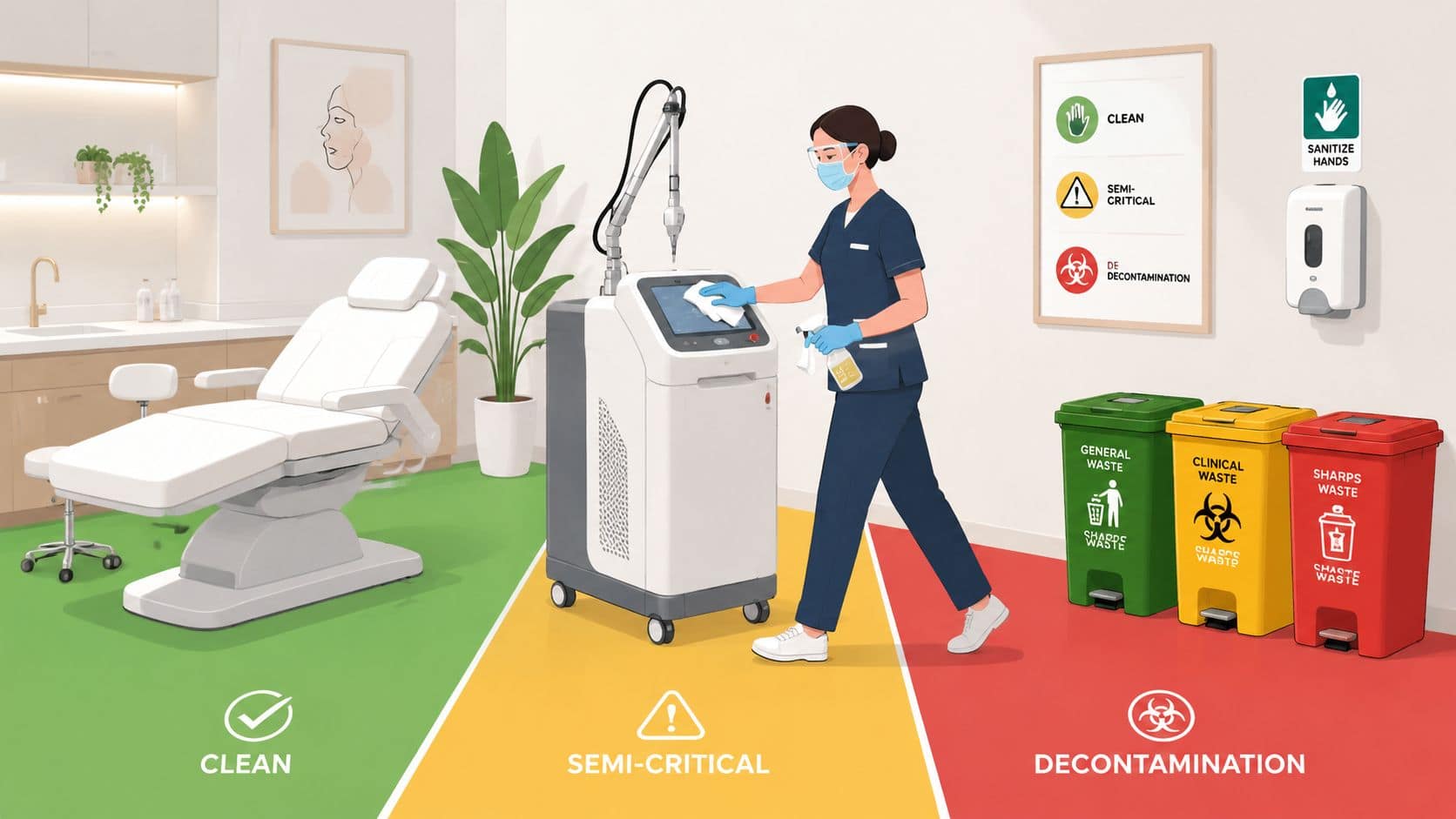
A busy aesthetic clinic can look spotless and still have weak infection control. The front desk is full, a client arrives late for laser hair removal, a therapist resets the room quickly, someone touches a trolley after opening the door, and a handset gets wiped with the wrong product because the correct one isn't within reach. Nothing dramatic happens in that moment. That's exactly why these failures get missed.
In practice, infection control isn't a cleaning task you assign at closing time. It's a workflow system that protects clients, protects staff, and protects the reputation you're trying to build in a competitive South African market. If you run lasers, RF microneedling, facials, skin treatments, injectables support services, or any procedure involving close contact, shared surfaces, consumables, or body fluids, your risk sits inside the daily flow of work.
The clinics that handle this well don't treat it as a compliance burden. They build it into booking, room setup, treatment sequencing, device care, waste handling, and staff training so that safety supports efficiency instead of fighting it.
Table of Contents
- Beyond Clean The Business Case for Infection Control
- The First Line of Defence Patient Screening and Hygiene
- Creating Safe Zones PPE and Clinic Workflow
- Device Disinfection OEM Guidance and Best Practices
- Managing Clinic Waste Safely and Compliantly
- Building a Competent Team Training and Documentation
- Your Infection Control Quick-Start Checklist
Beyond Clean The Business Case for Infection Control
An aesthetic clinic doesn't get judged only on results. Clients notice whether the room feels organised, whether staff change gloves correctly, whether treatment heads are handled with care, and whether your team looks calm and consistent. They may not know the technical standard, but they know when a clinic feels controlled and when it feels improvised.
That matters because infection control sits directly inside trust. A client who trusts your hygiene is more likely to proceed with treatment, return for a course, and refer others. A client who sees confusion around cleaning, PPE, or waste disposal starts questioning everything else, including your treatment standards, your device quality, and your professionalism.
Why this is a business issue not only a clinical one
South African aesthetic clinics aren't hospitals, but they still operate inside the same basic reality. Microbes move through hands, shared surfaces, reusable equipment, treatment beds, poor room flow, and rushed turnover. National South African surveys found that approximately 9.1% to 9.4% of hospitalised patients had at least one healthcare-associated infection, and the WHO reports that effective IPC programmes can reduce such infections by up to 70%, according to this summary of infection prevention findings.
Those figures matter because they move infection control out of the realm of “best effort” and into measurable patient safety. In a clinic setting, the same logic applies. If transmission risk can be reduced through better hygiene systems, then weak systems aren't just untidy. They're operational failures.
Practical rule: If a protocol only works when the clinic is quiet, it isn't a real protocol.
Strong infection control also supports your regulatory position. If you market premium treatments, discuss medical-grade standards, or emphasise approved and compliant equipment, your hygiene system has to match that message. You can't claim a high-standard clinic while running low-standard room turnover.
What profitable clinics understand
Profitable clinics don't spend blindly on infection control. They standardise it. They place supplies where they're needed, reduce unnecessary touches, simplify room reset steps, and document what staff must do every time. That lowers friction and protects consistency.
There's a lesson here from outside healthcare too. Food businesses that handle hygiene well don't rely on good intentions. They build repeatable systems around contamination control, cleaning, storage, and staff discipline. The Chef Royale guide to UK food safety is useful reading because it shows the same operational truth. Hygiene becomes sustainable when it's designed into workflow rather than added as an afterthought.
A clean-looking clinic can still be unsafe. A well-run clinic is different. It produces visible order, controlled movement, documented standards, and fewer opportunities for error. That's what clients trust, staff can follow, and your brand can stand on.
The First Line of Defence Patient Screening and Hygiene
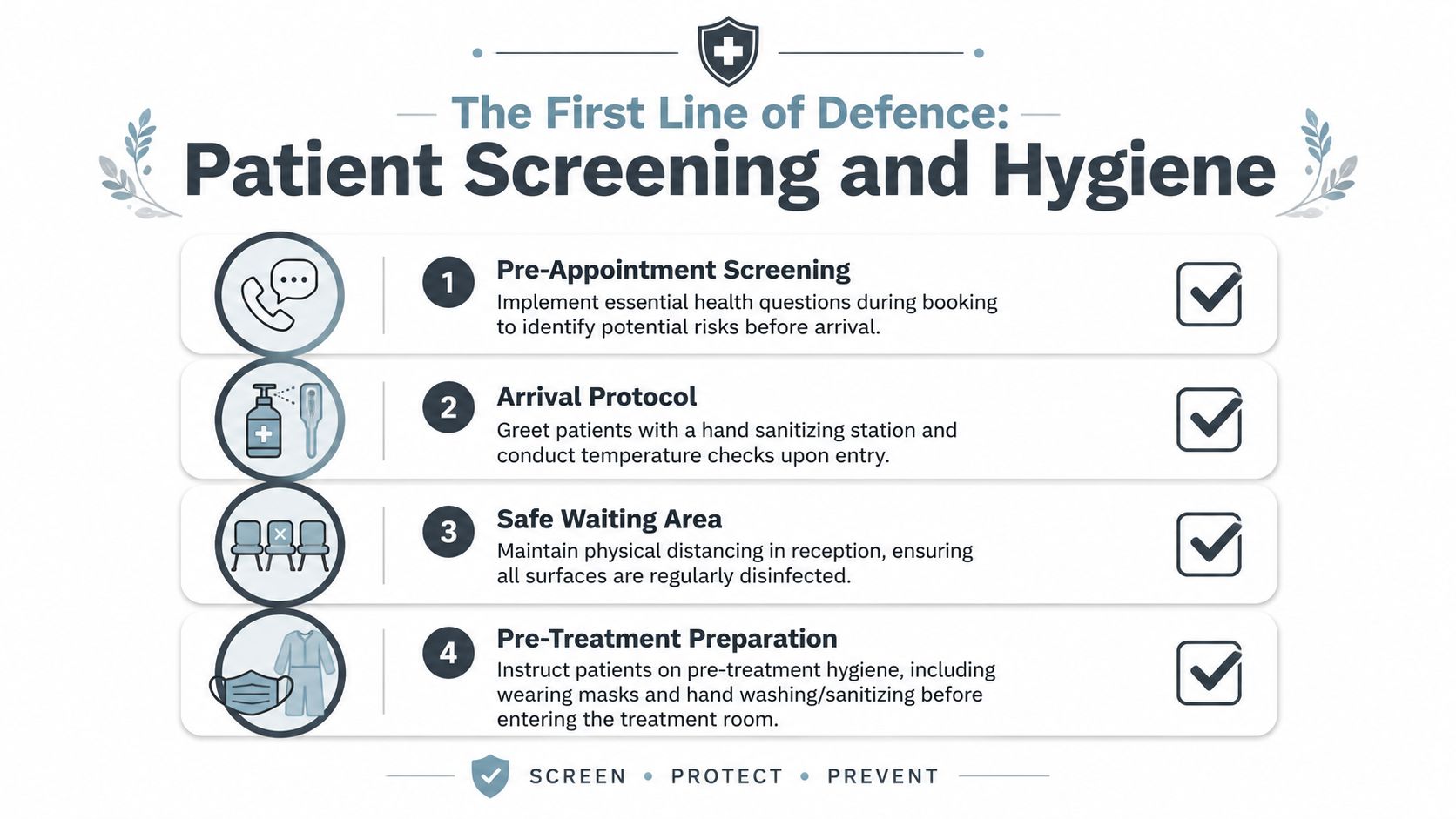
Most infection control failures start before treatment. They begin at booking, reception, or the waiting area, where clinics either catch risk early or allow it to move deeper into the business. If you wait until the client is already in the treatment chair to think about symptoms, hand hygiene, or source control, you're late.
The better approach is simple. Build the first line of defence into the patient journey so your team doesn't have to improvise.
Start at booking not at arrival
Your booking form and pre-appointment messages should ask practical screening questions in plain language. Don't make them dramatic. Make them useful.
A clinic screening process should check for current illness symptoms, recent exposure concerns where relevant to your policy, active skin infections in the treatment area, open wounds, and anything else that changes whether a treatment should proceed safely that day. For higher-contact services, add a reminder that clients should reschedule if they feel unwell or develop symptoms before the appointment.
This does two things. It protects the schedule, and it normalises honesty before the client is standing in front of reception feeling embarrassed about being turned away.
A strong script sounds professional, not punitive. You're not rejecting the person. You're postponing the service to protect everyone in the clinic.
Make hygiene visible and easy
CDC core practices recommend early detection and management of potentially infectious persons. They also emphasise respiratory hygiene, hand-hygiene supplies at entry points, and separating symptomatic patients as early as possible. Structured interventions have improved hand-hygiene compliance from 9.2% at baseline to 56.4% during the intervention phase, as outlined in the CDC core infection control practices.
That tells you something important. Knowledge alone doesn't change behaviour. Systems do.
Use the entrance well. Place hand sanitiser where clients naturally pause, not tucked beside retail shelves. Put tissues and a closed bin where they can be reached without asking. Use a simple sign that tells clients what to do on entry. If reception staff have to explain basic hygiene to every person who walks in, the system is too dependent on memory.
The most effective hygiene cue is the one the client can follow without needing instruction.
Manage symptomatic clients without creating a scene
Many clinics falter at this stage. Staff know they should act, but they don't know how to do it smoothly. The result is hesitation, mixed messages, and avoidable exposure.
Train one front-desk script and one clinical escalation script. Keep both short.
- Front desk script: “For everyone's safety, we need to postpone appointments when someone is unwell or showing symptoms. Let's help you move this booking to the next suitable date.”
- Clinical escalation script: “This treatment isn't appropriate to continue today. We'll reschedule once it's safe for you and for the rest of the clinic.”
If space allows, move the person away from shared seating while arrangements are made. In a small clinic, that might mean using an empty consult room or asking the client to wait outside briefly while reception completes the rebooking.
Tighten the handoff to the treatment room
The final hygiene checkpoint should happen before the client enters the room. That handoff can include:
- Hand hygiene reminder: Ask the client to sanitise or wash hands immediately before treatment.
- Pre-treatment skin review: Confirm the treatment area is free from visible concerns that require postponement or a revised plan.
- Personal items control: Keep phones, bags, and unnecessary belongings off treatment trolleys and clean surfaces.
- Mask or barrier use where appropriate: Apply this according to the service and your clinic's current respiratory risk policy.
These steps don't slow a clinic down when they're built into the routine. They reduce last-minute disruptions, keep treatment rooms cleaner, and stop reception risk from becoming clinical risk.
Creating Safe Zones PPE and Clinic Workflow
Most clinic owners understand the theory of clean and dirty flow. The problem is that their premises weren't built for theory. They're working in converted retail units, compact suites, shared buildings, or mixed-use spaces where reception, retail, consultation, and treatment all compete for the same square metres.
That's where infection control either becomes practical or collapses into paperwork. Compliance failures are often driven by layout, workflow, and ventilation constraints, not a lack of policy. Healthcare design guidance stresses that retrofitting compliance into space-constrained facilities requires deliberate design and human-factors analysis, as discussed in this infection prevention design article.
Zone the clinic you have
You don't need a hospital floor plan. You need clear rules for movement, storage, and handling.
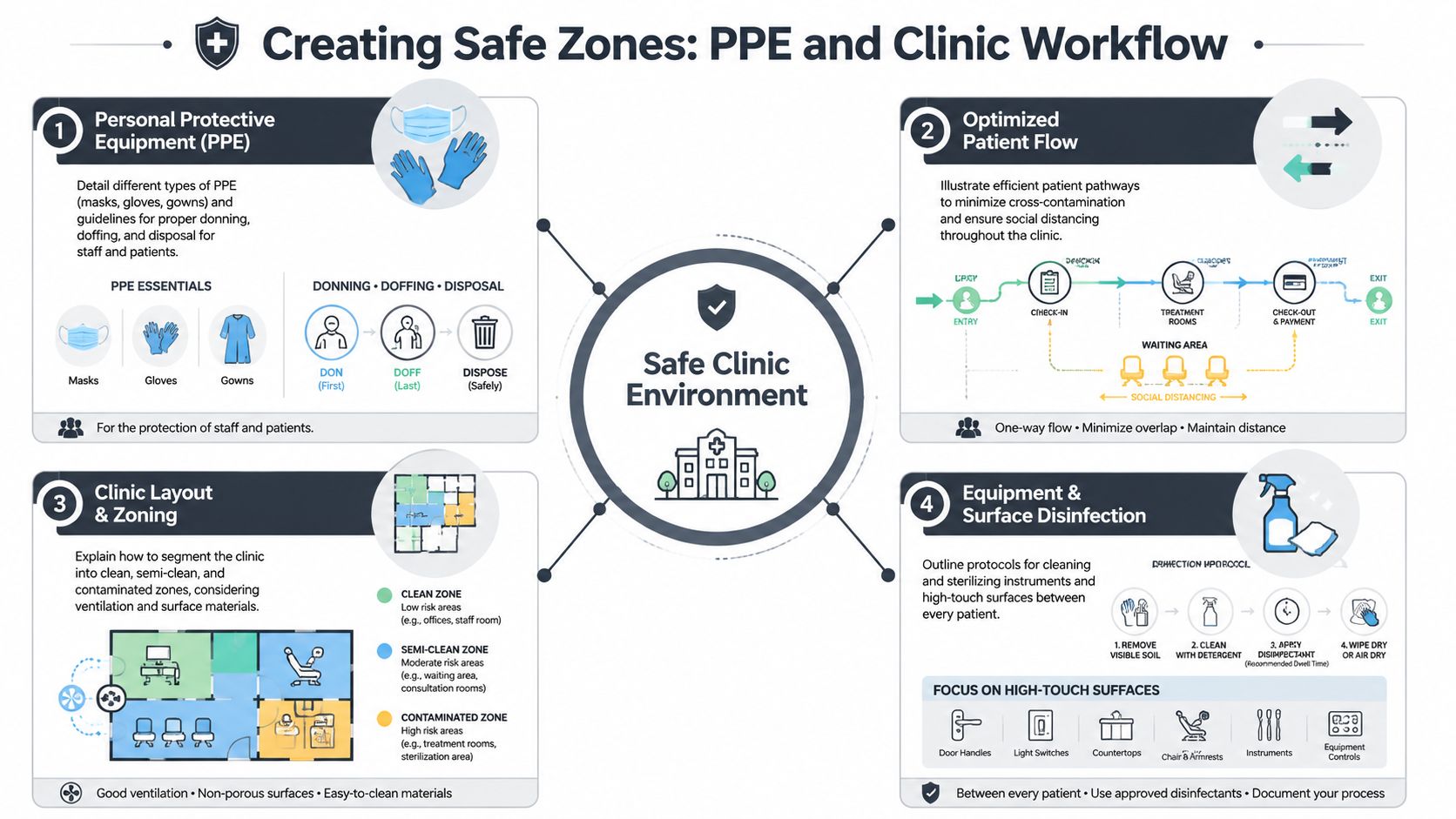
A small aesthetic clinic can usually function with three practical zones:
| Zone | What belongs there | Common mistake |
|---|---|---|
| Clean zone | Sealed consumables, disinfected devices, fresh linen, prepared trays | Storing stock beside used items |
| Treatment zone | Active procedure setup, clinician PPE, patient contact surfaces | Allowing clutter to build during treatment |
| Decontamination zone | Used instruments, waste segregation, cleaning materials | Carrying contaminated items back through clean prep areas |
Mark these zones with layout choices, not only signs. Use separate shelves, colour-coded containers, fixed trolley positions, and one-direction movement where possible. If a staff member has to think too hard about where an item belongs, the setup isn't clear enough.
Build a clean-to-dirty path
The path matters more than the room size. Staff should move from prepared items to patient contact to waste and decontamination, not backwards and forwards between them.
A practical room sequence looks like this:
- Prepare before the client enters. Open only what's needed.
- Keep clean stock behind the operator. Don't reach across contaminated surfaces to access fresh consumables.
- Use one side of the trolley for clean items and the other for used items.
- Dispose of waste immediately at point of use.
- Move reusable items straight to the decontamination pathway after treatment.
If clean and dirty items share the same trolley shelf, staff will eventually mix them under pressure.
For PPE, match the level to the treatment. Don't waste resources by over-dressing for low-risk services, and don't under-protect staff during higher-contact or more invasive procedures.
Match PPE to the procedure
For lower-contact treatments such as a standard facial, skin analysis, or non-invasive skincare service, staff generally need clean professional attire, hand hygiene discipline, and gloves when contact with mucous membranes, broken skin, or contaminated materials is possible. If the procedure generates close face-to-face exposure, add the appropriate mask for your clinic policy and current respiratory risk.
For laser hair removal and similar energy-based treatments, think about hand contact, surface contact, and device handling. Gloves should be available and used when indicated, especially where shaving, gel application, skin contact, or post-treatment skin care creates contamination points. If you're reviewing glove stock, choose products that hold up under repeated clinical use, such as black nitrile gloves for treatment-room workflow.
For procedures with blood spotting, barrier disruption, or higher splash risk, such as RF microneedling or more invasive skin work, increase protection. That may include gloves, mask, eye protection where splash is possible, and protective clothing that can be changed if contaminated. The point isn't to create a theatrical PPE display. The point is to block realistic exposure routes.
Ventilation and throughput need operational rules
Ventilation gets ignored because it feels technical. In reality, it's a room-turnover issue. If air feels stale, doors stay shut unnecessarily, or one room handles too many back-to-back clients without a reset routine, workflow starts amplifying risk.
You don't need to over-engineer every clinic, but you do need to know whether your treatment rooms support safe occupancy and turnaround. For owners reviewing air-quality support options, this overview of the key benefits of UV light in HVAC is a useful operational reference when discussing ventilation upgrades with building professionals.
A safe clinic layout isn't about having more space than everyone else. It's about making your existing space behave predictably under real working conditions.
Device Disinfection OEM Guidance and Best Practices
In aesthetic practice, your devices are high-value assets and high-risk touchpoints at the same time. They move between staff hands, patient contact zones, couplants, treatment products, carts, beds, and counters. If the disinfection routine is vague, rushed, or based on guesswork, you create two problems at once. You increase contamination risk, and you shorten the life of expensive equipment.
The first rule is simple. Always follow the original equipment manufacturer's instructions first. If the device manual limits the chemicals, contact time, wipe method, or moisture exposure, that instruction overrides habit and overrides whatever someone used in their previous clinic.
Start with the manufacturer not the chemical supplier
Device damage often happens because staff choose a disinfectant by convenience instead of compatibility. One wipe gets used on everything. The touchscreen, handpiece shell, cable, metal surfaces, and optical components all get treated the same way. That's poor infection control and poor asset management.
OEM guidance matters because aesthetic devices contain mixed materials. You may have coated lenses, sensitive plastics, seals, adhesives, painted housings, ports, vents, and screens in one system. A product that's acceptable for a trolley frame may be wrong for a laser handpiece window.
If the clinic uses ultrasound-based systems or skin-contact applicators with coupling products, control the whole chain. Product residue affects cleaning, and cleaning affects the next treatment. That's why even simple consumables such as ultrasound gel used with device-based treatments should be handled with the same discipline as the device itself. Keep them clean, closed, and stored correctly.
Never spray liquid directly onto a device unless the manufacturer explicitly permits it. Apply to the wipe first when allowed, then clean with control.
Choose the agent by surface type
Think in categories.
For non-critical external surfaces such as device housings, carts, counter tops, and treatment bed frames, use a clinic-approved disinfectant that matches the manufacturer's material guidance and the level of contamination expected. These surfaces need consistent between-patient wiping and end-of-day cleaning.
For touchscreens and control panels, use products and cloths that won't cloud, craze, or degrade the surface. Harsh chemicals and abrasive wipes create long-term visibility and functionality problems. Even when a chemical is technically effective, it's the wrong choice if it damages the interface staff need every day.
For optical surfaces and lenses, treat them as a separate class. These areas often need more delicate cleaning methods and stricter adherence to OEM instructions. The wrong wipe, wrong alcohol concentration, or too much pressure can impair beam delivery or reduce treatment quality.
For patient-contact accessories, focus on whether the item is single-use, reprocessable, or only suitable for low-level disinfection. Don't assume every detachable part can be soaked, sprayed, or immersed.
Laser and Device Disinfectant Compatibility Guide
| Disinfectant Type | Best For | Material Compatibility Notes | Efficacy Spectrum |
|---|---|---|---|
| Quaternary ammonium compounds | General external surfaces, trolleys, non-critical housings | Often suitable for many hard non-porous surfaces, but always check device guidance for plastics, coatings, and screens | Broad routine environmental disinfection when used as directed |
| Accelerated hydrogen peroxide | High-touch non-critical surfaces and some equipment exteriors | Often useful in clinics because it can balance efficacy with workflow, but compatibility still needs checking on sensitive finishes and labels | Broad disinfection for environmental and equipment surfaces when approved for that use |
| Isopropyl alcohol | Selected small surfaces, some touchpoints, certain manufacturer-approved wipe-down tasks | Can damage some plastics, coatings, adhesives, and optical elements if overused or used at the wrong strength. Be especially careful around lenses and screens | Useful against a range of organisms on suitable surfaces when used correctly |
| Soap or neutral detergent followed by approved disinfection step | Pre-cleaning visibly soiled surfaces before final disinfection | Often the safest first step for removing gel, product residue, and debris before using a compatible disinfectant | Cleaning step reduces soil load. The following disinfection step provides the antimicrobial action |
| Manufacturer-specified optical cleaner | Lenses, windows, optical tips, and delicate components | Use only when the OEM calls for it. Optical components should never be treated like general housings | Intended for safe maintenance of optical clarity and component integrity rather than broad environmental use |
The table isn't a substitute for the manual. It's a decision aid.
What works and what doesn't
What works is a written device-specific cleaning sheet kept in the room or near the equipment. It should name the approved product, the approved wipe method, the sequence for pre-cleaning if residue is present, and anything staff must never do.
What doesn't work is verbal tradition. “We've always used this.” “The rep said it should be fine.” “It's hospital grade.” None of that protects the device or proves compliance.
A strong routine has three parts:
- Pre-clean visible residue first: Gel, carbon, skin oils, and treatment products interfere with proper disinfection.
- Use the correct contact method: Wipe pattern, dwell time, and drying matter.
- Document maintenance issues quickly: If a surface cracks, clouds, peels, or stops sealing properly, infection control and engineering concerns now overlap.
When a clinic handles device disinfection properly, it doesn't only reduce contamination risk. It preserves treatment quality, supports warranty compliance, and reduces avoidable downtime.
Managing Clinic Waste Safely and Compliantly
Waste tells you a lot about how a clinic operates. A room can look neat while the disposal process is chaotic. Used sharps sit on trays too long, contaminated gauze gets dropped into general waste, liners overflow, and staff carry loose items across the clinic because the right bin wasn't in the room. Those are handling failures, not housekeeping issues.
The safest method is segregation at the point of generation. If staff have to sort waste later, you've already increased risk.
Separate waste where it is created
An aesthetic clinic typically generates more than one waste stream. Keep the categories practical and train them until staff can identify each one instantly.
- General waste: Packaging, office waste, and non-contaminated disposables.
- Healthcare risk waste: Items contaminated with blood or body fluids, treatment materials from invasive procedures, and anything your policy classifies as infectious clinical waste.
- Sharps: Needles, blades, lancets, and any item capable of puncture or cutting.
- Chemical or product-related waste: Certain leftover substances, containers, or materials that require controlled disposal under your operational and supplier guidance.
Don't place one large mixed bin in every room and assume staff will use judgement under pressure. Put the correct containers where the waste arises.
Container choice and storage discipline
Sharps need puncture-resistant containers positioned close to use, not across the room. Soft clinical waste needs appropriate lined containers that can be closed securely. General waste should be physically separate so staff aren't tempted to use the nearest opening for everything.
Labelling matters. So does the lid. So does who removes the waste and when.
Waste storage should never force staff to touch, compress, or re-handle contaminated material to make it fit.
Set collection points, internal transfer rules, and holding areas that keep waste secure from public access. In mixed-use buildings, this becomes even more important because back-of-house routes may also be used by cleaners, tenants, or delivery staff.
Keep the paperwork as clean as the process
In South Africa, clinics need a documented process and a certified medical waste disposal partner where healthcare risk waste is involved. That relationship shouldn't live in someone's inbox. Keep service agreements, collection records, and internal logs together so you can prove the chain of control.
A workable clinic standard includes:
- Room-level segregation rules
- Clear container placement
- Daily closure checks
- Secure interim storage
- Scheduled collection and record retention
If your team handles waste correctly, room resets get faster, exposure drops, and inspections become far less stressful. Waste control isn't glamorous, but it's one of the clearest signals that a clinic understands real infection control.
Building a Competent Team Training and Documentation
A written protocol doesn't protect anyone by itself. Staff protect people. If they haven't been trained properly, if nobody checks their technique, or if no one owns the system, your manual is decoration.
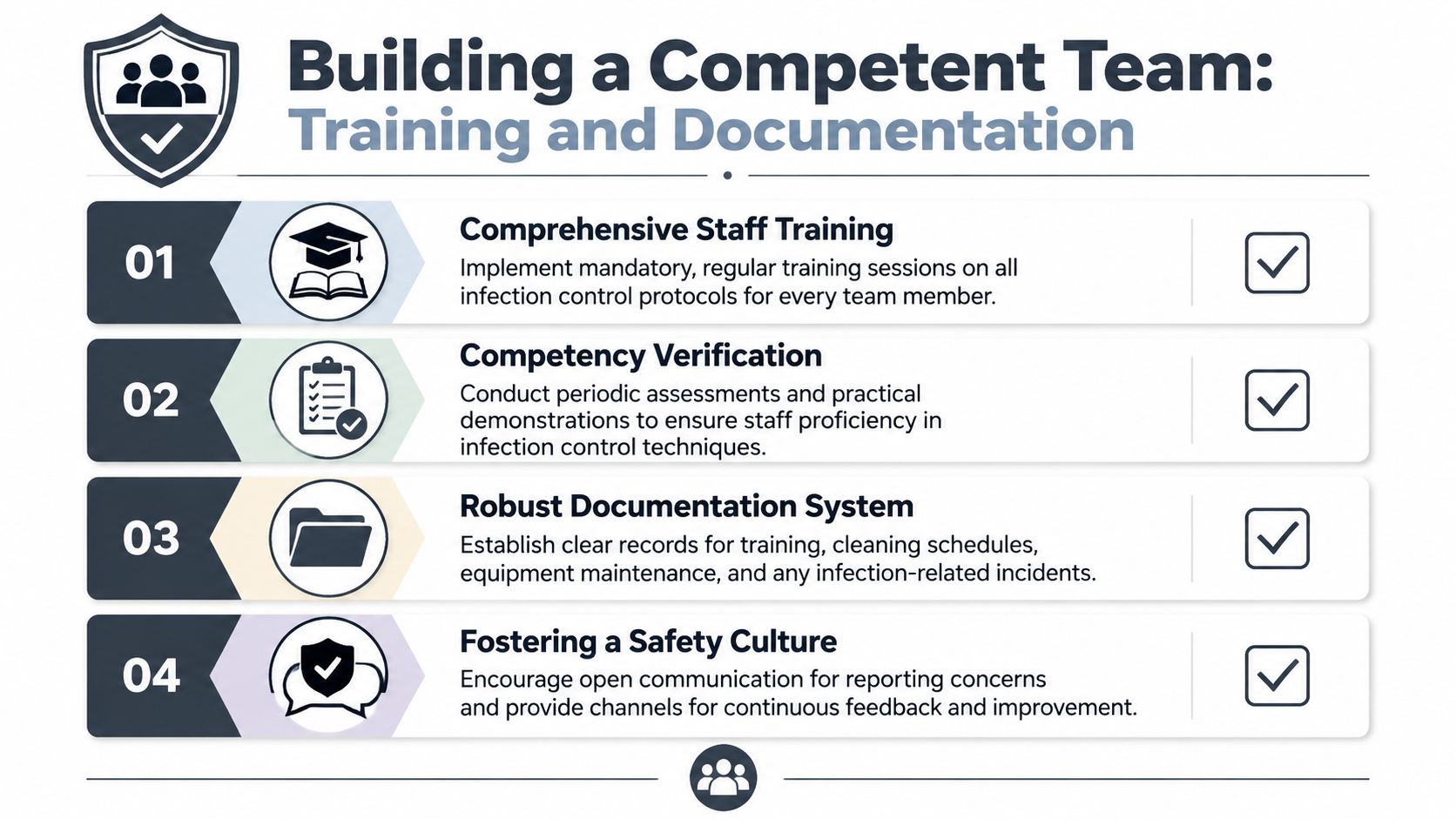
The strongest clinics treat infection control as a staff competency, not a document set. New hires learn it at induction. Existing staff refresh it regularly. Managers audit it. Someone in the team is accountable for keeping the system alive.
Give one person clear ownership
Every clinic needs a designated infection control lead, even if the team is small. This doesn't mean that person does all the cleaning or carries all the responsibility. It means someone monitors standards, updates documents, notices drift, and escalates problems before they become incidents.
In a laser-focused clinic, that lead also needs enough authority to correct treatment-room habits. If glove use is inconsistent, if eye protection is handled carelessly, or if room reset steps are being skipped, the lead must be able to intervene.
For device-based practices, training should include treatment-specific PPE and safety items such as laser safety glasses used in controlled clinical environments. Staff need to know where they belong, how they're cleaned or stored according to protocol, and when replacement is required.
Train for behaviour not only knowledge
Teams can answer hygiene questions in a meeting. The critical test is whether they perform correctly during a busy day.
A useful training programme includes:
- Induction training: Clinic zoning, hand hygiene, PPE use, room turnover, waste segregation, and incident reporting.
- Task demonstrations: Show exactly how to clean device surfaces, prepare trays, and close a treatment room after use.
- Observed competency checks: Watch staff do the task. Don't rely on signatures alone.
- Annual refreshers: Re-run critical procedures and update staff when services, layout, or products change.
- Incident-based retraining: If something goes wrong, retrain the process, not only the person.
Documentation proves its worth. Training records prove who was trained, on what, and when. Cleaning logs prove routines happened. Maintenance logs prove problems were noticed. Incident forms prove that the clinic responds in a controlled way.
Use a scored risk register
A practical infection-control risk assessment should translate factors like probability, impact, detectability, and readiness to prevent into a numeric score. The Quality Insights framework suggests prioritising items scoring 8 or more as high-risk actions for the annual plan, as described in this infection-control risk assessment framework.
That approach works well in aesthetic settings because it stops owners from treating every issue as equally urgent. A cracked trolley wheel and a poor hand-hygiene station position are not the same problem. A treatment room with no clean-to-dirty flow and inconsistent sharps disposal is a different level of risk again.
A simple risk register might include:
| Risk item | Why it matters | Action |
|---|---|---|
| Hand sanitiser poorly positioned | Clients and staff miss the hygiene cue at entry | Reposition and monitor use |
| Room layout causes cross-over | Clean items pass through contaminated space | Redesign trolley and storage flow |
| Device cleaning inconsistent | Surface safety and equipment integrity both suffer | Create device-specific cleaning sheet |
| Waste segregation confusion | Exposure risk increases during room turnover | Re-label bins and retrain staff |
Good documentation doesn't create bureaucracy. It creates evidence that the clinic is under control.
When staff are trained properly and records are current, audits become easier, incidents are easier to investigate, and standards are less likely to collapse when a senior team member is off duty.
Your Infection Control Quick-Start Checklist
If you want to improve infection control quickly, don't start by rewriting every policy. Start by checking whether daily behaviour matches the standards you think you already have. Most clinics discover the same gap. The protocol exists, but the workflow doesn't support it.
Use this as a fast operational self-audit.
The five pillars to check this week
- Screening works before arrival: Booking forms, reminders, and reception scripts identify risk early and make rescheduling straightforward.
- Hygiene is visible at entry: Clients can sanitise hands immediately, follow respiratory etiquette cues, and move through reception without confusion.
- Rooms have a clean-to-dirty flow: Consumables, instruments, waste, and reusable items move in one direction without backtracking.
- Devices are cleaned correctly: Staff follow written manufacturer-based instructions, use approved products, and don't improvise on screens, lenses, or housings.
- The team can prove competence: Training records, cleaning logs, waste records, and a live risk register are current and usable.
Quick-start audit for a clinic manager
Walk your clinic with this list and answer truthfully.
- At the front door, is the first hygiene action obvious?
- At reception, can staff manage a symptomatic client without hesitation?
- In each room, can you point to the clean zone and the decontamination pathway immediately?
- On each device, is there a clear cleaning instruction that staff follow?
- At each point of waste generation, is the correct container within reach?
- Can you produce training records without searching through multiple folders or messages?
- Do you review infection-control risks when staffing, patient flow, or services change?
If the answer to several of those is no, the clinic doesn't need more theory. It needs a tighter operating system.
What to fix first
Start with the highest-friction failures. These usually create the biggest daily risk.
- Entry hygiene gaps: Easy to fix and immediately visible.
- Room clutter and poor flow: High impact on cross-contamination.
- Unclear device cleaning methods: High risk to both safety and equipment.
- Weak documentation: Harder to notice day to day, but damaging during audits or incidents.
The goal isn't to create a perfect manual. It's to create a clinic where safe practice is the easiest practice. When infection control is built into workflow, it supports client confidence, staff discipline, and the kind of professional reputation that grows a clinic sustainably.
If you're building or upgrading an aesthetic clinic, Omega Lasers can support the bigger picture. That includes compliant device technology, practical training, and the operational guidance needed to deliver safe treatments with confidence.