




Your clinic already has records. The real question is whether they would protect you tomorrow.
Most aesthetic practices reach a point where the cracks start to show. A consent form is signed but not linked to the treatment note. A laser session is recorded in the diary but not in the patient file. A handpiece service visit happened, but nobody can find the maintenance log. Staff training was done, yet the certificates live in someone's inbox. That isn't a filing problem. It's an operational risk.
Good record keeping does more than satisfy an inspector. It helps a clinic defend clinical decisions, track device safety, recover quickly from disputes, and keep treatment quality consistent across staff. South Africa's long history of official census record systems, including a national census in 1911 and later censuses in 2001, 2011, and 2022, shows why structured records matter over time for governance and planning (South African census record history). In a clinic, the principle is the same. If the record is incomplete, the business loses memory.
Table of Contents
- Why Flawless Record Keeping Is Non-Negotiable
- Core Components of a Compliant Clinic Record
- Designing Your Clinic's Record-Keeping Workflow
- Implementing SOPs and Standardised Templates
- Training Your Team for Consistency and Security
- Audit Preparation, Retention, and Disaster Recovery
Why Flawless Record Keeping Is Non-Negotiable
A record keeping failure usually shows up at the worst moment. A patient questions what was discussed before treatment. A package balance is disputed. A complication appears later and the clinic needs to prove settings, consent, aftercare advice, and who performed the procedure.
If the record is scattered across paper forms, messages, a booking system, and a staff member's memory, the clinic has a weak position. Even when care was appropriate, poor documentation makes good decisions hard to prove.
Records protect revenue, not just compliance
Clinic owners often treat documentation as overhead because it doesn't feel billable. That's the wrong lens. A complete record supports charge reconciliation, package tracking, stock usage review, staff accountability, and complaint handling. It also reduces wasted time because the team can find the right version of the right document without hunting through folders.
Electronic record systems only help if the records remain usable. Recent U.S. federal guidance notes that electronic records must remain retrievable, legible, and protected, and that personally identifiable information must be safeguarded with controlled disclosure (electronic records and privacy guidance). That maps directly to what clinics struggle with in practice: going digital without losing confidentiality or auditability.
Practical rule: If a staff member can't retrieve the full treatment story quickly, the system isn't working.
Weak records create expensive friction
The damage from bad record keeping is rarely dramatic at first. It starts as small friction.
- Front desk friction: A receptionist can't confirm whether a patch test was done.
- Clinical friction: A practitioner repeats questions because the previous note is vague.
- Financial friction: Finance can't match treatment delivered against package sold.
- Risk friction: Management can't show who changed a record or when.
That's why clinics should treat documentation as part of operations design. If you're refining how you streamline document operations and security, focus less on where files sit and more on whether the clinic can rely on them under pressure.
Core Components of a Compliant Clinic Record
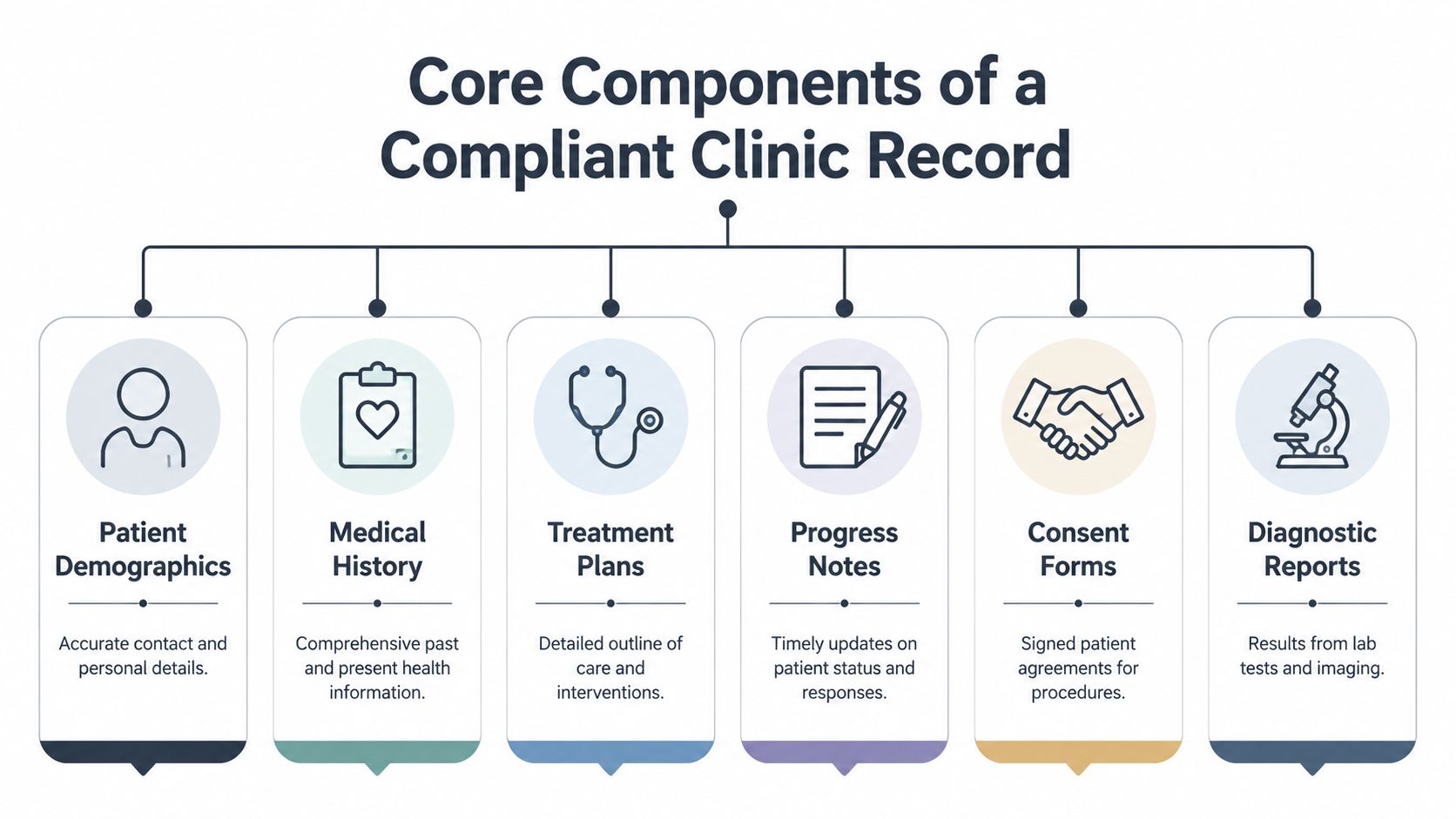
A compliant clinic record isn't one document. It's a connected set of records that tell a complete, defensible story from first contact to follow-up. In aesthetic practice, that story must cover the patient, the treatment, the device, and the person who delivered care.
By 2011, nearly 50% of physicians in the U.S. were already using electronic health record systems, and structured hospital registration systems had been formalised as early as 1793 and 1918 (history of structured medical records and EHR uptake). The lesson for clinics is straightforward. Formal record structures are not a bureaucratic fad. They're the basis of safe, repeatable care.
What belongs in the patient file
Start with the patient file itself. This should be complete enough that another authorised practitioner can understand the case without guessing.
A strong patient file usually includes:
- Identity and contact details: Full identifying information, reliable contact information, and any administrative identifiers the clinic uses.
- Medical history: Relevant conditions, medications, allergies, contraindications, previous procedures, and anything that could affect treatment choice or healing.
- Assessment notes: Skin or treatment area assessment, baseline observations, risk factors, and treatment suitability.
- Consent records: Signed consent tied to the specific procedure, supported by documented discussion of risks, expected outcomes, alternatives, and aftercare.
- Clinical photographs: If photos form part of treatment planning or progress review, they should be dated, stored securely, and matched to the correct patient and session.
- Progress notes: Clear session-by-session notes that explain what changed, what was observed, and what the patient reported.
The mistake I see most often is assuming that a signed form equals a complete record. It doesn't. Consent without the surrounding assessment and treatment notes is weak. Notes without linked consent are just as weak.
What must sit alongside the patient file
Aesthetic clinics also need records that aren't always filed inside the patient folder but are still essential to the clinical picture.
| Record type | Why it matters |
|---|---|
| Treatment logs | Show what was done on the day, including site treated, settings used, consumables or batch details where relevant, and immediate response |
| Device maintenance logs | Show that the equipment was inspected, serviced, calibrated, cleaned, or repaired according to clinic procedure |
| Incident records | Capture adverse events, complaints, treatment interruptions, and corrective action |
| Staff competency records | Show who was trained, on which device or procedure, and whether they were cleared to perform treatment |
| Communication records | Preserve important pre-treatment instructions, aftercare advice, and follow-up communication when clinically relevant |
A clinic record should answer four questions without hesitation: who was treated, what was done, what device or product was involved, and who was responsible.
That's where integration matters. Patient notes, device logs, and staff training records should not live as isolated islands. If a clinic wants to manage business compliance effectively, it needs a joined-up system where records support each other instead of competing with each other.
For teams reviewing intake and treatment workflows, Omega Lasers has a useful page on data collection methods that can help frame what should be captured consistently at the point of care.
Designing Your Clinic's Record-Keeping Workflow
The best workflow is the one your team will follow accurately every day. That sounds obvious, but many clinics choose a system based on preference instead of operational reality. They either overbuild a digital setup nobody understands or cling to paper long after it starts causing delays and gaps.
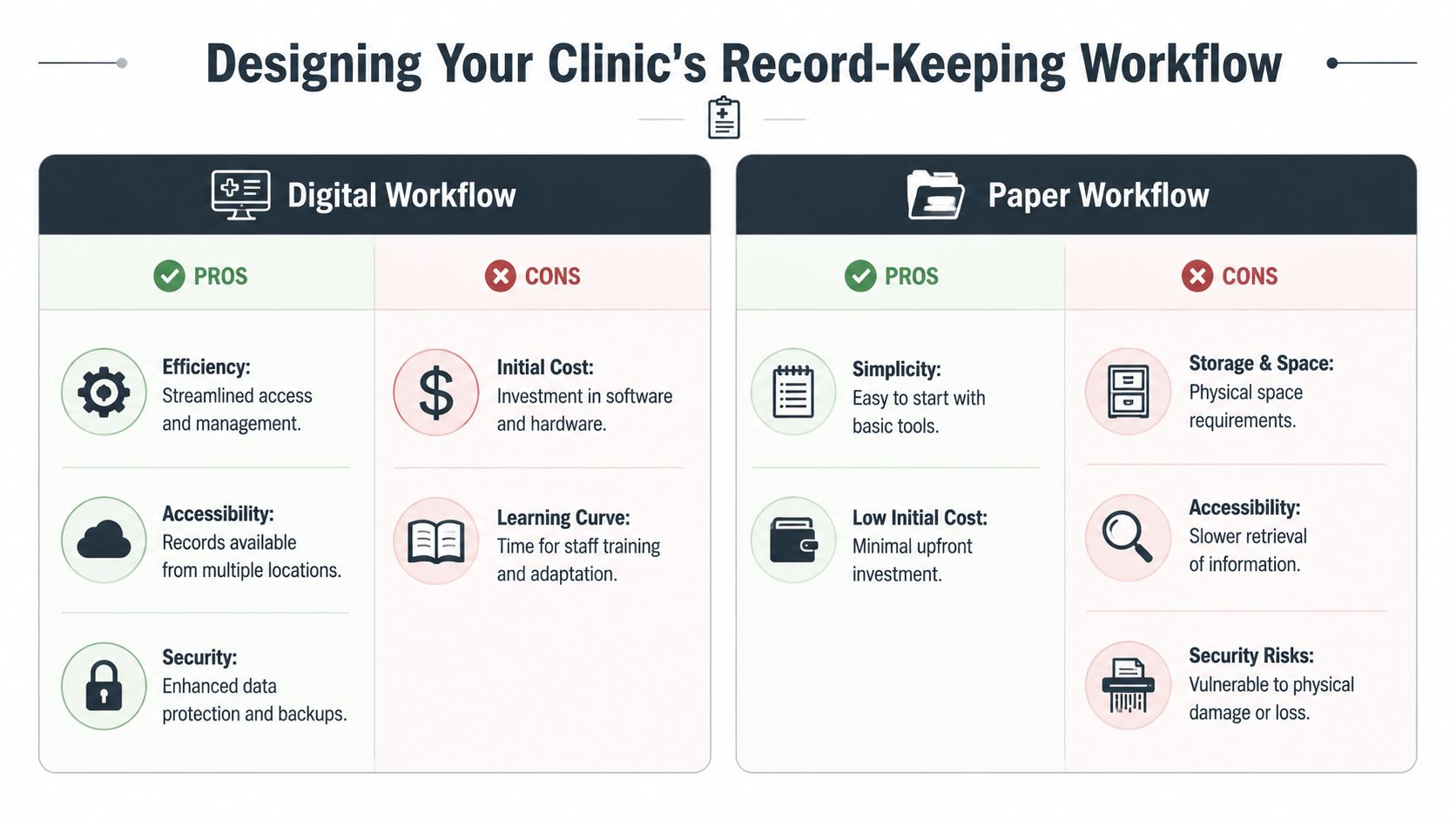
The decision isn't paper versus digital in the abstract. It's whether the workflow supports fast retrieval, controlled access, consistent completion, and clean handover between reception, practitioner, manager, and finance.
Digital, paper, or hybrid
Here's the practical comparison clinics should make.
| Workflow | Works well when | Common weakness |
|---|---|---|
| Digital | The clinic needs quick retrieval, tighter access control, and easier audit preparation | Poor setup creates bad naming, duplicate records, and sloppy permissions |
| Paper | The clinic is small, simple, and disciplined about manual filing | Retrieval is slow and records are vulnerable to physical loss or damage |
| Hybrid | The clinic is transitioning or still depends on some signed physical documents | Teams often don't know which version is the official record |
Paper feels simple because the upfront process is familiar. But simplicity on day one often becomes confusion later. Files split across cabinets, desks, and consultation rooms are hard to reconcile. Version control becomes guesswork. Photos and device logs end up somewhere else entirely.
Digital systems solve many retrieval problems, but they introduce governance problems if nobody owns the structure. Best-practice frameworks call for retention schedules, a named senior executive sponsor, a corporate records manager, and a cross-functional steering committee, precisely because record keeping fails when people treat it like passive storage instead of a managed control system (records management governance guidance).
The workflow that actually holds up
For most clinics, a disciplined hybrid-to-digital pathway is the most realistic route. Not because hybrid is ideal forever, but because transition needs control.
A workable workflow looks like this:
- Capture once at source: Intake, consent, treatment notes, and photos should be entered or filed against one patient identity from the start.
- Assign a single official location: Every record type needs one authoritative home. If duplicates exist for convenience, staff must know which copy governs.
- Build handoff points: Reception confirms demographics and admin forms. Practitioners complete assessment and treatment notes. Managers review exceptions, incidents, and missing items.
- Separate access by role: Not everyone needs access to everything. The person booking appointments doesn't need the same visibility as the treating practitioner.
- Review exceptions daily: Incomplete notes, unsigned consent, unmatched photos, and missing device logs should be fixed the same day.
- Choose digital first if your clinic handles a high volume of repeat visits, uses multiple rooms, or needs rapid search and audit readiness.
- Choose paper only if you can maintain strict filing discipline and have a credible plan for secure storage and disaster protection.
- Choose hybrid temporarily if you are moving systems and have a documented migration process.
What doesn't work is improvisation. A clinic can survive with a modest system. It can't survive for long with an undefined one.
Implementing SOPs and Standardised Templates
Most record keeping problems aren't caused by lazy staff. They're caused by undefined rules. If two practitioners document the same treatment in different ways, the clinic no longer has a reliable record set. It has individual habits.
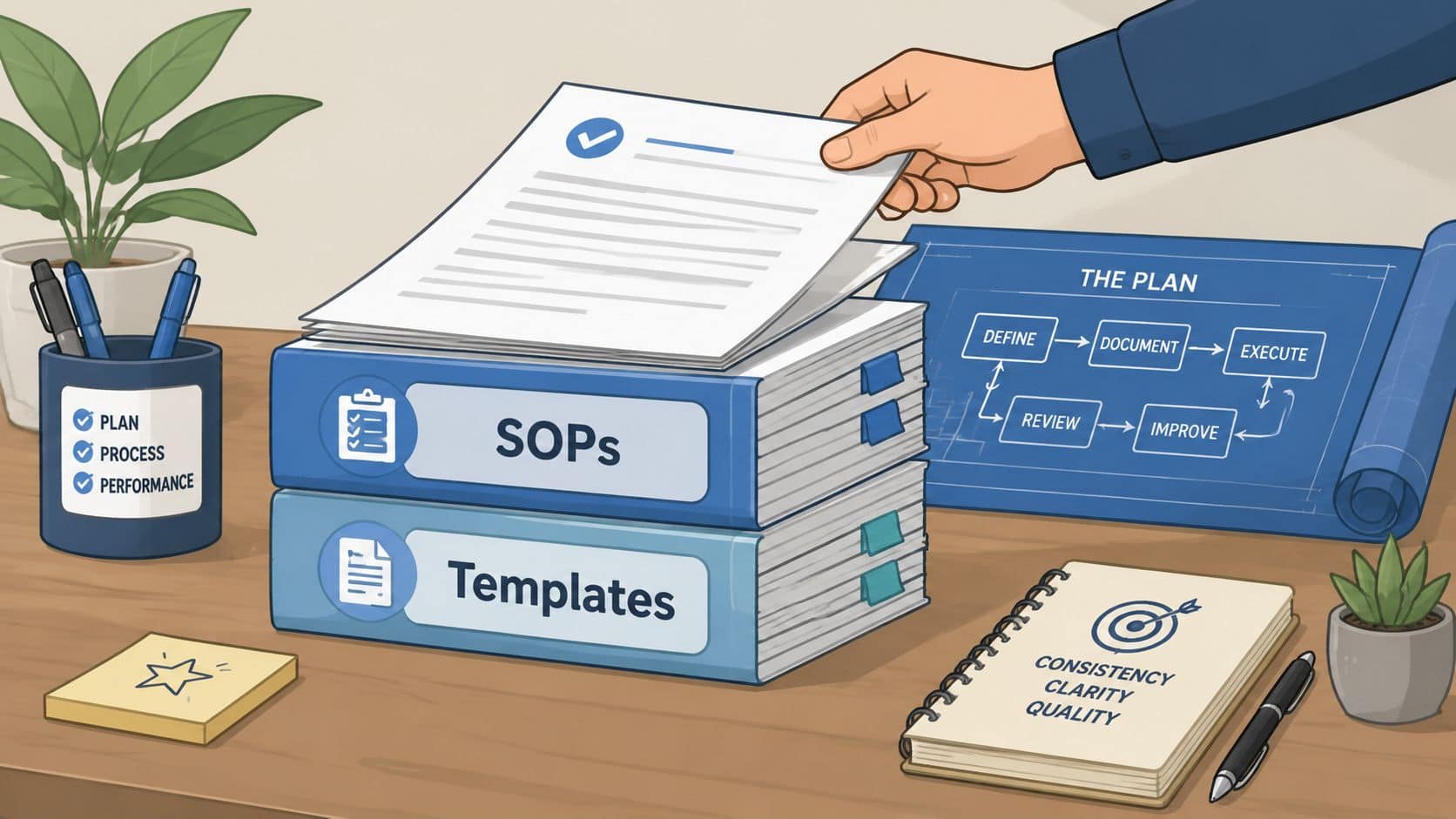
That's why SOPs and templates matter. They remove guesswork, reduce omissions, and give managers something objective to audit against.
Start with record definitions
Research guidance on record systems recommends a practical sequence: define what counts as a record, create a classification and naming structure, assign ownership, train staff, enforce retention and destruction rules, and perform periodic audits. It also warns that the main failure mode is inconsistent metadata and weak governance, not storage volume (record lifecycle and governance guidance).
That finding matches what happens in clinics. The problem is rarely that there are too many files. The problem is that staff save the same thing under different names, in different places, with no clear owner.
Start by writing down your record categories in plain language:
- Patient care records: intake, assessment, consent, photos, treatment notes, aftercare, follow-up
- Device records: servicing, repairs, calibration, cleaning checks, usage logs where required
- Stock and traceability records: consumables, batch information where relevant, wastage, recalls
- People records: training completion, competency sign-off, policy acknowledgement
- Governance records: incidents, complaints, audit findings, corrective action
If staff have to guess whether something should be saved, your SOP is incomplete.
Build templates people will actually complete
Templates should make the right action easier than the wrong one. Long, cluttered forms often create the same omission they were meant to prevent.
A good template has only the fields needed to create a defensible record. For example:
New patient intake template
- identifying details
- medical history prompts
- contraindication checklist
- previous treatment history
- baseline photos status
- privacy acknowledgement
Treatment note template
- date and practitioner
- treatment area
- device used
- settings and technique
- patient response during treatment
- immediate outcome
- aftercare advice given
- follow-up plan
Device maintenance template
- device identifier
- date of check or service
- reason for maintenance
- work performed
- person or provider responsible
- next due action
Use naming rules that are boring and consistent. Boring is good. File names should tell staff what the document is without opening it.
A simple standard often works:
patient surname + patient identifier + record type + date
Then lock the process in with SOPs that answer operational questions such as:
- when a draft note becomes a final record
- who may amend a completed entry
- how corrections are logged
- where photos are stored
- what happens when a consent form is incomplete
- who checks missing records at day end
The clinics that stay organised don't rely on memory. They rely on templates, ownership, and routine checks.
Training Your Team for Consistency and Security
A tidy system can still fail if the team treats record keeping as admin work that happens after the primary job. In clinic operations, documentation is part of the treatment process. If staff don't understand that, standards slip fast.
Training fixes two separate problems. It teaches people how to use the system, and it teaches them why shortcuts are dangerous. Both matter.
Teach the reason before the rule
When staff understand the risk behind each record, compliance improves. A practitioner who knows why treatment settings must be logged is less likely to leave the field blank. A receptionist who understands confidentiality is less likely to share access casually. A manager who sees the link between training records and scope of practice is more likely to enforce sign-off properly.
Your training programme should cover:
- Clinical rationale: why history, consent, settings, photos, and follow-up notes matter
- Privacy and confidentiality: how patient information should be accessed, disclosed, and protected
- System use: where each record belongs, how to name it, and when it must be completed
- Error handling: how to correct mistakes without obscuring the original record
- Escalation: when missing, conflicting, or suspicious records must be reported
A common blind spot in aesthetic clinics is device-specific documentation. Staff may know how to perform a treatment but not how to log settings, maintenance, faults, or treatment exceptions in a way that stands up later. That's why device education should include documentation standards, not just technique. For clinics building that side of team capability, laser hair removal training can form part of the broader competency framework if it's paired with in-house SOP training and sign-off.
Access control must match the role
Not every employee should see every record. Clinics frequently generate avoidable risk in this area. Shared logins, open folders, and unrestricted photo access are convenient until a complaint or privacy problem appears.
Use the principle of least privilege. Give each role the minimum access needed to do its job.
- Reception staff: booking details, required admin forms, limited demographic access
- Practitioners: full treatment-related records for the patients they manage
- Managers or compliance leads: incident logs, audit trails, permissions review, policy oversight
- Finance staff: only the financial and package information needed for billing and reconciliation
Train for repetition, not inspiration. A good record keeping culture comes from the same actions performed the same way every day.
Refresher training matters just as much as onboarding. If you change a form, alter a workflow, or add a new device category, retrain immediately. Don't assume staff will absorb the change by observation. They won't.
The strongest clinics make documentation competence part of performance, not an optional extra. That means checking real records, correcting weak habits, and refusing to normalise incomplete notes.
Audit Preparation, Retention, and Disaster Recovery
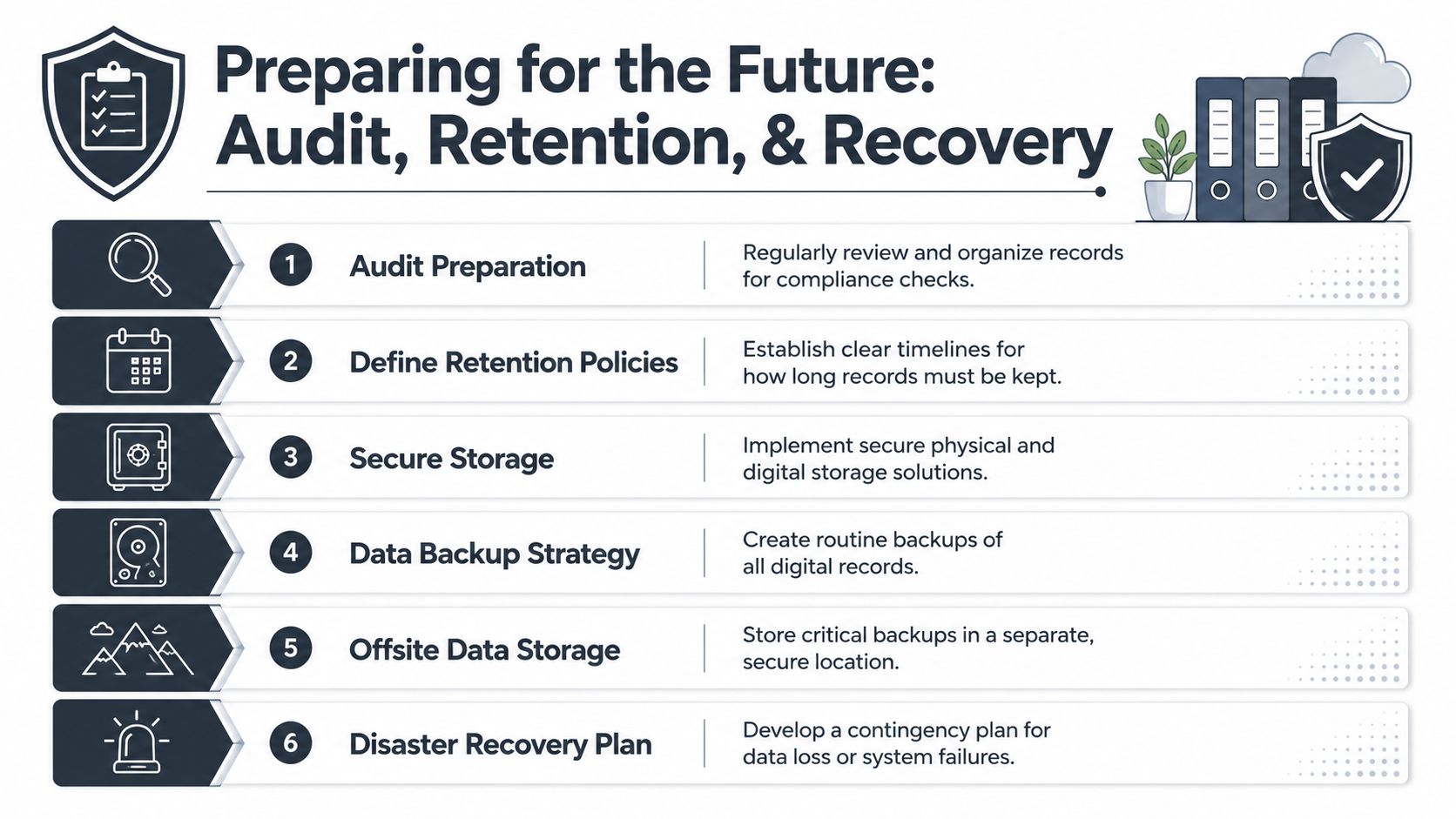
Clinics often think about audits only when one is looming. That's too late. Audit readiness is the result of small routine checks done before there's pressure, not a frantic filing exercise the week before inspection.
Retention works the same way. Recovery does too. If the clinic waits until records are missing, damaged, or requested, the weaknesses are already exposed.
Run internal checks before anyone asks
A clinic should test its own records regularly. Pull a sample of recent patient files and ask basic questions.
Can the team find the signed consent quickly?
Do treatment notes match what was billed?
Are photos dated and linked correctly?
Is the device used on that day identifiable?
Can the clinic show the practitioner was trained for that procedure?
That last point is where many businesses discover that their records live in silos. The patient file looks complete, but the training register is outdated. The device log exists, but nobody can prove who used the equipment that day.
For signed records, an electronic workflow is stronger when it preserves history around the document, not just the signature image. Features such as eSignature audit trail features are useful because they support the broader question every clinic should ask: can we show what happened, when it happened, and who was involved?
Use a short monthly review checklist:
- Check completeness: pick recent files and verify required documents are present
- Check consistency: make sure names, dates, treatment notes, and photos align
- Check permissions: remove access for former staff and confirm current role access still makes sense
- Check linked records: confirm device, incident, and training records support the clinical file
- Check infection control records: if procedures depend on room, equipment, or cleaning logs, make sure they are retrievable and current. Clinics reviewing those operational controls may also find infection control guidance useful as part of the wider compliance file.
Plan for loss before it happens
One of the most neglected parts of clinic record keeping in South Africa is disaster resilience for small practices. Global guidance on essential records stresses keeping duplicate copies in a separate location and planning recovery before a disaster occurs (essential records and disaster planning guidance).
That matters because clinics don't only lose records through cyber incidents. They lose them through flood, fire, theft, hardware failure, accidental deletion, power disruption, and simple mishandling of paper files.
Your disaster recovery plan should answer these points clearly:
Which records are essential first
Patient treatment histories, consent records, active appointment information, device safety records, and staff competency records usually need priority.Where duplicates are stored
Backups should not sit in the same place as the originals. If one event destroys the room or system, both copies can disappear together.Who is responsible for recovery
Name the person who starts the response, contacts service providers, and confirms restoration order.How restoration is tested
A backup that hasn't been tested is a hope, not a plan.How paper records are protected
For clinics still using paper, off-site storage for critical copies and a documented scan-and-index process are far safer than a single cabinet on site.
Recovery planning should be written in plain language. If staff need a consultant to interpret the plan during an emergency, the plan is too complicated.
Retention and destruction should also be deliberate. Keep records for the required period under the rules that apply to your clinic, then destroy them securely and consistently when that period ends. Don't keep everything forever out of fear. Don't destroy anything because storage feels inconvenient. Both habits create risk.
A resilient clinic doesn't treat record keeping as paperwork after treatment. It builds one connected system for patient files, device logs, staff competency, audits, and recovery. If you're setting that up from scratch or tightening an existing process around aesthetic devices, Omega Lasers can be part of that support ecosystem through training, operational guidance, and device-related documentation practices that fit real clinic workflows.