



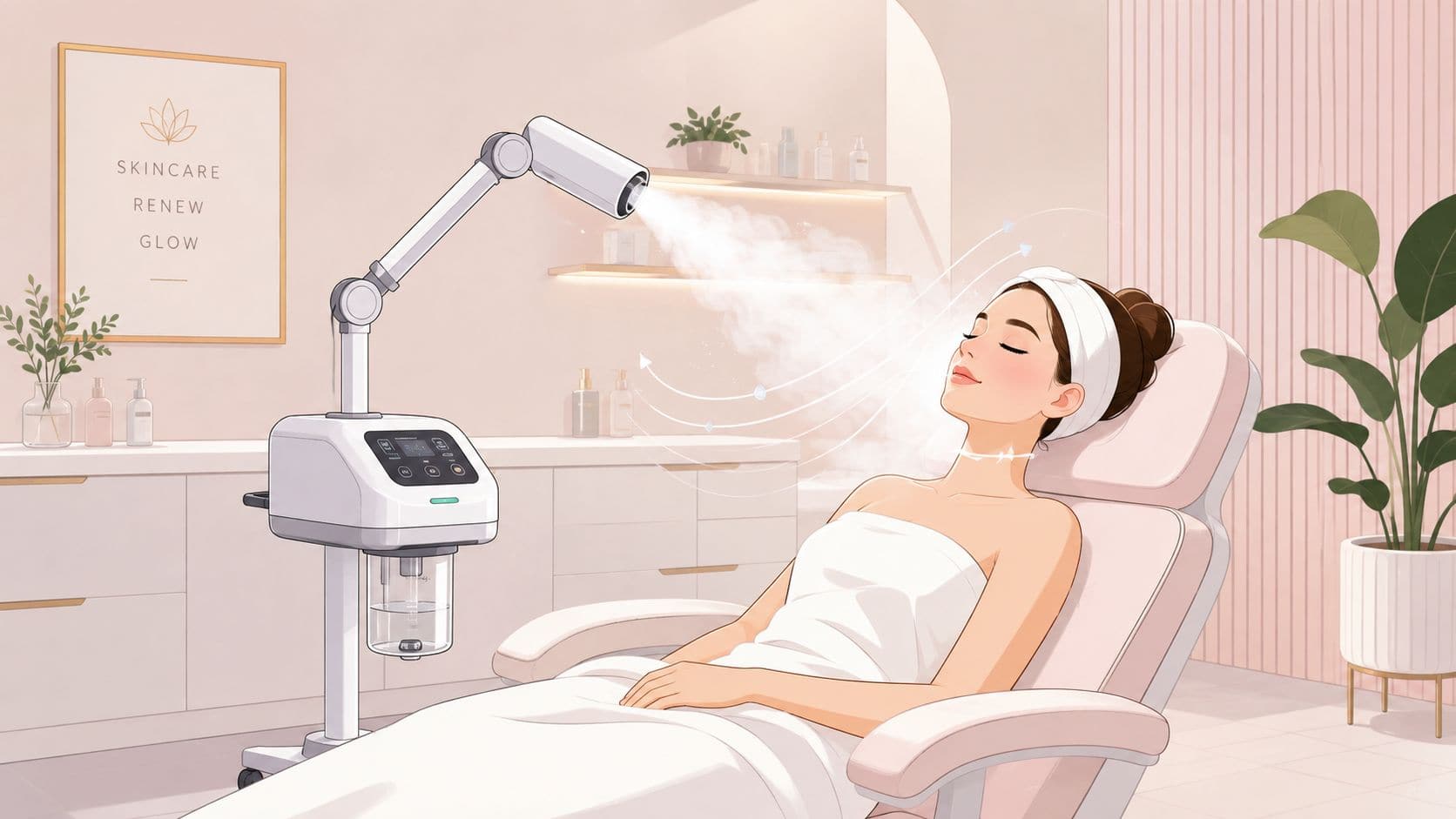
You're usually standing in the same spot when this question comes up, one client is already in the chair, another one is due in ten minutes, and the therapist wants to know whether the steam step belongs in the facial or whether it's just taking up counter space. In a South African clinic, that decision isn't abstract. It affects throughput, water handling, safety screening, and whether the unit will still behave properly when the day gets messy.
Table of Contents
- What a Steam Face Machine Brings to Your Treatment Room
- How a Steam Face Machine Actually Works
- Clinical and Client Benefits That Drive Repeat Bookings
- Device Features and Specifications to Evaluate Before Buying
- Safety Protocols and Contraindications Every Therapist Must Know
- Hygiene and Maintenance Protocols for South African Clinics
- Return on Investment and Business Case for Your Clinic
What a Steam Face Machine Brings to Your Treatment Room
A treatment room feels different once a steam face machine is part of the workflow. The client has been cleansed, the therapist is preparing for extractions or a mask, and the room needs controlled warm vapour that softens the skin without turning the session into a sauna. A dedicated unit gives the therapist a repeatable preparatory step instead of improvising with heat from session to session.
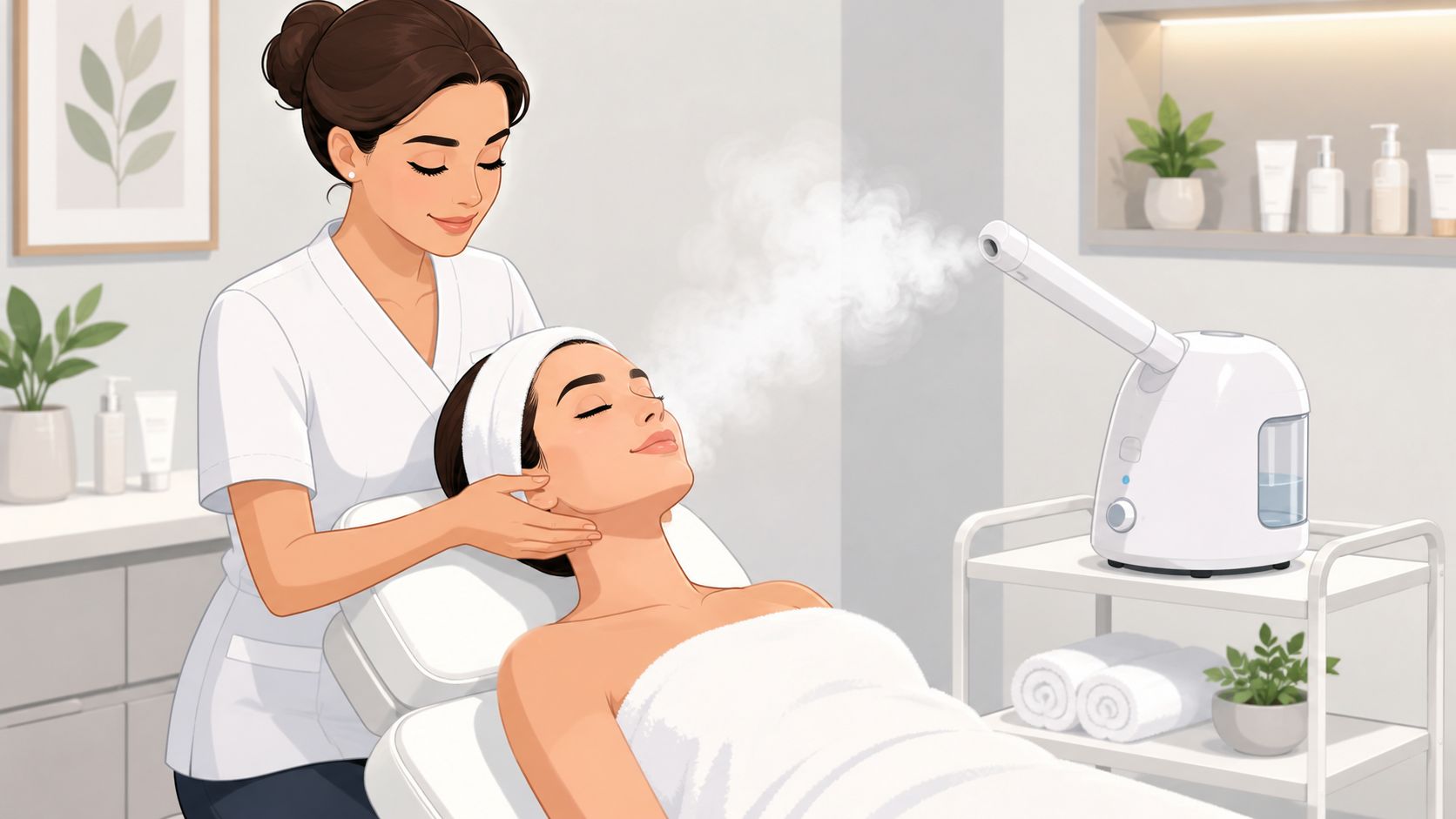
In a clinic setting, that repeatability matters. Facial steaming has been commercially documented for well over a century, including an early archived steamer created in 1903 by Jeanette Scale, also known as Mrs. Pomeroy, who marketed the “Russian Steam Bath” for cleansing the face, alongside skin products such as “skin foods” (historical record). The point for procurement is straightforward, the device belongs to a long professional treatment tradition, not a passing trend.
A steamer also has to fit the way a clinic runs. In South African rooms, that means checking how the unit behaves during load-shedding, whether its heating cycle recovers cleanly after interruptions, and whether the reservoir and output are practical for back-to-back bookings. Water quality matters too. Hard water leaves scale, reduces output consistency, and creates avoidable maintenance work, so the unit and the clinic's water protocol have to match.
Professional-grade units sit inside a much older steam-technology lineage. The steam engine's practical development reached major milestones with Savery's 1698 patent, Newcomen's circa 1712 engine, and Watt's 1765 condenser improvement, which reduced fuel consumption by approximately 75% and helped bring steam into dependable commercial use by the early industrial era (steam-engine history). For a clinic, the relevance is simple, stable steam delivery only became routine once the underlying engineering was reliable enough to shrink into tabletop equipment.
That is the key procurement question for a treatment room. Does the unit support your appointment flow, fit your electrical supply, and hold up under daily use without turning into a maintenance headache? It also needs to sit cleanly alongside adjacent facial devices, including a high-frequency facial machine, without adding clutter or slowing changeover between steps. A good steamer supports the treatment plan, the therapist's timing, and the clinic's cleaning protocol without demanding extra drama from the team.
The other part clinics sometimes miss is screening. A steam step may be routine, but it still needs a contraindication check, clear timing, and an understanding of when the client's skin should not be warmed further. For practical guidance on session duration, the article on how long to steam your face is a useful reference point, but room policy should still come first. That means the machine is never treated as a default setting, it is used only when the client's presentation and the treatment plan both support it.
Clinics that get this right usually end up with a calmer room, cleaner transitions, and fewer improvised decisions during the appointment. The steamer becomes part of the treatment structure, not a novelty on the trolley.
How a Steam Face Machine Actually Works
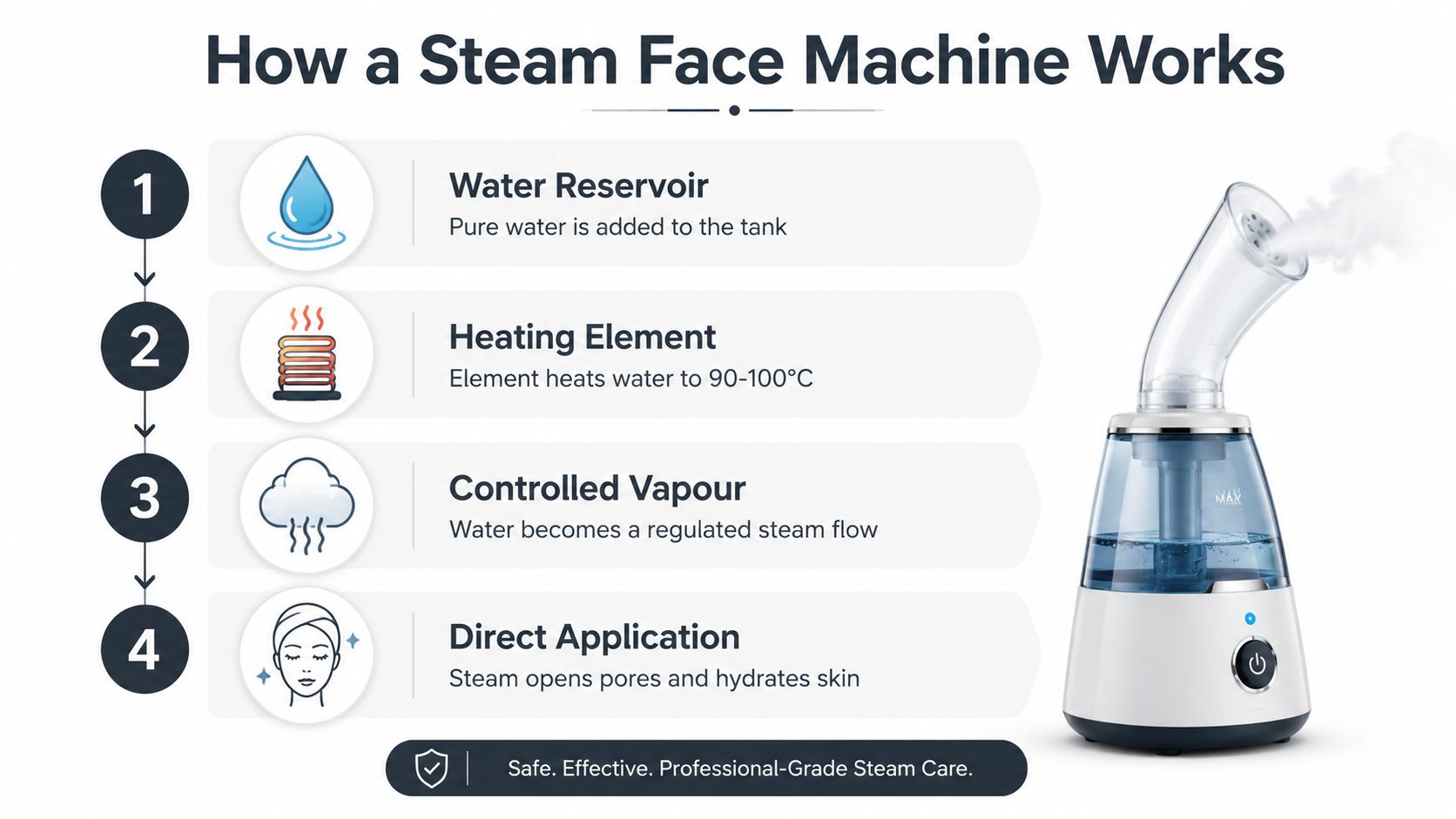
A facial steamer is simple in principle and specific in execution. Water goes into the reservoir, the element heats it, vapour is generated, and that vapour is directed at the face in a controlled stream. The equipment source description is straightforward, the steam is used to help open pores, moisten the skin, and cleanse the skin.
The mechanism in clinic language
Think of the skin barrier like a tightly sealed envelope. Steam doesn't tear it open, it gently loosens the seal so the surface becomes more receptive to the steps that follow. That's why therapists often use it before manual extractions, masks, or serum application, because the skin is slightly more pliable and easier to work with.
The clearest benefit tied to that change is permeability. A dermatology-oriented source notes that steaming can increase hydration of the skin and therefore increase permeability, which means topical products may be absorbed more easily after steaming. That doesn't mean every product suddenly works better in every client. It means the skin surface is temporarily more receptive, which is useful when you're trying to improve the feel and finish of a facial.
What the ozone function does and doesn't do
Many professional units include an ozone function. In practice, clinics should treat that as a device feature, not a miracle claim. If the unit offers ozone, the question is whether your therapists know when to use it, why they're using it, and whether the client's skin condition even warrants the extra step. The machine can create a more advanced treatment experience, but it doesn't change the need for proper screening and short, controlled use.
If the team can't explain the steam step in plain language, the client will hear marketing instead of treatment logic. That's when trust starts to slip.
For clients who want a simple, credible explanation, a practical resource on treatment timing is how long to steam your face. In the room, that question matters because timing controls comfort, safety, and whether the step feels purposeful or excessive.
Clinical and Client Benefits That Drive Repeat Bookings
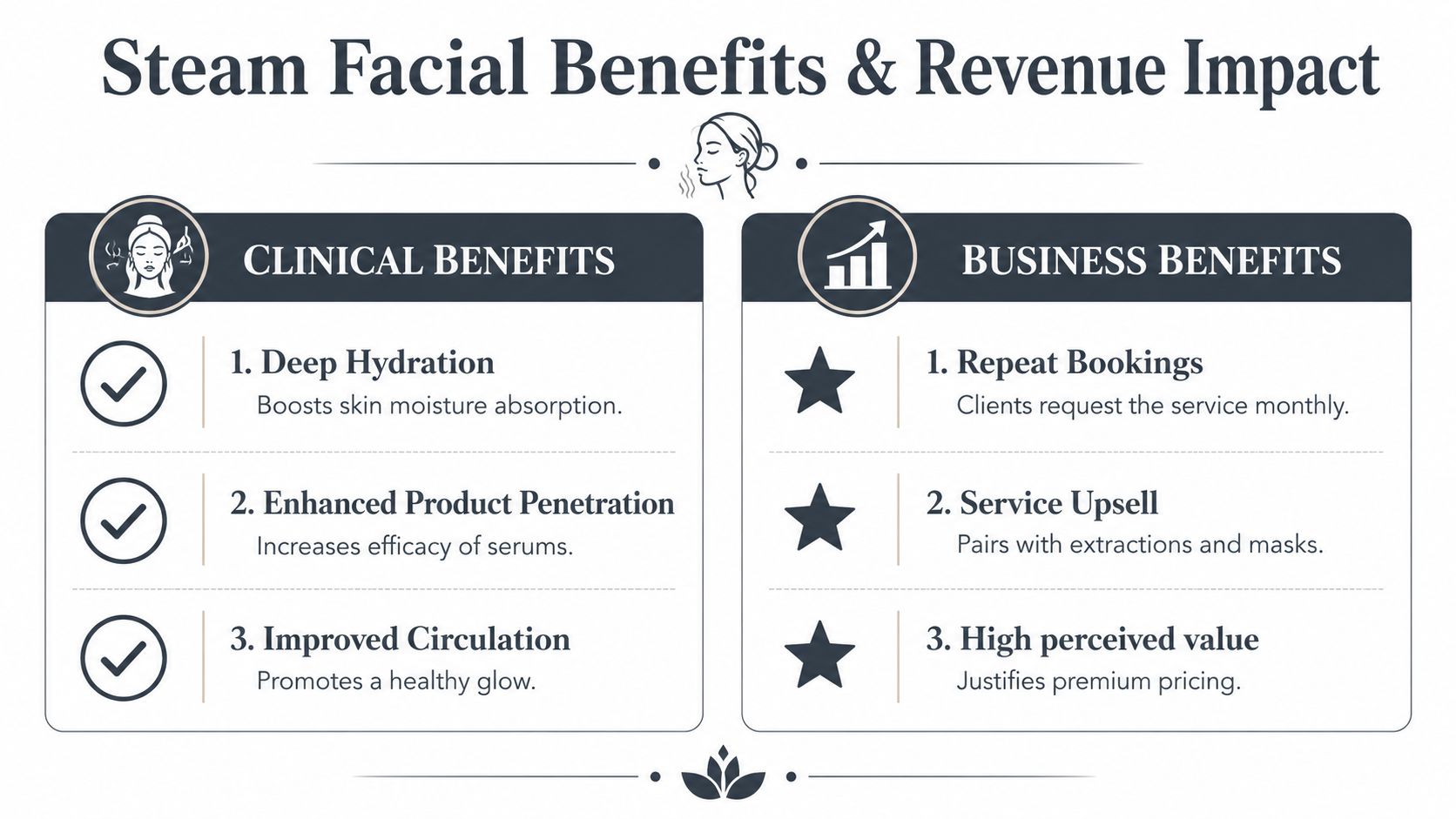
The best case for a steam face machine is not that it fixes skin. It's that it makes a facial feel more complete and more responsive, especially when the therapist uses it as a preparation step rather than a stand-alone treatment. The strongest claim you can make, and the one clients feel, is improved hydration at the surface and easier application of follow-up products.
What the steam step can support
Steam helps create a brief window where the skin feels softer and more receptive. That can make cleansers, masks, serums, and post-extraction care feel like they're working more efficiently, because the surface has been warmed and moisturised. In practical treatment-room terms, the steam step can support a more polished finish, especially when the rest of the facial is already well designed.
An honest sales conversation should stay close to that reality. Steam can support a refreshed look, a softer feel, and better product slip. It should not be sold as a permanent fix for pore size or as a universal detox method, because those claims drift away from what the device does.
How it helps booking behaviour
Repeat bookings usually come from treatments clients can understand and feel immediately. Steam fits that pattern because the experience is obvious, warm, and sensory. It can also be positioned as an add-on inside a broader facial menu, where the therapist uses it before extractions or before a mask to create a more luxurious appointment flow.
That's where clinic language matters. If your team describes steam as a preparation step that improves comfort and product responsiveness, it sounds credible. If they oversell it, clients may enjoy the treatment once and then never trust the recommendation again.
A useful framing for the team is to treat steam as an adjunct, not the hero. The facial still needs proper cleansing, skin assessment, and post-treatment guidance. Steam just makes the rest of the protocol easier to deliver well.
For practical service design and client experience ideas, the internal guide on how to improve patient satisfaction is relevant because the steam step often succeeds or fails on perceived professionalism rather than on the vapour itself.
A good habit guide for clients who are building a home routine can also help the clinic's follow-up conversations. The glowing skin habit guide is worth sharing contextually because it reinforces the idea that a steam facial sits inside a broader routine, not in isolation.
Device Features and Specifications to Evaluate Before Buying
A procurement decision should start with throughput, not aesthetics. If the steamer slows appointments, struggles to heat fast enough, or doesn't match local electrical supply, it becomes a bottleneck. For South African clinics, 220V/50Hz mains compatibility is essential, because the unit has to work cleanly with the electrical environment the clinic has.
Specification comparison
| Specification | Unit A Benchmark | Unit B Benchmark | Clinical Implication |
|---|---|---|---|
| Power | 800W | 750W | Higher wattage supports faster heating and steadier use between clients. |
| Mains rating | 220V, 50Hz | Not stated in the supplied benchmark | South African clinics should confirm local compatibility before purchase. |
| Reservoir capacity | 680 mL thermal spray volume | 600 mL safe cold-water capacity | Tank size affects treatment window and how often the unit needs refilling. |
| Continuous use | 30 minutes of thermal spraying | 5 to 30 minutes timer range | Useful for back-to-back bookings, but only if the water reserve and stability hold up. |
| Warm-up | Not stated in the supplied benchmark | 7 minutes heat-to-steam time | Shorter heat-up reduces client wait time between appointments. |
| Operating time | 30 minutes | 25 minutes | Clinics with higher throughput need enough usable steam, not just a headline feature. |
One professional unit lists 650W power with a 7-minute heat-to-steam time and 25 minutes operating time, while another lists 750W power, 600 mL safe cold-water capacity, and a 5 to 30 minute timer range. The supplied device data also shows a unit rated at 220V, 50Hz, 800W, 680 mL thermal spray volume, and 30 minutes of continuous thermal spraying. The takeaway is direct, higher wattage and a shorter heat-up cycle help reduce idle time, but the usable treatment window still depends on reservoir size and thermal stability.
What matters beyond the numbers
Look at the arm, nozzle movement, and stand height. A therapist working two or three facials back to back will notice poor ergonomics before they notice a cosmetic finish. If the nozzle is awkward to position, staff start improvising, and that usually shows up later as inconsistent distance from the skin.
Buy for the day you'll actually have, not the day when everything runs perfectly.
A good supplier conversation should cover refill access, descaling access, and how the unit behaves if the session is interrupted. If those answers are vague, the machine probably isn't clinic-ready.
Safety Protocols and Contraindications Every Therapist Must Know
Steam is not automatically gentle. It is heat, and heat burns skin faster than most clients expect. One skincare source citing the American Burn Association says water at 140°F (60°C) can burn skin in under five seconds, which is why boiling water should be allowed to cool before facial use (burn safety guidance).
Screen before you steam
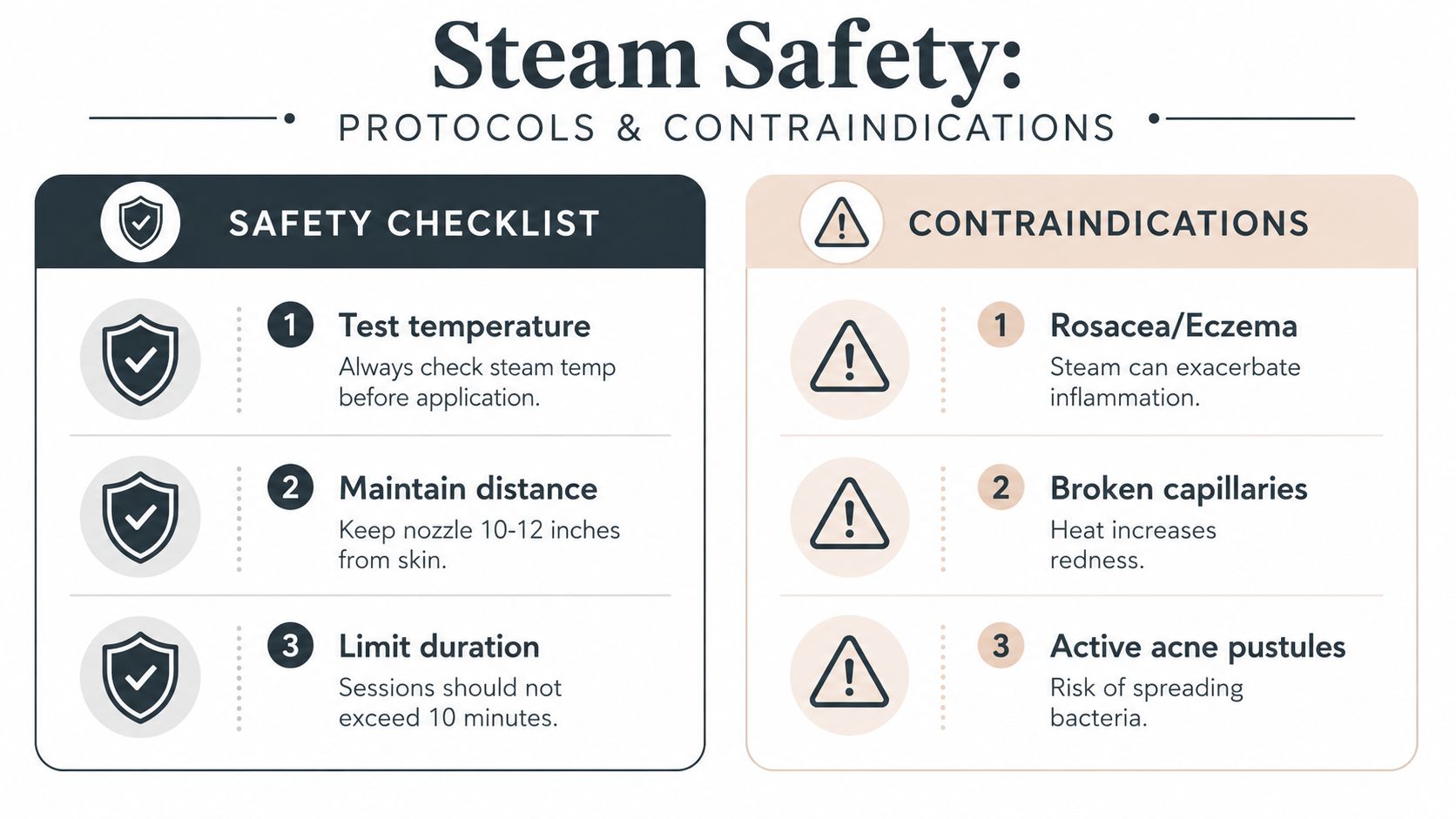
A solid intake form should ask about rosacea, eczema, active inflamed acne, compromised skin barriers, and recent procedures such as chemical peels or laser resurfacing. Those are not edge cases in real clinics. They are the clients most likely to react badly if heat is applied too soon or too aggressively.
Steam can worsen redness, trigger irritation, and make a fragile barrier feel tighter rather than calmer. That's why the therapist needs permission to skip the steaming step without turning the treatment into a compromise. A facial that excludes steam when needed is more professional than one that pushes ahead and creates a flare-up.
What the team should do in the room
- Test the temperature first: Never position the nozzle until the steam output is clearly comfortable for the therapist's hand and the client's face.
- Keep a sensible distance: Don't crowd the skin. Steam should feel indirect and even, not concentrated.
- Watch the skin, not the clock: If the client starts flushing, stinging, or pulling away, stop the step.
- Modify for sensitivity: For reactive skin, use shorter exposure or skip steam entirely.
- Treat recent procedures as a hard stop: If the barrier is compromised, don't force vapour into it.
For South African clinics, certification and liability matter too. Equipment should align with the clinic's compliance standards, and professional indemnity policies should be checked before steam is added to a treatment menu. If a unit doesn't have the paperwork you need, the price tag isn't the true cost.
Hygiene and Maintenance Protocols for South African Clinics
Water quality is where good steamers get ruined. If the clinic uses untreated tap water where mineral content is high, the reservoir and heating path can build scale, and the output becomes less clean and less predictable. Product guidance also warns that distilled water should be used where required, and the machine must be cleaned often because mildew or contamination can build up if it isn't maintained (home-use maintenance guidance).
A simple maintenance routine
Daily work should stay basic. Empty the reservoir after use, dry the tank, and wipe the exterior so nothing sits stagnant overnight. If the machine is mobile or used in a busy room, that cleaning step should happen before the last client leaves, not the next morning.
Weekly, inspect the nozzle, reservoir cap, and any areas where moisture collects. If you see mineral residue, treat it as an early warning, not an optional cosmetic issue. In practice, clinics that delay cleaning usually end up with weaker output and more frequent service problems.
Monthly, descale according to the manufacturer's instructions and document it. That log matters because it shows the clinic takes hygiene seriously and helps staff spot patterns before the heating element fails. If the unit has been unused for a period, flush and clean it before the next session so stagnant water doesn't become a contamination issue.
What matters in South African conditions
Intermittent water supply and load-shedding change how clinics should manage equipment. Don't leave a reservoir full “for later”, because later may be hours away, and standing water is exactly what you're trying to avoid. If the room schedule becomes unpredictable, treat the steamer like any other infection-control item, store it dry, and only fill it when the client is ready.
The internal infection control guidance is relevant here because contamination prevention is a clinical process, not just a housekeeping task. If a client develops an avoidable skin issue after a dirty unit was used, the problem is no longer about convenience. It becomes a liability issue.
The safest clinic habit is boring, empty, dry, documented.
Return on Investment and Business Case for Your Clinic
A steam unit earns its place when it improves the flow of a treatment without forcing the therapist to fight the device. If the machine is compatible with the room, quick to heat, easy to clean, and safe for the client mix you see, it can support better service consistency. If it only looks premium on the cart, it becomes dead space.
How to think about the business case
The true cost of ownership includes the unit itself, water handling, maintenance, electricity, therapist time, and the risk of avoidable rework. That's why throughput matters more than the headline feature list. A steamer that works smoothly in back-to-back facials often makes more sense than a more complicated device that sits unused because it's slow to set up.
Steam also works well as a low-friction entry step in a broader treatment journey. A client who books a facial that feels well structured and well explained is easier to move into more advanced skin services later, because the clinic has already established trust and routine. That makes the steam step useful as a client acquisition and retention tool, not just an add-on.
Omega Lasers offers an advanced multi-technology facial device for ageing, congestion, and dull or discoloured skin, which makes it one option clinics can consider when they want a more complex facial platform rather than a standalone steam step. That kind of device belongs in the same conversation as steam because both sit inside the treatment flow, but they solve different operational needs.
For most clinics, the decision comes down to room usage. If a steam face machine helps the therapist work faster and present the facial more professionally, it earns its floor space. If your team rarely uses steam, or if the contraindication screen is too broad for your patient mix, the budget may be better spent elsewhere.
If you're comparing facial equipment for a South African clinic, talk to Omega Lasers about systems that fit real treatment-room workflows, not just brochure specs. Their team can help you assess where a steam step belongs, where it doesn't, and what device mix makes sense for your service menu and compliance needs.