




You've bought the platform, trained the team, and updated the treatment menu. Then the hard question lands on your desk. What should you charge?
Most clinic owners don't struggle because they lack a price list. They struggle because skin laser treatment cost isn't just a number on a brochure. It's a margin decision, a positioning decision, and a trust decision at the same time. Price too low and you turn an advanced treatment into a low-value commodity. Price too high without a clear rationale and consultations stall.
A smart pricing strategy starts with a different question. Not “What are others charging?” but “What price reflects the treatment economics, the client journey, and the value of the technology in my room?” That's the shift that protects profitability.

Clinic owners often face the same pattern. They invest heavily upfront, then default to copying a nearby clinic's menu. That usually fails because your overheads, treatment quality, operator skill, and patient mix aren't identical. If you're tightening the commercial side of the business more broadly, this guide for small business owners is a useful reminder that lead generation and pricing have to work together.
There's also a practical distinction many teams blur. Hair removal pricing logic and skin resurfacing pricing logic aren't interchangeable. If you want to see how a different treatment category is framed commercially, this overview of the price of laser hair removal shows why service architecture matters.
Table of Contents
- Setting Your Laser Treatment Prices A Clinic Owner's Dilemma
- Average Skin Laser Treatment Costs in South Africa
- Key Factors That Influence Treatment Pricing
- Structuring Your Pricing Per Session vs Package Deals
- Calculating True ROI A Guide for Clinics
- Communicating Value and Managing Client Expectations
- Frequently Asked Questions About Laser Treatment Costs
Setting Your Laser Treatment Prices A Clinic Owner's Dilemma
A new laser platform changes the business the moment it arrives. The clinic owner sees opportunity. The finance side sees repayments, payroll pressure, room utilisation, and the risk of underbooking. The front desk sees one more service that clients will compare by price alone.
That tension is normal. Advanced laser services sit in a category where safety, outcomes, downtime, and provider skill all affect what a patient is willing to pay. The mistake is treating pricing like a once-off admin task.
The menu price is only one part of the strategy
A clinic can charge the “right” amount on paper and still lose money if the pricing model is wrong. That usually happens in three ways:
- Low headline pricing: The treatment looks easy to buy, but the clinic absorbs too much clinician time and too much aftercare.
- Flat pricing across different indications: A simple pigment case and a more demanding resurfacing case get priced too similarly.
- No link between consultation and conversion: The quote doesn't explain why the treatment costs what it does.
Practical rule: If your team can't explain the difference between price and value in one minute, patients will compare you on price alone.
The strongest clinic menus are organised around treatment depth, expected session count, operator time, and follow-up burden. That gives you a price logic staff can defend without sounding scripted.
A profitable price has to do three jobs
It must cover delivery. It must support profit. It must still feel fair to the client.
That's why seasoned operators don't start with a discount ladder. They start with treatment economics, then build a consultation script around value. If you skip that sequence, every objection turns into a negotiation.
A good price also gives your clinic room to operate professionally. You need margin for patch testing, consumables, aftercare guidance, rebooking effort, and the occasional high-touch patient who needs more reassurance than expected.
Average Skin Laser Treatment Costs in South Africa
South African clinics need a benchmark, but local pricing is fragmented. The most dependable anchor remains international resurfacing data. The American Society of Plastic Surgeons' published average puts skin resurfacing at US$1,829 per procedure, and that published average excludes facility fees, anaesthesia, and prescriptions according to this ASPS-based benchmark summary. For a ZA clinic, that matters because it shows resurfacing sits in a premium category and that the visible fee often understates the actual cost.
That doesn't translate into a fixed rand fee. It does give you a commercial frame. If international resurfacing benchmarks already place this category at a premium level before add-ons, a clinic that prices advanced skin work like a basic facial service usually creates a margin problem.
Average Per-Session Cost for Skin Laser Treatments in South Africa 2026
| Treatment Type | Average Price Range (ZAR) |
|---|---|
| Light non-ablative rejuvenation | Mid-thousands of rand-equivalent |
| Fractional non-ablative resurfacing | Mid-thousands to several-thousands of rand-equivalent |
| Fractional ablative resurfacing | Several-thousands of rand-equivalent |
| CO2 or erbium resurfacing | Several-thousands of rand-equivalent |
| Pigment-focused laser treatment | Varies by area, plan, and complexity |
| Acne scar laser treatment | Varies by depth, session count, and technology |
| Tattoo removal | Usually structured as a multi-session plan |
| Combination resurfacing programme | Often priced as a package rather than a single visit |
The table stays qualitative for a reason. Reliable South Africa-wide published ZAR averages for each individual category aren't established in the verified data. A clinic owner should resist the urge to force false precision into the menu.
What this means for local pricing decisions
The better use of benchmark data is directional, not literal.
- Premium treatments need premium framing: If you offer deeper resurfacing, your pricing has to reflect downtime management, longer chair time, and higher clinical oversight.
- Session count changes perceived affordability: A lower per-visit fee can still become the more expensive route over the full plan.
- Quotes should separate treatment fee from total plan cost: Patients often ask for one number when the actual decision is whether they can complete the course properly.
Clinics that win on laser profitability rarely have the cheapest menu. They have the clearest pricing logic.
For a South African owner, market intelligence should be used to position, not imitate. The aim isn't to match every nearby provider. It's to build a price architecture your team can explain confidently and deliver profitably.
Key Factors That Influence Treatment Pricing
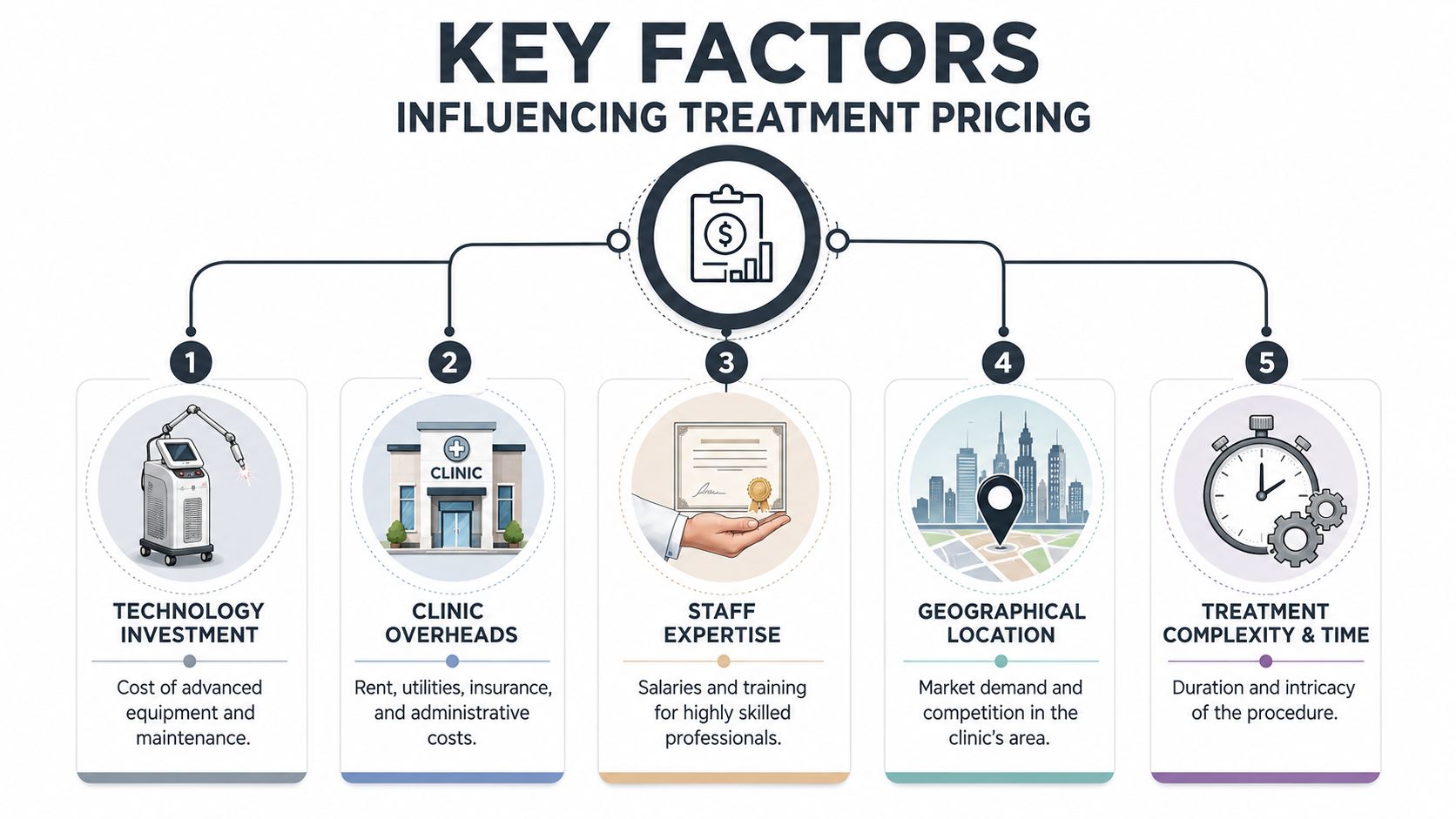
Laser treatment prices vary because the underlying treatment economics vary. A clinic owner who understands the inputs can defend a premium fee without sounding defensive.
The biggest shift in this category is technology stratification. According to this industry review on resurfacing cost by technology type, non-ablative laser resurfacing typically costs about US$1,000 to US$3,000 per session and often requires 3 to 5+ sessions, while ablative CO2 or erbium resurfacing usually costs about US$2,500 to US$2,800+ per treatment and often needs only 1 to 2 treatments. That pricing gap reflects treatment depth, downtime, and session planning, not random mark-up.
If your clinic also offers other energy-based categories, the commercial logic in this guide to best laser hair removal technology is useful because it shows how platform choice affects pricing power.
Build your price stack first
Most underpricing starts when owners think in market-facing terms before internal cost terms. Build your price stack first.
- Technology investment: More advanced platforms cost more to acquire and maintain. They also tend to justify stronger pricing if they improve treatment versatility or reduce treatment burden.
- Clinician time: A treatment that ties up a highly skilled operator for longer needs more pricing headroom than a quick protocol run by a junior team member under supervision.
- Consumables and room cost: Topicals, disposables, cooling, room turnover, and follow-up support all belong in the price.
- Downtime burden: More aggressive procedures often require more post-treatment communication and review.
- Local positioning: A clinic in a premium node can support a different price presentation from a volume-led suburban business.
Why premium pricing sometimes protects margin
Cheaper isn't always more accessible. A lower sticker price on a treatment that needs repeated visits can create fatigue, drop-off, and weaker completion rates. From a business perspective, that can mean more admin, more chasing, and less predictable revenue.
By contrast, a treatment with a higher per-session fee can still be commercially cleaner if it reduces repeat visits or simplifies the plan. That doesn't mean every clinic should push the most aggressive option. It means your pricing should reflect what the patient is buying: not just a session, but a path to an outcome.
Don't price the pulse count. Price the clinical effort, the treatment pathway, and the confidence behind the result.
Owners often make another mistake here. They assume the market only sees the machine. Patients evaluate the full service experience: assessment quality, safety, comfort, aftercare, and whether the provider seems precise. Pricing should support all of that.
Structuring Your Pricing Per Session vs Package Deals
The pricing model matters almost as much as the price itself. A clinic that charges correctly per visit can still weaken cash flow if it sells every treatment one appointment at a time.
This matters especially in resurfacing and rejuvenation categories where repeat sessions are common. Clinical literature shows that a nonablative 1410-nm fractional laser typically needs about 3 to 5 treatments, and many fractional protocols are performed at 2- to 4-week intervals, according to this clinical review of fractional and nonablative resurfacing patterns. That treatment rhythm makes package pricing commercially sensible when the indication fits.

When single-session pricing works
Single-session pricing is useful when the treatment is exploratory, highly customised, or likely to change after the first response.
Best fit scenarios
- New client entry point: A patient wants to try a lighter intervention before committing.
- Variable indication: The exact number of sessions depends heavily on skin response.
- High-consult complexity: You need flexibility after the first treatment review.
Single-session pricing also helps if your clinic is still learning local demand. It lets you test willingness to pay without locking in package economics too early.
When packages outperform
Packages win when there's a clinically logical sequence and a realistic expectation of repeat attendance.
| Model | Commercial upside | Common risk |
|---|---|---|
| Per session | Easier entry, flexible quoting, less upfront commitment | Weaker retention and less predictable revenue |
| Package deal | Better cash flow, stronger commitment, easier treatment planning | Poorly structured packages can erode margin |
A strong package isn't just “buy more, save more”. It needs clinical coherence.
- Tie it to an indication: Pigment correction, acne scarring, or maintenance all justify different package logic.
- Define review points: Patients stay engaged when they know when progress will be assessed.
- Protect margin: Build the package around expected clinician time and support burden, not only perceived savings.
Package deals work best when the patient understands the plan before the first pulse is delivered.
Many clinics also do well with a hybrid structure. Quote a single-session fee for transparency, then present a recommended course price for patients who are likely to benefit from completion. That preserves choice without weakening the treatment pathway.
Calculating True ROI A Guide for Clinics
The biggest error in capital equipment decisions is focusing on purchase price instead of revenue quality. An inexpensive platform can become the costly choice if it slows bookings, limits indications, or creates a high-labour service model.
For fractional resurfacing, the market itself shows how wide the economics can be. Independent benchmark data summarised in this fractional laser cost guide show session costs can range from US$450 to over US$4,500, and total treatment plans can exceed US$10,000. For a clinic owner, that's not just pricing trivia. It proves that throughput, positioning, and treatment-plan design shape profitability.

If you want a broader example of how hidden cost layers affect business decisions, this ContentRemoval.com's cost analysis is useful because it frames strategic spend as a full operating model rather than a headline fee.
The ROI lens most clinics miss
A profitable laser service depends on five operating questions.
- How many bookable indications can the platform treat well?
- How much clinician time does each treatment consume?
- What support burden follows the treatment?
- How quickly can your team become competent and efficient?
- How reliably does the treatment convert from consult to paid plan?
A device with broader use across rejuvenation, resurfacing, and maintenance work usually gives management more ways to fill the diary. That matters more than headline affordability.
A practical ROI worksheet
Use a simple clinic worksheet. No complicated finance model is needed at first.
- Start with revenue per completed treatment plan. Not just one session. Ask what a full patient journey is worth when the plan is completed properly.
- Subtract direct treatment delivery cost. Include consumables, operator time, room occupancy, and immediate aftercare inputs.
- Add operational drag. Count rebooking effort, cancellations, additional reviews, and staff admin.
- Check utilisation. A profitable service on paper fails quickly if the device sits idle for much of the week.
- Assess repeatability. Can different team members deliver the treatment consistently after proper training?
Here's the key commercial truth. The best-performing platform often isn't the one with the cheapest starting price. It's the one that helps the clinic maintain a healthy average ticket, complete treatment plans, and use room time efficiently.
A sample logic check might look like this:
| ROI question | Weak answer | Strong answer |
|---|---|---|
| Session time | Long and inconsistent | Efficient and repeatable |
| Indication range | Narrow | Broad enough to support regular utilisation |
| Team adoption | Requires heavy reliance on one operator | Easier to standardise across trained staff |
| Revenue model | Mostly once-off visits | Mix of single treatments and treatment plans |
Clinics that calculate ROI properly also tend to protect brand value better. They don't panic-discount to fill gaps. They build capacity, script consultations well, and choose equipment that supports the business model they specifically want.
Buy for throughput, versatility, and treatment completion. Those three factors usually matter more than the lowest capital number.
Communicating Value and Managing Client Expectations
A price objection often starts long before the quote is presented. It starts when the clinic explains the treatment poorly.
Patients usually don't object to cost in isolation. They object to uncertainty. They don't know what's included, how many visits they'll need, what downtime to expect, or why one clinic's quote looks higher than another's. The American Society of Plastic Surgeons notes that average resurfacing cost often excludes facility costs, anaesthesia fees, and prescriptions in this guidance on the real cost of laser skin resurfacing. That's why transparent explanation builds trust.
What to say in consultation
Train your staff to explain the price in layers.
- Start with the indication: “We're not charging for a generic laser session. We're treating a specific concern with a plan that matches your skin.”
- Clarify what's included: “Your quote covers the treatment itself, your treatment planning, and the support around it.”
- Frame total journey cost: “The right comparison isn't only session price. It's the cost of reaching the outcome safely.”
That approach works well for lower-downtime services too. If your clinic offers lighter rejuvenation options, this overview of a carbon laser facial is a useful example of how treatment framing affects client expectations.
How to reduce price resistance without discounting
Discounting is often a communication failure wearing a sales disguise.
Try these scripts instead:
- For comparison shoppers: “You're right to compare quotes. Ask each clinic what is included, who performs the treatment, and whether the quoted fee reflects the full plan.”
- For patients focused on one cheap session: “A lower session fee can look attractive, but if more sessions are needed the total spend may end up higher.”
- For anxious patients: “We'd rather be clear upfront than surprise you later. That helps you decide with confidence.”
One more point matters. The consultation should separate cosmetic desire from treatment suitability. Not every patient should be sold the most intensive option. When the clinic recommends the right treatment instead of the most expensive one, credibility goes up and long-term conversion usually improves.
Frequently Asked Questions About Laser Treatment Costs
Is skin laser treatment covered by medical aid?
In most aesthetic cases, patients should assume cover is unlikely. Cosmetic laser work is generally treated as elective rather than medically necessary. The safest way to communicate this is to avoid guarantees and tell patients to confirm directly with their scheme before treatment.
Do clinics offer payment plans or financing?
Many clinics do, especially for treatment courses rather than single visits. The commercial advantage is obvious. Patients can start a recommended plan without waiting, and the clinic improves commitment to completion. If you structure payment options, keep the agreement simple and make sure the team explains attendance expectations clearly.
How should a client compare quotes from different clinics?
Tell them to compare like with like. The cheapest quote often leaves out important variables.
Ask patients to check these points:
- Who performs the treatment: Skill level changes risk and value.
- What technology is being used: Device category affects treatment depth, comfort, and likely session count.
- What the quote includes: Consultation, aftercare, review visits, and extras all matter.
- Whether the recommendation is a session or a plan: A single visit price can hide the actual total spend.
For clinics that also offer collagen-induction services, these microneedling insights for professionals are a useful reminder that consultation quality shapes expectation quality across all advanced skin treatments.
Should clinics always publish prices online?
Not always. Entry-level pricing can help qualify leads, but advanced skin work often needs assessment before accurate quoting. A useful compromise is to publish starting prices or price bands, then give exact recommendations after consultation.
What's the safest way to present a premium fee?
Use plain language. Explain what the patient is paying for, what result pathway is realistic, and what support is included. Premium pricing feels fair when the patient sees competence, transparency, and a structured plan.
If you're reviewing platform options and want support that goes beyond hardware alone, Omega Lasers helps clinics build profitable treatment services with advanced aesthetic technology, training, technical support, and business guidance suited for real practice needs.