




You're likely weighing two realities at once. Bikini laser is one of the services clients ask for early and often, yet it's also one of the treatments that can expose a weak protocol faster than almost anything else in the room.
That tension is healthy. It forces good clinics to treat laser hair removal for the bikini area as a system, not a quick menu add-on. In practice, the clinics that get reliable outcomes usually do three things well. They assess properly before they treat, they match device choice to skin and hair characteristics, and they build the service around repeat visits instead of chasing one-off bookings.
In South Africa, that matters even more. You're working in a market with broad demand for bikini-area grooming, a highly diverse patient base in skin tone, and a treatment area where operator judgement affects both safety and retention. When you run this service well, you don't just reduce hair. You build package revenue, improve rebooking, and create a treatment that clients tend to stay with because the result is cumulative rather than instant.
Table of Contents
- Mastering the Most In-Demand Aesthetic Treatment
- The Foundational Patient Consultation and Assessment
- Device Selection and Parameter Protocol
- Step-by-Step Bikini Area Treatment Technique
- Mastering Safety for All Skin Types
- Aftercare Protocols and Treatment Planning
- Boosting Revenue with Bikini Laser Services
Mastering the Most In-Demand Aesthetic Treatment
A new client arrives before a long weekend and wants her first bikini treatment done properly because she has had irritation, ingrown hairs, and poor advice elsewhere. The appointment looks simple on the diary. In practice, it tests almost every part of your clinic system at once.
Bikini laser remains one of the highest-demand services because the concern is clear, the area is small, and clients are willing to commit when they trust the operator. That demand creates a trap for inexperienced clinics. They treat it like a quick add-on, then run into avoidable problems with discomfort, patchy clearance, post-inflammatory pigmentation, or unrealistic expectations.
The bikini area rewards discipline. Hair is often coarse and responsive, but the skin can be pigment-rich, reactive, and less forgiving of lazy technique. In the South African market, that matters even more. Your client base may include a wide range of skin tones, mixed ancestry, tanning habits, and previous hair-removal damage. A profitable service here depends on being able to treat that variation safely, not just treating ideal candidates.
From a training perspective, I treat bikini laser as a systems procedure. Results improve when the clinic standardises the parts that should never vary, then adjusts the parts that must be adapted to the individual. That means consistent records, clear treatment boundaries, disciplined overlap control, and a parameter strategy built around skin tone and hair characteristics.
Why this service matters commercially
Bikini laser is rarely a one-visit purchase. It is a course-based service with repeat bookings, regular review points, and a strong retention opportunity when the first treatment is handled well.
That has direct business consequences.
- Packages need a clear structure. Clients buy more confidently when the course is presented from the start, with a defined treatment area and realistic milestones.
- Scheduling must protect margin. The treatment itself can be quick, but profit drops fast if shaving prep, consent updates, photography, and room turnaround are poorly managed.
- Team training affects revenue. One operator who causes overtreatment, inconsistent coverage, or preventable complaints can erode trust across the whole category.
- South African clinics can widen their addressable market. If your team is trained to treat darker skin tones safely and consistently, you are not limited to a narrow client profile.
This is one of the few aesthetic services where sound clinical judgment and sound package design are tightly linked. Better protocols usually produce better retention.
What strong clinics do differently
Strong clinics do not rely on instinct. They use a repeatable method that protects outcomes and protects the business.
Consent, photography, area mapping, treatment notes, and aftercare instructions should be the same every time. Wavelength choice, fluence, pulse duration, cooling approach, and pacing should change according to the client in front of you.
I also advise new clinic owners to watch the hidden commercial indicators, not only the clinical endpoint. Track rebooking rate after first session, complaint rate by operator, average time in room, and the percentage of bikini clients who later add underarms or lower legs. Those numbers tell you whether the service is merely busy or effectively run.
Poor clinics usually fail in predictable ways. Settings get copied from another body area. Boundaries are discussed vaguely. Staff rush because the area is small. The client leaves unsure about what was treated, what reaction is normal, and what result timeline to expect. That is how a high-demand treatment becomes inconsistent and difficult to scale.
Handled properly, bikini laser is one of the most dependable services on the menu. It gives clients visible progress, gives clinics recurring revenue, and gives well-trained operators a treatment they can deliver with confidence across a diverse South African patient base.
The Foundational Patient Consultation and Assessment
A good bikini result is usually decided before the first pulse. Consultation is where you prevent avoidable burns, reduce disappointment, and identify the clients who are suitable, those who need modified settings, and those who should be postponed.
Why the consultation carries the risk load
The bikini area is intimate, pigment-rich, and often emotionally loaded for the client. People may arrive with shaving irritation, old waxing habits, post-inflammatory pigmentation, or unrealistic expectations about “permanent” removal. If your assessment is superficial, the treatment becomes reactive instead of planned.
Medical guidance notes that bikini laser hair removal commonly needs 4 to 6 separate sessions at 3 to 6 week intervals, and one plastic-surgery source cites an expected 80% reduction after an appropriate course, as outlined in this patient guidance from the American Society of Plastic Surgeons. That's the kind of expectation you should set before a package is sold, not after the second session when the client asks why hair is still present.

What to cover before you book the first full session
Start with a full intake, then narrow your decisions clinically.
Medical history comes first
Review relevant health history, medication use, previous reactions to light-based treatments, current skin irritation, and any tendency toward pigment change. New clinic owners often rush this because bikini laser is seen as routine. Routine treatments still produce complications when history is ignored.Assess skin type in real conditions
Determine the client's Fitzpatrick skin type carefully. In South Africa, this step isn't administrative. It drives wavelength selection, epidermal risk, and how conservative your initial settings should be.Examine the hair, not just the skin
Look at colour, calibre, density, and depth pattern. Coarse dark hair often responds well, but dense growth in a sensitive zone may still require slower pacing and stronger comfort support.Ask about recent hair removal methods
If the client has been waxing or plucking, follicular targets may be inconsistent. You need the root structure present for effective laser targeting.Inspect the treatment area
Note irritation, ingrowns, folliculitis, friction marks, tanning, or any product residue risk. A clean visual exam catches issues questionnaires miss.Patch test and document the endpoint
A patch test is not optional, especially in darker phototypes, recently sun-exposed patients, or anyone with a history of sensitivity. Record the exact settings and the visible skin response. Don't rely on memory.
If a client says, “I just want it all gone permanently,” the correct response isn't reassurance. It's education.
A clean consent conversation should cover three truths:
- The goal is hair reduction, not guaranteed total elimination
- The result builds across multiple appointments
- Maintenance may be needed later
Red flags worth slowing down for
Use your judgement, but treat these as pause points:
- Active tanning or recent heavy sun exposure
- Broken, inflamed, or infected skin in the area
- Unclear medication history
- A client pushing for aggressive settings on the first visit
- Anyone who dismisses aftercare
When in doubt, delay treatment and protect the clinic. One postponed session is cheaper than one preventable injury.
Device Selection and Parameter Protocol
Most treatment errors in the bikini area aren't caused by bad intentions. They come from poor matching between the device, the skin, and the operator's confidence. New clinic owners often focus on what handpiece they own. The more useful question is whether that wavelength is appropriate for the client you're treating today.
Wavelength first, settings second
For bikini-area treatment, Alexandrite 755 nm is associated with 80% to 90% permanent hair reduction in Fitzpatrick I to III, while Nd:YAG 1064 nm is cited as the safer choice for darker skin types, offering 70% to 85% reduction with a reported adverse-effect risk of less than 1% in trained hands, according to published laser hair removal statistics on wavelength performance. Those figures matter because the bikini area often carries more visible melanin than adjacent body zones.
That means wavelength choice isn't a technical footnote. It's the starting point of safe treatment design.
For fairer skin with strong hair contrast, Alexandrite can be highly effective. For darker skin tones, or where pigment risk is a concern, Nd:YAG is usually the safer path because it allows you to treat with lower epidermal competition from melanin. If your clinic is evaluating platform strategy, Omega Lasers' guide to laser hair removal technology for different treatment areas is useful for matching treatment needs to platform capability.
A practical starting framework
Don't copy another clinic's numbers and call it protocol. Initial settings should be based on skin type, hair thickness, treatment history, and your observed endpoint after patch testing. The objective is controlled follicular heating with epidermal safety, not dramatic immediate skin reaction.
Use a table like this as an internal training tool, then customise it to the exact device in your clinic.
| Fitzpatrick Type | Wavelength | Fluence (J/cm²) | Pulse Duration (ms) |
|---|---|---|---|
| I-III | Alexandrite 755 nm | Device-dependent, start conservatively based on patch response | Device-dependent, matched to hair calibre and epidermal safety |
| IV-VI | Nd:YAG 1064 nm | Device-dependent, start conservatively based on patch response | Device-dependent, often adjusted more cautiously for pigment-rich skin |
That table is deliberately restrained. Without device-specific validated ranges, a trainer shouldn't invent numbers. What matters is the decision logic:
- Use lower-risk wavelength selection before trying to “fix” safety with lower fluence alone
- Increase cautiously only when the previous endpoint was appropriate
- Lengthen pulse duration when epidermal safety needs more respect
- Avoid aggressive overlap in dense areas where heat stacking is easy to miss
What a good endpoint looks like
You're not chasing dramatic whitening, blistering, or severe discomfort. In practice, a useful endpoint is a controlled perifollicular response with tolerable heat and no sign of escalating epidermal injury. The bikini area can react quickly. If you wait for an obvious problem, you've already gone too far.
Clinical judgement: The best parameter is the one that can be repeated safely across the full treatment course, not the one that creates the most impressive first appointment.
A common mistake is increasing settings too early because the first session didn't produce a visually dramatic shed. Hair reduction isn't assessed by same-day appearance. It's assessed over the cycle that follows.
Step-by-Step Bikini Area Treatment Technique
Execution matters because even a correct parameter plan can be undermined by poor coverage, weak skin contact, or inconsistent pacing. The most polished bikini treatments feel calm and systematic. The patient knows what's happening, the operator knows exactly where they are, and the skin is observed continuously.
Prepare the field properly
Before the client is positioned, confirm the area is shaved, clean, and free from topical products. If stubble is excessive, the laser may waste energy above the surface and increase discomfort. If products remain on the skin, you lose consistency.
Positioning should expose the exact treatment boundaries while protecting modesty. That balance affects trust. Explain the planned treatment zone clearly, especially if the client uses terms like “bikini”, “extended bikini”, or “Brazilian” loosely. Never assume both of you mean the same border.

A clean pre-treatment routine usually includes:
- Boundary confirmation: Mark or verbally confirm what will and won't be treated.
- Skin inspection: Re-check for irritation, tanning, broken skin, or shaving trauma that developed since consultation.
- Comfort discussion: Tell the client where the sensation is usually sharper so they aren't startled when you reach more sensitive margins.
- Eye protection and room readiness: Keep everything set before the first pulse so you don't break rhythm unnecessarily.
Treat in zones, not by instinct
Work the bikini area as mapped sections. Don't “follow the hair” randomly. Random treatment causes missed strips on one side and excessive overlap on the other.
A reliable zone method looks like this:
Start laterally
Begin at one outer edge where the client usually tolerates sensation better. This gives you an early read on skin response and comfort.Move in parallel passes
Keep the handpiece perpendicular with consistent contact. Whether your system is stamped or glided, maintain a deliberate pattern. In the bikini area, poor angle control can produce uneven energy delivery.Treat the denser centre more thoughtfully
The central area may carry coarser growth and more sensitivity. Slow down. Watch the endpoint. Don't let speed dictate overlap.Handle contour changes carefully
Skin folds and curved anatomy can distort contact. Use gentle tension if needed to flatten the treatment surface and keep energy delivery even.Finish with a visual coverage check
Before stopping, inspect under good light. It's easier to correct a missed strip immediately than at the next appointment.
A neat treatment pattern is more than good habits. It protects outcomes, reduces retreatment complaints, and helps staff reproduce each other's work.
Comfort management that actually helps
Clients often tolerate bikini laser well when the operator controls pace and communicates clearly. Sudden silence, uneven rhythm, and surprise pulses create more anxiety than the treatment itself.
Useful habits include:
- Brief warning before sensitive zones
- Short pauses when tolerance dips
- Cooling support that's consistent, not occasional
- Steady operator posture so hand pressure doesn't vary
If your system includes integrated cooling, use it properly rather than treating it as a marketing extra. A cooling feature only helps when the operator understands how it affects comfort, epidermal protection, and treatment flow.
Mastering Safety for All Skin Types
The common assumption is that bikini laser is risky because the area is sensitive. That's only partly true. The larger issue is that some operators treat all skin types with the same confidence and the same style of settings. That's where avoidable complications begin.
The real problem is not the area
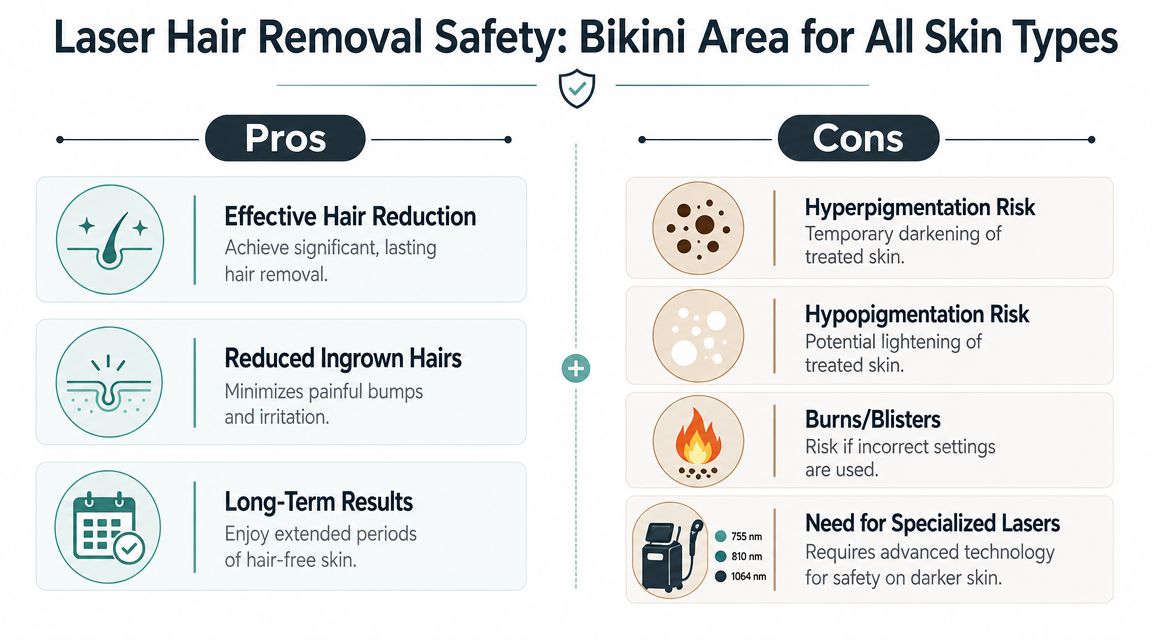
Laser hair removal can cause burns, blisters, infections, and both hyper- and hypopigmentation, and skin colour is a primary factor in deciding which laser should be used, according to clinical guidance from Cleveland Clinic. For the bikini area, this is especially relevant because pigment variation can be higher there than on the lower legs, arms, or back.
That doesn't mean darker skin should be excluded. It means protocol has to become more exact.
One useful clinical approach is to think in layers of risk control:
- Right wavelength for skin colour
- Patch testing before full treatment
- Conservative starting parameters
- Cooling and endpoint monitoring
- Strict aftercare and sun-avoidance counselling
For clinics treating a broad South African patient base, understanding when to favour a longer wavelength matters more than broad claims about “safe for all skin types”. If your team needs a practical reference on why longer wavelengths are commonly chosen for pigment-rich skin, the Nd:YAG laser overview from Omega Lasers gives a useful technical summary.
How to reduce preventable complications
The safest operators don't chase bravado. They watch for subtle warning signs early.
Look out for:
- Escalating heat beyond expected tolerance
- Excessive or spreading redness that looks disproportionate
- Uneven response across adjacent zones
- A skin surface that appears stressed rather than merely reactive
If you see that pattern, stop and reassess. Don't continue because “the settings were fine on the patch”. The patch gave you a starting point, not a licence to ignore the live response.
Different skin types don't need generic reassurance. They need different decisions.
A few habits consistently lower risk:
- Use strict exclusion standards for active tan
- Never let patient pressure set the fluence
- Keep treatment records detailed enough that another practitioner could safely continue the series
- Train staff to identify normal transient response versus a developing adverse event
The bikini area can be treated safely across diverse skin tones. What fails is the one-size-fits-all mindset.
Aftercare Protocols and Treatment Planning
A bikini treatment often succeeds or fails in the hours after the appointment. The skin may look calm in the room, then become more irritated later because the client exercised, used a fragranced product, or wore tight clothing home. Clear aftercare instructions reduce that risk and cut down on avoidable support calls, refund pressure, and disappointed reviews.
Immediate aftercare in clinic
Finish the appointment with a calm, structured handover. Check the skin again before the client stands up. Mild perifollicular redness and warmth are common. Ongoing stinging, marked swelling, or a surface change needs a closer review before discharge.
Keep the advice practical and specific to the bikini area, where heat, friction, sweat, and occlusion can easily aggravate a normal post-treatment response.
A useful handover should include:
- Cooling advice: Use a cool compress later the same day if the area feels hot or tender.
- Friction reduction: Choose loose cotton underwear and avoid tight gym wear if sensitivity is present.
- Heat avoidance: Skip hot baths, saunas, intense exercise, and anything that adds heat or rubbing until the skin settles.
- Product caution: Avoid scrubs, acids, retinoids, perfumed products, and harsh shaving products on the treated area during early recovery.
- Sun discipline: Prevent tanning and treat incidental sun exposure seriously, because pigment change is more likely when clients ignore this point.
Put those instructions in writing. Verbal advice alone is rarely enough, especially for first-time clients who are nervous and only remember half of what was said.
How to schedule the full series
Treatment planning needs to reflect hair biology, the client's consistency, and realities of clinic capacity. Bikini hair does not cycle in perfect synchrony, so reduction happens over a course of sessions rather than in one or two visits. As noted earlier, clinics usually position this as a repeated treatment plan with appointments spaced to catch new follicles entering active growth.
Clients do better when the explanation is simple. Treating too early usually means fewer target hairs are ready. Waiting too long can slow visible progress and weaken adherence. That matters clinically and commercially.
Book the next appointment before the client leaves. I advise new clinic owners to treat rebooking as part of the protocol, not an optional reception task. It improves completion rates, protects room utilisation, and makes monthly revenue easier to forecast. If you are building pricing and capacity around package sales, this ROI breakdown for South African diode laser clinics is a useful reference point.
One more point matters in the South African market. Diverse skin tones require conservative scheduling decisions after any strong post-treatment reaction, recent sun exposure, or poor aftercare compliance. Missing one session is easier to recover from than pushing ahead into avoidable pigment trouble. Safe repeatability keeps clients in treatment long enough to see real reduction, and that is what drives referrals.
A simple follow-up system helps. Send written aftercare on the day of treatment, check in if the skin response was stronger than expected, and use short educational content to reinforce the treatment journey. Clinics planning their client education content can borrow a few practical ideas from this 2026 video marketing guide.
Treatment momentum is built at checkout. If the client leaves uncertain about aftercare or without the next booking, the series is already less stable.
Boosting Revenue with Bikini Laser Services
Clinically, bikini laser is a protocol-driven treatment. Commercially, it should function like a retention engine. That only happens when the clinic sells the journey clearly, prices it intentionally, and markets it with the right promise.
Sell the course, not the single session
The simplest mistake is offering the bikini area as just another line item on the price list. Clients then compare it to one waxing appointment or one shave cycle, and the service feels expensive instead of strategic.
Package thinking fixes that. A bikini laser client is usually buying convenience, reduced upkeep, and a longer-term reduction path. Presenting the treatment as a structured course helps the client understand commitment and helps the clinic lock in continuity.
That commercial logic also improves forecasting. You can plan staffing, consumables, and room utilisation more accurately when bookings are sold in series rather than piecemeal. If you're modelling service profitability in a South African setting, this ROI breakdown for diode laser clinics is a practical reference for thinking about utilisation and returns.

Useful revenue habits include:
- Bundle intelligently: Offer treatment courses rather than relying on single-visit decisions.
- Pair natural companions: Underarms and bikini often fit the same client journey and scheduling pattern.
- Build follow-up discipline: Reminder systems matter because outcomes depend on attendance.
- Train the front desk properly: The person booking the consultation should understand course logic, not just price points.
Market the service with better language
The strongest marketing doesn't oversell permanence. It speaks to what the client already experiences with shaving or waxing, then positions laser as a more structured long-term solution.
Better messaging usually focuses on:
- Less frequent maintenance
- Convenience before holidays, events, and sport
- A professional treatment plan instead of endless upkeep
- Suitability based on assessment, not one-size-fits-all claims
If your team is improving how it communicates these services online, this 2026 video marketing guide is a helpful resource for turning common client questions into short educational content. That works especially well for topics like bikini line versus full bikini coverage, skin-type suitability, and what to expect during a course.
A clinic that explains well tends to close better. Not because the copy is louder, but because the client understands what they're buying and why the plan makes sense.
If you're building or refining a bikini laser service, Omega Lasers can help you align the technical side with the commercial side. The key advantage isn't just having a device. It's having a treatment framework, staff training, and business support that let you deliver safe, repeatable outcomes across diverse skin tones while keeping the service profitable.