




You're probably in one of two positions right now. Either you're replacing an ageing hair removal machine that no longer matches your client base, or you're about to make your first serious capital purchase and you've realised every supplier says their platform is the answer. On paper, Alexandrite, diode, Nd:YAG, dual-wavelength, triple-wavelength, cooling systems, fluence, pulse width, spot size. In practice, the question is simpler and far more expensive: which system will let your team treat the most clients safely, consistently, and profitably?
That decision gets harder in South Africa. A clinic in ZA rarely treats one narrow client profile all day. You may see lighter phototypes in the morning, tanned clients in the afternoon, and darker Fitzpatrick types later the same day. If your machine handles only a slice of that demand well, your calendar, your risk profile, and your return on investment all suffer. Price matters, but the machine's fit with your actual booking mix matters more.
Clinic owners often start with the wrong question. They ask which laser is “the best” in abstract terms. A better question is which technology gives your business the widest usable treatment range with the lowest avoidable risk. That's the lens that matters when you're comparing purchase price, training requirements, downtime exposure, and long-term utilisation.
Table of Contents
- Choosing Your Next Laser A High-Stakes Decision
- Understanding the Core Laser Wavelengths
- A Head-to-Head Comparison of Laser Technologies
- The Rise of Multi-Wavelength Platforms
- Essential Business Criteria for Your Laser Purchase
- A Practical Buyer's Checklist for Your Clinic
- Matching Technology to Your Clinic Model
Choosing Your Next Laser A High-Stakes Decision
A clinic owner recently described the buying process to me in a way that will sound familiar. One supplier promised speed. Another pushed comfort. A third leaned on technical jargon and implied that more power meant better outcomes. None of that answered the only question that mattered: would the machine work safely across the client mix already walking through the door?

That's where many purchases go wrong. Owners compare brochures instead of workflows. They focus on sticker price before they've worked through treatment suitability, training burden, cooling quality, handpiece ergonomics, and what a day of downtime will cost the business. If you're still mapping budgets, this guide to laser hair removal machine cost considerations is useful because it frames the purchase as an operating decision, not just a hardware expense.
Why this decision carries more weight than most equipment purchases
A hair removal platform affects almost every layer of the business. It shapes your consultation standards, patch testing protocols, operator confidence, rebooking rates, treatment room timing, and complaint management.
It also exposes weak thinking quickly. A machine that performs beautifully on a narrow range of clients can still be a poor investment if your market is mixed and your staff spend half the day declining treatment or referring cases elsewhere.
Practical rule: Buy for your real client base, not for the idealised one shown in marketing slides.
What usually works and what usually doesn't
What works is a buying process anchored in risk management and utilisation. Start with who you treat, then match technology to that demand.
What doesn't work is chasing whichever machine sounds most advanced without checking whether it expands your safe treatment window. In South Africa, flexibility usually beats purity. A clinic that can treat more of its market safely has more room to grow, train, and recover its investment.
Understanding the Core Laser Wavelengths
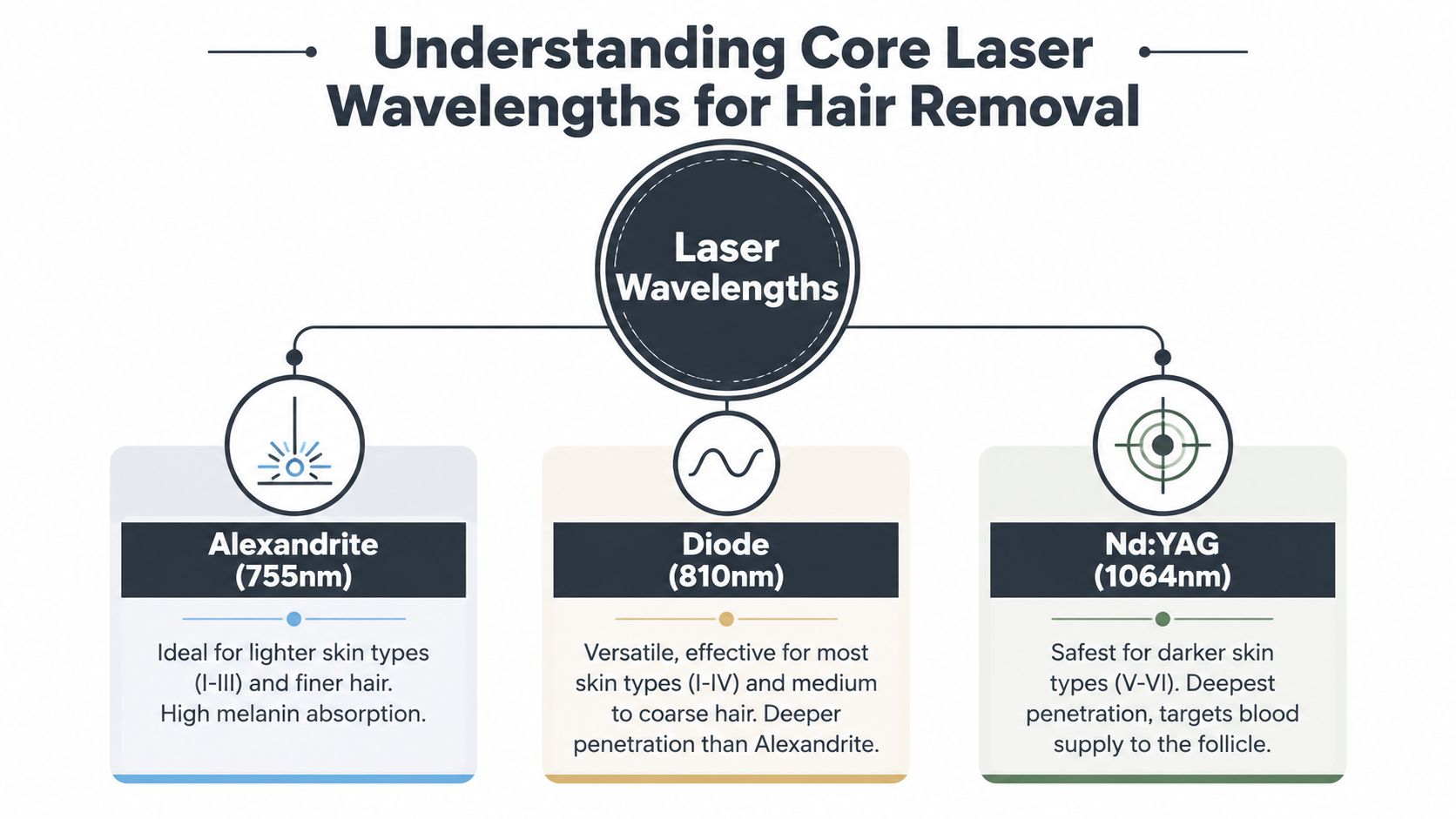
Hair removal decisions make more sense once you strip away the brand language and look at wavelength. The best laser hair removal technology isn't chosen by hype. It's chosen by how the wavelength interacts with melanin, how far it penetrates, and how safely it can deliver enough energy to disable the follicle without overheating the surrounding skin.
Why wavelength matters more than marketing language
The underlying principle is selective photothermolysis. In plain language, the device delivers light that the pigment in the hair absorbs. That energy converts to heat. If enough heat reaches the follicle at the right depth, the follicle is damaged while surrounding tissue is protected as much as possible.
For clinics comparing platforms, the most important technical differentiator is wavelength-to-skin-type matching. StatPearls summarises the benchmark clearly: Alexandrite (755 nm) is best for Fitzpatrick I to III because of high melanin absorption, diode (810 nm) penetrates deeper and is safer across Fitzpatrick I to V, and Nd:YAG (1064 nm) has the deepest penetration and the lowest melanin absorption, making it the safest option for Fitzpatrick I to VI, though sometimes less efficient on fine hair according to the StatPearls review of laser Fitzpatrick matching.
If your team doesn't understand that relationship, they'll rely too heavily on presets or sales training. That's risky. Good operators treat the wavelength as a clinical tool, not a label.
For a closer look at the darker-skin safety profile many clinics rely on, it also helps to understand how a 1064 platform is used in Nd:YAG laser treatments.
How the big three behave in clinic reality
Alexandrite 755 nm has strong melanin absorption. That makes it highly effective on lighter skin types and often very responsive on dark, coarse hair. It can be an excellent performer in the right demographic. Its limitation is that high melanin absorption also narrows your margin for error as epidermal pigment increases.
Diode around 810 nm sits in a very practical middle ground. It penetrates deeper than Alexandrite and is generally more forgiving across a wider range of skin types. In clinic terms, that often means fewer compromises when the day's bookings are mixed.
Nd:YAG 1064 nm reaches deepest and competes least with epidermal melanin. That is why it's widely treated as the safer option for darker or tanned skin. The trade-off is that it may be less efficient on fine hair, so safety improves while broad efficacy on all hair textures doesn't necessarily peak.
The right wavelength doesn't just improve results. It narrows the chance that a routine treatment turns into an adverse event.
A useful way to think about it is this:
- Alexandrite fits narrower but can perform strongly when the clinic primarily treats lighter phototypes.
- Diode fits broader day-to-day demand and often becomes the workhorse in mixed practices.
- Nd:YAG protects the clinic on higher-melanin cases where burn risk and pigment complications carry more weight than outright speed.
A Head-to-Head Comparison of Laser Technologies
Once you move past the basic science, the buying decision becomes operational. How well does the platform perform across different skin and hair profiles? How quickly can your team complete large areas? How comfortable is the treatment? How much risk does the system create when the operator is busy and the diary is full?
Benchmark comparisons consistently place diode systems in the strongest all-round position for busy ZA clinics because they balance speed, penetration depth, and safety. Professional diode units usually operate around 800 to 810 nm, and compared with Alexandrite they are less skin-type restricted, while compared with Nd:YAG they usually offer better melanin targeting. That balance is why many clinics treat diode as the practical workhorse for throughput and return on investment, as outlined in this professional comparison of Alexandrite, Nd:YAG, diode and IPL systems.
Laser Technology Performance Matrix
| Criterion | Alexandrite (755nm) | Diode (~810nm) | Nd:YAG (1064nm) |
|---|---|---|---|
| Skin type suitability | Strongest on lighter skin | Broad usability across mixed phototypes | Safest option for darker and tanned skin |
| Hair response | Often strong on dark hair against lighter skin | Strong on medium to coarse hair | Can be less efficient on finer hair |
| Penetration depth | More superficial than the others | Deeper than Alexandrite | Deepest penetration |
| Melanin absorption | Highest of the three | Balanced | Lowest |
| Throughput potential | Can be fast in the right cases | Strong all-round throughput | Often chosen for safety over speed |
| Risk profile in mixed populations | Narrower margin as epidermal melanin rises | Good balance for varied books | Best risk control on high-melanin skin |
A lot of clinics still compare laser systems to IPL hair removal platforms during procurement. That comparison matters, but it shouldn't distract from the main point here. If you're choosing among medical-aesthetic laser categories, the fundamental trade-off lies between Alexandrite, diode, Nd:YAG, or a system that combines them.
Efficacy across skin and hair profiles
Alexandrite can be outstanding in a narrow lane. If your clinic mainly treats Fitzpatrick I to III and sees a lot of dark terminal hair, it's a serious option. But many South African clinics don't operate in that narrow lane.
Diode is often easier to build a business around because it covers more situations without forcing the team into constant exclusions. That doesn't mean it wins every single case. It means the machine remains useful across more of the appointments you're likely to book.
Nd:YAG becomes essential when darker skin types are common, or when clients arrive tanned and you need a safer wavelength. Its lower melanin absorption is exactly why practices use it to reduce avoidable epidermal risk. The trade-off is clinical efficiency on certain finer hair types.
If your consultation team regularly says, “We can treat you, but only with a different machine,” your platform strategy is probably too narrow.
A common procurement mistake is buying around headline efficacy rather than service mix. The clinic remembers the dramatic before-and-after on ideal candidates and forgets the dozens of ordinary bookings that pay for the machine.
Speed comfort and safety in daily operations
The fastest machine on paper isn't always the fastest machine in business. Throughput depends on more than pulse repetition. It depends on whether the platform can treat the client safely without slowing down for excessive caution, repeat patch testing, or frequent parameter compromises.
Treatment speed
Larger spot sizes, stable fluence, and practical ergonomics matter. Busy clinics don't need a machine that is merely capable. They need one that remains efficient through a long treatment day.
Diode systems often perform well here because they combine useful penetration with efficient treatment flow. That's one reason they're so often chosen as the all-rounder in commercial settings.
Patient comfort
Cooling changes the experience more than many buyers expect. Strong sapphire contact cooling, or another reliable epidermal protection method, gives operators more confidence and helps patients tolerate full-body or larger-area work. A system with poor cooling often causes more hesitation, more stop-start treatment, and more complaints after the session.
Safety profile
Wavelength and operator discipline converge. Alexandrite can be very effective, but it is less forgiving when skin type selection is poor. Nd:YAG offers the safest route across the widest range of skin types, especially at the darker end. Diode sits between them, and that middle position is exactly why it often fits mixed clinics so well.
A good buying conversation should include questions like these:
- Who can safely operate this machine after initial training? Some systems are less tolerant of operator inconsistency.
- How does the cooling system behave during back-to-back sessions? Cooling quality under real workload matters more than showroom demos.
- What is the fallback option for darker, recently tanned, or higher-risk clients? If the answer is “we avoid them,” the machine is limiting your revenue.
- How often will your team need to change settings by skin type and treatment area? Frequent adjustments are normal, but overly fussy systems slow clinics down.
No single wavelength wins every category. The best laser hair removal technology for a real clinic is the one that produces safe, repeatable outcomes across the widest profitable portion of your client book.
The Rise of Multi-Wavelength Platforms
The more diverse your client base becomes, the harder it is to justify a single-wavelength purchase unless your clinic is deliberately specialised. That's why multi-wavelength platforms have gained so much attention in serious buying conversations. They address the core problem a mixed-market clinic faces: one laser type rarely covers every commercially important scenario well.

Why single-wavelength systems create operational limits
Single-wavelength machines are easier to understand, but they can force difficult business compromises. A clinic may buy Alexandrite for lighter skin performance, then discover that a meaningful part of its market needs Nd:YAG safety. Another clinic may buy only Nd:YAG, then find that many routine hair removal cases would have been more efficient on diode or Alexandrite.
Professional guidance aimed at mixed-population treatment highlights the practical value of dual-wavelength systems such as Candela GentleMax Pro, Elite IQ, and Clarity II because they combine Alexandrite and Nd:YAG to cover lighter and darker skin tones. It also emphasises a broader point that matters in South Africa: the actual decision is less about which label sounds best and more about which platform minimises burn risk while maximising utilisation across a diverse client book, as discussed in this industry article on choosing a laser for varied skin tones.
What platform flexibility changes for a ZA clinic
A platform approach changes the economics of the purchase. Instead of buying one machine for one ideal candidate, you invest in treatment adaptability.
That matters in several ways:
- Consultations become easier. Staff can match the client to the right wavelength instead of forcing the client to fit the machine.
- Risk management improves. Higher-risk phototypes or tanned clients don't automatically become awkward bookings.
- Utilisation rises. The device is relevant across more of the diary, which matters far more than occasional peak performance.
- Training becomes more valuable. Operators learn decision-making, not just button pushing.
One factual example of that platform trend is the single mention worth making here. Omega Lasers' Tetra Cool combines 755 nm, 808 nm, 940 nm, and 1064 nm in one platform, which reflects exactly where many buyers are heading when they want broader treatment flexibility across different skin types and hair profiles.
The strongest clinic investments usually don't remove complexity. They give the team better tools to manage it safely.
Multi-wavelength systems aren't automatically the right answer for every buyer. They still need strong cooling, thoughtful training, and realistic service support. But for clinics serving a broad South African population, platform versatility often solves more business problems than a single-wavelength machine ever can.
Essential Business Criteria for Your Laser Purchase
Many bad purchases happen because the demo looked good. The handpiece felt solid, the interface was clean, and the rep answered every objection. None of that tells you what ownership will feel like six months later when the room is fully booked and a handpiece fault takes the machine offline.
Commercial context matters here. In South Africa, diode laser technology held 45.97% of the energy-based hair removal device market in 2024, and its dominance is tied to the clinical practicality of the 810 nm wavelength, which offers deep follicular targeting with less epidermal absorption and suits a broad regional mix of skin tones, according to Grand View Research on the energy-based hair removal devices market. That figure matters because it reflects what many operators already understand on the ground: versatility tends to win.
Look past the headline price
A laser purchase should be evaluated as a total operating decision.
Consider these questions before you sign anything:
- What does downtime cost your clinic? Lost bookings, reschedules, and staff disruption usually hurt more than buyers expect.
- How dependent is the system on consumables or proprietary parts? A machine can be affordable to buy and frustrating to run.
- What does service support look like? Fast local support is worth more than vague promises.
- How easy is it to keep operator performance consistent? Complex systems raise training demands and increase variability.
A clinic owner should also think beyond treatment revenue alone. Cash flow discipline, collections, and admin efficiency all affect whether a capital purchase feels manageable or stressful. If you're tightening the financial side of the practice at the same time, these strategies for boosting healthcare profits are worth reviewing because equipment decisions land differently in clinics with weak revenue-cycle habits.
Support training and compliance are not extras
Regulatory status, warranty cover, and training quality aren't add-ons. They are part of the risk profile of the purchase.
What you want from a supplier is straightforward:
- Recognised compliance status that supports safe use, insurer confidence, and patient trust.
- Structured clinical training that covers consultations, contraindications, patch testing, parameter selection, and complication response.
- After-sales technical support that is responsive enough to protect your diary.
- Clear warranty terms that tell you what happens when a key component fails.
A cheap machine becomes expensive the first time your team hesitates to use it, or can't use it at all.
The best laser hair removal technology on paper will still underperform in business if your staff aren't trained well, your service support is slow, or your compliance documentation is weak.
A Practical Buyer's Checklist for Your Clinic
The global market trend supports serious investment when the clinic buys intelligently. The laser hair removal market was valued at $1.22 billion in 2024 and is projected to reach $4.60 billion by 2032, while Asia Pacific accounted for 39.34% of the 2024 market, according to Fortune Business Insights on laser hair removal market growth. Those numbers don't mean every machine is a smart buy. They do mean sustained demand is there for clinics that choose speed, versatility, and safe utilisation.
Start with your client book not the brochure
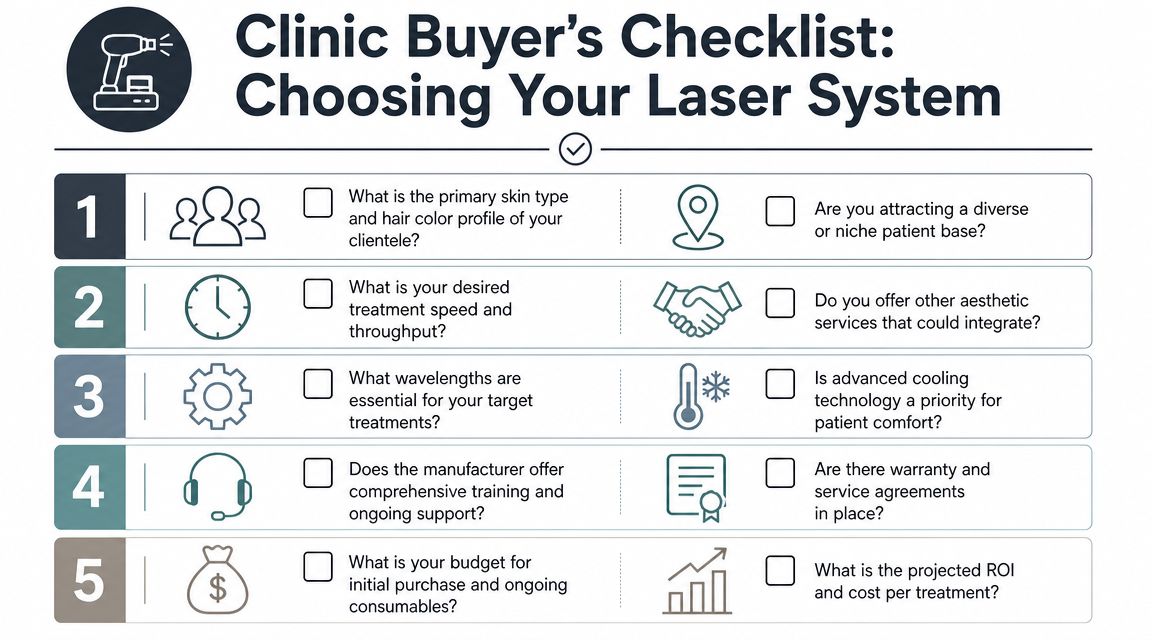
Before you compare suppliers, write down what your clinic sees.
Use a checklist like this:
- Map your dominant Fitzpatrick range. If your book is heavily weighted toward III to VI, that should shape the purchase from day one.
- Review common hair profiles. Coarse dark hair, mixed density, hormonal facial hair, and finer residual hair don't behave the same.
- Check how often clients present tanned. In many markets, that single factor changes what is practical and safe.
- Look at treatment-area demand. Full legs, underarms, bikini, beard shaping, and larger body areas create different throughput demands.
Then define your commercial model. Some clinics win through volume and need a workhorse platform with strong flow. Others run a more selective schedule and can justify narrower specialisation if the demographic supports it.
Score suppliers like long-term partners
Once you know what your clinic needs, compare suppliers using a simple scoring framework rather than gut feel.
A useful scorecard includes:
| Area | What to ask |
|---|---|
| Clinical fit | Does the wavelength mix suit your actual client population? |
| Cooling | Is the epidermal protection strong enough for busy treatment days? |
| Training | Will the supplier train your team to assess, patch test, and adjust safely? |
| Support | How quickly can faults be diagnosed and resolved? |
| Warranty | What is covered, for how long, and what is excluded? |
| Business enablement | Does the supplier help with launch, positioning, and treatment protocols? |
You should also pressure-test the administrative side of growth. As treatment demand increases, poor billing processes can eat into the return from an otherwise good equipment decision. If you need a framework for vendor assessment on the admin side, this guide on how to evaluate medical billing vendors is useful because the evaluation logic is similar: compare reliability, transparency, service scope, and operational fit.
Buy the machine your team can use confidently every week, not the one that sounds impressive in a sales meeting.
A final practical habit helps. Ask every shortlisted supplier to explain not only who the machine is ideal for, but also who it is a poor fit for. Honest answers are usually more informative than polished ones.
Matching Technology to Your Clinic Model
The right purchase becomes clearer when you stop thinking in abstract categories and start thinking in clinic models. In ZA, the central question isn't “which laser is best?” It's which platform minimises burn risk while maximising utilisation across a diverse client book, especially when many practices serve a wide spread of Fitzpatrick III to VI clients and need adaptable parameters or multiple wavelengths rather than one narrow answer.
The high-volume salon
A busy urban salon usually needs operational flexibility first. The diary is full, treatment times matter, and the client mix shifts constantly. For this model, a diode-based or multi-wavelength platform often makes the most sense because it supports broad usability without turning every second consultation into an exclusion conversation.
The specialist practice and the startup medispa
A dermatology or doctor-led clinic that sees a high proportion of darker skin types should weight safety even more heavily. In that setting, a validated 1064 nm Nd:YAG capability, or a platform that includes it, is often the sensible requirement because it gives the clinic a safer route for higher-melanin skin.
A startup medispa faces a different reality. Budget matters, but under-buying is expensive when the machine limits what you can safely treat. If the clinic plans to build a broad hair removal service in a mixed market, a versatile platform usually gives better room to grow than a highly restricted single-wavelength machine.
The best laser hair removal technology is rarely the most glamorous option. It's the one that fits your consultations, protects your patients, keeps your team confident, and stays productive across the widest profitable part of your market.
If you're comparing platforms and want a supplier that understands both clinical safety and day-to-day clinic operations, Omega Lasers is worth reviewing. Their range is aimed at salons, clinics, and aesthetic professionals who need compliant systems, training, technical support, and practical guidance around device selection for real treatment demand.