



You're probably balancing the same mix of pressure most new clinic owners face. The fit-out is expensive, the treatment rooms need to feel calm and premium, the devices are high value, and every patient who walks through the door expects safety, privacy, and professionalism without having to ask for it.
That's why security measures in an aesthetic laser clinic can't be reduced to a burglar alarm and a locked cupboard. In practice, security sits across patient safety, infection control, access control, staff permissions, documentation, data handling, and the increasingly overlooked problem of cyber-physical risk. A modern clinic may use connected systems for bookings, records, imaging, payments, and even device servicing. If those controls are weak, physical protections alone won't cover the entire exposure.
Table of Contents
- Why Comprehensive Security Measures Matter Now More Than Ever
- Foundational Laser and Device Safety Protocols
- Creating a Safe Clinic Environment
- Mastering Patient Consent and Data Privacy
- Building a Culture of Safety Through Staff Training
- Implementing Essential Cybersecurity Measures
- Ensuring Long-Term Safety with Maintenance and Response Plans
Why Comprehensive Security Measures Matter Now More Than Ever
Aesthetic clinics carry a difficult combination of risks. You're protecting people, expensive equipment, controlled treatment settings, personal information, and a brand that can be damaged by a single avoidable incident. When owners treat security as a back-office issue, the weak points usually show up in ordinary moments: a treatment room left open, shared passwords, unverified settings, informal consent, or a staff member using a connected device without clear authorisation.
That gap is getting wider because clinic technology is changing faster than many operating procedures. Physical barriers still matter, but they don't address the full risk profile of a clinic using networked systems. The most important blind spot I see is the space between traditional premises security and the protection of connected treatment devices and patient data.
A recent note on this gap is worth taking seriously. The risk between physical clinic protection and the cyber-physical security needed to prevent remote tampering or data manipulation on modern medical-aesthetic systems is now significant, and a 2024 NASCIO report highlighted that cybersecurity is a “vital, nonpartisan risk issue” and that 60% of small clinics lacked basic intrusion detection systems, leaving them exposed to threats that locks and gates can't stop, as referenced in this discussion of perimeter security blind spots.
Practical rule: If a device can store, transmit, receive, sync, or be configured through a connected system, it belongs inside your security plan, not outside it.
Strong security measures support profitability as much as compliance. A clinic that controls access properly, documents consent properly, trains staff properly, and handles data properly usually performs better operationally too. Fewer interruptions. Fewer disputes. Cleaner audits. More confidence in daily treatment delivery.
The right mindset is simple. Don't build a clinic that only looks safe. Build one that remains safe under pressure, during handovers, after hours, during staff changes, and when something goes wrong.
Foundational Laser and Device Safety Protocols
Laser safety starts before the patient enters the room. By the time a treatment begins, the environment, operator, machine settings, protective equipment, and emergency controls should already be confirmed. In a well-run clinic, no one “just switches on and starts”.
Control the treatment zone
Every laser room needs a clearly enforced treatment boundary. That means defining the Nominal Hazard Zone, limiting entry during operation, and making sure everyone inside the room has the correct protection for the wavelength and exposure risk involved. This isn't paperwork for its own sake. It prevents the most immediate avoidable injuries.
Eye protection deserves special attention. Protective eyewear must match the device and the treatment being performed. A generic pair kept in a drawer for “laser days” isn't a control. It's theatre. If your team needs a refresher on selecting the right protective eyewear, this guide to laser safety glasses is a useful reference point.
A practical room standard should include:
- Restricted entry: Keep the room closed during active treatment and stop casual foot traffic through the space.
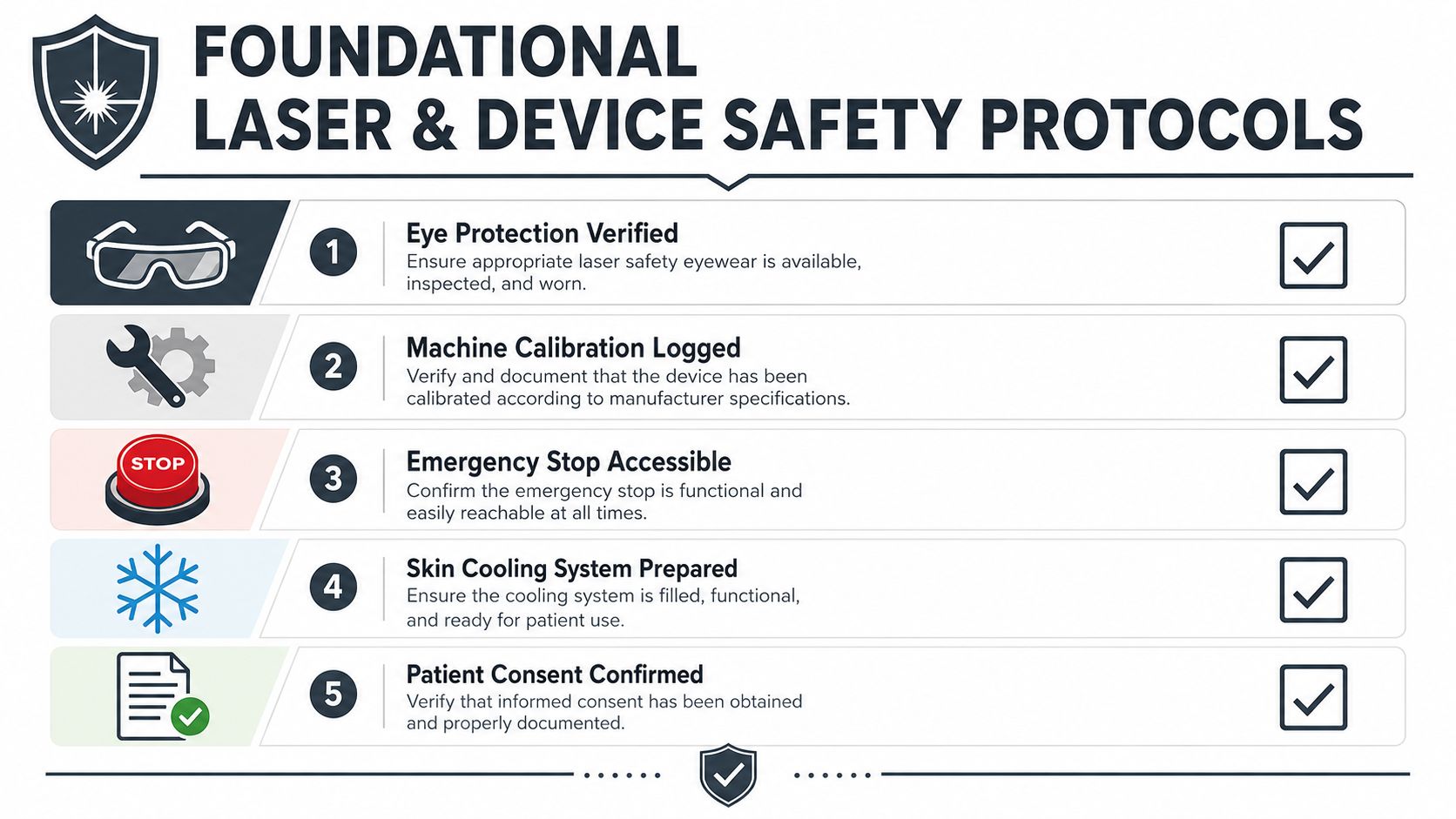
- Visible readiness checks: Confirm eyewear, warning signage, handpiece condition, and cooling readiness before the device is armed.
- Accessible emergency controls: Everyone authorised to operate the machine should know exactly where the stop control is and when to use it.
A laser room becomes unsafe long before a serious incident. It usually starts with one shortcut that becomes normal.
Use a pre-treatment release check
High-value treatment platforms often have multiple settings, accessories, applicators, and cooling dependencies. That makes routine discipline more important than confidence. I advise clinics to use a release check immediately before every session, even when the same operator is treating the same returning patient.
A strong release check usually covers the following:
Patient match and treatment plan
Confirm the patient identity, treatment area, contraindication review, and intended settings against the consultation notes.Machine readiness
Check calibration status, consumables, handpiece integrity, connector security, and whether any recent service note affects use.Support systems
Prepare cooling, smoke or plume management where relevant, skin prep materials, and aftercare supplies before the first pulse.Emergency readiness
Make sure the stop control is unobstructed and that the operator can interrupt treatment immediately if the patient reports unexpected pain or if the device behaves abnormally.
What works and what fails
The clinics that run safely don't rely on memory. They use repeatable controls, they restrict operation to authorised staff, and they log exceptions. What fails is the opposite: informal handovers, undocumented setting changes, and the assumption that someone who watched a colleague perform a treatment is ready to do it independently.
A simple authorisation rule helps. If a staff member hasn't been signed off for that device, mode, and treatment category, they don't operate it alone. Observation is not competence, and confidence is not clearance.
Creating a Safe Clinic Environment
A safe clinic feels calm to the patient, but behind that calm there should be tight routine control. Two layers matter most day to day. The first is hygiene and infection prevention within treatment areas. The second is physical security across the premises, especially where expensive systems, consumables, records, and staff are involved.
Hygiene controls that support safe treatment
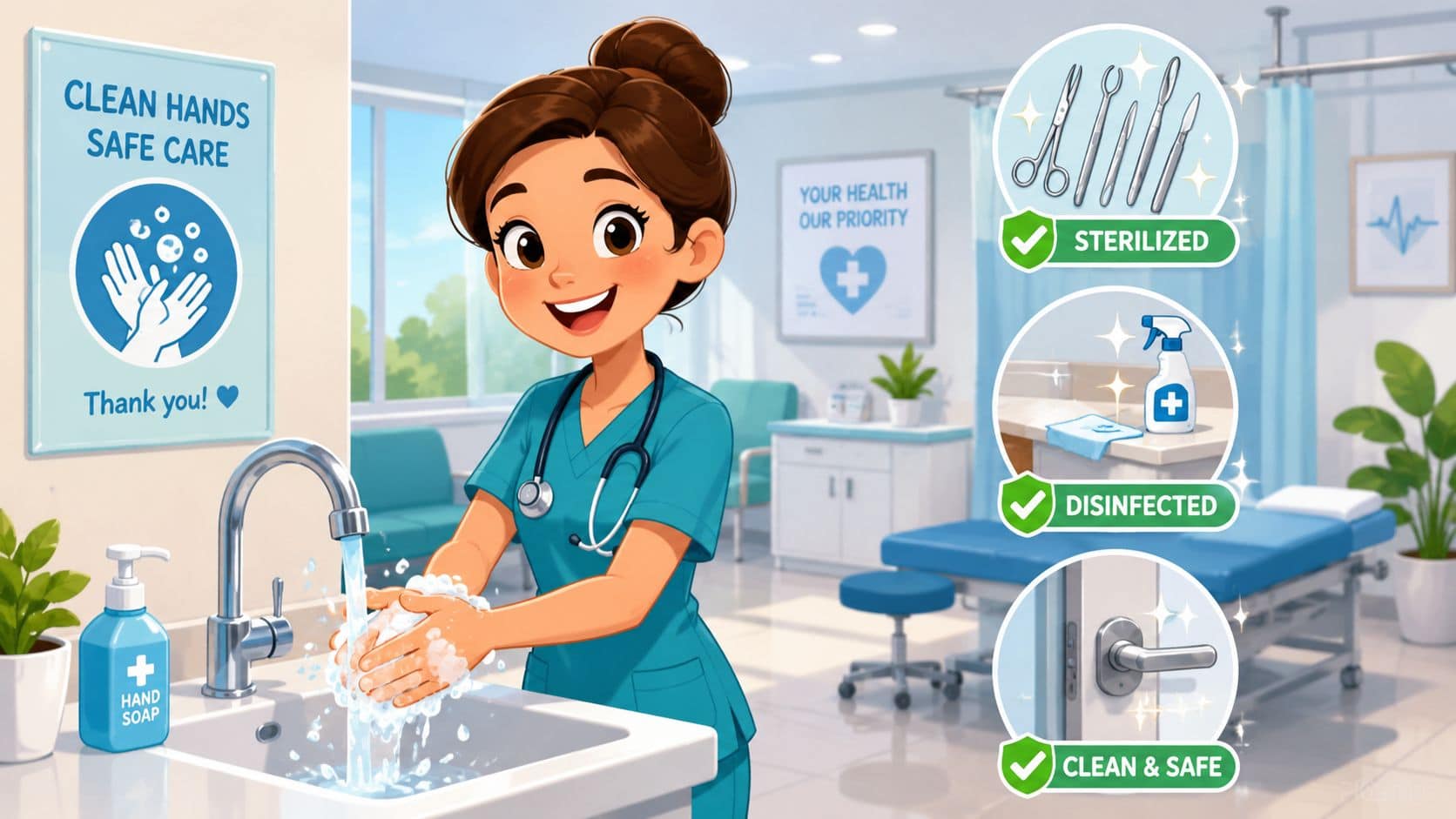
Infection control isn't separate from security. It's one of the clearest examples of operational security in a clinical environment because it protects patients, staff, treatment quality, and your legal position at the same time.
Focus on behaviours that are observable and enforceable:
- Handpiece handling: Clean and process reusable components according to manufacturer requirements, and separate clean items from used items physically, not just conceptually.
- Single-use discipline: Open disposables at point of use and discard them immediately after treatment. Don't leave partly used stock “for later”.
- Surface turnover: Reset beds, trays, touchpoints, and operator-contact surfaces between patients, with a written room turnover routine.
- Stock integrity: Store gels, tips, gauze, and sterile items in a controlled location away from dust, heat, and casual handling.
The clinics that struggle here usually don't have a knowledge problem. They have a consistency problem. If your room reset depends on who happens to be on shift, it isn't a system yet.
Physical premises security that works
Premises security should be layered. Start with controlled entry, then treatment-room access, then protected storage for devices and sensitive materials, then monitored after-hours response. South Africa has a large formal private security industry, with 2,536,000 registered private security officers reported by PSIRA in the 2023/24 period, as noted in this summary referencing PSIRA reporting. For clinic owners, the practical takeaway is that vetted guarding and response services are available within a regulated framework.
That doesn't mean every clinic needs guards on site. It means you should choose controls that match your location, trading hours, building type, and asset profile.
A workable physical security setup often includes the following comparison:
| Area | Poor control | Better control |
|---|---|---|
| Reception access | Open movement into staff areas | Clear separation between public and staff-only spaces |
| Treatment rooms | Unrestricted keys or shared codes | Named access permissions and lock discipline |
| Equipment storage | Devices left exposed after hours | Locked room or secured enclosure when not in use |
| Surveillance | Cameras installed without planning | Coverage designed around entry, blind spots, and evidence quality |
If you're planning camera placement, recording angles, or coverage priorities, Constructive-IT's guide on CCTV planning is a practical reference for thinking through layout before installation.
Good physical security doesn't try to look impressive. It removes easy opportunities.
Mastering Patient Consent and Data Privacy
Consent and privacy are often treated as admin tasks. That's a mistake. In an aesthetic clinic, both are core protection measures. They protect the patient from misunderstanding and the clinic from preventable disputes, poor documentation, and legal exposure.
Consent must be informed and documented
A signed form on its own is weak. Proper consent means the patient understands the treatment, expected outcomes, material risks, alternatives, aftercare, and when results may vary. That discussion has to happen before treatment, in language the patient can follow, with enough time for questions.
Strong consent records usually show:
- What was explained: The treatment purpose, realistic outcome range, limitations, and known side effects relevant to that patient.
- What the patient asked: Questions often reveal whether the patient fully understood the discussion.
- Why the plan is appropriate: Notes should connect the treatment choice to the consultation findings.
- What was agreed: Settings aren't the only thing to record. Document the scope of treatment, photography permissions, and aftercare advice.
If consent is rushed at reception or folded into a generic package of forms, the clinic keeps the signature but loses the protection. Detailed, consistent documentation matters. This overview of record keeping for aesthetic practice is a useful operational reference.
Privacy failures are also security failures
Patient records in an aesthetic clinic often include identity details, contact information, clinical history, treatment notes, images, and payment-linked administration. That isn't ordinary office data. It's sensitive operational material that should be stored, accessed, and shared on a strict need-to-know basis.
South Africa's Cybercrimes Act 19 of 2020 criminalises offences including unlawful access to or interference with data, which makes cybersecurity controls a direct form of legal risk reduction for clinics handling patient information, as discussed in this overview of the Cybercrimes Act and security implications.
The practical implications are straightforward:
- Limit access: Front-desk staff don't need the same access level as clinical decision-makers.
- Control image use: Separate treatment photography consent from general treatment consent, and store images in a controlled system.
- Protect communications: Don't send clinical details casually through unsecured personal channels.
- Secure paper records too: A locked cabinet in a restricted room still matters if any part of your workflow is paper-based.
Patients judge your professionalism by how carefully you handle the parts of their story they cannot see.
A clinic that takes privacy seriously also improves trust. Patients become more willing to share relevant health details when they believe those details will be handled discreetly and correctly. That leads to better screening, safer treatment decisions, and cleaner follow-up.
Building a Culture of Safety Through Staff Training
Most clinic incidents don't happen because nobody cared. They happen because someone assumed, forgot, copied an unsafe shortcut, or worked outside their real level of competence. Training is what stops that drift.

Build a competency framework
The safest clinics don't rely on job titles alone. They define what each person is allowed to do, what training supports that permission, how competence is checked, and when revalidation is required.
A simple competency framework should answer four questions:
| Question | What to define |
|---|---|
| Who may perform the task | Named staff members, not generic roles only |
| Under what conditions | Independent use, supervised use, or observation only |
| Based on what evidence | Training record, supervised cases, assessment, manager sign-off |
| For how long | Review date, refresher trigger, or reassessment point |
This matters most with treatment devices, image capture, consent handling, stock control, and patient record access. If authorisation lives only in the manager's memory, it won't survive staff turnover or a stressful day.
Train for routine work and abnormal events
New staff need structured onboarding, but that's only the start. Clinics should refresh training on room preparation, hygiene, contraindication screening, documentation quality, emergency interruption, and privacy handling. Short, regular refreshers usually work better than one overloaded annual session.
Use scenarios, not just lectures. Ask staff what they would do if a device displays unexpected behaviour, if a patient withdraws consent mid-process, if an unauthorised person enters a treatment room, or if someone requests records informally without verification.
The strongest training habits are practical:
- Shadowing with boundaries: Observation is useful, but don't blur it with authorisation.
- Drills on exceptions: Rehearse what happens when treatment must be stopped, not only when it goes smoothly.
- Written sign-off: Document who trained whom, on what, and when.
A culture of safety becomes visible when staff challenge uncertainty early. They ask before acting. They escalate small concerns. They don't hide near misses to avoid embarrassment. That's the standard worth building.
Implementing Essential Cybersecurity Measures
Cybersecurity in a clinic doesn't need to start with complex technology. It should start with the systems you already rely on every day: email, patient records, booking platforms, staff logins, payment workflows, Wi-Fi, and any connected treatment-related equipment. If those basics are weak, adding more software won't solve the underlying exposure.

Protect accounts before you buy more software
Account compromise is one of the most common ways a clinic loses control of records, schedules, internal communication, or financial workflows. Shared logins, reused passwords, and broad admin rights are still common in small practices, and they create unnecessary risk.
One baseline control stands out. 69% of companies internationally report using multi-factor authentication, according to this MFA benchmark summary. For a South African clinic handling personal information, MFA is no longer an advanced option. It's a sensible due-diligence measure.
Use that baseline in a clinic-specific way:
- Apply MFA first to critical accounts: Email, booking administration, patient records, finance, and any remote management access.
- Stop account sharing: Every user should have their own credentials and their own level of access.
- Reduce admin rights: Most staff do not need full control permissions to do their jobs.
- Review leavers immediately: Remove access the same day a staff member leaves or changes role.
For teams that need practical ideas for ongoing staff education, this resource on compliance-focused security awareness gives a helpful example of how awareness training can be framed around real operational responsibilities.
Separate clinic systems from guest access and device traffic
The cyber-physical issue transitions to an operational phase. A clinic should not treat all connected traffic as equal. Guest Wi-Fi, front-desk browsing, payment activity, records access, and any device-related connectivity should not sit loosely in one shared environment.
Use simple separation principles:
Separate guest and staff networks
Patients and visitors should never share the same access path used for clinic operations.Isolate sensitive systems
Keep booking, records, and financial workflows tighter than general browsing and entertainment use.Control updates and changes
Appoint one person or one managed process to approve software updates, password resets, and access changes.Log what matters
Record account changes, access changes, and unusual system events so you can investigate properly if something seems wrong.
If your clinic can't tell who accessed a system, when they accessed it, and whether they were supposed to, your security measures are too loose.
Good cybersecurity isn't about making the clinic hard to use. It's about making unsafe behaviour hard to repeat.
Ensuring Long-Term Safety with Maintenance and Response Plans
Security measures fail over time when clinics don't maintain them. Devices drift, checklists become performative, staff improvise around faults, and small issues sit unresolved because the clinic is busy. Long-term safety depends on maintenance discipline and a response plan that people can follow.
Maintenance prevents drift
Set a routine service calendar for treatment systems, room controls, access hardware, alarms, cameras, and documentation checks. If a control matters, it needs an owner, a schedule, and a record. For clinics reviewing their broader maintenance approach, this overview of integrated security system maintenance is a useful planning reference.
Where treatment equipment is concerned, don't wait for obvious failure. Performance drift, worn components, delayed updates, and incomplete service logging can all affect safety. Maintain a direct support route and use authorised help when faults appear. This matters for both compliance and continuity, especially when relying on manufacturer-backed after-sales service and technical support.
Use a simple incident response workflow
When something goes wrong, speed matters, but sequence matters more. Keep the response plan short enough that staff will use it correctly.
| Frequency | Task | Area |
|---|---|---|
| Weekly | Check access permissions still match current staff roles | User access |
| Weekly | Review alarm, lock, and camera status for faults or blind spots | Premises security |
| Weekly | Confirm treatment-room emergency controls and signage are in place | Clinical rooms |
| Monthly | Review incident log, near misses, and unresolved corrective actions | Governance |
| Monthly | Verify service records, maintenance bookings, and equipment status | Devices |
A practical response flow is usually: stop the activity, secure the patient or area, preserve evidence, notify the responsible lead, document facts, and escalate to technical, legal, or clinical support as needed. Don't let staff “fix” a serious issue informally before it's recorded. That's how clinics lose both clarity and protection.
If you're building or upgrading an aesthetic practice, Omega Lasers can support more than device supply. Their team works with clinics that need compliant, training-backed, operationally sound treatment systems, along with ongoing technical and after-sales support that helps practices stay safe, organised, and commercially strong.