




You're probably looking at a month that felt strong on paper. Appointments were full, the till moved, staff stayed busy, and one or two new treatment packages sold well. Then you sit down with the numbers and the core question surfaces. Did the clinic grow, or did it merely stay active?
That gap matters more in aesthetics than many owners realise. A clinic can produce healthy monthly revenue while experiencing a gradual leak of long-term profit through weak retention, poor follow-up, underused devices, and one-off clients who never return for a second phase of care. In South Africa, where affordability, timing, and trust often shape whether clients continue with treatment plans, short-term revenue can be a misleading comfort.
The clinics that build durable profitability track the full value of the client relationship, not just the first invoice. That's where customer lifetime value becomes useful. It gives owners a way to judge marketing spend, package design, staffing decisions, client communication, and device investment through one practical lens. Not “How much did this client spend today?” but “What is this relationship worth if we manage it properly?”
Table of Contents
- Beyond Monthly Revenue An Introduction to CLV
- What Is Customer Lifetime Value for Aesthetic Clinics
- How to Calculate Customer Lifetime Value
- CLV Benchmarks and KPIs for Your Clinic
- Practical Strategies to Increase Clinic CLV
- How Omega Lasers Helps You Maximise CLV
- Conclusion From Metric to Mindset
Beyond Monthly Revenue An Introduction to CLV
Aesthetic clinic owners often know their monthly turnover, their busiest treatment rooms, and which practitioner sells retail well. What they often don't know is whether the business is building stronger client relationships or only replacing old demand with new demand every month.
That distinction becomes obvious when two clinics report similar revenue but operate very differently. One fills its diary through constant promotions, first-visit offers, and heavy acquisition effort. The other sees clients return for review appointments, maintenance sessions, skincare, add-on treatments, and referrals because the treatment path was structured from the beginning. The first clinic can look busy while staying fragile. The second usually builds more stable profitability.
Customer lifetime value, or CLV, gives you a way to see that difference clearly. Instead of treating the first booking as the whole sale, CLV looks at the total worth of the relationship across the full time a client stays with your clinic.
A busy diary tells you what happened this month. CLV tells you whether those bookings are turning into a business that becomes easier to grow.
In aesthetics, that shift in thinking is powerful because many treatments are not single events. Laser hair removal often happens as a course. Skin rejuvenation usually needs review and maintenance. Body treatments, medical facials, skin plans, and retail all gain value when the client stays engaged and trusts the clinic's guidance.
A useful way to sharpen this thinking is to compare transaction-led management with relationship-led management. If you want an accessible outside perspective, Toki's insights on CLV frame that long-term view in a practical way.
A clinic owner's blind spot
The blind spot is simple. Owners often celebrate a high first sale while ignoring what happens after it.
A client who buys a premium introductory treatment and never returns can look impressive in monthly reports. A quieter client who starts modestly, follows the treatment plan, buys homecare, returns for maintenance, and accepts sensible upgrades often contributes more to profit over time. If you don't track that journey, you'll keep rewarding the wrong behaviours in your marketing and front-desk processes.
What Is Customer Lifetime Value for Aesthetic Clinics
Customer lifetime value is the total worth of a client over the entire relationship. Modern frameworks commonly model it as average transaction value multiplied by purchase frequency and customer lifespan, and that long-term framing has become central in customer analytics rather than a simple revenue snapshot, as explained in this CLV overview from Yotpo.
For aesthetic clinics, that definition needs to be made practical. A client's value is not the price of one peel, one facial, or one laser session. It's the combined value of the treatment journey they complete.
A clinic doesn't sell one treatment
Think of your clinic like a house builder. You're not in the business of selling one brick. You're in the business of building the full structure.
The same logic applies to a client journey. A first consultation may lead to a course of treatments. That course may lead to maintenance. Maintenance may lead to a skincare routine, seasonal top-ups, or treatment upgrades once trust is established. If you only measure the first brick, you'll undervalue the whole house.
That's why CLV is different from average transaction value. Average transaction value tells you what happened in one sale. CLV tells you what the relationship can become.
A clinic with strong CLV usually does several things well:
- It plans care over time instead of selling appointment by appointment.
- It improves retention because clients understand the treatment path and expected outcomes.
- It makes forecasting easier because repeat demand is easier to manage than constant first-time demand.
Why retention changes the maths
In aesthetics, retention is usually the most practical lever because it improves both frequency and lifespan. You don't need to raise prices to increase client value if more clients complete their plans, return at the right intervals, and stay connected to the clinic.
Practical rule: If clients regularly disappear after their first phase of treatment, your CLV problem usually starts long before the rebooking call. It starts in consultation quality, expectation-setting, and follow-up discipline.
Owners sometimes chase CLV by pushing larger opening packages too early. That rarely works for long. Clients don't stay because the package was expensive. They stay because the care pathway felt relevant, the result was visible, the communication was consistent, and the clinic made future steps easy to understand.
In South African clinics, this matters even more because clients often weigh treatment desire against budget timing. The clinics that retain well don't just sell. They guide, sequence, and support.
How to Calculate Customer Lifetime Value
Most clinic owners don't need a complex model to start. They need a reliable working method they can review every month. Standard explanations of customer lifetime value often use average order value × purchase frequency × customer lifespan, but for South African aesthetic businesses the stronger question is whether you're calculating profit-adjusted CLV by account type, especially when recurring support, training, consumables, maintenance, and upgrades affect real value over time, as discussed in this CMSWire explainer on CLV calculation.
Start with a simple working formula
For a clinic client, start with three inputs:
- Average spend per visit
- Average visit frequency
- Average client lifespan
Here's a simple working example using placeholders so you can insert your own clinic data.
| Metric | Example Value | Calculation Step |
|---|---|---|
| Average spend per visit | Your clinic's figure | Pull this from invoices over a defined period |
| Visit frequency | Your clinic's figure | Count how often the average client returns |
| Client lifespan | Your clinic's figure | Measure how long the average client stays active |
| Simple CLV | Derived result | Average spend per visit × visit frequency × client lifespan |
This first version is not perfect. It's a decision tool.
If you don't yet collect clean data, start there. Front desk notes, treatment records, package tracking, practitioner rebooking habits, and retail history all affect the quality of your CLV number. A practical place to tighten that process is your internal data discipline. Good clinic data collection methods make CLV calculation far less speculative.
Move to segment and cohort thinking
A single clinic-wide average can hide major differences. New clients behave differently from maintenance clients. Hair removal clients behave differently from corrective skin clients. A once-off facial buyer behaves differently from a treatment-plan client.
That's why better clinics calculate CLV by segment or cohort:
- By treatment category such as hair removal, resurfacing, rejuvenation, or skin maintenance
- By acquisition source such as referral, walk-in, campaign lead, or doctor referral
- By practitioner or room type if treatment pathways differ in quality or consistency
- By package type to see which offers create durable value and which only drive a first sale
A cohort view often changes management decisions. A campaign may bring in many enquiries but weak retention. A referral stream may start slower but produce stronger long-term clients. Without cohort analysis, those differences disappear inside one average figure.
Track CLV by the kind of client journey you sell, not just by the month the cash arrived.
Why profit-adjusted CLV matters more
Revenue is only half the story. A treatment may look valuable while absorbing too much chair time, support time, consumables, discounting, or practitioner effort.
Profit-adjusted CLV asks a better question. Which type of client produces the best long-term contribution after service cost?
That matters in aesthetic medicine and device-led treatment businesses because the highest-value relationship isn't always the one with the biggest first invoice. Sometimes it's the client who buys a modest starting plan, stays compliant, takes homecare seriously, and returns steadily for maintenance. In supplier and clinic-partner settings, the same logic applies. A smaller initial device sale can be more valuable over time if it leads to recurring support, training, upgrades, and ongoing usage.
A practical progression looks like this:
- Stage one: Calculate simple CLV for the whole clinic
- Stage two: Split by treatment category and acquisition source
- Stage three: Adjust for service cost, discounting, and retention quality
- Stage four: Use the result to guide ad spend, package design, and staffing priorities
If your current CLV is still in a spreadsheet built by instinct, that's fine. Start with a rough model, then improve the quality of the inputs. The mistake isn't starting simple. The mistake is treating a rough number as final.
CLV Benchmarks and KPIs for Your Clinic
Once you've calculated customer lifetime value, the next question is obvious. Is it healthy?
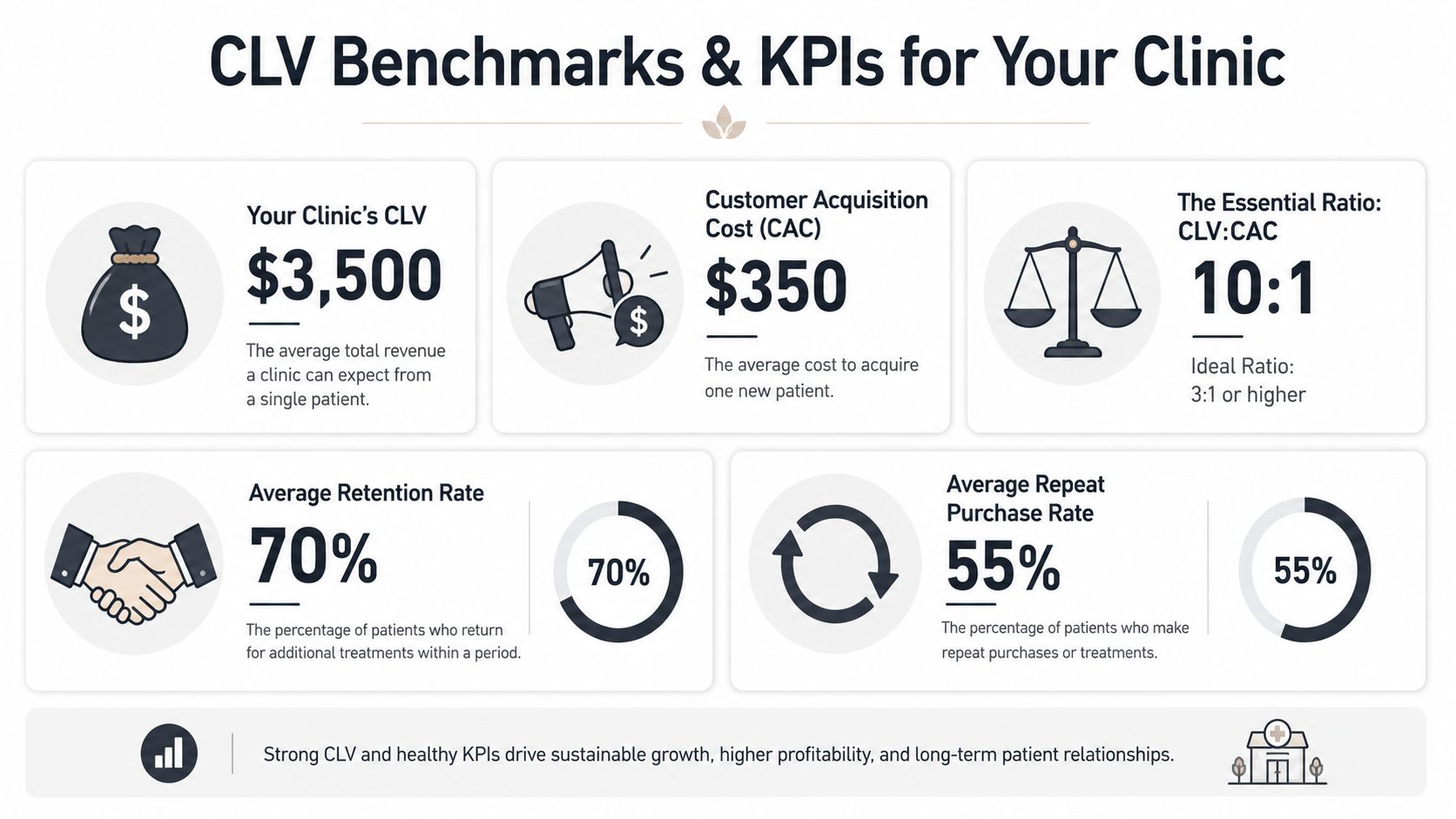
The most useful benchmark is not CLV on its own. It's the relationship between CLV and customer acquisition cost, or CAC. In the ZA region, the standard framework is to calculate CLV and compare it to CAC using a 3:1 CLV to CAC ratio as a healthy target. In practical terms, if a South African operator spends R10,000 to acquire a customer, the aim is roughly R30,000 in lifetime value for sound unit economics, according to this industry benchmarking discussion from CustomerGauge.
The ratio that keeps growth healthy
This ratio matters because acquisition can make weak businesses look successful for a while. If every new client costs too much to win, and too few stay long enough to justify that spend, growth becomes expensive and unstable.
In clinic terms:
- Low CLV with high CAC usually means promotions, paid campaigns, or referral incentives are bringing in clients who don't stay.
- Healthy CLV with disciplined CAC usually means the clinic converts suitable clients well, structures treatment plans clearly, and rebooks consistently.
- Very high CLV relative to CAC can be excellent, but it can also mean you're underinvesting in acquisition and leaving growth on the table.
If you're planning expansion, equipment finance, or a new treatment room, this ratio belongs in your forecasting. A practical way to map it into projections is through financial forecasting for clinic growth.
The supporting KPIs that give CLV meaning
CLV becomes much more useful when you view it alongside a short operating dashboard.
Track these supporting KPIs regularly:
- Retention rate because a clinic can't build long-term value if clients don't stay active.
- Churn rate because drop-off after consultation, after the first session, or after package completion reveals where the journey breaks.
- Purchase frequency because treatment plans with poor return timing weaken lifetime value.
- Average order value because price strategy, bundling, and treatment mix shape how much value is captured at each visit.
- Time to second booking because a delayed second visit often predicts weak continuity.
A benchmark is only useful if it changes behaviour. When a clinic sees CLV drift downward, the answer usually isn't “market harder”. It's “find out where the relationship is being lost”.
Practical Strategies to Increase Clinic CLV
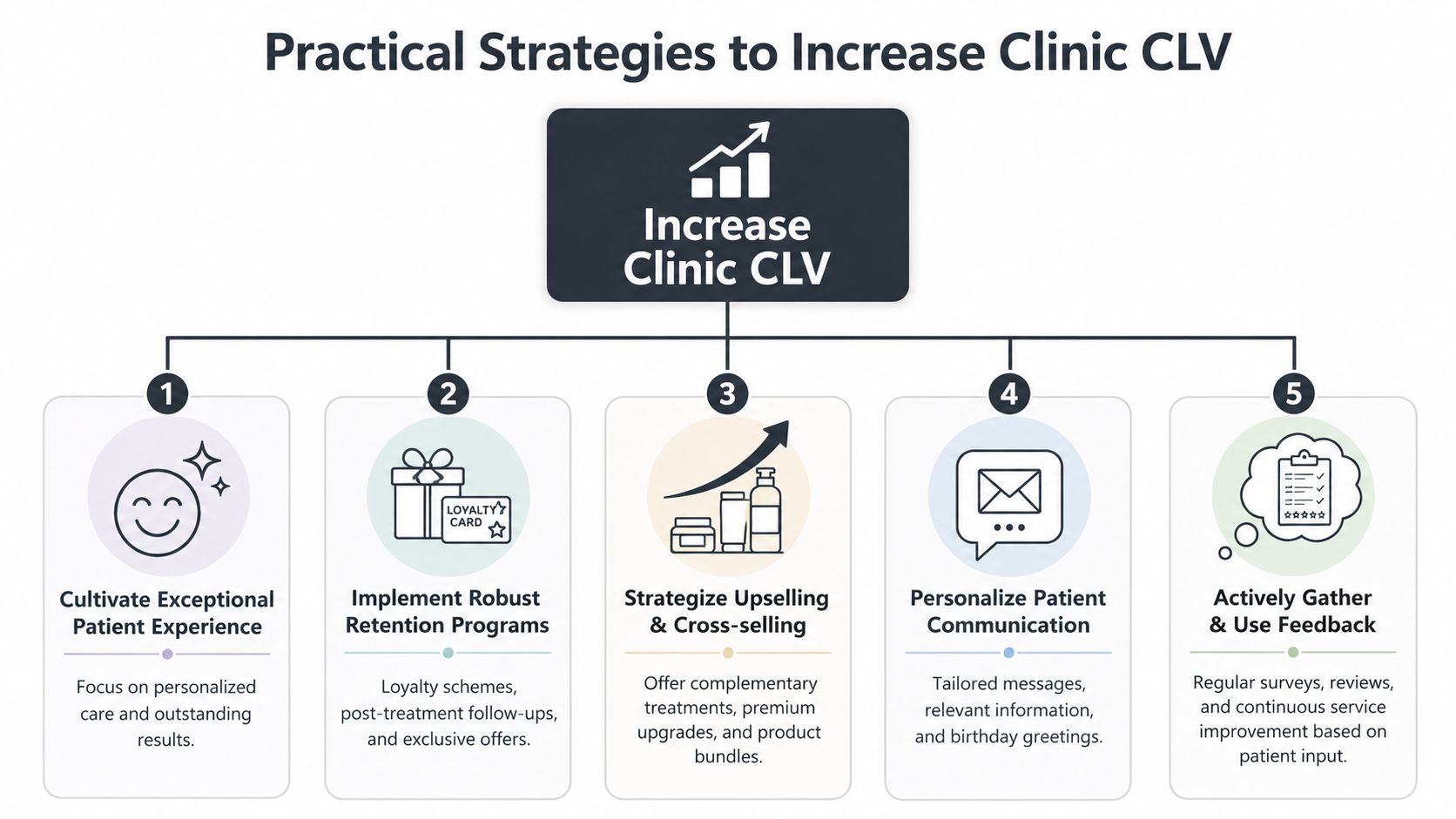
Most clinics don't raise customer lifetime value through one dramatic change. They improve it by tightening the full client journey. That includes how the consultation is structured, how treatment plans are packaged, how results are reviewed, and how quickly the clinic notices a client drifting away.
Design treatment plans instead of isolated bookings
A clinic that sells appointments one by one usually creates lower CLV than a clinic that sells a sensible treatment pathway.
That doesn't mean pushing large packages onto every client. It means connecting the consultation to a clear plan. If a client needs a sequence of sessions, explain the sequence. If maintenance is part of the outcome, introduce that early. If homecare affects results, build it into the recommendation instead of leaving it as an afterthought at reception.
What works:
- Structured consultations that link concern, treatment path, timing, and likely maintenance
- Phased packages that feel achievable and clinically coherent
- Review points where progress is assessed and next steps are explained
What usually fails is vague advice such as “come back when you can” or “let's see how it goes”.
Build recurring revenue carefully
Memberships, maintenance plans, and standing care programmes can improve CLV, but only when they fit the clinic's treatment model and client base.
The mistake is creating a membership that exists only to stabilise cash flow. Clients stay when the plan gives them relevance, convenience, and a reason to continue. In aesthetics, that might mean combining routine skin support, priority booking, member-only treatment pricing, or bundled review care. The exact structure matters less than the fit.
A useful outside reference for retention thinking in service businesses is this guide for retaining clients in service businesses. The principles apply well to clinics when adapted carefully.
Clinics often lose CLV in the quiet weeks after a treatment course ends. That's when clients need a maintenance plan, not silence.
Use device capability to widen the client journey
A single-function treatment menu limits how far a client can progress with you. A clinic with the right mix of capabilities can cross-sell more naturally because the next recommendation fits the client's real concern.
For example, a client who first enters through hair removal may later need skin support, pigmentation management, rejuvenation, or post-summer maintenance. A skin client may start with corrective care and later move into maintenance or premium upgrades. None of that should feel pushy. It should feel clinically logical.
Technology planning directly affects CLV. If your devices allow multiple treatment pathways with consistent results, your clinic can keep clients inside one trusted care environment rather than referring value away.
Tighten follow-up and recall systems
Many clinics think they have a retention problem when instead they have a follow-up problem.
Clients drift for ordinary reasons. They get busy, delay spend, forget timings, or lose urgency once an initial concern improves. If the clinic doesn't re-engage them with relevant timing, they fade away.
Useful systems include:
- Post-treatment follow-up after first visits and milestone sessions
- Recall reminders tied to treatment intervals rather than generic monthly messages
- Lapsed-client lists reviewed by treatment type and last booking date
- Outcome check-ins that reopen the conversation around maintenance or next-step care
The point isn't automation for its own sake. The point is to make continued care easy.
Model CLV under different demand conditions
Aesthetic demand in South Africa is not always stable. Some clients continue steadily. Others reduce visit frequency, postpone maintenance, or step down to lower-ticket options when budgets tighten.
That's why clinics should avoid one static CLV assumption. A more useful approach is scenario-based CLV that considers lower visit frequency, churn shocks, and discount rates in a market where affordability can vary by segment, as discussed in this InMoment article on CLV as a revenue metric.
Use three practical scenarios:
- Base case for normal client behaviour
- Conservative case where rebooking slows and lifespan shortens
- Upside case where treatment adherence and maintenance improve
This does two things. It protects you from optimistic forecasting, and it shows which interventions have the greatest effect on long-term value.
How Omega Lasers Helps You Maximise CLV
Technology can increase customer lifetime value, but only when the clinic can turn device capability into repeatable treatment journeys. A machine on the floor does nothing by itself. The commercial result comes from treatment range, practitioner confidence, service uptime, and the clinic's ability to guide clients from first treatment to ongoing maintenance.
Technology only pays when the clinic can use it well
A supplier relationship affects CLV, rather than solely capital expenditure. A multi-technology platform can create more cross-sell and upsell opportunities because it lets the clinic treat adjacent concerns inside one care pathway. But that only works when the team understands how to position treatments correctly and match them to the right client journey.
Omega Lasers fits into that conversation as one practical option because it supplies device platforms for clinics and aesthetic businesses, along with training, business guidance, and support that can help teams implement treatment pathways more consistently. In CLV terms, that matters because a wider treatment menu, if used well, can increase repeat engagement and reduce the tendency to treat each booking as an isolated sale.
Support affects lifespan value
Service support is often ignored when owners discuss lifetime value, yet it shapes it directly. If a clinic can't maintain treatment continuity, client confidence drops. If practitioners are unsure how to recommend the next step, treatment journeys stall. If maintenance and after-sales systems are weak, rebooking suffers.
That's why after-sales support belongs inside the CLV conversation. Reliable after-sales service for aesthetic equipment supports continuity, and continuity supports client lifespan.
The highest-value client relationship is usually the one the clinic can keep delivering on without interruption.
In practical terms, clinics tend to protect CLV better when they choose technology partners and operating systems that make follow-through easier, not more complicated.
Conclusion From Metric to Mindset
Customer lifetime value is not just another number on a dashboard. It's one of the clearest ways to judge whether a clinic is building durable profit or staying busy.
When clinic owners understand CLV properly, decisions improve. Marketing spend becomes easier to judge. Packages become more structured. Follow-up becomes less reactive. Device investment gets tied to treatment pathways and retention, not just to launch excitement. The clinic stops valuing clients only at the moment of sale and starts valuing the relationship over time.
That shift matters in South African aesthetics because demand can be strong while continuity remains fragile. Clinics that win long term usually don't chase every transaction. They build trust, sequence care well, and make it easy for clients to continue.
Treat CLV as a management mindset. Review it often. Segment it properly. Use it to test what's working and what isn't. The clinics that do this usually become more predictable, more profitable, and easier to grow.
If you're reviewing device investment, treatment expansion, or retention strategy, Omega Lasers is worth exploring as part of the operational picture. The core question isn't only what technology you buy. It's whether your clinic can use that technology to create repeat treatment demand, stronger retention, and better lifetime value from the clients you already work hard to earn.