



Is a higher menu price what makes a salon business profitable? In a price-sensitive South African market, the stronger model is the one with the best revenue per treatment hour and a course clients can finish, not the biggest single ticket. A busy diary beats a premium line that people try once and drop. Documented laser compliance belongs in that commercial offer, because trust is what gets the second booking.
Device treatments can lift margin only when the room, the operator and the rebooking habit are built around paid hours. Pick the business shape first, then the service that fills those hours, then the quotes and licences that make the investment real.
Table of Contents
- Choosing an Add-On Room or a Dedicated Clinic
- Which Device Services Earn per Treatment Hour
- Startup Costs Financing and What You Own
- Premises Rules Licences and Operator Training
- An Illustrative Payback with Stated Assumptions
- Marketing Packages and Client Retention
- Launch Checklist Before You Enquire
Choosing an Add-On Room or a Dedicated Clinic
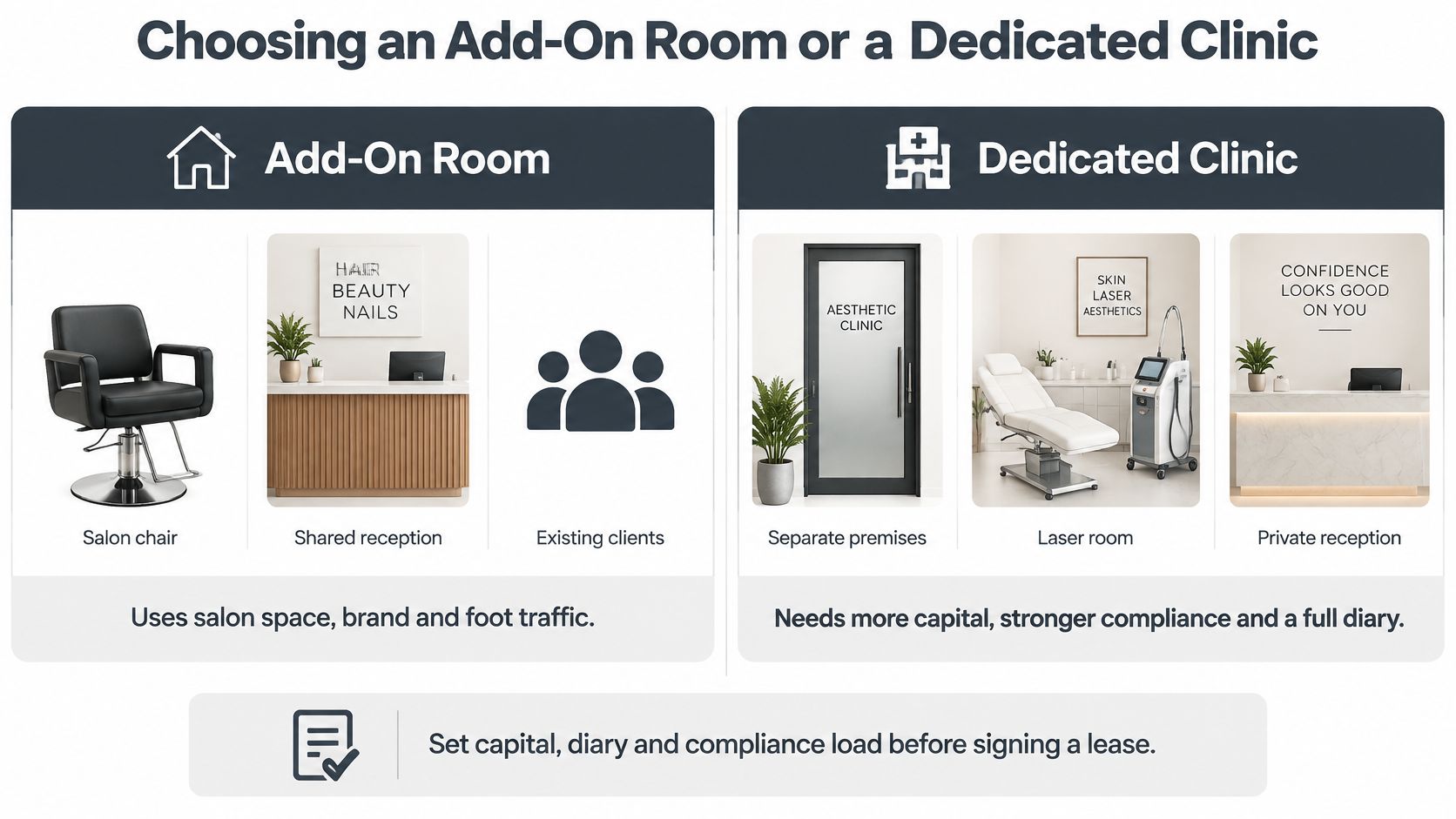
Could your existing salon book keep a device room busy, or does the service need its own clinic? Choose the setup that can generate the strongest revenue per treatment hour without relying on a high single-ticket price. A course clients can complete and a diary that stays full matter more than an impressive menu.
Model A, the add-on room, puts the service inside a working salon. You can use its existing clients, brand and premises, making this a practical way to test demand without building a separate business from scratch. A private, powered room can support services such as laser hair removal, skin scans or facials, provided it meets the device requirements. The main operational risk is divided attention: hair appointments can pull staff away, and rushed consultations can make the new service feel tacked on.
Model B, a dedicated aesthetic clinic, gives skin, body and hair-reduction courses their own appointment space. Longer treatments can run without competing with a hairdressing queue, but the clinic needs its own premises, fit-out, reception and compliance arrangements. It also starts without an existing salon book to draw on, so plan for a quieter opening period.
What the formal market looks like
The formal hair and beauty sectors include 7,370 employers, a useful reminder that a focused room can be a sensible starting point for an owner who wants to limit premises commitments. The Department of Higher Education and Training hairdressing launch speech cites Services SETA figures of 7,370 employers, comprising 6,337 in haircare and 1,033 in beauty treatments. Of these, 5,232 were non-levy-paying and 2,138 were levy-paying. Those figures describe formal employers, not the full salon market, which also includes household and informal work.
Three tests before a lease
- Demand you can name: How many current clients are likely to book a course within 90 days?
- Completion, not a trial visit: Will clients in the area pay to complete a course, rather than sample one appointment?
- Hours behind the commitment: Can a trained operator cover the hours your planned repayments depend on?
Practical rule: If you cannot identify a reliable source of bookings for the first months, do not take on clinic rent to fix a marketing problem. Start with an add-on room, prove demand and protect treatment time before committing to a dedicated clinic.
Which Device Services Earn per Treatment Hour
Which service can fill paid treatment hours at a price local clients will accept? In a price-sensitive South African market, a busy diary and a course clients can finish matter more than the highest single ticket. Documented laser compliance is part of the offer, too.
The Statistics South Africa personal services presentation.pdf) records R688 billion in personal-services income in 2023, up from R381 billion in 2018. It also reports employment of 565,709 people, average annual growth of 2.5% from 2018, and women making up 63% of that employment. For a salon, the practical lesson is to protect the operator's time: the room earns only when a trained therapist completes paid treatments.
Compare services by treatment time, client onboarding, training needs, uptime and the number of appointments one therapist can finish in a day. Track revenue per productive treatment hour by subtracting therapist time, consumables, payment costs and an allocated share of equipment cost from completed-session revenue. Review utilisation, rebooking, cancellations, average transaction and revenue per therapist regularly. Omega Lasers provides partners with personalised training, ongoing technical assistance and business guidance, which can support this operating plan.
Four services and the hour they sell
Laser hair removal can suit a high-turnover diary. Common treatment areas may take less time, consumables are low, and clients generally follow a course of six to eight sessions. Set your own price bands from local salon price lists, then check that the treatment duration and expected rebooking make the service worthwhile. Tetra Cool is a commercial laser hair removal machine for trained clinics, salons and aesthetic businesses, not for at-home use.
RF microneedling may command a higher ticket, but longer visits and less frequent return appointments can reduce hourly revenue. Skin analysis works best as a short consultation that supports a written treatment plan and relevant homecare recommendations. Body contouring is often packaged, but longer appointments mean fewer daily slots and can require more room.
| Service | Time and demand | Pricing pattern | Why the hour earns | Best fit |
|---|---|---|---|---|
| Laser hair removal | Shorter visits for common areas; a course of six to eight sessions | Set bands using local price lists | Low consumables and repeat appointments can fill paid hours | Salons able to rebook a course |
| RF microneedling | Longer facial visit; fewer repeat appointments | Set a ticket against treatment time and local demand | Higher ticket, but fewer clients may fit in a day | Skin-focused rooms with consultation time |
| Skin analysis | Short scan or consultation | Charge a fee or include it with a plan | Supports treatment planning and relevant homecare | Either model, as a consultation entry point |
| Body contouring | Longer visit; commonly packaged | Set package terms around visit length | Packages support repeat bookings, while longer slots limit daily capacity | Dedicated rooms with demonstrated demand |
For laser services, compare local prices against the full course, not just the first appointment. A full diary with disciplined rebooking can earn more per treatment hour than a less frequent, higher-priced facial. Build the schedule around treatments clients can complete, and check that each service's training, equipment and compliance requirements fit the business.
Startup Costs Financing and What You Own
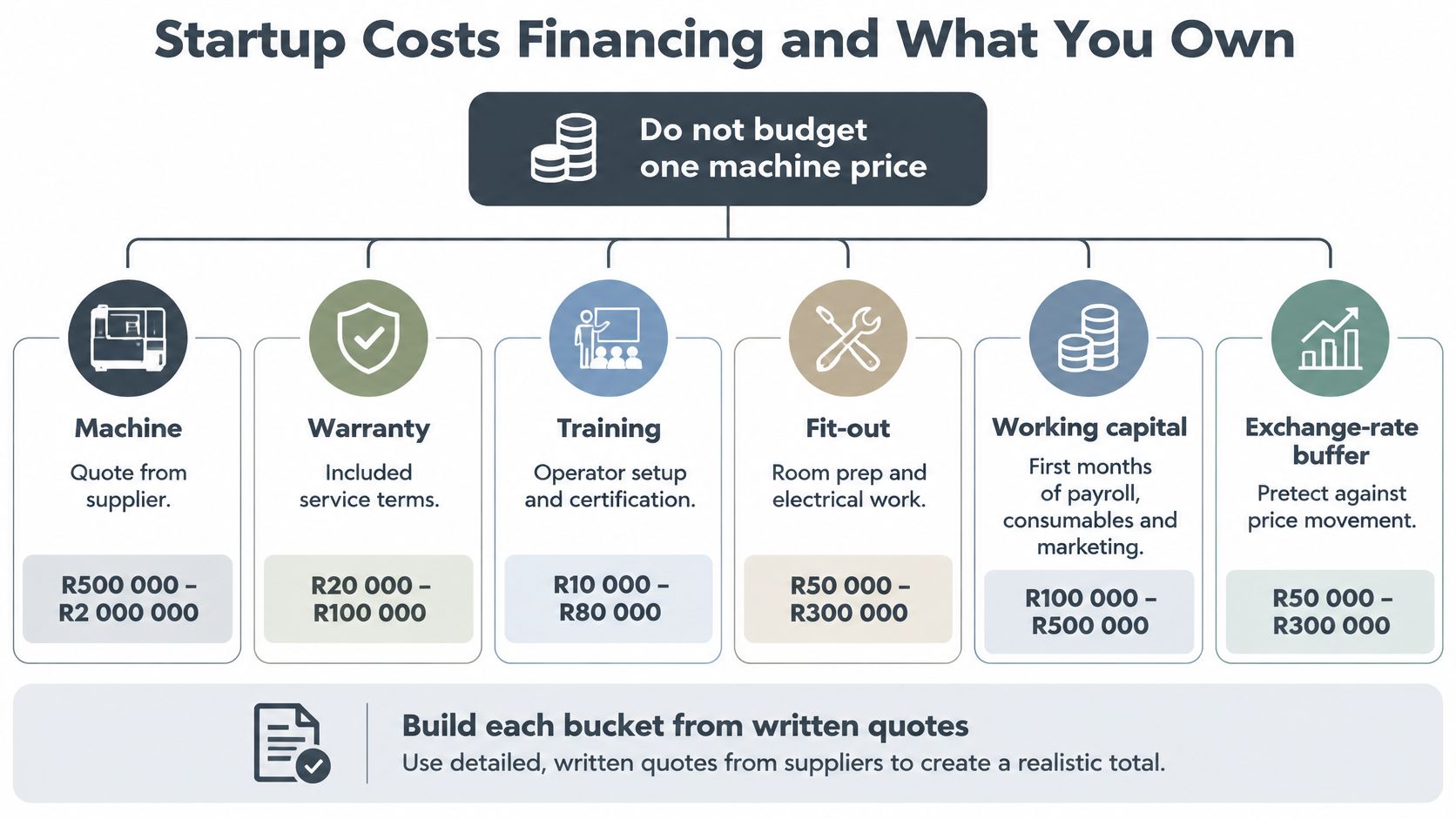
Do not budget a single machine price. Specification, warranty and the exchange rate move the number, so each bucket below has to come from a written quote. This guide does not publish a national equipment price. A figure without a supplier quote would be a guess.
Build these buckets before you compare offers. The device covers cash or instalment price, delivery and warranty. Room fit-out covers the couch, power, cooling and privacy. Municipal and professional fees are whatever your municipality and the relevant profession charge. Training and cover is course time plus wages while people are off the floor. Opening consumables, insurance, the first 90 days of marketing and the finance charge itself are separate lines. Laser hair removal often uses fewer consumables per visit than facial platforms that use tips or serums. Body treatments may need more floor space and power. Put those differences in the quote, not in a made-up average.
Read the repayment beside the cash price
Ask for total cost of ownership in writing: cash or instalment price, delivery, training days, the service plan, consumables per treatment, and who carries downtime. A low cash price and a monthly repayment are not the same thing. Use the financing options note next to the total cost of ownership worksheet so those two figures stay in separate columns. A cheaper machine with weak cooling, slow support or poor uptime can cost more per sold hour than a clearer package.
Card takings, deposits and package balances need a till that can split a course payment from a retail sale. Sambapay's guide to salon POS systems is a useful check on how a salon point of sale records those splits before the first device client pays.
| Cost bucket | What to quote | Figure in rand |
|---|---|---|
| Device | Cash or instalment price, delivery and warranty | Written quote required |
| Room fit-out | Couch, power, cooling and privacy screen | Written quote required |
| Municipal and professional fees | Licence and permit costs for your municipality | Written quote required |
| Training and cover | Operator training days plus cover while staff are off the floor | Written quote required |
| Opening consumables | Tips, serums, gels or disposables for the first booked month | Supplier quote required |
| Insurance | Premises and professional cover | Insurer quote required |
| Finance charge | Total repayments over the term | Lender's schedule |
Three quotes to collect this week
Collect a device-plus-training quote, a premises-work quote, and a 12-month running-cost estimate that includes consumables, power, insurance, service and the repayment. If a supplier will not put training days and downtime responsibility in writing, that offer is not ready to compare.
Premises Rules Licences and Operator Training
Which approvals and training records will let you open with confidence and sell a treatment clients can complete? In a price-sensitive South African market, revenue per treatment hour and course completion matter more than a high single-ticket price. Documented laser compliance belongs in that offer from the start.
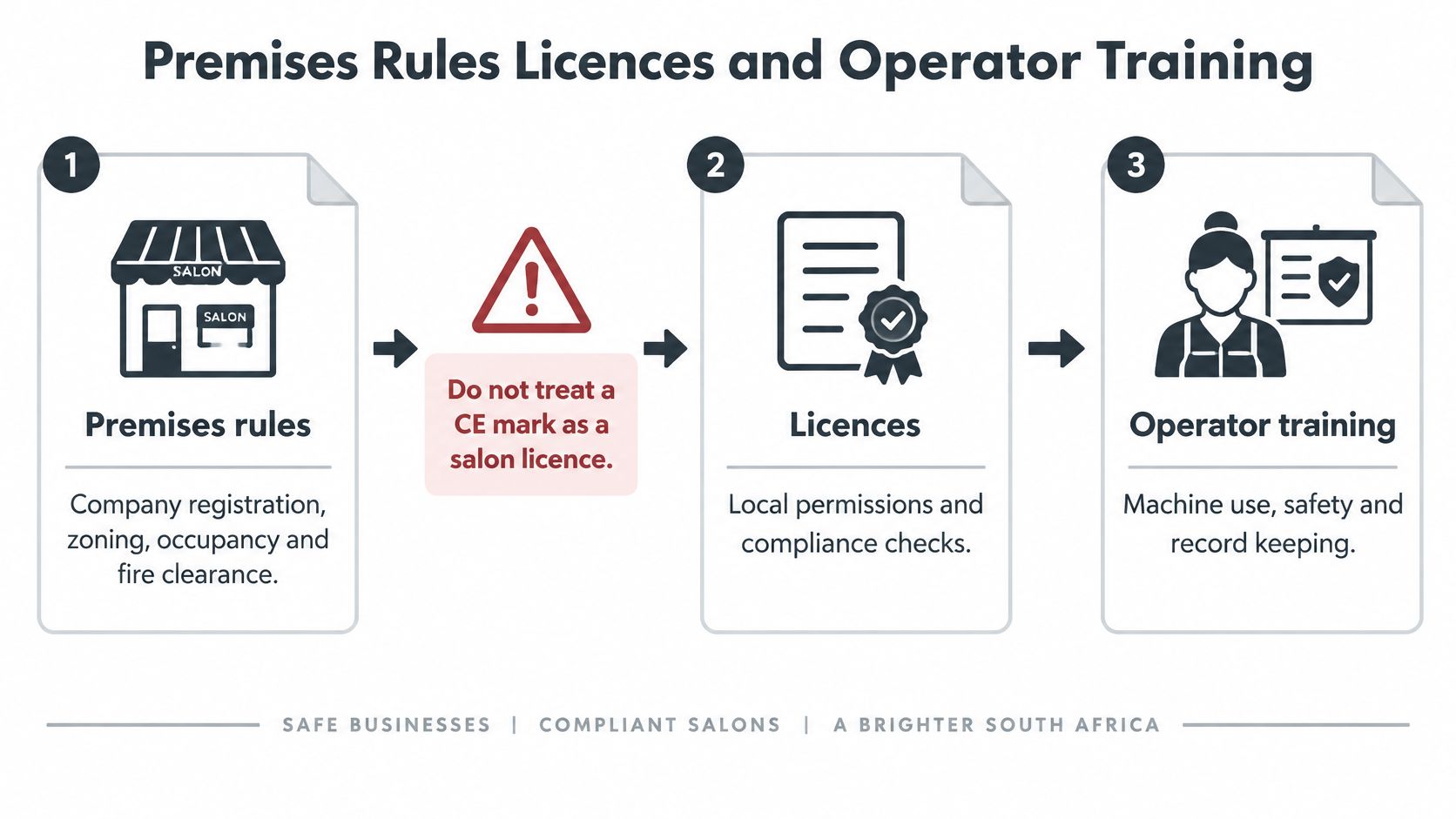
Start with the premises file. Requirements vary by municipality and may include company registration, zoning approval, an occupancy certificate, fire clearance and health permits. The 2025 Business Licensing Bill proposed a national licensing framework to replace the Businesses Act. Check current municipal rules before fitting out your room, and treat the Bill as a proposal until the relevant requirements apply.
Reporting in 2025 described proposals to place somatology, including laser and light treatments, microneedling and chemical peels, under Allied Health Professions Council oversight. The reporting did not make those proposals current rules. Patient-safety concerns and the potential burden of health-profession duties on small businesses were part of the debate. Build your commercial offer around documented protocols, qualified operators and clear referral rules, so clients can see how you manage their care while you confirm the rules that apply.
Device licences are a second file
The Hazardous Substances Act 15 of 1973 and the Schedule for Listed Electronic Products Regulations R1302 of 1991 cover certain listed electronic products. SAHPRA Radiation Control states that using Class 3B and Class 4 lasers requires a licence. Importers of listed products also need an import licence and must meet its conditions. Before installation, confirm the device classification, supplier documents, import status and use-licence requirements with SAHPRA. Keep the written reply on file, rather than relying on a supplier's FDA, CE or SAHPRA-related claim.
The SAHPRA medical devices page identifies manufacturer, distributor and wholesaler establishment licences, and states that medical devices may not be manufactured, distributed, imported, exported or sold without a valid establishment licence. Ask who imported the equipment and who services it. An add-on room can make use of compliant equipment in premises you already operate. A dedicated clinic needs records covering its premises, staff, protocols, maintenance and licensing correspondence. Use these laser safety and compliance notes to organise the questions before advertising.
Training is the third file
Training protects clients and supports consistent service. Include it in the cost of ownership alongside consumables, servicing, insurance and downtime. The discussion of laser hair removal compared with electrolysis reports that South Africa has no mandatory professional board or prescribed training hours specifically for laser hair removal. It also describes supplier instruction lasting two to four days and cites 100 hours as a minimum linked to SAAHSP-accredited training. Confirm current requirements with the relevant bodies before setting your policy. Use the regulatory compliance checklist and laser hair removal training outline to organise your questions, then rely on the relevant authority's written guidance.
Require documented competence in consultation, contraindication screening, skin assessment, eye protection, patch testing, adverse-event response, treatment records, device maintenance and referral to an appropriate healthcare professional. Set treatment parameters using the trainer's guidance, the device manual and each client's skin assessment. Never copy settings from a group chat.
File the written licence reply before publishing your first advert. A polished booking page cannot fix an unlicensed room.
File the written licence reply before the first advert. A polished page cannot repair an unlicensed room.
An Illustrative Payback with Stated Assumptions
Can a treatment course earn enough per hour to justify the cost of adding a service? Start with a transparent illustration, then replace every assumption with your own local figures. Assume 10 clients a week, two areas per visit, an average of R700 per area, and four weeks. Gross treatment revenue is 10 × 4 × 2 × R700, or R56,000 a month. That is an illustration, not profit or a promise of what a salon will bill.
Subtract therapist pay for the treatment hours, consumables, card fees, electricity, a fair share of rent, insurance and the finance repayment. The balance is monthly contribution. Divide the combined cost of the device, room, training and opening stock by that contribution to estimate payback in months. A half-empty diary stretches payback, even when treatments take little time. Use the cost-benefit worksheet to enter your own costs and revenue assumptions. Do not borrow a break-even month from another suburb.
| Line | What it assumes | Figure |
|---|---|---|
| Clients per week | Illustration only | 10 |
| Areas per visit | Illustration only | 2 |
| Average price per area | Illustrative assumption; verify against local price lists | R700 |
| Weeks counted | Illustration only | 4 |
| Gross monthly treatment revenue | 10 clients × 4 weeks × 2 areas × R700, illustration only | R56,000 |
| Monthly contribution | Gross minus wages, consumables, fees, power, rent share, insurance and repayment | Owner's quote |
| Payback months | (Device + fit-out + training + opening stock) ÷ monthly contribution | Set by the owner's quotes |
Two price architectures
Affordability shapes what clients will book and complete. ITWeb's review of 2025 consumer services trends reports that South Africa's beauty and personal-care market grew strongly in 2025 despite inflation and high unemployment, while affordability remained the primary consumer driver. The same review estimates the local hair-care market at roughly R9.1 billion in 2025, with a projection to R13.9 billion by 2034. Market demand does not guarantee a sale if the offer exceeds a household's budget.
A high single-session fee may look premium, but it cannot carry the business if clients do not return. A lower per-session price for a course of six to eight, with the full course cost visible up front and an instalment or membership option, may better suit a price-sensitive suburb when consumable costs are low and rebooking is consistent. The commercial test is revenue per treatment hour and whether clients can finish the course. A longer RF or body plan may earn more per hour when demand is there and the room cannot serve many clients in a day.
Calculate break-even at treatment level before adding the service. Include consumables, staff time, electricity, financing, downtime and the rebooking rate. No success rate or percentage lift is assumed here. If the contribution after those costs cannot cover the repayment with a diary you can staff, a high menu price will not fix the business case.
Marketing Packages and Client Retention
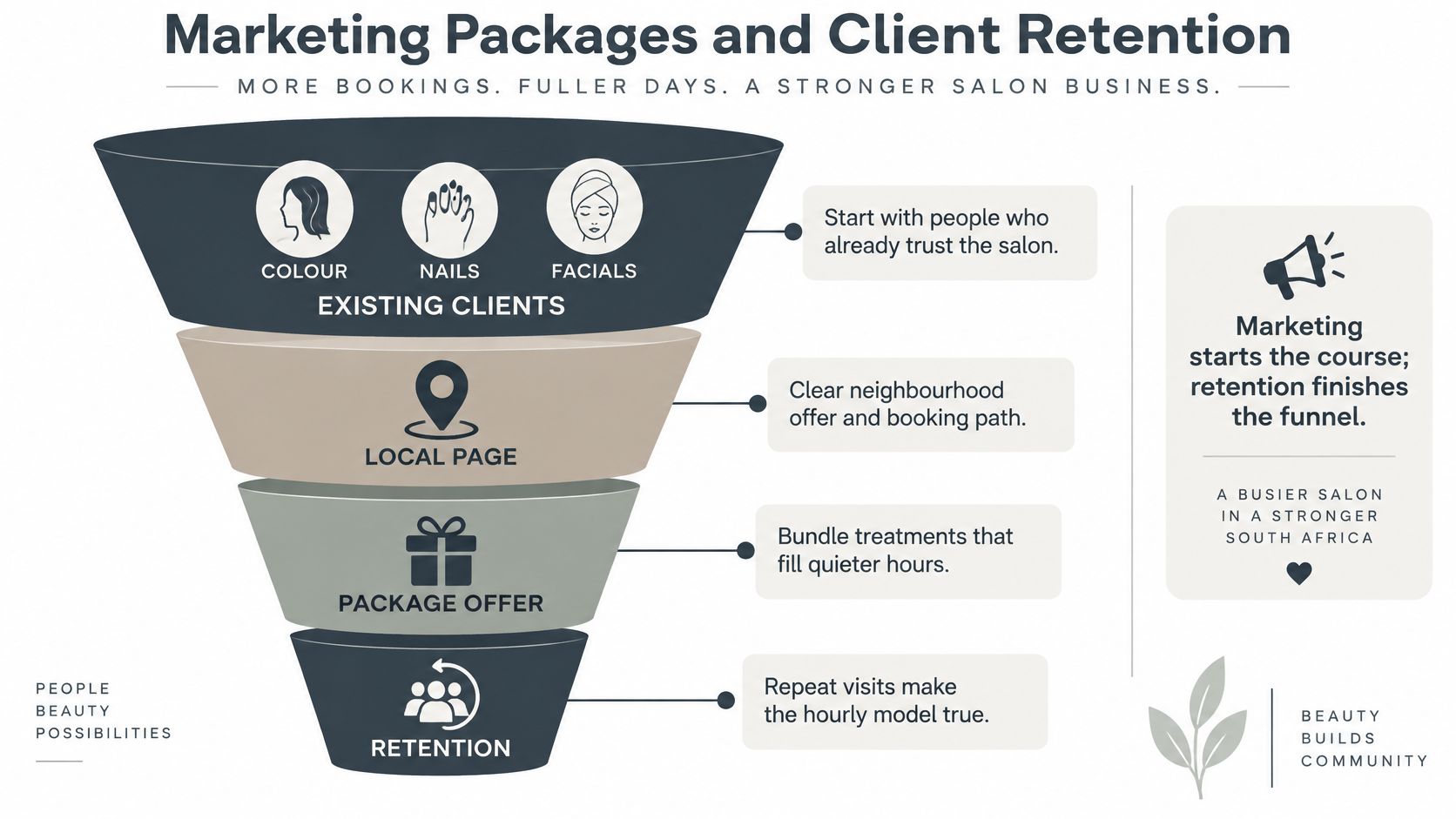
Marketing starts the course. Retention is what makes the hourly model true. Begin with people who already trust the salon: colour, nail and facial clients. Then publish one clear local page and a booking path for a consult or a patch test. Do not advertise unlimited sessions, pain-free guarantees or medical claims the team cannot support. Say what a course is, describe in plain language how a session generally feels, and say who should be referred elsewhere.
A consult that sells a plan
Use skin analysis as the consult that turns a browser into a written plan, including homecare. The scan is not the profit centre. Match price-sensitive demand with a visible course price plus instalments or a membership. A hidden discount trains clients to wait. Neighbourhood med-spa operators often separate the offer, the proof and the follow-up. The actionable med spa marketing strategies from Silver Spoon Agency are a useful outside checklist for that split, adapted to what a South African salon can claim.
After the first visit, book the next one before the client leaves. A missed rebooking is an empty hour later, and that empty hour damages device payback faster than a quiet week of new ads. The client retention practices worth copying are the ones tied to a dated next appointment, not a vague invitation to come back sometime.
Five numbers each month
- Rebooking rate: Share of clients who leave with the next session dated.
- Cancellations and no-shows: Hours you paid for and did not sell.
- Average transaction: Course payment, not only the first visit.
- Homecare attach: Products or add-on care sold from the written plan.
- Revenue per therapist: The hour, not the menu.
Keep consent, treatment notes and a photo policy that asks permission. Ask for a review after a completed course, not after session one, so the public story matches the timeline. Offer no invented client stories. For the first 90 days the message should be specific: one hero service, one course length, one consult path, and a diary target the team can staff. Partners also receive a library of poster artwork, digital banners and social visuals, plus on-demand printing, which saves design time. Those assets still have to match the claims your protocols can support.
Launch Checklist Before You Enquire
Tick the sequence. Do not skip to the machine.
- Choose the model from demand you can evidence. Add-on room or dedicated clinic, based on clients who would book a course, not on a brochure.
- Pick the first service by revenue per treatment hour. Laser hair removal is often the first candidate because courses refill the diary.
- Collect written quotes. Device, training, service plan and a 12-month running cost, each in rand from the party who will invoice you.
- Confirm premises rules and the laser use-licence position. Municipal requirements and the SAHPRA Radiation Control reply go in the file before any advert.
- Book operator training and write the clinical rules. Contraindications, consent and referral, on paper, before the first post.
- Set course prices and finish the payback sheet with this salon's own assumptions, not the illustration of R56,000 gross.
- Prepare records and a 90-day offer aimed at existing clients, with the next visit booked in the room.
- Advertise only after those files exist.
A website go-live still needs the same discipline as a treatment room. The Operosus website launch checklist is a practical pass over pages, bookings and tracking so the local offer is live only when the room behind it is ready.
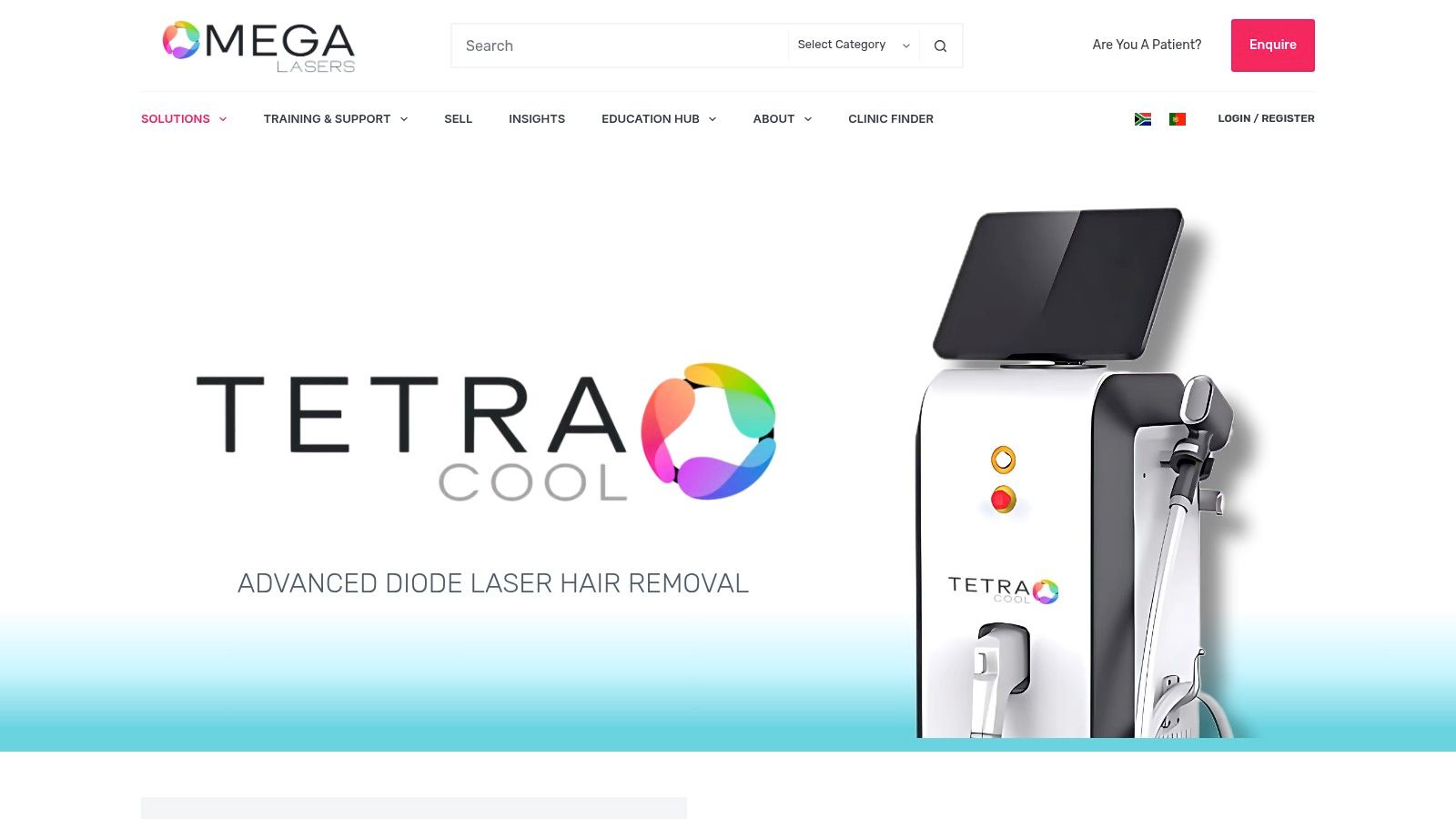
Tetra Cool, the diode laser hair-removal machine, is a commercial device for trained clinics, salons and aesthetic businesses, and it is not for at-home use. Each package includes the machine, an advanced hair-removal handpiece with sapphire contact cooling, four-wavelength diode laser technology, on-site or online clinical training, treatment guidance for different skin types and treatment areas, technical support, after-sales guidance and business support. Confirm in writing exactly which of those items, and which training days, sit in your quote. Do not treat marketing summaries as the contract, and do not expect energy settings or client outcomes from a sales page. Clinics can schedule a free virtual demonstration. The enquiry form is the place to ask whether the room, the licence file and the diary assumptions fit.
Omega Lasers supplies professional laser and multi-technology platforms to salons and aesthetic businesses, with training, technical support and business guidance around the device rather than a machine left at the door. If the hourly model, the course price and the compliance file are the decision in front of you, take the quotes and the licence questions to Omega Lasers and test them against your own diary before you commit.