



The most popular advice about pico laser is also the least useful for a clinic buyer: shorter pulses must mean better treatments. Picosecond isn't an automatic upgrade. A platform earns its place when its wavelengths, delivery options and support match the clinic's patients, and when the clinic can operate it safely and profitably.
For South African practices, the purchase decision starts with diagnosis, darker-skin protocols, Radiation Control licensing and operator competence. The specification sheet matters, but it can't replace clinical governance or a credible business case.
Table of Contents
- What a Pico Laser Is and How Its Pulses Work
- Pico Versus Q-Switched Nd:YAG for Pigment Work
- Skin Concerns Pico Lasers Treat and Realistic Outcomes
- Wavelengths, Device Features and Licensing to Verify
- Patient Selection, Protocol and Darker-Skin Safety
- Tattoo Removal in Brief
- Build Your Business Case Before You Enquire
What a Pico Laser Is and How Its Pulses Work
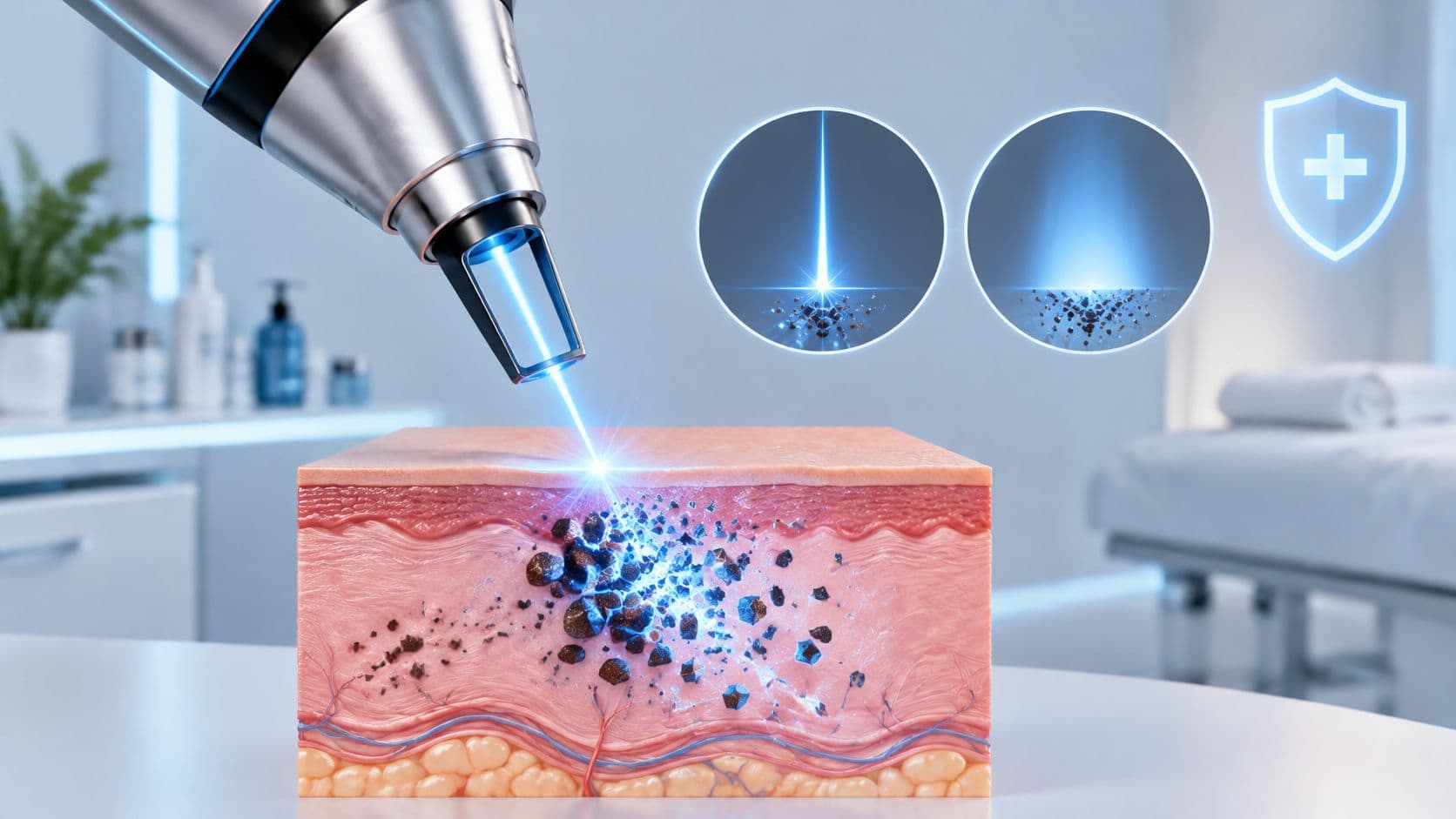
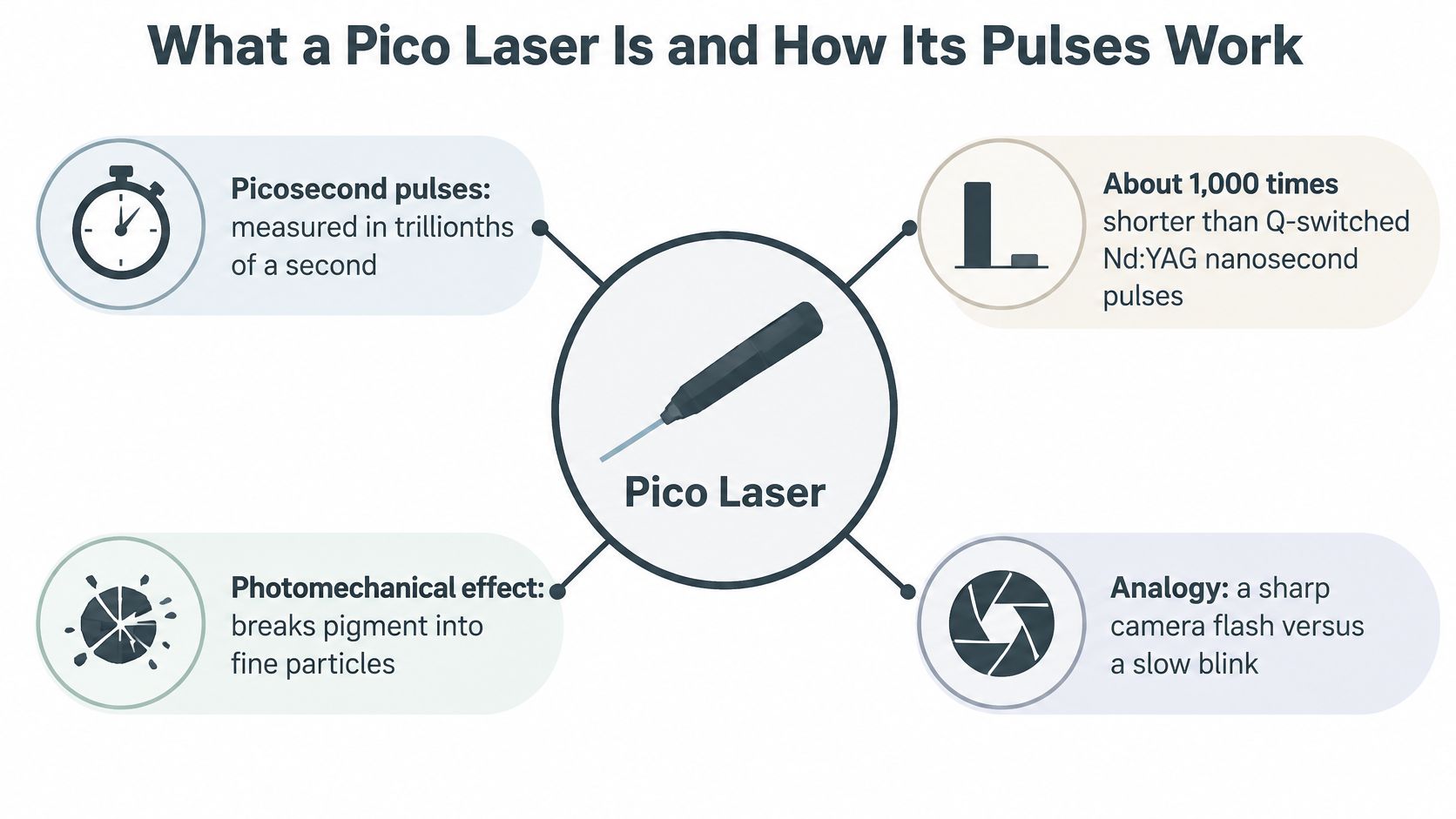
A pico laser delivers pulses measured in trillionths of a second, favouring rapid mechanical disruption of selected pigment targets. The useful distinction is how quickly energy arrives, not merely how much energy the machine produces.
Think of pressing a stamp slowly onto paper compared with giving it a sharp tap. The slower press allows more time for energy to spread; the tap concentrates the interaction into a brief event. It's an analogy rather than a literal description of skin, but it helps explain why pulse timing changes tissue response.
Heat and mechanical stress
Photothermal action heats an absorbing target and can warm surrounding tissue. Photomechanical action, also called photoacoustic action, creates rapid pressure changes and mechanical stress within the target. Pigment fragments can then be processed by the body over the following weeks.
Both effects can occur with pigment lasers. Picosecond delivery favours mechanical fragmentation while limiting the time available for heat to spread. It doesn't eliminate heat, inflammation or the possibility of injury.
Nanosecond Q-switched pulses commonly run around 5–10 ns, while picosecond pulses run in the hundreds of picoseconds. One nanosecond equals 1,000 picoseconds. That unit conversion doesn't mean every commercial pico platform delivers pulses exactly a thousand times shorter than every Q-switched device. Buyers need the actual pulse duration for each wavelength and operating mode.
Why timing matters for skin work
For pigmentation, the aim is a useful interaction with the pigment without unnecessary injury to surrounding skin. For fractional texture work, specialised optics distribute energy into microscopic treatment zones rather than treating the whole surface uniformly.
Several controls determine whether that interaction is appropriate:
- Wavelength determines which targets absorb the light and how strongly epidermal melanin competes for it.
- Spot size and delivery optics influence treatment distribution and the intended tissue interaction.
- Cooling and technique help manage comfort, overlap and unwanted heating.
- Pulse characteristics must remain suitable for the selected indication, not merely impressive on a brochure.
Buying principle: Picosecond describes pulse timing. It doesn't establish treatment suitability, operator competence or clinical superiority.
A shorter pulse can be useful without making the laser stronger in every meaningful sense. The practical question is whether that timing offers an advantage for the clinic's intended treatment menu.
Pico Versus Q-Switched Nd:YAG for Pigment Work
A clinic whose books fill with melasma and sun-damage cases faces a different purchase decision than one building a mixed pigment, toning and texture menu. Both platforms can support pigment work. The diagnosis and proposed protocol should decide which one earns the capital.
Picosecond versus Q-switched Nd:YAG at a glance
| Criterion | Picosecond | Q-switched Nd:YAG |
|---|---|---|
| Main action | Mechanical-stress fragmentation with less time for heat spread | Combined thermal and mechanical effects, with more time for heat spread |
| Melasma result in split-face study | No significant within-side improvement at six months | Significant within-side reduction at six months, p = 0.022 (randomised split-face melasma trial) |
| Serious adverse events in split-face study | None reported | None reported |
| Service breadth | Pigment fragmentation, toning and fractional texture work where the optics are included | Pigment and toning protocols on an established platform |
| What the quote must cover | Confirmation that fractional optics and pigment handpieces are included rather than optional extras | Equivalent accessories, training and service obligations, priced before machine cost is compared |
| Default case | Broader pigment and texture menus | A melasma-led service, where this platform deserves serious consideration subject to clinical assessment |
The table describes typical platform categories, not guaranteed specifications. Every configuration needs supplier confirmation.
What the melasma comparison actually establishes
The South Africa-linked trial compared a 755 nm picosecond alexandrite laser with a diffractive lens array against a 1064 nm Q-switched Nd:YAG. It found no statistically significant difference between the two modalities in treatment response or patient satisfaction. The significant improvement on the Nd:YAG side does not, by itself, prove that Nd:YAG outperformed pico.
That distinction matters commercially. The finding rules out an automatic pico superiority claim. It says nothing about picosecond treatment being ineffective, and the two arms differed in wavelength and delivery system, so pulse duration was never the only variable.
For a clinic whose demand is mainly melasma, an established Q-switched option deserves serious consideration before a purchase. Neither device replaces sun protection, topical management or medical assessment of persistent pigmentation. For broader pigment and texture work, picosecond equipment can offer useful delivery options, particularly where fractional optics are genuinely included. A standard pigment handpiece does not provide a fractional rejuvenation service on its own.
The Nd:YAG platform overview explains the underlying laser family, and the Q-switched laser guide supports a focused equipment comparison. Buy the platform your treatment menu justifies, priced on equivalent accessories, training and service obligations rather than machine cost alone.
Skin Concerns Pico Lasers Treat and Realistic Outcomes
A pico laser treatment menu should describe diagnosed concerns and treatment approaches, not promise general skin clearing. A brown spot, patchy melasma and an indented acne scar require different decisions even when the same console can address selected cases.
Pigment clearance and a more even appearance
Solar lentigines, or sun spots, suit targeted treatment once a clinician has confirmed the lesion is benign. A changing, irregular or uncertain lesion needs medical assessment rather than a cosmetic test pulse. A confirmed spot can respond well to targeted pulses, but a clinic shouldn't sell complete clearance as a guaranteed single-session result. Some lesions lighten fully, others fade to a degree that still satisfies the patient, and the honest conversation happens before the first pulse.
Melasma needs a management plan rather than a removal promise. Improvement can be followed by recurrence, and aggressive treatment can worsen pigmentation. The melasma treatment guide provides context for planning a service around ongoing control.
Diffuse pigmentation and dullness are the candidates for pico toning, where a broad-area, low-fluence protocol builds gradual change across repeat sessions. Dullness still isn't a diagnosis. Barrier damage, inflammation and uneven pigmentation shouldn't be bundled into the same treatment package without assessment, because each responds differently and one of them can be made worse by the wrong settings.
Fractional texture work and toning are separate services
Fine lines, uneven texture and selected acne scars are the territory of fractional pico delivery, where the optics concentrate energy into microscopic zones to support remodelling. Scar shape and depth still matter, and some scars need other approaches entirely.
Toning runs as a lower-disruption, repeated approach. Fractional treatment produces more visible recovery and its own consent conversation. Neither service substitutes for structural lifting or full ablative resurfacing, and the menu should say so.
- Diagnosis first: Use the pigmentation assessment pathway before assigning a package.
- PIH prevention: Treat post-inflammatory hyperpigmentation as a complication to avoid, not a routine laser sales category.
- Aftercare instructions: Pair device-specific recovery guidance with a patient-facing resource on aftercare for laser pigmentation treatment so patients leave with written steps rather than verbal reminders.
Results should be reviewed after healing, not judged from immediate redness or temporary darkening. The concern determines the protocol, recovery discussion and review criteria.
Wavelengths, Device Features and Licensing to Verify
Common pico wavelengths and their clinical fit
| Wavelength | Main targets | Skin-type consideration |
|---|---|---|
| 532 nm | Superficial pigment and selected redness indications where supported by the device | High melanin absorption requires greater care in darker skin |
| 755 nm | Melanin in selected lesions and pigment-toning applications | Often considered for lighter to intermediate skin, with careful test spots |
| 1064 nm | Deeper pigment and selected dermal targets | Lower epidermal melanin absorption often makes it a consideration for darker skin, still requiring assessment and test spots |
Wavelength follows diagnosis and skin type. More wavelengths create more options, but they also require more operator knowledge, separate protocols and correctly matched protective equipment. A wavelength label alone doesn't establish that a particular indication is supported.
Check the equipment and the paperwork
A practical equipment assessment should include:
- Pulse verification: Obtain documented pulse-duration options for each wavelength and mode.
- Treatment delivery: Confirm spot-size range, beam characteristics and the actual handpieces supplied for toning and fractional work.
- Cooling: Establish the cooling method, whether it operates during treatment and who services it.
- Maintenance: Request service schedules, calibration arrangements and records for demonstration or pre-owned equipment.
- Support terms: Put training scope, technical support, warranty exclusions and replacement-part arrangements into the purchase agreement.
SAHPRA's medical-device guidance sets out establishment licensing for manufacturing, importing, distributing and selling medical devices, alongside Radiation Control requirements for listed electronic products. Supplier authorisation and the clinic's permission to use equipment are separate checks.
The SAHPRA laser safe-use requirements require use licensing for Class 3B and Class 4 lasers, model-specific licensing for different imported models, and an appointed laser safety officer. That role includes determining personnel medical-surveillance requirements.
South Africa's framework isn't new: the South African laser-regulation review traces regulatory control to 14 April 1989, with relevant Group III declarations effective from 1 July 1991.
Before installation, the clinic should obtain supplier licensing details, device classification, import documentation and written clarification of who supports the use-licence application. It should also establish controlled-room access, wavelength-specific eyewear, warning labels, maintenance records and incident-reporting procedures.
FDA or CE status doesn't replace South African verification. The clinic's safety and compliance checklist should form part of procurement, not an administrative clean-up after delivery. Training and warranty promises need written confirmation for the exact model being purchased.
Patient Selection, Protocol and Darker-Skin Safety
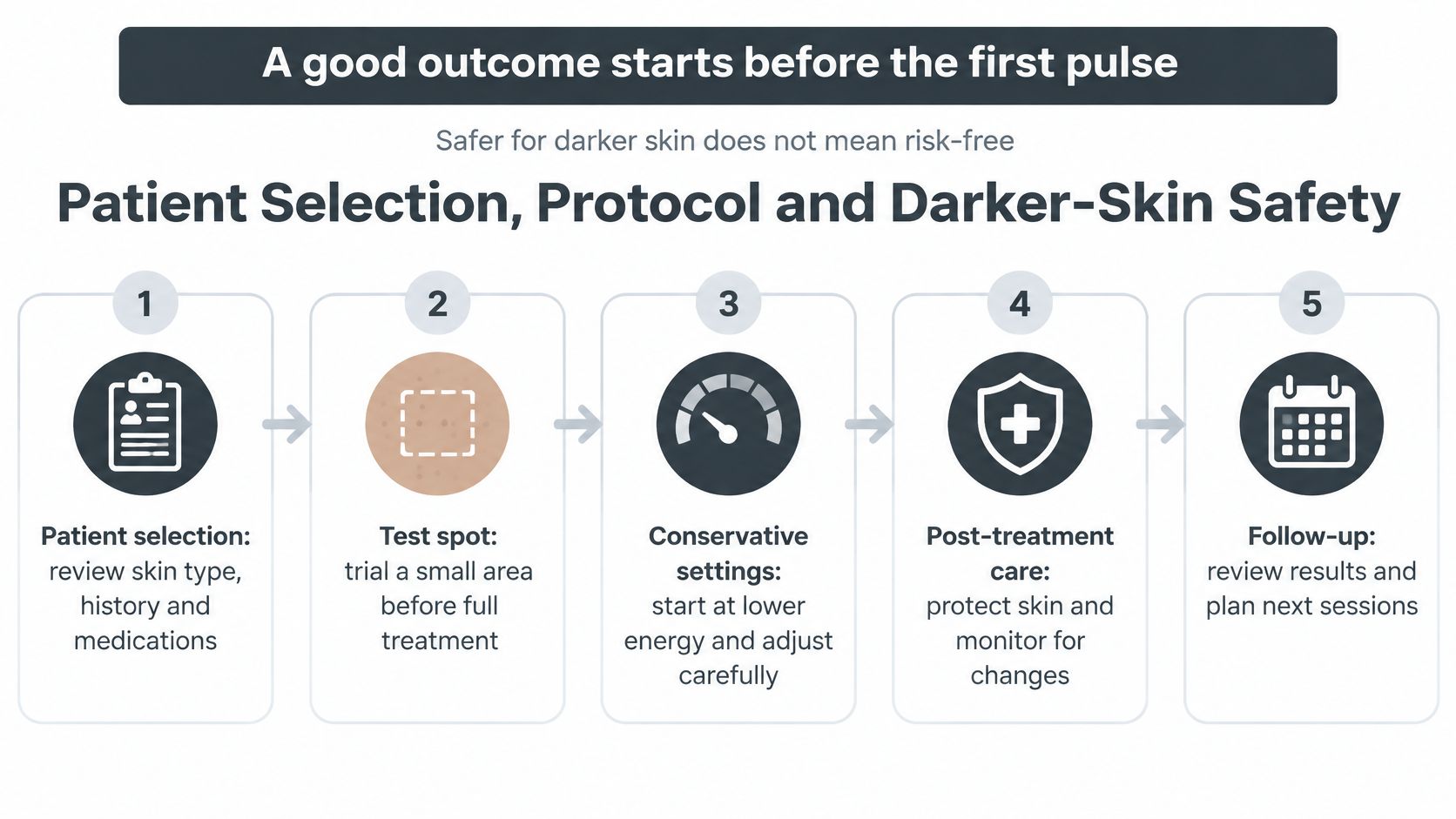
A good outcome starts before the first pulse. Safer for darker skin doesn't mean risk-free, and an uneventful previous treatment doesn't establish that the next procedure is appropriate.
A 2024 systematic review of picosecond treatment in skin of colour found limited evidence and insufficient strong efficacy data across treatment types, and reported PIH following repeated laser procedures in approximately 11%–17% of cases, particularly in darker skin. That isn't a universal complication rate for every pico platform or protocol, but it rules out blanket safety claims.
A protocol with a reason for every step
Classify the concern and skin response. Distinguish melasma, post-inflammatory pigment and lentigines before selecting a protocol. Record baseline colour, previous pigment changes and reactions to earlier procedures, not just a skin-type category.
Screen for recent sun exposure or tanning, active infection, herpes history, pregnancy, photosensitising medicines and recent isotretinoin use. Screening isn't an automatic exclusion list: the responsible clinician must determine whether treatment should proceed, be modified or be deferred.
Select the wavelength and handpiece for the diagnosis. Use the manufacturer's indication-specific guidance within the clinic's clinical-governance framework. An additional pass isn't a substitute for correct target selection.
Perform a test spot where indicated and review it after an appropriate observation interval. An immediate reaction can't rule out delayed pigment change. The review must consider both healing and the patient's capacity to follow aftercare.
Protect everyone in the room and document treatment. Eyewear must match the active wavelength and required protection level. Record the device, handpiece, settings, treated area, endpoint, cooling and any unexpected reaction.
Provide written sun-protection and gentle-skincare instructions before booking further treatment. Skin recovery, rather than a prepaid package deadline, should govern the next appointment. Active products should restart only under the clinic's instructions.
Review using standardised photographs. Keep lighting, position and camera conditions consistent. Assess pigment, inflammation, texture and patient-reported recovery before deciding whether continued treatment remains justified.
Common pico side effects, timing and response
| Side effect | When it appears | Response |
|---|---|---|
| Redness and swelling | Hours to a few days | Cool compresses, gentle skincare and sun protection |
| Crusting or micro-blistering | Days after treatment | Keep clean, avoid picking and follow written aftercare; review blistering |
| Post-inflammatory hyperpigmentation | Weeks to months, with greater concern in darker skin | Pause treatment, arrange assessment, review topical care and reinforce sun protection |
| Blistering or burns | During or soon after treatment | Stop, assess, document and arrange medical review |
| Melasma recurrence | Months to years | Reassess triggers and the maintenance plan |
| Ocular exposure | During treatment | Stop immediately, arrange urgent medical assessment and record the incident |
These timing descriptions are monitoring guides, not permission to dismiss symptoms. Spreading blisters, disproportionate pain, darkening beyond expected healing and signs of infection require medical review. Suspected ocular exposure needs urgent assessment even when discomfort seems minor.
Defer treatment when inflammation, diagnostic uncertainty or sun exposure is uncontrolled. Consent should name hyperpigmentation, hypopigmentation, incomplete response and recurrence, with a clear route for reporting concerns.
A booked course isn't an instruction to continue through worsening pigment.
Training must establish competence
A Cape Peninsula University of Technology study of South African laser and IPL training described informal, non-accredited supplier courses lasting 2–4 days. Its operator-training findings weren't a pico efficacy trial, but they identify a practical governance problem.
Manufacturer instruction should be paired with supervised practice, documented competence, continuing workshops and incident review. Each course also needs a recorded review point and stop rule: worsening pigmentation, persistent inflammation or failure to achieve meaningful benefit should trigger reassessment, not automatic escalation.
Tattoo Removal in Brief
Say a clinic already offers pigment consultations and receives a request to remove a dense, multicoloured tattoo. The familiar console doesn't make this the same service. Ink colour, density, depth, tattoo age, skin type and scarring history change the assessment and treatment plan.
Pico lasers can fragment selected inks for gradual clearance, but Q-switched and other appropriate platforms remain options. A single visit rarely clears a tattoo, and a clinician shouldn't invent a fixed session count before assessment. Consent needs to address incomplete clearance, residual colour, pigment changes and the possibility that existing scarring will remain visible.
Scheduling rule: Tattoo removal needs its own pricing, consent and diary allocation.
The clinical guide to pico laser tattoo removal covers treatment selection, while the picosecond tattoo-removal process and aftercare guide explains the patient pathway.
Spaced appointments and gradual change affect rebooking and cash flow differently from facial rejuvenation. Tattoo removal should therefore remain a separate offering rather than being folded into pigmentation packages with different recovery expectations and course structures.
Build Your Business Case Before You Enquire
Ten paid sessions a week at R3,000 each produce R30,000 in weekly turnover. Multiply that by 46 operating weeks and gross annual revenue is R1,380,000. That figure is the ceiling for the model below; a payback projection that multiplies weekly revenue by operating weeks and then applies a monthly factor on top has counted the same time twice, and its arithmetic will never reconcile with the appointment diary.
For a local pricing benchmark, Procompare's South African aesthetic-treatment guide lists laser skin resurfacing at R1,300–R10,000 per session, averaging R5,000, and laser tattoo removal at an average of R1,900 per session. Those categories are not pico-specific tariffs, so they give context on what local patients already pay rather than a recommended price list.

Illustrative pico payback model in Rand
The figures below are a worked example built on stated assumptions, with the device cost standing in for a supplier quote. The contribution assumption covers consumables, operator time, allocated room costs, maintenance and marketing.
| Line | Value | Basis |
|---|---|---|
| Paid sessions per week | 10 | Assumed completed, paid sessions |
| Average price per session | R3,000 | Assumed; below the resurfacing benchmark |
| Operating weeks per year | 46 | Assumed allowance for leave and closures |
| Gross annual revenue | R1,380,000 | 10 × R3,000 × 46, before VAT |
| Contribution margin | 45% | Assumed after the operating costs identified above |
| Annual contribution | R621,000 | R1,380,000 × 45% |
| Hypothetical device cost | R900,000 | Illustrative only; replace with a supplier quote |
| Simple payback | About 17 months | R900,000 ÷ R621,000 × 12 |
| Sensitivity with 10% fewer paid sessions | About 19 months | Annual contribution falls to R558,900, adding roughly two months |
Replace assumptions before approving the purchase
The model measures contribution payback only. Finance charges, tax effects, ramp-up, unexpected downtime, cancellations and incomplete courses all sit outside it, so the paid-session line must reflect completed appointments rather than enquiries or package bookings.
Published equipment listings span a wide range of specifications, regulatory status and support terms, and a headline price proves nothing about equivalence. A placeholder must never harden into a market-price claim; the only defensible capital figure is a written quote for the specific platform. Budget around it for installation, SAHPRA licensing work, protective eyewear, training, maintenance and a realistic downtime provision.
A defensible cost-benefit analysis uses the clinic's own eligible patient demand, operator availability and contribution per completed appointment.
The next action is to request a model-specific quote and written training scope, accompanied by the licensing checklist. Warranty duration, covered components, service responsibilities and exclusions should be confirmed before any payback estimate supports a purchase decision.
Omega Lasers supplies pico lasers for clinics evaluating pigmentation and skin-rejuvenation services, alongside equipment training and technical support. Visit Omega Lasers to discuss a platform against the clinic's patient mix, compliance requirements and treatment economics, with the exact training, service and warranty terms recorded in the proposal.