



The most common advice about a laser licence in South Africa is also the least useful: “get a laser licence”. There isn't one generic licence that covers every salon, every device and every activity. A clinic needs to establish which permissions apply to its own laser and premises, while separately checking that the supplier is authorised to bring the device into the medical-device supply chain.
The practical test is not whether a machine is advertised for cosmetic treatments. It is whether the clinic has confirmed the device's classification and intended use, checked the applicable Radiation Control route, and put the right safety controls and records in place before treatment begins.
Table of Contents
- Which Laser Licence Your Clinic Needs
- Supplier Licence Checks Before You Buy
- How to Prepare a Class 3B or Class 4 Use Application
- Laser Safety Officer Room and Eyewear Rules
- Records Renewals and the Compliance File
- Go-Live Gate and Next Step
Which Laser Licence Your Clinic Needs
A salon doesn't obtain one catch-all laser licence. Clinic use authorisation and supplier licensing are separate obligations, and neither should be treated as a substitute for the other.
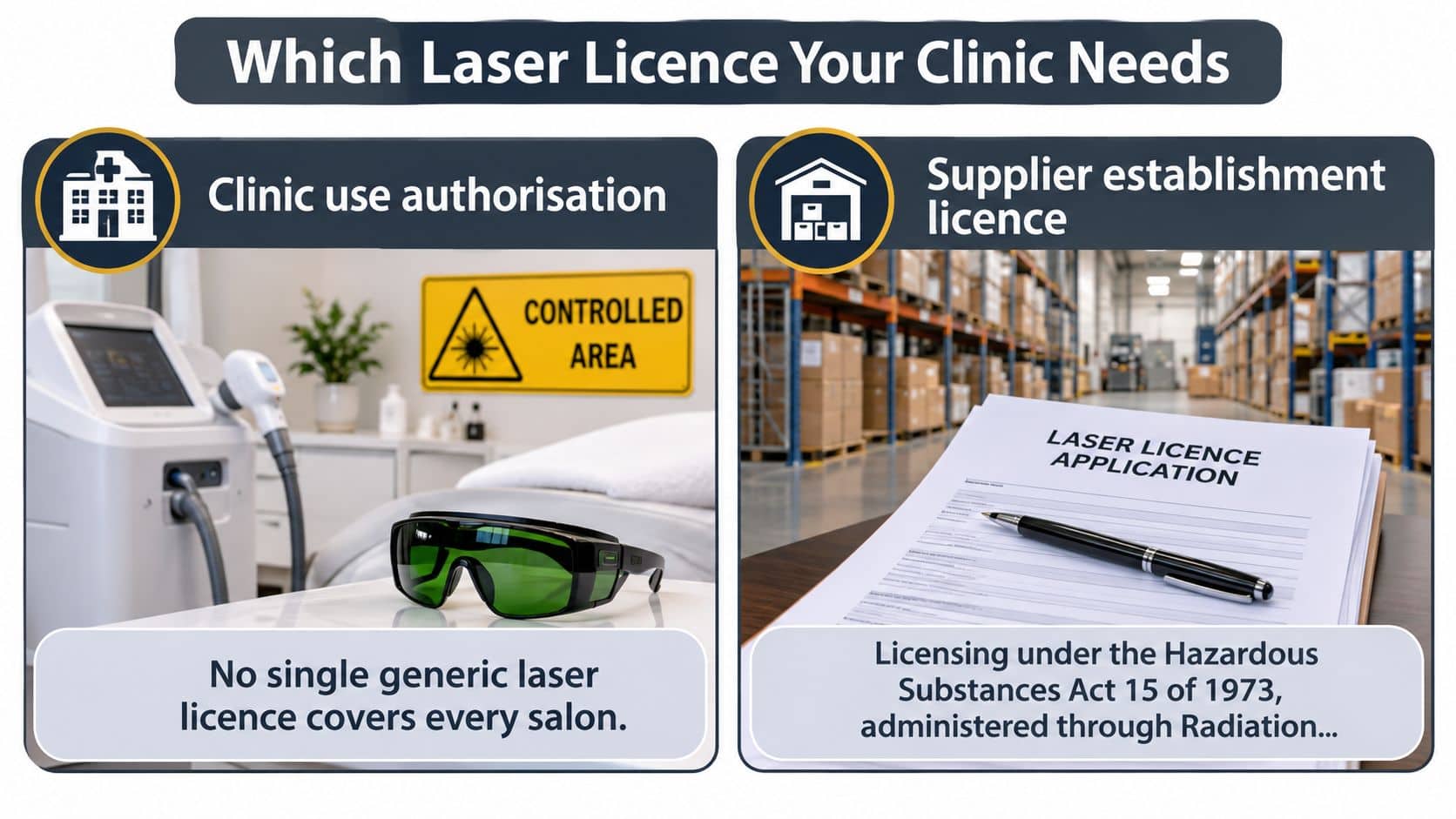
Under the Hazardous Substances Act 15 of 1973, licensing for laser use is administered through Radiation Control in the Department of Health. SAHPRA's Radiation Control materials distinguish between medical and non-medical laser applications, with separate forms for each category. They also identify Class 3B and Class 4 lasers as needing specific safe-use controls. Clinics should confirm the current application route and documents directly with Radiation Control because forms and administration can change. SAHPRA's Radiation Control forms provide the relevant category distinction, while its guidance identifies the safe-use framework for higher-risk systems.
The class on the device label and technical file matters more than the marketing description. The clinic should check the laser class, wavelength, maximum output and intended operation. FDA clearance or CE certification may support the technical file, but neither replaces a South African use licence. Similarly, a supplier's authority to import or distribute a machine does not establish that a clinic or premises operator is authorised to use it.
| Which South African laser obligation applies | Who acts | What it covers | What it does not replace |
|---|---|---|---|
| Class 3B or Class 4 laser used in the clinic | Premises operator or responsible applicant through Radiation Control | Use licence and safe-use controls under the Hazardous Substances Act | Supplier establishment licence, FDA clearance or CE marking |
| Medical versus non-medical laser use | Applicant selects the route matching the intended use | Separate Radiation Control application routes and forms | Assuming one form fits every treatment menu |
| IPL, which is not a laser | Clinic confirms requirements with Radiation Control before installation | A possible separate radiation-control requirement for the device | Treating IPL as automatically outside regulation because it isn't a laser |
| Import, manufacture, distribute or sell a device | The relevant SAHPRA-licensed establishment | Legal supply activities for a medical device | The clinic's authority to operate the laser on patients |
| Device registration status | Supplier and clinic check the applicable SAHPRA scope | Establishment licensing, while product registration is being introduced through a phased call-up | Assuming every aesthetic laser already has a universal registration number |
IPL isn't a laser, but that distinction alone doesn't settle whether Radiation Control requirements apply. The exact equipment and its characteristics should be checked before installation. SAHPRA's use-licence guideline for Class 3B and Class 4 lasers is a useful starting point for checking the framework, not a reason to assume a particular device is covered without confirmation.
For a start-up salon considering a diode platform, the first step is to get the technical file and identify the device class. The salon then needs to establish whether its intended treatments follow the medical or non-medical route, and identify the proposed applicant, such as the owner, importer, premises operator or responsible professional. Before paying a deposit, the clinic can also check product-status information through SAHPRA-registered product guidance, then confirm the current use-application requirements with Radiation Control.
Supplier Licence Checks Before You Buy
Before signing, ask the supplier for three documents: the current establishment licence, the listed device scope and the South African authorised representative's details. Those records show whether that business may legally supply the machine your clinic intends to buy.
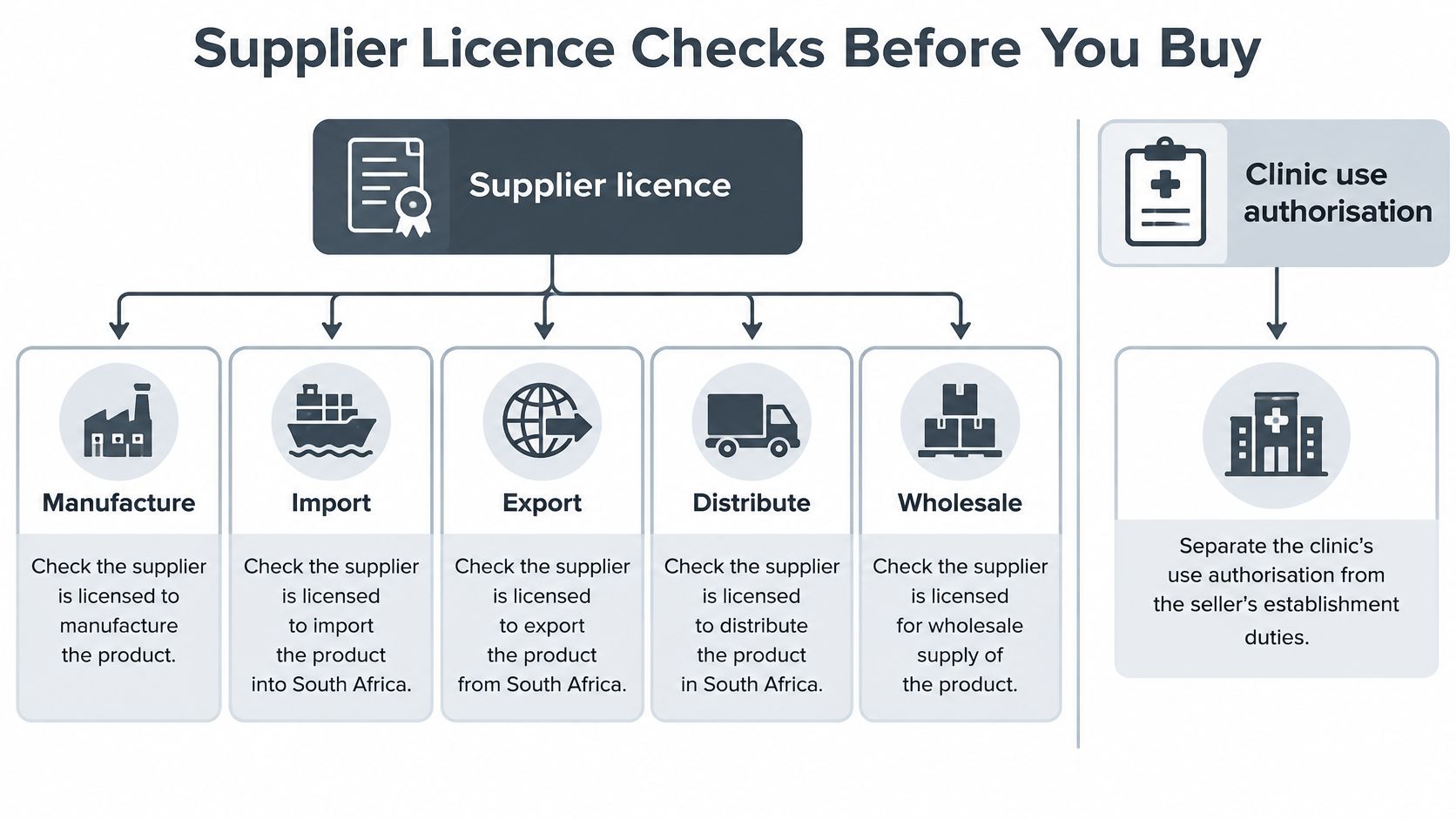
SAHPRA identifies three establishment-licence categories: manufacturer, distributor and wholesaler. A manufacturer licence covers manufacturing, packing, labelling, servicing, importing and exporting; a distributor licence covers importing, exporting and distributing; and a wholesaler licence covers storage, transportation and delivery. Its medical-device establishment requirements state that a medical device may not be manufactured, distributed, imported, exported or sold without a valid establishment licence, and that the applicant appoints a South African authorised representative who is a natural person.
Check the exact model, not a broad product family
Match the paperwork to the unit being quoted. The file should name the exact model, wavelength configuration, handpieces and legal manufacturer; once assigned, record the serial number on the invoice and installation record. A product-family certificate does not cover a specific model, its handpieces or its legal manufacturer.
For a diode platform purchase, I would ask four practical questions before a deposit: which licence category the supplier holds, whether that model sits inside the listed scope, who the local authorised representative is, and who handles complaints, incident reporting and recalls after installation. Keep the training and service documents with the clinic's equipment file, because they support later inspections and renewals.
A casually imported or grey-market unit becomes hard to defend when the establishment licence, device scope or authorised representative cannot be verified. Use Omega Lasers' SAHPRA-registered products information as a starting point for checking records and product scope, then confirm the current position with SAHPRA because forms, fees and licence numbers change.
At renewal, SAHPRA requires evidence of ISO 13485 certification from an accredited conformity-assessment body for manufacturer or distributor licences. SAHPRA's document library is the place to check current supply-side guidance; a brochure is not a licence. For organisations that also need to check the standing of individuals named in supplier records, digital credential verification options for 2026 can explain what a credential check may involve. That check does not replace verifying the establishment licence and listed device scope with SAHPRA.
How to Prepare a Class 3B or Class 4 Use Application
Start with the device label and technical file before you touch the form. The clinic should assemble its equipment and premises details, check the current Radiation Control route, and keep a copy of everything submitted.
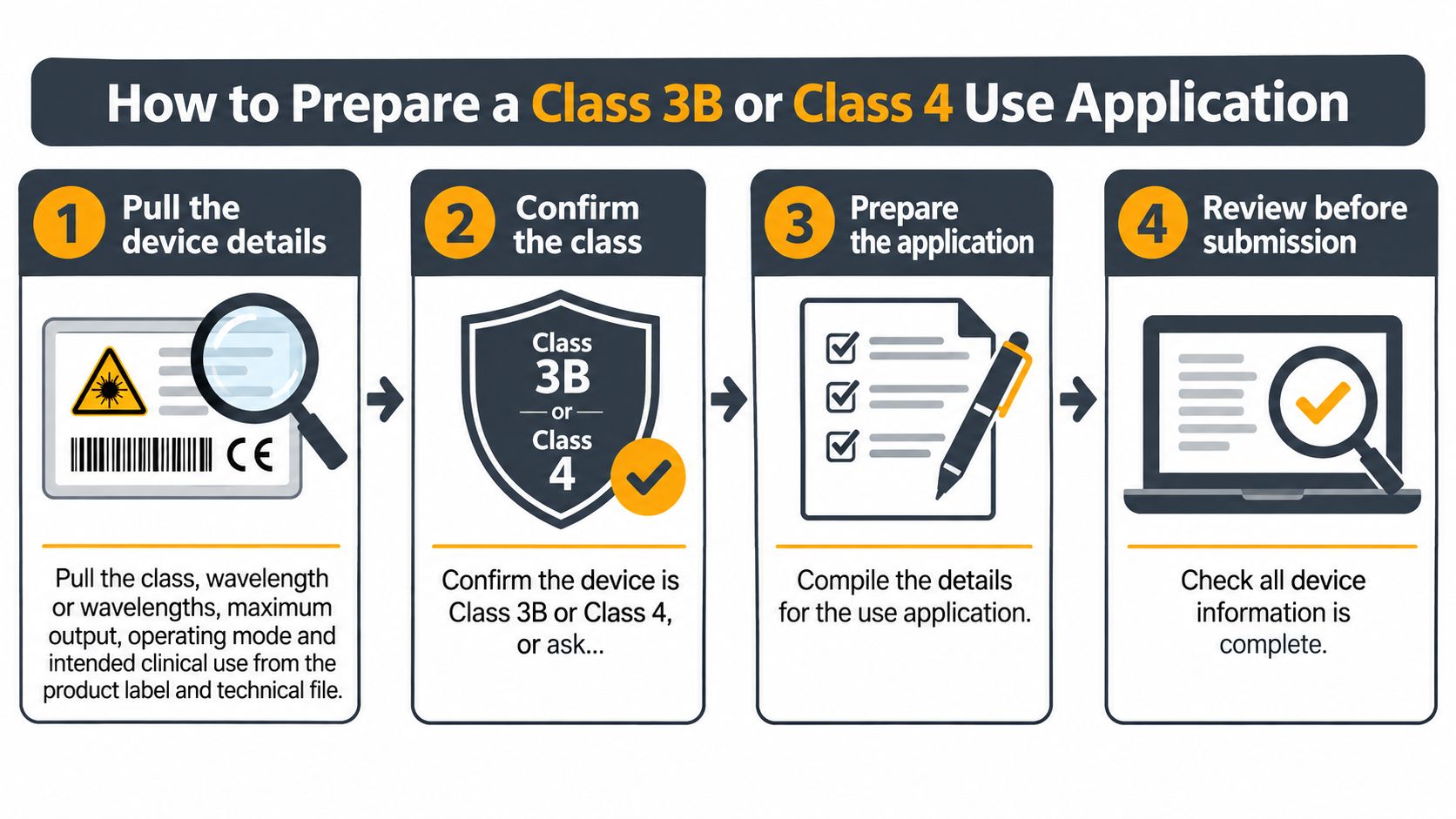
SAHPRA's guidance for use-licence applications and safe use of Class 3B and Class 4 lasers identifies the application and safe-use framework. A practical preparation sequence is:
Pull the device details. Record the laser class, wavelength or wavelengths, maximum output, operating mode and intended clinical use from the label and technical file. These details give Radiation Control the information needed to assess the actual system rather than a broad marketing description.
Confirm the classification and route. If the class isn't clear, ask Radiation Control in writing; use the same approach for IPL rather than assuming it falls outside the relevant requirements. Establish whether the application is for medical or non-medical use and who will apply, such as the owner, premises operator or responsible professional.
Prepare the applicant, premises and equipment information. Compile the responsible-user details, installation and safety-control information, and equipment specifications required for the use-licence application. Keep the room layout and control arrangements consistent with the device's beam path and intended operation.
Show the room exists as described. Radiation Control can ask to see that the safety arrangements in the application are physically in place at the premises. The room, signage and eyewear rules sit with the Laser Safety Officer section; the application's job is to describe an installation that already meets them. A paper-only setup invites follow-up queries and leaves the clinic unable to operate even with approval in hand.
Submit using the current process and retain the response. Confirm the current submission method and form with Radiation Control, keep copies of the application and supporting documents, and wait for written confirmation of the applicable use authority before treating patients on that system. FDA and CE documents may support the technical file, but they aren't a substitute for South African authorisation.
A mobile operator or clinic with more than one site should ask Radiation Control whether moving a device requires a new approval or notification. An authorisation for one installation shouldn't be assumed to cover another room or premises without confirmation. The regulatory compliance checklist can be used as a working document alongside the regulator's current guidance.
The available published material doesn't set out a fee or processing-time figure for clinics to rely on. Form names and renewal or resubmission requirements should also be confirmed directly before applying, because each item below changes and a guessed amount, form number or timeline won't hold up. Written confirmation gives the clinic a defensible record of the requirements that apply to its application.
| Fees, timelines and forms to confirm | Confirm with |
|---|---|
| Use-licence application fee | Radiation Control, Department of Health |
| Processing time | Radiation Control, in writing |
| Form for medical laser use | Radiation Control's current form list |
| Form for non-medical laser use | Radiation Control's current form list |
| Renewal or resubmission rule | Radiation Control |
| SAHPRA establishment licence fee for supplier | SAHPRA's current documents |
Laser Safety Officer Room and Eyewear Rules
The LSO needs written authority to stop a session. In a multi-device clinic with therapists rotating between treatment rooms, that means a named person who can pull a machine offline, refuse an untrained operator and pause a service visit. I'd put that authority on the treatment-room checklist itself, so a junior staff member knows exactly who can halt a session and is expected to call them.
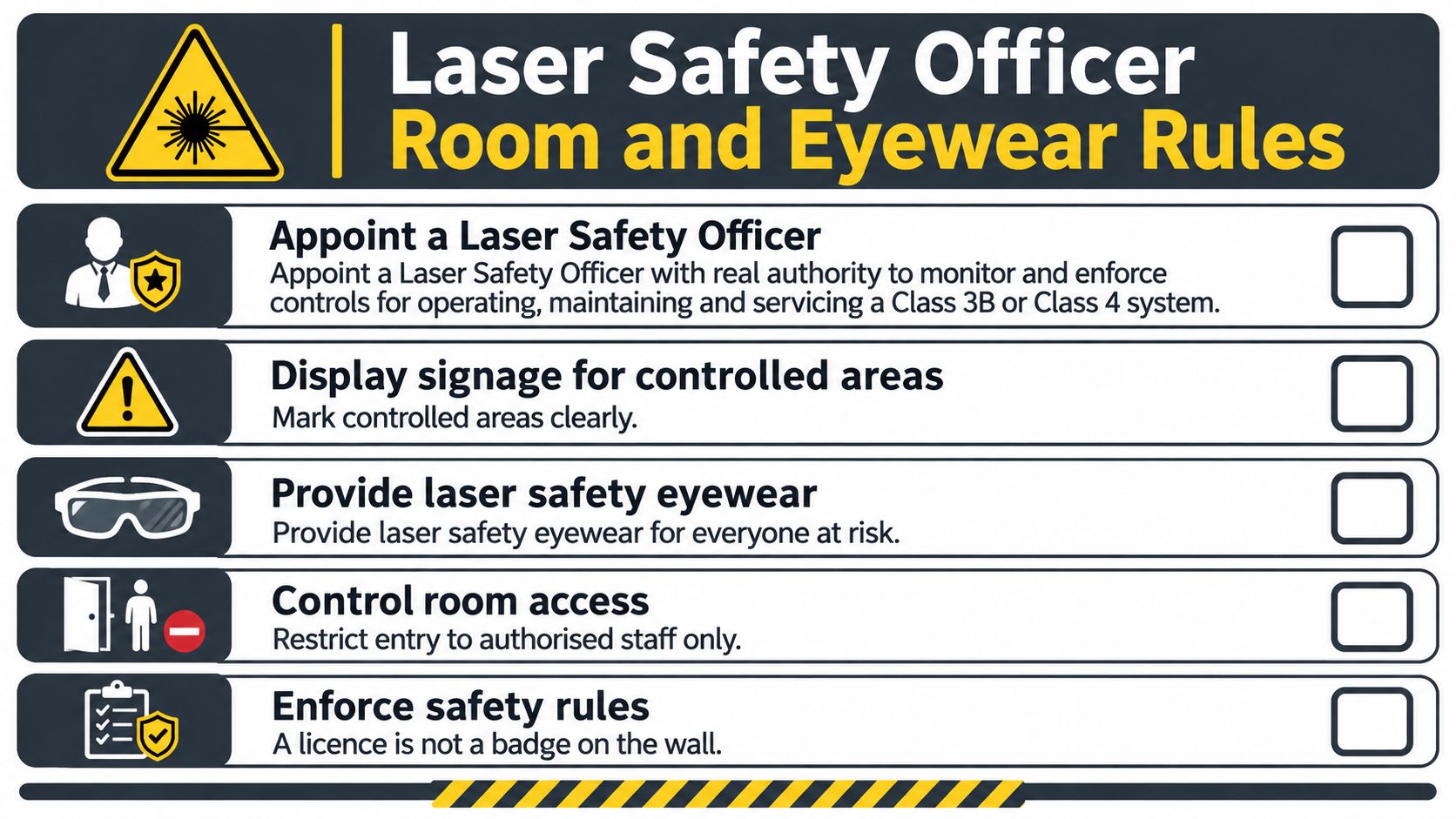
The LSO's job is to make the room safe in practice and show that staff follow the rules. The clinic should be able to demonstrate that:
- The controlled area is identified. Display suitable warning signage and restrict access while the laser can emit.
- The room permits safe movement. Entrance and area controls must allow rapid exit and emergency access.
- Eyewear matches the laser. Provide protective eyewear selected for the device's wavelength and optical-density requirements; a pair rated for a different wavelength gives the operator no useful protection.
- Staff are prepared. Personnel who regularly enter a Class 4 controlled area need appropriate training, protective equipment and administrative procedures.
- The controls are documented. Record procedures, training and maintenance so staff can follow the same safe routine across shifts.
The South African safe-use requirements for laser products set out the LSO role and controlled-area expectations. A rotating team needs a process for checking competency before a staff member operates the device or enters a controlled area.
The common failure happens at handover. A therapist steps out mid-afternoon to cover reception, a colleague finishes the session, and nobody confirms whether that colleague was signed off on the device. The written rule is that an untrained observer does not operate the machine, and a service visit or adverse event gets documented rather than passed along in a corridor conversation. That rule only holds if the LSO's competency check runs before the door closes.
The clinic can use laser safety glasses guidance for eyewear selection, then build its day-to-day rules into laser safety protocols and the wider safety compliance process. When deciding which controls to prioritise, the hierarchy of controls helps distinguish stronger hazard controls from reliance on personal protective equipment alone.
Employer duties under the Occupational Health and Safety Act 85 of 1993 sit alongside the laser-use process, and the documented exposure-risk assessment that flows from them belongs in the clinic's compliance file alongside its signage, access, training and maintenance records. The published material doesn't set a minimum qualification for an LSO or laser operator, so clinics should confirm training expectations with Radiation Control and the relevant professional body before assigning responsibilities.
Records Renewals and the Compliance File
Approval paperwork wins the licence. The compliance file is what keeps it usable. A Class 3B or Class 4 use authority only works day to day if the clinic can show, from one place, which device sits in which room, who is trained to run it and what was done at each service visit.
Build the file around the devices, not around folders of correspondence. It should hold the supplier's establishment licence and device-scope documents, the use-licence application and Radiation Control's written replies, a room map, the workplace exposure-risk assessment, staff training and supervision records, eyewear specifications matched to each device's wavelength, maintenance and service logs, and incident or complaint notes. Serial number and current room should stay traceable, so a relocation does not get lost in routine clinic changes.
A single-page device register carries most of that weight:
| Register field | What to record |
|---|---|
| Device and model | Manufacturer, model name and laser class |
| Serial number | Number from the device plate, matched to supplier paperwork |
| Room | Current treatment room, updated on every move |
| Use-licence reference | The Radiation Control authority covering that device |
| Authorised operators | Staff trained and signed off on that machine |
| Last service date | Date, service agent and work carried out |
Keep the records tied to the way the clinic operates
Three habits keep the register honest:
- Log training before assigning the device. A name only enters the operator column once training and supervision are recorded.
- File every service visit and adverse event. Record the checks done and any follow-up, not just the invoice.
- Record relocations before they happen. Note the planned move in the register and ask Radiation Control whether it requires approval or notification first.
Renewals deserve their own page. Keep a renewals log listing each authority the clinic holds, the conditions attached to it, the dates of every submission and reply, and the person responsible for following up. Forms and submission intervals change, so confirm with Radiation Control what must be resubmitted and when, rather than assuming an approval runs indefinitely.
The workplace risk file is a legal requirement, not admin polish. The physical-agent regulations require a documented exposure-risk assessment before exposure where reasonably practicable; keep the current assessment and its review notes in the same file so it can be produced with everything else.
Treatment scope sits outside the laser paperwork. Whether a professional may perform a treatment is checked against the applicable HPCSA or provincial professional rules, so confirm scope with the relevant professional body rather than inferring it from a device rule. The record-keeping guide offers a structure for pulling device, training and service records into one audit-ready file.
Go-Live Gate and Next Step
Do not treat on a new laser until four checks are complete:
- Use route confirmed: Radiation Control has confirmed in writing the applicable use-licensing route for the device and premises.
- Responsible safety lead appointed: An LSO has authority to monitor and enforce the relevant controls.
- Room ready: Controlled access, signage, procedures and wavelength-matched eyewear are in place.
- Supplier file checked: The establishment licence, listed device scope and South African authorised representative are documented.
A pass means each item is evidenced. File the Radiation Control confirmation with the device model, serial details and premises it covers, so the scope stays clear when staff or rooms change. Give the LSO named authority to pause a session and stop access or eyewear failures from being worked around. Treat room readiness as a physical check: door control active, warning sign visible, procedure posted and eyewear matched to the wavelengths in use. Match the supplier documents to the exact model on the invoice rather than the brochure family.
Before purchase, ask Omega Lasers for the exact model's technical file, serial details and training records, then confirm current forms with Radiation Control and SAHPRA.