



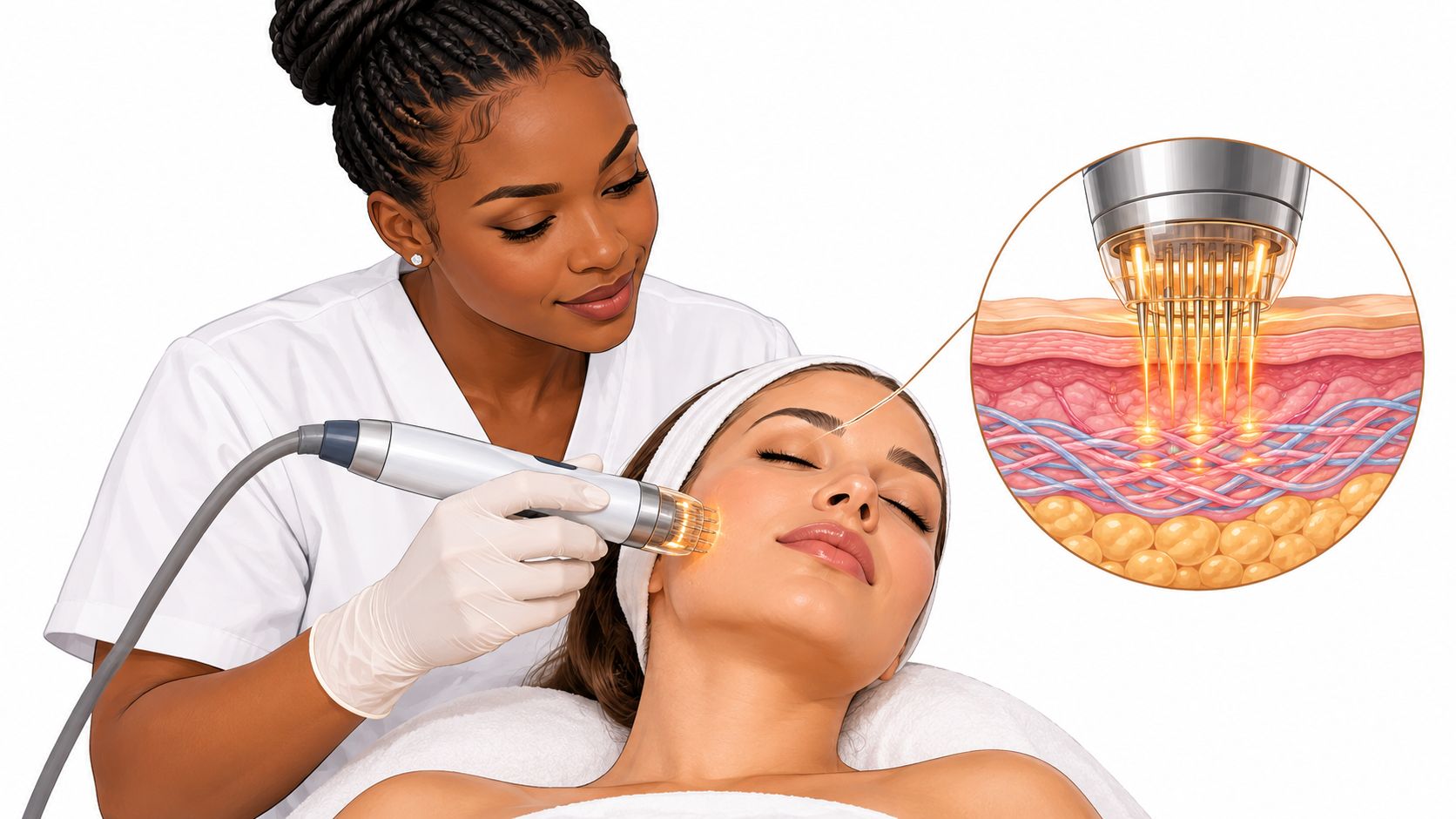
A clinic owner has a device quotation open, a treatment room to fill, and patients asking about acne scars, uneven texture and firmer-looking skin. RF microneedling looks like a logical addition, but the purchase decision becomes harder once training, darker-skin safety, consumables and realistic booking capacity enter the calculation.
Table of Contents
- Why South African Clinics Are Considering RF Microneedling
- How RF Microneedling Works and How It Differs from Standard Microneedling
- Main Clinical Indications and What the Evidence Supports
- Safety for Darker Skin Types and Managing Pigmentation Risk
- What to Look For in a Professional Device and How to Verify Compliance
- Treatment Courses, Downtime, and Pricing in South Africa
- Combining Modalities and Building a Profitable Treatment Menu
- Next Steps for Your Clinic
Why South African Clinics Are Considering RF Microneedling
The practical attraction is straightforward: RF microneedling could address several skin-quality concerns through a single treatment platform. For a practice already offering facials and conventional needling, it deserves evaluation as a distinct energy-based service, not merely a more expensive version of an existing appointment.
Consider a consultation for a patient concerned about acne scarring and cheek laxity. The clinician needs to establish which concern is treatable, whether the proposed device supports that indication, and whether the patient accepts the recovery and uncertainty involved. The owner must then decide whether enough suitable patients exist to justify the investment.
Start with the patient mix
A useful purchasing assessment separates genuine clinical demand from interest generated by promotional photographs. Enquiries alone aren't a reliable basis for purchasing equipment.
- Clinical fit: Review the concerns already appearing in consultations and identify where current treatments leave a defensible gap.
- Operational fit: Establish who would assess, treat and review patients, rather than assuming an available room means available clinical capacity.
- Commercial fit: Test whether patients would book at a price that covers proper treatment delivery, not merely the disposable cartridge.
Purchasing principle: A device should solve an identifiable clinical and operational problem before it becomes a revenue target.
South African owners also need a locally relevant assessment. Evidence from other populations can't replace careful consideration of pigmentation risk, and international marketing material doesn't establish local regulatory compliance.
The strongest purchasing decision connects the treatment mechanism, indication-specific evidence, patient selection and actual costs. A clinic shouldn't have to compromise any of those to make the spreadsheet look attractive.
How RF Microneedling Works and How It Differs from Standard Microneedling
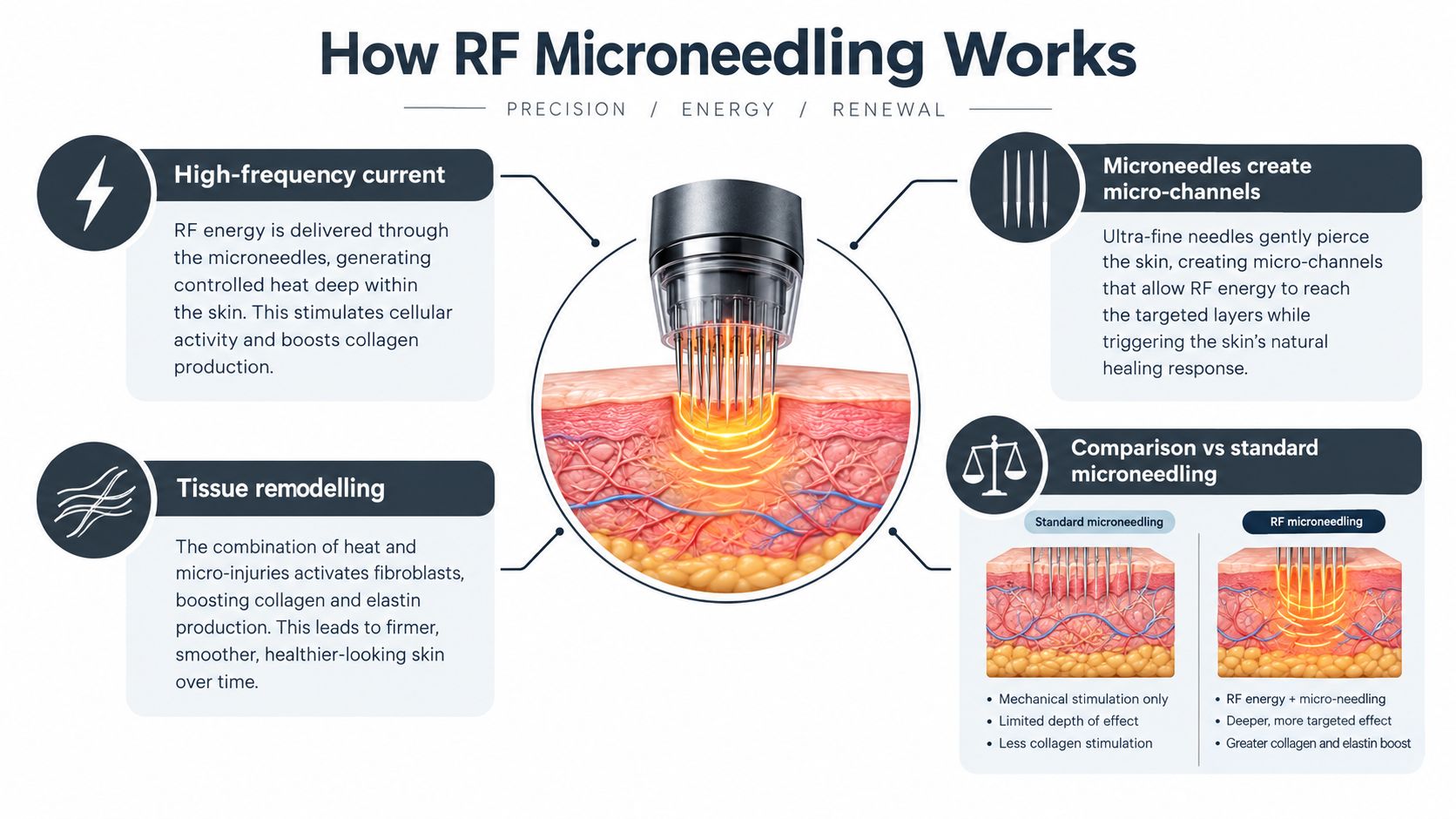
RF microneedling combines needle penetration with electrothermal energy delivery. High-frequency electrical current passes through microneedles, and tissue impedance converts that current into heat, creating microscopic zones of collagen denaturation surrounded by untreated tissue. Insulated needles concentrate energy at a selected dermal depth, whereas non-insulated needles distribute the RF effect along the needle track, as described in this review of RF microneedling mechanisms and needle designs.
The distinction from standard microneedling is the added thermal component. For the mechanical-treatment baseline, the guide to standard microneedling provides the relevant context without treating the procedures as interchangeable.
Needle design changes the treatment pathway
With insulated needles, the covered shaft limits electrical delivery along the insertion pathway while the conductive tip concentrates treatment at the selected depth. The rationale is to limit thermal exposure along the pathway, including the epidermis.
With non-insulated needles, the exposed needle acts as an electrode along its length. That creates a different distribution of thermal exposure, rather than a superior or inferior treatment.
| Procurement question | Clinical relevance |
|---|---|
| Which needle configurations are available? | The clinic needs to understand where each cartridge delivers energy. |
| Which indications support each configuration? | Cartridge selection should follow validated use, not habit. |
| How does training address different anatomical areas? | A single generic protocol isn't an adequate treatment plan. |
The practical mistake is to judge a platform by its maximum output or available depth alone. Neither establishes whether the clinician can deliver an appropriate treatment to the intended tissue.
The relevant question is whether the operator can select and document a justified protocol for the patient, indication and anatomical area. Manufacturer protocols and device-specific training should govern those decisions. Copying settings from another machine, a conference slide or a social-media demonstration isn't a sound substitute.
Main Clinical Indications and What the Evidence Supports
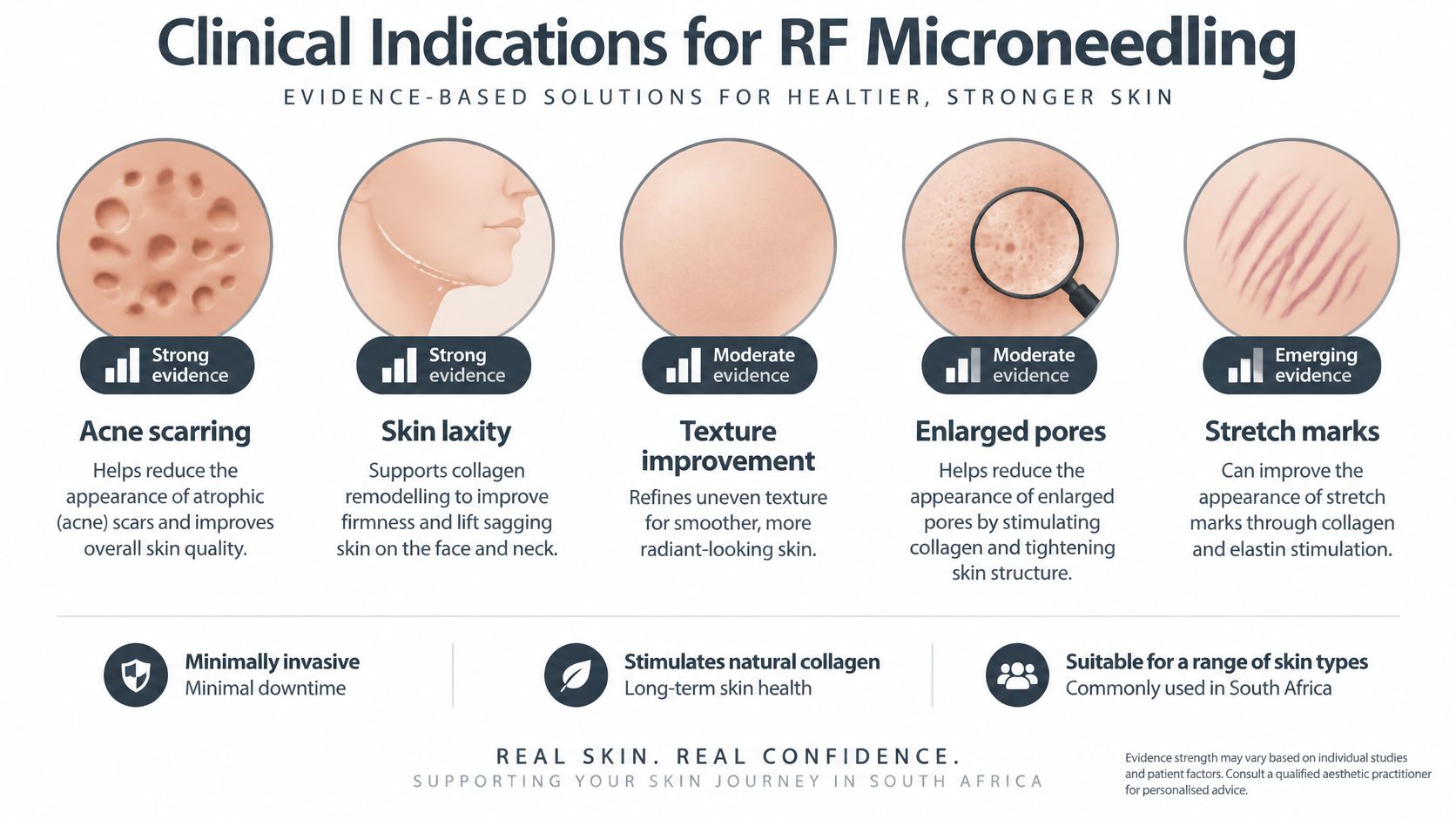
Indication-specific consultation matters more than a broad promise of rejuvenation. Acne scars, laxity, pores and stretch marks may appear together on a treatment menu, but they shouldn't share an undifferentiated outcome claim.
Translate concerns into assessable endpoints
The thermal-remodelling rationale supports evaluating changes in tissue quality. It doesn't justify promising that every visible concern will respond equally.
- Acne scarring: Define the scar pattern and document the desired change in contour. Improvement is a more appropriate discussion than complete scar removal.
- Skin laxity: Establish whether the patient's concern is skin quality, tissue descent or lost volume before proposing treatment.
- Texture and pores: Discuss changes in appearance, not permanent pore closure or a uniformly smooth surface.
- Stretch marks: Assess the affected area separately rather than transferring facial-treatment expectations to the body.
What the South African evidence actually says
A review describes a treatment series at Vivida and the Renaissance Body Science Institute in Cape Town involving 350 patients treated for wrinkles, alongside a wider clinical programme covering acne, burn scars, stretch marks and lax abdominal or arm skin; within the reported scar subgroup, 120 patients received an average of 2.5 treatments, every scar reportedly improved by at least 50%, more than 80% achieved 50–75% improvement, and 65% achieved improvement exceeding 75%, according to the review containing the Cape Town treatment experience.
Those reported percentage categories shouldn't be added together or converted into a single predicted response rate. The available account doesn't provide a complete South African breakdown for every indication or a controlled comparison against other technologies.
Local treatment experience is useful evidence of clinical use. It isn't a guarantee that a different device, protocol or patient will reproduce the reported result.
For menu planning, the defensible interpretation is that local observational experience supports considering scar and skin-quality applications. It doesn't establish equivalent effectiveness across all proposed indications, particularly when the consultation concern is enlarged pores rather than the outcomes specifically described in that dataset.
Baseline photographs and a written treatment objective make that distinction practical. The clinician and patient should agree on what improvement would mean before treatment begins.
Safety for Darker Skin Types and Managing Pigmentation Risk
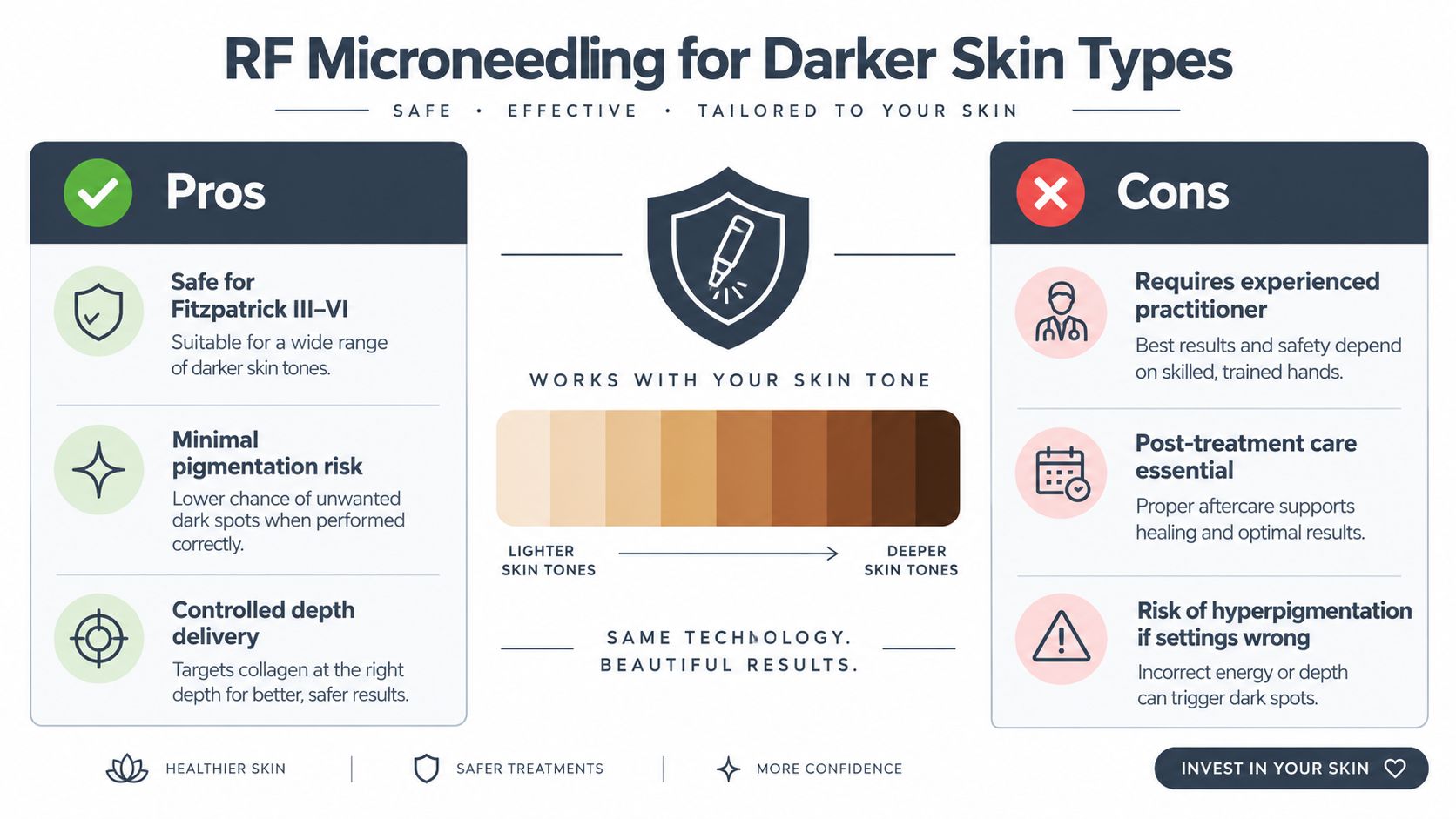
Suitable for darker skin doesn't mean free of pigmentation risk. South African clinics should resist marketing that reduces safety counselling to temporary redness and swelling.
A systematic review covering 35 studies of RF or RF microneedling in skin of colour reported transient hyperpigmentation in 7 studies, mild prolonged hyperpigmentation in one, and permanent scarring in one; it also noted limitations in evidence quality in its assessment of RF treatment safety in skin of colour. These are study counts, not patient-level complication rates.
Pigment preservation and volume preservation
For Fitzpatrick III–VI, consultation should explicitly address post-inflammatory hyperpigmentation rather than treating it as an incidental possibility. The infographic's broad safety language should be understood as conditional on appropriate assessment and delivery, not as a promise of minimal risk for every patient.
A separate concern is unwanted tissue injury beyond the intended target. The FDA's 2025 safety communication reported burns, scarring, disfigurement, nerve damage and fat loss after certain RF microneedling uses, as discussed in this review of RF microneedling complications.
That makes facial-fat assessment particularly relevant around the periorbital and malar areas. A patient seeking smoother skin may consider even subtle hollowing an unacceptable trade-off.
Make caution operational
- Assess the starting point: Record pigmentation history, recent sun exposure, active inflammation and existing facial hollowing.
- Postpone when necessary: Recent sun exposure or active pigmentary change should trigger reassessment against manufacturer guidance, not an automatic treatment appointment.
- Escalate conservatively: Follow device-specific protocols and training, with test areas where appropriate. Darker phototypes shouldn't receive a copied generic protocol.
- Review deliberately: Arrange documented follow-up and a clear route for reporting persistent pigmentation, unexpected contour change or worsening symptoms.
The appropriate response to safety concerns isn't to exclude every darker-skinned patient. It's to select patients carefully, explain meaningful risks and decline treatment when the proposed benefit doesn't justify them.
Consent should distinguish expected recovery from complications requiring assessment. A signed form alone doesn't demonstrate that the patient understood the possibility of pigment change or volume loss.
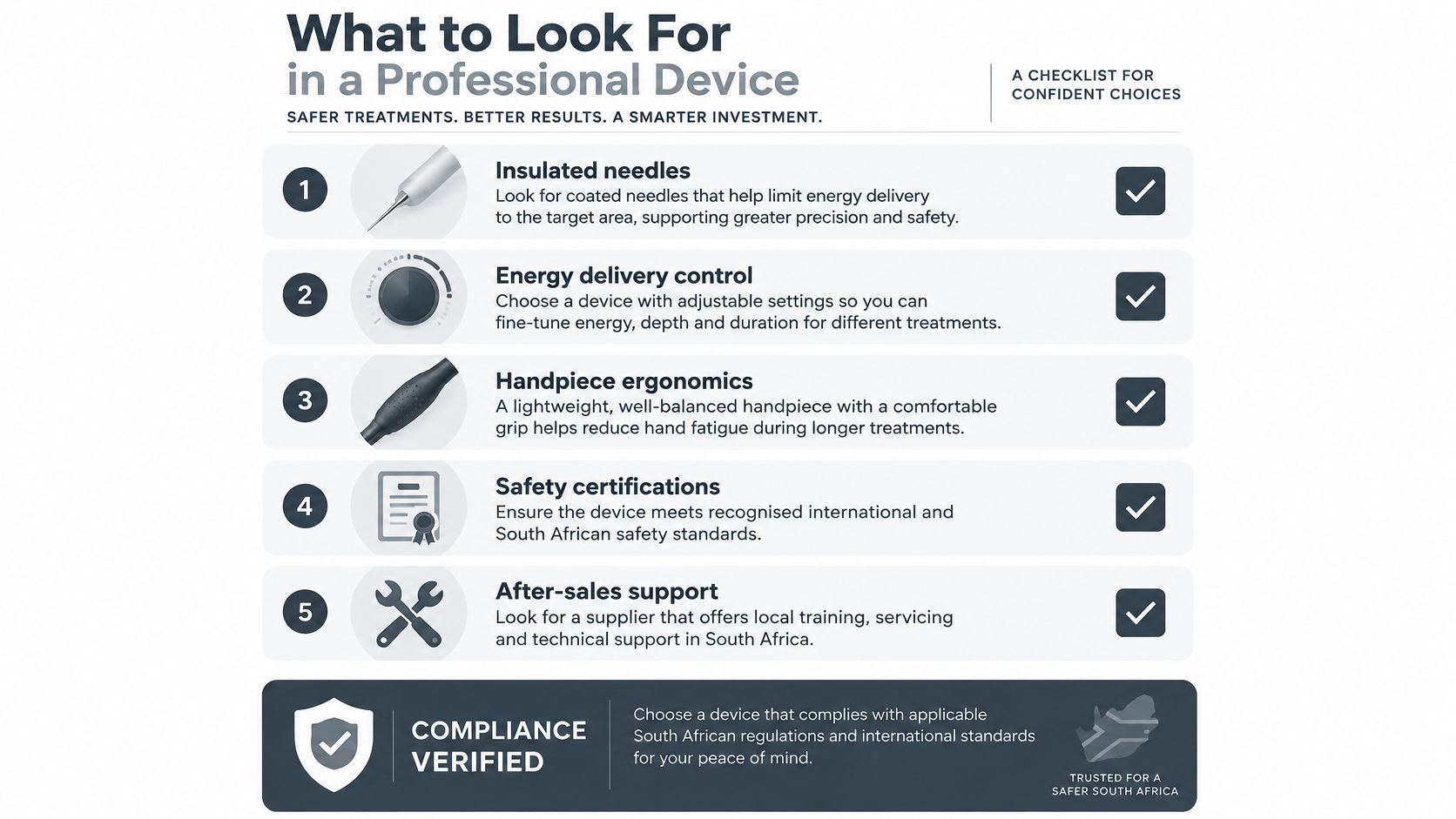
What to Look For in a Professional Device and How to Verify Compliance
A professional RF microneedling purchase needs a technical assessment and a regulatory assessment. Attractive specifications don't replace either.
South Africa's framework developed through the 2015 amendments, which came into force in 2017, introduced a four-tier risk-based classification system, and expanded oversight to medical devices under SAHPRA; a South African health-policy review also describes implementation limitations.
Request evidence before a deposit
SAHPRA states that relevant medical-device establishments require establishment licences and that devices must meet acceptable safety, quality and performance standards; applicable listed electronic products also require licensing for importation or manufacture under the framework described in its radiation-control acts and regulations.
A supplier's establishment licence isn't interchangeable with evidence covering the exact product and proposed use. The clinic should obtain written confirmation of the applicable regulatory pathway and registration status, where applicable.
- Technical documentation: Request the intended use, available needle configurations, control functions and compatible cartridges.
- Clinical usability: Assess handpiece ergonomics, treatment visibility and how operators record delivered parameters.
- Supplier accountability: Verify licensing, maintenance arrangements, consumable availability and the incident-reporting process.
- Training evidence: Require device-specific instruction, competency records and protocols covering patient selection and adverse events.
The safety and compliance resource can support the clinic's enquiry process, but the purchasing file should retain the actual documents supplied.
Build the operating file
Before launch, the clinic should document practitioner credentials and scope, infection-control procedures, informed consent, maintenance responsibilities and referral arrangements. The escalation process should identify who reviews suspected burns, infection, persistent pigment changes or unexpected tissue loss.
A scheduling tool for med spas from Recepta.ai is an administrative resource to evaluate when organising consultations and follow-up appointments. Scheduling software shouldn't substitute for a clinical record, consent process or incident-management system.
Governance check: Certification and training contribute to safe practice. Neither guarantees a safe outcome in every treatment.
Procurement should stop if essential documentation remains unresolved. A discount doesn't compensate for uncertainty about lawful supply, authorised use or after-sales accountability.
Treatment Courses, Downtime, and Pricing in South Africa
A treatment course should be response-led rather than package-led. Clinics should anticipate that patients may need repeated sessions, while deriving timing and total treatment recommendations from manufacturer protocols, the indication and reassessment.
The historical local treatment experience described earlier isn't a universal course prescription. Selling a fixed package before assessing healing and response makes commercial convenience more important than clinical judgement.
Recovery needs an individual plan
Counselling should cover redness and swelling, as well as the possibility of more complicated recovery. The FDA's microneedling device information also identifies bleeding, bruising, crusting, burning, pigment changes, infection and herpes reactivation among potential adverse effects.
Written aftercare should specify sun protection, cleansing, product restrictions and the clinic's contact pathway. A review of skin-barrier repair products can inform product discussions, but post-procedure suitability still needs confirmation against the treatment protocol.
Price evidence and an illustrative contribution model
A South African published treatment price list lists R2,500 for the face and R2,500 for the neck/decollete, with 15% VAT added at checkout; using an assumed selling price of R2,500 excluding VAT, 12 sessions monthly, an assumed R500 variable cost per session and hypothetical equipment expenditure of R240,000 produces R30,000 monthly gross treatment revenue, R24,000 contribution before fixed costs, and approximately 10 months to recover that equipment expenditure from contribution alone.
Those calculations use the published session price as a starting point. The utilisation, costs and equipment expenditure are illustrative assumptions, not observed returns or a quotation.
| Model component | What the clinic should substitute |
|---|---|
| Selling price | Actual realised price after discounts and package allocations |
| Booked capacity | Completed, paid treatments rather than available appointment slots |
| Variable costs | Cartridges, consumables and treatment-dependent staffing costs |
| Equipment expenditure | The actual quotation and associated purchasing costs |
Contribution isn't net profit. Rent, marketing, finance charges, tax and other fixed costs still need consideration, while VAT treatment should be checked with the clinic's accountant.
A useful downside assessment asks whether the service remains viable with fewer bookings or more expensive consumables. If profitability depends on uninterrupted demand from launch, the purchasing case is fragile.
Combining Modalities and Building a Profitable Treatment Menu
A profitable menu needs a clear clinical role for each treatment. RF microneedling shouldn't become a compulsory addition to every facial or an automatic upgrade for every existing patient.

Combine only with a clinical rationale
LED therapy or platelet-rich plasma may arise during treatment planning, but this evidence base doesn't establish that adding either guarantees better RF microneedling outcomes. A clinic proposing combination treatment should review supporting evidence, device instructions, procedural compatibility and additional consent requirements.
More modalities can mean more cost, more appointment complexity and a less clear explanation of which intervention produced the result. A standalone treatment may therefore be preferable when the indication is clear and the proposed combination adds no defensible benefit.
| Menu position | Appropriate commercial discipline |
|---|---|
| Standalone service | Price the complete assessment, treatment and review pathway |
| Treatment course | Preserve reassessment rather than guaranteeing an identical sequence |
| Combined plan | Explain the purpose and separate cost of each component |
Market the consultation, not certainty
Marketing should describe the concerns assessed, the treatment process and realistic limitations. Before-and-after documentation should use consistent lighting, positioning and photographic conditions, with patient permission and an honest account of accompanying treatments.
For owners evaluating how to grow your practice with marketing, Transactional LLC provides a medical-spa marketing resource to consider. Any external marketing support should work within the clinic's consent, evidence and advertising standards.
Staff should be able to explain candidacy without diagnosing at reception or promising a result before assessment. Commercial packages should make appropriate care easier to access, not pressure clinicians to treat unsuitable patients.
A treatment menu is stronger when staff can explain who shouldn't receive a service as clearly as who might benefit.
Next Steps for Your Clinic
The decision to add RF microneedling should end with a documented purchasing case, not just enthusiasm after a demonstration. Clinical fit, operational readiness and commercial viability need separate approval.
A clinic may have suitable demand but insufficient supervision. Another may have experienced clinicians but lack the booked capacity to support finance repayments. Either situation calls for preparation rather than an immediate purchase.
Turn the assessment into a purchasing file
The file should bring together the patient indications the clinic intends to treat, the evidence supporting those uses and the supplier's documentation. It should also identify unresolved questions and assign responsibility for answering them.
- Review a relevant platform: The Derma Pro RF microneedling machine is an option to assess against the clinic's intended indications, training requirements and procurement checklist.
- Assess funding separately: Compare the clinic's contribution model with the repayment obligations available through financing options.
- Check the wider equipment plan: Consider whether a skin rejuvenation machine addresses a different unmet need before allocating the capital budget.
Set launch conditions before signing
The owner should establish what must be complete before the first treatment: approved documentation, trained staff, available consumables, a functioning review pathway and a realistic appointment allocation. Demonstrations should answer those practical questions rather than focus solely on a treatment endpoint.
The most useful supplier discussion is specific. It should cover the exact machine and cartridges, intended applications, training content, service arrangements and the full cost of ownership.
A clinic that can't yet answer those questions hasn't necessarily rejected RF microneedling. It has identified the work required to offer it responsibly, without treating safety or profitability as assumptions.
Omega Lasers supplies medical-aesthetic technology, including RF microneedling equipment, alongside training and technical support. Clinics considering this treatment can visit Omega Lasers to request device documentation, discuss training requirements and obtain a quotation for a practice-specific financial assessment.