




A clinic owner can feel the pressure before the first quote is even signed. A patient asks about tightening, a competitor has just put a HIFU unit on the floor, and a salesperson is pushing a cheap import that looks good on paper and risky everywhere else. That's exactly when the wrong purchase starts, because the machine you choose doesn't just affect today's booking sheet, it shapes your treatment menu, your compliance exposure, and how clients talk about the clinic for years.
A HIFU machine is not a casual add-on. It's a clinical purchase, a capital commitment, and a reputational decision. Treat it that way, and the shortlist becomes much clearer, from how the energy is delivered to who services the unit when something goes wrong.
The smartest buyers judge the platform on seven things: how it works, what depths it covers, whether it's a professional device or a grey import, SAHPRA compliance, operator training, running costs, and whether the numbers pay back. Anything less is how clinics end up with cheap hardware, expensive downtime, and awkward conversations with patients.
Table of Contents
- Why a HIFU Machine Is a Strategic Purchase
- How HIFU Works and Where It Fits in a Treatment Menu
- Cartridge and Transducer Depths Explained
- Professional Devices Versus Grey Imports
- SAHPRA Registration and Buying from a Registered Supplier
- Treatment Pricing, Cartridge Running Costs and ROI
- Training, Maintenance and Informed Consent
- Your HIFU Buying Checklist and Next Step
Why a HIFU Machine Is a Strategic Purchase
A clinic that buys HIFU is really buying a new lane in its service menu. Done properly, it gives the business a tightening option that sits between surface treatments and surgery, and that can be positioned for face, neck, and body work depending on the platform. Done badly, it becomes an expensive piece of metal that attracts complaints because the operator, the cartridge depth, or the compliance paperwork was wrong.
That is why the purchase should be judged like a strategic asset, not a gadget. The machine has to match the clinic's patient profile, the intended treatment areas, the level of technical support on the ground, and the amount of training the team can absorb. A cheap sticker price means very little if the cartridges burn out early, the output drifts, or the supplier disappears after installation.
A useful way to think about it is to compare it with any other revenue-driving acquisition. A salon wouldn't buy a campaign system without considering targeting and creative. For a helpful example of structured planning in a consumer-facing market, the UGC creative platform for DTC brands shows how fit, workflow, and execution matter more than the headline tool name. The same logic applies here. The machine has to fit the business model, not the other way around.
Practical rule: If the sales pitch leans on the lowest price or the biggest D-number first, the clinic should slow down. Those are usually the least useful questions.
The right buyer also keeps the next decision in mind. HIFU brings patient expectations with it, so the clinic needs a clear path for staff training, informed consent, and follow-up. If the team can't explain what the machine does, what it doesn't do, and what happens if the client is not a good candidate, the purchase isn't ready yet.
How HIFU Works and Where It Fits in a Treatment Menu
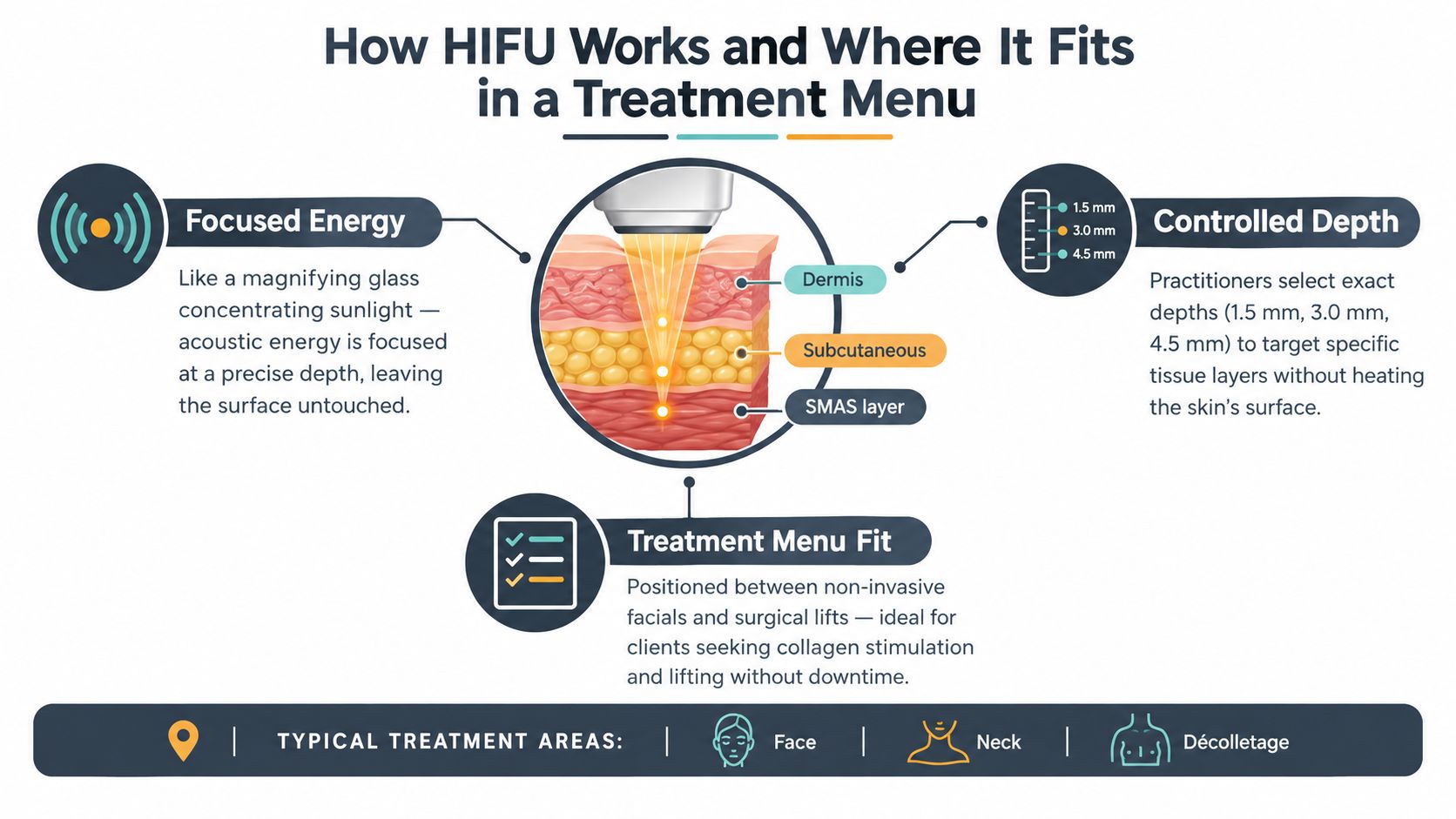
HIFU delivers focused ultrasound energy to a chosen tissue depth. The energy is concentrated at the target layer while the skin above and around it stays largely untouched. That is the core idea your team must understand, because it shapes how you sell the treatment, where you place it in the menu, and what results you can reasonably promise.
South African clinics should separate hospital-style ultrasound-guided HIFU from aesthetic HIFU. Local hospital use for uterine fibroids has been documented at Chris Hani Baragwanath Academic Hospital, including measured fibroid volume reduction in a local cohort, as reflected in SAHPRA's overview of its medical-device framework. That evidence shows the technology has legitimate medical use. A fibroid ablation protocol still belongs in a different clinical and commercial bucket from facial tightening, so do not let a sales pitch blur the line.
For aesthetics, the menu usually breaks into face and body work. Facial use is typically sold for brow support, jawline refinement, periorbital treatment, and neck tightening. Body use shifts to the abdomen, thighs, and arms. One machine rarely does every area equally well, so the buyer has to decide whether the clinic needs a face-first platform, a body-capable platform, or a broader service menu that can justify the cartridge spend.
Vaginal tightening sits in its own application category. It needs its own protocol, consent process, and patient conversation. A focused resource on vaginal HIFU information is useful, but it should not be mixed into a face-and-body buying decision.
A recent systematic review of 45 clinical trials and cohort studies reported approximately 18% to 30% improvement in skin laxity for facial, neck, and periorbital use, with body-contouring studies reporting roughly 2.5 cm to 4.5 cm circumference reduction in areas such as the abdomen and thighs. Visible outcomes generally emerged within about three months and could last up to one year. That gives a clinic a realistic range for patient discussions, and it keeps the sales conversation grounded in outcomes rather than hype.
Cartridge and Transducer Depths Explained
The cartridge depth is where most buyers either get sharp or get sold. A 1.5 mm cartridge is the shallow workhorse for delicate facial zones, especially where the clinic wants a more superficial response. 3.0 mm generally reaches deeper dermal tissue, while 4.5 mm targets the SMAS-oriented layer often associated with lifting protocols on the face.
For body platforms, the deeper cartridges take the conversation into subcutaneous tissue and broader contouring work. That's where the clinic has to be disciplined, because deeper is not automatically better. A wrong depth wastes cartridges, burns budget, and can over-treat facial areas that should not lose fat.
| Cartridge Depth | Target Tissue Layer | Typical Indication | Approximate Result Window |
|---|---|---|---|
| 1.5 mm | Superficial facial tissue | Delicate facial zones | Gradual tightening over weeks |
| 3.0 mm | Dermal layer | General facial tightening | Gradual tightening over weeks |
| 4.5 mm | Deeper support layer | Lifting-focused facial work | Gradual lifting over weeks |
| 6.0 mm | Shallow body or submental zone | Body or chin-area contouring | Gradual visible contour change |
| 9.0 mm | Deeper body tissue | Larger body areas | Gradual contour change |
| 13 mm | Deeper body tissue | Broader body contouring | Gradual contour change |
The buying mistake is to chase the biggest depth range without thinking about the menu. A clinic that mainly treats faces may never need aggressive deep-body cartridges. A clinic that wants body contouring needs the opposite mindset, because shallow facial cartridges won't build a credible body service. Cartridge selection is a menu-planning decision, not a technical footnote.
Rule of thumb: More depth expands options, but it also increases the need for training discipline. That's where quality operators separate themselves from everyone else.
The differentiators are shot life, energy calibration, and treatment-line spacing. Headline wattage is easy to print on a brochure. Stable delivery and consistent output across the session are what clients pay for. If the supplier can't document that properly, the machine isn't ready for a serious clinic floor.
Professional Devices Versus Grey Imports
This is the decision that separates a business purchase from a gamble. A professional device bought through a registered local channel comes with build consistency, firmware support, warranty terms, and somebody who can answer the phone when the handpiece needs attention. A grey import often arrives with a lower entry price and a much higher anxiety bill.
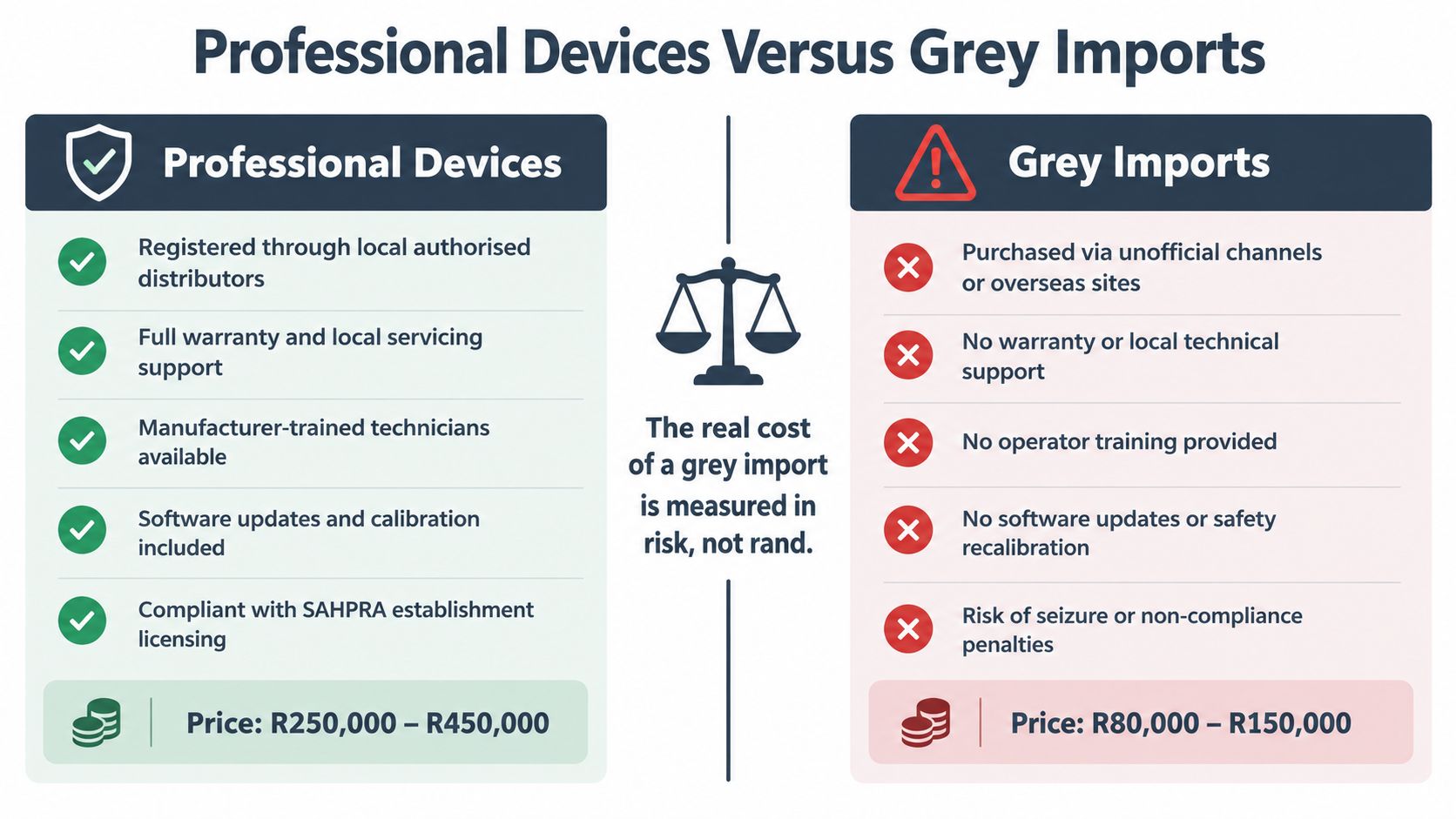
The first thing to examine is build quality. Professional devices are usually built for repeatable treatment cycles, with more reliable calibration and clearer documentation. Grey imports may look similar externally, but the internal consistency can be poor, which means the output on day one is not necessarily the output on day 90.
Then comes cartridge shot life. That is where the cheaper machine often stops being cheap. If the cartridge runs out quickly, the clinic pays more per treatment, even if the initial invoice was lower. The same logic applies to warranty and service. If there's no local technical support, every fault becomes a shipping problem, a downtime problem, and a cashflow problem.
A dealer relationship also matters for software, updates, and replacement parts. Professional supply is not about prestige. It's about reducing risk and protecting margin. A clinic can survive paying more upfront. It rarely survives a silent device failure during a busy month.
SAHPRA Registration and Buying from a Registered Supplier

In South Africa, medical devices, including non-IVD devices, sit inside the SAHPRA framework. SAHPRA's Medical Devices Unit regulates the licensing of medical-device establishments and the registration of medical devices to help ensure acceptable safety, quality, and performance, and it also publishes reliance procedures covering premarket and postmarket activities such as establishment licensing, product registration, ISO 13485 audits, importation, and market surveillance (SAHPRA medical devices). That is the baseline, not an optional extra.
The major mistake clinics make is assuming that FDA approval or CE marking is enough on its own. Those claims may be useful in an overseas sales conversation, but they do not describe South African regulatory status by themselves. Local compliance starts with the supplier, the device, and the documentation on file.
What a supplier should put on the table
- Establishment licence details: The supplier should be able to show a valid SAHPRA medical-device establishment licence and point to it without hesitation.
- Device registration evidence: The exact model should be documented, not just the brand family or a generic brochure.
- Manufacturer identification: The clinic should know who made the unit, under what quality system, and for which market configuration.
- Conformity paperwork: Essential Principles, labelling, clinical evaluation, and post-market documentation should be available for review.
- Record keeping: Purchase, service, and upgrade records should be organised from day one.
For clinics that want a faster screening path, SAHPRA-registered product information is the right place to start inside the buying conversation. It's a useful filter, not a substitute for due diligence.
Practical rule: If a supplier gets defensive when asked for registration numbers, model-specific paperwork, or servicing records, the conversation should end there.
A short supplier-vetting checklist is enough to expose weak sellers. Ask for the licence number, the device registration status, the service arrangement, and the exact model configuration. If the answers stay vague, the risk is already speaking.
Treatment Pricing, Cartridge Running Costs and ROI
A HIFU machine only makes business sense when the clinic understands the economics of each treatment. A full-face and neck session in South Africa is commonly priced in Rand bands that reflect the clinic's positioning, the number of zones treated, and the quality of the platform. The exact ticket should be set by the market the clinic serves, but it must leave room for consumables, labour, and downtime.
The consumable cost starts with the cartridge. The market reality is simple, cartridges are not free, and the cost of replacement is what turns a “high-margin” service into a respectable one or a weak one. The cheapest machine on a quote often has the most expensive running model in practice, because the cartridge lifespan is short or the support structure is poor.
| Line Item | Assumption | Monthly Value (ZAR) |
|---|---|---|
| Full-face and neck treatments sold | 12 treatments | R0 |
| Average selling price per treatment | R4,500 | R54,000 |
| Cartridge replacement cost per treatment | R650 | R7,800 |
| Labour and room utilisation allocation | R300 per treatment | R3,600 |
| Monthly fixed overhead allocation | R8,500 | R8,500 |
| Estimated monthly gross contribution | Selling price less consumables and allocated costs | R34,100 |
Those are illustrative assumptions only. They show why the buyer must test the numbers before signing anything. If the clinic sells fewer treatments, if the cartridge cost rises, or if the operator needs longer appointment slots, the payback window changes quickly.
A useful way to model it is to compare the installed cost against the monthly contribution after consumables and operating costs. If the device is cheaper but eats cartridges faster, the apparent saving can disappear in the first few months. For a tighter ownership view, total cost of ownership planning helps frame the expense stack before the order is placed.
Training, Maintenance and Informed Consent
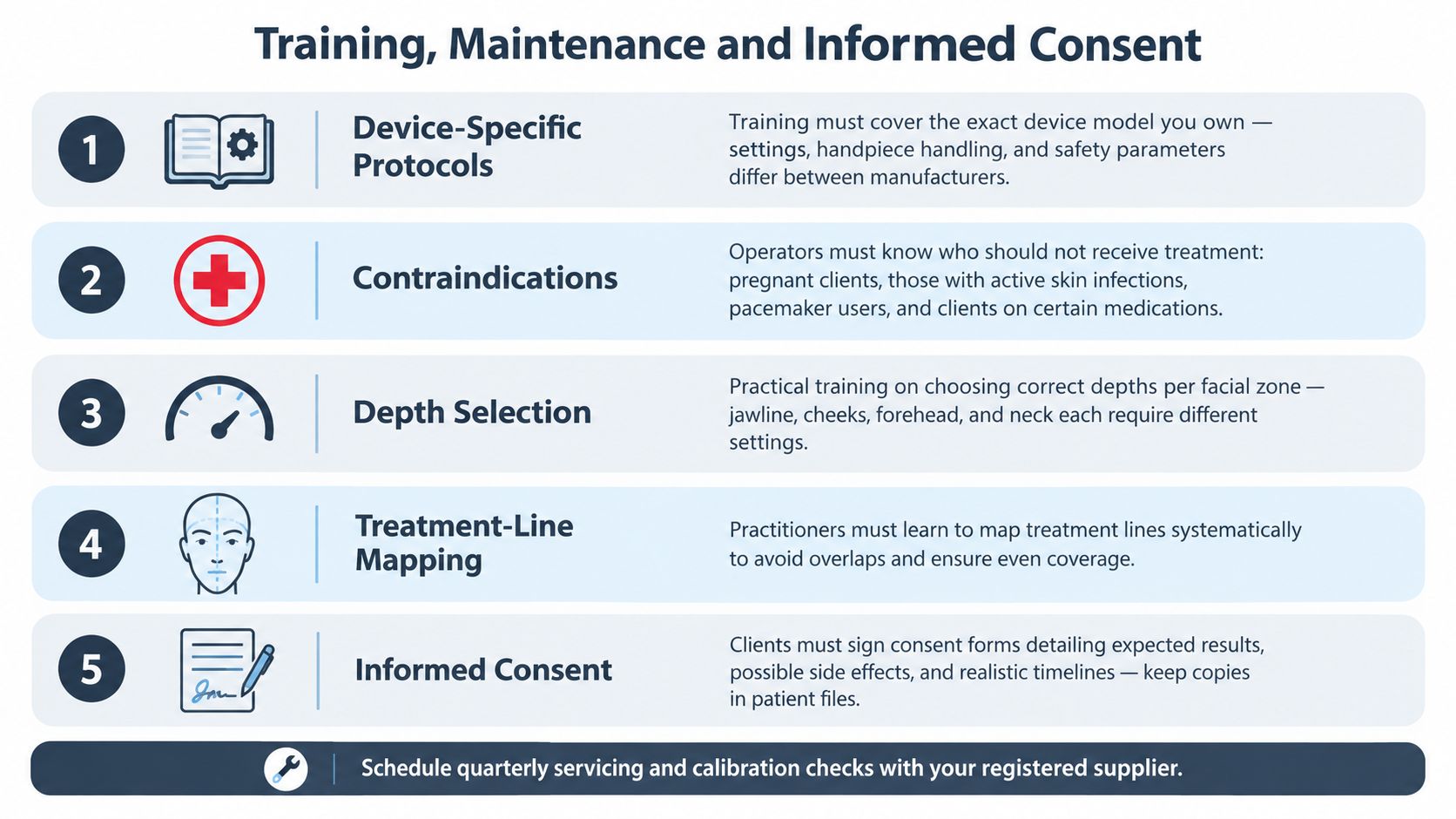
A good HIFU purchase fails without trained hands. Device-specific training should cover the exact model installed, not a generic overview, because settings, handpiece handling, and protocol logic differ from one platform to another. Operators also need to understand contraindications, depth selection, treatment-line mapping, aftercare, and how to respond when a client reports discomfort or delayed tenderness.
The maintenance side is just as practical. Cartridge inventory needs to be tracked, handpieces need care, calibration has to be checked, and software updates should not be treated as an afterthought. A clinic that ignores servicing ends up with inconsistent treatments, avoidable downtime, and arguments about warranty.
Training and maintenance feed directly into informed consent. A clinic with a standard script can explain realistic timelines, expected redness or tenderness, and the fact that non-invasive doesn't mean risk-free. South African clinical research on ultrasound-guided HIFU in Black women reported procedure-related symptoms including 69.2% lower-abdominal pain, 57.7% sciatic or buttock pain, 38.5% burning skin, and 34.6% transient leg pain, with no severe complications observed (PubMed). Those figures relate to therapeutic use, not cosmetic facial HIFU, but they still underline the same point, energy delivery and operator technique matter.
A clinic that cuts corners on training usually pays later in complaints, weak repeat bookings, or overpromised outcomes. The cleaner path is simple, train properly, document properly, and maintain the device properly. That is what keeps the treatment credible and the client conversation calm.
Your HIFU Buying Checklist and Next Step
A serious buyer should tick off SAHPRA status, professional supply, documented cartridge shot life, energy calibration evidence, included training, warranty terms, local service, and a transparent running-cost model before paying any deposit. If even one of those is vague, the machine is not ready for a South African clinic floor.
Omega Lasers supplies professional HIFU machines with training and local support, and it also provides related resources on financing options and skin tightening laser systems. For a personalized conversation about a HIFU setup that fits a clinic's menu and compliance requirements, enquire at Omega Lasers.
Omega Lasers can help a clinic compare HIFU configurations, support the compliance conversation, and structure the purchase around real operating costs instead of brochure claims. Visit Omega Lasers to start that discussion and put the buying decision on solid ground.