



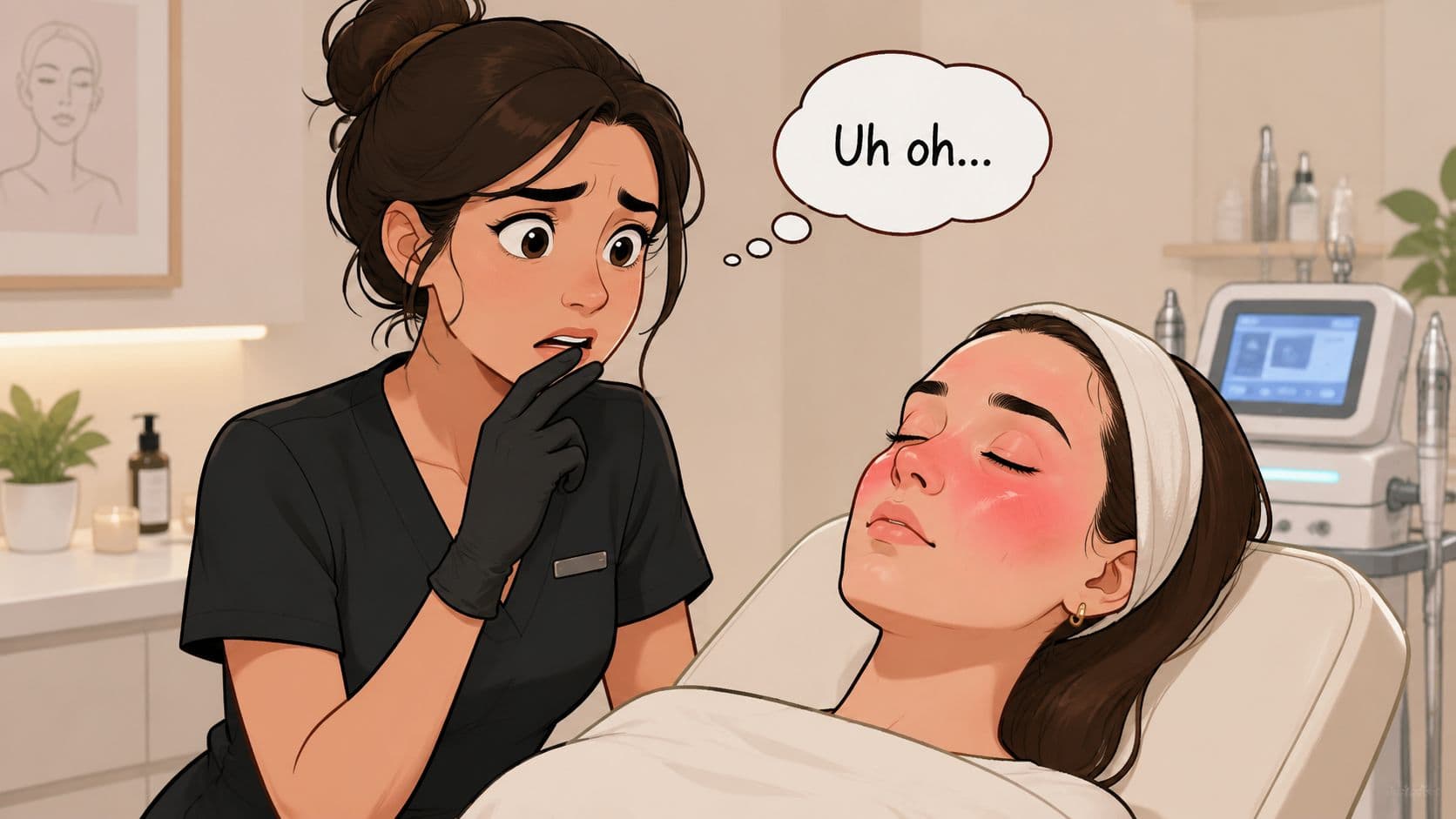
You've got a consent form signed, your therapist is trained, the laser was serviced, and the treatment looked routine. Then the client phones the next morning. Her skin is inflamed, she says the reaction is worse than expected, and by afternoon she's demanding payment for corrective care and threatening to post everything online.
That's the moment many clinic owners realise they've been thinking about risk too narrowly. In aesthetics, the exposure isn't only the device, the room, or the treatment bed. It's also the consultation, the assessment, the treatment choice, the settings selected, the aftercare advice given, and every statement made about likely outcomes.
For a South African clinic using lasers, IPL, radiofrequency, HIFU, skin needling, resurfacing systems, or combination protocols, professional indemnity is what sits behind the professional judgement chain. If a client says your advice, decision, omission, or treatment recommendation caused loss, this is the cover that matters.
Table of Contents
- Why Professional Indemnity Is Non-Negotiable for Your Clinic
- Understanding Professional Indemnity for Aestheticians
- Professional Indemnity vs Public Liability Insurance
- Analysing Your Policy Cover and Common Exclusions
- Real-World Claims Scenarios for Aesthetic Clinics
- Choosing the Right Professional Indemnity Policy
- Professional Indemnity FAQ for Omega Lasers Users
Why Professional Indemnity Is Non-Negotiable for Your Clinic
When a routine treatment becomes a claim
A client books laser hair removal after a patch test and consultation. The treatment is completed, she leaves happy, and your notes seem adequate. A week later, she alleges the settings were too aggressive for her skin condition, says she wasn't warned properly about sun exposure risk, and claims she's now missed work and paid for medical treatment elsewhere.
That dispute isn't just about skin response. It becomes a question of professional judgement. Did your team assess correctly, explain properly, document warnings, and stay within competence? That's where professional indemnity starts doing its job.
In South Africa, this matters because clinics don't just sell treatments. They sell expertise. Professional indemnity policies typically respond to claims involving negligence, breach of duty of care, and related financial loss arising from specialist advice or services. In a treatment environment built on consultation, device choice, parameter selection, contraindication screening, and aftercare instruction, the professional service is the product.
Why aesthetics creates professional risk
Aesthetics is full of grey areas that insurers care about. The client may say the problem was the procedure. The clinic may believe the issue came from undisclosed medication use, poor aftercare compliance, or unrealistic expectations. But once a complaint is framed as an error, omission, or failure to advise, you're in professional indemnity territory.
Practical rule: If the complaint starts with “you should have told me”, “you should have noticed”, or “you should not have treated me”, treat it as a professional risk issue immediately.
The reason this class of insurance exists at scale is simple. Once advice and specialist services become commercial, disputes follow. The UK professional indemnity market is estimated at £3.3 billion with about 1.5 million policyholders, which shows how broad the insured risk pool becomes when professional advice and technical service delivery are monetised according to this professional indemnity market overview.
For clinic owners, the commercial trade-off is straightforward:
- Without proper PI cover: One serious allegation can drain cash through legal fees, complaint handling, refunds, and time away from operations.
- With weak PI cover: You may still face a denied claim if your policy wording doesn't match the treatments you perform.
- With suitable PI cover and disciplined operations: You give the insurer a claim they can work with, rather than a file full of gaps.
A good clinic doesn't buy professional indemnity because it expects to fail. It buys it because even competent teams get accused, and a modern aesthetic clinic can't afford to defend professional decisions using operating cash.
Understanding Professional Indemnity for Aestheticians
What the cover is actually for
For an aesthetic clinic, professional indemnity is best understood as malpractice-style protection for your advice, procedural judgement, and service decisions. It's not mainly about the chair in reception, the front door, or the shelving unit falling over. It's about what happens when a client says your professional service caused harm or loss.
That can include an allegation that you:
- chose the wrong treatment,
- missed a contraindication,
- used inappropriate settings,
- gave poor aftercare advice,
- overstated expected results, or
- failed to refer out when you should have.
This is why professional indemnity differs from generic business cover. Aesthetic work combines hands-on procedures with consultation-led decision-making. The claim often turns on what was said, what was recorded, and whether the treatment pathway was clinically defensible.
If you want a plain-English legal reference for the idea behind malpractice, Porter Law Group's malpractice definition is a useful starting point because it frames the issue around professional conduct rather than ordinary accidents.
Who in the clinic needs cover
Many clinics run into trouble. They assume the business has one policy, so everyone is protected. Sometimes that's true. Often it isn't.
A key challenge in aesthetics is working out who needs professional indemnity. Existing guides often leave a gap around non-medical aestheticians, clinic managers, and mobile technicians, even though the cover is designed for claims arising from professional services as noted in this guide on professional indemnity for small businesses.
Ask these questions before you assume your setup is covered:
- Employee or independent contractor: If a therapist rents a room or works under a contractor arrangement, don't assume your clinic policy automatically covers that person's acts.
- Treatment role or admin role: A clinic manager who gives treatment advice, sells packages based on skin assessment, or handles complaint responses may create professional exposure even if they don't hold the handpiece.
- Fixed clinic or mobile service: Mobile operators often create extra uncertainty around policy territory, treatment environment, transport of equipment, and supervision.
- Single modality or mixed-service clinic: A business doing facials only has a different risk profile from a clinic combining laser, injectables support, peels, skin tightening, and pigmentation work.
Cover should map to the real service model, not the version of the business described in a rushed proposal form.
What negligence error and omission look like in practice
In clinic language, these terms are less abstract than they sound.
| Term | What it looks like in a clinic |
|---|---|
| Negligence | Treating despite a clear contraindication or failing to act with reasonable skill and care |
| Error | Selecting the wrong protocol, parameter range, or treatment interval |
| Omission | Failing to document Fitzpatrick assessment, medication history, patch test outcome, or aftercare warning |
The operational lesson is simple. The higher the reliance on judgement, the stronger the need for professional indemnity. Lasers and energy-based devices don't remove that need. They increase it, because the treatment path depends on competent assessment, safe use, and accurate client communication.
Professional Indemnity vs Public Liability Insurance
The difference comes down to the trigger
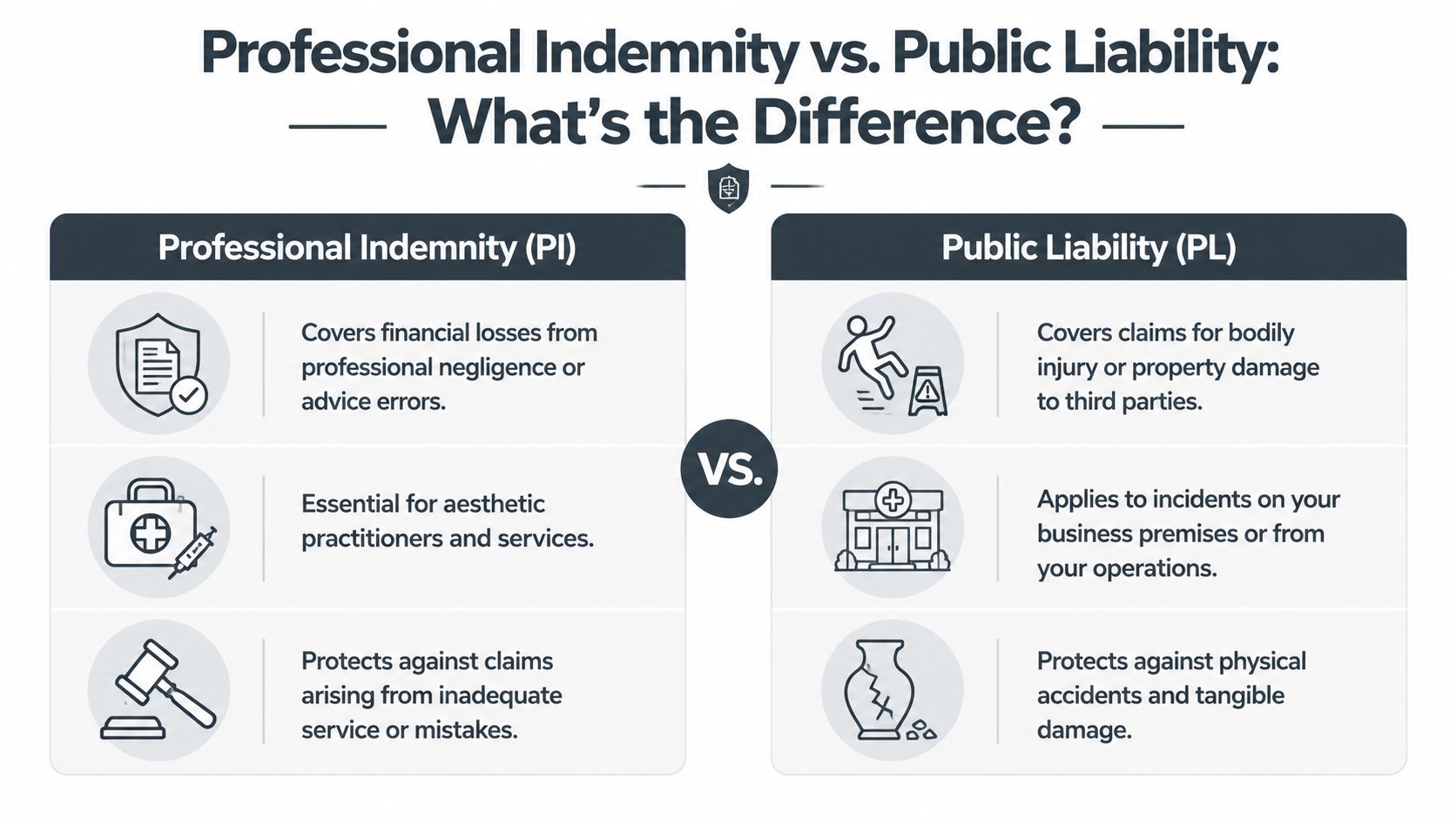
Clinic owners mix these two covers up all the time because both deal with claims. The cleanest way to separate them is this: public liability responds to accidental bodily injury or property damage involving third parties, while professional indemnity responds to allegations tied to your professional service, advice, or treatment judgement.
If a client slips on a wet floor in reception, that's a public liability type of event. If a client says your laser consultation was poor, your settings were inappropriate, or your aftercare advice was inadequate, that's a professional indemnity issue.
The confusion gets worse in aesthetics because one incident can contain both elements. A client may suffer a physical injury, but the legal argument can still focus on professional judgement. That's why treating laser and skin clinics as if ordinary premises cover is enough usually ends badly.
A practical example. If a team member stores eyewear badly and a client trips over equipment left in a walkway, you're looking at public liability territory. If the actual complaint is that the clinic failed to use appropriate protective measures during treatment, the analysis shifts. Clinics that use lasers should treat protective equipment as part of the service standard, not an afterthought, and that includes maintaining proper laser safety glasses for treatment environments.
Side by side comparison
| Question | Professional indemnity | Public liability |
|---|---|---|
| What triggers the claim | Alleged negligence, error, omission, poor advice, misstatement, failure in professional service | Accident causing bodily injury or property damage |
| What the client is saying | “Your treatment decision or advice caused my loss” | “I was physically injured on your premises or by your operations” |
| Typical clinic examples | Wrong treatment selection, poor consent process, inadequate aftercare advice, disputed laser settings | Slip in reception, falling equipment, accidental property damage |
| Why it matters in aesthetics | Clinics are advice-heavy and procedure-heavy | Clinics also operate public-facing premises |
| Can you need both | Yes | Yes |
A burn allegation isn't automatically a public liability claim. If the dispute turns on assessment, consent, settings, supervision, or advice, it's usually a professional indemnity problem first.
What works is buying both covers with clear wording and making sure the broker or insurer understands the exact treatments you provide. What doesn't work is relying on generic salon insurance for a clinic running high-risk device-led services.
Analysing Your Policy Cover and Common Exclusions
What a clinic owner should read first
Most clinic owners flip straight to the sum insured and premium. That's understandable, but it's not where the fundamental risk sits. The parts that matter most are the insuring clause, the definition of professional services, the claims-made wording, and the exclusions.
Professional indemnity is designed to cover claims for financial loss arising from an act, error, or omission in professional services, and these policies are typically structured to cover legal defence costs, settlements, and judgments tied to alleged professional negligence. Pricing can vary from 0.25% to 5% of fee income or turnover, which shows how strongly underwriting responds to complexity, severity, and documentation quality in this professional indemnity claims and pricing overview.
If policy wording makes your eyes blur, use a plain-language guide to read an insurance policy before renewal discussions. It won't replace advice, but it helps you spot where your actual treatments and the listed professional services don't line up.
Exclusions that matter in device-led clinics
A clinic using lasers or energy-based devices should read exclusions with unusual care. In this context, otherwise solid businesses discover they've insured a simplified version of themselves.
Common problem areas include:
- Unlisted treatments: If your schedule includes resurfacing, vascular work, pigment correction, skin tightening, tattoo removal, or combination protocols, each service should fit within the professional services description.
- Unapproved or non-compliant equipment: If there's any question around device compliance, import status, or regulatory standing, expect scrutiny after a claim.
- Practitioner competence: Insurers often care whether the person who performed the treatment was trained and authorised for that modality.
- Guarantees of outcome: “Guaranteed clearance”, “zero downtime”, or “completely safe for all skins” can create avoidable exposure.
- Poor records: Weak consultation notes make it much harder to defend what happened and why.
In some regulated professions, professional indemnity is mandatory. For aesthetic practitioners it may not always be legally required in the same formal way, but insurers and clients increasingly treat it as a baseline standard of professional practice. That means the policy isn't just about buying cover. It's part of how your clinic demonstrates seriousness and competence.
The claims-made issue clinics miss
Many clinic owners only learn what “claims-made” means after they change insurer or let a policy lapse. In simple terms, the policy in force when the claim is made is often what matters, not the policy you had when the treatment was performed.
That has two big consequences:
- Continuous cover matters. A gap between policies can create a serious reporting problem.
- Retroactive dates matter. If your retroactive cover is restricted, older treatments may sit outside the policy response.
The file that wins a defence is rarely the clinic with the best memory. It's the clinic with the best records.
For aesthetics, that means maintaining consult forms, photographs where appropriate, patch test evidence, treatment settings, signed consent, aftercare instructions, and complaint logs in an organised system. Strong record-keeping processes for clinics don't just help with compliance. They can be the difference between a defendable claim and an expensive settlement.
Real-World Claims Scenarios for Aesthetic Clinics
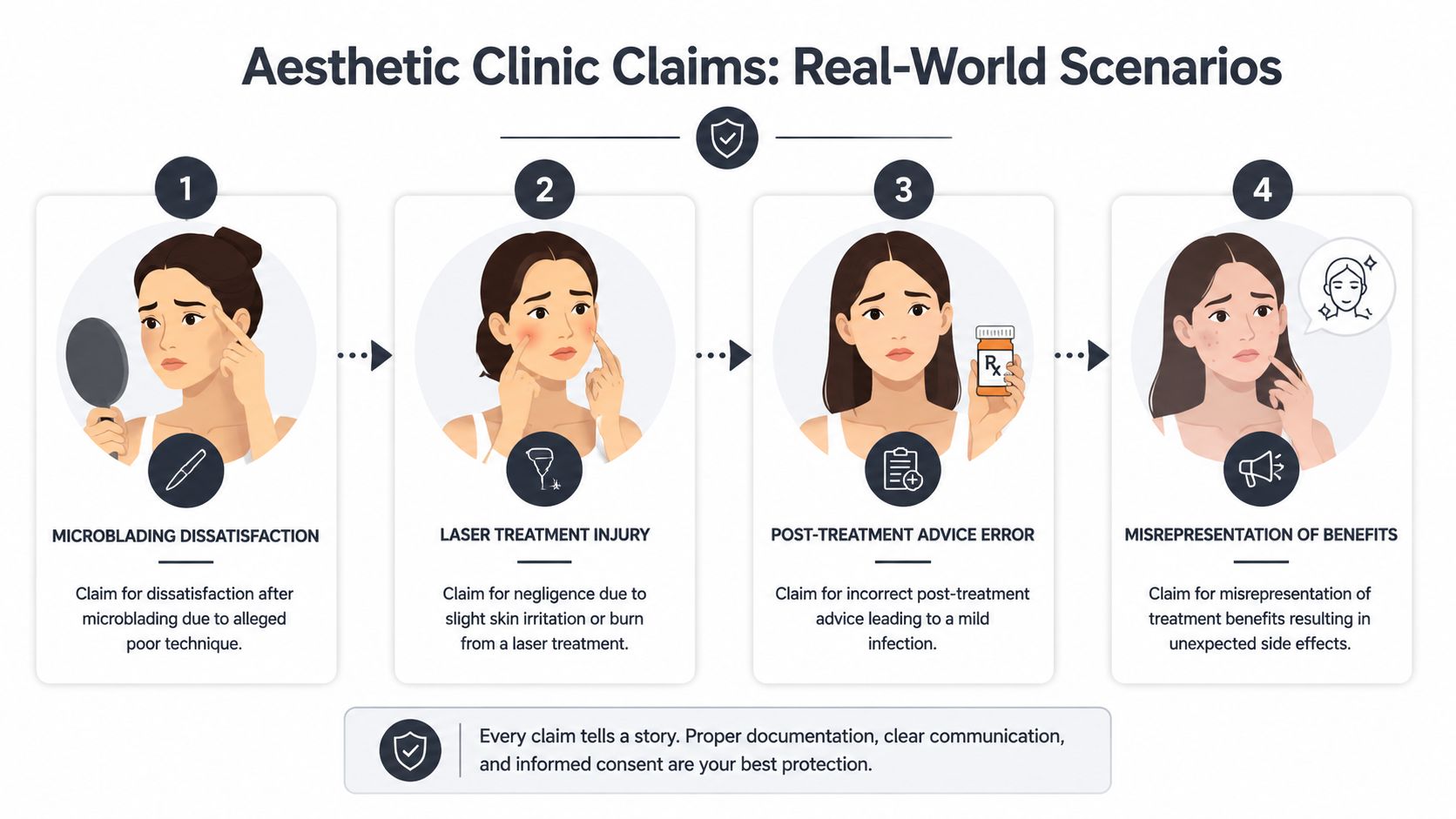
Scenario one the consultation problem
A client books a pigment treatment after seeing before-and-after photos on social media. During consultation, she mentions recent sun exposure casually, but the significance isn't explored properly. She later develops a poor outcome and says the clinic should never have treated her that day.
This is a classic professional indemnity dispute. The argument isn't only about what the skin did. It's about whether the consultation was competent, whether the contraindications were handled properly, and whether postponement should have been advised.
Scenario two the settings dispute
A laser hair removal client says the treatment caused blistering. The therapist says the settings were selected conservatively and the client denied recent tanning. The notes are brief, the patch test entry is incomplete, and there's no clear record of the exact warnings given.
Here, the policy may help with defence costs and any settlement path, but the clinic has made life harder for itself. When a settings dispute lands, the insurer wants to see a rationale. Why these parameters, for this skin, on this date, under these conditions?
Scenario three aftercare goes wrong
A resurfacing client receives verbal aftercare instructions but no written version. She uses active skincare too early, develops complications, and alleges that the clinic failed to warn her properly.
The treatment may have been competently performed. The claim still has legs if the advice process was weak. This is why infection prevention, healing guidance, and escalation instructions must be documented. Clinics that maintain strong infection control standards usually perform better not only clinically, but also when a complaint becomes a file.
Small documentation gaps create large credibility problems once lawyers get involved.
Scenario four the promise that became evidence
A client buys a premium package after being told she is an “ideal candidate” and should expect a particular level of improvement. Her outcome is modest. She now alleges misrepresentation and says she wouldn't have proceeded if the limitations had been accurately explained.
This kind of claim often surprises owners because the treatment itself may have been technically sound. But professional indemnity doesn't only respond to handpiece errors. It can also come into play when the complaint is about recommendation, representation, or failure to set proper expectations.
What works in the real world is dull but effective: cautious wording, conservative promises, documented consent, and escalation pathways when a result starts drifting off track. What doesn't work is relying on verbal reassurance and hoping a satisfied majority will protect you when one file turns hostile.
Choosing the Right Professional Indemnity Policy
Build the policy around your treatment map
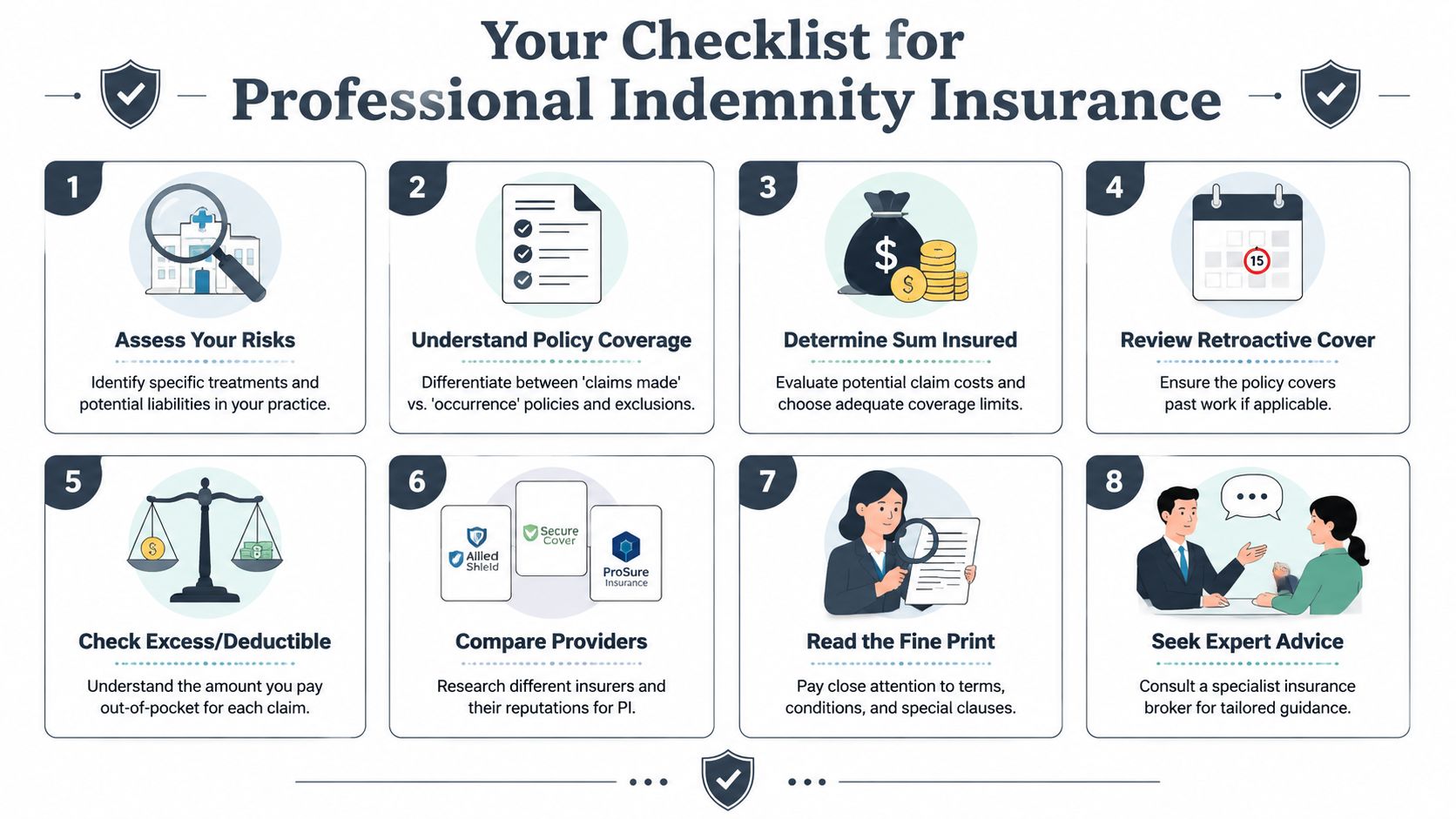
The right professional indemnity policy starts with an honest map of what your clinic does in practice. Not the brochure version. The operational version.
List every treatment category, every device class, every practitioner type, and every location where services are delivered. A clinic offering facials, peels, microneedling, laser hair removal, vascular work, skin rejuvenation, and body contouring has a different professional risk profile from a simple beauty room. Insurers price that difference.
One useful pricing benchmark from professional indemnity markets is that rates can vary from 0.25% to 5% of turnover, reflecting how much underwriting changes with service complexity and risk management quality. For clinics, that's the commercial signal: better training, tighter protocols, and stronger documentation can improve how the risk is viewed.
Questions that change the quality of the cover
Don't just ask “What does it cost?” Ask questions that expose whether the policy fits your clinic.
What treatments are expressly covered
Ask for the treatment scope in writing. If your business evolves faster than your annual renewal, update the insurer before adding new procedures.
Who is insured
Make sure the answer deals with employees, locums, contractors, trainees, and anyone who consults or advises clients.
Is the policy claims-made
If it is, ask how the retroactive date works and what happens if you switch insurers, pause trading, or sell the clinic.
Are defence costs inside or outside the limit
This affects how much protection remains if a claim becomes expensive to defend.
What is excluded
Ask specifically about high-energy devices, combination treatments, delegations, remote advice, and advertising representations.
Buy cover for the treatments you'll defend in real life, not for the neat category label on a proposal form.
A separate point matters in regulated professions generally. PI can function as a compliance control rather than a discretionary purchase. In auditing, for example, recognised rules require practitioners to maintain indemnity insurance and often align cover expectations with fee income under these professional indemnity insurance requirements. Aesthetic clinics aren't identical, but the lesson carries across. As your clinic grows, low limits and casual renewals become harder to justify.
Presenting your clinic as a good risk
Insurers respond better when a clinic can show operational discipline. The strongest proposal packs usually include:
- Training evidence: Keep modality-specific certificates current and easy to produce.
- Device governance: Maintain service logs, calibration records, and usage protocols.
- Consent discipline: Use forms that match the actual treatment and list meaningful risks.
- Complaint handling: Show that incidents are logged, escalated, and reviewed.
- Scope control: Don't let unqualified staff drift into consultation or treatment decisions beyond their competence.
Clinics often waste money by underinsuring the hard parts and overinsuring the easy ones. The best buying decision is rarely the cheapest premium. It's the policy that matches your risk reality, keeps continuity intact, and won't collapse under scrutiny after a serious complaint.
Professional Indemnity FAQ for Omega Lasers Users
Does device compliance help with insurance
Yes, usually in a practical sense. Insurers want to see that a clinic uses compliant, professionally supported equipment and can show proper training, servicing, and operating protocols. A device with recognised regulatory standing doesn't guarantee cover and doesn't remove the need for good clinical judgement, but it does support a cleaner underwriting story than undocumented or questionable equipment.
For a South African clinic, that matters because claims involving advanced devices often pull in multiple issues at once. The insurer may look at the treatment choice, the operator's competence, the maintenance history, the warnings given, and whether the equipment was suitable for lawful, professional use.
Is a warranty the same as professional indemnity
No. They solve different problems.
A warranty is about the machine. It may deal with repair or replacement issues depending on the terms. Professional indemnity is about your professional service. If a client alleges negligence, poor advice, wrong settings, inadequate consent, or failure to warn, a machine warranty doesn't defend that allegation for you.
The same applies to technical support. Useful support helps you run a safer clinic. It doesn't replace insurance for the professional decisions your team makes with the device.
What if the market becomes harder
That can happen faster than many clinic owners expect. A useful warning comes from the Australian professional indemnity cycle. The average premium per risk rose from A$2,116 in March 2013 to A$8,503 in June 2022, then eased to about A$2,286 by September 2025, with the source also noting insurers typically need to charge about $1 for every 70 cents of claims incurred to break even in this Insurance Council of Australia submission.
The lesson for aesthetic clinics is practical, not theoretical. If claims pressure rises and insurer appetite shrinks, premiums can move sharply and underwriting gets stricter. The clinics that cope best are the ones that already have disciplined records, stable claims histories, continuous cover, trained operators, and defensible treatment governance.
A final point. If you use advanced lasers and energy-based devices, don't wait for renewal to think about professional indemnity. Review cover whenever your treatment mix changes, whenever you hire new practitioners, and whenever you add a higher-risk modality. That's how you keep insurance aligned with the clinic you run.
If you're building or upgrading a clinic around advanced aesthetic technology, Omega Lasers can help you strengthen the parts insurers care about most: compliant devices, credible training, safer treatment delivery, and operational support that stands up under scrutiny.