



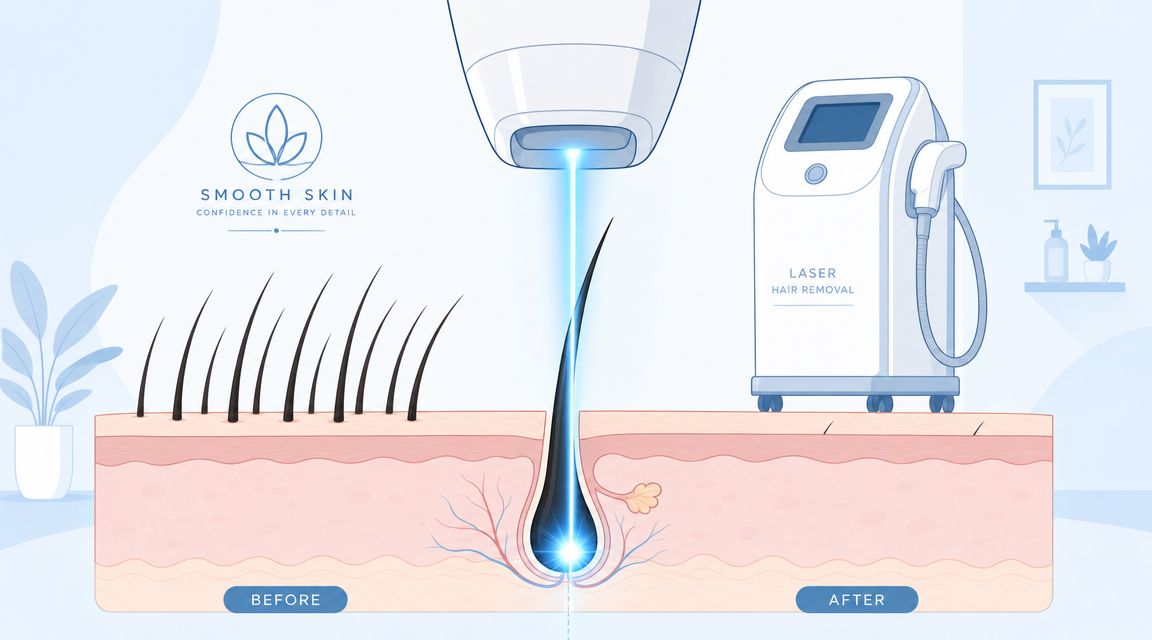
Most advice on permanent hair removal starts in the wrong place. It starts with smooth skin, convenience, and sales language. A professional conversation should start with accuracy.
If you run an aesthetic clinic in South Africa, the phrase that matters most is not “hair removal”. It's permanent hair reduction. That distinction shapes your consultation, your consent process, your device choice, your safety settings, and your long-term client retention. Clinics that promise total eradication create complaints. Clinics that explain durable reduction create trust.
A good hair service isn't built on the fantasy of zero regrowth forever. It's built on consistent protocols, realistic planning, and clear positioning in a regulated medical-aesthetic environment.
Table of Contents
- The Truth About Permanent Hair Removal
- How Hair Removal Technology Actually Works
- Comparing Hair Removal Modalities
- Patient Selection and Safety Protocols
- Clinic Operations and Regulatory Compliance
- Executing the Perfect Treatment Protocol
- Building a Profitable Service with Realistic Outcomes
The Truth About Permanent Hair Removal
The most common industry mistake is treating permanent hair removal and permanent hair reduction as if they mean the same thing. They don't.
Clinical guidance used in consumer education makes the point clearly. Laser treatment is better described as permanent hair reduction, not complete or guaranteed permanent removal, and it commonly requires 6 to 8 sessions plus maintenance. It also notes that outcomes depend heavily on hair colour, hair thickness and growth phase, with dark, thick hair responding best (clinical overview on body areas and expectations).
Why the word permanent causes problems
When a clinic markets absolutes, clients hear one message: “I'll never see hair there again.” That isn't a clinically responsible expectation to create.
A stronger consultation sounds different. You explain that the service is designed to produce long-term reduction in regrowing hair after a professional course. You explain that some areas respond faster than others. You explain that maintenance is not failure. It's part of honest treatment planning.
Practical rule: If your marketing says “permanent”, your consultation must define what that word means before the client signs consent.
This matters even more in South Africa, where clinics serve a very mixed patient base across skin tones, hair types, hormonal patterns, and treatment areas. The underarm client with coarse dark hair is not the same case as the facial-hair client with finer growth and more reactive skin. If your team uses one promise for both, you'll create avoidable dissatisfaction.
What clients should hear in consultation
A useful consultation doesn't sell certainty. It sells predictability.
Clients usually respond well when you say:
- Reduction, not erasure: The goal is a meaningful and durable decrease in hair growth, density, and treatment frequency.
- A course is required: One session won't address every follicle because not all hairs are biologically available to target at the same time.
- Results vary by profile: Hair colour, thickness, body area, and skin response all shape the pace of visible progress.
- Maintenance is normal: Some clients will need occasional follow-up treatments to keep the result stable.
That language protects both parties. It also improves conversion because it sounds informed rather than exaggerated.
Many clinics worry that precision will weaken the sale. In practice, the opposite usually happens. Once clients understand what “permanent” can realistically mean, they stop asking whether the treatment works and start asking the more useful questions: how much regrowth is normal, how long a course may take, and whether their skin and hair profile are well suited.
That is the point where your team stops sounding like a beauty counter and starts sounding like a professional treatment provider.
How Hair Removal Technology Actually Works
A client doesn't need a physics lecture. But your team does need a clear, repeatable explanation that's scientifically correct and easy to say out loud.
Selective photothermolysis in plain language
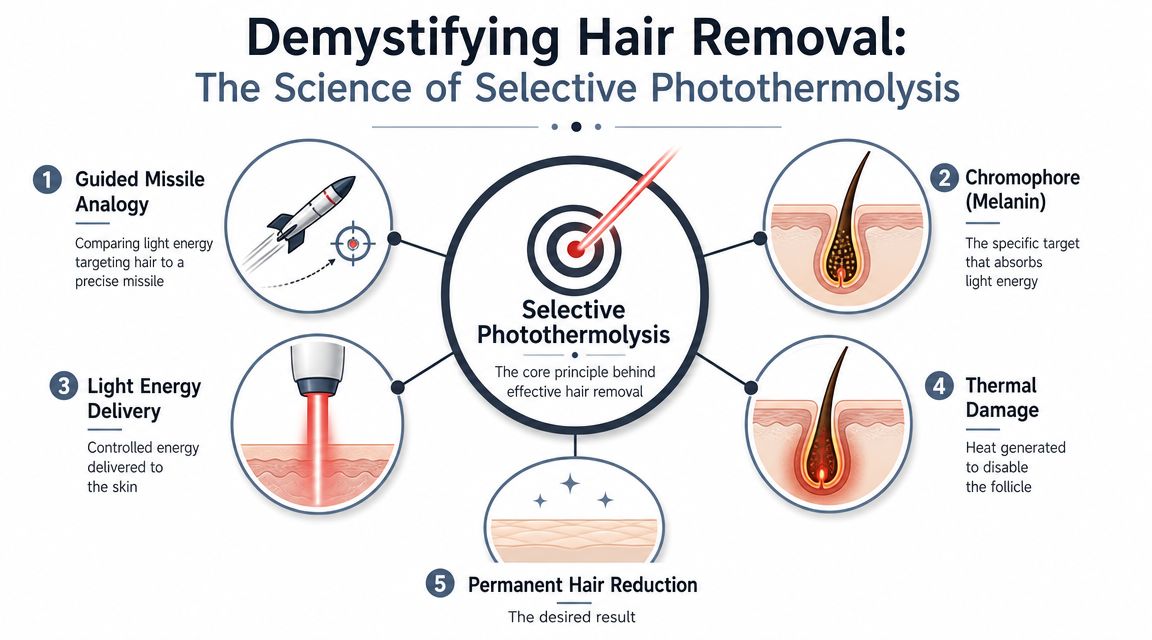
Laser hair reduction works through selective photothermolysis. In practical terms, the system delivers light at a wavelength and pulse duration designed so that melanin in the hair shaft and follicular epithelium absorbs the energy, converts it to heat, and damages the follicle while limiting injury to surrounding skin. A clinical review notes that commonly used hair-removal wavelengths span roughly 600 to 1200 nm, and that the hair matrix is most responsive during the anagen phase (StatPearls review of laser hair removal).
The easiest way to explain this to a client is to call it a smart heat-seeking target system. The target is pigment in the hair structure. The operator's job is to choose settings that concentrate enough thermal effect in the follicle without pushing unsafe heat into nearby skin.
That's why hair with stronger contrast often responds better. The device has a clearer target. It's also why parameter choice matters so much on darker skin. You still need follicular heating, but with more caution around competing epidermal melanin.
If a client wants a quick consumer-friendly explanation of a laser hair removal treatment, that kind of general overview can help frame the basics. Your consultation should then go further and translate the science into device choice, treatment spacing, and safety boundaries for that individual.
Why timing matters more than clients realise
The biology of the hair cycle is what makes this a course, not a once-off procedure.
Only follicles in the right growth stage can be targeted effectively. That's why a client can leave after a strong session, see shedding, and still grow visible hair later from follicles that weren't in the right phase during treatment. This is normal biology, not treatment failure.
Hair removal protocols succeed when operators respect the hair cycle instead of chasing immediate visual clearance.
This one point changes how you schedule, how you package, and how you manage expectations:
- Sessions need spacing: If you treat too early, you may catch fewer useful targets.
- Coverage isn't the whole story: Even perfect overlap and strong technique can't force every follicle into the same growth phase.
- Progress is cumulative: The visible endpoint comes from repeated disruption over time.
Electrolysis takes a different route because it treats follicles individually rather than relying on broad light absorption. That can make it useful in selected cases, especially where pigment targeting is weak. But it also creates a very different workflow, treatment speed, and operator burden. For most clinics, the practical decision isn't “which method is permanent?” It's “which modality fits our patient mix, our time model, and our safety competence?”
Comparing Hair Removal Modalities
Not every hair removal modality solves the same problem. Some are built for speed. Some are built for selectivity. Some are better at broad-area throughput, while others suit detail work.
For clinic owners, the right comparison is not marketing label versus marketing label. It's clinical fit versus business fit.
Where laser, IPL and electrolysis differ in practice
Modern laser platforms are the benchmark most clinics use when they want predictable professional hair reduction across common treatment areas. A clinically useful benchmark is that modern laser systems are commonly associated with roughly 70% to 90% hair reduction after a complete professional course, with many protocols requiring 6 to 8 sessions spaced about 4 to 6 weeks apart. Some clinical overviews also report around 80% reduction in hair growth in patients with fair skin and dark hair (clinical benchmark overview).
That figure is useful operationally because it gives your team language for consultations. It doesn't mean every client gets the same endpoint. It means the service should be sold as a documented, session-based reduction model.
Laser is usually the strongest fit when the clinic wants:
- Scalable treatment flow: Larger areas can be worked far more efficiently than follicle-by-follicle methods.
- A repeatable package structure: Session scheduling is easier to standardise.
- Broad commercial appeal: Clients already understand the category and often request it directly.
IPL sits in the same general conversation but not in the same category of selectivity. It uses broad-spectrum light rather than a single laser wavelength. In practice, that means you need disciplined patient selection and realistic indications. If your clinic is reviewing IPL as part of its service menu, this overview of intense pulsed light hair removal is useful for understanding where it may fit and where it may not.
Electrolysis remains relevant, but for a different reason. It is often considered when hair lacks enough pigment for light-based targeting or when the treatment zone is small and highly specific. The trade-off is time. Every follicle demands individual attention. That changes staffing, scheduling, and profitability.
Modality Comparison for Permanent Hair Reduction
| Modality | Best for Skin Types (Fitzpatrick) | Efficacy on Fine/Light Hair | Treatment Speed | Typical Sessions |
|---|---|---|---|---|
| Laser | Depends on wavelength selection and operator skill. Strong option for a wide clinical range when matched correctly to skin and hair profile | Limited when pigment is low. Stronger on dark, thicker hair | Fast on larger body areas | Commonly 6 to 8 sessions for a professional course, spaced 4 to 6 weeks apart in many protocols |
| IPL | More selective use is advisable because broad-spectrum light offers less targeted energy delivery than laser | Generally less favourable where hair is very fine or light | Moderate on large areas | Usually requires a course-based approach rather than one session |
| Electrolysis | Can be considered across skin types because it does not depend on melanin targeting in the same way | More suitable than light-based methods when hair has minimal pigment | Slow, as follicles are treated individually | Usually requires repeated appointments over time |
How to choose for your clinic model
A single-device mindset often leads to poor purchasing decisions. Start with your case mix instead.
If your diary is dominated by underarms, bikini, legs, backs, and chest work, throughput matters. If your enquiries lean toward facial detail, resistant growth patterns, or cases with limited pigment contrast, your operating model needs more nuance.
Use a simple filter:
- Who is your main client? Broad-area body client, facial-hair client, mixed aesthetic patient, or medically cautious referral case.
- What makes money in your rooms? Fast turnover, premium consultative care, or a blend of both.
- What can your team execute safely every day? The most profitable platform on paper is the wrong purchase if the operators can't use it consistently.
A clinic owner should also ask a harder question: will this modality reduce complaints? The answer often matters more than the headline treatment category. The safer, clearer, better-explained service usually outperforms the flashier one over time.
Patient Selection and Safety Protocols
The fastest way to damage a hair service is to treat every enquiry as suitable. Good hair reduction starts with exclusion, not inclusion.

Good outcomes start before the first pulse
A strong consultation does three jobs at once. It checks suitability, maps risk, and sets realistic expectations.
That means your assessment should cover:
- Medical history: Ask about conditions, current medication, previous reactions to energy-based treatments, and any tendency toward problematic pigmentation.
- Skin state on the day: Recent sun exposure, irritation, inflammation, or barrier disruption should change your plan or delay treatment.
- Hair profile: Colour, calibre, density, and area all influence how worthwhile the treatment is likely to be.
- Expectation quality: Some clients are suitable physically but unsuitable behaviourally because they still expect impossible outcomes.
Patch testing belongs in this process. Not as a box-ticking exercise, but as a practical way to assess skin response, comfort, and endpoint behaviour before committing to a full-area session.
Clinical judgement: A “treatable” client and a “good candidate” are not always the same person.
The Fitzpatrick framework remains useful because it forces operators to think about pigment risk before they think about power. On darker skin, the epidermis competes more actively for energy. That doesn't rule treatment out. It means wavelength choice, fluence strategy, cooling, and operator discipline matter more.
A clinic that serves the South African market well must be competent on diversity, not just familiar with it.
Darker skin and facial areas need stricter judgement
A peer-reviewed review on facial laser hair reduction highlights why facial work deserves more caution. Poor outcomes can include hyperpigmentation and paradoxical hypertrichosis, which is new or increased hair growth, and mitigation includes wavelength or device choice, cooling, and technique adjustments (peer-reviewed review on facial laser hair reduction).
Facial areas are where oversimplified sales messaging usually fails first. Fine hair, hormonally influenced growth, and visible skin reactions create a different risk profile from body treatments. That doesn't mean avoid facial work. It means counsel better and treat more selectively.
Your safety protocol should be unmistakable:
- Confirm indication quality: Not every facial hair complaint is an ideal laser indication.
- Select conservative parameters where appropriate: Especially when skin reactivity or pigment competition is a concern.
- Use effective cooling and disciplined technique: Comfort and epidermal protection are part of the treatment, not optional extras.
- Document response carefully: Facial cases often need closer review and more expectation management.
If your team needs structured operator education, formal laser hair removal course training helps standardise judgement across consultations, patch testing, treatment delivery, and complication prevention.
The clinics that build strong reputations in hair reduction are not the ones that treat the greatest number of clients. They're the ones that know when to proceed, when to modify, and when to say no.
Clinic Operations and Regulatory Compliance
A hair service becomes commercially stable when the clinical side and the regulatory side support each other. If they don't, the service stays fragile no matter how busy the booking book looks.
Compliance is part of the treatment result
In South Africa, permanent hair reduction is regulated as a medical-aesthetic laser use case, not a casual beauty add-on. The relevant framework expects local licensing and oversight, and the clinical meaning of “permanent” is a long-term, stable reduction in regrowing hairs after a treatment course. That foundation traces back to the first FDA approval in 1997 and reinforces why device quality and proper treatment planning matter in practice (regulatory and clinical background on laser hair removal).
This changes how a clinic should think about procurement. You aren't buying a trend treatment. You're adding a regulated energy-based service that affects consent, training, records, maintenance, and claim language.
For that reason, compliance should sit inside your operational model:
- Device legitimacy: Verify that the platform fits the regulatory expectations of your market.
- Operator competence: Training must cover more than button pushing.
- Maintenance discipline: A good treatment result depends on a machine performing as intended over time.
- Documentation: Consult notes, parameters, patch testing, adverse responses, and aftercare advice should all be traceable.
What to evaluate before buying a device
Most buyers focus too narrowly on headline output. That's incomplete.
A more useful purchasing checklist looks like this:
- Fit to patient mix: Can the system serve the skin tones and hair profiles you see?
- Workflow practicality: Does it support efficient treatment flow for the areas your clinic sells most often?
- Training and support: Can your team get competent quickly and stay competent?
- Service reliability: Downtime damages trust faster than almost anything else in a high-repeat treatment category.
- Commercial clarity: Can you build ethical packages and consultation scripts around the device's real capabilities?
This is the one place where a named supplier can matter. A provider such as Omega Lasers may be considered when a clinic wants a platform within a broader support model that includes training, technical support, and compliance-focused positioning. That isn't a substitute for due diligence, but it is part of a sensible procurement process.
Marketing claims that help instead of hurting
Hair reduction marketing should be sharp, but it should also survive scrutiny. That means your strongest message is often the most restrained one.
Use claims that emphasise:
- Long-term reduction
- Course-based planning
- Professional assessment
- Suitability by skin and hair profile
- Maintenance where needed
Avoid language that sounds like one-session certainty or universal suitability.
The same principle applies to social media. If your clinic posts before-and-after content, client stories, or treatment education, your team should understand privacy-safe communication standards. While it's written for another healthcare compliance context, this guide to ensuring HIPAA compliance in social media is still a useful reference point for building more disciplined patient-content processes.
A compliant clinic usually markets better because its claims are clearer, its records are cleaner, and its staff sound more credible.
Executing the Perfect Treatment Protocol
Protocol discipline is what turns a good device into a reliable service. Most inconsistent outcomes come from inconsistent preparation, rushed consultation updates, sloppy coverage, or weak aftercare instruction.

Before the appointment
The quality of the session is shaped long before the client arrives.
Your pre-treatment instructions should be simple and repeated in writing:
- Avoid tanning and unnecessary sun exposure: Recently stimulated pigment raises risk and complicates parameter choice.
- Shave, don't wax or pluck: The follicle needs to remain present for the treatment to have a target.
- Pause irritating topicals where relevant: If the skin barrier is already agitated, the session becomes less predictable.
- Arrive with clean skin on the area: Heavy product residue can interfere with efficient treatment preparation.
A lot of clinics lose time because these rules are buried in a welcome email and never reinforced. Confirm them again when the booking is made, the day before the appointment, and at check-in.
On the treatment day
Don't treat from memory. Reassess the client every time.
A clean operational sequence works well:
- Update the consultation record. Ask what has changed since the last visit. Medications, sun exposure, skin irritation, and hormonal shifts can all matter.
- Inspect and photograph if appropriate within your clinic policy. Baseline consistency helps later discussions about progress.
- Review consent and expectations. This matters most when the client wants the next session “stronger” without understanding the risk trade-off.
- Prepare the skin properly. Clean surface, clear boundaries, protective eyewear, and comfortable positioning all improve execution.
- Treat methodically. Use a deliberate coverage pattern so you don't under-treat gaps or overwork overlaps.
- Observe endpoints, not ego. Good operators respond to what the skin and hair are showing, not to the client's demand for maximum intensity.
Good technique often looks uneventful. Calm delivery, even coverage, and sound judgement outperform aggressive settings every time.
Client comfort also matters commercially. If discomfort is badly managed, the client becomes inconsistent with follow-up visits. That hurts outcomes and weakens package completion.
Aftercare that protects your results
The handpiece may be off, but the treatment is not over.
Give aftercare in plain language:
- Keep the area cool and calm: Heat-heavy activities straight after treatment may aggravate sensitivity.
- Don't pick or scratch reactive skin: Minor visible response can occur, but clients shouldn't traumatise the area.
- Use gentle skincare on the zone: Harsh exfoliation and irritating products can wait.
- Protect from unnecessary sun exposure: Post-treatment skin deserves caution.
- Stick to shaving if hair management is needed between visits: Don't remove the target structure with methods that disrupt the follicle.
A useful final step is to tell the client what normal looks like. Explain that some hair will appear to persist before shedding. Explain that progress is judged over a series, not over a weekend. Clients who understand the timeline are easier to retain and easier to satisfy.
Building a Profitable Service with Realistic Outcomes
The clinics that do well with permanent hair removal are usually not the ones making the boldest promise. They're the ones giving the clearest explanation.
Profit follows clarity
A profitable hair service rests on four things. Accurate consultations. Safe patient selection. Repeatable treatment protocols. Device choices that match your market.
When those are in place, the commercial model becomes far stronger. Clients commit to a course because they understand why a course is needed. They return for maintenance because you explained that maintenance can be part of durable reduction. They refer others because the outcome matched the promise.
If you're building the service line around financial planning as well as clinical planning, this diode laser ROI breakdown for South African professionals is a useful internal resource for thinking through utilisation, treatment mix, and service economics.
Retention comes from education, not hype
Trust compounds when your language stays honest. The phrase “permanent hair reduction” may sound less dramatic than “permanent hair removal”, but it's the phrase that protects your reputation.
That honesty also makes referral marketing easier. Happy clients don't need inflated claims to recommend you. They need a service that was well explained, competently delivered, and worth repeating. If you want a structured way to encourage that, this guide on how to build a referral program for beauty professionals offers practical ideas for turning satisfaction into steady new enquiries.
The long-term win is simple. Treat hair reduction as a medical-aesthetic service, not a beauty slogan. Sell the outcome. Train your team to explain it properly. Choose compliant technology that your staff can use safely and consistently. That's how a popular treatment becomes a stable, respected revenue pillar.
If you're evaluating compliant hair-reduction technology, training, and operational support for your clinic, explore Omega Lasers as part of your due diligence. The right partner should help you deliver safe, repeatable results and communicate them accurately in the South African market.