



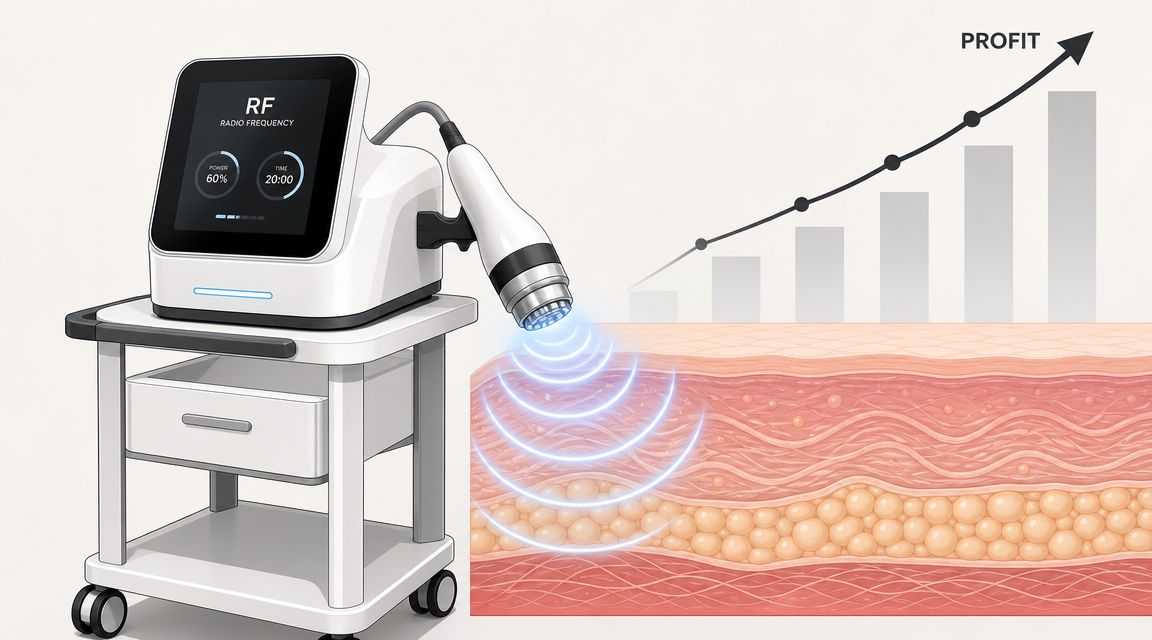
You're probably in the same position many clinic owners are in right now. You want to add a treatment that clients already recognise, that works across more than one concern, and that doesn't trap your business in a narrow service category six months later.
That's where a radio frequency machine usually enters the shortlist.
The problem is that most sales content still explains RF in a vague way. It “stimulates collagen”, “tightens skin”, and “rejuvenates tissue”, but it rarely helps you answer the questions that directly affect buying decisions in South Africa: Which RF modality suits which indication? How deep does it really treat? What matters for darker skin types? Which specifications change outcomes, and which are just brochure filler? What should you check from a compliance and risk perspective before you put a patient on the bed?
Table of Contents
- Why a Radio Frequency Machine Is Your Next Strategic Investment
- How Radio Frequency Works to Rejuvenate Skin
- Exploring the Main Types of RF Technology
- Clinical Applications and Effective Patient Selection
- Building a Safe and Compliant RF Practice in South Africa
- Analysing the ROI of a Radio Frequency Machine
- Your Purchasing Checklist for a Radio Frequency Machine
Why a Radio Frequency Machine Is Your Next Strategic Investment
A good radio frequency machine isn't a trend purchase. It's a platform decision.
That distinction matters. Trend purchases usually solve one marketing problem for a short period. Platform purchases give you multiple treatment pathways, broader patient suitability, and room to build packages, maintenance plans, and combination protocols around one core technology.
RF has the credibility that many aesthetic categories don't. Radiofrequency has been used in medicine for over 100 years, with the first electrosurgical use reported on 1 October 1926. In South Africa, its move into mainstream aesthetics prompted the National Department of Health to publish formal guidelines in 2022. That shift matters because it places RF in a regulated clinical-aesthetic context rather than in the category of novelty devices or loosely defined beauty equipment, as outlined in this medical history and South African guidance review.
Why clinics keep coming back to RF
A radio frequency machine stays commercially relevant because it can support several common demand drivers in one service line:
- Skin tightening for clients who don't want surgery and aren't ready for more invasive procedures
- Collagen remodelling for early to moderate laxity
- Body contouring support where tissue heating and tightening fit the treatment goal
- Texture-focused work when the device includes fractional delivery or needle-based RF
That range changes the business case. Instead of relying on one hero treatment, the clinic can position RF across face, neck, and body services, then decide whether to keep it as a standalone tightening category or combine it with resurfacing, facials, or body programmes.
Practical rule: Buy an RF platform only if you can name at least three indications you'll treat confidently in your clinic, not three indications the brochure mentions.
Why this matters in South Africa
In the ZA market, device decisions are shaped by more than trend demand. Skin diversity, practitioner skill, compliance, and treatment safety all influence whether a machine becomes profitable or problematic.
RF is especially relevant where clinics serve patients who may face a higher risk of pigment disruption with some light-based treatments. That doesn't mean RF is risk-free. It means the mechanism is different, and that difference can make RF a stronger strategic fit in practices that need versatility across a broad patient base.
A clinic that understands modality, depth, and treatment planning can turn a radio frequency machine into a reliable centrepiece of its service menu. A clinic that buys only on headline promises usually ends up underusing the device, discounting treatments, or blaming the hardware for weak outcomes that were really caused by poor protocol design.
How Radio Frequency Works to Rejuvenate Skin

RF heats tissue differently from light-based devices
The simplest way to explain RF is this. It's a controlled tissue-heating technology, not a light-targeting technology.
Lasers depend on light absorption by a target in the skin. Radio frequency works differently. It delivers energy into tissue and generates heat through electrical resistance. In practical terms, that means the tissue itself resists the current, and that resistance creates thermal energy where the treatment is delivered.
This is why RF is often described as a skin-bypassing modality in the aesthetic context. It doesn't depend on the same surface interaction pattern as a laser. The epidermis still matters, of course, because you must protect it, cool it when appropriate, and avoid overheating. But the treatment target is usually deeper.
A useful clinical analogy is this: surface heat behaves a bit like warming the outside of a dish in an oven. RF is closer to generating warmth inside the tissue where resistance is highest and the device is designed to focus energy.
What the heat actually does inside skin
Once you understand that RF creates controlled heat in the dermis and related tissue layers, the treatment logic becomes clearer.
The first effect is collagen contraction. When collagen is heated appropriately, fibres can tighten, which is why some patients notice an earlier sense of firmness after treatment.
The second effect matters more for long-term improvement. Controlled thermal injury can trigger a repair response that supports neocollagenesis, or the production of new collagen during healing and remodelling. That's why RF results usually develop over time rather than appearing all at once.
Clinically, this creates two very different expectations that you need to explain in consultation:
- Some tightening may be noticed earlier, depending on the indication and protocol.
- Structural improvement takes time, because tissue remodelling is biological, not instant.
RF doesn't “replace” collagen in a single session. It creates the thermal conditions that can encourage remodelling if the settings, treatment spacing, and patient selection are right.
This is also why not every RF treatment belongs in the same category. Surface applicators, fractional RF, and needle-delivered RF don't create the same pattern of heat, depth, or tissue response. If you're evaluating texture and scar-focused options, it helps to compare RF delivery with devices used for controlled epidermal and dermal stimulation, including a microneedling machine for skin remodelling workflows.
Why treatment outcomes vary so much between devices
Clinics often think RF is inconsistent. In reality, many “inconsistent” outcomes come from three variables:
Energy delivery pattern
Surface contact RF behaves differently from fractional or needle-based RF.Depth of action
A device built for broader heating in deeper tissue won't perform like one designed for superficial texture.Operator control
Pass speed, coupling, endpoint recognition, stacking, and patient feedback all change the result.
That's why “RF stimulates collagen” is true but incomplete. The useful question is: where is the energy going, how is it delivered, and what tissue response are you trying to produce? Once you answer that, treatment planning becomes far more precise.
Exploring the Main Types of RF Technology
Not all radio frequency machines should be evaluated in the same way. The modality changes the heating pattern, the depth profile, the treatment comfort, and the indication range.
If you buy without understanding that, you'll probably end up with a machine that performs well on paper but doesn't fit your service mix.
Monopolar RF
Monopolar RF is built for broader and deeper energy delivery. The current travels from the treatment electrode toward a return path, which allows deeper tissue interaction than more contained systems.
This makes monopolar configurations relevant for larger treatment areas and indications where deeper heating is useful, especially in body-focused work. The trade-off is that deeper-reaching systems demand stronger operator judgement. You need careful control of energy, movement, skin response, and patient feedback.
Monopolar systems aren't automatically “better”. They're better only when the treatment goal requires that depth profile.
Bipolar and multipolar RF
Bipolar RF contains energy flow between electrodes placed close to one another. That creates a more controlled and generally more superficial heating pattern than monopolar systems.
For facial work, neck tightening, and areas where precision matters more than bulk heating, bipolar or multipolar designs often make more sense. They can offer a safer-feeling treatment framework for practitioners who want tighter control over where the energy is concentrating.
A practical benchmark appears in a public procurement specification used for RF ablation equipment. It specifies 50–120 W output power, 2.5 MHz or better for unipolar, 1.5 MHz or better for bipolar, and 220–240 V input, all of which matter because power influences heating rate while frequency affects depth behaviour and tissue interaction, as shown in this RF equipment specification document.
Fractional RF and RF microneedling
Fractional RF changes the conversation completely. Instead of treating tissue as one broad heated field, it creates fractionated zones of thermal effect.
That matters for clinics targeting textural change, acne scarring, and resurfacing-focused indications where a simple bulk-heating handpiece often isn't enough. RF microneedling goes a step further by delivering energy through insulated or non-insulated needles into selected tissue depths. That allows a practitioner to reach dermal targets more directly rather than relying only on surface transmission.
For the right patient, this can be far more useful than a standard tightening handpiece. For the wrong patient, or in untrained hands, it can create avoidable downtime, irritation, or disappointing expectations.
The machine doesn't fail when a resurfacing case responds poorly to surface RF. The treatment match fails.
Comparison of Radio Frequency Modalities
| RF Type | Mechanism | Typical Depth | Best For |
|---|---|---|---|
| Monopolar RF | Energy travels from active electrode toward a return path | Deeper relative heating pattern | Larger areas, body tightening, broader tissue heating |
| Bipolar RF | Energy flows between closely placed electrodes | More contained and generally more superficial | Face, neck, controlled tightening |
| Multipolar RF | Multiple electrodes shape and distribute the current path | Usually controlled superficial to mid-level treatment pattern | Comfort-oriented facial rejuvenation |
| Fractional RF | Fractionated thermal zones created across treatment area | Varies by device design | Texture, resurfacing-focused rejuvenation |
| RF microneedling | Needles deliver RF into selected tissue depths | Depth selected by needle penetration and energy delivery | Acne scarring, dermal remodelling, combined texture and tightening goals |
What to ask when a vendor says a machine does everything
Be cautious when a device is marketed as equally effective for face tightening, body contouring, scar revision, texture, and fat reduction without explaining how.
Ask these questions instead:
- Which modality is doing the work? One platform can house multiple handpieces, but each handpiece should have a defined job.
- How is depth controlled? If the answer is vague, clinical planning will be vague too.
- Is the result based on bulk heating or fractional injury? Those are different therapeutic pathways.
- What is the ideal indication for each applicator? A serious supplier should answer this clearly.
A radio frequency machine becomes easier to evaluate when you stop asking whether it is “advanced” and start asking whether the modality fits the tissue target.
Clinical Applications and Effective Patient Selection
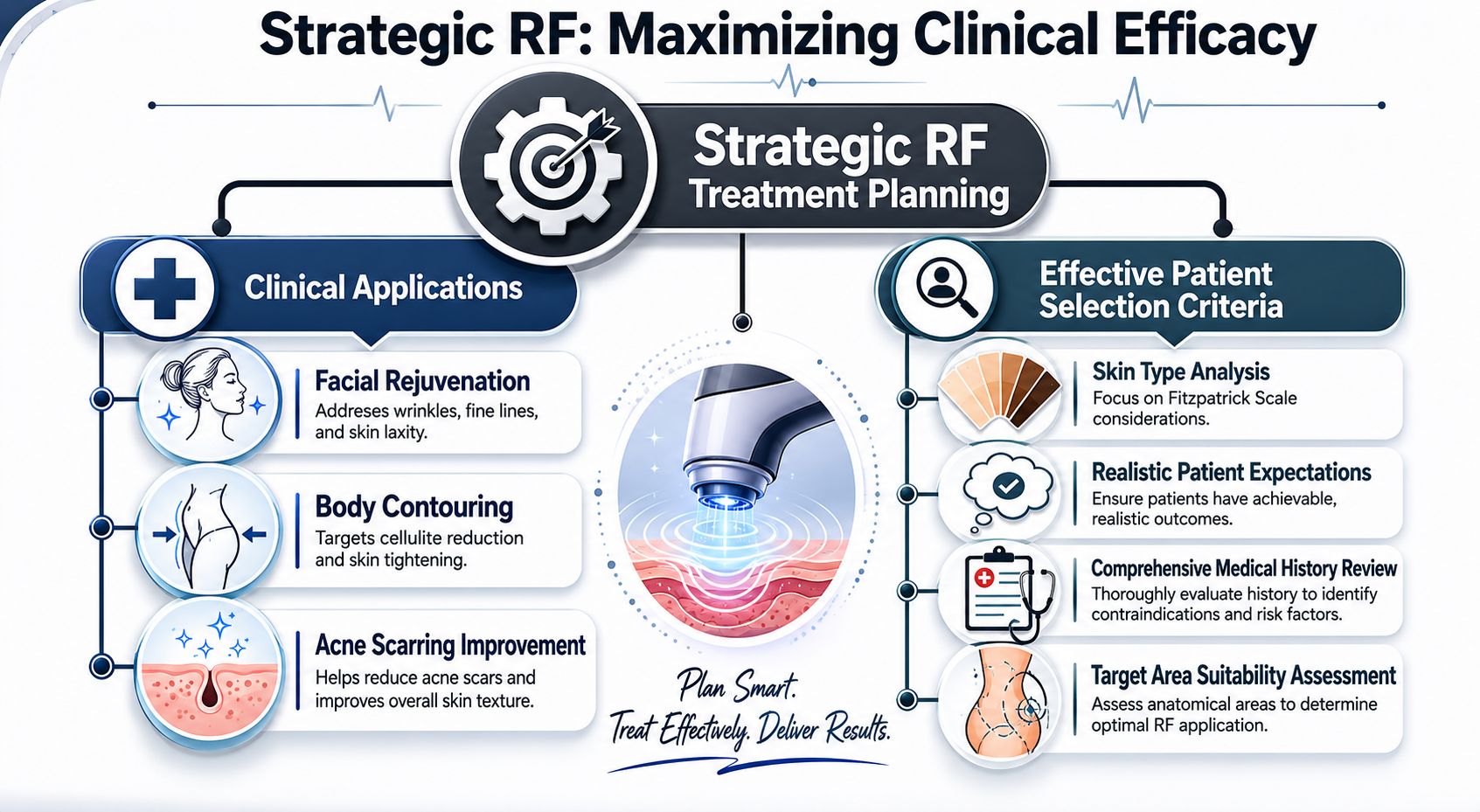
Match the modality to the complaint
RF works best when the clinical complaint and the delivery method match.
For facial laxity, broad thermal tightening can be useful, especially when the patient wants a non-surgical option and understands that improvement is gradual and not permanent. For fine textural change, superficial or fractional approaches make more sense because they target a different level of tissue response. For acne scarring, surface-only heating is often too blunt an instrument. Needle-based or fractional RF usually gives a better rationale because the problem sits in dermal architecture, not just in loose superficial tissue.
Depth is central to that decision. Independent technical guidance notes that a 1 MHz device may penetrate roughly 4–25 mm, while 40.68 MHz is reported to act around 0.5–1.5 mm. That difference is clinically important because it helps explain why one platform may suit body tightening, while another is more appropriate for facial texture-focused work, as discussed in this frequency and penetration overview.
Here's a simple treatment-matching framework:
Lax lower face or neck
Choose a modality built for controlled heating and tightening rather than aggressive resurfacing.Post-acne texture and scars
Consider fractional RF or RF microneedling where dermal remodelling is the actual target.Body skin looseness
Prioritise systems designed for deeper tissue interaction and practical treatment ergonomics over facial-style applicators.Cellulite or contour support
Position RF carefully. It can support tightening and tissue heating, but it shouldn't be sold as a cure-all for every body concern. Patients often compare it with other non-invasive body sculpting options, so your consultation needs to explain what RF can and can't realistically do.
If your clinic also evaluates broader body-treatment categories, it helps to compare RF with a fat cavitation machine for non-surgical contouring discussions, especially when deciding whether your next purchase should focus on heating, mechanical disruption, or a combined service menu.
Patient selection in a diverse ZA clinic
South African clinics don't serve one skin type. That changes protocol design.
RF is often attractive because it doesn't depend on pigment targeting in the same way many light-based treatments do. But safe treatment still depends on parameter selection, tissue response, and operator skill. Poor control can cause burns, and that risk increases when practitioners chase dramatic endpoints instead of using repeatable technique.
Patient selection should include:
Primary concern clarity
Is the patient asking for tightening, resurfacing, scar revision, or body shaping? If they're asking for all four, you need to narrow the main priority.Skin quality and thickness
Thin, reactive tissue behaves differently from thicker sebaceous skin. The same settings won't suit both.Phototype awareness
Darker skin types may still be good candidates, but treatment should stay disciplined. Lower-fluence thinking doesn't automatically translate to lower-risk RF. Heat injury is still heat injury.Expectation management
A patient expecting facelift-level lifting from a conservative RF facial treatment isn't a good candidate until that expectation is corrected.
Choose patients for the result your machine is built to deliver, not for the before-and-after they brought from social media.
A mature RF practice doesn't promise every outcome to every patient. It selects well, treats consistently, and refers out or pivots when the indication doesn't fit the machine.
Building a Safe and Compliant RF Practice in South Africa
A radio frequency machine can strengthen your clinic's reputation or damage it. The difference is rarely the box itself. It's your screening, your protocols, your documentation, and your standards.
Non-negotiable screening points
Every RF consultation should screen for obvious contraindications and practical treatment risks. The exact list depends on the device, handpiece, and treatment area, but your consultation process should be disciplined enough to catch issues before the treatment room.
At minimum, build a screening workflow that checks for:
- Implanted electronic devices such as pacemakers or similar systems
- Pregnancy
- Active infections or inflamed treatment areas
- Compromised skin barrier
- Recent procedures that may change heat tolerance or healing response
- Relevant medical history that affects tissue response, sensation, or wound healing
You also need a pre-treatment habit that many clinics skip. Test whether the patient understands the endpoint. If they think stronger heat always means better results, stop and reset the consultation. Unsafe expectations often lead directly to overtreatment.
What compliance should look like in practice
South African practitioners also need to think beyond technique. Compliance starts before you sign the invoice.
Check the device paperwork, intended use, training pathway, and local regulatory fit. If a supplier can't explain the status of the machine clearly, that's a warning sign. Clinics often focus on handpiece count, screen design, or special offers while ignoring the part that protects the business.
A safe RF setup should include:
Clear device credentials
You want a device with recognised safety and market credentials appropriate to its category and use case.Documented protocols
Every indication should have a protocol framework, not just verbal guidance from a salesperson.Hands-on training
Theory doesn't teach endpoint recognition. Your team needs live treatment understanding.Consent that names real risks
RF is generally considered safe in aesthetic practice when properly used, but burns and other adverse effects can occur. Your consent must say that plainly.
Good compliance isn't administrative clutter. It's what allows a clinic to scale treatments without scaling risk.
Post-treatment care also needs structure. Patients should know what heat-related reactions are expected, what isn't, when to contact the clinic, and how to protect the treated area. That follow-up language builds trust and reduces preventable complaints.
If you want your radio frequency machine to become a long-term revenue category, treat governance as part of treatment quality, not as a separate office task.
Analysing the ROI of a Radio Frequency Machine

ROI on a radio frequency machine doesn't start with the selling price. It starts with the indication mix you plan to own.
That matters because RF can sit in several business models at once. One clinic uses it mainly for facial tightening. Another builds it into acne scar correction. Another uses it as part of a body menu. The same machine can underperform in one clinic and become a steady profit centre in another, depending on treatment positioning, staff confidence, and whether patients are returning for maintenance.
A key business reality is that RF results are temporary and require maintenance sessions, which affects long-term planning and revenue forecasting, as noted in this clinical overview of RF skin tightening.
Start with indication, not hardware
Many buyers ask, “How long until this machine pays for itself?” That's the wrong first question.
Ask these instead:
- Which indication will I market first?
- Which indication can my team deliver most consistently?
- Which indication suits my current patient base?
- Which indication can support follow-up and maintenance revenue?
For some clinics, the most bankable use of RF isn't the broadest one. It's the one the team can explain clearly and treat well every time. Tightening services can be commercially attractive, but scar work may create stronger differentiation if your practitioners already assess texture and remodelling properly. Body RF may bring demand, but only if the clinic can manage expectations and package it intelligently.
Build your own ROI model
You don't need invented industry averages to evaluate a machine. You need a clean internal model.
Use a worksheet built around the following inputs:
| ROI Variable | What to calculate |
|---|---|
| Treatment revenue | Your fee per session or per package |
| Staff cost | Therapist or clinician time per treatment |
| Consumables | Tips, cartridges, coupling media, disposables if applicable |
| Operational cost | Room use, maintenance allocation, admin time |
| Utilisation | How many treatment slots you can realistically fill |
| Retention | How many patients continue into maintenance or related services |
Then stress-test that model against real clinic behaviour.
A useful scenario is a Johannesburg clinic that buys an RF platform expecting body tightening demand, but its existing database mostly books facial services. If the clinic launches body packages without the audience or consultation skills to support them, utilisation stays weak. The same machine may perform better if the clinic starts with face and neck tightening, then upsells maintenance or adds targeted scar protocols later.
Where clinics usually misjudge profitability
The first mistake is counting only revenue and not delivery friction. A treatment can look profitable until you factor in staff time, repeat consultations, slow bookings, and underused room capacity.
The second mistake is buying too broad. A machine with multiple handpieces sounds commercially safer, but if the team only becomes confident with one indication, the rest of the platform sits idle.
The third mistake is ignoring maintenance as a feature of the business model. Since results aren't permanent, recurring treatment planning can support revenue. But that only works when the patient understands maintenance from the start and sees value in coming back.
Here's the practical framework I use when discussing RF profitability with clinics:
Sell a treatment journey, not one session
RF rarely shines as a one-off impulse treatment.Price around outcomes and operator skill
Discounting usually attracts poor-fit patients faster than it grows good demand.Package by indication
Tightening patients, scar patients, and body patients don't buy for the same reason.Track rebooking patterns
If patients aren't returning, review consultation quality before blaming the machine.
One category worth examining alongside RF is muscle stimulation when the clinic is building body-focused packages. In some service menus, a muscle stimulator machine for body treatment planning may serve a different commercial purpose than RF, even when both are discussed under non-surgical body services.
A realistic ROI mindset for 2026 planning
For 2026 planning, treat RF as a service platform with recurring potential, not as a magic device that prints profit by existing in the room.
That means your ROI is strongest when all of these are true:
- The indication matches local demand in your database
- The team knows how to produce repeatable outcomes
- The consultation sets realistic timelines and maintenance expectations
- The machine fits your room flow and treatment menu
- Marketing language matches what the treatment delivers
A profitable radio frequency machine isn't necessarily the one with the longest feature list. It's the one your clinic can use often, safely, and with enough consistency that patients come back for the next step.
Your Purchasing Checklist for a Radio Frequency Machine
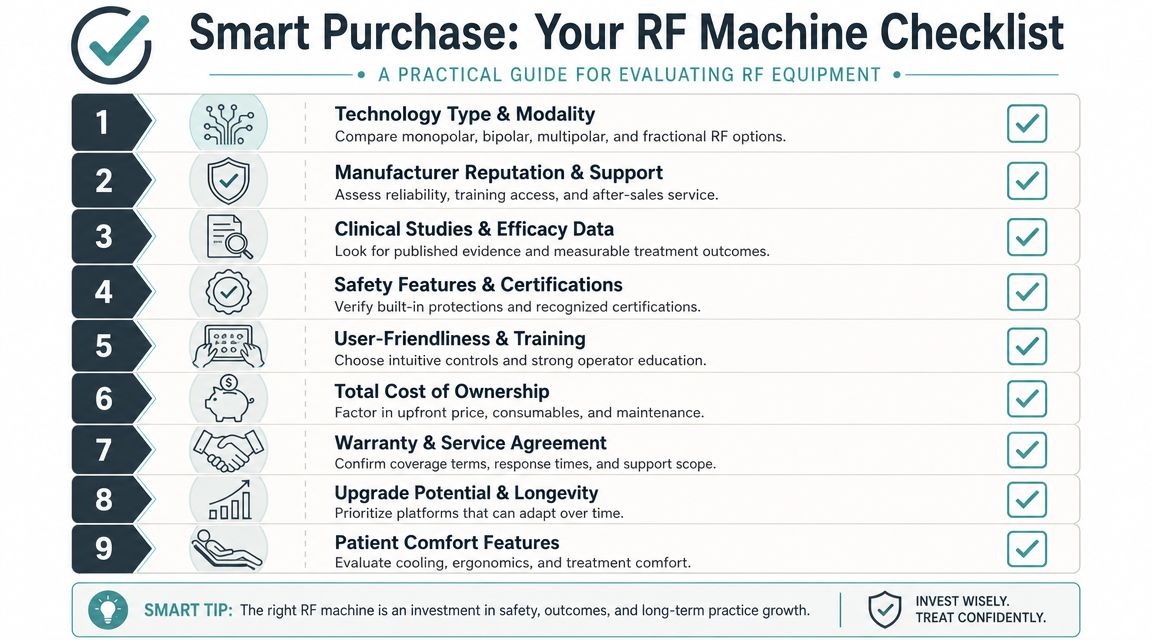
Buying a radio frequency machine should feel more like hiring a long-term team member than buying furniture. You're choosing a treatment capability, a training burden, a maintenance commitment, and a revenue pathway all at once.
Questions that reveal the real value of the machine
Use this checklist in vendor discussions and insist on clear answers.
What modality am I buying?
Ask whether the machine is monopolar, bipolar, multipolar, fractional RF, RF microneedling, or a true multi-modality platform. Don't accept “all-in-one” without explanation.Which indication is strongest on this machine?
Every RF device has a sweet spot. Serious suppliers can name it without hesitation.How is depth controlled or influenced?
If the vendor can't explain the treatment depth logic in plain language, clinical outcomes will become guesswork.What are the consumables and ongoing service needs?
Hardware cost is only part of total ownership.What training is included?
Ask who trains, how training is delivered, and whether protocol refinement is available after launch.
One factual example from the local market context is Omega Lasers' Derma Pro Radiofrequency Microneedling Machine, which is relevant if your clinic is specifically evaluating needle-delivered RF rather than broad surface tightening.
What makes a purchase pay off long term
The strongest buying decisions usually come down to support quality more than feature count.
Look for these signs:
| Checklist area | What good looks like |
|---|---|
| Training | Hands-on, protocol-based, and suited to your team's current skill level |
| After-sales support | Clear service channels and realistic response expectations |
| Warranty | Written terms that are easy to understand |
| Documentation | Treatment parameters, contraindications, and maintenance requirements in writing |
| Usability | Interface and handpiece workflow your staff will actually use confidently |
Buy the machine your team will use well, not the one that sounds most sophisticated in a demo.
A final filter helps prevent expensive mistakes. Ask yourself whether the device fits your clinic's identity. If your patients mainly want texture correction and acne scarring support, don't buy a body-led RF platform because the handpiece assortment looks impressive. If your business relies on therapist-led facial journeys, don't buy a machine that needs doctor-level intervention to be used properly.
A radio frequency machine becomes a smart investment when the clinical fit, training support, compliance pathway, and revenue model all line up. When one of those is missing, the machine usually ends up being blamed for a decision problem.
If you're comparing RF options and want help narrowing the choice to the modality, indication mix, and compliance requirements that fit your clinic, Omega Lasers can help you assess the practical side of the investment, including training, support, and how the device would sit within your treatment menu.