




You're probably in one of two positions right now. You've either bought a laser platform and realised that training is the part that will determine whether it becomes a profitable treatment room asset, or you're still comparing devices and trying to work out which laser hair removal course prepares your team to treat clients safely in South Africa.
That's a sensible hesitation. Too many clinic owners still treat training as the paperwork that follows the purchase. In practice, training is what decides whether your therapists can assess risk properly, choose the right parameters, work confidently across different skin tones, document treatments correctly, and protect the business if a complaint or inspection lands on your desk.
A weak course creates expensive problems. A strong one creates consistency, confidence, and better use of the machine you've already paid for.
Table of Contents
- Investing in Excellence Not Just a Certificate
- What a Professional Laser Course Actually Teaches
- Understanding Course Formats and Duration
- Navigating Accreditation and Legal Requirements in South Africa
- How to Choose the Right Training Provider
- The Business Case Costs ROI and Device Integration
- Conclusion Turning Training into a Competitive Advantage
- Frequently Asked Questions
Investing in Excellence Not Just a Certificate
A clinic owner I often think about had done everything people usually focus on first. She had researched treatment demand, compared handpieces, negotiated supply terms, and mapped out room usage. Then she hit the training question and got stuck between a cheap short course and a more substantial programme that took more time, more coordination, and more money.
That's where the business decision sat.
The cheaper option looked efficient on paper. The stronger option looked inconvenient. But when you work backwards from what happens in a treatment room, the answer becomes clear. Your operator needs to identify contraindications, understand tissue response, adjust settings, manage expectations, recognise a bad endpoint early, and document what happened. A certificate alone doesn't build that judgement.
Practical rule: If the laser hair removal course is marketed as a quick add-on rather than a clinical skills pathway, expect gaps in safety, consistency, and team confidence.
In the South African market, that matters even more because training isn't just about technique. It sits alongside device compliance, operator records, and the realities of treating a diverse client base. If the course doesn't prepare your team for those conditions, the business still carries the risk.
A better way to frame the purchase is this. You're not buying a class. You're buying a standard of care and an operating system for one of the most sensitive services in your clinic.
For owners still comparing options, it helps to look at how training fits into the wider support ecosystem around beauty training and clinic readiness. The best outcomes usually come from structured education, practical supervision, and operational follow-through, not from a one-day confidence boost.
What a Professional Laser Course Actually Teaches
A strong laser curriculum builds clinical judgement before an operator ever treats a paying client. The course should teach how energy behaves in skin, how different devices deliver that energy, and how to adjust treatment plans for the person in front of you rather than follow a preset blindly.
A useful benchmark is whether the provider teaches across multiple systems and wavelengths instead of one machine script. Training with real depth covers laser and IPL principles, contraindications, treatment selection, and the differences between Alexandrite, Diode, and Nd:YAG platforms, as outlined in this overview of what you learn in laser hair removal school.

Science before settings
Operators need a working grasp of wavelength, melanin absorption, follicle depth, epidermal response, and hair growth cycles. Without that, they tend to memorise numbers and copy protocols from the last client. That approach fails as soon as skin tone changes, the body area is more reactive, or the client arrives with recent sun exposure, hormonal hair growth, or a history of pigmentation.
Courses with proper clinical value usually teach:
- Laser-tissue interaction: How selective photothermolysis applies in practice and why epidermal protection matters.
- Hair biology: Why anagen targeting matters and why outcomes depend on treatment intervals and client adherence.
- Skin assessment: How Fitzpatrick typing, tanning history, medications, and barrier condition affect planning.
- Device selection: Which platform suits which indication, and where each wavelength carries limitations.
For a plain-language refresher on treatment mechanics, this guide explaining how laser hair removal works is useful background alongside formal training.
Safety used in the treatment room
Safety training needs to be operational, not theoretical. Staff should leave the course knowing how to screen, when to patch test, what eye protection is required, how to prepare the room, how to identify a concerning endpoint, and when to stop a treatment.
That includes adverse event handling. An operator must recognise the difference between expected perifollicular erythema and a reaction that signals too much epidermal injury. They also need clear habits around consent, treatment notes, photography, maintenance logs, and aftercare instructions. Those records matter when a client queries results, reports a reaction, or when your clinic needs to show that protocols were followed properly.
Operators who feel pressured to finish an area despite a poor skin response usually lack supervised clinical training. Good training teaches them to pause, reassess, and document.
Parameters and treatment judgement
Poor results usually come from weak parameter judgement. The machine is rarely the whole problem.
A serious course teaches how fluence, pulse duration, spot size, repetition rate, overlap, and cooling work together. Operators need to understand why coarse terminal hair on underarms responds differently from finer facial hair, and why a comfortable session can still be clinically weak if settings never move into an effective range.
The practical distinctions matter:
Body area response
Face, legs, bikini, and underarms do not tolerate or respond to the same approach.Hair calibre and density
Thick clustered growth behaves differently from finer residual hair.Cooling method
Cooling supports client comfort, but it also protects the epidermis and affects how confidently you can treat.Clinical endpoints
Staff should know what useful follicular response looks like and what suggests overtreatment.
Generic training often stops at presets. Good training teaches when presets are a starting point and when clinical judgement should override them.
Why darker skin training matters in South Africa
Many courses fall short for the South African market. A provider may cover general laser theory well, then spend too little time on treating Fitzpatrick IV to VI safely and profitably. For many clinics here, that is not a side topic. It is daily practice.
Melanin-rich skin changes the margin for error. The operator needs to understand pigment competition, wavelength choice, cooling strategy, endpoint recognition, and the pace of escalation across a treatment series. Nd:YAG often has a larger role in these cases, but device choice alone does not protect the client. Technique, assessment, and restraint do.
Guidance from the British Medical Laser Association highlights why dark skin requires careful device selection and operator skill. That matters commercially as well as clinically. In South Africa, clinics that treat darker skin confidently and safely widen their addressable market, improve retention, and reduce the risk of avoidable complications that damage reputation.
A good programme should prepare operators to assess:
- Epidermal melanin load: More melanin means less room for careless parameter changes.
- Cooling strategy: Cooling affects safety, comfort, and treatment consistency.
- Escalation across sessions: Conservative starts are often appropriate, but settings still need a plan to progress.
- Client counselling: Expectations need to match hair type, previous removal methods, hormonal factors, and skin response.
If a training provider cannot explain how they teach for Fitzpatrick IV to VI in a South African clinic context, the course is incomplete.
Hands-on practice changes outcomes
Theory creates awareness. Supervised treatment builds repeatable skill.
Live-model sessions show whether operators can section an area properly, maintain handpiece contact, manage overlap, communicate during treatment, identify endpoints, and document the session clearly. They also show whether the instructor corrects bad habits early or lets them pass.
When I assess a course, I look closely at the practical component. Clinics do not earn revenue from theory alone. They earn it when an operator can produce safe, consistent results across different skin types, handle client questions with confidence, and know when a case should be delayed or referred.
The strongest operators are not the ones who recall settings fastest. They are the ones who can justify the setting choice, explain the expected tissue response, and adjust safely when the skin gives different feedback than expected.
Understanding Course Formats and Duration
Delivery format matters because it affects retention, scheduling, and practical competence. The right format depends on your team's baseline knowledge and how quickly you need them treatment-ready.
In South Africa, the pattern has shifted away from very short awareness-style training and towards more structured programmes. One benchmark course lists 40 total hours made up of 31 hours of online learning and 9 hours of in-person practical training, while other professional programmes can take 1 to 6 weeks and may lead toward a formal apprenticeship licence, according to this description of a laser hair removal technician licensing pathway.
In-person intensive training
An in-person intensive course works best when you need rapid skill development and close supervision. It tends to be more immersive because there's less delay between theory and application. Staff can learn a concept in the morning and use it on a live model the same day.
The downside is operational. You may need to close diary slots, manage travel, and accept a short-term productivity hit while staff train off-site. It's often worth it for new operators, but only if the practical exposure is substantial.
Hybrid learning models
Hybrid training is often the most sensible option for established clinics.
The theory is completed online, which gives staff time to absorb the fundamentals without taking them fully out of the business. Then the in-person component focuses on what can't be taught on a screen: consultation flow, parameter choice, supervised treatment, troubleshooting, and safe device handling.
For many clinics, this format creates the best balance between convenience and competence.
| Format | Strength | Limitation | Best fit |
|---|---|---|---|
| In-person intensive | Fast immersion and close supervision | More disruption to operations | New teams or new service launch |
| Hybrid | Flexible theory plus practical training | Quality depends on the in-person component | Busy clinics adding laser carefully |
| Online-only | Easy access and low scheduling pressure | Weak for clinical skill and confidence | Theory refreshers, not primary training |
Online-only courses
Online-only training has a place, but it's narrow.
It can work for introductory theory, policy familiarisation, or refresher learning for someone who is already competent. It doesn't work well as the sole preparation for treating paying clients with an energy-based device. There is no substitute for supervised practical correction when someone is learning hand speed, overlap control, skin observation, or client communication under treatment conditions.
If a provider sells online-only education as a complete laser hair removal course for beginners, that should raise concerns. It may be convenient, but convenience and readiness are not the same thing.
Navigating Accreditation and Legal Requirements in South Africa
The most expensive misunderstanding in this space is believing that a training certificate automatically gives you legal clearance to offer treatment. It doesn't.
South African clinic owners need to think beyond the course itself and into the wider compliance environment around the device, the premises, and the people operating it.

A certificate is not legal clearance
One of the biggest gaps in course marketing is that it rarely answers the question clinic owners need answered: Can my team legally treat clients after this training?
In South Africa, compliance sits under the Department of Health's radiation-control framework for non-ionising radiation devices, and clinics need proper device documentation and competent operator records, not only a certificate, as outlined in this discussion of laser compliance and operational requirements.
That means a provider may state its course is extensive while still leaving out the legal reality that your clinic needs an audit trail. If an inspector, insurer, or unhappy client asks for records, “my therapist attended a course” won't be enough on its own.
What clinic owners need to verify
When I advise owners, I tell them to treat compliance like a file that must stand on its own. If someone who has never met your team opens that file, they should be able to see that the device is appropriate, the operator was trained, the treatment protocols are documented, and the clinic has basic control measures in place.
At minimum, ask whether your operation has clear documentation for:
- Device status: The machine's local regulatory position and supporting documentation.
- Operator competency: Training records, internal sign-off, and any supervised rollout process.
- Premises suitability: Room setup, safety controls, and treatment protocols.
- Client records: Consent, contraindication screening, treatment notes, and aftercare documentation.
- Incident management: A procedure for complaints, adverse reactions, and escalation.
A clinic is usually exposed by paperwork before it is exposed by technology. The machine may be excellent, but if the records are poor, the business still looks unsafe.
Device standards and local compliance are different things
Clinic owners also need to separate international device standards from local operational compliance.
Terms such as FDA approved and CE certified speak to the device and its manufacturing or regulatory pathway. They matter. They are not the same as proving that your clinic is properly set up to administer treatment in South Africa.
That distinction is where many owners get caught. They buy a credible machine, assume the brand status covers everything, and only later realise that staff competency records, room procedures, and internal protocols still need to be built.
A training provider who understands the South African environment should be able to discuss that distinction clearly. If they avoid the question, or reduce everything to “you'll get certified”, they're not helping you manage real business risk.
How to Choose the Right Training Provider
A clinic owner usually sees the gap in training quality at the worst possible moment. The first consultation on acne medication. The first Fitzpatrick V client asking whether the treatment is safe for her skin. The first staff member who knows how to switch the machine on but cannot explain why a setting should change.
That is why provider selection needs more than a quick scan of a course page. A strong training partner teaches clinical judgement, disciplined safety habits, and decision-making your team can use under pressure.

Start with the instructor and the curriculum
Ask who delivers the training and what their current treatment-room experience looks like. Instructors who still work with clients tend to teach the parts that matter commercially and clinically: consultation quality, treatment selection, reaction management, and when to refuse a case.
Then review the curriculum line by line. It should cover laser and light theory, contraindications, test spots, consultation workflow, parameter selection, endpoint recognition, aftercare, and incident response. In South Africa, I would also want clear teaching on SAHPRA-related device and documentation awareness, because a provider who cannot discuss local compliance usually leaves the clinic to build that framework alone.
Skin type training needs direct scrutiny. Clinics serving the South African market cannot rely on vague claims about treating "all skin types". The provider should explain how they teach wavelength choice, cooling method, fluence adjustment, conservative treatment planning, and risk reduction for Fitzpatrick IV to VI clients. The British Medical Laser Association guidance on laser and light-based treatments is a useful benchmark for the level of safety-focused thinking you want to hear in that conversation.
If the answers stay general, the training probably is too.
Inspect the practical component properly
Hands-on training is where brochures often sound stronger than the classroom.
Ask exactly what students do. Observation has value, but it does not produce treatment confidence on its own. Staff should perform supervised consultations, prepare the treatment room, assess contraindications, choose settings with explanation, and work on live models across different skin tones where possible. If your clinic plans to launch with a diode platform, training on a completely different device category creates avoidable friction later. A diode laser ROI breakdown for South African professionals can help frame why device alignment matters financially as well as clinically.
Use a checklist that forces specific answers:
| Evaluation Area | Key Questions to Ask |
|---|---|
| Curriculum relevance | Does the course cover consultation, contraindications, parameter choice, safety, and adverse event management? |
| Device alignment | Will staff train on the same type of platform the clinic will use in practice? |
| Skin type competency | How does the provider teach treatment planning for Fitzpatrick IV to VI clients? |
| Practical depth | How much supervised live-model work is included, and what does the student actually do? |
| Instructor quality | Are trainers active practitioners with real treatment-room experience? |
| Compliance awareness | Does the course address clinic documentation, operator records, and local regulatory expectations? |
| Ongoing support | What happens if the team needs help after the course ends? |
Ask what happens after the course ends
Post-course support affects profitability more than many owners expect.
A trained therapist still needs backup during the first few months of rollout. Questions come up around borderline contraindications, patch test interpretation, treatment spacing, and how to document a mild reaction without causing confusion or legal exposure. Good providers stay available for those moments. Weak ones disappear once the invoice is paid.
Look for practical support that improves performance after launch:
- Accessible clinical guidance: Someone can answer treatment questions once you begin seeing clients.
- Protocol resources: Written materials, forms, and treatment frameworks are available after the course.
- Device-specific familiarity: The training reflects the platform you use, not only a generic machine.
- Refresher options: Teams can revisit advanced topics when confidence or staffing changes require it.
Provider choice also needs to fit the financing reality of the clinic. If training, device purchase, and launch costs are landing at the same time, some owners explore flexible equipment financing for beauty businesses so they can avoid underfunding staff preparation while buying the machine.
The best provider is usually the one that helps your team make sound decisions after the course, not the one that promises the fastest certificate.
The Business Case Costs ROI and Device Integration
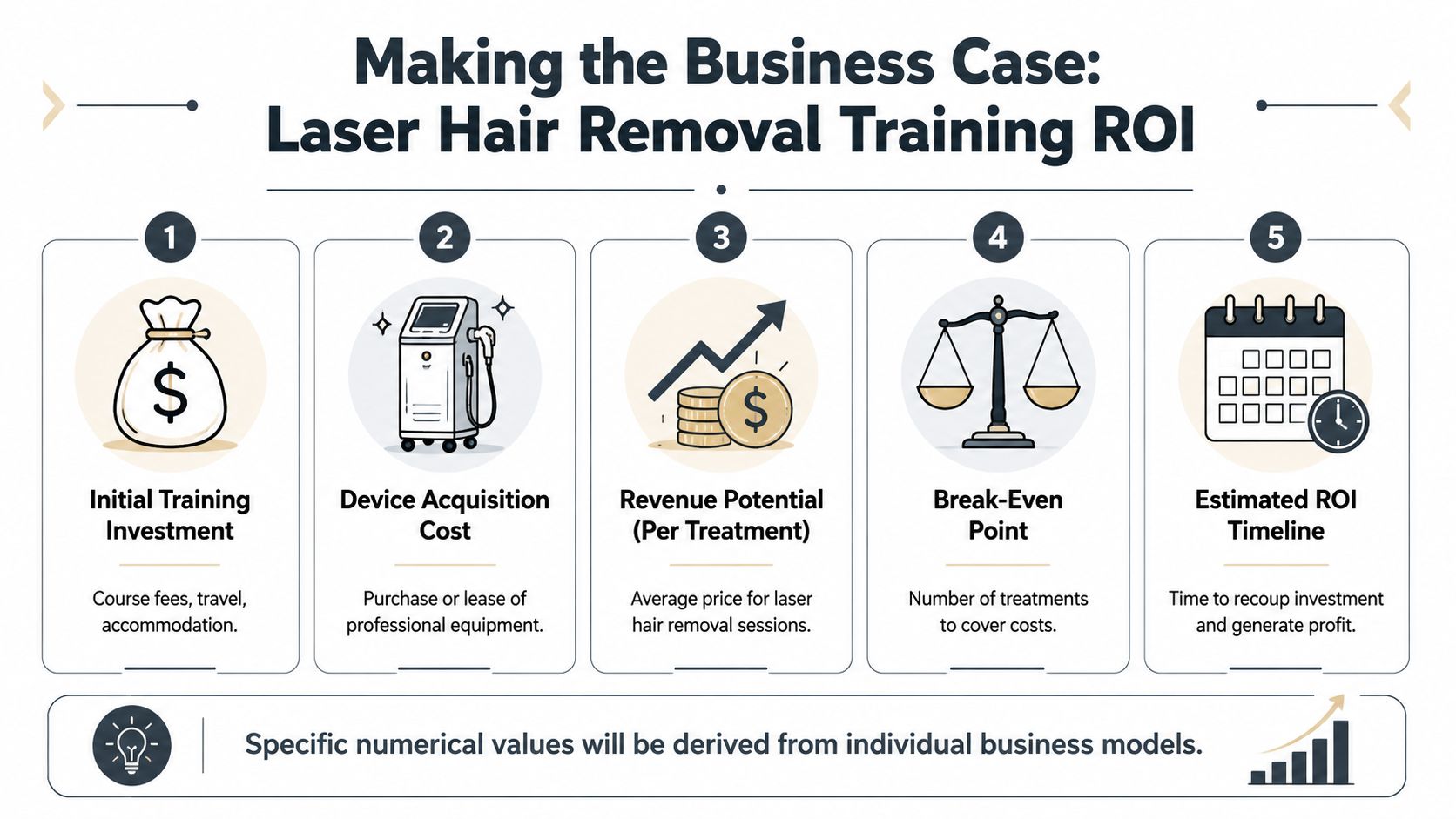
Training only looks expensive when it's isolated from the rest of the business model. Once you connect it to utilisation, client retention, complaint prevention, and treatment confidence, the calculation changes.
There's a useful global benchmark that shows how structured and substantial this investment can be. One apprentice-in-training laser hair removal certification course is advertised as an 8-day programme priced at $3,400, according to Advanced Aesthetics Academy. The lesson isn't that every South African course should cost the same. The lesson is that serious training is treated internationally as a professional capital investment, not a casual workshop.
Count the real cost not only the invoice
The invoice is only one line item. The true cost of a laser hair removal course can include travel, accommodation, staff time away from revenue-generating work, launch delays, and the internal time spent building protocols after the course.
But there's a second side to that ledger. Poor training has a cost too. It shows up as hesitant consultations, inconsistent results, underused devices, avoidable complaints, and staff who never move beyond default settings.
For owners planning around equipment acquisition as well as training, it can help to review options such as flexible equipment financing for beauty businesses so capital planning reflects both the machine and the operational support needed to make it productive.
Training affects revenue and risk at the same time
The strongest business case for training is that it improves both upside and protection.
A well-trained team tends to consult more confidently, package treatment plans more clearly, and deliver a client experience that supports repeat bookings. At the same time, that same team is more likely to screen correctly, document properly, and avoid the sort of preventable incidents that drain management time and damage reputation.
That's why I don't separate ROI from safety. In aesthetics, they are tied together.
Device integration matters more than most owners expect
Device-specific training is where profits often become practical.
When staff learn on the exact category of machine they'll use daily, setup gets faster, handpiece familiarity improves, and treatment flow becomes more predictable. Teams make fewer hesitant pauses, fewer avoidable errors, and fewer inconsistent decisions between operators.
For owners who want a more structured planning lens, this resource on a diode laser ROI breakdown for South African professionals is a helpful way to think through utilisation, payback logic, and the commercial effect of proper clinical adoption.
Conclusion Turning Training into a Competitive Advantage
The right laser hair removal course does more than certify a therapist. It shapes how your clinic treats risk, delivers outcomes, and uses expensive technology in daily practice.
That's why the decision should never be reduced to course length or convenience alone. In South Africa, the clinics that build durable laser services are the ones that combine compliant operations, strong documentation, practical clinical skill, and real competence across diverse skin types. Those are not separate goals. They reinforce each other.
Training also becomes part of your brand. Clients notice when consultations are precise, when explanations are clear, and when the operator works with calm control rather than trial-and-error confidence. That professionalism converts into trust.
Operationally, it also helps to think beyond the treatment room. Tools such as healthcare chatbot solutions can support enquiry handling, lead qualification, and appointment communication, which complements a well-trained team by reducing friction before the client even arrives.
The clinics that outperform over time usually don't treat education as a once-off requirement. They treat it as part of how they stay safe, efficient, and difficult to compete with.
Frequently Asked Questions
Do therapists need refresher training after completing a laser hair removal course
Yes, in many clinics they do. Refresher training is useful when a team changes devices, starts treating a wider range of skin tones, or notices inconsistency in consultation quality or outcomes. It's also sensible after a long gap in performing treatments.
Is manufacturer training enough on its own
Sometimes it's useful, but it depends on what is covered. Manufacturer training is often strongest on platform operation and workflow. It may not go deep enough on wider clinical judgement, complication management, or local compliance expectations unless those topics are built into the programme.
Should a clinic buy the device first or arrange training first
Ideally, plan both together. Training should match the platform, the client profile, and the clinic's compliance setup. Buying the machine first without a training plan often delays launch and creates uncertainty in the team.
What should be in the operator file after training
Keep training records, competency sign-off, treatment protocols, consent forms, contraindication screening tools, aftercare instructions, and maintenance or safety documentation. If a problem occurs, clear records matter.
If you're evaluating laser systems and want support that goes beyond hardware, Omega Lasers offers SAHPRA-licensed, FDA-approved, and CE-certified medical-aesthetic platforms backed by training, technical support, and business guidance for clinics that want to launch safely and grow with confidence.