



Your treatment room may already be busy, but busy doesn’t always mean scalable. Waxing keeps clients coming back, shaving solves nothing, and inconsistent device results can damage trust faster than any marketing campaign can rebuild it.
A strong diode laser hair removal service changes that equation. It gives a clinic a treatment that clients understand, value, and commit to as a course rather than a once-off visit. For a South African clinic owner, that matters because the primary decision isn’t only whether the technology works. It’s whether it works safely across varied skin types, whether your team can deliver repeatable outcomes, and whether the numbers make sense once training, compliance, and rebooking are factored in.
Why Diode Laser Hair Removal is a Cornerstone Service
Most clinic owners start in the same place. They want a treatment that clients ask for without needing heavy education, and they want outcomes visible enough to generate referrals. Diode laser hair removal earns its place because it does both.
It isn’t a trend service. It’s a foundational one. Hair reduction sits in that rare category where client demand, repeat bookings, and long-term perceived value overlap. When a clinic adds a reliable laser platform, it changes how the whole business is positioned. You stop looking like a salon that happens to offer advanced treatments and start looking like an aesthetic practice with systems, standards, and measurable outcomes.
Why clinics keep building around it
Clients understand the problem immediately. They’re tired of ingrowns, shaving frequency, irritation, or the endless cycle of waxing. That makes consultation easier than with treatments that need more education.
For the clinic, the commercial logic is straightforward:
- It suits treatment packages: Clients rarely book one session and disappear when expectations are set properly.
- It supports calendar stability: Hair removal tends to create recurring bookings rather than one-off spikes.
- It lifts perceived professionalism: A proper laser offering signals a higher clinical standard.
- It creates natural cross-selling: Clients who trust your laser protocols enquire about skin treatments next.
Clinical demand also supports that position. Clinical investigations affirm diode laser hair removal's efficacy with 90% of treated individuals achieving marked long-term hair regrowth reduction by the end of their treatment course, which is why clinics continue to treat it as a dependable service line rather than a risky add-on (clinical investigations on diode laser efficacy).
A good hair removal service doesn’t just fill appointment slots. It improves how clients talk about your clinic when you’re not in the room.
Why it matters in South Africa
South Africa’s market adds another layer. Your client base may include lighter phototypes, darker phototypes, and many mixed presentations in the same week. A device category that can handle that reality is more useful than one that performs beautifully only in a narrow demographic.
That’s why diode remains a cornerstone service. It sits at the intersection of clinical practicality and commercial sense. Done properly, it builds treatment consistency, client confidence, and a more resilient revenue mix.
The Science Behind Diode Laser Technology

Marketing makes laser physics sound mysterious. It isn’t. The treatment works because the device delivers light energy in a wavelength range that melanin inside the hair structure absorbs efficiently, while the surrounding skin is protected through careful parameter selection and cooling.
Selective photothermolysis in plain language
Think of a dark thread woven into pale fabric. If you could heat only the thread without scorching the cloth around it, you’d have the basic principle of selective photothermolysis. In diode laser hair removal, the “thread” is the pigmented hair and the target structures around its base.
That’s why hair colour, hair thickness, skin type, and settings all matter. The device doesn’t remove hair by magic. It removes hair by heating the follicular target enough to disrupt future growth while limiting unnecessary epidermal heat.
Why 810 nm became the practical standard
The 810 nm wavelength is the gold standard, using fluence of 10 to 40 J/cm² and pulse durations of 15 to 400 ms. The same technical framework explains why it performs so well in practice. The laser heats the follicle to 70 to 80°C, inducing apoptosis, while sapphire cooling protects surrounding skin (technical overview of 810 nm diode parameters).
Those numbers matter because they control three things a clinic owner cares about:
- Efficacy: Enough heat must reach the target.
- Safety: Heat must stay controlled in the epidermis.
- Comfort: Cooling has to make treatment tolerable enough that clients complete a course.
If your team wants a technical refresher, this explanation of how laser hair removal works gives the treatment logic in straightforward clinical terms.
The settings that change outcomes
A diode platform is only as good as the operator’s understanding of settings. New owners focus on wattage because it sounds impressive. In day-to-day treatment, that’s the wrong priority.
What matters more is how the system lets you balance:
| Parameter | What it controls in practice | What happens if it’s wrong |
|---|---|---|
| Fluence | How much energy reaches the follicle | Too low gives weak results. Too high raises risk on darker skin |
| Pulse duration | How quickly heat is delivered | Too short can spike epidermal heat. Too long may under-treat resistant hair |
| Repetition rate | How fast pulses are delivered | Affects treatment speed and operator rhythm |
| Cooling | Surface skin protection and comfort | Poor cooling limits safe settings and client tolerance |
Cooling is not a luxury feature
A clinic can spot the difference between a serious platform and a weak one by looking at cooling design. Integrated contact cooling, especially sapphire-based cooling, changes treatment quality in a very practical way. It lets you work confidently, maintain comfort, and avoid the “stop-start” sessions that happen when the skin heats too quickly or the client can’t tolerate the sensation.
Practical rule: If the cooling system is poor, the published specs matter a lot less because your operator will end up treating too cautiously or the client won’t finish the course.
That’s the science in usable form. The physics matters, but only because it determines whether a practitioner can treat efficiently, protect the skin, and produce results that justify the investment.
Understanding Clinical Efficacy and Safety Profiles
Technology only matters if outcomes hold up over time. In hair removal, that means looking past day-one shedding and asking a harder question. Does the reduction last, and can you achieve it without creating unnecessary risk across the skin types your clinic treats?
What the long-term data tells us
A clinically useful result is not “hair disappeared after one session”. A clinically useful result is sustained reduction after a completed course and appropriate follow-up. That’s why the stronger diode data matters.
A clinical study on the 810 nm diode laser reported an average hair count reduction of 72.9% at 12 months post-treatment, with baseline counts in the axillary area dropping from 61.4 hairs per 2 cm² to 15 hairs, and no significant adverse events reported. The study involved 11 of 14 initial patients returning for the one-year follow-up after 3 treatments spaced 4 to 6 weeks apart, and the result was statistically significant (P < 0.05) (one-year clinical study on 810 nm diode hair reduction).
For a clinic owner, that gives you something useful in consultation. Not hype. Not “permanent removal” language that creates impossible expectations. It gives you evidence for long-term hair reduction.
Permanent reduction versus permanent removal
This distinction matters in every consultation.
Clients say they want permanent hair removal. In practice, the medically honest phrase is permanent hair reduction. That wording protects trust because it leaves room for biology. Hormonal shifts, hair cycles, and untreated follicles can all affect the final picture.
A strong consultation should make three points clear:
- The goal is reduction, not fantasy: Fewer hairs, finer regrowth, and longer clear periods are realistic treatment goals.
- A course matters: Results build over multiple sessions because not all follicles are treatable at the same stage.
- Maintenance can still be needed: Some clients will want occasional follow-up even after a successful course.
Clear language during consultation usually improves retention because clients know what success looks like.
Safety across South African skin diversity
Diode systems earn significant value in local practice. South African clinics don’t treat one narrow profile of patient. They treat a broad mix of tones and hair patterns. A useful laser must handle that reality safely.
The diode category is particularly relevant where mixed-race skin types and darker phototypes are common, because the wavelength profile and cooling design allow effective follicular targeting without the excessive epidermal heating that older or less selective approaches can create.
Safety still depends on operator behaviour. The platform doesn’t replace judgment. Patch testing, conservative escalation, proper skin assessment, and respect for recent sun exposure are essential.
What works and what fails in practice
What works:
- Accurate skin typing
- Matching settings to hair calibre
- Good cooling contact
- Consistent session spacing
- Expectation management from day one
What fails:
- Treating tanned skin casually
- Copying one preset across all clients
- Overpromising on facial or hormonal hair
- Ignoring medication and pigmentation risk
- Chasing pain as proof of efficacy
Pain is not the target. Follicular injury is. Clinics that confuse the two create unnecessary complications and poorer retention.
Patient Selection and Treatment Protocols
The consultation determines most of the outcome. If a clinic gets patient selection wrong, no premium handpiece or polished treatment room will rescue the result.
Good diode laser hair removal starts before the first pulse. It starts when the practitioner decides whether the client is appropriate, whether expectations are realistic, and whether the treatment plan fits the biology in front of them.
Who tends to do well
The classic strong responder is still the client with darker, coarser hair and enough contrast between hair and skin for clean targeting. In practice, though, modern diode treatment is broader than that, especially when the operator understands parameter selection and skin protection.
You’re looking at more than colour contrast. Assess these factors together:
- Hair calibre: Coarse hair responds more predictably than very fine hair.
- Hair density: Dense terminal hair gives clearer early feedback.
- Body area: Axillae and bikini commonly respond differently from face or hormonally driven areas.
- Skin behaviour: A client who pigments easily needs a more conservative approach.
- Hormonal context: PCOS, peri-menopausal change, and other endocrine drivers can slow or complicate response.
What needs extra caution
Some clients are not poor candidates, but they are not straightforward candidates either.
Proceed carefully when the client has:
- Photosensitising medication use
- Recent sun exposure or active tanning
- A history of post-inflammatory hyperpigmentation
- Hormonal facial hair
- Very fine or lightly pigmented hair
- Skin irritation, infection, or barrier disruption in the treatment area
There are also situations where postponement is the better decision. If the skin is compromised, if the medication history is unclear, or if the client wants treatment immediately before heavy sun exposure, delay protects both outcome and reputation.
The consultation is where many clinics either make money later or refund money later.
Timing matters because hair grows in cycles
Laser doesn’t affect every hair equally on the same day because follicles are not all in the same stage. The treatment is most effective when the target hair is in active growth, which is why sessions are planned as a course rather than a once-off event.
The practical lesson for a new owner is. Don’t compress bookings to speed up cash flow. If you treat too soon, you hit too few useful targets. If you wait too long, momentum drops and clients start questioning the programme.
A sensible protocol should include:
- A proper first consultation and patch test where indicated.
- Photography and baseline documentation so progress can be judged objectively.
- A pre-treatment shave protocol with clear home instructions.
- Regular spacing based on area and regrowth pattern rather than guesswork.
- Review points during the course to adjust settings or expectations.
Setting expectations that hold up
The biggest communication mistake is making every area sound equally easy. They aren’t.
Axillae and bikini behave differently from face. Legs can produce good cosmetic improvement, but density, calibre, and growth rhythm vary. Facial hair requires the most careful language because clients expect complete elimination when a realistic goal may be clear reduction and easier management.
Use language your team can repeat consistently:
- Explain what reduction means
- Explain why multiple sessions are needed
- Explain that skipped appointments weaken the plan
- Explain that maintenance isn’t failure
- Explain that hormones can affect durability
Protocol discipline protects your brand
A clinic grows faster when every therapist follows the same process. That means standardised intake forms, contraindication checks, patch-test rules, treatment photography, and written aftercare. It also means therapists know when not to treat.
Many businesses drift in this area. They buy a device, then let each operator improvise. Improvisation is expensive in laser practice. Protocol is what protects results, safety, and client confidence.
Comparing Diode Lasers with Other Hair Removal Modalities
A device purchase shouldn’t be driven by brochure language. It should be driven by the clients you treat, the speed your clinic needs, and the level of operator skill you can maintain consistently.
Where diode sits in the market
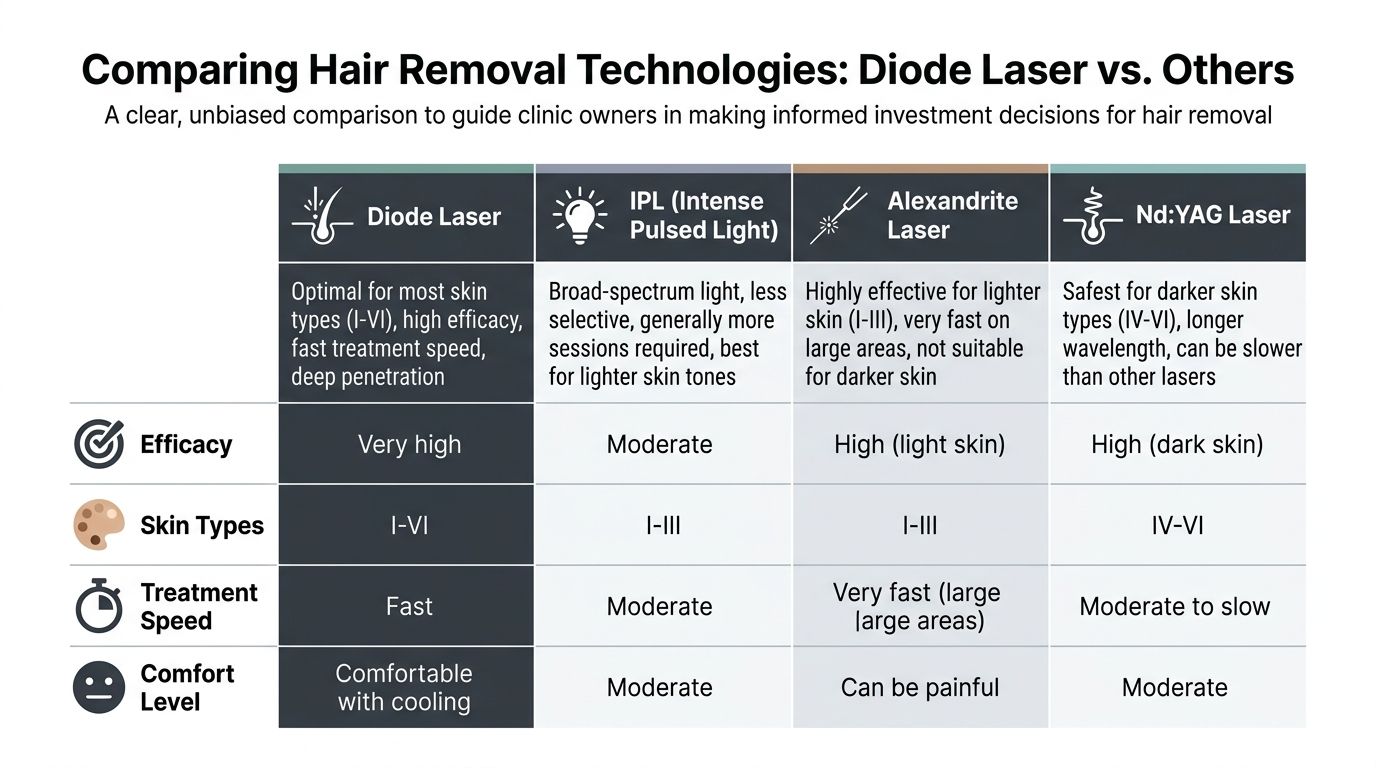
Diode has become the practical middle ground for many clinics because it balances penetration, speed, versatility, and skin-type reach. In South Africa, that matters more than in markets with a narrower patient profile.
Modern high-repetition-rate 10 Hz diode protocols outperform single-pulse Nd:YAG in speed and deliver permanent reduction rates of 70% to 90% after 4 to 6 sessions, offering a strong balance of safety and efficiency for skin types III to VI (clinical review of high-repetition diode protocols).
That doesn’t mean diode is perfect for every single patient. It means it is the most commercially sensible choice for a clinic serving mixed skin types and wanting efficient throughput.
Side-by-side technology comparison
| Technology | Best For (Skin Type) | Efficacy on Fine Hair | Pain Level | Treatment Speed |
|---|---|---|---|---|
| Diode | Broad use across diverse skin types in clinic practice | Moderate to good, depending on pigment and calibre | Generally comfortable with strong cooling | Fast |
| Alexandrite | Lighter skin types | Often strong on finer pigmented hair | Can be higher | Very fast on large areas |
| Nd:YAG | Darker skin types | Usually less favoured for finer hair | Moderate | Moderate to slower |
| IPL | Select cases, usually lighter skin and less demanding indications | Less selective | Moderate | Moderate |
What each modality does well
Diode
Diode is the clinic workhorse. It handles a broad range of indications and tends to suit practices that need one primary platform for daily use.
Practical strengths include:
- Useful skin-type flexibility
- Good treatment speed
- Strong pairing with contact cooling
- Solid commercial fit for package-based treatment plans
A clinic comparing category options may also want to review how IPL compares with laser hair removal in practice, especially if the decision involves broad-spectrum systems versus true laser platforms.
Alexandrite
Alexandrite is appreciated for speed and effectiveness on lighter skin with pigmented hair. On the right patient, it can be excellent.
Its limitation is obvious in a mixed South African market. If your daily caseload includes darker phototypes, alexandrite becomes a narrower business tool.
Nd:YAG
Nd:YAG has an established role, particularly for darker skin. It offers valuable depth and safety in the right hands.
The trade-off is that some clinics find it slower in practical workflow, and comfort may not compare as favourably with well-cooled diode protocols for mainstream hair removal demand.
IPL
IPL still appears in many clinics because it can be versatile across other indications. For hair removal alone, though, it is less selective than laser.
That shows up in two places. First, more variable outcomes. Second, more dependence on ideal candidate selection.
Buying a platform because it can do many things only works if it does your main service well enough to protect your reputation.
The investment decision most owners should make
If your clinic serves a broad South African population and you want one core technology for hair reduction, diode is the most practical choice. It gives you a stronger blend of inclusivity, workflow speed, and treatment consistency than narrower systems.
In the solutions category, Omega Lasers supplies FDA approved, CE certified, and SAHPRA licensed multi-wavelength platforms for clinics that want laser hair removal capability alongside broader aesthetic treatment options. The key point is not branding. It’s that the platform you choose must fit your patient mix, your compliance needs, and your staff training reality.
Managing Client Side Effects and Aftercare
A smooth treatment can still produce a poor client experience if aftercare is handled casually. Most complaints don’t start with a dangerous reaction. They start with confusion. The client sees redness, feels warmth, or notices delayed shedding and nobody explained it properly.
What is normal after treatment
The most common immediate responses are temporary redness and mild perifollicular swelling. In practical terms, that means the skin looks pink around follicles and feels warm for a short period.
These responses can be reassuring when they are mild and expected. They show that the follicular target has absorbed energy. The problem comes when therapists either oversell them as proof of “strong treatment” or fail to mention them at all.
Use calm, precise wording. Tell the client what is common, what should settle, and when they should contact the clinic.
Aftercare advice that protects outcomes
Give every client written aftercare. Verbal instructions alone are not enough in a busy practice.
A practical aftercare sheet should include:
- Avoid heat exposure: Skip hot baths, saunas, and similar heat-heavy activities for the immediate recovery window if the skin feels warm or reactive.
- Protect from sun exposure: Sun management matters because recently treated skin is more vulnerable to irritation and pigment change.
- Keep products simple: Use non-irritating skincare rather than strong acids, scrubs, or actives on the treated area.
- Don’t wax or pluck: The follicle needs to remain available for the treatment course. Shaving is usually the acceptable option between sessions.
- Report unusual reactions early: Blistering, prolonged irritation, or marked pigment change should be assessed promptly.
What clinics should monitor
Not every side effect is avoidable, but many are predictable. Patterns point back to one of five causes:
| Issue seen after treatment | Common practical cause |
|---|---|
| Excessive redness | Settings too aggressive for the skin response |
| Pigment concern | Recent sun, poor candidate selection, or rushed parameter choice |
| Poor shedding | Undertreatment or unsuitable hair characteristics |
| Patchy results | Inconsistent overlap or rushed technique |
| Low client confidence | Weak consultation and aftercare explanation |
Good aftercare isn’t admin. It’s part of treatment delivery.
What works best for retention
Clients don’t expect perfection. They expect professionalism. If your team explains expected reactions, follows up when needed, and documents anything outside the normal pattern, trust stays intact.
The clinics that retain hair removal clients well are not always the ones with the fanciest rooms. They are the ones where every therapist gives the same clear instructions, the same calm reassurance, and the same sensible escalation when something doesn’t look right.
Business Implications and the South African Regulatory Environment
A diode platform can be clinically sound and still be a poor business decision if the pricing, packaging, and compliance model are weak. Owners spend months comparing handpieces and almost no time building the operating model around them.

Pricing pressure is real
South African clinics operate in a market where affordability matters. The available pricing range discussed for treatment is substantial, creating immediate positioning questions. If you price too low, you attract commitment problems and compress margins. If you price too high without the environment, compliance, and consultation quality to support it, clients shop elsewhere.
The answer is not “be cheaper”. It’s “be clearer”.
Build pricing around:
- Single-session logic for accessibility
- Course packages for commitment
- Area-based pricing that reflects time and complexity
- Consultation quality that justifies the treatment plan
A useful business breakdown of clinic earnings is in this guide on how much a clinic can earn with a diode laser and ROI considerations in South Africa.
Compliance is part of profitability
Using a compliant device is not only about legal comfort. It affects market trust, insurer confidence, staff confidence, and the clinic’s ability to position itself professionally.
According to the available market guidance, clinics in South Africa face pricing pressure and retention challenges, while SAHPRA-licensed multi-technology platforms can boost profitability by an estimated 25% through service bundling and regulatory trust (South African business considerations for diode laser clinics).
That service-bundling point matters. Hair removal clients become skincare clients if your business is set up to retain them. But that only works if the original laser service is delivered safely and documented properly.
Where new owners make expensive mistakes
The most common mistakes are operational, not technical:
- Buying a device without a training plan
- Ignoring SAHPRA status
- Underpricing in order to “get busy”
- Failing to package treatments
- Not tracking rebooking and completion rates
- Relying on one star operator instead of clinic-wide protocol
A diode laser should be treated like a service line, not a machine in a room. That means scripts, consent forms, photography standards, review procedures, aftercare, and sales reporting.
The practical business test
Ask four questions before buying:
- Can my team treat safely across the skin types we see?
- Can we sell and manage full treatment courses, not just isolated sessions?
- Can we prove compliance and support standards if challenged?
- Can this platform create follow-on revenue from related services?
If the answer to any of those is unclear, the issue usually isn’t the laser category. It’s the business system around it.
Frequently Asked Questions for Aesthetic Practitioners
Can I treat every client with the same preset if the device has an automatic mode
No. Automatic modes can help workflow, but they don’t replace judgment. Skin type, hair calibre, body area, pigment history, and recent sun exposure still need manual assessment.
How should I speak about results during consultation
Use permanent hair reduction, not guaranteed permanent hair removal. Clients trust clinics more when the language is medically honest and easy to understand.
Are facial treatments harder than body treatments
Yes. Facial hair can be more hormonally influenced and less predictable. That doesn’t mean don’t treat it. It means consult carefully and avoid overselling.
Is stronger pain a sign that the treatment is working
No. Excessive pain can mean excessive epidermal heating or poor cooling contact. The goal is effective follicular targeting with controlled skin response.
What usually causes disappointing outcomes
Three causes come up in practice:
- Poor candidate selection
- Inconsistent spacing between sessions
- Settings that are too cautious or copied from another client
Should therapists patch test routinely
Patch testing is a sensible risk-management habit, especially when skin behaviour is uncertain, the client has a pigment history, or treatment variables have changed.
What keeps clients compliant through a course
Clear consultation, realistic timelines, written aftercare, visible progress photos, and consistent rebooking discipline. Clients stay committed when the clinic sounds organised and behaves consistently.
Is a faster device always better for business
Only if the team can use it safely and consistently. Speed helps throughput, but rushed technique, poor overlap, and weak assessment can erase any financial advantage.
If you're evaluating a diode laser hair removal system for your clinic, Omega Lasers is one option to review for SAHPRA-licensed, FDA approved, and CE certified aesthetic platforms, along with training, technical support, and business guidance that matter when turning a device purchase into a working treatment service.