



A patient asks your receptionist, “Can I just see one of your other client's before photos so I know what to expect?” At the same time, a therapist wants to post a treatment-room story, and your marketing partner asks for a list of recent clients for a follow-up campaign. None of those requests feels dramatic in the moment. Any one of them can still become a patient confidentiality breach.
That's the daily reality in an aesthetic clinic. The risk rarely starts with a hacker or a dramatic system failure. It usually starts with a normal conversation, a quick message, a familiar patient, or a staff member who thinks they're being helpful.
Always ensure the information is accurate and true, as this concerns aesthetic lasers, energy-based devices, and health.
Table of Contents
- Why Patient Confidentiality is Your Clinic's Greatest Asset
- Understanding Your Legal Duties Under POPIA and the NHA
- The Confidentiality Risks Every Aesthetic Clinic Faces
- Creating an Ironclad Patient Consent Process
- How to Securely Manage Patient Data and Images
- Navigating Social Media and Third-Party Data Sharing
- What to Do When a Confidentiality Breach Happens
Why Patient Confidentiality is Your Clinic's Greatest Asset
Aesthetic practices live on trust. Patients disclose skin conditions, hormone-related concerns, scarring, pigmentation issues, body areas they feel self-conscious about, and photographs they wouldn't share anywhere else. If they sense that your team treats that information casually, they stop speaking freely.

In practice, patient confidentiality isn't only about locking a filing cabinet or setting a password. It shows up in the waiting room, at reception, on the clinic floor, and inside the staff WhatsApp culture many businesses allow to form without rules. A patient doesn't separate “formal” confidentiality from informal behaviour. If a receptionist says a recognisable name too loudly, or a clinician discusses a treatment history where others can hear, the damage is immediate.
What patients actually notice
Patients notice small signals before they notice your policies:
- Reception discipline matters. Staff should verify identity discreetly and avoid discussing procedures within earshot of other patients.
- Photo handling matters. A patient wants to know whether their images stay inside the clinical record or might end up in a gallery, slide deck, or social post.
- Screen visibility matters. Tablets and desktops must be angled away from public view, especially in open-plan reception areas.
- File control matters. If your team moves images, consent forms, or treatment records between devices, you need a system for protecting your private files that doesn't rely on good intentions alone.
A clinic that treats confidentiality well feels organised. It feels calm. It feels safe. That impression is commercial, not just ethical.
Practical rule: Patients will forgive a delayed appointment more easily than they'll forgive careless handling of private information.
Why this matters more in high-visibility aesthetics
Aesthetic medicine creates a special kind of confidentiality pressure. The treatment itself is often visible. Redness after resurfacing, post-laser instructions, facial mapping notes, and progress photography all create information that's easy to expose accidentally. Add digital bookings, device-linked treatment records, and online marketing, and the risk multiplies.
That's why clinic managers need confidentiality controls built into operations, not left in a handbook no one reads. The basics include role-based access, clear image rules, and secure workflows for records attached to treatment devices and admin systems. If you're reviewing your setup, your clinic's security measures for patient information and systems should be checked with the same seriousness you apply to treatment safety protocols.
Patient confidentiality protects reputation, retention, and clinical candour. Without it, patients hold back. When patients hold back, treatment quality drops.
Understanding Your Legal Duties Under POPIA and the NHA
South African aesthetic clinics don't have the luxury of treating confidentiality as an optional best practice. It is a legal duty.

According to this explanation of privacy and access to medical information, Section 26(1) of the National Health Act No. 61 of 2003 requires that all information relating to a health service user, including health status, treatment, or stay, must remain confidential. The same source explains that POPIA classifies health data as special personal information and prohibits its processing without explicit written consent, except in limited cases such as a court order, a serious public health threat, or where processing is necessary for the patient's own treatment and care.
That sounds legalistic until you apply it to normal clinic material. In an aesthetic setting, “health information” includes consultation notes, treatment plans, patch test records, photos, adverse event notes, medical history forms, and any identifiable record showing that the patient attended your clinic.
What counts as protected information
Clinic teams often make a mistake here. They protect diagnosis and treatment notes, but they treat photos, booking messages, and internal chat discussions as if they sit outside the same duty. They don't.
A simple rule works better than debating categories at the desk:
| Clinic item | Treat as confidential |
|---|---|
| Consultation forms | Yes |
| Before and after images | Yes |
| Device treatment logs linked to a patient | Yes |
| Appointment details tied to a named person | Yes |
| Messages discussing a patient's procedure | Yes |
If a record can identify the patient directly or reasonably connect them to treatment, handle it as protected health information.
The written consent standard
Written consent is the safest default for clinics because it is the most common lawful basis for disclosure in ordinary operations. If you want to share information beyond direct care, assume you need express, written permission unless you have a clear legal basis to do otherwise.
A patient saying “that's fine” at reception is not the same thing as documented consent.
This matters when staff share records with insurers, employers, family members, or external service providers. It also matters when a clinic wants to use images for teaching, websites, testimonials, or social media. Treatment consent does not automatically cover marketing consent.
Why managers must take this seriously
A second South African source explains that disclosure of confidential patient information without written consent is treated as a criminal offence under the National Health Act framework, subject to narrow exceptions such as court orders, legal mandates, or serious threats to public health, and that practitioners must obtain express consent before sharing records with third parties like insurers or employers, as outlined in this discussion of patient confidentiality in the health sector.
For a clinic manager, the practical takeaway is simple:
- Collect only what you need
- Limit who can access it
- Document consent clearly
- Never assume a third party may receive data just because they work with your clinic
Good compliance isn't paperwork for its own sake. It's the operating system behind safe, credible patient care.
The Confidentiality Risks Every Aesthetic Clinic Faces
The biggest confidentiality failures in aesthetics rarely come from advanced attacks. They come from ordinary clinic habits that no one challenged early enough.
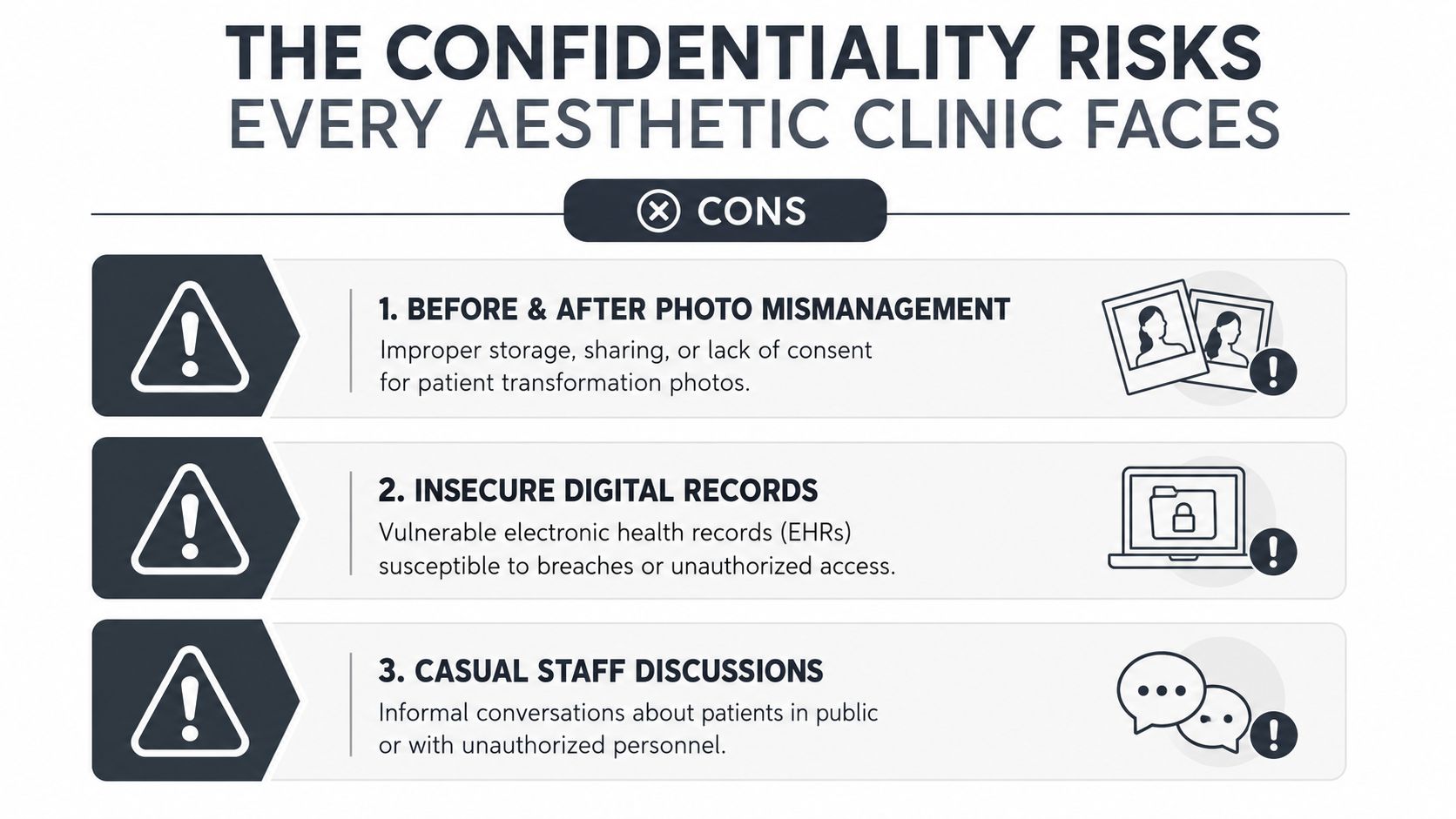
In aesthetic work, three areas create the most exposure: image handling, device-linked records, and informal communication. Those risks overlap. A single patient journey can touch all three in one day.
The before and after photo trap
Clinics often treat image capture as routine and image governance as optional. That's backwards. Before and after photography is clinically useful, but it is also one of the easiest ways to expose identity, treatment history, and highly sensitive concerns.
According to this South African aesthetics ethics discussion, 38% of ethics complaints in aesthetic practices in 2024–2025 stemmed from unconsented photo sharing via WhatsApp or Instagram by staff or patients, rather than from database breaches. That figure should change how managers prioritise risk.
Common failures include:
- Personal device capture where images sit in a staff member's phone gallery
- Loose naming conventions such as saving a file under the patient's full name
- Messaging images internally without checking whether everyone in the group needs access
- Social reposting after a patient, friend, or staff member shares content publicly first
Once a photo leaves the clinical record and enters a casual channel, control drops fast.
Device data and treatment logs
Energy-based devices generate a trail of information: treatment parameters, session history, contraindication notes, outcomes, and sometimes images or linked patient identifiers. Clinics usually focus on using that data to improve consistency. They often ignore the confidentiality angle.
If your team exports logs to a shared desktop, emails screenshots, or allows unrestricted access to treatment history, the risk isn't abstract. You've created a health information access point that may be wider than your clinical need.
Informal communication is still disclosure
Some of the most damaging breaches happen in ways staff don't even recognise as disclosure. A therapist mentions that a local business owner is having pigmentation treatment. A receptionist confirms that a known patient “comes every second week”. A clinician asks for help in a broad messaging group and includes a recognisable face.
Patient confidentiality can be breached without malicious intent. Carelessness is enough.
For perspective on how healthcare information exposure can escalate once systems and judgement fail together, it's useful to look at examining the Sami Se security incident. The lesson for clinics is not to fear technology. It's to stop relying on informal habits around sensitive data.
Creating an Ironclad Patient Consent Process
If your clinic still uses one broad consent form for treatment, images, marketing, third-party sharing, and follow-up communication, your process is too weak. A strong consent process separates decisions so the patient can say yes to one use and no to another.
Consent must also be workable at reception, in consultations, and after treatment. If staff can't explain it clearly, they won't administer it properly.
Build consent in layers
The cleanest model is to split consent into distinct parts:
Treatment consent
This covers the procedure itself, expected outcomes, limitations, and clinical risks.Clinical image consent
This authorises image capture for the medical record and treatment comparison only.Marketing image consent
This applies only if the patient agrees to external use such as websites, social posts, brochures, or presentations.Third-party sharing consent
This covers each outside recipient where disclosure may occur.Communication consent
This covers how the clinic may contact the patient and what may be sent through each channel.
That structure avoids the common problem where a patient agrees to treatment and the clinic later treats that as permission for public exposure.
What good consent language does
Good consent language is specific, separate, and revocable in practice. It doesn't bury image use inside clinical paragraphs. It doesn't force patients into bundled choices. It doesn't use vague wording such as “trusted partners”.
Use tick-boxes. Name the purpose. Name the category of recipient. Keep the decision narrow.
A practical internal checklist looks like this:
- State the purpose clearly so the patient knows whether the data stays in the record or leaves it
- Separate internal and external uses because these are different risk levels
- Record the date and version of the consent form used
- Store the signed form with the relevant record so staff can verify permission before any disclosure
- Make refusal workable so a patient can decline marketing use without affecting care
The rule for minors and other disclosure limits
The HPCSA guidance is precise here. According to Booklet 5 on confidentiality and providing information, healthcare practitioners may divulge patient information only under six specific statutory conditions: statutory provision, court instruction, public interest, express patient consent, written parental or guardian consent for minors under 12 years, or written next-of-kin consent for deceased patients.
That “under 12 years” threshold matters because staff often generalise about minors without checking the actual rule. In a busy aesthetic setting, that leads to guesswork. Guesswork around consent is where breaches start.
If a staff member has to interpret what the form “probably meant”, the form has already failed.
How to Securely Manage Patient Data and Images
Patient confidentiality lives or dies in daily handling. Policy matters. Storage, access, naming, exporting, and staff behaviour matter more because those are the places where records move.
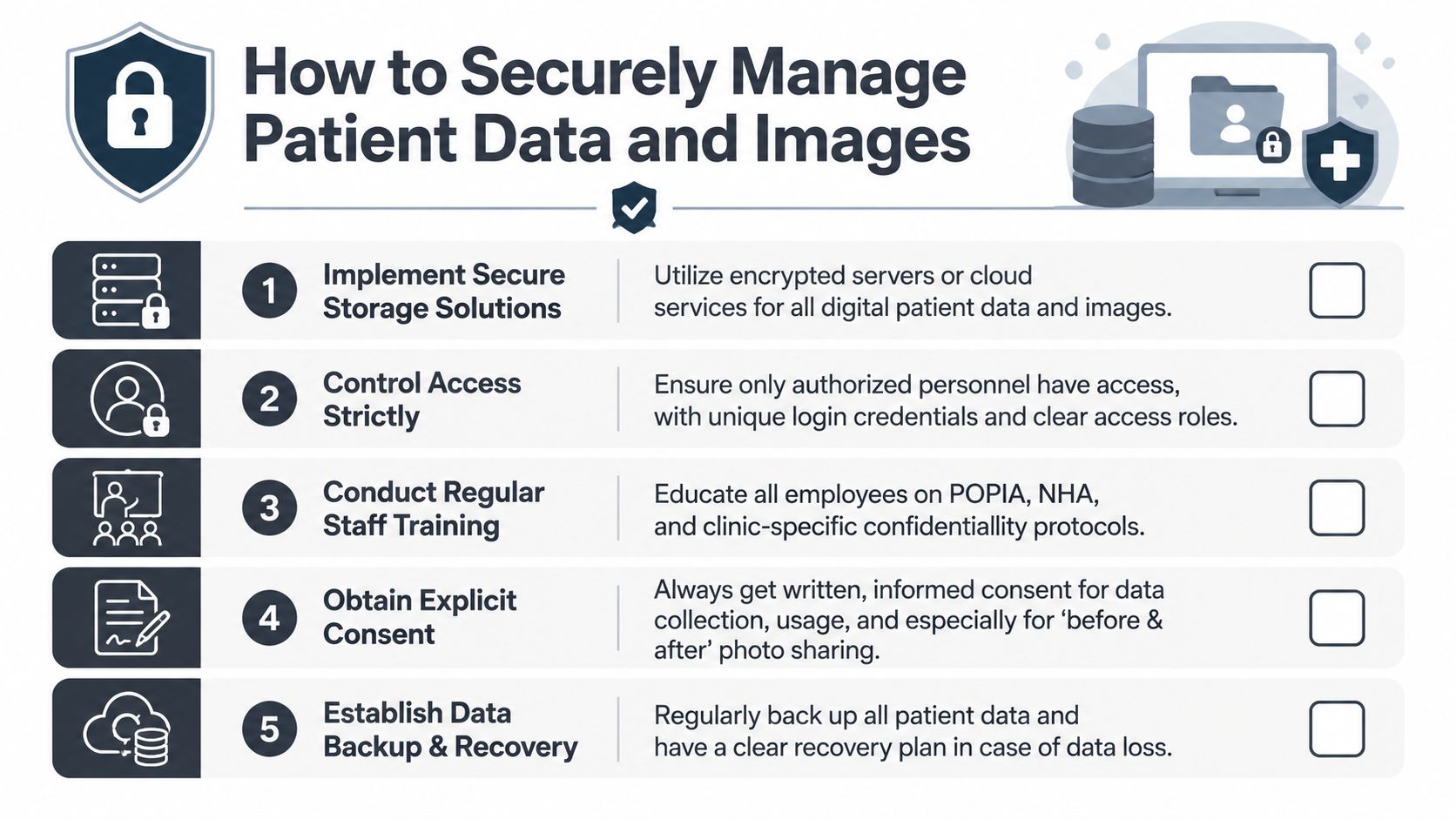
South African healthcare providers must meet technical and procedural duties when handling health information. As explained in this POPIA healthcare privacy overview, Section 26 of POPIA prohibits processing personal health information unless strict confidentiality is maintained and Section 32's conditions are met. The practical implications include password-protected electronic records, encrypted emails containing electronic protected health information when sent beyond firewalls, authorised-access-only controls, and de-identification wherever feasible for research use.
Start with access control
Not every employee needs the same view.
A receptionist may need appointment data. A treating clinician may need consultation notes and images. A finance staff member may need billing records but not treatment photos. If everyone can see everything, your system is convenient and non-compliant.
Use this access model:
| Role | Should access |
|---|---|
| Front desk | Booking and contact details needed for scheduling |
| Clinician | Full treatment record relevant to care |
| Marketing staff | No patient record access unless explicit, documented need and consent exist |
| Technical support inside the clinic | Device status only, not identifiable patient files unless necessary and authorised |
Tighten image management
Images need their own workflow. Don't mix them loosely into admin storage.
A solid clinic protocol includes:
- Clinic-owned capture only using approved devices, never personal phones
- Neutral file naming that avoids full names in visible file titles
- Immediate upload to the approved record location after capture
- Local deletion from the capture device once confirmed in secure storage
- Permission checks before use every single time, even if the image was taken months ago
Secure device-linked information
Advanced treatment systems can improve consistency and record-keeping, but only if the clinic controls who accesses exports, logs, and linked patient data. Lock down admin credentials. Restrict data export rights. Keep a written procedure for how records move from treatment room to patient file.
If your team is reviewing operational standards, your record-keeping workflow for aesthetic treatments should align with your confidentiality rules, not sit in a separate admin silo.
Train for behaviour, not just policy
Most clinics do one induction session and assume the team understands confidentiality. That's not enough. Staff need scenario-based training:
- A patient's friend asks whether she attended
- A therapist wants to post a treatment room clip
- A clinician requests photo feedback in a group chat
- An admin employee receives an insurer request
- A supplier representative is physically present near visible screens
Give staff scripts. Give them escalation rules. Give them confidence to say, “I can't disclose that without the proper consent.”
Navigating Social Media and Third-Party Data Sharing
Many aesthetic clinics expose themselves unintentionally. The legal rule sounds straightforward. Its practical application is messier because modern clinics market aggressively, use digital imagery constantly, and work with outside partners.
Social media is the first blind spot. A patient may post voluntarily, but that does not automatically permit the clinic to repost, tag, comment with treatment detail, or confirm the patient relationship. Staff also create risk on personal accounts. Even if they don't name the patient, a face, tattoo, treatment room background, booking card, or recognisable voice can identify the person.
Social media needs separate consent and staff rules
A clinic social media protocol should include:
- Platform-specific permission so external image use isn't treated as blanket approval
- Content review before posting to remove identifiers in frames, captions, and metadata
- No reposting by assumption even when the patient tags the clinic first
- A staff conduct rule that bars discussion of patient cases on personal social accounts or public groups
Short-term campaigns need their own caution. A patient may agree to a single testimonial or image use today and not want indefinite circulation later. Clinics should reflect that operationally by checking current permission before republishing archived content.
Third-party sharing is where confusion becomes liability
According to this legal guidance for aesthetic clinics in South Africa, a 2025 ZA industry survey by the South African Aesthetic Medicine Association found that 62% of aesthetic clinics are unsure whether their data-sharing agreements with clinic finder platforms or marketing partners comply with relevant legal and ethical requirements. That uncertainty is itself a warning sign.
If a clinic shares data with a marketing agency, software support provider, finance partner, or finder platform, the right question is not “Do we work with them?” The right question is “What exact patient information do they receive, for what purpose, and where is the patient's separate consent for that recipient?”
That matters for visual tools too. If your clinic uses patient imagery to support consultation journeys, progress tracking, or educational visuals, the workflow around features such as a 360 treatment photography setup must be tied to specific opt-in permissions, not folded into a vague intake form.
Public visibility does not erase private rights. A patient can share their own results and still refuse clinic reuse or third-party processing.
What to Do When a Confidentiality Breach Happens
Even disciplined clinics can have an incident. The difference between a containable problem and a reputational crisis is the speed and quality of your response.
Start with containment. Remove the post, stop the message thread, disable access, recover the device, or cut off the export route. Preserve evidence while you do it. Staff often panic and start deleting traces without documenting what happened.
Then assess the scope. Identify what information was exposed, who saw it, whether images or health details were identifiable, and whether the disclosure is still ongoing. Keep one incident log with timestamps, names, actions taken, and pending decisions.
Use a response sequence like this:
- Contain immediately by stopping further disclosure.
- Assess harm by identifying the type of data and likely impact on the patient.
- Notify appropriately based on your legal obligations and internal governance process.
- Correct the weakness by changing the workflow, not only warning the person involved.
If the breach has online visibility, practical clean-up may include takedown requests and search-result suppression steps. In those situations, guidance on removing personal data from Google can help clinics understand the clean-up path after public exposure.
The final step is uncomfortable but necessary. Ask what allowed the breach to happen. Weak consent wording, overbroad access, poor staff scripts, and informal image handling usually sit behind the event. Fix the system, not only the symptom.
Patient confidentiality isn't separate from clinical quality. It is part of clinical quality. If you're building or upgrading an aesthetic practice, Omega Lasers supports clinics with advanced medical-aesthetic technology and the operational foundation needed to run safely, professionally, and with patient trust intact.