



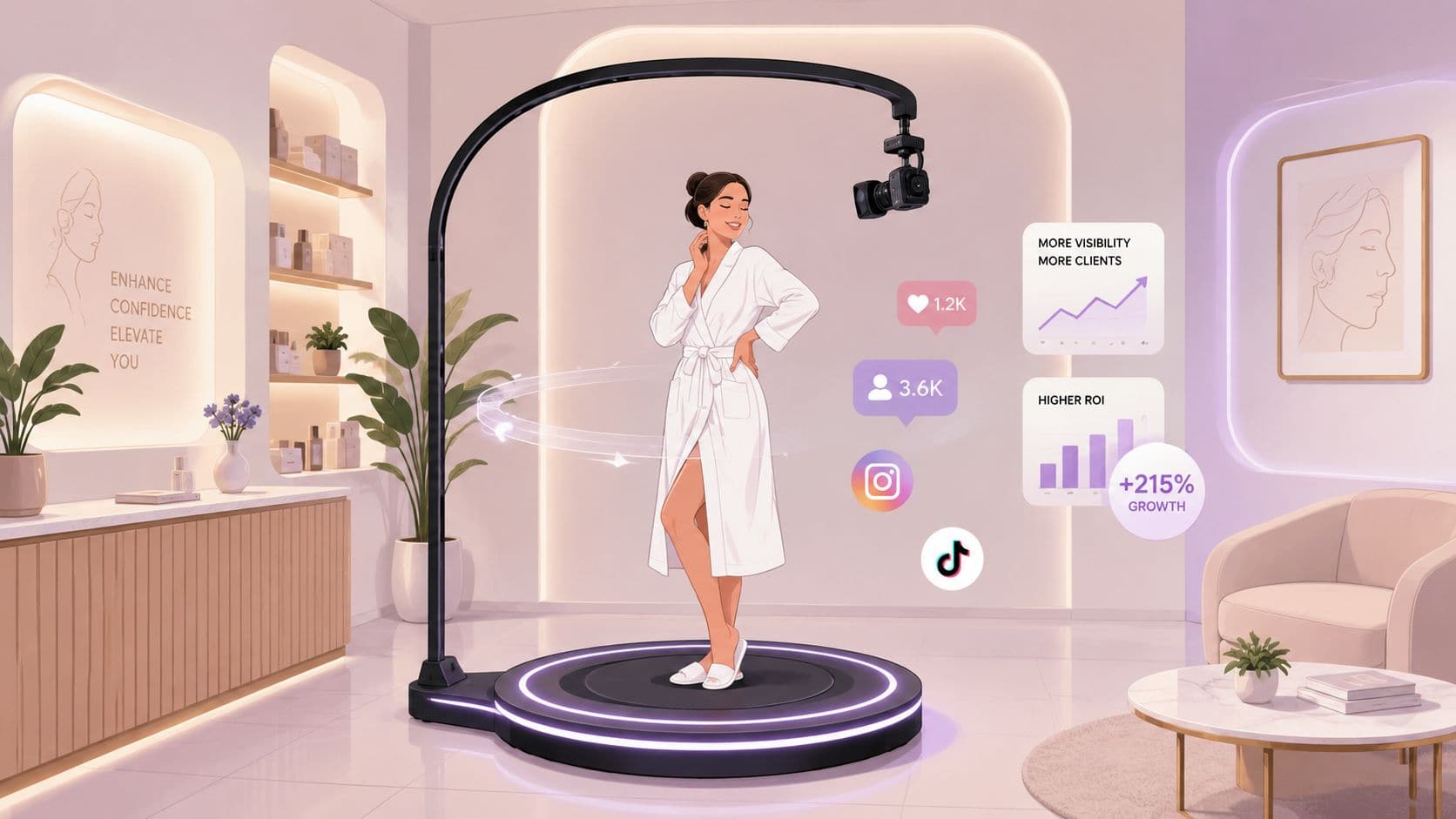
You're probably already sitting on a familiar problem. Your treatments may deliver visible results, your team may do excellent consults, and your clients may leave happy, but your marketing still leans on static before-and-after photos that all start to look the same on social media.
That gap matters. Aesthetic clinics don't just need content. They need proof, credibility, and a reason for clients to share their experience publicly without it feeling forced. A 360 Photo Booth can help with that, but only when it's used as a clinical marketing asset rather than a party extra rolled into the reception area.
It's also worth being precise here because this concerns aesthetic lasers, energy-based devices, and health. A 360 booth is not a treatment platform, not a laser, and not a regulated energy-based device. It's a video capture system. Used properly, it can support documentation, improve event engagement, and strengthen the way your clinic presents treatment journeys.
Table of Contents
- Beyond Before-and-After Photos A New Marketing Tool
- Understanding the 360 Photo Booth Mechanism
- Practical Setup and Safety in a Clinic Environment
- Buying vs Renting Which Is Right for Your Clinic
- Strategic Use Cases for Aesthetic Marketing
- Calculating the ROI for Your Clinic
- Frequently Asked Questions for Clinic Owners
Beyond Before-and-After Photos A New Marketing Tool
A clinic owner hosts an open day for injectables, laser hair removal, or resurfacing. The team prepares beautifully. The waiting area is styled, consult slots are booked, and the treatment rooms are spotless. Then the content from the day ends up being a few phone photos, a staff group shot, and one or two polished images that don't capture the atmosphere or the client journey.
That's where a 360 Photo Booth changes the output. It gives you a structured way to create branded, movement-based content that clients want to share. The difference isn't novelty alone. It's that the final clip feels more like a mini campaign asset than an incidental photo.
In practice, that makes it useful for more than launch parties. Clinics can use it for membership evenings, treatment milestone celebrations, practitioner-led educational events, and high-touch consult days where trust and presentation matter. If your team already tracks consultations, treatment plans, and visual progress through disciplined record-keeping, this fits naturally alongside your existing data collection methods for better clinic decision-making.
Why clinics respond well to it
- It creates client-led promotion. A guest shares a branded clip because it looks polished, not because you asked for a favour.
- It upgrades event perception. The clinic appears organised, current, and media-aware.
- It gives your staff better raw material. Your marketing person no longer has to build a campaign from random phone footage.
A 360 booth works best when it's planned like part of the client journey, not treated like decoration.
The handoff matters too. A beautiful clip loses value if delivery is clumsy. Clinics that want a better post-capture process can borrow ideas from SendPhoto's client handoff guide, especially around keeping delivery simple and client-friendly after content is captured.
Understanding the 360 Photo Booth Mechanism
A 360 Photo Booth is a video system. It is not a medical device, not an energy-based platform, and not part of the treatment itself. That distinction matters in an aesthetic setting because clinic owners are used to evaluating devices through the lens of treatment efficacy, safety standards, and regulatory status. A 360 booth belongs in your content and guest-experience workflow, not your treatment stack.
What the device is and is not
The basic setup is straightforward. A client stands on a circular platform while a camera mounted on a rotating arm moves around them. Lighting helps keep exposure clean and consistent. Software then processes the captured footage and prepares a finished video for delivery.

The modern commercial version traces back to 30 October 2014, when OrcaVue founder Daniel Rosenberry invented the first motorised 360 photo booth for the YouTube channel JoyRiders. That milestone matters because it marks the point where this moved from an inventive concept into a commercial event product with real adoption.
If you want a simple primer on the broader idea of immersive capture formats, understanding 360 degree photos and videos is a useful starting point. In clinic use, though, the important distinction is simpler. Your patients are not stepping into imaging hardware for diagnosis. They're stepping onto a branded capture platform for visual storytelling.
How the slow-motion effect is created
The signature look comes from speed and frame capture. A commercial platform is typically rated to support up to 400kg (approx. 880lbs), while the camera arm captures at 120 frames per second. That frame rate is what allows the footage to be slowed significantly without losing clarity, creating the cinematic slow-motion effect associated with a 360 booth.
A few technical points shape the result:
- Platform stability matters. If the base shifts, the video looks amateur and guests feel uncertain.
- Camera quality matters. Commercial setups typically use 4K resolution capture rather than relying on a basic mobile camera.
- Lighting matters more than most owners expect. Even strong treatments can look underwhelming if shadows hide texture or create uneven skin tone in the footage.
Practical rule: The booth should make movement look controlled and elegant. If the final clip feels shaky, cramped, or dim, the setup is the problem, not the client.
The best clinic operators keep the effect restrained. Too many overlays, props, or gimmicky transitions dilute the professional tone. In aesthetics, clean branding nearly always performs better than noisy entertainment styling.
Practical Setup and Safety in a Clinic Environment
A clinic can absolutely run a 360 booth well, but the room has to be planned for it. The most common mistake isn't camera quality. It's trying to fit the booth into a lounge, corridor edge, or reception zone that doesn't give the arm enough clearance.

For indoor operation, a minimum spatial footprint of 10ft x 10ft (approx. 3m x 3m) is required, and a South African Event Safety Alliance report found that 34% of booth-related incidents in dense urban venues occurred due to inadequate space planning (reference here). In a clinic setting, that matters even more because you're often working in compact, design-heavy spaces where furniture, retail shelving, and traffic flow compete for the same floor area.
What you need in the room
A workable clinic setup usually includes these basics:
- Clear floor area: Keep the booth out of walkways used by clients moving to consult rooms or treatment areas.
- Stable power access: Commercial units for the ZA market require 100-240V at 50-60Hz.
- Controlled lighting: LED lighting should provide uniform illumination at approximately 500 nits to help avoid flicker and exposure inconsistency.
- A capable host computer: Real-time editing workflows typically require at least 16GB RAM and a dedicated GPU for smooth processing.
- Offline reliability: In venues where connectivity is inconsistent, an offline-first workflow prevents the booth from becoming unusable mid-event.
A clinic should also apply the same discipline to the booth area that it applies to the rest of the site. If your team already follows strong infection control procedures in client-facing spaces, the booth zone should be managed with the same mindset around flow, touchpoints, and staff oversight.
How to reduce operational risk
Space isn't the only issue. Operator behaviour, guest briefing, and queue management affect safety just as much as hardware does.
- Mark the perimeter clearly. Guests need to know where the rotating arm travels before stepping on.
- Assign one operator. One trained staff member should control entry, positioning, and timing.
- Limit distractions around the booth. Drinks tables, handbag piles, and retail displays don't belong near the rotation path.
- Brief every group. Clients must know when to step on, where to stand, and when not to lean outward.
In clinics, the booth should feel supervised, not self-service.
If you're planning a launch or branded activation, planning your corporate event photo booth offers useful event-flow ideas that translate well to a more polished healthcare-adjacent environment.
What doesn't work is squeezing the booth in because “it technically fits”. The legal and reputational downside of a preventable incident is larger than the upside of getting one extra station into the room.
Buying vs Renting Which Is Right for Your Clinic
Most clinics shouldn't start by asking which option is cheaper. They should ask which option fits how often the booth will be used and who will manage it. A 360 booth can be a recurring brand asset, but it can also become an expensive piece of stored equipment if no one owns the process.
Industry data places the average rental cost for a few hours at $500 to $1,500, depending on location, event length, and customisation such as branded overlays (reference here). That makes renting a sensible entry point for many clinics, especially if the booth is tied to open days, launch nights, or occasional campaigns rather than weekly use.
Comparison of Buying vs. Renting a 360 Photo Booth
| Factor | Buying | Renting |
|---|---|---|
| Upfront commitment | Higher initial outlay | Lower initial spend |
| Frequency fit | Better for repeated in-house use | Better for occasional events |
| Maintenance | Clinic handles upkeep and storage | Provider usually handles logistics |
| Branding control | Easier to standardise across events | Often available as package add-ons |
| Staffing demand | Team needs an internal owner | Less internal burden if support is included |
| Flexibility | Fixed asset with fixed format | Easy to scale up or down by event |
| Risk of underuse | Higher if events are infrequent | Lower because spend is tied to use |
When renting makes more sense
Renting usually wins when your clinic is testing demand. It also suits teams that don't want to manage transport, assembly, software, and troubleshooting.
That's especially true if your main use case is:
- launch events
- influencer evenings
- seasonal campaigns
- a once-off patient appreciation event
When buying makes more sense
Buying becomes stronger when the booth is part of a repeatable internal system. That means regular content days, recurring educational events, or a dedicated brand studio area inside the clinic.
If no one on your team can own setup, content standards, and client flow, don't buy yet.
The trade-off is control versus convenience. Ownership gives you more consistency if your clinic has the volume and discipline to support it. Renting gives you speed and lower operational friction if you're still validating the use case.
Strategic Use Cases for Aesthetic Marketing
The strongest argument for a 360 Photo Booth in aesthetics isn't entertainment. It's that it helps clients see and share change more vividly than static imagery often can.
A 2025 South African study found that aesthetic clinics using 360-degree impact videos for pre/post-treatment documentation achieved a 22% higher client retention rate compared with clinics relying solely on static photos (reference here). For clinic owners, that shifts the conversation. This is no longer just about a fun clip from an event. It's about a better way to document perception, progress, and treatment confidence.

Clinical documentation that clients understand
Static photos still matter. They're useful for charting consistency and keeping records standardised. But they often fail to capture how a result presents in real life. Skin texture, contour, posture, confidence, and movement can all influence how a client perceives improvement.
A 360 booth can be useful in situations such as:
- Treatment milestone reviews: A client completing a course wants to see progress from multiple angles.
- Body-focused services: Shape and silhouette are often easier to appreciate in motion than in a front-facing still.
- Practice education: Practitioners can use footage to explain what has changed and what still requires time.
The key is discipline. Use the booth as a complement to your standard photography, not a replacement. Keep wardrobe guidance, lighting, timing, and positioning as consistent as possible for comparable progress documentation.
The booth adds persuasive visual context. Your standard photography still carries the record-keeping burden.
Event content that doesn't feel generic
Clinics also get strong value from the booth during open days and community-facing events. It works especially well when the experience is connected to a treatment theme or campaign rather than dropped into the room with no narrative.
A few examples work well in practice:
- Launch evenings: Tie the content to a new service, a seasonal package, or a clinic refurbishment.
- Client celebration moments: Mark treatment completion or loyalty milestones with a polished branded video.
- Practitioner visibility: Feature your clinicians in short, professional clips that humanise the brand without feeling staged.
What usually fails is a booth covered in novelty props that clashes with the clinical identity of the practice. The more premium and medically led your positioning is, the more restrained the styling should be.
Clients don't need another random event clip. They need a reason to associate your clinic with visible results, confidence, and a premium experience. Used that way, a 360 booth becomes part content studio, part trust-building tool.
Calculating the ROI for Your Clinic
A clinic shouldn't evaluate a 360 booth only as an event expense. The better question is whether the content and retention value justify the spend within your current marketing model.
In Johannesburg and Cape Town, premium 360 booth rentals for corporate events typically range from ZAR 15,000 to ZAR 30,000, and instant sharing via QR code or SMS can increase social media sharing rates by up to 40% compared to delayed delivery (reference here). That matters because the primary value often comes from speed. If clients receive their clip while enthusiasm is high, they're more likely to post it, send it, and talk about it.

Where the return actually comes from
Think about return in three buckets rather than one.
- Retention value: If the booth supports stronger treatment storytelling and clearer progress conversations, it can help clients stay committed to a plan.
- Acquisition value: Shared clips can expose the clinic to new prospects who would never engage with a standard before-and-after post.
- Brand value: A polished capture experience can make a clinic feel more current and premium, which supports pricing confidence.
The mistake is expecting the booth to produce direct revenue in isolation. It usually performs best when tied to a campaign, a treatment category, or a patient journey you already want to promote.
A simple way to evaluate the spend
Use a practical decision model:
- Start with the event or campaign cost. Include rental, staffing time, and any branded creative.
- List the intended outcomes. More bookings, more referrals, better treatment adherence, or stronger launch visibility.
- Track what happens after the event. Ask where leads came from, which clips were shared, and whether consult conversions improved.
- Compare against your usual content output. If the booth gives you more useful material than a standard event shoot, that difference has value.
If your clinic already budgets by campaign or service line, fold the exercise into your normal financial forecasting process. That makes the decision operational rather than emotional.
Don't buy or rent a booth because it feels modern. Use it when it helps clients understand results and helps your team market those results more effectively.
Frequently Asked Questions for Clinic Owners
Who on my staff should operate the booth
Choose one person who is calm, organised, and comfortable directing clients. This doesn't have to be a clinician. In many practices, a marketing coordinator, front-of-house lead, or event support person is a better fit because the role is about flow, positioning, consent, and delivery rather than treatment expertise.
What are my POPIA obligations when capturing client videos
Treat booth footage as personal information. Get clear consent before capture, explain how the clip may be used, and separate private documentation from public marketing use. If the system stores or transfers video files, use workflows that protect the data. In South Africa, operators should use encryption such as AES-256 to protect video data and support POPIA compliance.
How quickly are videos usually delivered
Well-configured systems can process and edit footage in 2 to 3 seconds after capture, allowing near-instant delivery through QR code, SMS, or AirDrop. That speed matters because delayed delivery reduces the chance that clients will share while interest is still high.
How do I light the booth to show skin properly
Use even, stable LED lighting and avoid dramatic shadows. In a clinic, flattering light isn't enough. You want consistency. Keep the booth lighting predictable, avoid mixed colour temperatures, and test how your treatment areas, reception finishes, and skin tones appear on camera before the event.
Can it replace standard before-and-after photography
No. Standard photography should remain your primary documentation system. The 360 booth is best used as a complementary layer for client engagement, education, and marketing presentation.
If you're building an aesthetic practice that needs stronger treatment storytelling, better client retention, and more polished launch marketing, Omega Lasers can help you think beyond the device itself. The right growth tools aren't only in the treatment room. They're also in the systems that help clients see results, trust your process, and keep coming back.