




You've just installed a new laser or energy-based device, the training day went well, and everyone sounded confident in the room. Then Monday arrives, a nervous first client is on the bed, the junior therapist hesitates, and the senior person is suddenly pulled away to fix a booking issue, answer a client complaint, and rescue the treatment plan at the same time.
That's the moment many South African aesthetic practices realise that device training and clinical confidence are not the same thing. A device course can teach protocol. A mentorship program gives your team the judgement, support, and accountability that keep protocol inside a real clinic from becoming guesswork.
Table of Contents
- What a Mentorship Program Actually Is in an Aesthetic Clinic
- Four Models of Mentorship and Where Each One Fits
- The Business Case for Mentorship in Aesthetic Practices
- How Mentorship Complements Device Training
- Building Blocks of an Effective Mentorship Program
- Measuring Whether Your Mentorship Program Is Working
- Two Clinic Stories That Bring Mentorship to Life
- Choosing, Launching, and Stress-Testing Your Program
What a Mentorship Program Actually Is in an Aesthetic Clinic
A real mentorship program in a clinic is structured support, not a friendly shadowing arrangement that fades after induction week. It has a start point, a finish point, clear goals, scheduled check-ins, and one accountable senior person who stays involved long enough to notice whether confidence is growing.
That distinction matters because clinic work isn't only about knowing the steps. A therapist also has to judge when a skin response is normal, when a client needs more reassurance, when a treatment should slow down, and when a case should be escalated. A mentor sits in that decision space and helps the junior practitioner develop sound habits before risky shortcuts settle in.
Mentorship, supervision, and coaching are not the same thing
Supervision usually carries a formal oversight function. Coaching is often more targeted, short-term, and performance-specific. Mentorship is broader, because it blends knowledge transfer, confidence building, and career shaping while still keeping the work grounded in day-to-day clinical reality.
That's why a clinic can't treat mentorship as a casual favour after the device rep leaves. The relationship needs rules, especially where scope of practice, recordkeeping, and safe device use are involved. A useful mental model is simple, training is the swimming lesson, mentorship is the lifeguard who stays close while the person completes the first open-water swim.
Practical rule: if your support ends the moment the course certificate is printed, you've got training, not mentorship.

What counts as mentorship on a normal clinic day
In practical terms, the mentor reviews cases, watches technique, gives feedback, and helps the mentee make better decisions under pressure. That can mean talking through a borderline contraindication, guiding a new therapist through a difficult first consultation, or helping a seasoned staff member adjust to a new device without losing confidence.
If your current setup has no calendar, no goals, and no review point, it's probably not a program yet. It's goodwill. Goodwill is nice. It's just not enough when client safety, reputation, and device ROI are on the line.
Four Models of Mentorship and Where Each One Fits
A clinic doesn't need one “best” model. It needs the model that matches its size, staff maturity, and case mix. A solo therapist working out of a compact space needs something very different from a multi-doctor practice with layered clinical risk and more complex client journeys.
One-to-one, group, peer, and clinical preceptorship
A one-to-one model gives depth. It works well when one mentee needs close clinical guidance, especially after a new hire starts handling treatments independently. A group model spreads one senior voice across several learners, which can suit teams that all need the same protocol confidence at once.
A peer model is different. The participants learn alongside each other, compare decisions, and normalise questions that people are often too shy to ask in front of a senior clinician. A clinical preceptorship is the most tightly supervised form, and it fits higher-stakes clinical environments where judgement, escalation, and governance need to be visibly reinforced.
Matching the model to the clinic
A solo beauty therapist in Cape Town may get more value from peer accountability than from hiring a remote expert who only appears occasionally. A Sandton practice with several practitioners may need a preceptorship layer for junior doctors and a group format for consistent device roll-out. The point is not prestige, it's fit.
Decision lens: choose the model that answers the clinic's biggest current problem, not the one that sounds most impressive in a brochure.
| Mentorship models at a glance | Best for | Time per month | Typical cost |
|---|---|---|---|
| One-to-one | New staff, high-risk treatments, deep confidence gaps | Moderate | Usually the highest of the four |
| Group | Teams learning the same protocol or process | Lower per person | Shared across participants |
| Peer | Small teams, early-career confidence, reflective practice | Low to moderate | Usually leaner than senior-led formats |
| Clinical preceptorship | Junior clinicians, regulated settings, complex decision-making | Highest intensity | Highest supervision demand |
The right model also changes over time. A peer-circle arrangement may be enough in the first months, then a preceptorship layer becomes more appropriate once the team begins handling more advanced clients. That flexibility keeps the program practical instead of ceremonial.
The Business Case for Mentorship in Aesthetic Practices
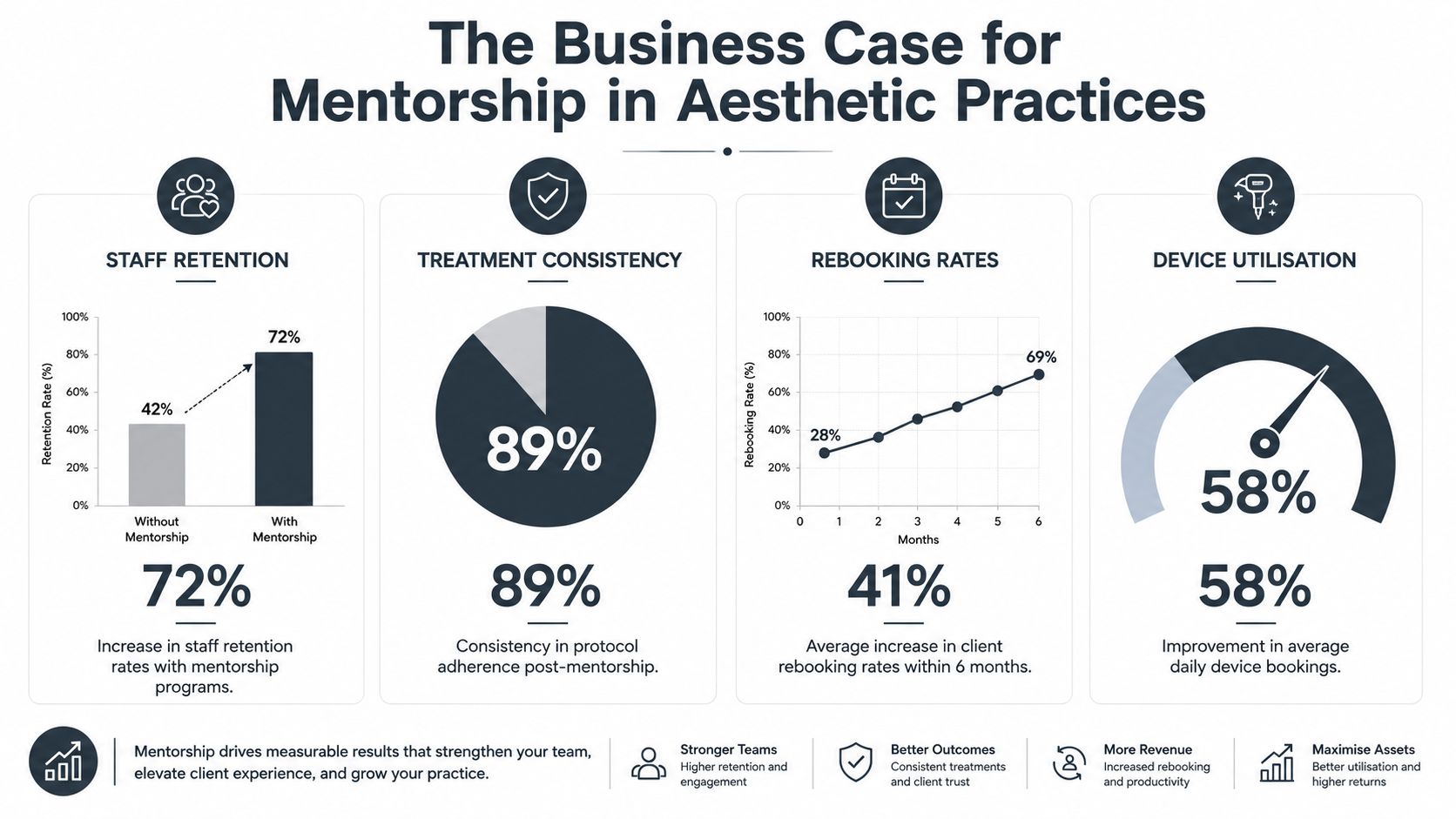
Aesthetic clinics usually feel the cost of weak mentorship first in the treatment room, then in the accounts. A practitioner who is still guessing eats up chair time, needs more supervision, and can slow the rhythm of the whole day. A mentored team member settles faster, asks better questions, and makes fewer avoidable errors while confidence is still forming.
Across workplaces, employees with mentors are reported to be twice as engaged as those without mentors, highly engaged teams can deliver 18% more productivity and 23% higher profitability according to workplace research summarised in mentoring studies, and Zippia reports mentored employees are promoted five times more often than those without mentors, with salary-grade changes at 25% versus 5% for non-participants (Zippia mentoring statistics). In a clinic, that usually shows up as steadier room usage, fewer hand-holds for senior staff, and a stronger internal pipeline.
What that means in a treatment room
A laser hair removal room is a good example. If the protocol is clear but the practitioner is still new, a mentor can correct small mistakes before they become habits, which helps with consultation consistency, treatment flow, and post-care explanations. Clients notice that kind of steadiness, especially when they compare experiences and results on social media.
The commercial case is broader than one chair or one device. Organisations with mentoring programmes report profits about 18% higher on average, and one synthesis found mentoring can deliver a 600% ROI in some settings (Zippia mentoring statistics). Those are broad workplace figures, not clinic-specific guarantees, but they explain why mentorship is often treated as a revenue lever, not just a people initiative.
Why this matters in South Africa
South Africa adds its own pressure points. Mentoring has been institutionalised in higher education and skills development, and the national youth policy emphasis on structured support reflects a workforce-readiness mindset, not just personal development (Mentorloop mentoring statistics). In clinic terms, that means mentorship can bridge the gap for younger practitioners who need workplace exposure, guided growth, and a path into reliable service delivery.
The revenue side links back to client value. The logic behind customer lifetime value in a clinic setting fits neatly here, because mentorship helps protect that value by making staff more consistent, more coachable, and more likely to stay long enough to build client relationships.
The short-term cost
Mentorship costs time before it pays back. Senior people have to stop producing for a while and teach properly. That feels expensive in the short term, but clinics that skip the support layer often pay later in inconsistent outcomes, avoidable staff turnover, and slower adoption of new treatments.
How Mentorship Complements Device Training
Device training gives staff the protocol. Mentorship teaches the judgement calls that happen between protocols. That gap is where many clinics lose confidence, because the technician knows the steps on paper but still hesitates when a client's skin response, comfort level, or medical history doesn't fit neatly into the script.
From certificate to clinical judgement
A good example is a borderline case. A protocol may say what to do in standard conditions, but the mentor helps the practitioner decide whether to continue, pause, document, or escalate. Another common moment is the first nervous client, where the mentor shows the junior practitioner how to slow the room down without losing professionalism.
That's why mentorship should sit on top of device training, not replace it. Training on its own can be very strong and still leave a gap in real-world confidence. A device course teaches the “how”, while the mentor helps with the “how do I know this is the right moment to do it this way?”
Why the pairing matters for return on investment
A clinic that buys a new platform but stops at induction is leaving value on the table. The better pattern is device education, a supported transition period, and an ongoing feedback loop that keeps performance improving as the team gets familiar with the machine. If the device comes with after-sales support and a strong warranty, the clinic gets even more stability because the technical side and the human side are both covered.
For a practical example of how formal learning is often positioned around a device roll-out, the training pathway described in laser hair removal training is the kind of foundation mentorship can strengthen. The course may show the protocol, but mentorship keeps the protocol usable once clients, time pressure, and mixed skin needs enter the room.
A mentor is the person who catches the small uncertainty before it becomes a poor habit.
The biggest mistake is assuming experienced staff don't need this layer. They do. Experienced people usually need less basic instruction and more structured reflection, especially when they're adapting familiar skill to a new platform or helping a junior colleague work safely under pressure.
Building Blocks of an Effective Mentorship Program
An effective programme starts with a written curriculum. That curriculum should use SMART objectives, because vague goals like “build confidence” are too soft to manage and too hard to measure. A better target is a clear competency or behaviour that the mentor can observe, discuss, and sign off.
The four pillars that keep the programme real
The first pillar is the curriculum itself. It should name the skills, the order they'll be covered, and the evidence that shows progress. The second pillar is mentor selection, and many clinics make a mistake here by choosing the most senior person rather than the best teacher.
The Cornell evidence review found that promotion and retention outcomes for diverse groups improve most when senior-level executives serve as mentors, pairings are assessed for shared values and Big Five personality traits, and direct managers are actively involved (Cornell evidence review). In a clinic, that means the mentor needs authority, teaching aptitude, and enough alignment with the mentee's working style to make feedback useful rather than intimidating.
The third pillar is time. A realistic competency window often runs for several months rather than a single rushed onboarding week. The fourth pillar is a feedback loop tied to observable client outcomes, so the mentor isn't only asking, “How did that feel?”, but also, “Did the client understand the aftercare, and did the process happen safely and consistently?”
A simple scaffold a clinic can use
| Program element | What to write down | What to avoid |
|---|---|---|
| Curriculum | Core competencies, order, sign-off points | Loose topic lists |
| Mentor role | Who mentors, what they review, when they escalate | “Senior staff will help where needed” |
| Timeline | Start date, review dates, end date | Open-ended support |
| Metrics | Skills observed, client outcomes, completion evidence | Vague impressions only |
If you're building the wider leadership structure around this, it helps to design a data-driven leadership program with the same discipline. The same principle applies here, leadership development works better when the expectations are written, not assumed.
A clinic also needs one visible rule, no mentorship without calendar time. If the check-ins live only in people's heads, the programme will collapse the first time the diary gets crowded.
Measuring Whether Your Mentorship Program Is Working
Many clinics stop at pairing people. That's the easy part. The harder part is proving that the relationship is improving confidence, client care, and team stability rather than just creating another meeting on the calendar.
Use a two-layer KPI stack
The first layer is leading indicators, the things that tell you whether the relationship is healthy right now. That includes match quality, meeting frequency, goal completion, and participant satisfaction. The second layer is lagging indicators, the business results that appear later, such as retention, promotion, and leadership-pipeline strength (TogetherPlatform on measuring leadership mentorship).
This split matters because relationship quality predicts later outcomes, but you won't wait a year to find out whether the programme is drifting. Simple pulse surveys and calendar or HRIS-linked tracking make it easier to review progress quarterly instead of relying on memory.
What to track and how to keep it clean
The evaluation method should be disciplined. Define SMART objectives, collect both numbers and written feedback, clean the dataset before analysing it, and segment results by role, department, gender, or seniority so you can see where the programme works best (DataCalculus on mentorship evaluation). That segmentation matters because mentoring effects are rarely uniform.
Practical rule: if you can't tell which people improved, you can't tell where the programme is doing the most good.
A useful clinic dashboard doesn't need to be fancy. It just needs to answer three questions, are people showing up, are they learning, and are the business outcomes changing in the right direction? For a deeper lens on how to collect and organise the evidence, the framework in data collection methods for clinics gives the right kind of discipline without overcomplicating the process.
One honest point is important here. Formal mentoring does work, but the average effect can be modest rather than dramatic. A 2019 meta-analysis reviewed 70 youth-mentoring studies and estimated a positive mean effect of about one-fifth of a standard deviation, which is real but not life-changing (Evidence-Based Mentoring). In clinic terms, that means you should measure lift against your own baseline, not expect mentoring alone to fix every operational problem.
Two Clinic Stories That Bring Mentorship to Life
A solo aesthetic somatologist in Cape Town has one recurring problem, the diode-laser room is underused because confidence drops when tricky conversations or borderline skin responses come up. She joins a peer-circle mentorship with two other practitioners, keeps a simple log of each session, and uses the group to rehearse consultations, discuss objection handling, and compare aftercare explanations.
The solo-practice version
The structure is light, but it's not casual. The group meets on a fixed cadence, each person brings one real case, and the discussion ends with one specific action to test in the next week. Over time, the room becomes less intimidating because the practitioner isn't relying on memory alone, she's building a repeatable way to think through the appointment.
The result is not magic, it's steadiness. Her confidence rises, the service feels more organised, and the treatment room stops depending on last-minute improvisation. That matters in a small business because one person's uncertainty can ripple straight into the client experience.
The multi-doctor version
A Pretoria practice takes the opposite approach. A junior aesthetic doctor enters a formal clinical preceptorship with a senior dermatologist, and the pair use case review, observation, and escalation rules to tighten decision-making. The point isn't only technique, it's clinical judgement under pressure, which is where governance matters most.
In that setting, mentorship behaves like a safety layer. The junior doctor gets better at reading when a case should be slowed, supervised, or referred, and the practice gets a more consistent standard across consultations. The team also notices that client conversations become clearer, because the junior doctor is no longer guessing at every unusual presentation.
These two models look different, but the lesson is the same. Mentorship works best when it is tied to a real clinic problem, tracked through simple evidence, and given enough structure to survive a busy week.
Choosing, Launching, and Stress-Testing Your Program
Start with the problem, not the format. If the clinic's biggest issue is new-staff confidence, one-to-one support may be enough. If the issue is consistency across several therapists, group mentoring may give better coverage. If the issue is clinical risk, preceptorship belongs on the table.
A realistic 90-day launch sequence
In the first month, write the purpose, name the mentor, and define the first competency. In the second month, start the check-in rhythm and collect baseline feedback from the mentee and the relevant manager. In the third month, review the evidence, decide what needs to continue, and stop anything that isn't moving.
A few questions deserve direct answers.
- Can you mentor across disciplines? Yes, if the mentor understands the context well enough to give useful feedback, but the clinical boundaries still need to stay clear.
- Are external mentors worth it? Sometimes, especially when internal hierarchy makes honest feedback difficult or when the clinic lacks enough senior depth.
- How long should a programme run? Long enough for a meaningful competency to be observed, practised, and reviewed. Anything shorter tends to feel rushed.
- What if a pairing isn't working? Reassign early. Bad fit is a programme risk, not a personal failure.
- Should everyone get the same support? No. Some people need more structure, some need less, and equity usually means matching support to need rather than pretending all learners start from the same place.
The equity issue matters more than people admit. Matching should use structured criteria and ongoing reflexivity, not assumptions about who will “fit” with whom, because demographic guesswork can reproduce exclusion rather than fix it. The programme should also have a neutral channel for negative mentoring experiences, because quality can collapse when no one is allowed to say the relationship isn't working.
A mentorship programme becomes a governance tool when it has an escalation path, not just a pairing.
The final stress test is simple. If a mentor is too busy to meet, too vague to give feedback, or too unaccountable to the clinic's goals, the programme is already drifting into performative territory. Fix the design before you scale the problem.
If you're ready to turn mentorship into a clinic governance layer, not just a nice extra, speak with Omega Lasers about building the training and support structure your team can use on Monday morning.