


South Africa's case-study habit is grounded in real operational scale, not theory alone. The 2022 General Household Survey estimated that 20.6 million people lived in households with refrigerators, while 18.9 million had access to internet at home or elsewhere (Statistics South Africa context on case-study use). That mix of household-level detail and measurable access patterns is exactly why strong case study examples work so well in clinics and spas, especially when you need to explain what changed, who it affected, and what the treatment pathway delivered.
The same logic applies to aesthetic services. A case study that only says a protocol “worked” is weak, but one that shows the challenge, the implementation path, and the outcome gives managers something they can put to use. Guidance from Adobe says a credible case study should present the challenge, explain the solution, include data, and then demonstrate impact with measurable results and customer voices (Adobe case-study guidance), while Shopify's case-study guide says the solution, implementation, and results should show the process and then present numbers, time frames, or outcomes so readers can judge the effect (Shopify case-study guide). That structure is what turns a marketing story into a decision tool.
Table of Contents
- 1. Dermatology Clinic Hair Removal Service Expansion Using Four-Wavelength Technology
- 2. Medical Spa Launch Complete Skincare Rejuvenation Program Using Integrated Multi-Modality Platform
- 3. Hair Removal Service Profitability Transformation in High-Volume Salon Environment
- 4. Dermatology Practice Revenue Growth Through Integrated Aesthetic Sideline
- 5. Anti-Aging Treatment Center Launch Targeting Affluent Demographics
- 6. Mobile Aesthetic Service Model Using Portable Multi-Wavelength System
- 7. Acne Treatment Program Clinical Outcomes Driving Patient Acquisition and Retention
- 8. Medical Spa Franchise Model Standardisation Enabling Rapid Multi-Location Expansion
- 9. Burn Scar and Trauma Recovery Program Multi-Modality Approach to Functional and Cosmetic Outcomes
- 10. Telemedicine-Integrated Aesthetic Practice Remote Consultation Model Expanding Geographic Reach
- 10-Case Comparison: Aesthetic & Dermatology Strategies
- Putting Insights Into Action
1. Dermatology Clinic Hair Removal Service Expansion Using Four-Wavelength Technology
A dermatology practice that wants to move beyond medical-only work usually hits the same bottleneck, limited treatment diversity and inconsistent appointment flow. In South African settings, the strongest answer is often a system that can handle different skin types without forcing the team to split the workflow into separate device pathways. That is where multi-wavelength thinking becomes commercially useful.

What made the expansion credible
The most defensible case study examples in this category are built around clinical breadth and workflow discipline. A four-wavelength platform gives the practice a way to position hair removal as a service line that can be integrated into a dermatology timetable without turning each appointment into a custom engineering exercise. The brand value here is not only smoother treatment delivery, but also the perception that the clinic can serve a broader patient mix responsibly.
Practical rule: If the team cannot explain why one wavelength or protocol path was chosen over another, the patient education script is not ready yet.
That kind of clarity matters because case studies in aesthetic settings should not read like device brochures. B2B guidance from Brixon Group says a compelling case study needs a measurable title, customer context, solution path, concrete results, and authentic customer voices, with quantitative metrics such as percentage increases, absolute values, temporal improvements, and cost savings when available (Brixon Group case-study guidance). Even when your own practice does not disclose those figures, the structure still applies.
How clinics usually operationalise it
A clinic can make this kind of expansion more auditable by doing three things. First, train staff before launch. Second, document skin-type suitability in intake notes. Third, standardise the booking flow so consultations, treatment, and follow-up fit together cleanly.
- Training first: Manufacturer-led training should happen before launch so the team can explain settings and aftercare with confidence.
- Protocol discipline: Start with established pathways, then expand customisation only after the staff are comfortable.
- Patient education: Use a simple explainer that ties wavelength choice to skin-type suitability and comfort.
The best case study examples in this space do not just say “we added hair removal.” They show how the service was absorbed into the practice without disrupting medical dermatology, which is the key commercial insight readers want.
2. Medical Spa Launch Complete Skincare Rejuvenation Program Using Integrated Multi-Modality Platform
A new medical spa has a different operational problem from an established clinic. It must look credible before it has a long record, and it has to avoid buying so much equipment that the business becomes operationally fragile. A consolidated platform that combines resurfacing, radiofrequency, and LED-style treatment options addresses that tension by letting the spa build packages around patient needs instead of around disconnected machines.
The strongest case study examples in startup aesthetics begin with a simple question, how do you deliver multiple visible outcomes without overwhelming the team? In this type of launch, the answer is standardisation. Aesthetic protocols become easier to teach, easier to sell, and easier to review when they are packaged around concern-led journeys such as texture, tone, and maintenance.
Turning a new service line into a repeatable offer
The business value sits in repeatability. A spa that can explain a package clearly, deliver it consistently, and document progress has a better chance of turning one-off visits into structured programmes. A strong case file should show the patient concern, the service path, and the observed result, because case-study guidance stresses a clear challenge, a solution, and measurable impact supported by evidence and client voice.
The internal operating lesson matters just as much. New teams need more than product handover. They need a method for turning a device into a reliable service system, which is why structured staff training and development should be built into launch planning.
A launch built on trained staff and defined protocols also creates cleaner reporting. If intake notes, treatment selection, and follow-up are documented in the same format, the spa can see which concerns respond best to which pathway, and can adjust packages without guessing.
What a launch-ready case file should capture
A useful case file for this kind of spa should include:
- The patient problem: What concern brought the client in, and what was the expected treatment sequence?
- The implementation path: Which modality was used first, and why?
- The evidence trail: Before-and-after photography, follow-up notes, and any short outcome survey the team can repeat.
- The marketing bridge: Which result can be responsibly used in messaging without overstating the claim?
The strongest launch story is not “we bought a platform.” It is “we built a package clients understood, staff could deliver, and the business could repeat.”
That difference matters because it separates a device purchase from a service model, and it gives the spa a clearer basis for training, documentation, and patient communication.
3. Hair Removal Service Profitability Transformation in High-Volume Salon Environment
High-volume salons feel pricing pressure first. Waxing and threading can keep the appointment book full, but they do not always support premium service economics once labour, rebooking friction, and client comfort are factored in. A fast multi-wavelength laser system changes that equation because it standardises each appointment and reduces variation across the day.
A case study on this kind of shift should focus on operations, not just equipment. When a salon group moves from traditional hair removal to laser, the workflow has to support throughput, staff confidence, and a clearer pricing story. That is what makes the service read as a deliberate upgrade rather than an untested add-on.
Key insight: Profitability improves when the service model is easier to repeat than the legacy offer. In a high-volume setting, consistency is a business metric.
Why high-throughput salons need structured transitions
In a busy beauty centre, one therapist's inconsistency can ripple through the schedule. Phased retraining helps reduce service disruption and gives the team a shared approach to consult language, prep instructions, and follow-up routines.
The service narrative should show the shift as a sequence of decisions, not a single event. The case-study methods overview makes the same point, a case study works best when the reader can see the problem, the solution, and the outcome in context. In a salon setting, that context includes booking pressure, service timing, and how clients respond when the offer moves from temporary removal to longer-term reduction.
A second layer matters here. Operational redesign only works if the commercial model can absorb it. The salon needs to know how treatment duration affects chair use, how consults are framed, and how pricing is explained so clients understand why the service sits above a standard waxing visit. That is where a practical break-even analysis becomes useful, because it links utilisation, pricing, and staff time to the point where the service starts to carry its own weight.
The strongest salon cases do not stop at adoption. They show how training, timing, and pricing align to make the service repeatable.
What to include in the service narrative
A strong salon case write-up should show the conversion path, not just the final result.
- The client conversion path: How existing waxing clients were introduced to laser.
- The scheduling shift: How treatment times were standardised to protect throughput.
- The team impact: How therapist confidence changed after retraining.
- The retention logic: Why comfort features and cleaner expectations improved repeat booking behaviour.
Burying the proof weakens the story. The Venngage case-study format guidance recommends leading with the most decision-relevant metric and using numbers where available, because vague claims do not help readers evaluate the offer. If hard numbers are not available, state the operational change plainly and show what improved in the day-to-day service model.
4. Dermatology Practice Revenue Growth Through Integrated Aesthetic Sideline
A dermatology practice in a major city can add aesthetics without diluting its medical identity. The model works when roles are clearly separated, the patient journey is structured, and technician-run services sit alongside the clinical core. That is why an integrated aesthetic sideline can improve revenue mix without forcing doctors to carry every cosmetic consult themselves. A practical break-even analysis helps quantify how utilisation, pricing, and staff time shape the point where the sideline starts to carry its own weight.
This case study example is strong because it addresses a familiar tension. Specialists want growth, but they do not want the core practice to lose focus. The answer is not to add every cosmetic treatment available. It is to choose a platform that supports hair removal, skin resurfacing, and anti-aging services, then build a workflow that lets patients move between medical and cosmetic care without confusion.
Key insight: The practice grows more predictably when aesthetic demand is handled by trained technicians under clear oversight, not when clinicians improvise every cosmetic consult themselves.
The workflow logic behind the sideline
The case-study structure should make the decision path visible. The practice did not add aesthetics because it sounded trendy. It added it because the existing patient base already showed cosmetic demand, and the clinic's reputation could support that service line. That makes the expansion easier to explain and easier to defend inside the business.
Operational documentation matters as much as the commercial idea. In South Africa, the National Department of Health has repeatedly highlighted uneven data quality and fragmented reporting across facilities, which makes rigorous before-and-after claims difficult for smaller providers to produce (Milbank analysis of primary care data and reporting challenges). In that setting, practices need to record operational evidence carefully, even if the final case study is qualitative rather than statistical.
Clear records carry more weight than vague growth claims. If a practice cannot show the change in appointment mix, consult flow, or staff allocation, the sideline story stays weak.
A practical case-study template for this model
Use this sequence.
- Patient context: Why the client came to a dermatology practice rather than a standalone spa.
- Service path: Which aesthetic treatment was introduced first and how it was explained.
- Clinical oversight: How the doctor's role was defined.
- Commercial outcome: What changed in appointment mix, patient interest, or internal workflow.
A useful write-up should also show the revenue logic behind the sideline, not just the service description. The question is whether the new aesthetic line improves financial viability without disturbing the medical schedule or overloading consultation time. That is why the strongest case study examples for dermatology practices connect service adoption to staffing, chair use, and patient conversion, then show how the sideline fits the practice's operating model.
5. Anti-Aging Treatment Center Launch Targeting Affluent Demographics
Premium anti-aging care sells on proof of control. Affluent clients usually expect physician oversight, a setting that feels intentional, and a protocol presented as preventative rather than reactive. An anti-aging centre in Cape Town can use multi-modality treatments to position itself as a medical aesthetics destination instead of a general beauty room.
The strongest case study examples in this category focus on trust architecture. A physician-led advisory board, dermatology-trained aestheticians, and premium clinic design all signal that the client is entering a managed care environment. That signal matters because the client is not only buying a treatment, they are buying confidence in the process.
Why positioning changes the economics
The commercial logic is straightforward. When the service is framed as preventative care, the consultation becomes part of a longer relationship rather than a one-off indulgence. That gives the business a stronger basis for personalised plans and follow-up pathways that clients can return to over time.
Case-study guidance that emphasises measurable titles, customer context, solution paths, concrete results, and authentic customer voices is relevant here, especially when quantitative metrics are available. In premium aesthetics, those principles help the story move beyond aspiration and into credible proof.
What premium clients need to see
A strong anti-aging case file should include:
- A clinician-led plan: Who oversaw the protocol and why that oversight mattered.
- A documented baseline: What concern was being addressed before treatment started.
- A visible progression story: How the client was shown change over time.
- A service environment note: Why the clinic design supported the pricing model.
A luxury setting does not create the outcome by itself. The pricing case is strongest when staffing, protocol, and environment all point to the same promise.
The takeaway is that design, staffing, and protocol need to align if the business wants higher-value clients to stay engaged. In premium case study examples, the result is often a stronger sense of legitimacy, and that legitimacy becomes part of the product.
6. Mobile Aesthetic Service Model Using Portable Multi-Wavelength System
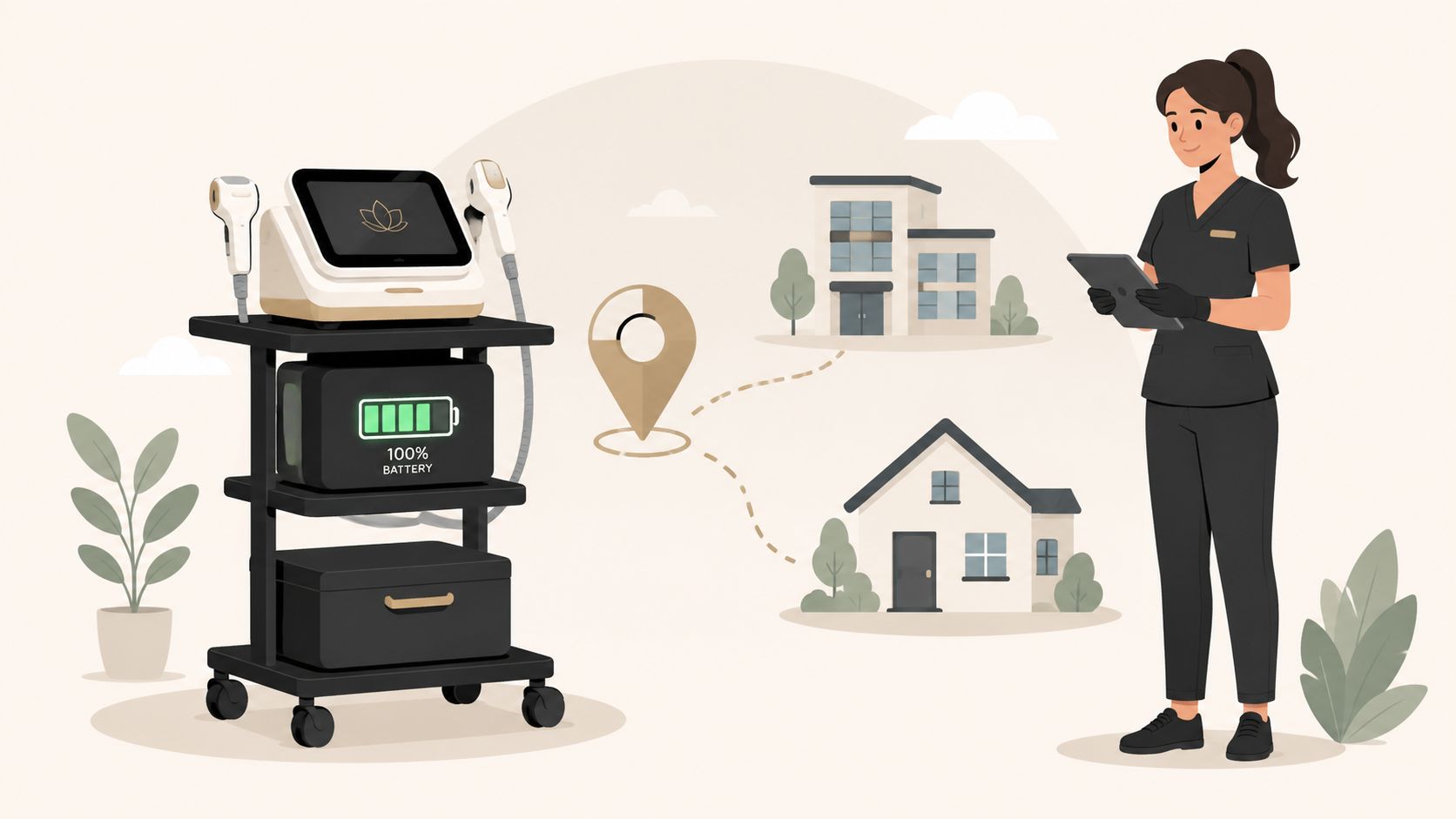
Mobile aesthetics works when the service is narrow enough to be reliable and portable enough to move without breaking consistency. A technician who serves corporate wellness programmes, country clubs, and residential communities needs a setup that travels well, stores neatly, and still feels professional at the client's door. A portable multi-wavelength system with battery backup and a mobile treatment cart makes that possible.
This is one of the most commercially interesting case study examples because it changes the location problem. Instead of waiting for clients to come to the clinic, the business takes the consultation and treatment experience to them. That expands reach, but it also forces discipline around prep, timing, and records.
How mobile delivery stays credible
A mobile model only works if the team can keep the service repeatable. Standardised 25 to 30 minute treatment windows make scheduling more realistic, and they reduce the chance that travel logistics will eat the margin. Mobile-friendly booking and payment systems also matter, because a slick treatment experience falls apart quickly if admin is slow.
Operational rule: The mobile unit should feel like a clinic visit that happens off-site, not a casual beauty drop-in.
That mindset helps with professionalism, especially when the service is delivered in corporate environments where confidentiality and appearance matter. The case-study logic here is to show how the provider maintained continuity across different sites, and how client records followed the person rather than the location.
What to document for a mobile case study
The write-up should capture the practical points that make the model viable.
- Travel workflow: How the cart, device, and consumables are packed and set up.
- Client prep: What instructions clients receive before the visit.
- Repeat booking logic: Which partnerships create recurring demand.
- Record continuity: How treatment notes travel across touchpoints.
The best mobile stories are specific about friction. They show how the business solved movement, safety, and scheduling together, which is exactly the kind of operational evidence buyers trust.
7. Acne Treatment Program Clinical Outcomes Driving Patient Acquisition and Retention
Acne programmes are among the easiest aesthetic services to document well because the patient journey is visible, emotionally meaningful, and naturally time-bound. A dermatology-affiliated clinic that structures care around blue and red light therapy, radiofrequency, and supportive skincare can present a programme that reads as clinically serious and commercially repeatable.
A strong case study in this space does not depend on hype. It depends on structured follow-up. Six-week and 12-week pathways give the clinic a consistent way to compare baseline and follow-up states, which makes the programme easier to explain to parents, adolescents, and young adults who want clear expectations before they commit.
Why acne programmes convert well
Acne care has a built-in retention engine because clients often need more than one visit to see meaningful change. That makes the programme suitable for referral-based growth, especially when dermatologist-developed protocols give the team a clearer framework for expectations and support.
Progress is easier to present when the programme has a timeline, a follow-up point, and a visible reason to stay engaged.
Outcome tracking gives this model its credibility. Even if a clinic is not publishing formal research, it can still document response patterns with before-and-after photography, note adherence issues, and record which supportive skincare products were paired with the device sessions. Venngage case-study format guidance recommends putting results front and center when the evidence is available, but clarity still matters when a clinic cannot disclose numbers.
A structure clinics can reuse
- Baseline presentation: Severity, duration, and prior attempts.
- Protocol cadence: How the 6-week or 12-week path was explained.
- Support layer: What skincare guidance was added to improve compliance.
- Follow-up story: How the patient's confidence or routine changed over time.
A useful takeaway is that acne case study examples can function as both acquisition content and retention content. When patients see a clear sequence, they are more likely to commit to the full programme rather than drop out after the first visit.
8. Medical Spa Franchise Model Standardisation Enabling Rapid Multi-Location Expansion
Multi-location growth often breaks down when each site starts improvising its own version of the service. A medical spa that expands from one location to eight in a short period has to control that drift by standardising equipment, protocols, training, and outcome tracking. Without that backbone, scale multiplies inconsistency instead of performance.
The strongest case study examples in franchised aesthetics show sameness where it protects quality and flexibility where it supports local delivery. A single multi-modality platform across sites lowers training complexity and makes cross-location comparison more reliable. Centralised reporting then gives leadership a clearer view of performance, instead of a pile of disconnected local stories.
Standardisation turns expansion from a series of local experiments into a repeatable operating model.
Why standardisation is the real growth lever
The model works because franchisees are not starting from zero. They receive a defined service stack, a repeatable operating pattern, and manufacturer guidance that reduces uncertainty. The value sits in cutting the amount of improvisation each new site requires.
The Shopify case-study guide makes a similar point about operational storytelling, because it argues that the solution, implementation, and results sections should show the process used and then present numbers, time frames, or outcomes so readers can evaluate the effect. Growth without process is only a claim. Growth with a standardised rollout becomes a model other operators can assess.
What franchise leaders should record
- Launch consistency: Which elements were identical across locations.
- Training compliance: Who was certified and when.
- Quality control: How audit checks were handled.
- Outcome visibility: Which metrics were compared centrally.
The lesson is not that every site must look identical. It is that every patient should receive an experience consistent enough to trust, regardless of which branch they visit. That is the discipline serious case study examples should surface.
9. Burn Scar and Trauma Recovery Program Multi-Modality Approach to Functional and Cosmetic Outcomes
A burn and trauma recovery programme has to address more than surface appearance. A multidisciplinary centre that combines laser resurfacing, radiofrequency remodeling, skincare, and rehabilitation support is working on texture, pigmentation, contracture, mobility, and the patient's emotional recovery at the same time. That makes the case study more complex, and more useful for clinicians who want to understand real-world recovery.
These programmes matter because they show how aesthetic protocols can fit inside rehabilitation timelines instead of sitting outside them. When burn surgeons, dermatologists, and physiotherapists coordinate care, treatment can follow the tissue's healing stage rather than forcing the tissue to fit the treatment. That gives the case study clinical value as well as cosmetic relevance.
The value of phase-based treatment
A phased approach lets the team match intervention intensity to the recovery stage. It also gives patients a clearer framework, which matters when treatment extends over time and the emotional burden is high. Case study methods are often used in health settings for exactly this reason, as noted in the case study method overview, because they help explain how outcomes develop in real-world conditions.
Clinical insight: In trauma recovery, the key question is often not which device to use, but what the tissue and the patient can tolerate at that point in the pathway.
That distinction matters because the outcome is not only cosmetic change. It also includes how well the patient can move, cope, and return to normal routines.
What a strong recovery case file includes
- Functional tracking: Range of motion, comfort, and tolerance across phases.
- Cosmetic tracking: Texture, pigmentation, and scar appearance.
- Psychological tracking: Confidence, avoidance behaviour, or readiness to resume social settings.
- Coordination notes: How the aesthetic work aligned with surgery and physiotherapy.
A strong recovery file also records how decisions were made between visits, because those choices shape both function and appearance. A record like that gives a clearer basis for review than a final image alone.
Analysis: The most useful burn and trauma case study examples connect treatment timing with measurable recovery signals, so the reader can see why each intervention happened and what changed afterward.
The best examples are rigorous because they treat recovery as a linked process, not a cosmetic finish line. They show how care was managed, how the plan adapted to healing, and how the team balanced function with appearance at each stage.
10. Telemedicine-Integrated Aesthetic Practice Remote Consultation Model Expanding Geographic Reach
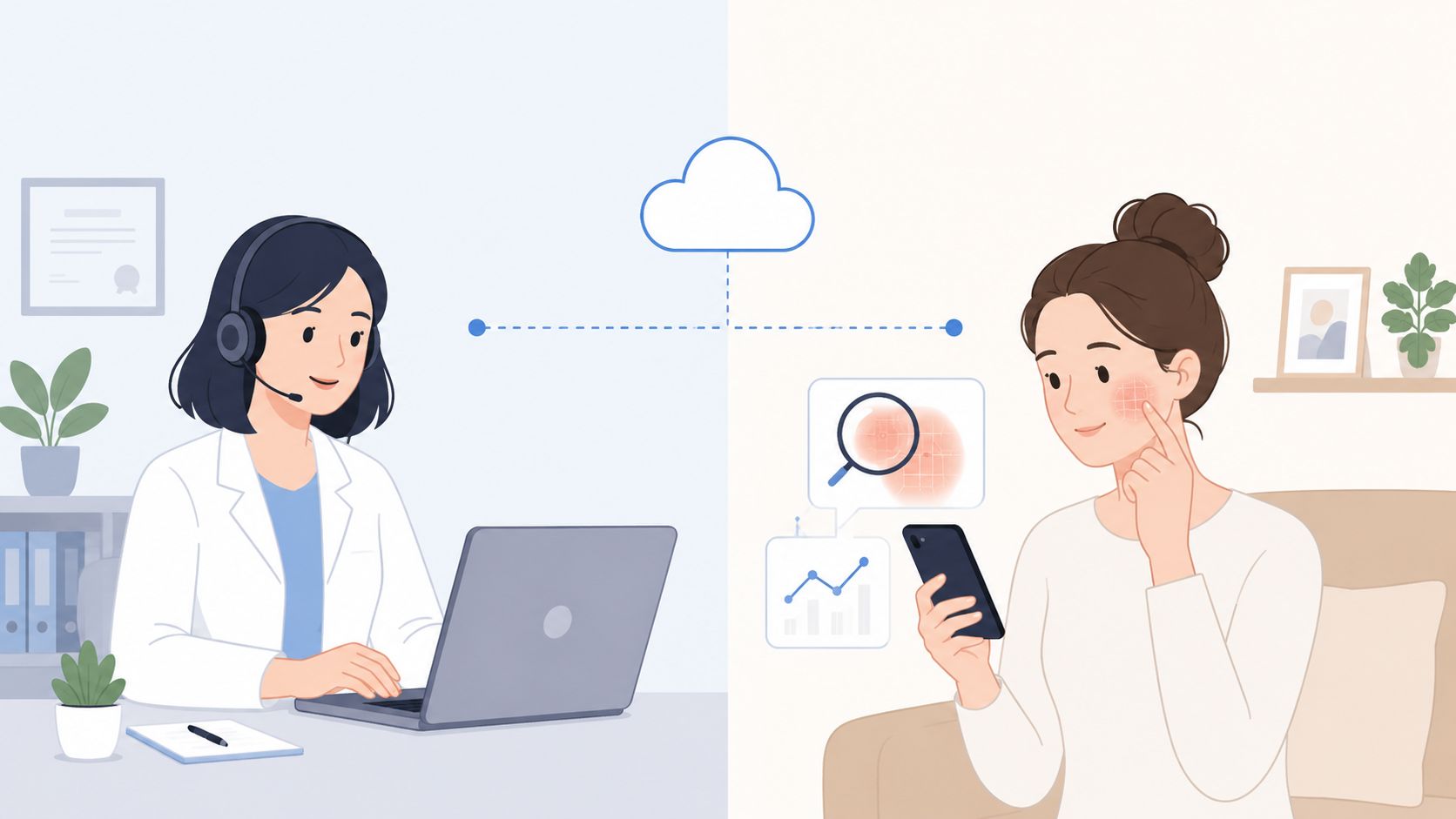
Remote intake changes access patterns quickly. Patients outside major centres can complete screening, review treatment options, and receive follow-up guidance without repeated travel, while the clinic keeps in-person appointments for assessment and procedures that require hands-on judgement. That structure makes the model practical for aesthetics, where convenience matters but clinical oversight still has to stay tight.
A hybrid consultation model solves a geography problem in aesthetics, but it also creates a workflow problem that has to be managed carefully. Digital skin analysis, standardised photography, and scheduled chair time only work if each remote review is documented in the same way. The practice becomes easier to scale when the first touchpoint is handled by an AI assistant for speed to lead, because patient inquiries are captured faster and routed into the right consult path before interest goes cold.
How hybrid care keeps quality intact
The main risk is expectation mismatch. Patients need a clear line between what can be reviewed on camera and what requires an in-person examination, and staff need a fixed template for remote notes so follow-up decisions remain traceable over time.
South Africa's HIV response offers a useful context lesson here. The country had about 7.8 million people living with HIV in 2023, with adult prevalence around 14%, and that scale helped make South Africa a frequent setting for case studies on treatment access and service delivery (HIV/AIDS case-study context). The comparison is not about medical similarity. It shows how large, tracked systems make service design easier to study, because teams can see how intake, follow-up, and outcomes move together. Telemedicine aesthetics benefits from the same discipline, careful records make the hybrid pathway visible instead of anecdotal.
Analysis: Remote consultation models work best when the clinic standardises what can be decided online, what must wait for an in-person visit, and how each step is logged.
What makes the model scalable
- Remote screening: Reduces unnecessary travel for early-stage consults.
- Standard photography: Makes before-and-after review more consistent.
- Visit planning: Groups travel-sensitive steps into fewer appointments.
- Documentation discipline: Keeps the patient pathway auditable across touchpoints.
The strongest telemedicine case study examples show reach without losing structure. They prove that geographic expansion does not require a new branch for every cluster of demand, provided the practice keeps intake, documentation, and follow-up aligned.
10-Case Comparison: Aesthetic & Dermatology Strategies
| Service / Model | Implementation complexity 🔄 | Resource requirements 💡 | Speed / Efficiency ⚡ | Expected outcomes 📊 | Ideal use cases | Key advantages ⭐ |
|---|---|---|---|---|---|---|
| Dermatology Clinic Hair Removal, Four‑Wavelength | Medium‑high 🔄: device integration, staff training | High 💡: significant capex, trained staff, maintenance | Very high ⚡: 20‑min full‑body, 55% time reduction | High 📊: 34% retention ↑, R2.1M/yr, 95% satisfaction | Mid‑size dermatology clinics adding aesthetic hair removal | Inclusive Fitzpatrick I–VI treatment, throughput, clinical/regulatory credibility |
| Medical Spa Launch, Integrated Multi‑Modality | Medium 🔄: protocol selection and staff onboarding | Moderate‑high 💡: consolidated device, training, room space | Moderate ⚡: single device simplifies workflow but sessions vary | Strong 📊: 78% package conversion, R3.8M/yr, 42% gross margin | New medical spas in secondary markets | Consolidates modalities, standardized protocols, manufacturer support |
| Salon Group High‑Volume Hair Removal | High 🔄: large‑scale retraining & workflow redesign | High 💡: durable high‑throughput devices, dedicated rooms | Very high ⚡: 20‑min sessions, 10Hz+ repetition rates | Very strong 📊: 43% revenue from lasers, 210% productivity ↑, 68% margins | Large salon chains converting from waxing | Converts low‑margin services to recurring, high‑margin laser offerings |
| Dermatology Practice, Aesthetic Sideline | Medium 🔄: technician workflows with physician oversight | Moderate 💡: multi‑modality platform, certified technicians | Moderate ⚡: adds services without using physician time | Strong 📊: R5.2M added, 41% visit frequency ↑, 89% conversion | Established dermatology practices expanding revenue | Adds revenue without diverting physicians; builds referral pipelines |
| Anti‑Aging Treatment Center, Premium | High 🔄: physician‑led protocols, premium positioning | Very high 💡: premium clinic design, specialized staff, tech | Moderate ⚡: ongoing protocols with repeat visits | High 📊: R12.4M/yr, R8,500 avg visit, 82% retention | Luxury clinics targeting affluent demographics | Premium pricing, high LTV, clinical credibility and differentiation |
| Mobile Aesthetic Model, Portable System | Medium 🔄: logistics, scheduling, mobile SOPs | Moderate 💡: portable device, battery backup, transport costs | High ⚡: 25–30min protocols; multiple daily sites possible | Good 📊: R2.8M/yr, 73% repeat, 340+ clients | Independent technicians, corporate wellness, underserved areas | Low fixed overhead, flexible scaling, convenient premium service |
| Acne Treatment Program, Multi‑Modality Protocols | High 🔄: dermatologist‑developed phased protocols | Moderate‑high 💡: light/laser tech, clinical oversight | Low‑moderate ⚡: 6–12 week programs (longer timelines) | Strong 📊: 31% clinic revenue (R2.2M), 87% completion, 78% long‑term convert | Dermatology‑affiliated clinics targeting adolescents/young adults | Evidence‑based acquisition funnel; strong compliance and social proof |
| Medical Spa Franchise, Standardized Platform | High 🔄: standardization, training, centralized ops | High 💡: centralized systems, training infrastructure, bulk purchasing | High ⚡: enables rapid multi‑location scale | Very strong 📊: 8 locations, R18.6M combined, 86% satisfaction consistency | Operators pursuing multi‑location franchising | Scalable, repeatable brand experience with centralized quality control |
| Burn & Trauma Recovery Program, Multi‑Modality Rehab | Very high 🔄: multidisciplinary coordination, phased care | Very high 💡: specialist teams, rehab integration, complex protocols | Low ⚡: phased, long‑term rehabilitation timelines | Strong 📊: 84% satisfaction, 67% scar severity reduction | Burn/trauma centers integrating aesthetic rehab into recovery | Improves functional + cosmetic outcomes; strong psychosocial benefit |
| Telemedicine‑Integrated Aesthetic Practice | Medium‑high 🔄: tech integration, virtual protocols | Moderate 💡: telemedicine platform, digital skin analysis tools | High ⚡: virtual consults increase consultation efficiency | Strong 📊: client base +240%, R6.8M/yr, conversion ↑ (52→71%) | Urban clinics serving regional/rural patients via hybrid care | Expands geographic reach, improves conversion and remote follow‑up |
Putting Insights Into Action
The strongest case study examples in aesthetics do three things well. They define the problem clearly, describe the solution in operational terms, and report outcomes in a way that helps the next clinic make a better decision. That matters whether the goal is a new spa launch, dermatology expansion, or standardised services across multiple locations.
The common thread across these protocols is not the device category. It is the discipline behind implementation. Clinics that train before launch, assign ownership for each step, and document results carefully build a case study library that does more than market services, it improves them. Framework-led writing matters because it forces clarity around challenge, response, and measured impact. The same logic applies to the clinical side. Readers need to see the process first, then the numbers, time frames, or outcomes that make the effect credible.
Strong case studies do not rely on claims alone. They connect workflow, measurement, and patient response in a way another clinic can adapt.
For South African clinics and spas, the practical takeaway is straightforward. Use your actual workflow, your actual follow-up, and your actual patient journey to build proof that can withstand scrutiny. If hard numbers are limited, document what is available, baseline condition, implementation steps, and observable change, because a credible qualitative case study is still better than a vague success claim. The reporting gaps discussed in South Africa's primary care system are a reminder that evidence quality varies, so internal documentation needs to be tighter, not looser.
Treat your next case study as a business asset, not a brochure. Pull one protocol, one patient pathway, and one measurable result into a short narrative, then test whether it helps your team sell, train, and improve the service. If you want a faster way to package those stories into usable marketing assets, use automate your customer success stories, then review your device training and service mix with Omega Lasers so your outcomes and your positioning stay aligned.
A CTA for Omega Lasers.