


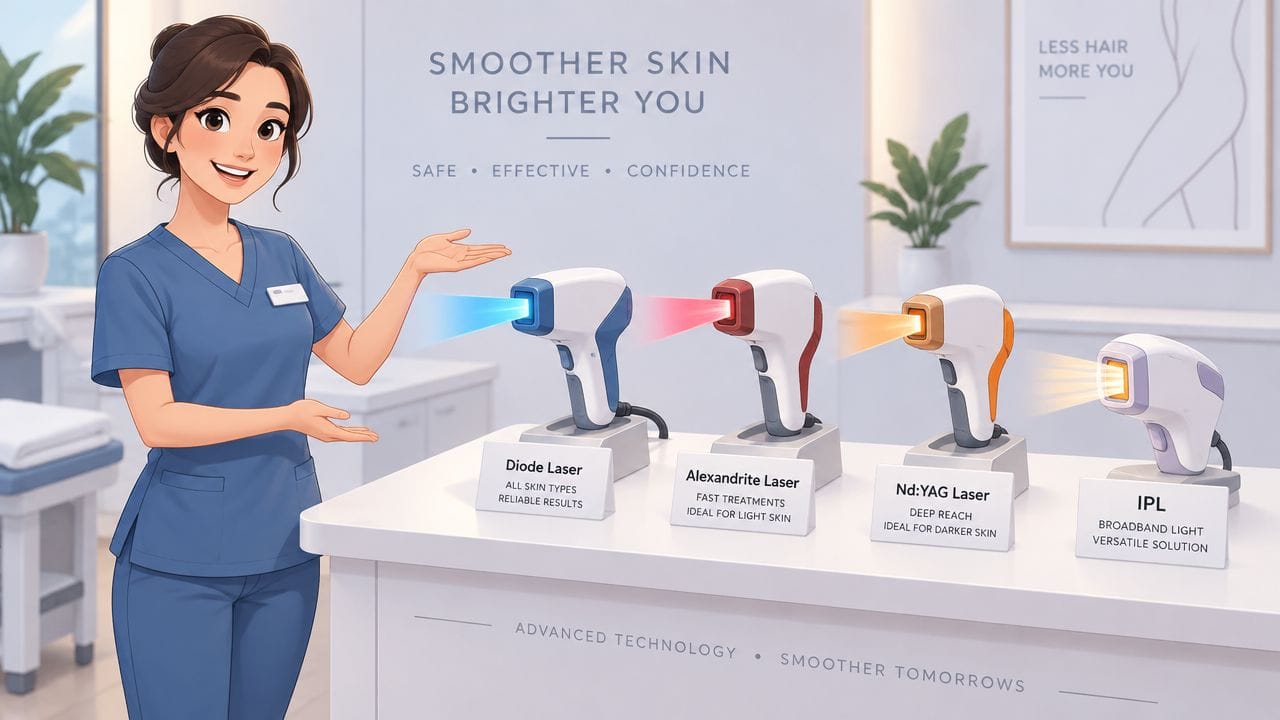
A clinic manager stands on a Johannesburg showroom floor with three quotations open on a tablet, two sales representatives explaining different handpieces, and a treatment diary already filling for the following month. One machine costs less. Another promises broader coverage. The third has the strongest cooling system, but the supplier's answers about registration and training remain vague.
That decision isn't really about buying the most powerful facial hair removal equipment. It's about choosing a system your team can operate lawfully, safely and consistently on the skin types you treat, then recovering the investment through a realistic booking schedule. A polished clinic brand, supported by an accessible healthcare site inspiration resource, won't compensate for poor treatment selection or weak operational controls.
The practical framework is straightforward. Assess the equipment family, match wavelength and delivery method to skin type and facial zone, verify SAHPRA compliance and Laser Safety Officer arrangements, then test the return on investment against actual utilisation. The cheapest device often becomes the expensive choice when it produces inconsistent facial outcomes, requires another purchase for darker skin, or cannot be operated under a defensible safety system.
Table of Contents
- Choosing the Right Facial Hair Removal Equipment for Your Clinic
- The Four Main Facial Hair Removal Equipment Families
- Comparing Diode, Alexandrite, Nd-YAG and IPL Side by Side
- Matching Equipment to Skin Type and Facial Zone
- SAHPRA, Class Ratings and the Laser Safety Officer
- Why Operator Training Decides Whether the Equipment Pays Off
- ROI and Procurement for Facial Hair Removal Equipment
- A Practical Checklist Before You Buy
Choosing the Right Facial Hair Removal Equipment for Your Clinic
The first quotation usually focuses on technical specifications. Suppliers talk about power, spot size, repetition rate and cooling, while the clinic manager is thinking about whether the upper-lip appointment will be comfortable, whether the chin can be treated safely on melanin-rich skin, and whether the machine will earn its place in the treatment room.
Those are the right questions. Facial hair is less forgiving than a large, flat body area because the upper lip, chin, jawline and sideburns have different contours, follicular depths and sensitivity. A device that performs well on legs can still be a poor commercial choice for the face if its handpiece is awkward, its cooling is inadequate, or its controls encourage operators to use generic presets.
Start with the client profile
Your dominant client profile should determine the platform, not the sales demonstration. If your practice treats many Fitzpatrick IV to VI clients, a device family that manages epidermal melanin safely deserves priority over a lower-priced system that performs mainly on lighter skin. If your clinic attracts fair-skinned clients with coarse dark hair, speed and wavelength absorption may carry more weight.
South Africa's market makes this decision commercially relevant. The country's laser hair removal market generated about USD 9.4 million in 2025 and is projected to reach USD 22.5 million by 2033, with an expected 11.3% CAGR from 2026 to 2033. Diode lasers generated the largest revenue within the market in 2025, while Nd:YAG was identified as the fastest-growing segment, according to South Africa laser hair removal market data.
Evaluate the whole operating model
A proper assessment covers four points:
- Clinical fit: Can the system address your common skin types, hair characteristics and facial zones?
- Compliance: Can the supplier provide the registration and safety documentation required for the device?
- Operator capability: Will your team receive meaningful theory, supervised practice and adverse-event training?
- Financial recovery: Can your current booking pipeline support the machine without relying on optimistic utilisation?
Practical rule: Buy the platform your clinic can use safely and repeatedly, not the platform with the most impressive specification sheet.
The equipment family matters, but so do service response, handpiece costs, cooling performance, calibration records and treatment documentation. A machine earns a return only when the entire system, supplier, operator and workflow work together.
The Four Main Facial Hair Removal Equipment Families
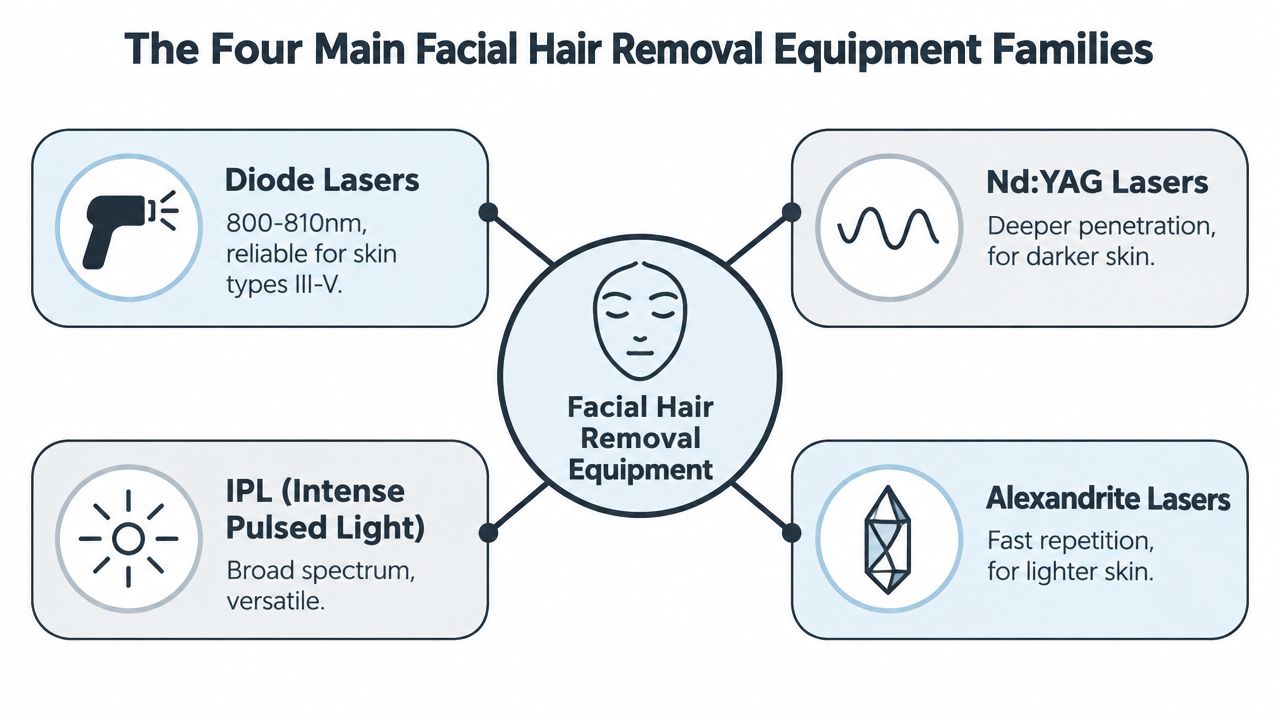
Facial hair removal equipment falls into four broad families. Think of diode as a steady torch, Alexandrite as a bright spotlight, Nd:YAG as a deep-heat beam and IPL as a camera flash. The analogy isn't a substitute for clinical training, but it helps explain why one device can suit a particular client better than another.
Diode lasers
Diode systems commonly operate around 800 to 810 nanometres. They're the commercial middle ground, with a balance between follicular reach and epidermal pigment management. For many practices, diode is the everyday workhorse because it can serve a broad client base when the operator selects parameters carefully.
The advantage is flexibility. The limitation is that “works across skin types” doesn't mean “use the same settings on everyone”. Facial treatment still depends on phototype, hair thickness, tanning history, cooling and endpoint recognition.
Alexandrite lasers
Alexandrite operates at 755 nanometres, where melanin absorption can support fast treatment on lighter skin with coarse, dark terminal hair. It behaves like a bright spotlight, delivering strong target absorption but leaving less room for careless treatment on darker complexions.
That makes it attractive for clinics with a predominantly fair-skinned clientele. It becomes a riskier choice when the same handpiece is used on high-melanin skin without appropriate assessment and conservative parameter selection.
Nd:YAG lasers
Nd:YAG uses a 1064 nanometre wavelength that penetrates deeper and is generally the safer laser choice for darker skin types and coarse facial hair on melanin-rich skin. Its deeper delivery reduces competition with epidermal pigment, although it still requires competent fluence selection and cooling.
For a South African clinic, Nd:YAG deserves serious consideration when Fitzpatrick V and VI clients form a meaningful part of the service mix. It may not be the fastest option for every fair-skinned client, but safety and reliable skin-type coverage matter more than showroom speed.
IPL
IPL is broadband, not a single wavelength. It's the camera flash of the group, delivering a range of light that can address selected hair-removal cases and other aesthetic indications, but its results depend heavily on filtration, skin-hair contrast and operator judgement.
IPL's lower entry cost can be useful for a small practice. On facial hair, however, operator dependence is a serious trade-off. The thin upper lip and contoured chin leave little tolerance for inconsistent overlap, inappropriate filters or excessive energy.
Wavelength matters because facial follicles sit at different depths, epidermal pigment competes for energy, and treatment zones are small and curved. Your machine must provide control, cooling and handpiece access that match those realities.
Comparing Diode, Alexandrite, Nd-YAG and IPL Side by Side
A decision matrix is more useful than a sales ranking. The table below focuses on practical positioning, not manufacturer promises.
| Device Family | Wavelength | Best Skin Types | Facial Suitability | Comfort Level | Capital Cost Band | Consumable Cost |
|---|---|---|---|---|---|---|
| Diode | Around 800 to 810 nm | Broad middle range, commonly III to V with appropriate settings | Strong general option for upper lip, chin, jawline and sideburns | Moderate to high with effective contact cooling | Mid to high | Moderate, depending on handpiece and service model |
| Alexandrite | 755 nm | I to III, especially with coarse dark hair | Fast on fair skin, useful for defined facial zones | Often comfortable with reliable cooling | High | Moderate to high |
| Nd:YAG | 1064 nm | IV to VI | Strong option for darker skin and coarse facial hair | Moderate, cooling is important | High | Moderate to high |
| IPL | Broadband light | Fair to olive skin with strong hair-skin contrast | Variable on the face, highly operator-dependent | Usually moderate with suitable filtration and cooling | Low to mid | Often lower, but lamp and filter replacement must be budgeted |
The capital bands are deliberately qualitative because purchase prices vary by specification, supplier, financing structure and regulatory package. A low acquisition price doesn't guarantee a low cost of ownership. Handpieces, cooling components, calibration, servicing and downtime can change the financial result.
Where each family wins
Diode offers the broadest commercial middle ground. It's the sensible first platform for many mixed practices, provided the team can adapt settings rather than treating every face from a preset.
Alexandrite wins on speed and target absorption for fair skin. It loses flexibility when darker skin types or recent tanning are common.
Nd:YAG is the strongest safety-led choice for melanin-rich skin. It may require more deliberate treatment planning, but it protects the clinic from building a facial service around a narrow client profile.
IPL wins on entry cost and versatility. It loses on facial consistency when operators lack strong assessment skills or when hair and skin contrast is poor.
The rule of thumb is simple: choose the family that fits your actual client distribution, not the technology the manufacturer presents as universally superior.
Matching Equipment to Skin Type and Facial Zone
Start with three assessments before selecting a wavelength: skin phototype, hair chromophore and anatomical location. The follicle needs enough pigment to absorb the treatment, while the epidermis needs protection from competing energy. Grey, white and very light hair often gives the operator little useful target pigment, so the correct decision may be referral rather than treatment.
For Fitzpatrick IV to VI clients, Nd:YAG at 1064 nanometres is generally the more appropriate starting point because it reaches deeper while reducing competition with epidermal melanin. Alexandrite at 755 nanometres suits phototypes I to III with coarse, dark terminal hair. Diode around 800 to 810 nanometres covers much of the middle ground, while IPL should be reserved for suitable fair-to-olive skin with clear contrast.
Treat the zone, not just the face
The upper lip is small and sensitive, and its contours make overlap control important. The chin and jaw require careful handling around bony prominence, while the pre-auricular area benefits from a smaller spot size and controlled cooling.
| Device | Best Skin Types | Upper Lip | Chin / Jaw | Sideburn / Pre-auricular |
|---|---|---|---|---|
| Diode | III to V, with individual assessment | Suitable with precise overlap control | Suitable with adjusted technique over bone | Suitable when the handpiece allows accurate access |
| Alexandrite | I to III | Fast for dark terminal hair on fair skin | Effective, but use caution as pigmentation increases | Useful on fair skin with suitable contrast |
| Nd:YAG | IV to VI | Strong option for darker skin | Well suited to coarse hair and darker phototypes | Suitable with smaller spot access and cooling |
| IPL | Fair to olive with strong contrast | Variable, operator-dependent | Variable, especially where hair is fine | Use only after careful assessment |
The dark-skin laser hair removal guidance is useful when your team needs to refine wavelength selection and consultation for higher-melanin clients.
Know when not to treat
Refer or postpone treatment for active acne in the treatment area, isotretinoin use within six months, pregnancy and recent tanning. Vitiligo, a history of keloid formation and grey-white hair also deserve referral or specialist review rather than routine booking.
South African clinical guidance commonly asks clients to stop waxing, plucking, bleaching and epilator use before treatment, while shaving, trimming or depilatory creams may be used between sessions. One local clinic source specifies avoiding waxing or plucking for at least 3 weeks before treatment and avoiding sun exposure for about 3 to 4 weeks beforehand, as described in South African pre-treatment guidance.
SAHPRA, Class Ratings and the Laser Safety Officer
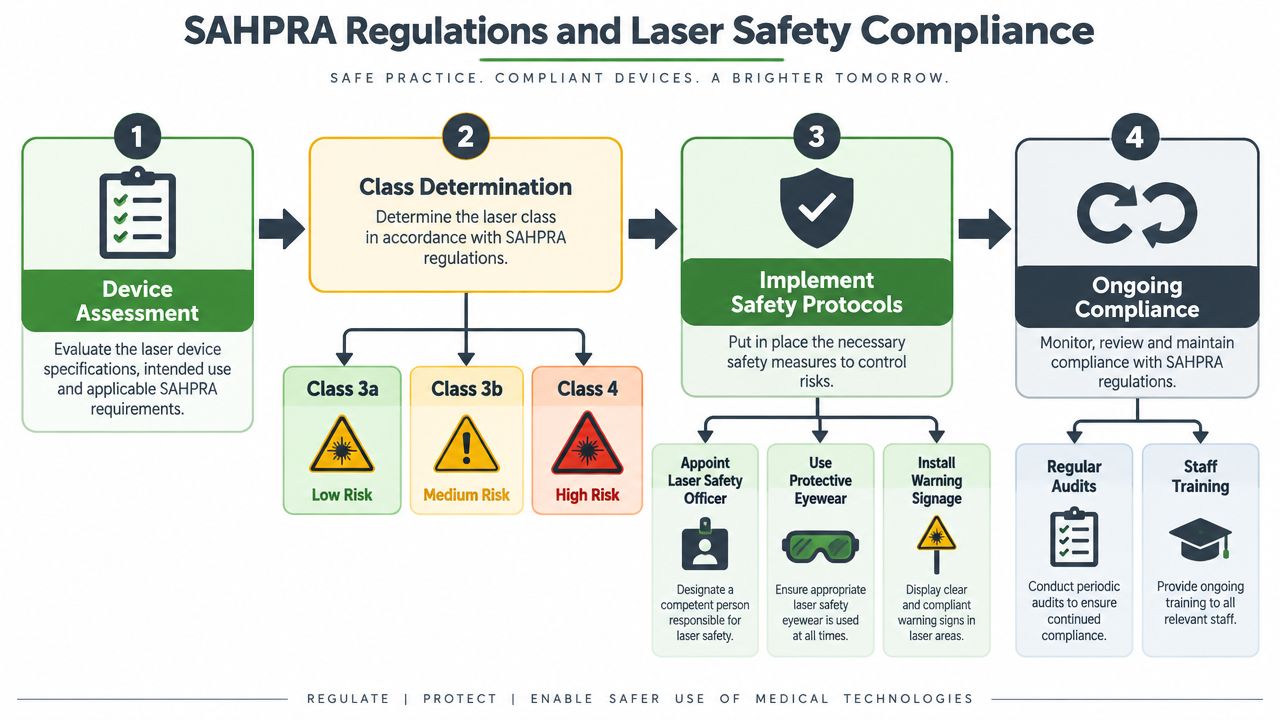
Compliance must be checked before the deposit is paid. Independent South African regulatory summaries state that Class 3 and Class 4 laser devices must be registered with SAHPRA, and that a Laser Safety Officer must be appointed for each machine. IPL and LED devices are excluded from these strict registration requirements, but that doesn't remove the need for competent operation, documented consultation and sensible safety controls. Review the SAHPRA registration and product requirements with the supplier before purchase.
Convert the regulation into documents
Ask for the device registration evidence, the supplier's authorisation documentation, local service arrangements and the exact class assigned to the unit you're buying. Don't accept a general statement that the brand is compliant. Registration must relate to the actual device and its lawful supply pathway.
The Laser Safety Officer should have a defined role at the site, not just a name on a file. That role includes local rules, controlled access, protective eyewear specifications, warning signage, incident procedures and staff records.
South Africa's operating environment has a further complication. Research has reported no statutory regulatory board specifically governing who may perform laser hair removal, and a South African qualification-and-training study also stated that no statutory regulatory board existed for laser or IPL hair-removal procedures. That gap doesn't reduce the clinic's responsibility. It increases the need to set an internal competency standard and retain evidence that each operator can assess, treat and respond to complications.
The practical risk is clear. Unregistered laser devices can expose a clinic to legal penalties and safety risks, while missing operator governance leaves the practice vulnerable when a client suffers a burn, pigmentary change or poor outcome.
Why Operator Training Decides Whether the Equipment Pays Off
A high-quality handpiece can't compensate for an operator who doesn't understand fluence, pulse duration, cooling or clinical endpoints. Facial work demands more than knowing how to start the console and select a preset.
Supplier training of only 2 to 4 days has been described as common in South Africa. By contrast, the South African Association of Health and Skincare Professionals recommended at least 100 hours of combined practical and theory training where supplier training is offered for cosmetic laser and IPL hair removal, according to the South African qualification and training study.
What weak training looks like in practice
An under-trained operator may treat recently tanned skin without adapting the plan, stack overlapping pulses on the upper lip, or mistake excessive erythema for an appropriate endpoint. Those errors can produce burns, hyperpigmentation or under-treatment, risks described in South African clinical literature concerning operator competence, fluence selection and skin-type matching.
The financial effect reaches beyond a refund. A visible adverse event consumes staff time, damages trust, complicates rebooking and may create a negligence dispute. Professional indemnity protection can also become difficult to rely on when the clinic can't demonstrate appropriate competency and supervision.
Build evidence, not just attendance
A credible programme should include:
- Theory: Skin classification, hair biology, contraindications, wavelength selection and device limitations.
- Supervised practice: Documented cases across relevant skin types and facial zones.
- Assessment: A practical competency check, not only a certificate of attendance.
- Incident response: Clear actions for excessive pain, blistering, pigmentary change and unexpected endpoints.
- Ongoing records: Treatment parameters, photographs, consent and follow-up notes.
Use laser machine training as a procurement question, not an optional add-on. The machine pays off when trained operators deliver repeatable care, retain suitable clients and avoid preventable incidents.
ROI and Procurement for Facial Hair Removal Equipment
ROI calculations need a booking model, not a sales promise. Start with the services you can sell repeatedly, then subtract the true costs of ownership, including maintenance, consumables, staff time, financing and downtime.
A four-wavelength platform priced at R650,000, treating 12 facial patients weekly at an average booking value of R1,400, would generate R873,600 in gross annual revenue before operating costs. Those figures are an illustrative procurement model, not a market benchmark, and the result depends on maintaining that schedule.
Build the calculation from your diary
The most important variable is utilisation. A machine that sits idle for much of the month can't recover its cost because its technical specifications are strong. A multi-modality platform can broaden the addressable client mix, but it also brings a higher capital commitment and requires operators who understand each modality.
Do not make a payback claim until you have tested:
- Expected weekly facial bookings.
- Average treatment value.
- Staff time per appointment.
- Maintenance and service obligations.
- Handpiece, lamp or other consumable exposure.
- Financing cost and downtime allowance.
- The proportion of clients suitable for each technology.
A single-modality diode system may be financially sensible for a focused clinic. It becomes less attractive if the practice later needs another platform to serve Fitzpatrick V and VI clients, because the second purchase adds floor-space, training and service obligations.
Compare ownership scenarios
| Metric | Single-modality diode (R420,000) | Four-wavelength platform (R650,000) |
|---|---|---|
| Upfront capital | R420,000 | R650,000 |
| Skin and hair coverage | Focused, dependent on the selected diode configuration | Broader, subject to appropriate operator selection |
| Expansion path | May require an additional modality later | More modalities available within one platform |
| Floor-space requirement | Lower for the initial purchase | Higher initial commitment, one main platform |
| Training burden | Focused but still clinically demanding | Broader, because operators must understand multiple modes |
| ROI risk | Lower capital exposure, narrower service mix | Higher capital exposure, broader potential service mix |
Don't treat a multi-wavelength claim as proof of universal suitability. The platform still needs credible cooling, appropriate spot sizes, a compliant supply chain and a team capable of choosing the correct mode for each face.
A Practical Checklist Before You Buy
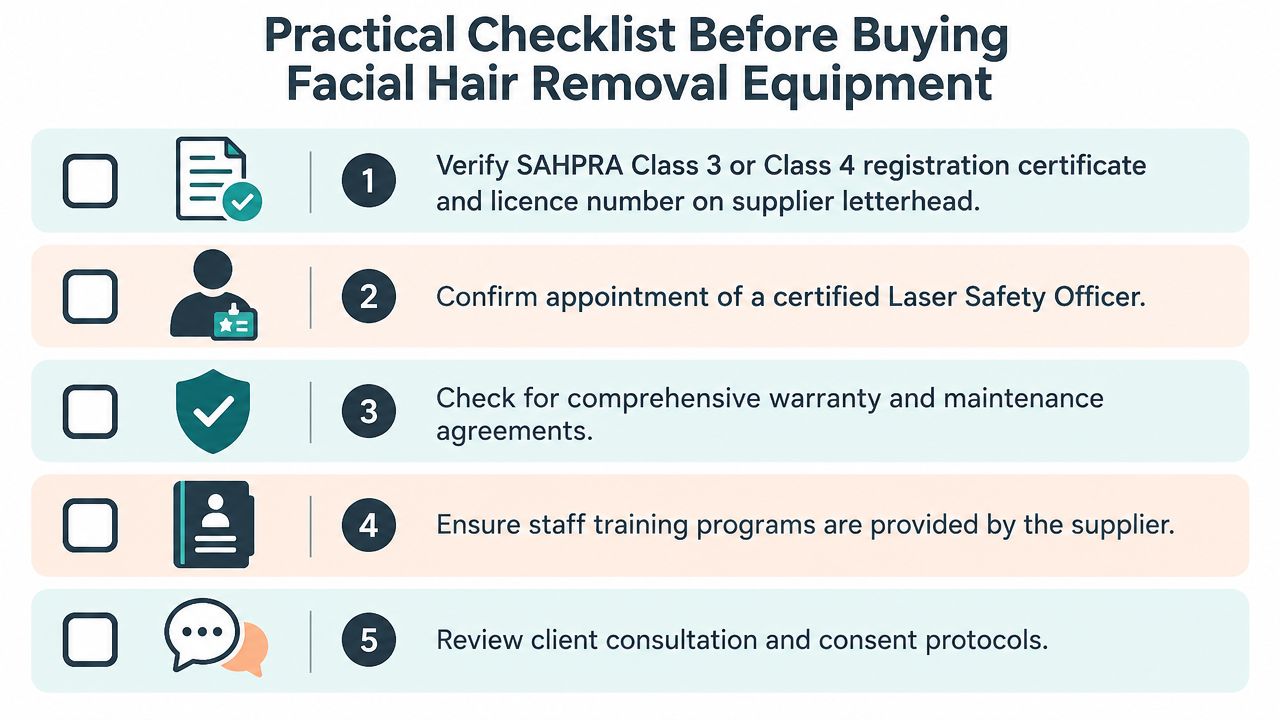
Procurement should end with evidence, not enthusiasm. Put every promise into the quotation, service agreement or training schedule before signing.
Documents and safety controls
- Verify registration: Request the SAHPRA Class 3 or Class 4 registration certificate and licence number on the supplier's letterhead.
- Confirm the Laser Safety Officer: Check that an appointment letter is included or that the supplier will arrange the appointment.
- Inspect training scope: Compare theory hours, supervised practical cases and competency assessment against the 100-hour benchmark described in the South African training study.
- Review warranty language: Scrutinise coverage for the console, handpiece, cooling system and calibration.
- Price consumables: Ask for replacement costs, stock availability and lead times rather than accepting a vague maintenance promise.
- Check IPL safety equipment: If you're buying IPL, confirm that eye-safety goggles and calibration certificates ship with the unit.
A warranty target of 2 years or 2 million shots may be useful as a negotiating reference, but don't assume every supplier offers it. Make the exact term part of the written agreement, including exclusions and the response process for a failed handpiece.
Test the supplier, not just the machine
Ask for a reference clinic running the same model. Request a paid demonstration on staff with Fitzpatrick IV and V skin, provided the demonstration is clinically appropriate and performed under proper consent and supervision. Ask how quickly a technician can attend, and verify whether the supplier can respond within 48 hours when that service level is promised in writing.
A practical trial is more informative than a showroom session. Shortlist two devices, arrange a 30-day trial period, and compare actual outcomes on at least ten facial treatments per device. Record consultation quality, treatment time, client comfort, endpoint consistency, photographic change, operator confidence and any follow-up concerns.
The final choice should follow the evidence from those treatments. If the cheaper machine requires more workarounds, creates less operator confidence or excludes too many of your clients, its lower price is not a saving.
Omega Lasers supplies facial hair removal systems, including the Tetra Cool diode platform for smaller treatment areas, alongside laser machine training and technical support. Review the available options and discuss your clinic's client mix with Omega Lasers before selecting equipment.