



Choosing beauty salon equipment for sale feels less like shopping and more like picking a strategic business partner. The right machine defines your services, your client results, and ultimately, your long-term profitability. This is especially true when you're investing in advanced aesthetic lasers and energy-based devices.
Finding The Right Beauty Salon Equipment For Your Business
Bringing new equipment into your salon is a major decision. It’s a choice that goes far beyond a single purchase—it shapes your brand's reputation, the safety of your clients, and your financial future. This guide is designed to help you navigate the complex market of professional aesthetic technology, moving past glossy brochures to focus on what really matters for a thriving business.
Our goal here is to help you make a smart, informed investment. That means understanding how to get incredible clinical outcomes while ensuring every piece of equipment delivers a strong return. We'll look at how the right technology, from high-powered lasers to versatile multi-modality platforms, can take your salon from just another option to the go-to destination in your area.
A Partnership Beyond The Purchase
Think of this as more than just buying a tool. You're investing in a complete business system. A quality investment isn't just the device itself; it’s everything that comes with it to make sure you succeed.
- Certified Training: Proper education on clinical protocols and how to operate the device is non-negotiable. It's the foundation for safety and delivering consistent, impressive results.
- Ongoing Support: You need responsive technical help and business development guidance to overcome challenges and jump on growth opportunities.
- Comprehensive Warranty: A solid warranty is your safety net. It protects your investment against unexpected issues, minimising downtime and protecting your revenue.
Choosing a supplier is choosing a long-term partner. The best suppliers set the benchmark by providing an entire ecosystem of support designed to ensure your success from day one.
The Growing Demand For Advanced Aesthetics
The South African beauty industry is seeing a major shift towards more advanced, results-driven treatments. This growth highlights just how important it is to invest in compliant, high-performance technology.
The local market for advanced aesthetic equipment surged by 12.5% annually between 2020 and 2025, driven by massive demand for treatments like laser hair removal and skin rejuvenation. Data from SAHPRA-licensed suppliers shows that in 2025 alone, over 4,200 aesthetic clinics and salons upgraded their equipment, investing a combined R2.8 billion in FDA-approved and CE-certified laser systems.
You can get a deeper look into what's driving this growth and discover key aesthetic device trends in South Africa. This trend makes one thing clear: salon owners who invest in modern, certified technology are the ones positioning themselves to meet rising client expectations and capture a bigger piece of the market.
Understanding Your Technology and Treatment Options
When you start looking at beauty salon equipment for sale, the technical jargon can be a real headache. Wavelengths, modalities, energy sources—it all sounds incredibly complex. But getting a solid grip on the basics is the only way to choose equipment that delivers real results and a strong return on your investment. Let’s cut through the noise and talk about what really matters.
Think of it like this: you could buy a single, specialised tool, or you could invest in a multi-functional platform. One does its job well, but the other opens up a world of possibilities, letting your business adapt and grow as client demands change.
Laser vs. IPL: The Core Differences
One of the first things you need to get straight is the difference between Laser and Intense Pulsed Light (IPL). Many people use the terms interchangeably, but they are fundamentally different technologies. Understanding this is non-negotiable for ensuring both client safety and treatment efficacy.
- Laser Technology: A laser uses a single, focused wavelength of light. This incredible precision allows it to target a very specific chromophore—like the melanin in a hair follicle or a pigmented lesion—without damaging the surrounding tissue. This makes it a highly effective and much safer choice for specific jobs, especially on our diverse South African skin tones.
- Intense Pulsed Light (IPL): In contrast, IPL is more like a floodlight than a laser pointer. It uses a broad spectrum of light with multiple wavelengths. While it can be versatile for treating a few things at once (like redness and minor pigmentation), it's far less targeted. This lack of precision carries a higher risk of complications like burns or post-inflammatory hyperpigmentation, particularly on darker skin types.
For treatments that demand precision and safety, like hair removal on a range of skin tones, a dedicated laser is almost always the superior choice. Its focused energy gives you predictable, reliable outcomes your clients will pay for.
Choosing The Right Laser For Hair Removal
Even once you've settled on laser, you're not done. Not all lasers are created equal, and the wavelength you choose is critical. The effectiveness of laser hair removal hinges on how well the wavelength is absorbed by melanin, and this is the key to safely treating clients with different skin and hair colours.
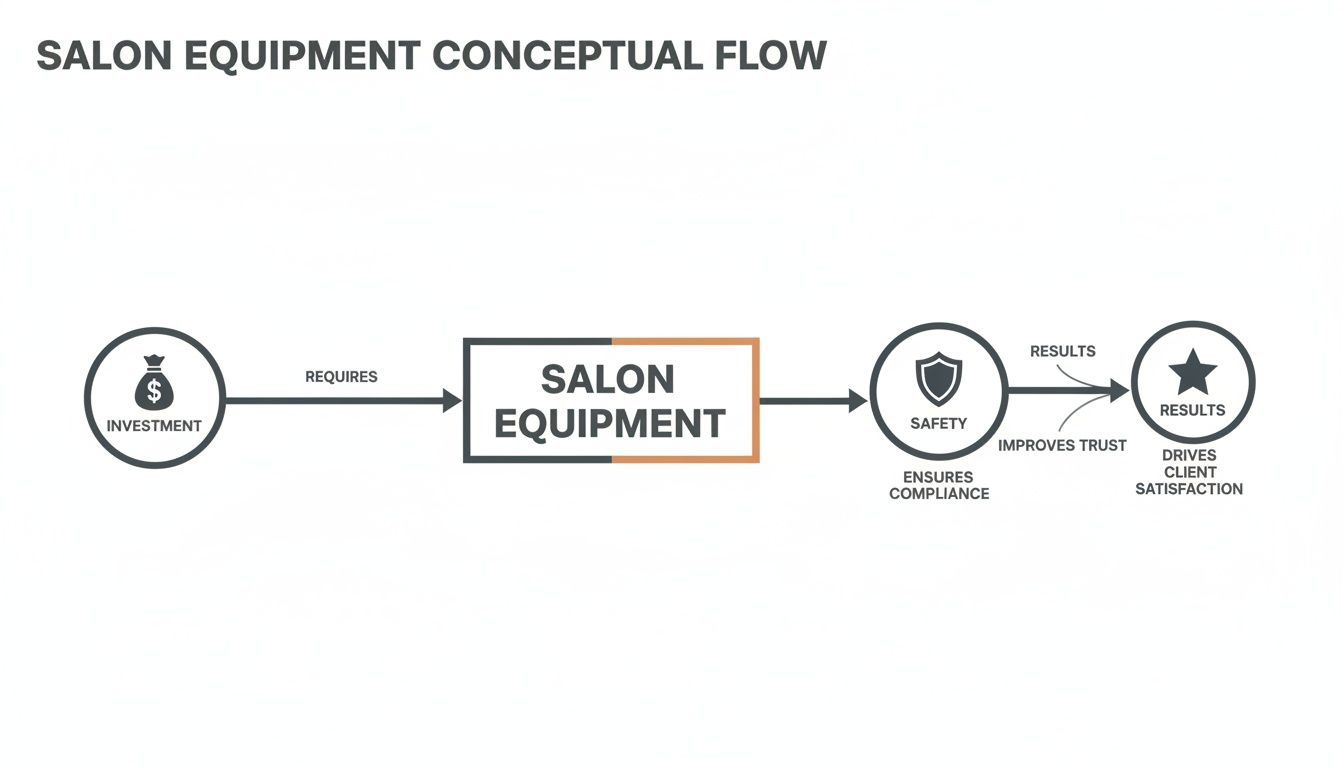
This chart says it all. A smart investment in certified, safe technology is the only path to the outstanding results your clients expect and the trust that keeps them coming back.
Here’s a quick breakdown of the most common laser wavelengths used for hair removal:
- Alexandrite (755nm): This wavelength is brilliant for clients with very light skin (Fitzpatrick I-III) and dark hair, thanks to its high melanin absorption.
- Diode (808nm): Often called the gold standard, the diode laser strikes a fantastic balance of safety and efficacy for a broad range of skin types (I-IV).
- Nd:YAG (1064nm): This is the workhorse for darker skin. With its lower melanin absorption, the 1064nm wavelength is the safest option for treating Fitzpatrick V-VI skin, dramatically minimising the risk of pigmentation changes.
Today, some of the most advanced systems combine multiple wavelengths into a single handpiece. This gives you the ultimate versatility to safely and effectively treat almost any client who walks through your door.
The Power of Multi-Modality Platforms
While a single-purpose device like a dedicated hair removal laser is a fantastic workhorse, multi-modality platforms are a total game-changer for ambitious salons. These systems pack several different technologies into one machine, letting you massively expand your service menu without cluttering your treatment room.
For instance, a single platform might integrate powerful technologies like:
- Hydra-dermabrasion: For deep cleansing, exfoliation, and intense hydration.
- Radiofrequency (RF): The go-to for skin tightening and stimulating new collagen.
- Ultrasound: Used to enhance product penetration for better results.
- LED Light Therapy: Fantastic for treating acne, calming inflammation, and speeding up healing.
When you invest in a multi-modality platform, your beauty salon equipment for sale isn't just a one-trick pony. It becomes an all-in-one workstation that grows with your business. This allows you to easily introduce new, high-demand treatments and maximise your revenue from every single client. If you want to dive deeper, you can learn more about the benefits of LED lamp therapy and see how it complements other treatments. This smart approach ensures your investment pays for itself for years to come.
The Non-Negotiable: FDA, CE, and SAHPRA Compliance
When you’re hunting for beauty salon equipment for sale, it’s easy to get dazzled by flashy features and tempting price tags. But let's be clear: the single most critical factor is regulatory compliance. This isn't just a sticker on a machine—it's the foundation that protects your clients, your reputation, and your entire business.
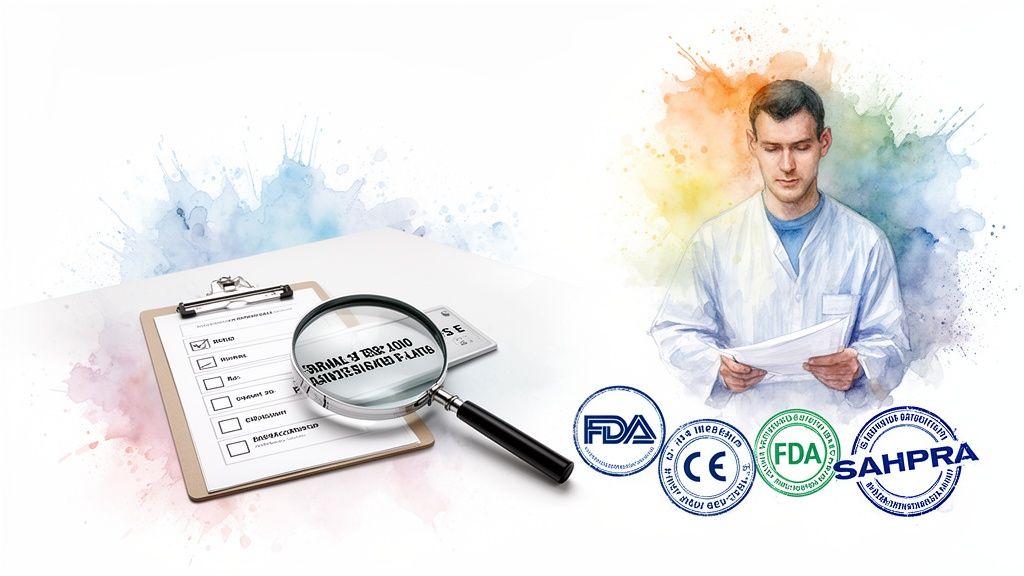
In the world of professional aesthetics, approval from regulatory bodies is the bedrock of your practice. Using an uncertified device is a gamble you can't afford to take. It opens you up to devastating legal action, the risk of harming a client, and doing permanent damage to your brand.
Decoding The Big Three Regulatory Marks
Navigating the alphabet soup of compliance can feel overwhelming, but for any South African clinic owner, it boils down to understanding three key approvals. Each one is a seal of quality, safety, and rigorous testing.
-
FDA Approval (U.S. Food and Drug Administration): This is one of the toughest regulatory hurdles in the world. When a device is FDA-approved, it means it has survived extensive clinical trials to prove it is both safe and effective for its stated purpose.
-
CE Marking (Conformité Européenne): A CE mark shows that a product meets the European Union’s high standards for safety, health, and environmental protection. For aesthetic equipment, this confirms the machine was built according to strict manufacturing protocols.
-
SAHPRA Licensing (South African Health Products Regulatory Authority): This is the mandatory legal stamp of approval for any medical or aesthetic device sold and operated in South Africa. A SAHPRA licence proves the device has been vetted and is authorised for use here, meeting our local safety and quality standards.
Think of these certifications as a device's passport. A machine with FDA or CE approval still needs a SAHPRA licence to be legally brought into and used in South Africa. Never, ever take a supplier's word for it—always demand to see the official paperwork.
The True Cost of Cheap, Uncertified Imports
The lure of a bargain from an online marketplace is strong, but the potential fallout is catastrophic. These cheap devices are almost always built with low-grade components, unverified software, and dangerously unstable energy outputs.
The risks are not just theoretical; they are real and multifaceted:
- Poor and Unpredictable Client Results: Inconsistent energy delivery means treatments don't work. That leads to unhappy clients who won't come back and, even worse, will leave negative reviews that kill your reputation.
- Serious Safety Hazards: Uncertified lasers and energy devices are notorious for causing burns, scarring, and permanent skin damage like hyperpigmentation. This is a nightmare scenario for any practitioner.
- Constant Breakdowns and Downtime: Cheaply made machines fail. A lot. Without a local supplier for support, you could lose weeks or even months of income waiting for parts or repairs from an overseas seller who has no incentive to help you.
- Legal and Insurance Catastrophes: If a client is injured by your uncertified machine, your professional liability insurance will likely refuse to cover the claim. That leaves you personally and financially responsible for everything.
This is exactly why authorities like SAHPRA are so important. Their oversight makes a real difference. For example, SAHPRA approvals helped ensure 95% of imported lasers met crucial safety benchmarks, preventing recalls that affected 12% of non-certified equipment in previous years. You can dig deeper into market trends and the impact of regulation on hair salon equipment to see the bigger picture.
Your Practical Compliance Checklist
Protect your business by asking the right questions. Before you even think about buying, use this checklist to vet any piece of equipment.
- Demand the SAHPRA Licence Number: Ask the supplier for the specific SAHPRA licence number for that device. You can then verify it directly with the authority.
- Verify FDA or CE Certification: Don’t accept a logo on a brochure. Ask for the official certificates as proof of FDA approval or CE marking.
- Confirm the Supplier Is Legit: Is the supplier a registered South African company? Do they have a physical address and a valid SAHPRA licence to import and distribute medical devices?
- Check for Traceability: The device must have a unique serial number. This proves it can be traced back to the original manufacturer and isn't a counterfeit "grey" import.
Right, we've talked tech specs, but let's get down to what really keeps the lights on: profitability. When you're looking at beauty salon equipment for sale, a smart investment goes way beyond the initial sticker price. It’s all about understanding the true return on your investment (ROI).
Getting this number right turns a big, nerve-wracking purchase into a predictable growth engine for your clinic. It’s the difference between crossing your fingers and hoping for profit versus engineering it from day one.
Beyond The Sticker Price: Analysing Your Cost-Per-Treatment
To really understand ROI, you have to break down your costs. The best place to start is with your cost-per-treatment. This simple metric shows you exactly how much each client session costs you to perform, giving you a solid baseline for your pricing strategy.
Here’s what you need to factor in:
- Consumables: Does the device need single-use tips, gels, or cartridges? You need to know the cost of these items for every single treatment you do.
- Energy and Maintenance: It might seem small, but you should factor in electricity usage and any scheduled maintenance costs the manufacturer recommends.
- Financing Costs: If you’re financing the equipment, that monthly interest payment needs to be divided across the number of treatments you perform each month.
A machine with a low price tag can be a trap. If it needs expensive, proprietary consumables or constant servicing, your cost-per-treatment can quietly balloon, eating into your profit margins without you even realising it.
Uncovering The Hidden Costs Of Cheap Equipment
Let’s be blunt: choosing cheap, uncertified equipment is one of the most expensive mistakes you can make as a clinic owner. These "bargains" almost always come with hidden costs that drain your profits and damage your hard-earned reputation. A proper ROI analysis has to account for these financial leaks.
Think about the real-world impact of:
- Frequent Downtime: When a cheap machine breaks, it’s not just about the repair bill. You're losing revenue for every single appointment you have to cancel. A week of downtime could cost you tens of thousands in lost bookings.
- Repeat Sessions: Weak technology delivers poor results, which means you're stuck offering free repeat sessions to unhappy clients. This doubles your consumable costs and staff time for zero extra revenue.
- Wasted Consumables: Unreliable devices often misfire or need multiple passes to get the job done, using up expensive consumables for no reason. This directly pushes up your cost-per-treatment.
Quality systems are built for efficiency. For instance, a high-performance device like Omega Lasers' EM Pulse uses faster treatment protocols. This means you can see more clients in a day while delivering the kind of consistent, superior results that build loyalty. That combination of speed and effectiveness is what boosts your revenue-per-hour and maximises your bottom line.
Calculating Your Revenue Potential And Client Lifetime Value
Once you’ve got a handle on your costs, you can start projecting your revenue. A powerful metric here is revenue-per-hour, which shows exactly how much income a device can generate. If a treatment costs R1,200 and takes 30 minutes, your revenue-per-hour is R2,400. Faster, more efficient tech directly increases this number.
But the real money isn't just in one-off treatments. The ultimate goal is to increase your Client Lifetime Value (CLV). A happy client who gets amazing results from their first package is far more likely to come back for maintenance, try your other services, and—most importantly—refer their friends. High-quality equipment is the key to creating these loyal, high-value clients.
Recent data shows just how big the financial impact can be. Dermatologists who expand their offerings with premium systems report an average R180,000 monthly revenue uplift. With 40% of new practices launched in 2025 choosing bundled packages that include marketing support, the trend is clear.
For a deeper dive into how these numbers work for one of the most popular treatments, our guide provides a full ROI breakdown for South African aesthetic professionals. It walks you through the exact revenue potential and operating costs for laser hair removal.
When you do a full financial assessment, the conclusion is obvious. Investing in a compliant, high-performance system isn’t a cost—it's a direct path to higher profitability, happier clients, and a much stronger business.
Why Training and Support Are Your Most Valuable Assets
When you're looking at beauty salon equipment for sale, it’s easy to get fixated on the machine itself—the hardware. But an advanced aesthetic device is only as good as the person using it. The real power comes from the "software": your knowledge, your skill, and your confidence.
This isn't a one-off purchase; it's the start of a long-term relationship. The quality of your supplier’s training and how quickly their support team responds will shape your daily success far more than any single tech spec. It’s the difference between owning a fancy, complicated tool and mastering a system that gets results.
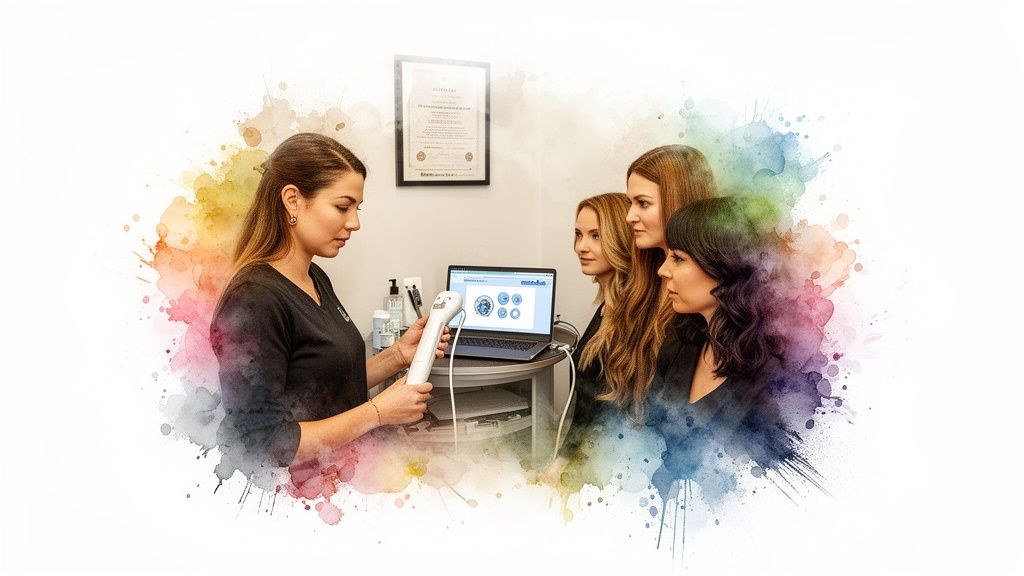
What Comprehensive Training Really Looks Like
A quick demo that just shows you the on/off switch is a massive red flag. Real, comprehensive training is a deep dive that turns you into a genuine expert, someone who can operate the device with total competence and safety.
A quality training programme must cover these key areas:
- Device Operation: You should master every single setting, handpiece, and function. No guesswork.
- Clinical Protocols: Learn the exact, tested treatment parameters for different skin types and conditions to deliver safe, repeatable results every time.
- Advanced Consultation Skills: Know how to properly assess clients, manage their expectations, and build treatment plans that actually work.
- Safety and Contraindications: Understand who is a good candidate for treatment, who isn't, and exactly how to handle any adverse reactions.
Think of it this way: buying a machine without certified training is like being handed the keys to a high-performance race car with no driving lessons. You might have a powerful asset, but you have no idea how to use it safely or effectively to win.
A Tale Of Two Salons
Picture this: two clinic owners both invest in a new laser hair removal machine.
Salon A finds what looks like a bargain online. The machine arrives with a short manual in badly translated English. The owner tries to learn from a few generic videos and starts treating clients. Before long, she’s dealing with inconsistent results, unhappy clients, and a machine flashing error codes with no one to call for help.
Salon B, on the other hand, partners with a full-service supplier. Her team gets in-person, certified training on clinical protocols and safety. They’re also given a full suite of marketing materials to promote their new service and have a direct line to a technical support team. When a tricky client case comes up, an expert is just a phone call away.
Six months later, Salon A is on the brink of closing down. Salon B is thriving, with a growing list of happy, loyal clients. The machine wasn't the deciding factor—the support system behind it was.
The Impact Of End-to-End Support On Your Bottom Line
This story isn’t just a cautionary tale; it's backed by hard numbers. For example, comprehensive end-to-end support—covering both technical help and business guidance—has helped over 750 entrepreneurs launch their practices and break even in just 4 months. That’s half the industry average of 8 months.
Furthermore, post-sales data shows a 96% uptime for properly warranted systems. This minimises losses from the staggering 15% failure rate common with generic, unsupported imports. You can explore more insights on the beauty salon equipment market to get a clearer picture of the financial risks.
Ongoing education, ready-to-use marketing assets, and responsive technical help are what drive great clinical outcomes and sustainable growth. This support is your safety net and your launchpad, ensuring your investment in beauty salon equipment for sale pays for itself for years to come.
Your Vendor Selection Checklist Before You Buy
Choosing who you buy your salon equipment from is just as critical as choosing what you buy. A great supplier is a long-term business partner who has your back. A bad one can quickly become your biggest headache and a serious financial drain.
This checklist is designed to help you cut through the sales pitches and get the real answers you need. Use it to score potential suppliers across four critical areas before you even think about signing a contract.
Technology and Efficacy
First things first: does the machine actually work? You need to be absolutely sure it can deliver the results your clients will pay for. Don't fall for vague promises or slick brochures; demand proof.
- Clinical Evidence: Can you show me before-and-afters and case studies from actual South African clinics using this exact model?
- Treatment Versatility: What skin types and conditions can this device safely treat? More importantly, what are its limitations?
- Live Demonstration: Can I see a live demo of the equipment? I'm happy to do it in person or over a detailed video call.
Regulatory and Safety Compliance
This is non-negotiable. Proper compliance protects your clients, your reputation, and your bank account from the kind of legal issues that can shut a business down.
The single most important question you can ask is about SAHPRA licensing. If a device doesn't have it, it's illegal to operate in South Africa. No other certification matters if SAHPRA licensing is absent.
Here’s exactly what you need to confirm:
- SAHPRA Licensing: Could you please provide the device's official SAHPRA licence number so I can verify it?
- International Certifications: Can I see the official certificates for its FDA approval or CE marking?
- Supplier Legitimacy: Are you a registered South African company with a valid SAHPRA licence to import and distribute aesthetic devices?
Business and ROI Potential
Your new machine needs to be a profit centre, not just a fancy piece of furniture. These questions will help you understand the real financial picture and project your return on investment.
- Cost-Per-Treatment: What are all the consumable costs for a single treatment? Be specific.
- Warranty Details: What, exactly, does the warranty cover? How long does it last, and what is your process for making a claim?
- Financing Options: Do you offer any in-house financing, leasing, or rent-to-own options to make this investment more manageable?
Supplier Training and Support
Your success long after the sale depends heavily on the support you receive. A responsive supplier with real expertise is your most valuable asset once the machine is in your treatment room.
- Training Protocol: What does your certified training programme involve? Is it conducted in person by an experienced professional?
- After-Sales Support: What is your exact process if I need a service call? What’s the typical turnaround time for technical help?
- Marketing Assistance: Do you provide any marketing materials or business guidance to help me launch this new service successfully?
Vendor Evaluation Checklist
This checklist isn't just a list of questions; it's a scoring system. Print it out for each vendor you speak to and give them a score. This simple step turns a confusing decision into a clear, numbers-based choice.
| Evaluation Criteria | Questions to Ask | Your Notes / Vendor Score |
|---|---|---|
| Technology & Efficacy | Real SA case studies? Safe for all skin types? Live demo offered? | |
| Regulatory & Safety | SAHPRA licence number provided? FDA/CE certificates shown? Supplier SAHPRA-licensed? | |
| Business & ROI | Clear cost-per-treatment? Fair warranty terms? Flexible financing available? | |
| Training & Support | In-person certified training? Clear support process & timeline? Marketing help offered? |
By the time you’ve filled this out for a few potential suppliers, your best choice will be obvious. The vendor with the highest score isn’t just selling you a machine; they’re investing in your clinic’s future.
Common Questions Before You Invest
As you get closer to making a decision, a few practical questions always pop up. It’s completely normal. Making a smart investment in new salon equipment means getting straight answers, especially when it comes to the big-ticket items. Let’s tackle the questions we hear most often from salon and clinic owners.
IPL vs. Diode Laser for Hair Removal — Which Is Better?
This really comes down to your primary business focus and the clients you serve. For dedicated, effective hair removal, diode lasers are considered the gold standard. A device using an 808nm wavelength, for example, delivers focused, reliable energy that works safely on a wide range of skin types (Fitzpatrick I-IV). The results are predictable and professional.
IPL, on the other hand, uses a broad spectrum of light. Think of it like a flashlight beam versus a laser pointer. It’s less targeted, which means it’s often less effective for hair removal and carries a much higher risk of burns or pigmentation issues on darker skin.
For any practice serious about offering safe, top-tier hair removal to a diverse client base, a quality diode laser is almost always the smarter, more professional choice.
What Are the Financing Options for Expensive Aesthetic Lasers?
You don’t have to drain your bank account to get your hands on premium technology. Most reputable suppliers get it—cash flow is king. They’ll have flexible pathways to make the investment manageable.
Your options usually fall into a few categories:
- In-house Payment Plans: The supplier sets up a direct payment schedule with you, spreading the cost over an agreed-upon term.
- Medical Finance Partnerships: Many vendors have established relationships with specialised lenders who create loan packages specifically for aesthetic and medical equipment.
- Rent-to-Own Agreements: This is a popular route. You start earning revenue from the machine immediately while making manageable payments towards full ownership.
These options help you line up your monthly equipment costs with the new income it brings in. This makes even a high-end device a profitable asset right out of the gate.
Do I Need to Be a Doctor to Operate Medical-Grade Equipment?
In South Africa, the scope of practice is strictly regulated to ensure public safety. Advanced energy-based devices, particularly those classified as medical-grade lasers, must be operated by a qualified and certified professional. This includes practitioners such as somatologists or medical doctors, depending on the device classification and the treatment’s invasiveness. This is a non-negotiable part of SAHPRA compliance.
Any trustworthy supplier will verify your qualifications before selling you this kind of equipment. They must also provide the mandatory, device-specific certified training required for safe and legal operation. If a seller is willing to bypass these crucial verification and training steps, it’s a major red flag indicating a lack of regard for safety and regulatory standards. Walk away.
Ready to invest in technology that delivers real results and a powerful return? Omega Lasers provides SAHPRA-licensed, multi-modality platforms backed by the comprehensive training and support you need to succeed.
Explore our range of advanced aesthetic devices and partner with us today.