




A clinic owner usually reaches the same point before buying a hair removal machine. The demand is there. Clients keep asking for a longer-term solution than waxing. Competitors already advertise laser. Revenue upside looks obvious. The hesitation comes from the other side of the ledger. One wrong purchase can lock you into the wrong wavelength, the wrong support model, and the wrong client base.
That tension is justified. Hair removal machines sit in a category where clinical outcomes, patient safety, and business performance are tightly linked. If the machine is slow, bookings back up. If the platform isn’t suitable for darker skin types, you narrow your market in South Africa immediately. If the supplier disappears after installation, every technical issue becomes your problem.
I’ve seen buyers focus too heavily on brochure language and too little on what affects daily operations: skin type suitability, treatment speed, cooling, training, compliance, support, and whether the machine can produce repeatable outcomes across the people who will walk through your door.
In South Africa, this decision carries extra weight. Your clinic doesn’t operate in a market built around lighter skin assumptions. It operates in a market where treating Fitzpatrick IV to VI safely isn’t a niche skill. It’s core business. The machine you buy needs to reflect that reality from day one.
The right purchase can become a durable service line that improves retention and strengthens cash flow. The wrong one can create complications, disappointed clients, and expensive downtime. That’s why the buying process needs to be clinical first and commercial second, with no shortcuts on either side.
Table of Contents
- Introduction Your Next Big Investment
- The Foundation of Light-Based Hair Removal
- Decoding the Technology Wavelengths Lasers and IPL
- Clinical Safety and Regulatory Compliance
- Calculating Your Return on Investment
- The Professional's Purchase Checklist
Introduction Your Next Big Investment
Buying one of the serious hair removal machines for a clinic doesn’t feel like buying equipment. It feels like choosing a direction for the business.
Most owners reach this point after the same sequence. Demand grows first. Staff start fielding repeat questions about laser. Then the owner notices the gap between what clients want and what the clinic can currently deliver. At that moment, the opportunity is obvious, but so is the risk. A machine can expand revenue, but it can also expose every weak point in your operation if it isn’t the right fit.
The usual mistake is to treat all machines in this category as roughly interchangeable. They aren’t. Two devices can both be marketed for hair removal and still perform very differently on coarse hair, fine hair, lighter skin, or darker skin. In South Africa, that difference matters immediately because your market is broad, your skin type mix is broad, and your tolerance for adverse outcomes has to be low.
A clinic owner also has to think beyond treatment outcomes. Capital cost matters, but so does uptime. Training matters, but so does whether your team can set safe parameters with confidence. Warranty language matters, but so does what happens when the handpiece fails during a fully booked week.
A hair removal machine should be judged as a clinical tool, a staffing tool, and a revenue asset at the same time.
The clinics that buy well usually ask better questions from the start. Can this platform safely treat the majority of my local market? Can my team use it well after training? Will treatment times support a profitable schedule? Is the supplier equipped to support the machine after the sale?
Those questions are more useful than any marketing promise. They lead you toward a machine that fits your patient mix, your pricing model, and your clinic’s real operational capacity.
The Foundation of Light-Based Hair Removal

A clinic can only buy well in this category if the team understands what the light is meant to do in tissue. Without that foundation, sales demos sound convincing, settings are copied without context, and the first difficult Fitzpatrick V or VI case exposes the gap.
How the treatment works
Light-based hair removal is built on selective photothermolysis. The device delivers light at a wavelength that is absorbed by melanin in the hair unit. That absorbed energy becomes heat, and the goal is to damage the follicle’s growth structures while limiting heat injury in the surrounding epidermis.
That sounds simple. In practice, it is where good clinical outcomes are won or lost.
Hair with strong pigment is a better target than light, grey, red, or very fine hair. Skin with higher epidermal melanin competes for the same energy. In South Africa, where many clinics treat a high proportion of Fitzpatrick IV to VI patients, that trade-off matters every day. A platform that performs well on lighter skin can become slower, less forgiving, or higher risk on darker skin if wavelength choice, pulse structure, and cooling are poorly matched.
This is why experienced operators do not judge a machine by maximum fluence alone. They look at whether the system can deliver usable energy at the right depth, with pulse durations that suit the thermal relaxation time of the target, and with cooling that protects the epidermis under real treatment conditions. If you want a plain-language comparison of IPL and laser hair removal technologies, start there, then assess what that means for your patient mix.
Practical rule: Good hair removal depends on target selection, depth, pulse control, and epidermal protection working together.
What this means clinically
The treatment endpoint is not random redness or a high pain score. The endpoint is controlled follicular injury. If settings are too low, you get poor reduction and more repeat visits without a strong result. If settings are too aggressive for the skin type, you increase the chance of burns, post-inflammatory hyperpigmentation, and loss of patient trust.
For a clinic owner, that has direct commercial consequences. Poor selectivity reduces efficacy. Poor epidermal protection raises complication risk. Both affect retention, referral rates, and the amount of chair time required to produce a result that patients will pay for again.
Hair growth cycling also shapes outcomes. Only follicles in the correct growth phase respond well at the time of treatment, which is why multiple sessions are part of the protocol rather than a sign that the technology has failed. Consultation language should reflect that from the start.
Why the category matured around laser
The commercial success of laser hair removal came from speed, repeatability, and the ability to treat larger areas more efficiently than older methods. The technology improved because earlier systems exposed the limits of poor selectivity and weak epidermal protection. That history still matters. It is one reason conservative parameter setting, test spots, and disciplined training remain necessary even with modern platforms.
Clinics also need to use the right claim. Laser supports permanent hair reduction, not permanent hair removal. The distinction protects both informed consent and your reputation. Electrolysis still has a place for isolated hairs, resistant facial work, or cases where permanence at the individual follicle level is the priority, but it does not offer the same throughput for larger treatment areas, as outlined in this history of electrolysis and laser hair removal.
For clinic owners, the operating logic is clear:
- Use light-based systems for scale and treatment speed on suitable hair and skin combinations.
- Use consultation protocols to screen for poor targets, including very light or very fine hair.
- Set expectations around reduction and maintenance, especially in hormonally driven cases.
- Choose technology with South African skin diversity in mind, not just ideal results shown on lighter skin in supplier marketing.
That foundation helps you judge every machine more accurately. You are not buying light in a box. You are buying a system’s ability to deliver repeatable follicular injury, safely, across the skin types your clinic sees most often, within a SAHPRA-conscious operating environment.
Decoding the Technology Wavelengths Lasers and IPL
A clinic in Johannesburg buys the cheaper light-based system on the floor because the brochure promises speed and versatility. Six months later, bookings are limited to a narrow patient profile, darker skin types need more cautious settings or are declined, and the machine sits idle for too many appointment blocks. That is usually a technology selection problem, not a marketing problem.

Laser and IPL are not the same category
IPL uses broad-spectrum light filtered into treatment bands. Laser delivers a defined wavelength. For hair removal, that difference affects selectivity, parameter control, and margin for error on pigmented skin.
In South Africa, that matters commercially as much as clinically. Clinics serving Fitzpatrick IV to VI need systems that can target the follicle while limiting unnecessary epidermal heating. Broad-spectrum platforms can have a place in aesthetics, but for high-volume hair reduction across mixed skin types, they usually demand tighter case selection and more conservative treatment planning.
| Technology | Energy profile | Clinical implication |
|---|---|---|
| IPL | Broad spectrum | Lower selectivity. Outcomes depend heavily on filtration, operator skill, and patient selection |
| Laser | Single wavelength | Higher targeting precision for specific skin and hair combinations |
Clinic owners comparing the two should start with treatment fit, not price alone. This IPL versus laser hair removal guide gives a useful plain-language comparison, but the buying decision needs to go further into wavelength, cooling, fluence stability, and your actual patient mix.
What each wavelength does in practice
Wavelength determines how far energy penetrates and how strongly melanin absorbs it. That is why the same operator can get very different results from two machines that both claim to treat “all skin types”.
755 nm Alexandrite
Alexandrite has high melanin absorption and performs well on lighter skin with dark, coarse hair. It is often productive on Fitzpatrick I to III, where epidermal melanin creates less competition for the target.
The trade-off is clear. As skin tone deepens, the safety margin narrows and treatment parameters usually need more restraint. For many South African clinics, 755 nm is useful, but rarely sufficient as a stand-alone investment if a large share of the patient base falls into Fitzpatrick IV to VI.
808 nm Diode
808 nm diode is the workhorse category for a reason. It offers a practical balance between penetration depth and melanin absorption, which makes it useful across many body areas and a broad range of hair types.
Machine quality matters here. Two diode systems on paper can perform very differently in treatment rooms. Pulse width range, repetition rate, contact cooling, handpiece size, and output consistency affect speed, comfort, and whether your team can maintain results across a full day of bookings.
1064 nm Nd:YAG
For darker skin types, 1064 nm deserves close attention. Nd:YAG penetrates deeper and is less strongly absorbed by epidermal melanin than shorter wavelengths, which improves the safety profile on darker skin when protocols are set correctly. The American Society for Laser Medicine and Surgery explains this principle in its overview of laser treatment selection by wavelength and target chromophore.
That is why many experienced clinics in South Africa want 1064 nm capability available, whether as a dedicated Nd:YAG platform or as part of a multi-wavelength system. If your business needs to treat Fitzpatrick V and VI confidently, this is not a minor specification line.
Why multi-wavelength platforms matter commercially
A single-wavelength machine can still make sense in a narrowly defined clinic model. A practice serving mainly lighter skin types, with disciplined patient selection and a clear referral network, can run profitably on that basis.
Most clinics do not have that luxury. They see mixed skin types, hormonally influenced facial hair, dense underarm and bikini hair, and body areas that respond differently to the same wavelength. A platform with access to multiple wavelengths gives the operator more room to match the treatment to the patient instead of forcing the patient to fit the machine.
Independent manufacturers and training groups commonly position multi-wavelength systems as more versatile because they combine shorter and longer wavelengths in one platform. The stronger commercial point is simpler. Broader treatment suitability improves utilisation. It reduces the number of consultations that end in “not suitable”, lowers the need to refer out profitable cases, and helps one capital asset serve more of your booked demand.
One example in the local market is Omega Lasers’ EM Pulse platform, which combines four wavelengths in one system and is positioned for broader treatment flexibility across different skin tones and hair characteristics.
The cheaper machine often costs more over three years if it excludes a meaningful part of your market. For a South African clinic owner, the practical question is not whether the machine can remove hair under ideal conditions. The key question is whether it can treat the skin types you see, at a safe pace, with repeatable results, and enough booking density to justify the capital spend.
Clinical Safety and Regulatory Compliance
A clinic buys a lower-cost machine, starts treating across a mixed client base, then the first post-inflammatory hyperpigmentation complaint lands on the front desk. At that point, the discussion is no longer about features. It is about whether the device selection, protocols, training, and paperwork would stand up to scrutiny from a patient, an insurer, and a regulator.
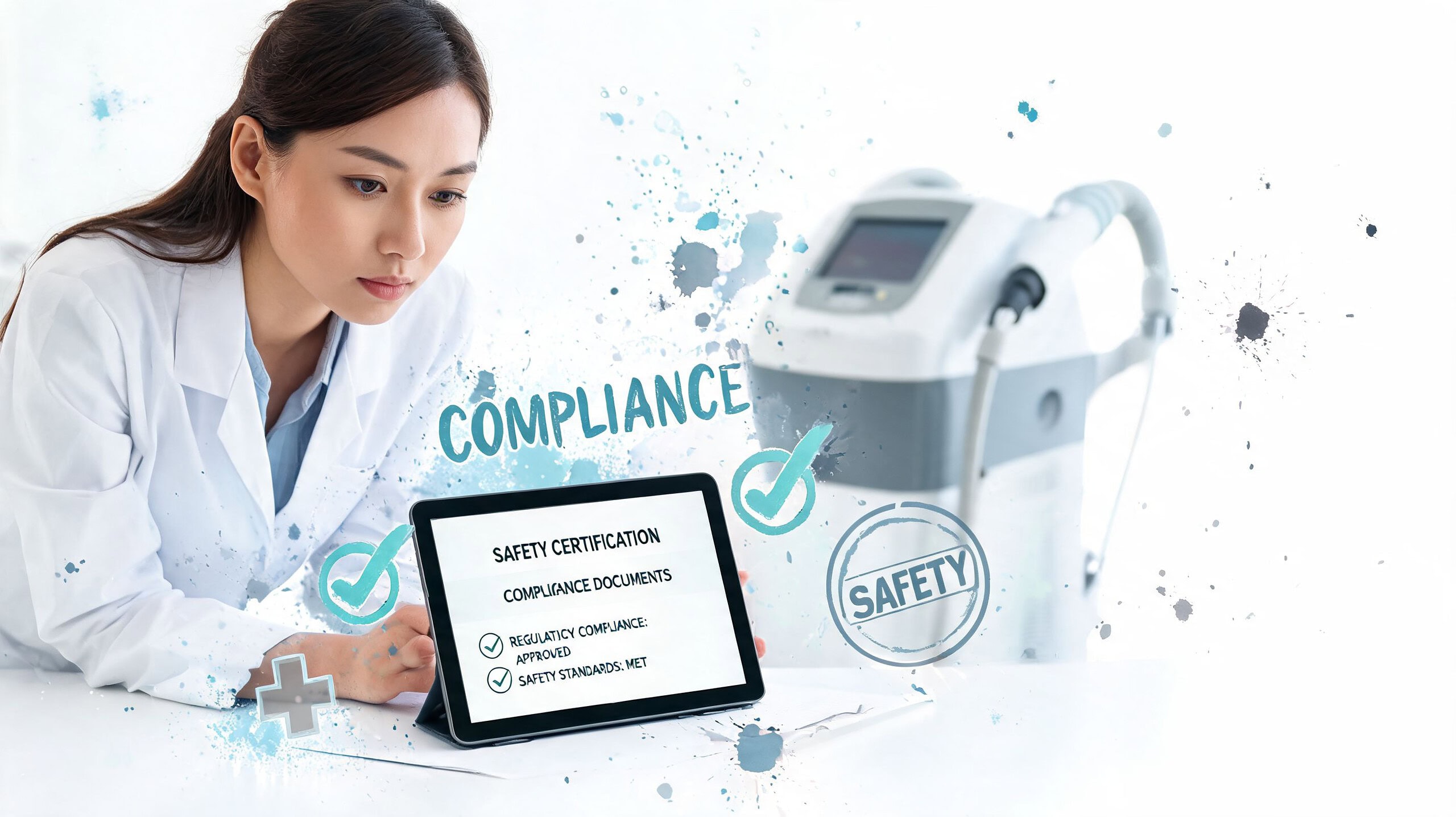
Compliance is a clinical control system
For a South African clinic, compliance starts with one practical question. Can this platform be operated lawfully and safely in the environment and patient population you serve?
SAHPRA licensing matters because it is the local regulatory checkpoint. FDA clearance and CE marking may support a device’s broader documentation trail, but they do not replace local compliance requirements. Those labels also mean different things, so any supplier who treats them as interchangeable is creating risk before the machine is even delivered.
The commercial consequence is straightforward. If the device is not properly licensed or the documentation trail is weak, the clinic carries more exposure when an adverse event, insurance query, or patient complaint arises.
South African skin types change your safety threshold
Imported buying advice often falls short. South African clinics routinely treat Fitzpatrick IV to VI, and that changes both device selection and operator discipline.
On darker skin, the margin for error is narrower. Epidermal melanin competes more strongly for light energy, so wavelength choice, fluence control, pulse duration, cooling, and patch testing carry more weight. A machine that performs acceptably on lighter skin can still be a poor fit for your actual patient mix if its settings are limited, its cooling is weak, or its clinical support is generic.
Industry guidance from the American Society for Laser Medicine and Surgery reflects the same core principle clinics see in practice. Device selection and treatment parameters must match skin type and hair characteristics if you want safe, repeatable outcomes. For South African owners, that is not a niche consideration. It affects your mainstream caseload.
A supplier should be able to answer specific questions without defaulting to brochure language. Ask which skin types are treated most often on the platform locally, what parameter ranges are available for higher Fitzpatrick types, how epidermal cooling is achieved, and what adverse-event protocols are taught during training.
Safety lives in the room, not in the brochure
I do not assess a platform on specifications alone. I assess the treatment system around it.
That system includes consultation forms, contraindication screening, patch test protocols, consent language, endpoint recognition, aftercare instructions, maintenance records, and eye protection. Protective eyewear is part of the clinical setup for every treatment room. Clinics should source appropriate laser safety glasses for aesthetic treatments and train staff to check wavelength compatibility, fit, and condition before use.
Training quality matters just as much as hardware quality. A compliant machine in inexperienced hands can still produce burns, poor outcomes, and refund disputes. In practice, the safer clinic usually has the better operational habits, not just the better machine.
The South African Bureau of Standards also provides the local standards context many buyers skip during procurement. That matters when you are reviewing electrical safety, documentation quality, and whether the supplier can support installation and ongoing service in a way that fits a regulated healthcare setting.
What to verify before you treat a single client
Use a pre-launch checklist and keep it on file.
Confirm the licence trail
Obtain the SAHPRA documentation and store it where management can access it quickly. Do not rely on verbal assurances or screenshots from a sales presentation.Check fit for your actual patient mix
Verify treatment suitability for the skin types and hair profiles your clinic sees every week. In South Africa, that usually means validating darker-skin protocols in detail.Review cooling and parameter control
Good cooling and usable parameter ranges reduce operator strain and widen the clinic’s safe treatment window.Audit training depth
Staff should be trained on contraindications, test spots, treatment endpoints, pigment-risk management, incident escalation, and aftercare communication.Inspect service and maintenance support
Ask who handles breakdowns locally, how quickly parts are available, and what downtime process applies if the unit fails mid-booking cycle.Standardise consultation and consent
Your forms should screen properly, set realistic expectations, document risk discussion, and identify when treatment should be postponed or declined.
The right compliance decision protects more than patients. It protects utilisation, reputation, and the long-term return on the machine.
Calculating Your Return on Investment
A clinic in Johannesburg buys a machine at a price that looks manageable, then loses margin within six months because treatment times are slow, staff use conservative settings on Fitzpatrick IV to VI clients, and service delays disrupt bookings. That is how hair-removal ROI fails in practice. The purchase price matters, but utilisation, safety across your actual patient mix, and uptime decide whether the asset performs.
Look past the purchase price
Start with total cost of ownership and revenue capacity, not the quoted machine price.
Our own analysis of the South African market, summarised in this guide to laser hair removal machine cost and ROI, points to an upfront range of roughly ZAR 300,000 to ZAR 500,000 for professional systems, with payback often modelled around a few months under active utilisation assumptions. Treat that as a planning reference, not independent market verification, and test it against your clinic’s booking reality.
The hidden costs usually sit in four places. Undertraining lowers confidence and slows conversion from consultation to treatment plan. Weak local service support increases cancellations. Parts and consumables chip away at margin. Poor fit for darker skin types limits who you can treat safely, which is a direct revenue constraint in South Africa.
A machine only pays for itself when it is booked, operating, and clinically trusted by your team.
Your ROI model should include:
- Training time and supervision: New operators need time to reach safe, efficient treatment speeds.
- Service response times: A lower purchase price loses value fast if the unit stands idle for days.
- Replacement parts and consumables: Handpieces, filters, and wear components affect long-term margin.
- Room time and staffing: Shorter treatments increase daily capacity only if scheduling and staffing support it.
- Warranty detail: Check what is covered, what is excluded, and who carries labour and shipping costs.
Features that change commercial performance
Clinical specification and business performance are tied together. In hair removal, they are the same decision viewed from different angles.
If your clinic treats a high proportion of Fitzpatrick IV to VI patients, wavelength selection, pulse control, and cooling affect more than safety. They affect how confidently your team can treat, how often clients complete a full course, and whether adverse events interrupt referrals. In South Africa, broader skin-type suitability often has a larger commercial effect than headline speed claims.
A larger spot size can improve throughput on backs, legs, and chests. Reliable cooling helps maintain tolerable treatments without forcing operators to back off too much. Stable energy delivery and clear presets reduce hesitation during busy clinic days. These are operational advantages, not brochure details.
| Feature | Operational effect | Business effect |
|---|---|---|
| Multi-wavelength capability | Better fit across varied skin and hair profiles | More consultations convert into suitable treatments |
| Effective cooling | More tolerable sessions and lower operator caution | Better treatment completion and repeat booking rates |
| Faster treatment speed | Shorter appointments on larger areas | Higher room utilisation |
| Local technical support | Fewer disrupted clinic days | More predictable monthly revenue |
| Structured clinical training | More consistent parameter selection | Lower complication risk and stronger retention |
A practical ROI model for a ZA clinic
Use conservative assumptions. If the numbers only work under full diaries and premium pricing, the purchase is too tight.
The same South African cost analysis cited above uses a sample treatment price of about ZAR 800 per session and annual utilisation of around 200 sessions as a basic planning frame. That is useful for rough modelling, but it is not a profit forecast, and it should not be presented as guaranteed clinic performance.
| Metric | Planning Range | Calculation |
|---|---|---|
| Upfront machine cost | ZAR 300k to 500k | Typical quoted range in the cited internal market analysis |
| Average treatment price | About ZAR 800 per session | Sample pricing assumption |
| Annual sessions | Around 200 | Sample utilisation assumption |
| Annual treatment revenue | Around ZAR 160,000 | 200 × ZAR 800 |
| Indicative payback | Model-dependent | Varies with utilisation, pricing, downtime, and support costs |
That table is only the first layer. A sound investment decision also tests your consultation conversion rate, package structure, no-show rate, retreatment intervals, and the percentage of your client base that falls into darker skin categories. For many South African clinics, the wrong platform does not fail because demand is weak. It fails because the machine cannot safely and efficiently serve the patients who walk through the door.
I advise owners to build two cases before signing. One should reflect expected performance. The second should assume slower ramp-up, more cautious operator use, and some downtime in year one. If the machine still carries its costs under those tighter assumptions, the purchase is usually on solid ground.
The Professional's Purchase Checklist
A clinic owner signs for a machine, installs it, runs a few launch specials, and then encounters the significant challenges. The handpiece is awkward for high-volume work, the team is still unsure on darker skin settings, and a service fault wipes out a fully booked Saturday. That is usually how a poor buying decision shows itself. Not on day one, but in month three when revenue, safety, and staff confidence start pulling against each other.

The required checks
By this stage, the broad compliance and skin-type issues should already be clear. The final screen is simpler. Confirm that the platform can serve the patient mix your clinic sees in South Africa, especially if a large share of your bookings falls into Fitzpatrick IV to VI. A machine that performs well on paper but forces conservative settings, slow treatment times, or frequent exclusions will hurt utilisation and patient trust.
Use this shortlist before you compare branding, finance offers, or showroom demos:
- SAHPRA status: Ask for the registration details and verify what is licensed, the base unit, applicators, or both.
- Suitable wavelength mix: Match the platform to your common treatment areas, hair types, and skin types. Do not buy a narrow-fit machine for a broad patient base.
- Training standard: Confirm who provides training, whether it is clinical or only operational, and whether refresher sessions are available for new staff.
- Service response: Get the fault-reporting process, expected turnaround times, and access to loan units or backup options in writing.
- Warranty scope: Check term length, consumables, exclusions, handpiece cover, and whether travel and labour are included.
One missed detail here can erase your margin faster than a small discount improves it.
Questions that expose weak suppliers
Strong suppliers answer precise questions with documents, workflows, and realistic timelines. Weak suppliers answer with brochures.
Ask for evidence on the points that affect treatment safety and uptime:
- Show the compliance documents: Verbal assurance is not enough for a regulated medical device purchase.
- Explain treatment parameters for darker skin: Ask how they set fluence, pulse duration, cooling, and patch testing for higher Fitzpatrick types.
- Set out post-installation support: Confirm who takes the call, where the technical team is based, and what happens if the fault cannot be resolved remotely.
- Detail the training pathway: Handover training is only the start. Your operators need enough structure to treat confidently and consistently.
- Define downtime handling: Ask what support applies if the unit is out of service for several days and your booking diary is full.
I usually tell owners to listen for specificity. If the supplier cannot explain their darker-skin protocol approach, escalation process, or spare-parts availability in South Africa, assume support will be slow once the invoice is paid.
The purchase is not a once-off delivery. It is a service relationship that affects every treatment slot you sell.
Final decision filter
Run the last check against operations, not marketing.
Measure the floor space. Review your power requirements. Confirm whether your current therapists can use the system safely after the proposed training period. Test whether treatment times fit your booking model. Check if your pricing can hold without relying on constant promotions. Then ask the hard question: if this machine is offline for a week, what is the revenue impact?
A good purchase supports clinical outcomes and daily workflow at the same time. If you still have doubts around patient fit, operator confidence, or supplier response times, pause the deal and get clearer answers. Delaying a capital purchase is cheaper than carrying the wrong one for five years.
If you're evaluating hair removal machines and want a local supplier that is responsive to South African compliance, skin diversity, training, and after-sales support, Omega Lasers is worth reviewing. Their portfolio includes SAHPRA-licensed, FDA-approved, and CE-certified platforms, backed by training, technical support, marketing support, and a 2-year manufacturer warranty.