



Saturday morning starts the same way in too many clinics. A laser needs to move from one room to another, a facial tower is parked where it shouldn't be, cables are draped across a doorway, and someone is pushing a cart with a wheel that sticks just enough to make the whole load feel unsafe. That's when the “just buy any trolley” approach stops being cheap and starts becoming expensive.
In an aesthetic clinic, trolleys with wheels are part of patient safety, device protection, and staff ergonomics. The right cart keeps a treatment room tidy, but it also keeps a device stable when it's powered, plugged in, wheeled, stored, or moved between spaces. For background on how mobility equipment supports clinical environments, Intech Corporation's medical applications overview is a useful reference point for thinking about the role of support equipment in working medical settings.
If you're choosing a trolley for a laser, facial platform, or mobile rig, the key question isn't “what has wheels?”. It's which cart matches the device, the room, the floor, and the way your team works.
Table of Contents
- Why the Right Trolley Matters in an Aesthetic Clinic
- The Core Trolley Categories Used in Clinics
- Casters, Load Capacity, and Surfaces That Last
- Sizing a Trolley for Your Laser and Multi-Tech Devices
- Matching Trolley Type to Clinical Scenarios
- Safety, Compliance, and Maintenance on the Floor
- Procurement Checklist and Customisation Options
- Putting It All Together and Getting Support
Why the Right Trolley Matters in an Aesthetic Clinic
A cart failure rarely looks dramatic at first. It's usually a wobble, a cable snag, or a brake that doesn't quite hold, then the room loses five minutes while a therapist resets the setup and checks the device again. In a clinic, that lost time lands on the floor, on the patient schedule, and on staff confidence.
The trolley is doing more than carrying a machine. It's managing weight, movement, cable routing, and the gap between one treatment room and the next. If the frame flexes, the drawer jams, or the wheels chatter over a threshold, the device feels harder to use and the operator starts compensating with awkward body mechanics.
Practical rule: choose the cart for the heaviest and most awkward thing it will carry, not the lightest item it looks good with.
That matters even more in treatment environments where power leads, handpieces, foot switches, bottles, and disposables all compete for space. A cluttered cart becomes a contamination risk and a trip risk at the same time. A clean, stable cart makes the room easier to reset between patients and much easier to supervise when the clinic is busy.
Aesthetic teams also need to think about where the trolley lives when it's not moving. Some devices stay beside the bed all day, some travel room to room, and some leave the premises in a vehicle. That's why a good buying brief starts with the device itself, then the route it needs to travel, then the support accessories it needs to carry.
The Core Trolley Categories Used in Clinics
A device is already on the bench, a cable is hanging low, and the trolley has to leave the storage bay, cross a doorway, then stop cleanly beside the treatment chair. In that moment, the right cart is the one matched to the load, the route, and the way the room is used.
Clinics usually end up with three practical trolley families, even if suppliers use different names. The categories are simple, but the fit matters once a machine is loaded and switched on.
A hand trolley is the tilt-back type with handles at one end and wheels at the base, which makes it behave like a wheelbarrow for boxes or boxed equipment. It is also called a hand truck, dolly, sack truck, stack truck, or two wheeler in different places, so naming can get messy fast. A dolly is different, because it is a flat platform with four swivel wheels, while a hand trolley typically has two wheels and an upright frame.
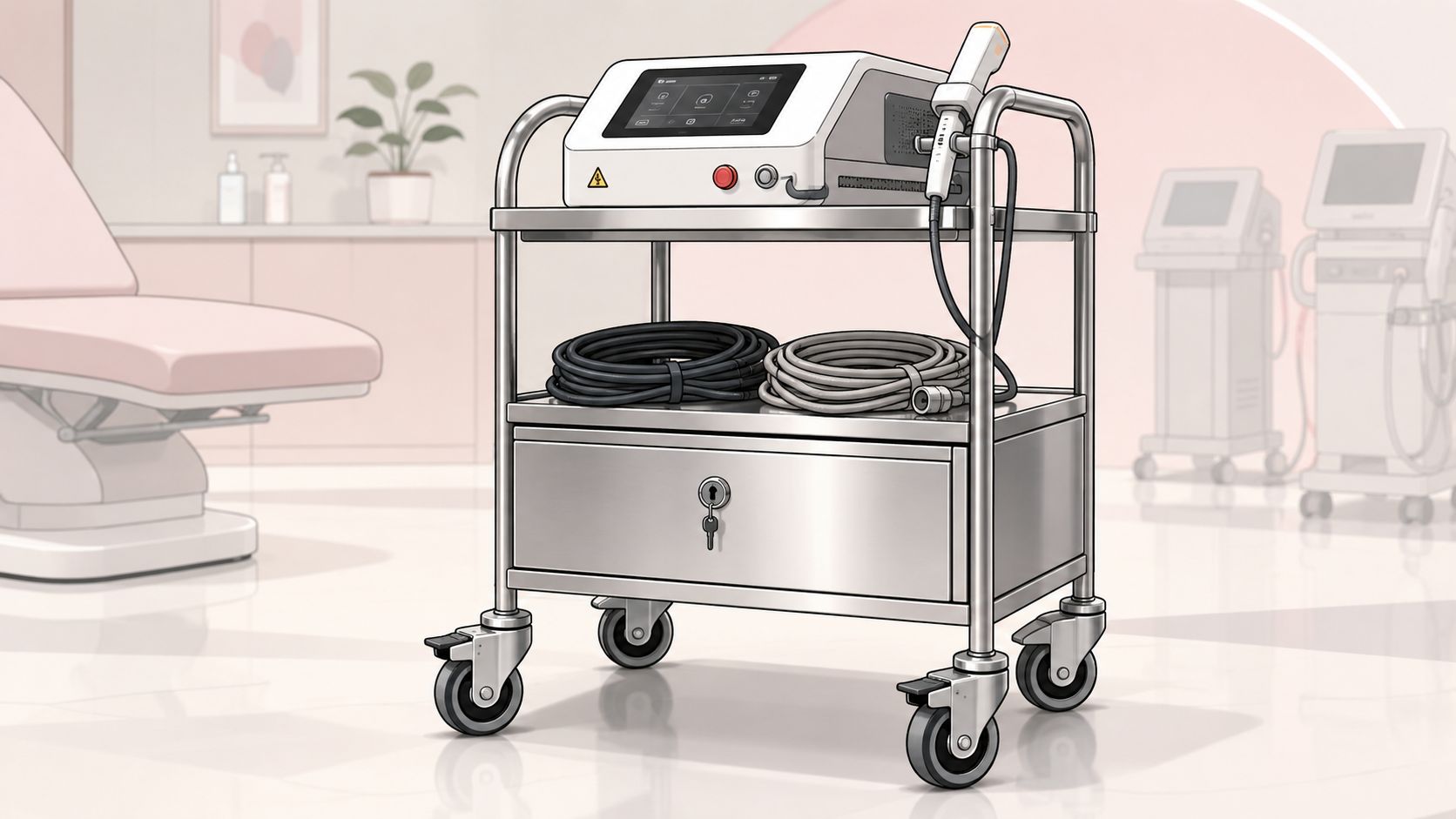
A platform trolley is the luggage-cart style deck used to move larger items between rooms or into a vehicle. It is the shape many picture when they think of wheeled transport in a warehouse or hotel. An instrument trolley is the treatment-room cart, usually stainless steel, with shelves, rails, and sometimes drawers. It works like a compact work surface on wheels, built for devices, consumables, and the way clinical workflow runs.
Choosing by task, not by habit
The mistake I see most often is buying one cart and expecting it to solve every movement problem. A hand trolley is useful for a single heavy load and poor as a treatment-room organiser. A platform trolley is well suited to moving a device between spaces, but it does little once the machine is plugged in and needs consumables arranged beside it.
A clinic should match the cart to the job:
- Hand trolley: best for moving boxed equipment, stock, or a single item over a short route.
- Platform trolley: best for transport between rooms, storage, and vehicles.
- Instrument trolley: best for a fixed treatment bay where the device stays accessible during use.
That split avoids a lot of confusion at ordering time. It also stops staff from forcing the wrong cart into service, which is usually how damage starts. If the route includes thresholds, tight corners, or vehicle ramps, the category matters just as much as the wheel count.
Casters, Load Capacity, and Surfaces That Last
A trolley on a smooth showroom floor can hide a lot of problems. Put the same cart into a treatment room with doorway lips, vinyl joins, and a narrow turn into storage, and caster choice decides whether staff steer it cleanly or fight it at every corner. For clinic work, 4 wheels with 2 front swivel casters and 2 fixed rear wheels is a common layout because it gives control without making the trolley feel twitchy when it is loaded.
Load ratings need to be read with care. Dynamic capacity is the moving limit, while static capacity is the parked safety margin. One passenger-baggage trolley specification paired an AISI 304 stainless-steel frame with 100 kg dynamic and 300 kg static ratings, which shows that frame stiffness and wheel layout have to work together rather than being chosen separately. In a clinic, that matters because a trolley may only travel a short distance, then sit fully loaded beside the device for much longer.
Wheels, floors, and the trade-off nobody wants to discuss
Wheel diameter changes how a cart behaves on real floors. Larger wheels bridge floor defects better and reduce the sharp jolts that wear bearings and make a trolley feel heavy through the hands. Industrial trolley benchmarks place wheel diameters in the 75 to 300 mm range, with 160 to 200 mm wheels typically supporting 250 to 500 kg per wheel and 250 to 300 mm wheels supporting 500 to 1000+ kg per wheel as documented in this industrial guide. Material choice matters too. Polyurethane suits higher abrasion and heavier duty, while rubber or TPR makes more sense when floor protection and lower noise matter more than raw capacity.
Bigger wheels are still not the default answer. Incline testing on a trolley with Rotacaster wheels found it needed between 14% and 227% more incline to start rolling than a standard-wheeled trolley, depending on load and angle according to the testing report. In a clinic, that means a wheel can be excellent at resisting runaway movement and still feel harder to push on a ramp or a threshold. The key question is not which wheel looks strongest, it is what floor, load, and slope the cart has to handle.
A wheel that protects the floor can still slow staff down if the load is heavy or the ramp is steep. That trade-off is what separates a trolley that works on day one from one that gets left in the corner.
Sizing a Trolley for Your Laser and Multi-Tech Devices
Start with the device, not the cart. A laser or multi-technology platform has a footprint, a weight, a cable path, and usually one or more accessories that need a home while the device is in use. If you build the trolley around those four things, the rest becomes much easier to specify.
For an EM Pulse body-contouring unit, the trolley usually needs to support a heavier base, strong braking, and enough open space to keep power and handpiece lines from crossing one another. For HydroLuxe facial platforms, the cart often needs more shelf discipline, because the workflow is built around products, consumables, and repeated handpiece access. Derma Pro and SkinSkan Pro devices are better served by a layout that protects screens, keeps scanning accessories close, and avoids top-heavy storage. Tetra Cool systems need stable positioning and sensible cable management so hoses or cooling components don't get pulled when someone turns in a narrow room.
A few practical checks help before you buy:
- List the heaviest device first. That sets the minimum frame strength and wheel duty.
- Measure the route. Door frames, corners, lifts, and vehicle ramps matter more than catalogue photos.
- Check the cable reach. Long leads need controlled routing, not loose loops.
- Decide whether the cart is static or mobile. A room-side cart and a transport cart are not the same thing.
- Plan for locking and anti-tip behaviour. Once a powered device is on board, unwanted motion becomes a real risk.
Cable management isn't tidiness, it's safety. A dangling handpiece lead can snag, pull, or contaminate a work area. Locking casters, shelf height, and drawer placement all need to match the treatment rhythm, not just the device brochure.
Matching Trolley Type to Clinical Scenarios
A laser stack waits in one room, a facial platform moves between bays, and a technician is loading gear into a van before the first appointment. Each setup asks for a different trolley, even if the equipment looks similar on paper.
A fixed treatment room usually benefits from a platform trolley or instrument trolley with a low centre of gravity, locking casters, and a frame that keeps the device steady beside the chair. That setup works best when the trolley stays in place, the operator reaches for handpieces often, and the room layout leaves only a narrow path around the bed. If the device sits low and wide, the cart should follow that footprint instead of adding unnecessary height or storage above the load.
A multi-room practice needs easier steering and better control at the turn points. A trolley that is comfortable to push across one bay may feel clumsy when it has to cross thresholds, swing through doorways, and stop cleanly in a second room. In that setting, wheel choice matters as much as shelf layout, because the cart has to move without drifting, and it still needs enough organisation for accessories that are used in sequence rather than all at once.
A mobile technician van changes the requirements again. The trolley has to load without catching on trim, fit through the vehicle opening, and stay restrained while the van is in motion. Compact frames, secure strap-down points, and wheels that do not chatter on hard floors are the details that prevent damage during load-in and unload. A cart that is perfect in a treatment bay can become awkward the moment it has to travel with other equipment and cable bags.
The wrong choice usually shows up on the floor, not in the brochure. A room cart sent into mobile work gets knocked around, because it was built to sit still and support procedure flow, not repeated lifting and transport. A transport cart placed in a treatment room can leave the operator with less working surface, poorer access to supplies, and a layout that slows the procedure. The safest approach is to identify the device first, then the room or vehicle it must pass through, and then the load it has to carry under clinic conditions.
A monthly floor-level inspection that helps catches the problems that matter most. Check the casters for flat spots and hair in the bearings, test the brakes under real load, and look over the frame where repeated movement puts stress on joints and fasteners. Clinics already using structured infection control routines can fold trolley checks into the same maintenance habit, which keeps wear from turning into a handling problem during patient care.
Safety, Compliance, and Maintenance on the Floor
A trolley used with regulated equipment inherits part of the regulatory burden. It must not create a tipping hazard, a contamination problem, or an electrical snag that undermines the device's safe use. In practice, that means the cart, its brakes, its surfaces, and its accessories need to support the clinic's compliance posture rather than work against it.
That's especially relevant when devices are already built to sit inside a formal compliance environment. If a system is positioned as FDA approved, CE certified, and SAHPRA licensed, the trolley should be specified to match that standard of care, not feel like an afterthought. You can also align maintenance routines with the infection-control habits already used in the clinic, which is where the practical guidance on infection control becomes directly useful.

A monthly floor-level inspection that actually helps
A simple routine catches most trolley problems before they become incidents:
- Inspect the casters: look for flat spots, hair in the bearings, and uneven swivel action.
- Test the brakes: make sure they hold under real load, not just when the cart is empty.
- Wipe down surfaces: use clinic-approved disinfectant on the frame, shelves, and handles.
- Check cable strain reliefs: confirm cords aren't being pulled or crushed by shelf edges.
- Review route clearance: the trolley shouldn't block emergency egress or create a pinch point.
- For mobile work, re-tension straps: transit loosens tie-downs and shifts load balance.
That routine does two jobs at once. It protects the device and it protects the room. A cart that rolls smoothly, brakes firmly, and stays clean is easier to trust during a full day of treatments.
Procurement Checklist and Customisation Options
When you brief a supplier, keep the request short and specific. You want a trolley that fits the device, the room, and the way the team moves, not a generic “medical cart” that looks fine on paper and fails in practice. The best procurement specs are the ones a supplier can read in one minute and quote accurately.
A good checklist starts with the basics and gets more specific from there:
- Caster type and lock: choose polyurethane for floor-safe durability or rubber/TPR where quiet movement matters more.
- Load rating with margin: don't order to the edge of capacity, especially if the cart will carry accessories too.
- Frame material: powder-coated steel gives durability, while aluminium gives lightness where mobility matters more.
- Surface finish: stainless steel cleans easily, while ABS plastic can reduce cost in less demanding setups.
- Shelf count and height: match the cart to the number of devices, bottles, and consumables you use.
- Cable management: add hooks, rails, or recessed routing so handpieces don't trail across the floor.
- Drawer configuration: use lockable drawers for sharps or higher-value handpieces.
- Accessory rails and poles: add them only if the workflow needs them.
- Branding and identification: colour coding or laser-etched branding can help staff identify treatment zones quickly.
- Warranty alignment: match the trolley warranty horizon to your device support cycle.
For clinics using Omega Lasers devices, the company notes a 2-year manufacturer warranty, so it makes sense to choose trolley support terms that don't fall short of that same horizon. That keeps the cart from becoming the weak link in the support chain. If you're buying through a clinic package or furnishing a new room, the catalogue of salon equipment for sale is a practical starting point for thinking about how the cart fits the rest of the setup.
The red flags are easy to spot. Avoid flimsy welds, loose shelves, tiny wheels on uneven floors, and carts with no brake logic at all. A cheap trolley can look acceptable right up until the first threshold, the first cable snag, or the first time a device has to sit parked under load.
Putting It All Together and Getting Support
The decision rule is simple. Match the trolley to the device first, the room second, and the budget third. If the cart can't safely carry the machine, support the route, and stay stable during use, the lower price doesn't matter.
The three trolley families solve three different problems. The hand trolley moves a single load. The platform trolley moves equipment between spaces. The instrument trolley lives beside the treatment chair and organises the procedure. In the background, the maintenance routine stays the same, inspect, clean, brake-test, and check cable control before the next busy day.
If you're building out a new room or reviewing an old one, it helps to compare your setup against clinic standards, not guesswork. Technical support, training, and post-sale guidance make a bigger difference than most buyers expect, especially when the device and the trolley need to work as one system. The right after-sales partner matters when the cart must fit the machine and the workflow stays under pressure, which is where after-sales service becomes part of the procurement discussion.
For next steps, choose the cart, document the route, and ask the supplier how the trolley supports your specific device list. That's the fastest way to avoid the common mistakes that only show up after delivery.
If you're planning a new treatment room or replacing unstable carts, speak with Omega Lasers about device-compatible setup support, training, and technical guidance. The right trolley should protect your equipment, simplify your workflow, and fit the room you work in, and their team can help you pair the cart with the device before procurement turns into a problem.