




A patient sits in your consultation room and says, “My friend had her treatment here and wouldn't stop talking about the result.” Most clinic owners know that moment. No paid advert caused it. No promotion pushed it. One satisfied patient carried your reputation into someone else's decision.
That's why word of mouth marketing matters so much in aesthetics. People don't choose laser and energy-based treatments the way they choose everyday retail products. They're weighing trust, safety, visible outcomes, privacy, comfort, and whether the person treating them understands their concern. Always ensure the information is accurate and true, as this concerns aesthetic lasers, energy-based devices, and health.
In South Africa, that reality is even sharper. Clinic owners need more than generic marketing advice. They need a practical way to encourage referrals, capture reviews, measure what's working, and stay compliant while doing it.
Table of Contents
- The Most Powerful Marketing You Are Not Paying For
- Why Word of Mouth Is Your Clinic's Superpower
- Creating a Share-Worthy Patient Experience
- Activating Word of Mouth with Proven Clinic Tactics
- Measuring the Impact of Your WOM Efforts
- Navigating Compliance and Ethics in Referral Marketing
- Your Partner in Growth and Reputation
The Most Powerful Marketing You Are Not Paying For
A clinic can spend heavily on creative, offers, and campaign setup, then watch its strongest new enquiry come from a WhatsApp message between friends. That isn't unusual in aesthetics. It's normal.
A patient gets a visible skin improvement, a more comfortable treatment journey than expected, or aftercare that makes her feel looked after. She tells her sister, colleague, gym partner, or neighbour. By the time the new patient contacts your front desk, trust already exists. Your team isn't starting from zero.
In a high-trust category like medical aesthetics, word of mouth marketing is reputation made visible. It includes personal recommendations, online reviews, patient conversations, community mentions, and the quiet referrals that happen without your clinic ever seeing the original exchange.
That's why clinic owners need to stop treating referrals as luck. Good clinics often hope happy patients will spread the word. Stronger clinics build systems that make sharing easier, more natural, and more measurable.
Practical rule: Patients don't talk about “good service” in the abstract. They talk about specific moments, results, and how your clinic made them feel.
What is repeated is rarely your equipment specification sheet. It's a simple story. “They explained everything.” “I felt safe there.” “My skin looked better and they checked on me after.” “They didn't oversell me.” Those are referral triggers.
For aesthetic businesses, that makes word of mouth marketing more than a branding benefit. It becomes a commercial asset. The clinics that grow steadily usually earn two things at the same time. They earn trust in the treatment room, and they earn retelling outside it.
Why Word of Mouth Is Your Clinic's Superpower
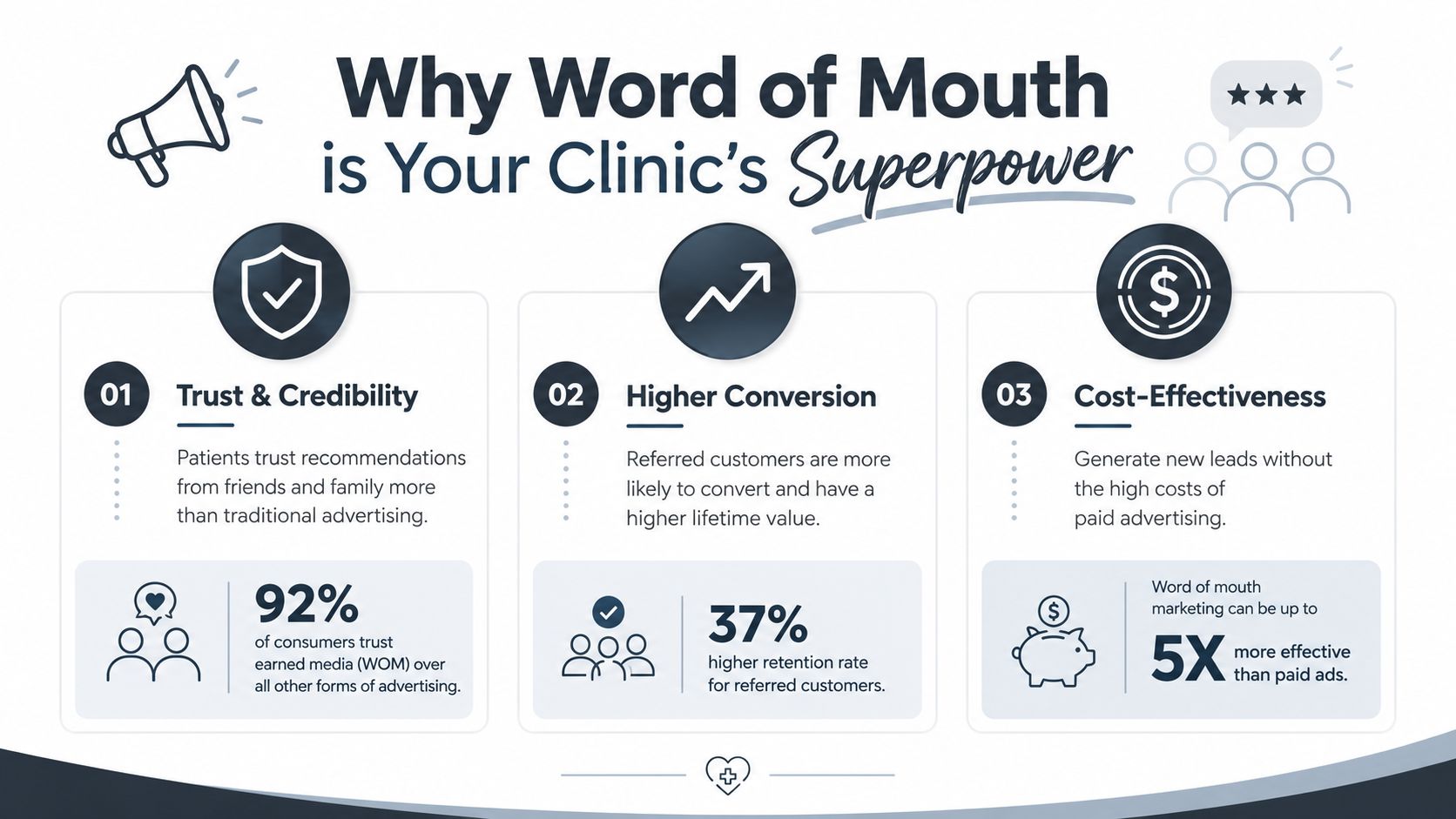
Many clinic owners still treat word of mouth marketing as a nice bonus that happens after the “real” marketing. That view costs money. Referrals and recommendations influence how people discover, shortlist, and finally choose a clinic.
The scale is hard to ignore. Word-of-mouth marketing drives an estimated $6 trillion in annual global consumer spending and accounts for 13% of all consumer sales; 92% of consumers believe a recommendation from friends and family over any other form of advertising, and it can improve marketing effectiveness by up to 54%, according to these word-of-mouth marketing statistics and trends.
Trust closes the gap faster
Aesthetic treatments carry emotional and financial weight. Patients worry about discomfort, poor outcomes, unnatural results, and whether they'll feel judged. A recommendation from someone they know reduces that uncertainty before your team even speaks to them.
That trust advantage changes the sales process. Referred patients often arrive with fewer defensive questions and better intent. They still need proper consultation, consent, and expectation management, but they're usually comparing less and listening more closely.
Reputation compounds while adverts reset
Paid campaigns stop when spending stops. Referral momentum doesn't work that way. A clinic that consistently delivers visible outcomes and a calm patient experience can keep generating new enquiries from old appointments.
That's one of the biggest strategic advantages in this category. Every satisfied patient can become part of your clinic's distribution network without feeling like a marketer. They share what happened.
A clinic with strong word of mouth marketing isn't dependent on being the loudest. It becomes easier to choose because people hear the same positive story from more than one direction.
The financial logic is stronger than most owners realise
When a patient arrives through a trusted recommendation, the clinic usually faces less resistance than with colder traffic. The conversation starts warmer. The credibility barrier is lower. Follow-up often feels less like chasing and more like guiding.
That doesn't mean referrals replace every other channel. They don't. Clinics still need a proper digital presence, clear service positioning, and operational discipline. But word of mouth marketing improves the efficiency of everything else because it reduces scepticism.
Here's the trade-off in plain terms:
| Approach | What happens |
|---|---|
| Paid attention only | The clinic keeps buying visibility, then re-earning trust from scratch |
| Strong referral engine | Patients arrive with pre-built confidence from someone they trust |
| Combined approach | Paid visibility works better because reputation supports conversion |
For a clinic owner, that's a true superpower. You're not just generating awareness. You're borrowing trust from the people your future patients already believe.
Creating a Share-Worthy Patient Experience
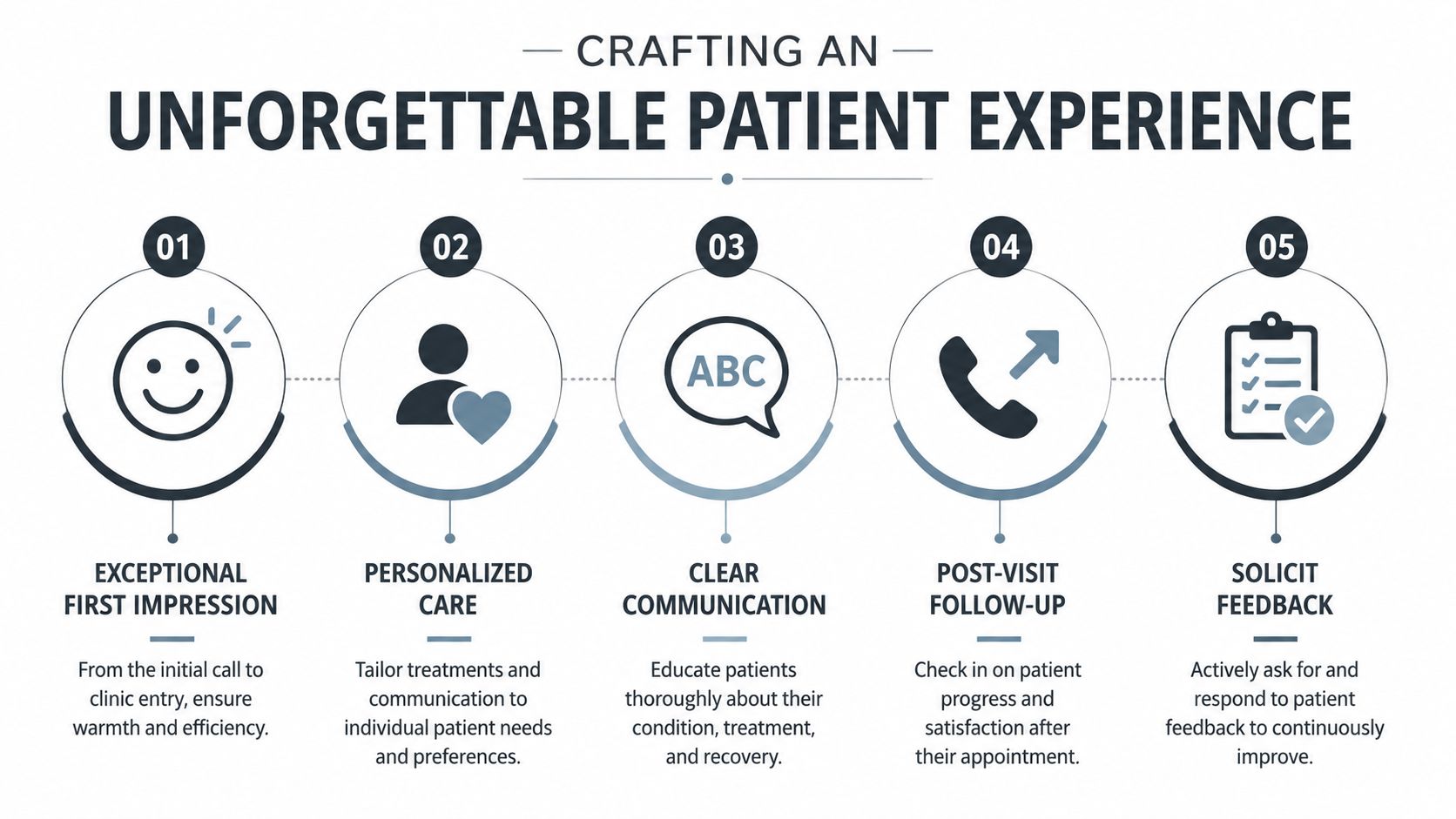
The clinics that attract steady praise usually don't start by asking for referrals. They start by giving patients something worth talking about. In aesthetics, that begins long before the treatment starts and continues long after the patient leaves.
A 2023 study in the South African aesthetic clinic sector found that 78% of patients who reported high satisfaction with treatment outcomes actively shared reviews online, and that correlated with a 32% increase in new patient bookings for clinics that systematically solicited and showcased these testimonials, as reported in the South African Journal of Business Management study on eWOM and patient experience.
Start before the appointment
Patients form an opinion before they meet the practitioner. If the phone rings unanswered, online enquiries sit too long, or booking feels confusing, the clinic already looks disorganised. In a category tied to health, that creates doubt.
Small details matter:
- Response quality: Answer questions clearly, without sounding rushed or scripted.
- Booking ease: Confirm times, pricing expectations, preparation steps, and parking or location details.
- Tone: Speak in a way that feels informed and calm, not pushy.
A first interaction should reduce anxiety, not increase it.
Make the consultation feel personal and safe
Patients talk about consultations when they feel heard. They also talk about them when they feel sold to. One creates advocacy. The other creates resistance.
Use the consultation to understand the person behind the treatment request. Ask what outcome matters to them, what they've tried before, what worries them, and what success would look like in everyday life. Explain what the treatment can do, what it can't do, and how long the process may take.
The clinics people recommend most often aren't always the cheapest or the flashiest. They're the ones that make patients feel informed, respected, and safe.
Build moments people naturally share
Most referral-worthy experiences come from memorable moments, not grand gestures. In a clinic, that can be the warmth of the welcome, the professionalism of the room setup, or the relief a patient feels when aftercare is explained properly.
A few practical examples work well:
Visible professionalism
Clean treatment rooms, organised paperwork, punctual appointments, and calm handovers signal competence.Comfort during treatment
Explain sensations before they happen. Check in during the procedure. Help the patient understand what's normal.Support after treatment
Send aftercare in clear language. Follow up when it matters. Invite questions.
Some clinics also create optional touchpoints that encourage patients to celebrate their results in a tasteful way. For example, a branded in-clinic photo moment can make progress feel tangible if it's done with consent and sensitivity. A visual setup similar to a 360 photo booth activation for branded experiences can work for selected events or launches, but it should never override patient privacy or make a clinical space feel performative.
Aftercare is where trust often hardens
A patient may like the treatment on the day. She recommends the clinic after she sees how your team behaves afterwards. Follow-up is where patients decide whether the clinic cares once payment is complete.
That's also where share-worthy experiences become review-worthy ones. If the result is good and the patient feels supported, asking for feedback won't feel awkward. It will feel deserved.
Activating Word of Mouth with Proven Clinic Tactics
A patient leaves after a good result, tells her sister, then forgets to mention your clinic name. The intent was there. The referral was not. That gap is where clinic systems matter.
Word of mouth grows fastest when the clinic gives patients simple, low-friction ways to recommend you, review you, and share their experience without feeling pushed. In South African aesthetic practice, that also means keeping every tactic aligned with professional standards, POPIA-conscious handling of patient information, and the reputational realities of a high-trust medical service.
Build a referral offer patients can repeat without hesitation
If the offer takes more than one sentence to explain, staff will describe it differently and patients will describe it badly. Keep it tight.
A workable referral structure usually includes:
- One clear reward: a treatment credit, skincare add-on, or consult-linked benefit that your margins can absorb
- One clear trigger: reward the referral after a booked consultation or completed paid treatment
- One clear explanation: “If your friend books and attends, you both receive X”
- One clear limit: set expiry dates, eligible treatments, and any exclusions in plain language
Many clinics lose money by offering rewards that are too generous, too broad, or disconnected from treatment profitability. A skin consultation credit is often easier to control than a blanket discount on injectables or device-based procedures.
Keep the terms easy for staff to remember. If reception has to check a WhatsApp thread or ask the owner every time, the programme will stall within a week.
Ask for reviews at the point of confidence
The best time to request a review is usually after the patient feels informed, supported, and clear on what happens next. For some treatments, that is the same day. For others, especially where results develop over time, the better window is after a follow-up check-in.
Timing should match the treatment journey.
A generic “Please review us” blast sent to every patient on the same schedule creates poor-quality feedback and unnecessary risk. Segment the request. Patients who came for skincare, laser hair removal, body treatments, or injectables do not all reach satisfaction at the same point. Clinics that respect that difference tend to get stronger reviews and fewer awkward follow-up conversations.
Make the ask easy to complete and easy for your team to manage. If you want to display testimonials easily, it helps to collect them in a format that can be reviewed, approved, and reused without adding manual admin every week.
Turn real patient feedback into consultation proof
Reviews help with discovery. Testimonials help with conversion.
Prospective patients in South Africa often arrive cautious, price-aware, and alert to overpromising. They want proof that your clinic explains treatment plans well, handles concerns properly, and delivers care that feels worth the spend. That makes specific patient language more persuasive than polished marketing copy.
Use feedback that answers commercial and clinical objections such as:
- concern about pain or downtime
- uncertainty about whether results will look natural
- fear of being judged during consultation
- confusion about treatment sequencing and cost
- concern about privacy, especially in a smaller local market
Organise approved stories in one place so the same proof can be used on your site, in consult follow-up, and during front-desk enquiries. A dedicated page for patient testimonials for aesthetic clinics helps the whole team work from the same set of approved examples.
Train staff on referral moments, not generic scripts
Referrals are usually won or lost in short interactions. The practitioner reassures. Reception reinforces. Admin follows up. If each person handles the moment differently, results become inconsistent.
Use a simple role-based standard:
| Team role | Referral support moment |
|---|---|
| Front desk | Mentions the referral offer at checkout or rebooking, using the same wording every time |
| Practitioner | Invites feedback once the patient reaches a sensible review point for that treatment |
| Coordinator or admin | Sends the review or referral message with the correct link and patient context |
| Owner or manager | Checks uptake, protects margins, and corrects drift in how the offer is explained |
I advise clinic owners to test this for 30 days before expanding it. Track whether staff are mentioning the offer, whether patients understand it, and whether the reward cost makes sense against average treatment value. A referral programme that brings in low-margin bookings or attracts price shoppers can damage profitability even when volumes rise.
Good clinics do not leave referral activity to memory. They build it into checkout, follow-up, rebooking, and consultation support, then tighten the process until it works consistently.
Measuring the Impact of Your WOM Efforts
One of the biggest mistakes clinic owners make is treating word of mouth marketing as valuable but unmeasurable. It's true that some referrals stay invisible. A patient may say, “I heard about you.” But that doesn't mean the channel can't be tracked well enough to influence decisions.
A 2025 study by the South African Medical Association found that 78% of patients chose clinics based on peer recommendations, while only 12% of clinics in the ZA region tracked these conversions financially, according to this report summary discussing peer recommendation tracking. That gap matters because clinics often underinvest in the channel that's already driving choice.
Track source at first contact
The cleanest place to start is your intake process. Add a required field that asks how the patient heard about the clinic. Don't stop at “referral.” Break it down.
Use options such as:
- Friend or family recommendation
- Existing patient referral
- Online review
- Social media mention from someone you know
- Walk-by or local visibility
- Other
Then add a free-text field for the referring person's name where appropriate. That one detail gives your team a usable trail.
Separate referrals from reviews and repeat visits
Clinics often lump everything together. That makes the data less useful. A referred first-time patient is different from a returning patient who left a review. An online review is different from a direct recommendation in a community group.
Use a simple tracking sheet or CRM setup that records:
- original source,
- booking status,
- treatment purchased,
- whether the patient referred someone else later.
That last point matters because referral value often compounds. Some patients bring one friend. Others become ongoing advocates.
If you don't separate referral types, you can't tell which behaviour actually produces revenue.
Look at revenue quality, not just lead volume
A clinic can get many enquiries from one channel and still earn better revenue from another. That's why referral measurement should include commercial quality, not just counts.
Review your data monthly and ask:
- Which source books at the highest rate?
- Which source produces the best-fit patients?
- Which source returns for maintenance or follow-up treatment plans?
- Which source creates second-generation referrals?
You don't need perfect attribution to make better decisions. You need a disciplined enough process to see patterns. Once a clinic can identify where trusted referrals come from, it can invest more intelligently in experience, review collection, and referral design.
Navigating Compliance and Ethics in Referral Marketing
Referral marketing in aesthetics sits close to sensitive personal information. That changes the tone and the rules. A patient may be delighted with her outcome and still not want her treatment history discussed, displayed, or used as a prompt for public sharing.
That's especially important in South African settings where privacy expectations differ by community. A 2024 report by the ZA Department of Health found that 40% of patients in low-density communities feel uncomfortable when clinics explicitly ask for referrals, citing privacy concerns, as noted in this report summary on referral discomfort and privacy concerns.
Keep consent specific and informed
Consent for treatment is not consent for marketing. Consent for a photograph is not consent to publish it. Consent for a testimonial on one platform is not consent for broad reuse everywhere.
That means your clinic should document exactly what the patient agreed to, where the material may appear, whether their name will be shown, and whether they can withdraw permission later. General wording creates risk.
Avoid pressure, especially in sensitive communities
Patients shouldn't feel that their care, future booking access, or relationship with the practitioner depends on giving a review or referral. If the ask feels loaded, trust drops.
A better standard is invitation without expectation. Offer the opportunity to leave feedback. Make referral information available. Don't corner the patient into a public response.
Respect protects reputation. Patients remember when a clinic handles private information with restraint.
Write scripts that protect dignity
Most problems come from clumsy wording, not bad intent. Give staff language that sounds respectful and optional.
For example:
- For reviews: “If you'd like to share your experience, we can send you a private link.”
- For testimonials: “We only share patient stories with written permission, and you can choose how much is visible.”
- For referrals: “If someone asks where you went, we'd be grateful if you mention us.”
For teams that create content or manage social channels, it's also useful to study how healthcare-related posts can create privacy risk. Resources explaining how Sift AI prevents HIPAA violations are useful as a practical reference point for internal safeguards, even though local compliance obligations must still be assessed in the South African context. Clinics should also align staff processes with their own patient confidentiality standards and internal privacy practices.
Your Partner in Growth and Reputation
Aesthetic clinics don't build strong word of mouth marketing through clever scripts alone. They build it by delivering outcomes patients want to talk about, then supporting those outcomes with a system that captures trust without cheapening it.
That means the commercial side and the clinical side can't be separated. If treatment results are inconsistent, no referral programme will save the clinic. If patient care is strong but the follow-up process is loose, advocacy will be underused. If reviews come in but no one organises them, social proof gets wasted.
The clinics that win over time tend to repeat a disciplined formula:
- They prioritise visible, safe outcomes because those create credible patient stories.
- They make the journey feel organised from booking to aftercare.
- They ask for feedback at the right moment instead of waiting passively.
- They measure referral performance closely enough to improve it.
- They protect privacy and consent so reputation grows without ethical shortcuts.
For device-led practices, treatment quality is the base layer. The right systems, training, and operational support shape how consistently that quality gets delivered. That's why business support matters alongside equipment selection. A clinic owner doesn't only need a treatment platform. They need a repeatable way to turn outcomes into retention, testimonials, referrals, and steady revenue.
In practice, word of mouth marketing becomes strongest when three things line up. The patient gets a result she values. The experience feels professional and personal. The clinic makes it easy, appropriate, and safe for her to share that experience if she wants to.
That's how reputation stops being accidental. It becomes part of the operating model.
If you're building an aesthetic clinic that needs stronger patient trust, better treatment consistency, and a more measurable referral engine, Omega Lasers is worth exploring. Their focus on medical-aesthetic technology, training, technical support, marketing support, and business development guidance fits what clinic owners need when they want word of mouth to become a reliable growth channel, not just a pleasant surprise.