



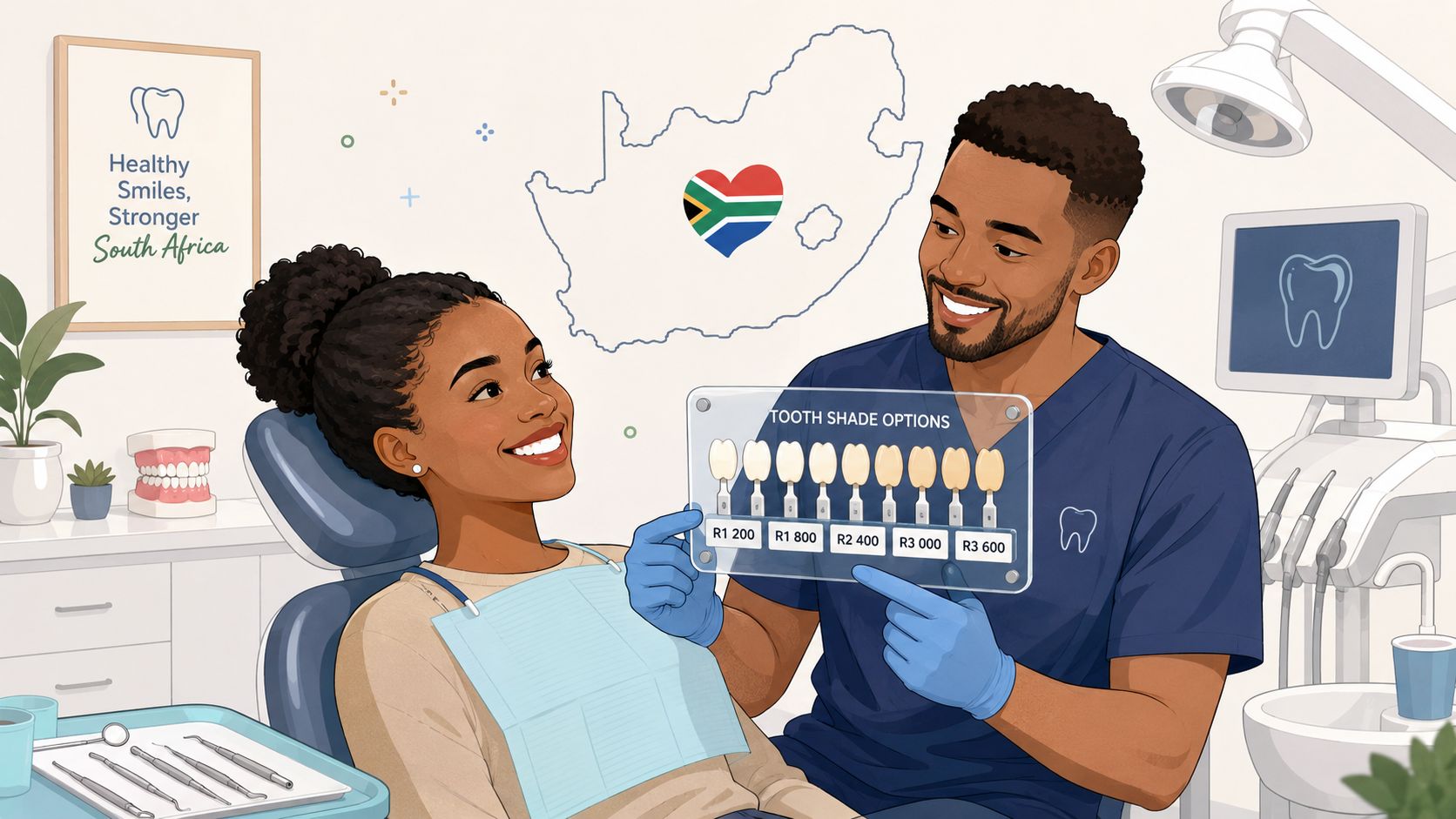
Most South African teeth whitening treatments fall between about R1,450 and R10,000, with single-session salon whitening at the low end and dentist-led laser or LED packages at the top. The right price depends on the treatment format, clinical supervision, number of sessions and what the package includes.
You've probably seen this spread while comparing quotes in Durban, Johannesburg or Cape Town. One provider advertises an attractive introductory price, another quotes several thousand rand, and a clinical practice presents a package that looks expensive until you notice that consultation, cleaning and follow-up care are included. Those prices aren't necessarily contradictory. They describe different services.
The useful question isn't “What does teeth whitening cost in South Africa?” It's what result, supervision and maintenance does each price buy? A low upfront fee may suit someone seeking a quick cosmetic refresh, while a dentist-supervised kit or in-chair treatment may offer better predictability and value over time. Clinics also need to understand the difference, because technology, treatment time and bundled care determine whether a whitening service produces a healthy margin or merely fills a treatment slot.
Table of Contents
- What Most People Actually Pay for Whiter Teeth
- The Three Main Whitening Formats Explained
- Real ZAR Price Bands by Method
- What You Get for the Price You Pay
- Why Prices Vary So Much Across South Africa
- Realistic Results and Lifetime Cost
- How Advanced Laser and LED Platforms Change the Numbers for Clinics
- Your Whitening Decision Checklist
What Most People Actually Pay for Whiter Teeth
A patient in Durban might compare a dental quote with a salon-style single visit, while a clinic owner in Johannesburg may be deciding whether to launch an entry-level service or a premium in-chair package. In Cape Town, the same customer can encounter multiple prices from one provider, depending on session count and treatment intensity.
The broad South African market sits at roughly R1,450 to R10,000, according to published local price listings. Durban dental pages quote R1,450 to R4,650, a national dental-cost aggregator lists R1,500 to R8,000, and clinic-facing pricing guidance reaches R2,000 to R10,000, depending on the method and provider. See the consolidated South African whitening price ranges for the underlying market listings.
The price spread reflects different services
That range doesn't represent one standard treatment sold at wildly different prices. It includes:
- Entry-level visits, often designed around speed and a limited treatment format.
- Dentist-led in-chair whitening, where assessment, professional products and chairside supervision add cost.
- Take-home protocols, where trays, gels and follow-up support replace some of the chair time.
- Multi-session packages, which price intensity and repeat visits together.
A patient paying below R2,000 may be buying a simpler service with fewer inclusions. Someone paying toward the upper end may be paying for clinical screening, professional cleaning, staged treatment, a stronger positioning around technology and a more structured aftercare pathway.
Practical rule: Compare the treatment contents before comparing the headline fee.
South African whitening has become more segmented rather than more uniform. A historical local benchmark placed whitening at up to R5,500 in 2021, while published prices by 2025 and 2026 show packages both below and above that level, including laser treatments from R6,500 and home kits from R4,500 in one Cape Town listing. The market now makes the format and level of involvement more visible, which helps informed buyers choose a suitable band instead of chasing the cheapest advertised number.
The Three Main Whitening Formats Explained
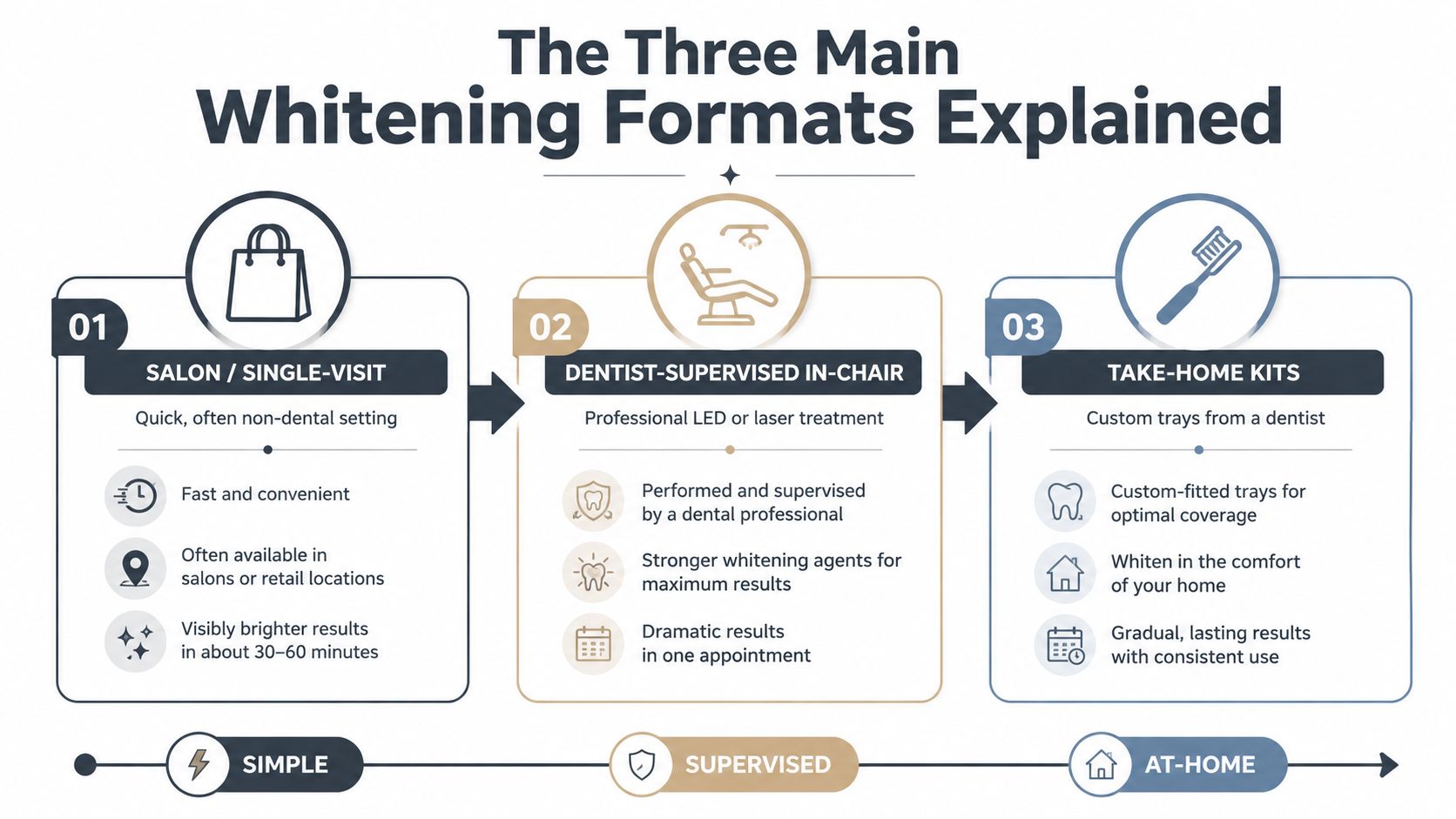
Start with the delivery model, not the brand name. Most professional whitening offers fit into three broad categories, and each one creates a different balance between convenience, supervision and expected consistency.
Salon-style or single-visit whitening
This is the simplest format. The customer attends one visit, receives a whitening application and leaves without a longer clinical pathway. The appointment may suit someone preparing for an event or looking for a quick cosmetic improvement, but the level of dental assessment and aftercare depends heavily on the provider.
Ask whether the service includes an oral health check, sensitivity guidance, cleaning or any follow-up. A low price can be reasonable when the treatment is clearly limited. It becomes poor value when the customer expects the same predictability as a dentist-supervised procedure.
Dentist-supervised in-chair whitening
In-chair treatment usually begins with an assessment of the teeth and gums. A professional applies the whitening product, protects the soft tissues and manages the treatment under supervision. LED or laser technology may be used as part of the system, but the device alone doesn't determine the quality of the outcome.
This format suits patients who want a more structured appointment and prefer professional oversight. It also gives clinics more control over eligibility, product handling and the treatment sequence. Anyone comparing systems should understand the difference between marketing language and the actual gel, protocol, protective measures and follow-up included.
For readers researching product selection and application standards, this guide to choosing a pro whitening gel offers useful background before committing to a format.
Dentist-prescribed take-home kits
A dentist-supervised kit normally uses custom or professionally supplied trays and whitening gel. The patient follows instructions at home, often over a planned period, with professional follow-up available when needed.
Take-home whitening suits patients who value flexibility or want a maintenance option. It can also be easier to manage for people who prefer gradual treatment rather than sitting through an in-chair appointment. The trade-off is that the patient must follow the protocol consistently, and the final experience depends on correct tray use, gel storage and aftercare.
A responsible provider should explain suitability, existing restorations, sensitivity risks and realistic expectations before recommending any of the three formats.
Real ZAR Price Bands by Method
Once the format is clear, the price becomes easier to interpret. South African clinics commonly place whitening into entry, mid-tier and premium bands, with the fee rising as clinical involvement, session intensity and package depth increase.
A Cape Town provider illustrates this clearly with a menu that lists R1,599 for single advanced whitening, R2,399 for a Bright Boost package, R2,800 for a double advanced package and R4,799 for a triple advanced package. The menu demonstrates that clinics often price by intensity and session count, rather than applying one flat whitening fee. These published prices are available on the provider's advanced whitening menu.
| Method | Indicative ZAR range | Typical inclusions |
|---|---|---|
| Salon-style or single-session whitening | R1,050 to R1,999 | One visit, whitening application and limited add-ons, depending on provider |
| Entry-level professional whitening | About R1,450 to R2,800 | A single or introductory treatment, with inclusions varying by clinic |
| Dentist-supervised take-home kit | R2,000 to R3,500 | Dentist assessment, trays or professional kit, gel and guidance |
| Professional chairside whitening | R4,000 to R6,000 | Clinical assessment, professional application and treatment supervision |
| Premium or multi-session clinical packages | R5,850 to over R8,000 | Consultation, cleaning, staged treatment and higher-touch follow-up |
| Higher-end laser or technology-led positioning | From R6,500 | Premium in-chair format, depending on system and package |
The table is a decision guide, not a fixed tariff. The South African Academy of Aesthetic Dentistry's whitening guidance places professional chairside whitening at R4,000 to R6,000, while dentist-supervised take-home kits with follow-up visits sit at R2,000 to R3,000.
What the session logic tells you
A single visit can look cheaper because it concentrates less care into the package. A multi-session option may cost more overall but spread treatment intensity across visits and make the protocol easier to manage. Patients should compare the total planned pathway, not divide the headline fee by an assumed number of shades, because shade change varies between individuals and isn't guaranteed by price alone.
For a broader consumer comparison of chairside treatment and home-based options, this explanation of Zoom whitening versus at-home kits is useful. The key commercial point is simple: format explains more of the price gap than branding does.
What You Get for the Price You Pay
The visible treatment is only one part of the bill. A higher fee may include diagnosis, cleaning, protection, clinical time, products and follow-up that a low-cost advertisement leaves out.
A bundled in-office pathway provides a clear example. One South African clinic prices the total at about R5,850, made up of a R1,000 diagnostic visit, a R2,600 whitening deposit and a R2,250 final treatment balance when consultation and cleaning are included. The published in-office whitening cost breakdown shows how a final price can be assembled in stages.
The hidden components behind a clinical fee
A patient should ask what each of these elements contributes:
- Assessment: The provider checks whether the teeth and gums are suitable before treatment.
- Cleaning: Professional prophylaxis can remove deposits and surface staining that may otherwise produce an uneven appearance.
- Whitening product: The gel, storage requirements and application protocol affect consumable cost.
- Protection: Soft-tissue protection and sensitivity management require time and materials.
- Follow-up: A review gives the provider an opportunity to assess the response and advise on maintenance.
A budget package may include only the application. That isn't automatically a problem, provided the scope is clear and the patient receives appropriate safety guidance. The concern starts when a consumer pays for a low-cost service while assuming that clinical screening and aftercare are included.
Clinics can also use bundling as a deliberate pricing lever. A consultation, cleaning and whitening pathway is easier for patients to understand than a list of disconnected charges, while staged payments can make a premium service feel more accessible without hiding the total cost.
Providers developing their consumables strategy can review professional teeth-bleaching gel options as part of a broader protocol review. Product choice should sit inside a clinically appropriate process, not replace assessment or trained supervision.
Ask for the total pathway in writing. A quote that lists only the whitening application doesn't tell you the real cost of becoming treatment-ready or maintaining the result.
Why Prices Vary So Much Across South Africa
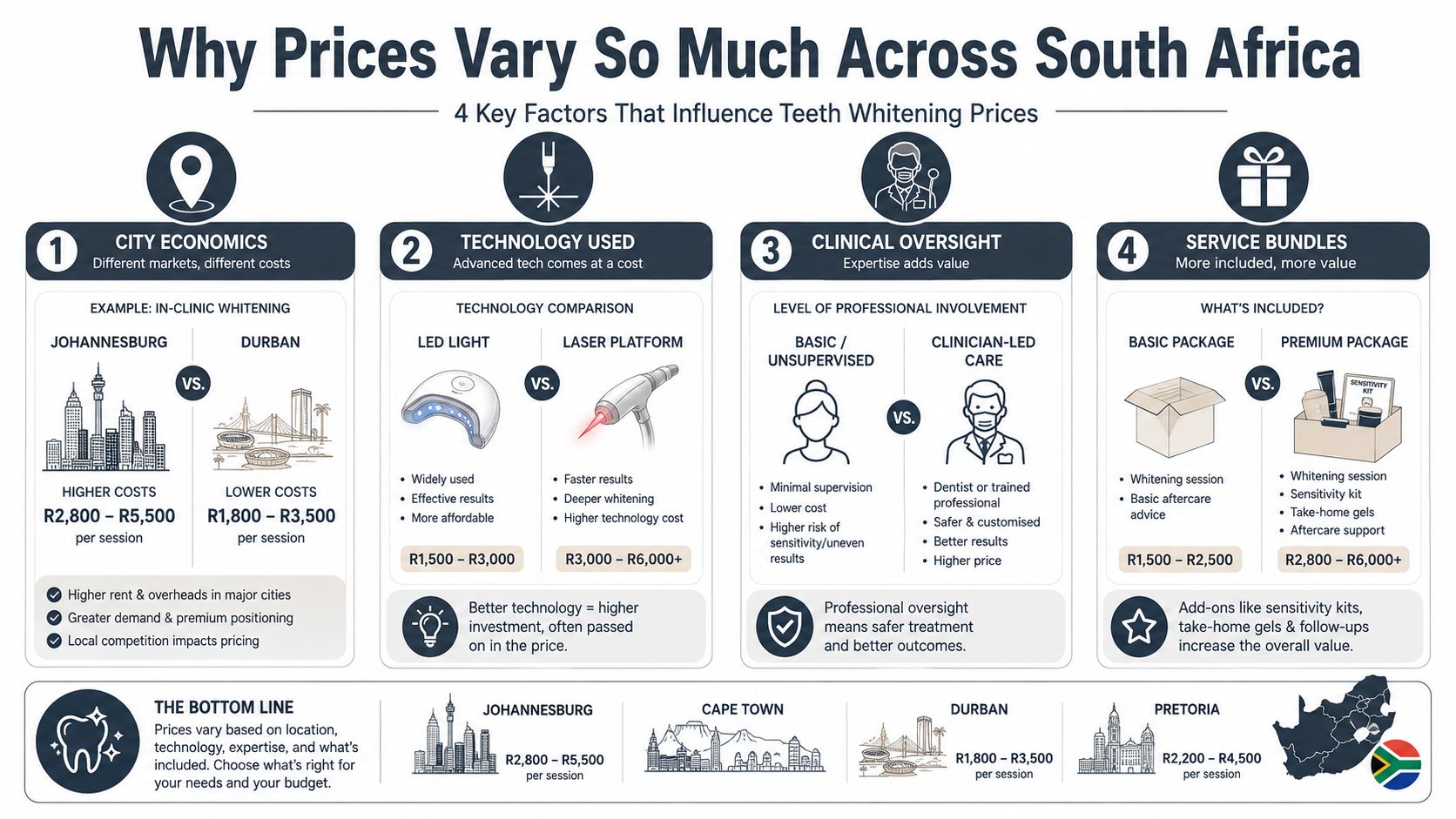
Price variation across Durban, Johannesburg and Cape Town follows identifiable commercial and clinical levers. It isn't random, and the city name alone doesn't tell you whether a quote is fair.
Location changes the operating base
A practice's suburb, rent, staffing model and target clientele influence its pricing. That doesn't mean every Johannesburg clinic should charge more than every Durban clinic, or that Cape Town prices follow one standard. It means providers set fees against their local overheads and positioning.
The published Durban range of R1,450 to R4,650 shows that a dental practice can offer several tiers within one city. National listings extending from R1,500 to R8,000 reinforce the point that method and provider matter alongside location. These figures are collated in the South African dental cost listings.
Technology supports positioning, but it isn't the whole service
LED and laser systems can help a clinic present whitening as a premium, technology-led appointment. Yet the device doesn't justify a premium by itself. The provider still needs an appropriate gel, safe tissue protection, trained operators and a protocol that patients can understand.
Clinical oversight adds time and accountability
The South African Academy of Aesthetic Dentistry places professional chairside whitening at R4,000 to R6,000, compared with R2,000 to R3,000 for a dentist-supervised take-home kit with follow-up visits. That difference reflects the balance between chair time and home-based treatment, not merely a different label.
Bundles create the clearest premium
A clinic can charge more when the package includes cleaning, consultation, sensitivity support and follow-up. A Cape Town menu ranging from R1,599 for a single advanced option to R4,799 for a triple advanced package shows how one provider can serve both price-sensitive and premium customers without offering the same service at two arbitrary prices.
Realistic Results and Lifetime Cost
The cheapest visible price isn't always the lowest lifetime cost. South African listings place single-session or salon-style whitening at about R1,050 to R1,999, clinical in-chair packages at R5,850 to over R8,000, and take-home options from under R300 for bleach to R1,500 to R3,500 for dentist-supplied kits. The South African method comparison illustrates why the first price a patient sees can be misleading.
Think in cost per result
Whitening doesn't produce an identical shade change for every patient. Existing staining, enamel characteristics, restorations, diet and adherence to aftercare all influence the outcome. A clinic that promises a guaranteed number of shades is oversimplifying a biological and cosmetic process.
A more useful comparison asks:
- What level of improvement is realistic for my starting shade?
- How many visits or applications does the quoted fee cover?
- What happens if sensitivity interrupts the protocol?
- Are trays, gels or follow-up consultations included?
- What will maintenance cost when the colour gradually fades?
A low-cost salon visit may seem attractive, but repeated visits can overtake the price of a supervised kit if the patient needs ongoing maintenance. Conversely, a premium in-chair package may not be worthwhile for someone who wants a modest refresh and is comfortable following a dentist-prescribed home protocol.
Aftercare belongs in the calculation
Normal eating and drinking habits, smoking, oral hygiene and future staining all influence how long a result remains noticeable. Patients should ask for practical advice rather than assuming that a more expensive device creates permanent whitening.
Sensitivity also affects value. If a patient is prone to discomfort, the provider should discuss the treatment plan, product strength and ways to manage sensitivity before the appointment. A clinic assessing topical comfort measures can review topical anaesthetic cream guidance as part of its broader patient-care planning, while recognising that suitability must be evaluated professionally.
The best deal is the protocol you can complete safely and maintain realistically, not automatically the cheapest appointment.
How Advanced Laser and LED Platforms Change the Numbers for Clinics
For clinic owners, the question isn't merely whether a laser or LED platform looks modern. The commercial test is whether the system improves the relationship between treatment time, consumables, chair availability and the price patients will accept.
A faster, well-designed protocol can make premium whitening easier to schedule, but speed only matters when the clinic has demand and a trained team. A device that sits unused won't produce a return, regardless of its technical specification.
Throughput must be measured against real demand
Clinics should map the full appointment, including setup, assessment, treatment, cleaning and room turnover. The relevant calculation is not the advertised treatment duration. It's the amount of chair time consumed from the first patient contact to the room being ready again.
Use the existing market bands to test several offers:
- An entry package can attract price-sensitive clients without forcing the clinic to deliver premium inclusions at a discount.
- A mid-tier supervised option can combine professional assessment with a defined treatment pathway.
- A premium in-chair package can support higher pricing when the technology, comfort measures, operator training and follow-up justify it.
South African pricing had become visibly tiered by 2025 and 2026. One Cape Town listing placed laser whitening from R6,500, home kits from R4,500, and consumer specials at roughly R1,599 to R5,999, demonstrating how technology choice can support premium positioning when the offer is clearly differentiated. The published South African whitening pricing context provides those market examples.
Margin protection needs more than a device
Before investing, calculate:
- Consumable cost: Include gel, barriers, trays and sensitivity-related materials.
- Operator time: Price the staff hours required for assessment, treatment and aftercare.
- Chair opportunity cost: Compare whitening with the service that would otherwise use the room.
- Demand generation: Decide how patients will discover and understand the offer.
- Training and support: Confirm that the team can deliver the protocol consistently.
- Compliance and documentation: Verify that the equipment and operating process meet the requirements applicable to the practice.
FDA approval, CE certification and SAHPRA licensing can strengthen trust when they apply to the specific system and use case, but clinics should verify the documentation rather than relying on a sales phrase. Warranty coverage, technical support and training also protect operational continuity. The best investment is the one that supports safe delivery, repeatable outcomes and a service bundle patients can understand.
Your Whitening Decision Checklist
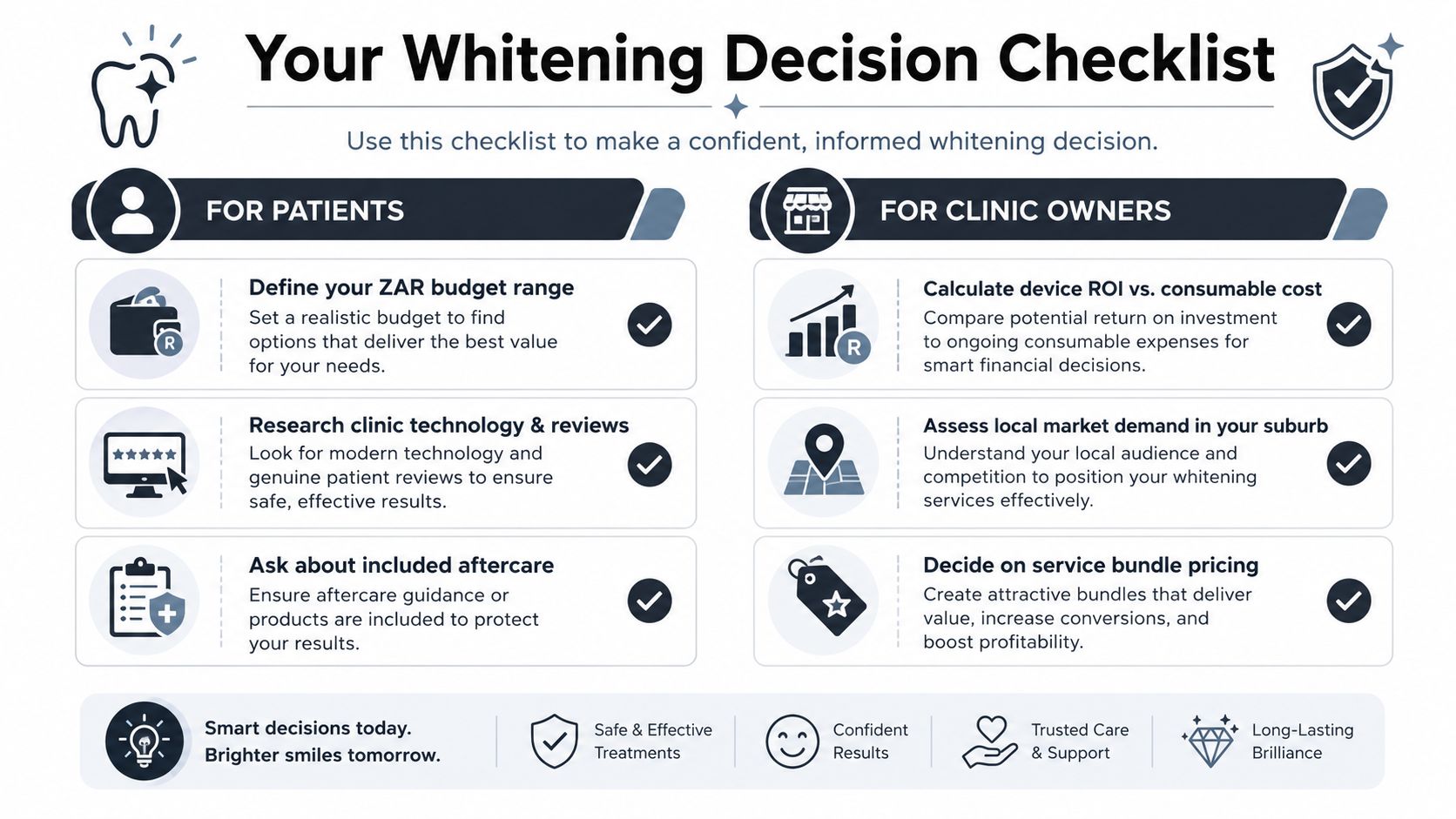
Patients should choose the treatment band before comparing providers. A salon offer, supervised home kit and clinical in-chair package cannot be judged on price alone because each carries different inclusions, supervision and cost per shade.
For patients
- Set a realistic ZAR budget: Choose between an entry-level visit, supervised home kit or clinical laser or LED treatment.
- Request the full inclusions: Confirm whether consultation, cleaning, trays, gel, sensitivity advice and follow-up are included.
- Ask about suitability: The provider should assess your teeth and gums before treatment.
- Compare lifetime cost: Include maintenance and possible repeat visits, not only the first appointment.
- Check the operator and protocol: Ask who performs the treatment and what aftercare is provided.
For clinic owners
- Calculate device economics: Add consumables, staff time, chair usage, training, support and the local price patients will accept.
- Choose a clear service ladder: Separate entry-level, supervised home and premium in-chair options.
- Bundle deliberately: Consultation, cleaning and follow-up can support the fee when they match the clinical pathway.
- Train before promoting: Marketing cannot fix inconsistent delivery.
- Measure patient experience: Review how to improve patient satisfaction alongside revenue, utilisation and repeat demand.
Clear online communication should explain the protocol, inclusions, suitability and aftercare without promising guaranteed results. Clinics needing general digital support may review services for eye doctors and lawyers, while keeping regulated professional information accurate and compliant.
Omega Lasers helps salons, clinics and aesthetic professionals assess treatment technology, training, technical support and business needs. Visit Omega Lasers to explore systems and support for a credible whitening and aesthetic offering.